
IV
Though he felt she needed more training before making a professional debut as a concert singer, Truman had supported his adored daughter Margaret in her ambitions all along. So also had her aunt Mary Jane and Mamma Truman, who had been the most enthusiastic, telling her to “go at it, hammer and tongs.” Bess, however, was not pleased, and Grandmother Wallace declared that the stage was no life for a lady.
“If she wants to be a warbler and has the talent and will do the hard work necessary to accomplish her purpose, I don’t suppose I should kick,” Truman had written to his mother and sister. “She’s one nice girl,” he told them in another letter, “and I’m so glad she hasn’t turned out like Alice Roosevelt and a couple of the Wilson daughters.” To Margaret he wrote that it took “work, work and more work” to get satisfactory results, “as your pop can testify.”
She talked for a while of singing under the name of Margaret Wallace, so as not to appear to be capitalizing on his position. But Mamma Truman, extremely displeased, couldn’t understand any name being substituted for Truman.
Since the start of the year Margaret had been living in a small apartment overlooking Central Park in New York, working with her Kansas City teacher, Mrs. Thomas J. Strickler, who also stayed with her in the apartment as chaperon. Truman felt her absence acutely. Like his mother’s precarious condition since her fall in February, it gave him a feeling of emptiness not easy to face. While he was so intensely preoccupied with his responsibilities, time was moving on, life passing him by.
For someone who had spent so much of his life in such male-dominated vocations as the military and politics, he had few close male friends and no real confidants among the men he knew or worked with, any more now than in boyhood. It was the four women in his life, Bess, Mamma, Mary Jane, and Margaret, who mattered above all, whose company and approval he most valued and needed. Now two of them, Mamma and Margaret, appeared to be deserting him.
“Margaret went to New York yesterday and it leaves a blank place here,” he had written to his mother and sister in January 1947. “But I guess the parting time has to come to everybody….”
In early March, with her first performance in the offing, she received a quick note from him:
Here’s a little dough in case you need R.R. tickets to some mysterious town.
Now don’t get scared, you can do it! And if anyone says you can’t I’ll bust him in the snoot.
Margaret Truman, coloratura soprano, made her radio debut in Detroit on March 16, 1947, as a guest on the Ford Motor Company’s “Sunday Evening Hour,” with the Detroit Symphony conducted by Karl Krueger. As reported in the papers, possibly no vocal performer in history had ever appeared for the first time under such pressure, or before so big an audience and so many critics. The broadcast was nationwide on ABC and reportedly 15 million people were listening, making it the largest radio audience ever for such a performance. “She could not help realizing,” observed The New York Times, “that not only the immense listening public, but…every vocalist, every singing teacher and vocal student who has access to a radio set, was critically appraising her voice and her interpretations.” In addition, singing with an orchestra was a new experience for her.
Scheduled to have appeared on the program the week before, she had had to back out at the last minute because of a sudden attack of throat and chest pains, diagnosed by Wallace Graham as bronchial pneumonia.
Truman was in Key West the night of the broadcast, still resting after his March 12 speech to Congress. The half hour he spent sitting by the radio, waiting for Margaret’s turn on the show to come, was, he said afterward, as long as any he could remember. “Perhaps,” she later wrote, “sheer naivete saw me through.” She was the first daughter of a President ever to attempt a professional career of her own.
I was aware that my father was glued to a radio in the Navy Commandant’s quarters in Key West; that my mother was listening in the White House, that Mamma Truman was listening from her bed in Grandview, and that Grandmother Wallace, who didn’t have much use for the stage, was listening critically in Independence. I couldn’t let anybody down.
She sang three selections, beginning with the Spanish folk song “Cielito Lindo,” then an aria from Félicien David’s La Perle du Bresil, and finishing with “The Last Rose of Summer,” a request of her father’s.
The orchestra indicated its approval with spontaneous applause, and though the Detroit Times said she sang no better than a fairly talented student, the reviews were generally good—kinder than she deserved, she later acknowledged. Noel Straus, music critic for The New York Times,described her voice as “interesting,” and said she had shown remarkable poise and self-control, considering the pressures she was under. Her phrasing was careful, the legato smooth throughout. “Miss Truman’s work from start to finish,” the reviewer concluded in a judgment that greatly pleased her father, “had an allure that resulted from deep sincerity and an unaffected simplicity of approach.”
At home in Kansas City, to the delight of her father, the Star praised her for her courage and called it a “highly agreeable” occasion. The White House switchboard was so engulfed by calls of approval that it had to close down temporarily.
To reporters gathered around at Key West, Truman said he thought she had done “wonderfully,” and for weeks after his return to Washington, it was obvious that nothing pleased him quite so much as to have visitors mention they had heard Margaret on the radio and enjoyed her singing.
Another performance, a full concert this time, was scheduled for May in Pittsburgh. Truman wanted only success for Margaret, but by no means should she become a prima donna.
Wish I could go along and smooth all the rough spots—but I can’t and in a career you must learn to overcome the obstacles without blowing up. Always be nice to the people who can’t talk back to you. I can’t stand a man or woman who bawls out underlings to satisfy an ego.
The Pittsburgh concert had to be postponed at the last minute, however, when word came that Mamma Truman had suffered a stroke and was not expected to live.
Truman flew from Washington immediately. It was his fifth trip home since his mother first fell and broke her hip. Ross, Wallace Graham, the whole presidential entourage were with him and set up headquarters on the eleventh floor of the Muehlebach Hotel. Mamma seemed to improve, knowing he was there, and he stayed on at the Muehlebach for nearly two weeks, driving out from Kansas City to Grandview every day. The weather was poor, chill and raining, and she slept most of the time. As the papers said, “the eyes of the world” were focused on the small yellow clapboard house day after day. Truman worked at the Mission oak table in the parlor. (It was then that he signed the bill for aid to Greece and Turkey.) “Whenever she wakes up,” he told reporters, “she wants to talk to me. I want to be there.”
But then to everyone’s amazement she made a comeback and Truman returned to Washington. He called her nearly every day thereafter, returned for another visit in mid-June, and wrote regularly to Mary Jane, who would read the letters aloud for Mamma. He kept her posted on politics, as he knew she liked. “I’ve come to the conclusion that Taft is no good and Hartley is worse,” he wrote. He also warned her he was about to make a speech she wouldn’t like. It was for the National Association for the Advancement of Colored People. He would be quoting Abraham Lincoln, he said.
Delivered from the steps of the Lincoln Memorial, on June 29, to a crowd of ten thousand people, it was the strongest statement on civil rights heard in Washington since the time of Lincoln, and the first speech ever by a President to the NAACP. Full civil rights and freedom must be obtained and guaranteed for all Americans, Truman said, with Walter White, head of the NAACP, standing beside him.
When I say all Americans, I mean all Americans.
Many of our people still suffer the indignity of insult, the narrowing fear of intimidation, and, I regret to say, the threat of physical and mob violence. Prejudice and intolerance in which these evils are rooted still exist. The conscience of our nation, and the legal machinery which enforces it, have not yet secured to each citizen full freedom of fear.
We cannot wait another decade or another generation to remedy these evils. We must work, as never before, to cure them now.
He called for state and federal action against lynching and the poll tax, an end to inequality in education, employment, the whole caste system based on race or color. That someone of his background from western Missouri could be standing at the shrine of the Great Emancipator saying such things was almost inconceivable. As he listened, Walter White thought of Lincoln’s Gettysburg Address. “I did not believe that Truman’s speech possessed the literary quality of Lincoln’s speech,” he later wrote, “but in some respects it had been a more courageous one in its specific condemnation of evils based upon race prejudice…and its call for immediate action against them.”
Late in 1946, at the urging of White and others, Truman had established his own blue-ribbon commission on civil rights, with Charles E. Wilson, the head of General Electric, as chairman. It was an unprecedented step and Truman, White was sure, had put his political fortunes on the line. “Almost without exception,” White wrote, “Mr. Truman’s political advisors from both South and North were certain that his authorization of inquiry into the explosive issue of civil rights was nothing short of political suicide…. Mr. Truman stood firm.” The report of the commission would not be ready until October.
Taking his seat again after the speech, Truman turned to White and said he meant “every word of it—and I’m going to prove that I do mean it.”
To his mother, Truman said it was a speech he wished he did not have to make. “But I believe what I say,” he told her, “and I’m hopeful we may implement it.”
He described for her the flowers in bloom at the White House, “down in the yard.” With so much wet weather, were Vivian’s sons able to get in the hay crop, he wanted to know.
He was thinking more than usual about times gone by. The morning of July 26, writing to Bess in Independence, he found himself reminiscing about Uncle Harrison and about Tasker Taylor, their high school classmate who had drowned in the Missouri River after graduation. July 26 had always been known to Missouri farmers as Turnip Day, the day to sow turnips, he told Bess. Once, in 1901, a particularly dry year, Uncle Harrison had walked into the seed store and declared he needed six bushels of turnip seed. Asked why so large an amount, Uncle Harrison said he understood turnips were 90 percent water and that maybe if he planted the whole farm in them the drought would break.
But he must not dwell on the past. “You see age is creeping up on me. Mamma is ninety-four and a half because she never lived in the past.”
An hour or so later, Mary Jane telephoned from Grandview to say Mamma had pneumonia and might not live through the day. Truman ordered his plane made ready, but there was a delay. He wanted to sign the National Security Act and name James Forrestal the new Secretary of Defense before Congress recessed. A few congressional signatures were still needed. At the airport, he held off departure, waiting beside the plane for nearly an hour until the bill was brought to him. Minutes later the plane was airborne.
Somewhere over Ohio, dozing on a cot in his stateroom, he dreamt Mamma came to him and said, “Goodbye, Harry. Be a good boy.” He later wrote, “When Dr. Graham came into my room on The Sacred Cow, I knew what he would say.”
She had died at 11:30 that morning. “Well, now she won’t have to suffer any more,” Truman said. For the rest of the flight he sat by the window looking down at the checkerboard landscape and saying nothing.
Martha Ellen Young Truman had been born in 1852, when Millard Fillmore was President, when Abraham Lincoln was still a circuit lawyer in Illinois, when her idolized Robert E. Lee was Superintendent at West Point, overseeing the education of young men from both North and South. She had seen wagon trains coming and going on the Santa Fe Trail. She had been through civil war, survived Order No. 11, survived grasshopper plagues, flood, drought, the failures and death of her husband, the Great Depression, eviction from her own home. She had lived to see the advent of the telephone, electric light, the automobile, the airplane, radio, movies, television, short skirts, world wars, and her adored eldest son sitting at his desk in the White House as President of the United States. As Margaret would write in memory of her “country grandmother” some years later, “Everything had changed around her, but Mamma Truman had never changed…. Her philosophy was simple. You knew right from wrong and you did right, and you always did your best. That’s all there was to it.”
The funeral at the house in Grandview was simple and private. She was buried on the hillside at the Forest Hill Cemetery, next to her husband.
A few days later in Washington Truman asked Charlie Ross to bring the White House press into the Oval Office.
“I couldn’t hold a press conference this week,” Truman began quietly when they were assembled, “but I wanted to say to you personally a thing or two that I couldn’t very well say any other way, so I asked Charlie to ask you to come in.
“I wanted to express to you all, and to your editors and publishers, appreciation for the kindness to me during the last week.
“I was particularly anxious to tell the photographers how nice they were to me, and to the family, and I didn’t know any other way to do it but just call you in and tell you.
“I had no news to give you, or anything else to say to you, except just that, and I felt like I owed it to you.
“You have been exceedingly nice to me all during the whole business, and I hope you believe it when I say to you that it is from the heart when I tell you that.”
To Margaret he wrote, “Someday you’ll be an orphan just as your dad is now.” Later, when she was on tour, he would tell her:
You should call your mamma and dad every time you arrive in a town…. Someday maybe (?) you’ll understand what torture it is to be worried about the only person in the world that counts. You should know by now that your dad has only three such persons. Your ma, you and your aunt Mary.
On August 24, Margaret sang at the Hollywood Bowl before nineteen thousand people. To the Los Angeles Times her performance was only “satisfactory,” but the audience brought her back for seven curtain calls. On October 17, she returned to Pittsburgh to make her first full-length concert appearance at the city’s immense old Syria Mosque auditorium, before a full house that included her mother, who was hearing her sing in public for the first time. Truman stayed away because he wanted Margaret to have all the attention.
Again her stage presence and rapport with the audience were remarkable for someone so young and inexperienced. The audience loved her. She had nine curtain calls, sang three encores. Everyone seemed to be pulling for her, even the ushers and the press, wrote the music editor of the Pittsburgh Post-Gazette, Donald Steinfirst. “You felt it in the waves of kindly feelings directed to this girl, standing assuredly with complete poise over the footlights in the spotlight. You wanted to feel that this young girl, who gave up most of the pleasures of White House living, if any such there might be, for a career in music, would realize her life’s ambitions.”
She was wearing a full-length, off-the-shoulder gown of pink taffeta, her blond hair in soft curls, and she sang, as she had in Detroit and Los Angeles, as if she were enjoying every moment. But this time the critics were considerably less kind.
The bold fact is [wrote Steinfirst] that Miss Truman, judging from last night’s performance, and with the usual allowances for youth and debut, is not a great singer; and, in fact, is not at this stage of her career, even a good singer. She is a young woman of a great deal of personal charm, considerable stage presence, apparently a fair knowledge of the fundamentals of singing, but she is not an artist by commonly-accepted standards.
Others said she had launched her career too soon, before she was ready, just as her father had worried she might. The critic in the Pittsburgh Press thought her training “very faulty.”
“I called up Daddy after the concert, and he seemed to be satisfied,” she remembered. “I can’t say I was.”
The tour went on. She sang in Fort Worth, Amarillo, Oklahoma City, Shreveport, and Tulsa, and she did better. “Margaret seems to be making a hit wherever she goes,” Truman reported to Mary Jane. Fort Worth was a sellout. So was Amarillo. All the same, he wished she would come home and stay.
Sometimes, relaxing with friends, Truman liked to say that he and his small family might have been a hit as a vaudeville team. Margaret would sing, he would play the piano, and Bess would manage the act. He would then grin at Bess, while she responded with a skeptical look. It had become a family joke.
To those who knew Bess well the manager’s role was perfect casting, and greatly to her husband’s advantage. Margaret spoke of her mother as “the spark plug” of the family. Truman himself said many times he seldom made a decision without consulting “the Boss.”
She had no more interest than ever in the limelight of public life, no desire to play any part beyond that of wife and mother.
Old friends from Independence or members of the White House domestic staff who saw her on an almost daily basis would speak warmly of her kindness, her “rollicking sense of humor.” She would laugh so hard her whole body would shake, laugh, remembered one of the servants, Lillian Parks, “as if she had invented laughter.”
No First Lady in memory had been so attentive to the welfare of the servants, and particularly in the summer months, before the advent of air conditioning in the White House. “It’s too hot to work,” she would say. “If it wasn’t hot,” remembered Lillian Parks, “she’d say, ‘You’ve been working too long. Stop now.’ [She] was the kind of First Lady who hated fussiness, loved cleanliness and neatness and an all-things-put-away look, but who didn’t want her servants to keep working all the time and would order, yes order, them to rest.”
To nearly everyone she seemed “the perfect lady,” the phrase used so often to describe her mother. “She’s the only lady I know who writes a thank you note for a Christmas card, and she writes it in a beautiful hand,” a Kansas City friend would tell a reporter. Marquis Childs of the St. Louis Post-Dispatch called her the perfect Missouri lady. Once, when Childs and his wife gave a party at their Washington home for a poet who was an old friend, they invited the Trumans. “Mrs. Truman came with great apologies for her husband…who just couldn’t possibly get away,” Childs remembered. “And the wife of the poet had too much libation, and had to be taken off somewhere, put to bed somewhere. But Mrs. Truman was very polite and never made any fuss of this at all. She was a very proper woman. I think her whole life was Harry Truman….”
Reathel Odum, her secretary, remembered Bess as “the white gloves type.” Serene, shy, and stubborn were other words used often to portray her.
California Congressman Richard Nixon and his wife, attending their first White House reception, were impressed by the way both the President and Mrs. Truman made them feel at home. “They both had the gift of being dignified without putting on airs,” Nixon wrote. “Press accounts habitually described Mrs. Truman as plain. What impressed us most was that she was genuine.”
The longer people knew her, the more they appreciated her quiet strength and quality. Among her greatest admirers were Robert A. Lovett and his wife. Lovett, who, at the end of June 1947 replaced Dean Acheson as Under Secretary of State, was a suave, urbane New York investment banker, a partner at Brown Brothers Harriman, and a Yale graduate like Harriman and Acheson. To Lovett there was no question about the importance of Bess Truman. She was “one of the finest women I ever saw in my life,” Lovett remembered. And, “of course,” she helped Truman “immeasurably”: “My wife and I absolutely loved her. She was simply superb….”
Clark Clifford would later describe her as “a pillar of strength to her husband” and credit her with “better insight than her husband into the quality and trustworthiness of people who had gathered around him….”
But if Truman relied on her, as he himself also attested, she clearly was extremely dependent on him. Years later, when asked by a friend what she considered the most memorable aspect of her life, Bess answered at once: “Harry and I have been sweethearts and married more than 40 years—and no matter where I was, when I put out my hand Harry’s was there to grasp it.”
Five foot four and stout, Bess Truman stood as straight as a drum major, head up, shoulders squared. She dressed simply and conservatively. There was nothing ever in any way mannered or pretentious about her. (Throughout her years in Washington, as Jonathan Daniels reported, she laughed at nothing so heartily as the sudden pretensions of some officials’ wives.) She was exactly as she had always been and saw no reason to change because she had become First Lady. Some guests at the White House found her so natural and unprepossessing they had to remind themselves to whom they were speaking. Time said somewhat condescendingly that with her neatly waved gray hair and unobtrusive clothes she would have blended perfectly with the crowd at an A&P.
Asked once by reporters for his view of her appearance, Truman said he thought she looked exactly as a woman her age ought to look.
Many people, meeting Bess Truman for the first time, were surprised by how much younger and more attractive she appeared than in photographs, where her expression was often somber, even disapproving. Something seemed to come over her in public, and particularly when photographers pressed in on her. In receiving lines she often looked bored, even pained, as if her feet hurt—a very different person from the one her friends knew. A Louisiana congressman’s wife, Lindy Boggs, would remember how vivacious the First Lady could be while arranging things for a reception, what delightful company she was behind the scenes. “And then…the minute the doors would open and all those people would begin to come in, she would freeze, and she looked like old stone face. Instead of being the outgoing, warm and lovely woman that she had been previously, the huge crowds simply made her sort of pull up into herself.”
Where Eleanor Roosevelt had seen her role as public and complementary to that of her husband, Bess insisted on remaining in the background. “Propriety was a much stronger influence in her life than in Mrs. Roosevelt’s,” remembered Alice Acheson, the wife of Dean Acheson. It was widely known that Bess played cards—her bridge club from Independence had made a trip to Washington in the spring of 1946, stayed several days at the White House, and was the subject of much attention in the papers—and that she and Margaret, unlike the President, were movie fans. Bess also loved reading mysteries and was “wild” about baseball, going to every Senators game she could fit into her schedule. But she had no interesting hobbies for reporters to write about, no winsome pets, no social causes to champion or opinions on issues she wished to voice publicly. Her distaste for publicity was plain and to many, endearing. She refused repeatedly to make speeches or give private interviews or to hold a press conference, no matter how often reporters protested. “Just keep on smiling and tell ‘them’ nothing,” she advised Reathel Odum. “She didn’t want to discuss her life,” Margaret remembered.
Two early public appearances had turned into embarrassments. She had been asked to christen an Army plane, but no one had bothered to score the champagne bottle in advance, so it would break easily. She swung it against the plane with no result, then kept trying again and again, her face a study in crimson determination. The crowd roared with laughter, until finally a mechanic stepped in and broke the bottle for her. Truman, too, had been amused, as was the country when the newsreel played in the movie theaters, but not Bess, who reportedly told him later she was sorry she hadn’t swung that bottle at him.
The other episode concerned her acceptance, in the fall of 1945, of an invitation to tea from the Daughters of the American Revolution at Constitution Hall, a decision protested vehemently by Adam Clayton Powell, the flamboyant black congressman and minister of the Abyssinian Baptist Church in Harlem, whose wife, the pianist Hazel Scott, had been denied permission to perform at Constitution Hall because of her race. Bess, however, refused to change her mind. The invitation, as she wrote to Powell, had come before “the unfortunate controversy,” and her acceptance of such hospitality was “not related to the merits of the issue.” She deplored, she said, any action that denied artistic opportunity because of race prejudice. She was not a segregationist, but she was not a crusader either. Powell responded by referring to her publicly as “The Last Lady of the Land,” which caused Truman to explode over “that damn nigger preacher” at a staff meeting, and like Clare Boothe Luce, Powell would never be invited to the White House.
When at last in the fall of 1947 Bess agreed to respond to a questionnaire from reporters, her answers were characteristically definite and memorable:
What qualities did she think would be the greatest asset to the wife of a President?
Good health and a well-developed sense of humor.

Truman, President in his own right, and Vice President Alben Barkley on the reviewing stand, Inauguration Day, January 20, 1949.
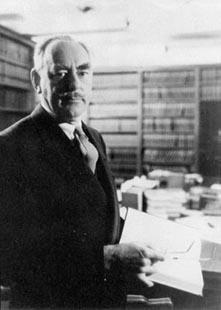
Secretary of State Dean Acheson, by far the strongest, most brilliant, and most controversial member of Truman’s Cabinet through all of the second term. “Do you suppose any President ever had two such men with him as you and the General [Marshall]?” Truman would later write to Acheson.

Truman’s World War I pal and presidential military aide, General Harry Vaughan, who was seen as the ultimate White House “crony.”

Alger Hiss, symbol of Republican charges that the administration was “soft on communism.”

Republican Senator Joseph McCarthy, whom Truman loathed and mistakenly believed time and the truth would soon destroy.

Opposite: At midday, June 27, 1950, having announced that Amercian forces would intervene in Korea, Truman, accompanied by Attorney General J. Howard McGrath (left) and Secretary of Defense Louis Johnson, heads from the White House to his temporary residence across Pennsylvania Avenue at Blair House (above). It was at Blair House, after meeting there with his advisers the two previous nights, that Truman reached his fateful decision on Korea—the most difficult and important decision of his presidency, he felt.


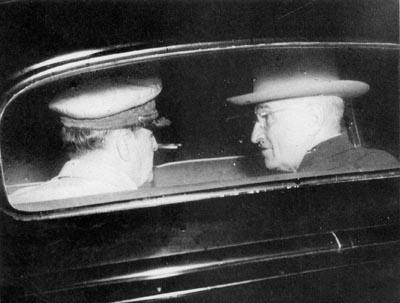
On October 15, 1950, a month after the stunning success of General Douglas MacArthur’s surprise assault at Inchon (above), Truman and MacArthur met at Wake Island in the Pacific, driving off for a first private talk in a battered Chevrolet (below). By all signs the Korean War, Truman’s “police action,” was nearly over.
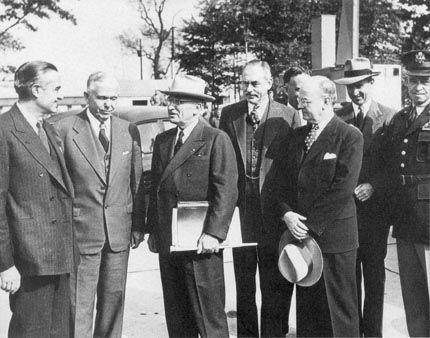
On his return from Wake, Truman is met at the airport by his Washington high command (from left to right): Special Assistant Averell Harriman, Secretary of Defense Marshall, Secretary of State Acheson, Secretary of the Treasury John W. Snyder, Secretary of the Army Frank Pace, Jr., and General Omar Bradley, Chairman of the Joint Chiefs.

In late 1950, as the Korean War entered its darkest time, Truman had also to oversee the complete reconstruction of the White House within the gutted shell of the old exterior walls (opposite). And on November 1, two fanatical Puerto Rican nationalists attempted to assassinate him (right, one lies wounded at the Blair House front steps).
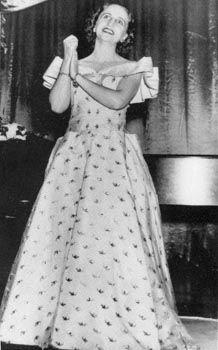
On December 6 (left), a Washington Post music critic roundly panned his daughter Margaret’s singing, eliciting from her father the most stinging letter of his presidency.


Pages from Truman’s diary, April 6 and 7, 1951.


General MacArthur addresses Congress, April 19, 1951.

MacArthur’s replacement as Far East Commander, General Matthew B. Ridgway (with hand grenades strapped to his chest).

Though often called one of Truman’s most courageous decisions as President, the firing of MacArthur was to Truman simply something that had to be done to keep control of the military where it belonged, in the Oval Office. Left: The outlook from the seat of responsibility and (below) a cartoon from the time by Herblock.

Chicago, July 26, 1952: Truman introduces to the Democratic National Convention the new, somewhat reluctant standard-bearer, Governor Adlai E. Stevenson of Illinois.

Oxford, England, June 20, 1956: The former President is congratulated by Lord Halifax, Chancellor of Oxford University, after receiving the honorary degree of Doctor of Civil Laws.

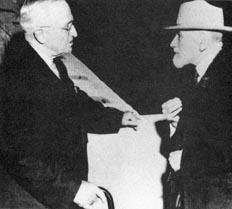
Florence, Italy, May 27, 1956: Truman chats with Renaissance art authority Bernard Berenson, who found him very unlike the “Give ’Em Hell Harry” of the cartoon at left.
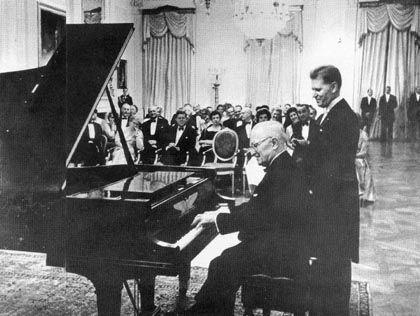
Washington, November 1, 1961: To the delight of President John F. Kennedy, the First Lady, and guests, Truman plays a bit of Paderewski’s Minuet in the East Room, after an absence from the White House of eight years. The principal performer of the evening, Truman’s favorite concert pianist, Eugene List, stands at right.

Margaret and Clifton Daniel on their wedding day, April 21, 1956.

From the window of the Daniels’ New York apartment, Truman greets reporters with grandsons Clifton and William.

A resident of Independence for the last twenty years of his life, Truman said of his time as President, “I tried never to forget who I was and where I’d come from and where I was going back to.”


Did she think there would ever be a woman President of the United States?
No.
Would she want to be President?
No.
Would she want Margaret ever to be First Lady?
No.
If she had a son, would she try to bring him up to be President?
No.
If it had been left to her own free choice, would she have gone into the White House in the first place?
Most definitely would not have.
What was her reaction to musical criticism of Margaret’s singing?
No comment.
Did any of the demands of her role as First Lady ever give her stage fright?
No comment.
What would you like to do and have your husband do when he is no longer President?
Return to Independence.
“She seems to think Harry ought to run the country, not her,” a Washington cab driver was quoted as saying. It was a sentiment widely shared, and according to Jonathan Daniels, Truman “conspired willingly” with her to protect her privacy.
Asked once if she was interested in any particular period of White House history, Bess said the Monroe years—an interesting observation that the press passed by. James Monroe’s wife, another Elizabeth—Elizabeth Kortright Monroe—had followed the gregarious Dolley Madison, who had been as much the center of attention in her time as had Eleanor Roosevelt. A quiet aristocrat, Elizabeth Monroe married a hard-drinking politician and made a good marriage. In the White House, she had insisted on keeping her life a private matter.
As manager of household expenses, Bess was extremely frugal. She cut back on the size of the White House staff. Mrs. Nesbitt, the elderly housekeeper responsible for years of dreary food on the Roosevelt table, had been sent packing, with the result that both the cooking and the housekeeping improved. Most objectionable had been the cold, hard, dinner rolls, long a White House staple, but which to anyone raised as Bess had been on traditional hot southern biscuits—biscuits baked with Waggoner-Gates “Queen of the Pantry Flour”—were altogether inedible. “It was only on the command of President Truman,” wrote the American correspondent for the BBC, Alistair Cooke, “that her recipe was passed on to the chef and the Trumans reverted to breaking the bread of their fathers.”
“Mrs. Truman was no fussier than her predecessor…. It was just that she had been brought up to be house proud,” recorded J.B. West. She kept close watch on the cost of food, kept her own books, went over all the household bills “with a fine tooth comb,” and wrote every check herself.
According to West and Lillian Parks, both of whom later wrote books about their years of service in the White House, the staff felt closer to the Trumans than to any of the other presidents and their wives, which was saying a great deal, considering how long some of the staff had been employed. John Mays, a doorman who also cut Truman’s hair every two weeks, had been on duty at the White House since the time of Woodrow Wilson. The way the Trumans lived, remembered West, the White House “might as well have been in Independence. As far as everyday living goes, they were no different.” And for all the President’s talk of not liking life in the White House, said West, “He liked living there better than living in his mother-in-law’s house in Independence.”
Truman’s salary in his last years in the Senate, plus what Bess had earned, came to $14,500. As Vice President, his pay was $20,000; as President, it was $75,000. But nearly half of that would go to taxes, and while the government paid for the White House servants, Bess had to pay for their food, plus all meals for the family and guests. In Roosevelt’s time, monthly food bills alone sometimes reached $7,000. Bess had been able to cut that back to about $2,000. In their twelve years in the White House the Roosevelts had never lived within the President’s salary, but the Trumans had no family fortune to fall back on. Margaret would later describe her mother as a chronic penny pincher, of necessity. Still, she was able to save very little year to year. After expenses and taxes on his $75,000 salary, it was reported, the President had about $4,200 left.
In a smart Washington dress shop, browsing one day with Mrs. John Snyder, Bess told the sales clerk mildly but firmly there was no use for her to try on anything, since she couldn’t afford the prices.
According to J.B. West, Bess guarded her privacy like a precious jewel, yet within that privacy played a role far exceeding what any but a few suspected. She did indeed advise Truman on decisions. “And he listened to her.”
Margaret would later write that in her father’s first months in office, Bess had felt shut out of his life, “more and more superfluous,” and especially after the realization that he had not discussed with her his decision on the atomic bomb. The feeling of being left out, wrote Margaret, combined with Bess’s original opposition to Truman’s ever becoming President “to build a smoldering anger that was tantamount to an emotional separation,” which may explain some of her long absences from Washington. Still, Margaret, too, would stress her mother’s influence on her father, saying he constantly talked things over with Bess and would often do as she said. He was “very, very conscious” of her views and needed her approval. “Have you ever noticed Father when he’s with Mother at any sort of public gathering?” Margaret remarked to a reporter at the time. “He’s always trying to catch her glance to see if she approves of what he is saying or doing.”
She remained, as she had been for more than thirty years, the most important person in his life.
Among family and old friends, he freely acknowledged the difference “Miss Lizzie” had made to the course of his life. “Suppose Miss Lizzie had gone off with Mr. Young, Julian Harvey or Harris,” he wrote to Ethel Noland from the White House, recalling old suitors from days long past. “What would have been the result? For Harry I mean. He probably would have been either a prominent farmer in Jackson County or a Major General in the regular army….”
To judge by the letters he wrote to Bess in the fall of 1947, while she was with her mother in Independence, he did indeed want her to know his mind and the details of the problems he faced in a “topsy-turvy world.”
He was preoccupied with the immense projected cost of the Marshall Plan.
Marshall and Lovett were in yesterday and went over the European situation from soup to nuts with me. If it works out as planned it will cost us about 16 billion over a four-year period…. This amount of 16 billion is just the amount of the national debt when Franklin took over. He ran it up to 40 odd and then the war came along and it is 257 but we can’t understand those figures anyway.
A few days later, on September 30, he went on, telling her more:
Yesterday was one of the most hectic of days…. I’m not sure what has been my worst day. But here is the situation fraught with terrible consequences. Suppose, for instance, that Italy should fold up and that Tito then would march into the Po Valley. All the Mediterranean coast of France then is open to Russian occupation and the iron curtain comes to Bordeaux, Calais, Antwerp, and The Hague. We withdraw from Greece and Turkey and prepare for war. It just must not happen. But here I am confronted with a violently opposition Congress whose committees with few exceptions are living in 1890; it is not representative of the country’s thinking at all. But I’ve got a job and it must be done—win, lose, or draw.
Sent letters to Taber, Bridges, Vandenberg, and Eaton requesting them to call their committees together as soon as possible. Had my food committee together and will make a radio speech Sunday. To feed France and Italy this winter will cost 580 million, the Marshall Plan 16.5 billion. But you know in October and November of 1945 I cancelled 63 billion in appropriations—55 billion at one crack. Our war cost that year was set at 105 billion. The 16.5 is for a four-year period and is for peace. A Russian war would cost us 400 billion and untold lives, mostly civilian. So I must do what I can. I shouldn’t write you this stuff but you should know what I’ve been facing…. I haven’t resumed my walks yet but will in a day or two. Too much to read. General Bradley made a report to me today on his European trip and he remarked on my having had to make more momentous decisions than nearly any other President. He’s right, and I hope most of ‘em have been right….
In a month’s time that fall he wrote twenty-two letters to her. That he adored her as much as ever was also among his reasons for the letters. The following June, on their anniversary, he would write:
Dear Bess:
Twenty-nine years! It seems like twenty-nine days.
Detroit, Port Huron, a farm sale, the Blackstone Hotel, a shirt store. County Judge, defeat, Margie, Automobile Club membership drive, Presiding judge, Senator, V.P., now!
You still are on the pedestal where I placed you that day in Sunday school in 1890. What an old fool I am.
Except for Bess and Margaret, and his secretary, Rose Conway, few women ever had the opportunity to observe Truman close at hand or privately. There were no women on his staff in any but secretarial roles, none who sat in on staff meetings or who worked with him or accompanied him beyond the White House. But in that crucial year of 1947, a young Austrian-born artist named Greta Kempton came to the West Wing and with the help of two Secret Service agents set up her heavy wooden easel in the Cabinet Room. She was the first woman who had ever been invited to do a presidential portrait—Truman’s official White House portrait as it would turn out—and she had never met the President. In all there would be five sittings.
“I was very impressed with him,” she remembered. “He came in. I asked him to sit down. He had some papers, but I told him he couldn’t study papers. ‘Oh, no!’ I said. ‘This is the time I’m working. You are going to relax.’”
Unaware that the two who had helped her get set up were Secret Service men, she turned and said there would be nothing more, they needn’t stay. Truman, amused, nodded to them and they left.
He sat down…and I could only see a big important man and a big important portrait. I had to switch canvases. It had to be bigger….
The smaller the person, the more against posing they are, the more they feel they’re doing you a favor. Not Mr. Truman…. He never seemed irritated or annoyed…never seemed impatient. He would settle down…and [the room] seemed to take on a feeling of grandeur and peacefulness. I felt very inspired…. He was always helpful. He wanted the finished portrait to be as good as I could possibly make it.
The more he sat the more interested he became in the work, my work—the technique of painting, the canvas. He took a serious interest….
She had told him at the start that under no circumstances was he to see the portrait until it was finished. But once, during a break, he decided to take “a little walk” around the enormous Cabinet table, his direction, as she remembered, “easing toward the canvas.” Sensing what he was up to, she told him again there could be no peeking.
“You mean I can’t have a look at my own portrait?” he said.
She told him no, and with good grace he went back to his chair.
When she had finished and asked if he would like to take a look, he stood in front of the easel for several minutes. “Well, I certainly do like that,” he said, “but, of course, I wouldn’t really know. I’ll have to ask the Boss.”
He telephoned Bess, who came at once, looked at the picture, and heartily approved. It was exactly as she saw him herself, she said.
Against a darkening sky, he sat foursquare, unsmiling, jaw firm, hands at rest on the arms of a wooden chair—a figure of strength and determination in a dark double-breasted suit, white shirt, dark striped tie, the familiar handkerchief in place, the service pin on his lapel, and in the distance, the Capitol Dome.
Now and then, during the sittings, Greta Kempton remembered, he had seemed a little hurried. “But in general I felt he had a great confidence in himself, as if, ‘I know what I’m doing.’ But also some humbleness…. I think he was very even.”

In the summer of 1947, in the journal Foreign Affairs, George Kennan had published an article in which he introduced the idea of “containment,” an expression already in use at the State Department by then. Kennan recommended “a policy of firm containment [of Russia]…with unalterable counterforce at every point where the Russians show signs of encroaching”—until the Soviet Union either “mellows” or collapses. The article was signed simply “X,” but the identity of the author was known soon enough, and in another few months Walter Lippmann issued his own strong rebuttal to the concept in a book called The Cold War, an expression Bernard Baruch had used earlier in a speech, but that now, like the Iron Curtain, became part of the postwar vocabulary.
When and why the Cold War began—whether with announcement of the Truman Doctrine, or earlier, when Truman first confronted Molotov, or perhaps with the eventual sanction of the Marshall Plan by Congress—would be the subject of much consideration in years to come. But the clearest dividing point between what American policy toward the Soviets had been since the war and what it would now become was George Marshall’s return from Moscow. The change came on April 26, 1947, when Marshall, of all men, reported to Truman what Truman had already privately concluded, that diplomacy wasn’t going to work, that the Russians could not be dealt with, that they wanted only drift and chaos and the collapse of Europe to suit their own purposes.
Chip Bohlen, who had been witness to so much—Molotov’s first call on Truman in the Oval Office, the meetings at Potsdam, Marshall’s pivotal session with Stalin at the Kremlin—said the Cold War could really be traced to the seizure of power by the Bolsheviks in 1917. It had begun then, thirty years before.
Truman, looking back on his first years in office and the decisions he had made, would regret especially that he had been unable to stop wholesale demobilization after the war ended. It had been a grave mistake, he felt.
The Cold War was an expression he never much cared for and seldom used. He called it “the war of nerves.”
In later years, he would be charged with acting too impulsively and harshly with the Russians, with making snap judgments as a new President, without the benefit of experience or understanding. But “patience, I think, must be our watchword if we are to have world peace,” he had written to Eleanor Roosevelt less than a month after assuming office, and, in fact, it had taken two years to arrive at a policy toward the Soviets. He had moved slowly, perhaps too slowly, and always with the close counsel of the same people Franklin Roosevelt too had counted on, and particularly George Marshall.
In September, Truman received a handwritten note from Churchill, to say “how much I admire the policy into wh[ich] you have guided y[ou]r g[rea]t country; and to thank you from the bottom of my heart for all you are doing to save the world from Famine and War.”
In a note of thanks, Truman said no man could carry the burden of the presidency and do it all right, but that he had good men around him now.
In mid-October, at an informal meeting in his office with newspaper editorial writers from around the country, he spent most of the time expounding on the vital need for the Marshall Plan. At the end, he was asked whether the United States would ever “get any credit…for sending this stuff to Europe?”
“I’m not doing this for credit,” Truman answered. “I am doing it because it’s right, I am doing it because it’s necessary to be done, if we are going to survive ourselves.”
The Marshall Plan was voted on by Congress in April 1948, almost a year after Marshall’s speech at Harvard, and passed by overwhelming majorities in both houses. It was a singular triumph for the administration, “the central gem in the cluster of great and fruitful decisions made by President Truman,” as Arthur Krock would write. Indeed, it was to be one of the great American achievements of the century, as nearly everyone eventually saw.
“In all the history of the world,” Truman wrote privately a few days after final passage of the program, “we are the first great nation to feed and support the conquered. We are the first great nation to create independent republics from conquered territory, Cuba and the Philippines. Our neighbors are not afraid of us. Their borders have no forts, no soldiers, no tanks, no big guns lined up.”
The United States wanted peace in the world and the United States would be prepared “for trouble if it comes.”