
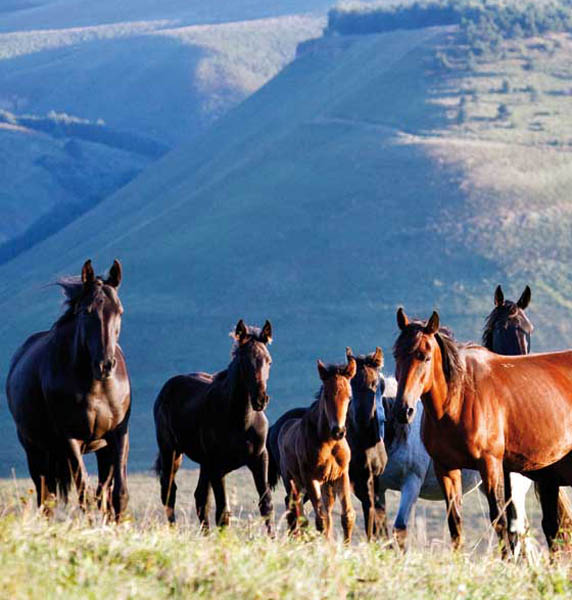
The classical herd structure and its variations
A horse in the wild usually will live as part of a herd, because a herd offers certain advantages. Many eyes see better than two, so together they can defend themselves against enemies. A herd member can fall back on the experiences of other herd members when faced with different situations. A herd is a collection of animals that know one another, form a collective group and to the outside world form a unit that can act as one. But here we come to the first hitch: not every collection of horses is necessarily a herd! Large groups of horses put out together will often divide up into various subgroups that coexist in the same field but will only join up together at signs of danger. A herd is identified by the existence of a social group structure and the fact that the members of the group know each other individually. Since horses can’t personally learn to know an unlimited number of other horses, a large group of more than 20 animals will always form into subgroups. In this chapter I would like to introduce the findings from current behavioural science research studies and explain their significance to the way we group together horses in our care.
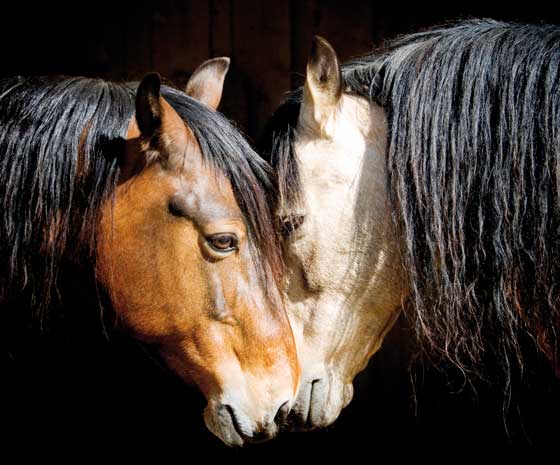
Some stallions form deep friendships with other stallions that last a lifetime.
Different ways of living together
In the natural world there is a confusing variety of possible combinations of groupings and ways of cooperating within species, and even more so in the case of horses in the care of humans. Let’s begin with the simplest type – a single horse. Unfortunately many domesticated horses are forced into an isolated existence which never occurs in nature – or does it? On the contrary, even in nature these loners do occur at times. As a rule they are usually young mares that have been driven out of the herd but who usually quickly find another stallion’s herd to join, young stallions that are searching for a group of similar bachelors to join, or sometimes fully grown but older stallions. However, this lone existence is rare in the wild and is very much the exception. In any case, in the natural world, a loner has chosen this existence of their own free will and so can’t be compared to the many stallions who have an isolated existence forced upon them by the way they are stabled. This isolation, in which horses are kept without contact with others, is neither fair nor appropriate for the species and is quite rightly banned under legislation that prevents cruelty to animals in countries such as Germany and the UK.
If we look at a horse that is able to organise its own life in a natural or wild state, then the smallest possible ‘herd’ consists of two individuals. Some horses form such a deep relationship with their partner that they spend a long time with each other and seem to be able to live without any other company. Furthermore some stallions have such a pronounced preference for a particular mare that gradually the other mares in their harems will migrate to other herds. Often this pairing will produce offspring that remain as part of a ‘mini herd’ for a while, but adult members will not join up with it. Mostly though, this pairing is the start of a new and larger family. A young inexperienced stallion joins up with a mare, and is gradually joined by other mares and their offspring.
Stallions too sometimes live together in pairs. This can either be the start of what will later be described as a bachelor group, or this pairing might be based on two males bonding to form a deep friendship or a close family relationship, such as occurs between brothers. Sometimes adult stallions will still roam around in pairs after they have lived together in a larger group of bachelors. They will help each other out and may even later look to join another group together. Such a friendship can even go so far that they may later share a harem of mares.
If a stallion should die, his mares are left on their own. Once they come into season the mares will quickly find another stallion or will be encouraged forcibly by a stallion to join his harem. Outside of the breeding season, though, mares are often very choosy when it comes to selecting a new stallion. They will make their own choice and in general won’t be forced into joining a particular herd. For this reason it is possible for herds to exist that consist only of mares with no male companion.
And now we come finally to what some people think of as the true ‘normal’ herd structure, and to which many trainers refer: the so-called family unit that consists of a mature stallion and differing numbers of mature mares and their offspring living together. Here we are dealing with a common structure that remains stable over many years.
Earlier it was thought that the stallion led his group unchallenged and could be designated as the highest ranking alpha animal, hence the term ‘dominant’ or ‘lead stallion’. Later it was realised that individual mares played just as important a role as the stallion, hence the term ‘lead mare’ and the idea of a division of labour amongst the sexes. We will see later what an over-simplification this represents.
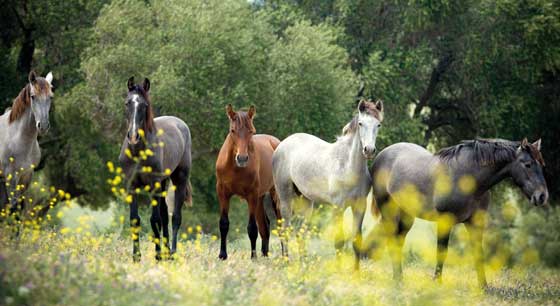
The family group within herds of wild horses is one of many different forms of coexistence.
I am me
Every horse has its own personal space, a zone around its body that others can only enter into when permitted – and even then this is usually restricted to horses that are either already known or related. This personal space can vary greatly in size. In the case of some breeds and individuals it can be very small. Thus a number of Shetland ponies might stand clustered around a hayrack with their bodies touching, while a group of thoroughbred mares might need five metres space around each of them in order to be able to eat without feeling cramped. There can be pronounced differences in the scale of each individual’s personal space and how strongly it is felt, and the effect of this will carry over into real-life situations. Within a horse’s individual space the rules of hierarchy also lose their force. It is an area about which they make their own decisions and is taboo to everyone else. Humans also have greatly differing sensitivities when it comes to personal space. While in some cultures it is common to embrace each other effusively or kiss cheeks when meeting, in others it is enough to politely shake the other’s hand. Personal space is thus dependent on the individual’s inherent personality, on how they have been socialised, and on the prevailing culture.
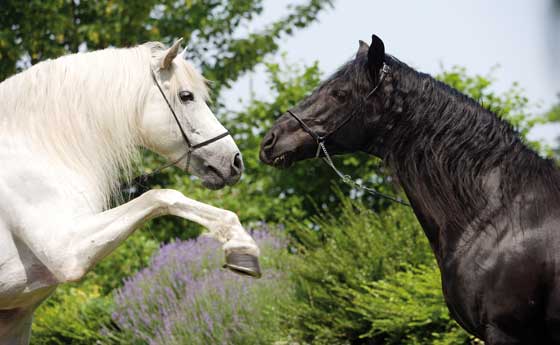
A horse has its own personal space and may react to an unwanted intrusion from another horse by stamping its foot.
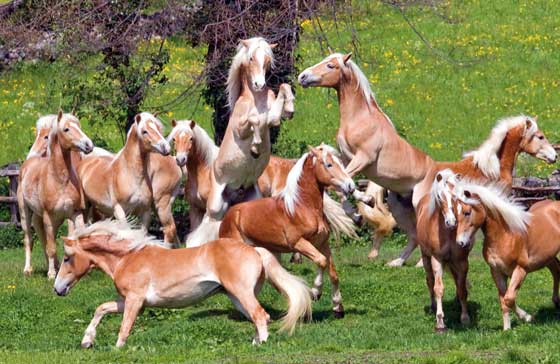
A bachelor group is a loose association of members that change frequently. Under the protection of the group, young stallions can mature to become well balanced individuals.
Pairs – the strongest link in an equine family
Alongside family groupings, of particular significance within equine society are pair-bonds or pair relationships. Two horses may form a deep and firm friendship, often lasting many years. These friendships can even survive membership of different family groups. The horses will feed together and each will form the most important social partner for the other. If such a bond exists between a stallion and one of his mares, the stallion will spend more time with this mare and will cover her more frequently than the others. Pairs will spend much time with each other during the day, often grazing close together, standing nose to tail to offer protection to the other from flies, walking around together and carrying out intensive sessions of mutual grooming.
Boys alone – bachelor groups
Given that there are about the same number of stallions born as mares, in addition to the family groups with one stallion at the head, there must also be groups of males – otherwise many stallions would have to live by themselves. Living together in groups always holds considerable advantages for horses, so young stallions will often form groups of their own. These bachelor groups can last for many years, although the members of the group will change more frequently than is the case with family groups. One stallion may leave because he has joined up with a mare to start a family, while another may be driven away from the family group by his father and will join the bachelor group and grow to maturity under the protection of the others. These herds of young bachelor stallions will have a very loose social structure with fluctuating membership.
Stallions united
Pair-bonded stallions may share mares, living more or less side by side with equal rights. Such cooperation can be very worthwhile. Although each stallion in this grouping will potentially only sire half of the foals born, each will also have a strong partner at his side to help him with the defence and security of the group. Each of the stallions therefore has more time during the day to rest and is likely to stay fit and healthy for longer. Such stallions may also remain with a group of mares over a longer period and thus sire more offspring throughout their lifetime. In a biological sense this is especially sensible in the case of related stallions. Two brothers are still closely related to the offspring of the other, so this can prove to be a very successful strategy from an evolutionary perspective. In evolution it is all about passing on hereditary characteristics from one generation to the next. Animals that are related can therefore pass on the genetic material to the next generation not only through their own offspring but also through the offspring of their relatives.
There will also be mature male offspring that remain inconspicuous, never having made any approaches towards the mares. Males such as this will be tolerated by the dominant stallion as being a subordinate companion. Stallions such as this are likely to be kept at a distance when the mares come into season, but will live alongside them for the rest of the year.
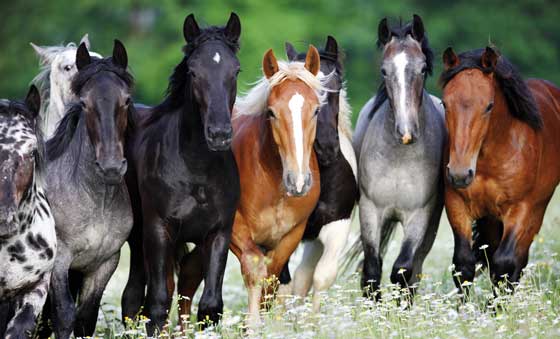
United we’re strong!
Step by step into adulthood
Young stallions are usually sexually mature by the time they are one year old; however, depending on the type of horse and its individual development some may be mature by eight months and others only at two years old. At this stage they will become more independent and distance themselves gradually from the family they were born into. Either they will be driven away by the dominant stallion when showing too strong an interest in the mares within the family group, or they will of their own accord seek out a bachelor group nearby or a solo mare. Young mares tend to stay with the group they were born into for much longer, sometimes for their entire life. When they reach sexual maturity at about the age of two years they will either be ‘kidnapped’ by a stallion from outside the family group, or they may leave the group independently, which naturally gets around the problem of inbreeding.
A journey into the world of behavioural science
It is only possible to observe and interpret the behaviour of animals if you examine not only the theory of evolution, as mentioned in the first chapter, but also further biological facts about the behaviour of living things.
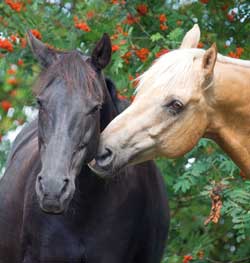
Horses within a herd often go around together as couples. They enjoy a close relationship and go throughlife side by side.
The game of life
Game Theory is a theory of evolutionary science that predicts that when no one single behavioural strategy is always a winner, a number of different strategies may exist in the population, which are used by different individuals. Everyone plays according to their strengths and, as long as you are successful sooner or later, your genes will survive. It is assumed that a certain type of strategic behaviour is stable, in evolutionary terms, meaning that it is consistently shown in horses over many generations. If there isn’t just a single strategy that, when one is faced with a specific problem, is guaranteed to result in reaching the goal (in other words a win), but rather a number of possibilities, then these various possibilities will continue to live on as evolutionarily stable options within a population. Every horse plays this game for its own life or death as well as its physical and mental qualities allow. If it is successful, it passes on its strategy as one of the options to its offspring.
To explain this phenomenon further, we just need to imagine a typical problem for a typical stallion. The stallion’s instinct is to want to father as many foals as possible, so he requires a strategy that helps him fulfil this aim. The best known strategy is to live as a stallion with his own harem. The advantage of this is that the stallion could sire a large number of offspring, but the cost of this is that he lives with the threat of danger and under a great deal of pressure due to the heightened need for energy, the continual stress of reproduction and defending his mares, as well as the constant risk of injury through having to fight off other stallions. For a strong, powerful fully grown stallion this might be the best strategy; however it wouldn’t be sensible for nature to allow only a limited number of stallions to reproduce. The genetic variation in horses, which allows the species to adapt itself to a variety of changing environmental situations, would be diluted after only a few generations.
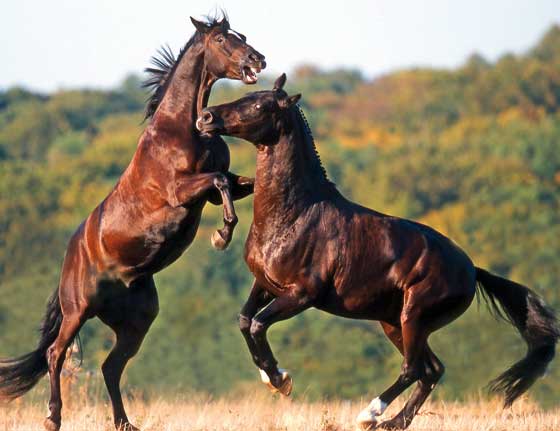
The behaviour of the same horse can range between rough and gentle. Horses adapt their conduct according to their particular companions and the current situation.

There also needs to be a way for other, less strong or younger, stallions to play the game of life. There has to be a mechanism that ensures more evenness and balance. For this reason many stallions attach themselves to bachelor groups that remain close to herds and wait for a moment that gives them the chance to mate with a mare.
This strategy can be successful for many stallions, not just when young but for their entire life. A stallion living like this avoids all of the work and responsibilities that life as a stallion with a harem brings, and despite this enjoys the protection of a group while also managing to sire offspring. This phenomenon has been proven by studies showing that the dominant stallion is not always the biological father of all the foals in his herd, but only a certain percentage of them. A considerable proportion of the foals will have been sired when mares were ‘unfaithful’ with stallions from a nearby group of bachelors. Mares appreciate the presence of the strong dominant stallion as a protector for their foals, but might not always chose him as the father of their offspring.
An additional successful strategy can be for a young stallion to live as long as possible inconspicuously under the protection of the harem stallion, without challenging him and only at his death stepping into his shoes.
Game Theory can be applied in many spheres of life. There will undoubtedly be a large number of individuals that stick by the established rules of the game, but there are specific percentages that play the game according to their own rules. For this reason, in nature there is a great range of possible behaviours and traits among horses.
Kin selection
The term ‘kin selection’, also known as ‘relative selection’, reflects a basic principle in the nature of family relationships. To secure the continuation of the horse as a species and the passing on of its own genetic material, a horse needs to produce as many offspring as possible. Given, however, that a filly foal will always have at least 50 per cent of the genetic material of each of her siblings, it makes sense to ensure their survival. We can see this apparently unselfish behaviour of mares in the way in which they devotedly look after the offspring produced by their own mother. In reality they are selfishly securing their own genetic material, and natural selection will be influenced towards the direction of their own relatives.
This leads us to ask the question whether horses act selfishly, in other words egoistically, or whether they act altruistically, for the sake of the wider community. The fundamental theory, that every living being is fighting to spread its own genes, would suggest that every animal should behave strictly egoistically. In some cases, as described in the example given of kin selection, in an evolutionary sense it is more sensible to act for the benefit of others rather than for oneself. This also occurs in the case of reciprocal altruism. This involves animals mutually helping each other out, and it works as long as opportunities arise often enough to repay the debt to the other. It is an example of treating others as you wish to be treated by them. Nature gives horses the opportunity to help each other, and then they return the favour. This principle is particularly obvious when it comes to horses scratching each other on the withers. One horse scratches the other, on the one hand to make it itself feel better and cement the relationship, and on the other hand to have the favour reciprocated. Thus both get something out of the behaviour.
The optimal skew theory says that the optimal division of the reproduction in a population is dependent as much on the environment as on the degree of relationship of the horses. The example of our adolescent, inconspicuous stallion shows this. If in the immediate vicinity there are few enemies and many unattached mares, then it would make most biological sense to find his own harem quickly and produce offspring. If however there is no availability of mares and the habitat is barren and limited in size, then the better alternative may be to wait for the opportunity to take the harem over and in the meantime protect the offspring of his mother and sisters.
The concept of gender
What makes a man a man and a woman a woman? Are the obvious differences really of a biological nature or more of a social or psychological nature? In the case of horses, the question must also be asked whether specific behavioural patterns can be assigned to a specific gender or whether they can be attributed to the qualities of an individual under certain conditions. Some patterns of behaviour will be shown, depending on the context, by both stallions and mares. Up until now only a few generalisations could be made about the behaviour of one gender that didn’t also, in individual cases, apply to the other. So we observe mares that cover another horse’s droppings with their own, just as a stallion would, or we may even see a mare that tries to mate with another. Similarly, there are stallions that spend a lot of time scratching and grooming their foals, which is usually the job of the mother. Gender appears to be a semantic concept, which leads us to compartmentalise certain types of behaviour into a specific ‘gender drawer’.
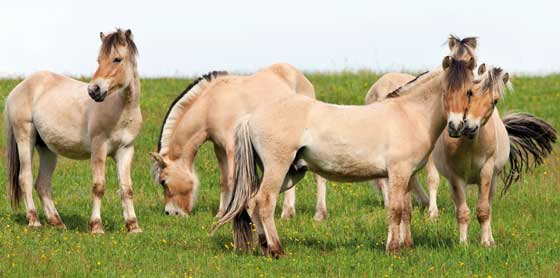
Friendships exist not only within a herd but also between members of two different herds.
Contact with other horses and herds
Horses not only have contact with the members of their own group but they also cultivate friendships outside of this unit. Given that horses as a rule are not territorial and are happy to coexist with others, different groups will tend to live in more or less close contact. They will meet at a shared waterhole, or perhaps rest together in a dry or sheltered area, and then graze far apart during the day. Many groups get to know each other very well over the years. Foals from family A will play with those from family B, mares will mix together, and even mature stallions from different groups have been observed grooming each other – with no obvious sign of hostility. Of course such contact is less extensive during the mating season, but this only affects a relatively short part of the year.
Is blood thicker than water?
For horses, relatives are the glue that keeps their social order stuck together. Mares look after their foals devotedly and frequently maintain contact with their filly foals over their entire life. Siblings also remain close. Older sisters learn from seeing how their younger siblings are raised and use this to effect when they become mothers themselves.
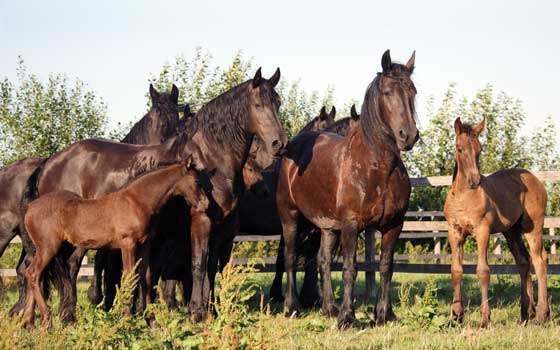
Foals learn what it is to be a foal through early socialisation.
Do horses really show preferences for other members of the same breed or for those of the same coat colour? It is often claimed that horses will only get on really well with those of the same breed or with other horses that are the same colour. Experiments, however, have shown that no general pattern could be shown in preferences for certain breeds or colours.
A horse probably does not have a real idea of what it looks like, its coat colour, or its breed. Over the course of its youth there is a process called socialisation, during which a horse will unconsciously learn what is ‘normal’ and what is not. If, for example, it lives in a group that consists exclusively of Icelandic ponies, then later it is likely to feel drawn to this type of horse and will not accept other horses with different characteristics as easily.
The colour of its mother and siblings will also be imprinted on a foal. Given that coat colour is hereditary, it may well be that a foal lives with only bay horses and once fully grown may take longer to befriend a skewbald or a leopard-spotted Appaloosa. How pronounced this preference is will vary greatly from horse to horse. It can be so strong, however, that some stallions will not accept mares of a certain colour and not cover them when they are in season.

From day one a foal will watch its mother carefully.
It will adopt many of her preferences and copy her behaviour.