

Aramaic was used as an official language by the Assyrians, Babylonians, and Persians. After the collapse of the Persian Empire, the Imperial Aramaic language and script, which had been more or less unified across the empire, began to break up, and local dialects and scripts developed, such as (Square) Hebrew; Nabataean, from which Arabic eventually emerged; Palmyrene; Hatran, Syriac (several forms); and Mandaic. I
2: [Modern Square] Hebrew
3: Aramaic inscription on stele of King Zakkur of Hamath, 780-775 B.C.E.
4: Aramaic, sixth century B.C.E.
5: Aramaic, cursive form, fifth century B.C.E.
6: Palmyrene, first/second century C.E.
7: Nabataean, first century C.E.
8: Nabataean, second century C.E.
9: Syriac-Estranghelo, fifth century C.E.
10: Syriac-Jacobite, eighth century C.E.
11: Mandaic
12: [Samaritan, developed from Old Hebrew script, which, in turn was derived from Early Phoenician. While the Jewish community as a whole abandoned the Old Hebrew script in favor of the Aramaic script, certain Jewish sects, such as the Samaritans, retained it.]
Reproduced with the kind permission of Pere Jean-Hugo Tisin o.p. Pere Tisin also helped, with much generosity and patience, with all matters Aramaic and Syriac, for which I thank him warmly.
NOTE
1. John F. Healey, The Early Alphabet (London /Berkeley, 1990), p. 42
The Development of Aramaic
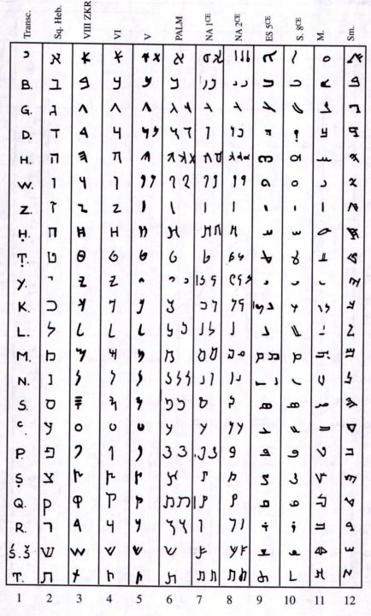

A Comparative Table of Hebrew, Syriac, and Arabic Scripts


A Comparative Table of Nabataean and Arabic

Adapted from Dictionanaire de in Bible, vol. I, Paris, 1895.

Nabataean and Arabic Inscriptions
From J. Catineau, Le Nabateen (Paris, 1930); Regis Blachere, Histoire de la Litterature Arabe, vol. I (Paris, 1952); John F. Healey, The Early Alphabet (Berkeley, 1990).
The Nabataeans were the founders of the first independent northern Arab kingdom centred on Petra in modern Jordan (see map). They spoke a form of Arabic but used Aramaic for their inscriptions. The Nabataean Aramaic script is found in two forms: a formal script used for monumental inscriptions, and a more flowing cursive script used on papyrus. It is fairly certain that the Nabataean script is the origin of the Arabic script. Unfortunately, the epigraphic evidence is meager.
In modern discussions, the point of departure is the bilingual Greco-Nabataean inscription found at Umm al-Jimal, to the west of the volcanic plateau of Hauran (south of Bosra) in modern Syria. It was studied by Littmann, and dated to roughly the end of the third century C.E. The language is Aramaeo-Nabataean, and the script is characterized by numerous ligatures.
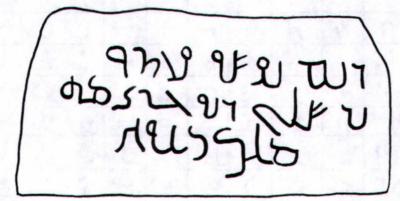
Umm al -Jimal, third century C.E.
The next inscription of importance is that of an-Namara, discovered in 1901 by Dussaud and Macler at an ancient Roman site east of Jabal Druze (northeast of Bosra) This proto-Arabic inscription was found on the lintel of the door of a mausoleum, built for the King Imru'-1-Qays, who died in 328 C.E. The writing used is similar to that at Umm al-Jimal. The number of ligatures has increased, the letters are more rounded, though certain, like the `ayn or the final in of the plural already prefigure Kufic writing.
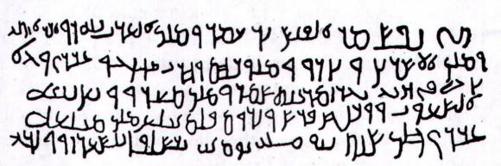
Namara Inscription, 328-329 C.E.
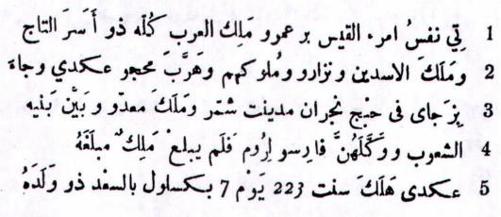
Transcription
Translation:
This is the tomb of Imru-I-Qays, the son of Amr, king of all Arabs, who assumed the crown (2)which subdued (the two tribes) of Asad, and Nizar and their kings, who scattered MHDJ until now, who carried the day (3) at the siege of Najran, the town of Chammar, who subdued the tribe of Ma`add, who divided among his sons (4) the tribes and organized that the latter like a cavalry corps for the Romans. No other king attained his glory, (5) to this day. He died in the year 223 [328. c.E.], the seventh day of Kesloul. May happiness reign over his descendants.
The third epigraphic piece of evidence was discovered in 1879 by Sachau on the lintel of a door of a sanctuary dedicated to Saint Sergius, in the small village of Zabad. The Arabic text, engraved next to two inscriptions, one in Greek and the other in Syriac, seems to have been added later. It simply gives the names of the founders, all Aramaic. The script, dated to 512 c.E., very different from that of the an-Namara inscription, deserves to be called properly "Arabic," since it shows all the characteristics of cursive writing. Obviously, we lack all the intermediate steps in the evidence that leads from Namara to Zabad.
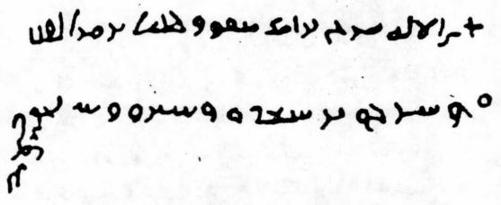
Zabad, 512 C.E.
The fourth piece of evidence is a bilingual inscription discovered by Wetzstein in 1864, at Harran, northwest of Jabal Druze on the borders of the plateau Leja. It represents the dedication of a martyrium, which the Greek text tells us was consecrated to Saint John the Baptist, and the door bears the date 463, the era of Bosra (568 c.E.). The style can be called "kufic." With this document clearly dated, we have a specimen of a system of writing definitively established. (Notice the Christian context.)
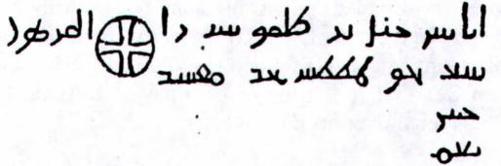
Uarran, 568.
Transcription
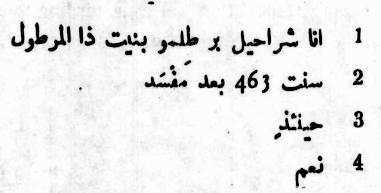
Translation:
I, the Sharahil, the son of Talemu, built this, (2) in the Year 463; after the corruption (3,4), prosperity.

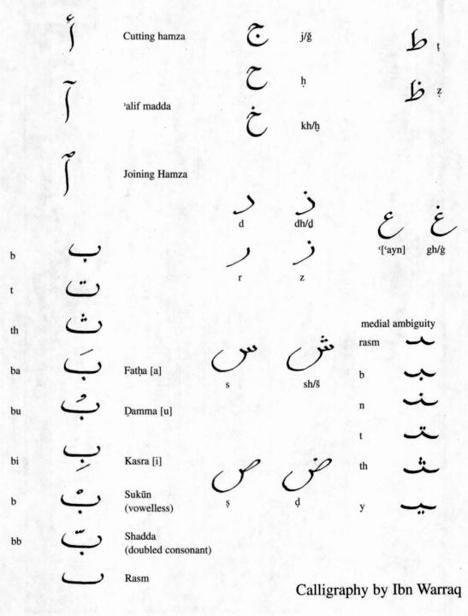
The Arabic Alphabet
The form of the Arabic letters varies according to whether the letter is in initial, final, or medial position in a word.
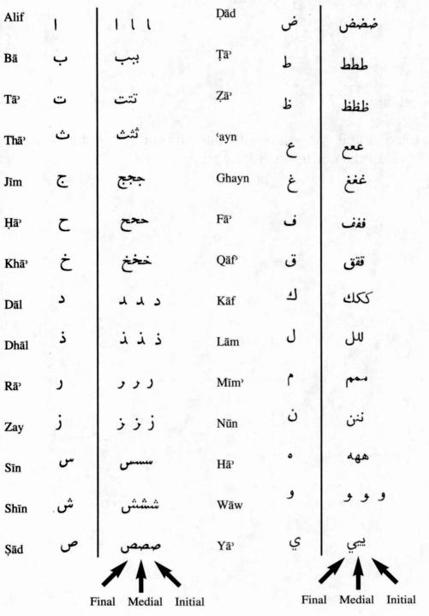

A Dot or Two Can Make All the Difference

Arabia and the Near East
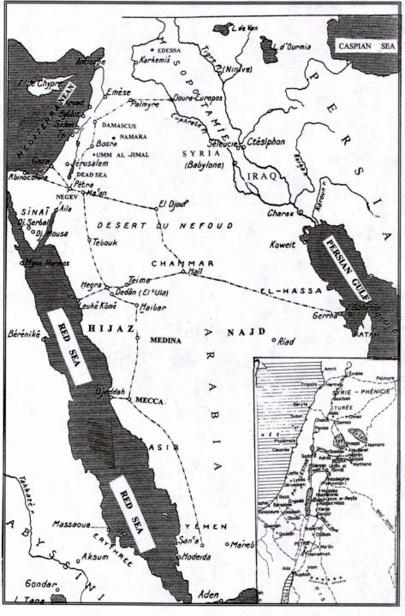
Map adapted from J. Catineau, Le Nabateen, Paris, 1930. Inset adapted from Dictionnaire de la Bible, Supplement. Ed. Pirot, Robert et al. Tome 7. Paris, 1966.

List of Contributors
Jacob Barth (1851-1914), from a Jewish family, was a teacher from 1874 onward at the newly founded Seminary for the Orthodox Jewish Education of Rabbis in Berlin. Later, Barth taught Semitic philology at Berlin University, and became well known for his works on Semitic grammar (Die Nominalbildung in Semitischen) and for his edition of the Arabic commentary of Maimonides on the Mishnah tract Makkoth. The latter was one of the first Middle Arabic texts to be published.
Rev. Dr. Richard Bell (1876-1952) was educated at Edinburgh University, where he studied Semitic languages and divinity. He became a minister of the Church of Scotland in 1904, and ordained to the parish of Wamphrey in 1907. After fourteen years in the parish ministry, Bell returned to Edinburgh as lecturer in Arabic, attaining the position of reader in Arabic in 1938, a position he held until his retirement in 1947.
J. Bellamy is professor emeritus in the Department of Near Eastern Studies, University of Michigan.
A. Ben-Shemesh taught at the University of Tel Aviv, and edited and translated a well-known Arabic work on taxation: Yahya b.Adam, Kitab al-kharaj (Leiden, 1967).
Dr. Bishai graduated from the Johns Hopkins University in 1959, with a dissertation entitled "The Coptic Influence on Egyptian Arabic." Dr. Bishai taught at the Johns Hopkins University and then at Harvard University, where he retired as senior lecturer of Arabic in 1973.
The Reverend E. F. F. Bishop was formerly principal of the Newman School of Missions in Jerusalem and senior lecturer in Arabic at the University of Glasgow.
Joshua Blau is professor emeritus of Arabic at the Hebrew University of Jerusalem, and author of The Emergence and Linguistic Background of Judaeo-Arabic vol. 5 of Scripta Judaica (Oxford, 1965), and A Grammar of Christian Arabic, CSCO Subsidia 27-9 (Louvain, 1966-67).
M. Bravmann taught at the Hebrew University in Jerusalem, and is author of The Spiritual Background of early Islam (Leiden, 1972) and Studies in Semitic Philology (Leiden, 1977).
Claude Cahen (1909-1991). Following research in Turkey in 1936, Cahen taught, after the war, at the University of Strasbourg, where he founded the first journal devoted to the social and economic history of the East. In 1959 he went to the Sorbonne, where he taught for twenty years. Hourani described Cahen's work as "perhaps the most systematic attempt to apply mature sociological concepts to the realities of Islamic society."1
August Fischer (1865-1949), a disciple of H. L. Fleischer, was a professor in Leipzig. His particular talent for linguistic analysis led him to write some Koran-critical essays (e.g., "Der Wert der vorhandenen Koranubersetzungen and sure 111," Berichte uber die Verhandlungen der Sdchsischen Akademie der Wissenschaften [BVSAW] zu Leipzig 89, Heft 2 [1937]). Also worth mentioning is his monograph "Der Koran des Abu 1-`Ala al-Ma'arri," BVSAW 94, Heft 2 (1942), and the establishment of the Shawahid Indices, which were completed in 1945 by his disciple and successor, Erich Braunlich.
Rudolf Geyer (1861-1929) was a disciple of D. H. Muller. On Muller's retirement, Geyer became professor of Semitic languages at the University of Vienna. Geyer also continued Muller's work on strophic poetry in the Koran, though his main interest remained Arabic poetry.
Adolf Grohmann (1887-1977) was professor of Semitics and cultural history of the Near East in Prague and Vienna. His main field of interest was Ethiopic and South Arabic of pre-Islamic times. One of his discoveries was that the Old Ethiopic Hymnody was derived from an Old Arabic, pre-Islamic translation, carried out before 500 C.E., and which, in turn, was derived from a Coptic original (Athiopische Marienhymnen, Abhandlungen der Sachsischen Akademie der Wissenschaften, Phil.-hilt. Klasse, Bd.33 No.4, Leipzig 1919.) He was also the author of two further important works: Arabien. Handbuch der A lterumswissenschaft (Munich 1963), which is a reference book on Arabian cultural history throughout the ages; and "Arabische Palagraphie," in Sitzungsberichte der Osterre- ichischen Akademie der Wissenschaften Wien, Phil.-hist. Klasse, Denkschriften, 94. Bd., 1. Abhandlung (Wien 1967-1971).
C. Heger, after studies at the universities of Cologne and Bonn, and research at the Ruhr-University in Bochum, worked with the Council of Environmental Experts. He is currently engaged in research on early Islam, and the textual criticism of the Koran.
Paul Kahle (1875-1964) began his academic career as a Protestant theologian working on the textual tradition of the Hebrew Old Testament. Kahle spent five years in Cairo as pastor of the Protestant parish in Egypt; this stay brought him closer to the field of Arabic and Islamic studies. He eventually became professor of Semitic languages at the University of Bonn. He was advised to leave Germany in 1938 since he and his family had helped persecuted Jews. Kahle's knowledge of Christian theology gave him a different perspective on the Koran than was usual in Germany. Under the influence of Carlo de Landberg and Karl Vollers, Kahle regarded the language of the Koran as not Classical Arabic.
M. J. Kister is professor emeritus at the Hebrew University of Jerusalem. He is the author of Studies in Jahiliyya and Early Islam (London, 1980).
Rev. Professor Raimund Kobert was researcher and teacher at the Pontifical Biblical Institute, Rome. He was the author of numerous articles in learned journals such as Der Islam ("Zur Lehre des Tafsir fiber denbosen Blick (Mk.7.22par)," Der Islam 28, 111-121), Biblica, and Orientalia.
Toby Lester is a writer and editor whose articles have appeared frequently in the Atlantic Monthly. From 1988 to 1990 he was a Peace Corps volunteer in North Yemen, and from 1992 to 1994 he worked for the United Nations in Jerusalem and the West Bank.
David S. Margoliouth (1858-1940) was professor of Arabic at the University of Oxford, and a member of the Council of the Royal Asiatic Society. He was the author of numerous articles and books on Islam, including Muhammad & the Rise of Islam (London, 1905), and The Early Development of Mohammedanism (London, 1914). His research into the history of Early Islam led him to compare the life of Joseph Smith, the founder of Mormonism, to that of the Prophet of Islam, and forced him to conclude that human beings with unusual powers fall easily into dishonesty.
Alphonse Mingana (1881-1937) was a great scholar of Semitic languages, especially Syriac and Arabic. He was a member of the Chaldaean Church in Iraq, where he was also professor of Semitic languages and literature in the Syro-Chaldaean Seminary at Mosul. He collected invaluable Arabic and Syriac manuscripts that became the foundation for the famous Mingana Collection, now housed in Birmingham, U.K. The last twenty years of his life were spent in England, where he taught Semitic languages. His essays were collected in Woodbrooke Studies: Christian Documents in Syriac, Arabic, Karshuni (1927).
Yehuda D. Nevo was a freelance archaeologist, whose discovery in the Negev Desert (Israel) of Kufic inscriptions, four hundred of which were published in Ancient Arabic Inscriptions from the Negev, led him and Judy Koren to reexamine the origins of Islam and early Islamic history. At his death, Nevo left the manuscript of Crossroads to Islam, which Judy Koren is revising with a view to its publication soon. Koren and Nevo have also published together "The Origins of the Muslim Descriptions of the Jahili Meccan Sanctuary, Journal of Near Eastern Studies (1990).
M. Philonenko is professor at the University of Strasbourg, and one of the directors of the journal, Revue d'Histoire et de Philosophie Religieuses. He is the author of many articles on the Dead Sea Scrolls, and edited La Bible; Ecrits Intertestamentaires (Paris: Gallimard, 1987), for which he also translated from the Hebrew into French, The Testament of Job; the Apocalypse of Abraham; and The Book of Secrets of Enoch, among others.
Gerd-R. Puin is a member of the Institute of Oriental Studies at the Uni- versitat des Saarlandes, Saarbracken, Germany. During the 1980s he was in charge of a German cultural aid project in the Yemen concerned with the restoration of Koranic fragments written on parchment.
Chaim Rabin, Ph.D. (1939, London), D.Phil. (1943, Oxford), was lec turer in post-biblical Hebrew at the University of Oxford and Professor of Hebrew Language at the Hebrew University of Jerusalem. He is the author of Ancient West-Arabian (London, 1951), and Qumran Studies (Oxford, 1957).
Ibn al-Rawandi is a freelance writer on philosophical and religious subjects. He has a special interest in the mystical and esoteric aspects of the world's religious traditions, and has personal experience of Sufism, Christian Theosophy, and Jewish Qabalah. He is the author of Islamic Mysticism: A Secular Perspective (Prometheus Books, 2000) and numerous articles and book reviews.
F. Rosenthal completed a Ph.D. on the language of the Palmyrenian Aramaic inscriptions under H. H. Schaeder in 1935. He left Germany at the end of 1938 for Sweden, England, and the United States, where he arrived in February 1940. Rosenthal taught at the Hebrew Union College in Cincinnati, Ohio, served in the US Army, and was appointed professor at the University of Pennsylvania in 1948 and at Yale University in 1956. Professor Rosenthal retired in 1985. He has translated Ibn Khaldun's The Muqaddimah and the first part of Tabari's History, and is the author of A History of Muslim Historiography (Leiden, 1952).
Uri Rubin is a professor of Arabic and Islam at Tel Aviv University. He is the author of over twenty articles published in learned journals such as BSOAS, JRAS, and JSS, and of the full-length study The Eye of the Beholder: The Life of Muhammad as Viewed by the Early Muslims (A Textual Analysis) (Princeton, 1995), and is working on Between Bible and Quran: The Children of Israel and the Islamic Historical Self-Image.
Michael Schuh, Ph.D. was lecturer in Arabic language and literature at Yale University for three years. He now teaches at Trinity College in Hartford, Connecticut.
C. C. Torrey (1863-1956) was professor of Semitic languages at Yale University. He worked with the American Schools of Oriental Researchin the Near East, helping to excavate a Phoenician Necropolis at Sidon. He was an expert on Palestine antiquities in general, and a formidable biblical scholar with more than fifteen works to his credit, including The Four Gospels (1947); The Apocryphal Literature (1945); and The Second Isaiah (1928).
Julius Wellhausen (1844-1918), German biblical scholar and orientalist. In his pioneering work on the Old Testament, which he began publishing in 1876, Wellhausen showed that the Pentateuch was a composite work in which one could discern the hand of four different writers. His research completely transformed Old Testament studies. Wellhausen then turned his critical mind to the sources of early Islam. His works include Prolegomena zur dltesten Geschichte des Islams (Berlin, 1899), and Das Arabische Reich and sein Sturz (Berlin, 1902).
NOTE
1. A. Hourani, "Islam and the Philosophers of History," in Europe and the Middle East (Berkeley, 1980), p. 73, quoted in The Jewish Discovery of Islam, ed. M. Kramer (Tel Aviv, 1999), p. 35.
*The author died on February 12, 1992. The article was seen through the press by the editors.
*Prof. Margoliouth seems to have interpreted Eccles. 2: 8 in his own fashion, for the Hebrew Bible (Biblia Hebraica, Stuttgart, 1952, p. 1213) reads.frym wsrwt. This is a difficult passage, which has been variously interpreted; the older interpretation gives: sommeliere and sommelieres (wine waitresses?). Modem editors of the Biblia Hebraica propose the reading: srh wsrwt, meaning: prince and princes. The King James Version has men and women singers.-Ed.
*The typescript is not at all clear; there is room for another word.