

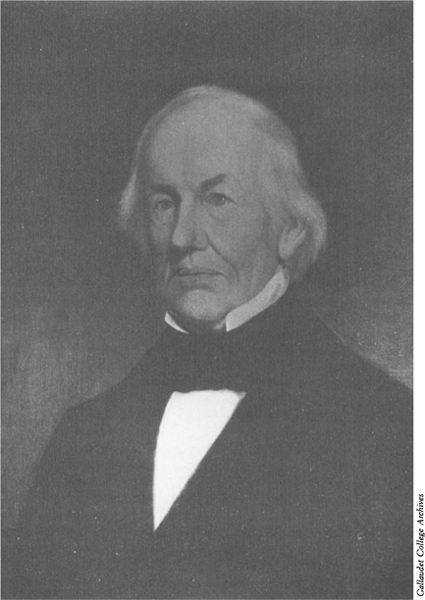
LAURENT CLERC (PAINTING BY JOHN CARLIN)

ONE

My name is Laurent Clerc. I am eighty-three years old. My hair is white, my skin wrinkled and scarred, my posture crooked; I shuffle when I walk. Undoubtedly my life will soon end in this time and place: 1869, Hartford, Connecticut. I spend most of my day sitting alone at my dining room window, looking at my orchard and remembering.1 I also read the paper and occasionally friends come to visit. I know what’s going on. Important people, distinguished gentlemen, are repudiating the cause to which I have devoted my life. Endowed with the sacred trust of my people’s welfare, they seek, without consulting us, to prevent our worship, marriage, and procreation, to stultify our education, and to banish our mother tongue simply because our way and our language are different from theirs.2 As I write, America licks its nearly fatal wounds; the enslavement of colored people has been ended, and the Union has begun the Reconstruction. Yet how should we rejoice who remain imperiled? The disease of intolerance itself is unchecked and threatens to invade other limbs of the body politic.
Every creature, every work of God, is admirably made; perhaps what we find faulty in its kind turns to our advantage without our knowing it. One day the sun shines on my orchard, another it does not. The orchard has fruitful trees and unfruitful; even in the same species there are different varieties—everything is variable and inconstant. And we ourselves: we vary in our forms and functions, in our hearts and minds. I do not know, as you do not know, why this should be so. We can only thank God for the rich diversity of His creation and hope that in the future world the reason for it may be explained to us all.3
Meanwhile—language must come once again to my aid. It has always been my weapon to fight evil, my vessel to fill minds thirsting for knowledge, my lure to solicit relief.* It must serve me grandly one last time and cast such a brilliant light on the history of present injustices that their perpetrators will cringe and their victims rally.
I am impelled by the present threat to the well-being, dignity, and freedom of my people to tell our story, one that I have lived almost from its beginning: how we gathered in France and in other European lands and then in America; how our language† spread throughout Europe and crossed the Atlantic; the great struggle to create schools for us, in which it was my lot to play a leading role. It is a story of builders: of an abbé rejected by the Church who established the education of an entire class rejected by society; of a deaf shepherd who achieved international acclaim by personifying what such an outcast class can achieve through education; of a frail New England pastor who channeled the love of a little deaf girl into a mighty force that has created the first college in the world for that class. It is also a tale of destroyers: of a zealous physician who put mock science ahead of true humanity; of a haughty nobleman who imposed his will on the deaf, knowing, he believed, what was best for them but knowing, in fact, none of them; of a professional reformer who has sought to recast entire classes of society in his own image.
The story has never been told. I will tell it all, and the forces of darkness will be revealed for what they are. I do not mean to say I shall relate all the facts; indeed, what interest would such an inventory have, even if all the facts were known? But I will tell the true story, how it really was, for I have seen much of it unfold with my own eyes; I have been a witness and a shaper of events.
My own story and my people’s became one seven decades ago, when I was twelve years old. King Louis XVI had been guillotined four years before, ‡ Robespierre’s head had fallen in its turn a year after that, and the nightmare of the Terror he directed was beginning to fade.§ As my boyhood drew to a close, my prospects, like those of the new nation that proclaimed the fraternity of all its citizens, were uncertain, for I was starting a new life: my uncle had brought me to the capital to place me in the National Institution for Deaf-Mutes (my father could not accompany me because of his duties as mayor of our village, La Balme, on the sunny banks of the Rhône).
I am profoundly deaf. When I was about a year old, I was left home alone for a few moments, in a chair by the fire; I fell and badly burned my face (the scar remains and inspired my name sign, two fingers brushed against the right cheek). My family believed it was this accident that deprived me of my hearing and my sense of smell, too; but I may have been born that way.
At first my parents tried to undo my deafness. A certain doctor in Lyon had a cure and my mother took me there; he said he could make me hear if I called at his office twice a day for a fortnight. This we did and he injected I know not what liquids into my ears but without effect. At the end of the fortnight I returned home with my mother, still as deaf as I was before.4
My mother was a devout Catholic and I would often accompany her when she went to the church perched high on the cliff overlooking La Balme. Secreted within the cliff are magnificent and labyrinthine grottos, and in the giant archway at the opening lies an oratory, a chapel to which pilgrims traveled as early as the fourteenth century and which my mother and I visited from time to time. I was not supposed to go beyond the chapel, into the cavernous halls and dank recesses of the grottos themselves. But a deaf boy could not go to school and, like the village idiot, could not be instructed either in any useful occupation, so I was left to myself and I ventured where foaming rapids and strange concretions struck delicious terror in my mind: there was an avenging monk, I recall, and a pork-butcher covered in gore. Sometimes I sought out the more tranquil setting of the banks of the Rhône, where I spent hours watching the muddy river glide off to distant places beyond Lyon. Occasionally I drove my mother’s turkeys to the field or her cows to pasture or my father’s horse to the watering place.
My brother and sisters communicated with me in “home sign,” gestures that were scarcely more than pantomime but had become abbreviated with use. I had the impression that my mother wanted to learn these signs but never could, while my father, who could learn anything, did not care to. He was the king’s notaire,* as was my maternal grandfather—thus were the careful keeping of records and the love of history bred into me. My father, who had offices in three villages, was a man more respected than liked, but he was elected mayor all the same. In his middle age he was encumbered with a deaf son and he was offended: it was inconvenient, untidy, embarrassing, and it implied that he was guilty of something.5
I could not know what reasoning or events lay behind his decision to send me to Paris. The fame of the Institution for Deaf-Mutes would have reached even La Balme, and it is possible that my father was not displeased to have the opportunity of helping me while also discharging his burden. In any case, when I was twelve, a tawny-haired, gangly slip of a youth, I made the week’s journey with my uncle to Paris. The bustle of the city, the imposing façade of the school, the long waiting alone in anterooms, my uncle’s tearful farewell—all these frightened me terribly at first. Fortunately, I did not have to face as well the renowned head of the school, the abbé Sicard. The Directory, which then ruled in France, had recently ordered him deported, along with two of their own number and many politicians and journalists, for sympathy with the deposed monarchy, and he was in hiding to avoid the perils of an involuntary trip to the jungles of French Guiana.6 I was received, instead, by a young deaf man, twenty-five at the time, Jean Massieu, who had been appointed Abbé Sicard’s chief teaching assistant by Louis XVI.
Massieu had flowing brown locks and long sideburns, which emphasized his oblong face. His eyes and lips traced thin horizontal lines there, where his large flat nose extended from a broad forehead down toward a jutting chin. He wore, as I soon discovered was his custom, a bizarre outfit he had bought at auction and over it a gray riding coat that reached his ankles. The coat had two large deep pockets, filled with books and chalk and watches—Massieu had a passion for watches.7 Jean Massieu would become my teacher, then my colleague, and my lifelong friend, but he appears in my memory after the passage of all these years as he did on that first day, like an icon: full face, calm, radiating a saintly aura, a childlike candor; loving, inviting. Jean Massieu—who had to wait until he was twenty to learn the mysteries of the Sacrament, as there was none to educate him before the abbé Sicard; Jean Massieu—who consecrated his life to the disinherited and died penniless himself.
I will tell you more about my teacher, Massieu; and about his teacher, the abbé Sicard, some thirty years older than he; and about Sicard’s teacher, thirty years older again, “the father of the deaf,” as he is called, the abbé de l’Epée. But let me begin this unfolding as I experienced it, with the product of their labors, or rather the temple devoted to them, the National Institution for Deaf-Mutes, where I would spend the next twenty years of my life. It was the first public school for the deaf in the history of the world and the inspiration and model for hundreds that would soon follow. Created by Epée and Sicard, it created in turn educated leaders among the deaf, instilling in us pride in our language and ourselves, and an elevated vision of what we could become.
Everything about the institution was grand, all the more so to a twelve-year-old boy from the provinces. Situated on the plateau of the Montagne Sainte-Geneviève, on the rue Saint-Jacques next to the Luxembourg Palace and gardens,* it had gardens of its own that occupied several acres, alleys lined with linden trees where we pupils played. The school building was shaped like an H, embracing a large courtyard in front and a spacious terrace overlooking the gardens behind. The façade was sculpted limestone and the two stories, each with more than a dozen lofty windows spaced a yard or so apart, were topped by a steep slate roof with little mansard windows and jutting chimneys.8 It had been built by the Fathers of the Oratory,* in the seventeenth century, on the ruins of a refuge constructed in the thirteenth by the monks of the nearby church of Saint-Jacques-du-Haut-Pas—the first in a chain of refuges that served one of the most traveled pilgrimages in Christendom, from Paris to Santiago de Compostela in Spain, where a miracle had placed the body of the apostle. For over a century, the Oratorians trained the priests of the diocese of Paris there, and those destined for the provinces as well, until church property was abolished by the Revolution and the seminary was seized by the new Republic, to be turned over to the abbé Sicard for our school in 1794.9 In the cobblestone court stood an elm tree of breathtaking size: reputedly planted in 1600 by the duke of Sully, † it had attained over 150 feet by the time I arrived and was known as the plume of Mount Sainte-Geneviève. It took six of us pupils, holding hands, to reach around it. By now, it must take seven or eight.
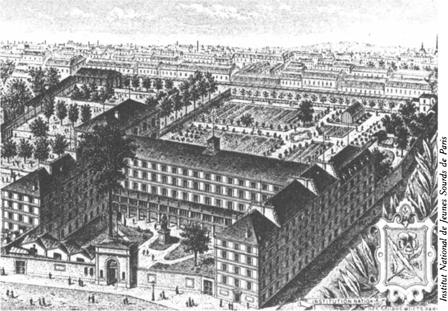
NATIONAL INSTITUTION FOR THE DEAF (PARIS, 1898)
Once the formalities of my admission were completed I was led by way of a stately sweeping staircase of stone and wrought iron to the second-floor sleeping quarters, a long rectangular room, airy and light, with rows of windows on each side (overlooking the street and the gardens) and windows wide open at each end. Formerly each window had illuminated a monk’s cell; the partitions had now been removed to create a spacious dormitory. Plain stone columns marched single file down the middle of the room, separating two rows of beds, some fifty in all, each covered with a counterpane and each bearing a sign at its foot giving the name of its tenant. A small chest stood alongside. All of these things were made in the school, the beds and chests in the woodshop, and the signs in the printshop.10 The linen was woven by the twenty young women who were quartered across the rue Saint-Jacques, and tutored separately by Abbé Sicard’s associate, the abbé Salvan.
My bed was last in the row, hence immediately next to the large, luxurious one, surrounded by curtains, in which slept the surveillant, ‡ an elderly deaf man who had studied for a time under the abbé de l’Epée, the abbé Sicard’s predecessor. At the opposite end of the hall, in a smaller bed without curtains, slept the monitor, a senior student. The room was feebly lit at night by six oil lamps deployed between the two ends of the hall, and feebly warmed on winter mornings by a pot-bellied stove. It would be my sleeping quarters for years to come.
In the morning we were awakened at five o’clock by a drum roll (the sound woke a few, the vibrations, others, and the ensuing tumult, everyone).11 The fifty of us ran helter-skelter into the washroom, where fifty watercocks protruded above a long leaden trough and fifty towels were suspended from a rod that ran the length of the trough, above the cocks. The monitor opened the large tap in the corner, one of the pupils pumped, a stream of cold water flowed into our hands, and we made our toilettes so, over the trough. Each of us then replaced his toilet articles in his pigeonhole (a box in a large dresser in the middle of the room) and went into one of the stalls containing a chaise percée.* Finally, we returned to make our beds and stand beside them waiting for inspection.
So began all the days of my youth; it did not take me long to discover that “institution” meant regularity, regulation, regimentation. Each detail of everyday life was prescribed by written rules enshrined in a decree with seventy-nine articles issued by the Ministry of the Interior, which governed welfare establishments such as my school was considered to be. All orders to the staff were given in writing and special instructions were carried by a servant to the parties concerned. Pupils were not permitted to correspond with anyone except a parent, and even these letters passed through the hands of the director.12
It seemed that I had exchanged the fields and grottos of La Balme for the confines of a monastery. So much I had lost. What had I gained? The answer lay in the amazing flurries of signing all around me, although I understood little more than tantalizing snatches at first. After inspection, one of the students stepped forward, the rest of us kneeled, our eyes fixed on him while he recited the morning prayer.13 His right hand, index finger pointing upward, swept in a horizontal arc across his chest (OUR); then he placed his two hands on his hips and lowered them obliquely so they came together over his stomach (FATHER); he raised them together to eye level and separated them describing an arc (HEAVEN); then he brought them together again, plunging the right hand into the partially open left (IN). He held his hands out, palm up, and pulled them toward him (WE-WANT), pointed to the sky (YOUR), struck his left index finger with his right a couple times (NAME), then touched his forehead with his open hand and swept it away from his body in an arc while inclining his head (SANCTIFY); WE-WANT YOUR SOULS REIGN PROVIDENCE COME-DOWN-TO-US; WE-WANT YOUR WORD DONE, HEAVEN, EARTH, SAME.… As I watched him run mechanically through this incantation, which my mother had long ago tried to explain to me in elaborate pantomime, I had my first idea about the nature of language (my life would prove to be largely concerned with such ideas): I realized that the same notion could be expressed in different sign languages; or rather, as I would say now, I realized there was a difference between the home signs I used with my family and the sign language in use among the deaf in Paris. And I knew then, too, that I would learn this new language and that these people, this society of the deaf, would be my new family.
Just about the time I was making this discovery, a deaf Frenchman, Pierre Desloges, described it in a book that I came to read years later. He explained that when deaf children have no friends, when they are in an asylum or isolated in the countryside as I was, their signing is usually limited and concerns mainly physical wants. “But things are quite different for the deaf who live in a great city, in Paris for example, which could be justly called the epitome of all the marvels of the universe. In such a theater our ideas develop and when the isolated deaf man arrives he learns to polish and organize his signing, which was formerly without order and linkage. Dealing with his comrades he quickly learns the supposedly difficult art of portraying all his thoughts, even the most abstract. I ought to be believed,” Desloges went on, “as this is what happened to me.”14 And to me, dear reader, to me. When I left La Balme for the City of Light,* I came out from a cave in which the shadows of meanings had flickered, cryptic and ominous, on the gray walls; I came out into the bright day of true communication, where meanings were as plain as the hand in front of your face, where a message was no sooner expressed than understood.”
After prayer we regularly filed downstairs to our classrooms, but on my first day I was taken to the tailoring shop to be outfitted by one of the older boys. Our clothing and shoes were made in the institution. I was issued a blue cotton blouse, pants in blue velour, a sweater, and a beret. That was the inside uniform. For formal occasions such as the abbé Sicard’s public exercises and our walks into town, we wore an outside uniform consisting of a shirt, pants, a jacket and a dark-blue peaked cap with red braid. And in winter an overcoat. New clothes in which to begin a new life.
At seven, breakfast—for the pupils, a thin soup—was served in the ground-floor dining hall, which had been the monks’ refectory. This room was nearly as large and airy as the dormitory just above it: in the middle of the flagstone floor were three long tables of red-and-yellow marble beneath which, on a narrow wooden shelf, were arranged a napkin and a silver mug for each boy. At either end of the hall were three rows of tables set crosswise to ours, reserved for the deaf staff. (The hearing faculty had their meals in their homes, off the school grounds. The director dined in his own suite of rooms on the ground floor behind the chapel; they opened onto a private terrace in a corner of the gardens, and were decorated in ornate wood paneling carved by pupils at the school.)
During the twenty years that were to pass before I left on my mission to America, the staff became nearly as numerous as the pupils, many of whom stayed on, as I did, to serve the deaf society. Even when I arrived, there were cooks and assistants and gardeners and the concierge and the masters of the shops and the business manager and his assistant, and the surveillants, and the deaf professors and répétiteurs.* And Père Antoine, an old deaf man, one of the kitchen staff, who was with the school for so long that his very existence came to tell part of its story. The abbé de l’Epèe had bequeathed him to the abbé Sicard and he would live to see three more directors fired or forced to resign. For the twenty years I knew him at Saint-Jacques (as we called our school) he was always old, but always the same; time seemed to have no further sway over his body. I imagine him still, with his big round head topped with a little visored cap, his short jacket and pants of olive velour, his canvas smock, his back bent with age, arms dangling at his sides as he walked with measured strides. When he died it was a major project to discover his family name so that it could be properly inscribed on the mortuary register; I do not even know whether the project succeeded.
Père Antoine had never learned reading or writing or enough religion to receive first communion, but he had a good memory, he knew how to calculate, and he was unusually adept with mechanical things. He had managed to get money enough to buy a watch; none of the pupils had such an article and there was no clock in the institution, so they were constantly coming to him to know the time of day. He was, at first, willing to tell them, for it gave him an opportunity to gratify his vanity by showing the watch; but after a time he got tired of the annoyance and set his wits to work to get rid of the trouble. At length, an idea struck him. The clock on the church of Saint-Jacques was in full view of the school but it had not been maintained and no longer told time. Père Antoine studied the mechanism of his watch until he understood it: then, secretly, in his leisure moments, he managed to repair the old church clock. Thereafter, he referred the pupils to it when they asked him the time, and kept his watch to himself. Later he became the timekeeper for the church and it was said that he set the clock by his own gait, so regular and measured was his pace. He was extremely punctual. The last day of the month he infallibly appeared at the vestry to collect his salary. If by chance it was not prepared, he went away fuming. On the other hand, when he was ill and hadn’t wound up the clock for a month, he refused his salary. Stubborn as a Breton and economical as an Auvergnat, he earned only eight francs a month but managed to save more than two hundred; it was his treasure and he would not have entrusted it to anyone. Still, he wasn’t stingy, for he sometimes lent money to the pupils.
Time, perhaps charmed by his attentions, ignored him for many decades, but in his last days it took him almost an hour to get from his room to the kitchen. Finally, his legs were too stiff to manage the stairs and he had to be carried. The staff would fetch him down in the morning and place him where he could catch some rays of the sun and greet passersby. Lunch was brought to him, and in the evening, they would take him up again to his room. It was on one of these days that a robber slipped into his room and stole his cache of francs, the savings of a lifetime. When Père Antoine discovered the loss, he was inconsolable, and though the staff calmed him by saying that the school had made good his loss and the money was deposited with the school treasurer, the old man never really believed it. He became somber, no longer took an interest in anything, and one morning the porters found him dead in his bed. Thus ended, after more than eighty years, the life of a contemporary of the abbé de l’Epée. The pupils and administrators accompanied his body to the cemetery, not only out of respect for him, I think, but also because they felt they were interring a way of life for the deaf. For Père Antoine had been born too soon and could only witness the progress that followed the abbé de l’Epée’s discovery of a way to educate the deaf. My new family, profiting from that progress, could make me as lettered as my father, as Christian as my mother.15
My first class was taught by Jean Massieu. Standing before us, he withdrew a watch, checked the hour, took out a piece of chalk and wrote a student’s name on the blackboard; the student promptly stood up. Then Massieu wrote my name on the blackboard; though I could neither read nor write, I could recognize my name and, following the example of the first student, I, too, stood up. Massieu beamed approval. “THAT’S YOUR NAME,” he signed, pointing to the board, then to me, and executing a sign I understood at once to be NAME. “THAT’S HIS NAME,” he signed, engaging the other student. Then he wrote Jean Massieu on the board and signed “THAT’S MY NAME.” Then he wrote chaise on the board, pulled a chair to the front of the room, and signed “THAT’S ITS NAME.” By noon I had learned the written names in French of chairs and pens and scissors and a few other objects. I had also learned their signs. Sometimes Massieu sketched an object, or he might point to it, or sign or write its name, and in every case we would variously be expected to fetch it, or sign it, or sketch it ourselves. I also learned his name sign, which consisted of a flick of the wrist near the head, as if to raise long hair, and I acquired my own, the stroke on the right cheek, where my scar lies. My new name.16
After the morning classes, lunch lasted half an hour and consisted of a vegetable, bread, and wine.17 A half hour’s play in the gardens and back to class. Newcomers like me were presently introduced to the alphabet as the stock of letters making up the names we had learned. We also learned a handshape to go with each letter, so we could spell French words on our hands as well as with chalk on the board. To these two ways of rendering French to the eye, a third was added: most common French words, and even prefixes and suffixes, were assigned particular gestures. A precise sequence of gestures stood for a sequence of French words so, as with fingerspelling, we had to know French as well as the gestures to understand the message. Quite different from this manual French was the primary language of my new family, which had a vocabulary and a grammar all its own. But that language, French Sign Language, we were never formally taught. I simply acquired it from the older pupils and from the deaf faculty, who used it in the classroom much as any teacher of a foreign language might use the native language of his pupils to teach them another tongue.
Learning to fingerspell, and to read, write, and sign French nouns, took up most of the formal instruction of the first year. The curriculum for the second level centered on French verbs; adverbs, adjectives, prepositions and pronouns were also taught and we started to learn our catechism. The emphasis at the third level was French syntax, although there was some mathematics, more catechism, and confession, and we were required to give original definitions and descriptions; only at the fourth level were we finally given books and instructed in history and geography, and prepared for Communion. It generally took five years to complete the four levels.18 Language and religion supplanted other fields of instruction in the curriculum more than we would allow nowadays but this is not surprising: the abbé Sicard (like his predecessor, the abbé de l’Epée) was both grammarian and priest; he labored to educate the impoverished deaf in order to save their immortal souls.
If salvation was the goal of our instruction in letters, self-sufficiency was the goal of our instruction in trades. We spent the early morning and late afternoon in the workshops in small groups. I have mentioned printing, carpentry, clothing- and shoe-making shops; there were also shops for design, engraving, and mosaic work.19 I chose to work in the print shop, which produced on its three presses the school’s learning materials as well as two scholarly journals.20
In the evening, from six-thirty to seven-thirty we studied under supervision; then to supper: a vegetable, wine, and boiled or roast meat. On Thursdays and Sundays there was also dessert.
At the end of the meal, weather permitting, some fifty students flowed out of the dining room and into the adjoining gardens for recreation. The pupils in each year played together and I rapidly came to know my classmates, at first relying on mime to communicate with them, then increasingly using our sign language.21 Most were there on government scholarships: to obtain one of these, you had to come from a desperately poor family, not uncommon among the deaf, or to have your application supported by some notable—this was a great hurdle—or, preferably, both (Abbé Sicard was quite candid in later years in urging destitute parents to secure a noble sponsor, of whom the most distinguished was Napoleon’s wife, Joséphine.) There was Joseph Desruez, son of a health officer in a military hospital who had died in an epidemic, leaving a widow and two children, both deaf. There was Pierre de Rodouan, whose father had been the king’s prosecutor in the department of the Meuse before the Revolution, then a health officer in a military hospital in Metz, where he died, leaving a widow and four children. Louis Ferdinand Monteilh’s father had been the king’s prosecutor in Angoulěme, but lost all his possessions and three of his children in the Revolution. Louis learned to engrave semiprecious stones, of which he gave several to Francis I, Emperor of Austria, when he visited our school during the allied occupation of Paris in 1814.*Guillaume-Pierre Rabeau had been wounded during the Vendée uprisings† when a band of robbers broke into his house to steal grain; they killed his mother and brother and deafened him. He went on to become an excellent typographer, employed, as many of our graduates were, in the Imperial Printing Office, whose director was a friend of the abbé Sicard and a fellow member of the Society of Observers of Man.‡
I have mentioned that there were also female pupils in the early years. They were, however, housed and schooled apart; we had few opportunities to meet and none to converse. Nevertheless, in my heart I came to know one of them. She was a golden-haired blue-eyed beauty my own age, and the white muslin robe with an open neckline that was the girls’ uniform revealed much of her early womanhood. Little black slippers—like the dress, made at the school—graced her dainty feet. One day in chapel I stared so intently at the back of her head, at the risk of my immortal soul and a mundane thrashing, that she finally accorded me a demure glance, one that chastised and inflamed me at the same time. At each successive encounter, our eyes lingered longer, her mock reproof faded, my frustration grew. I was enthralled.
Let priests and pastors call me licentious if they will, I say candidly it is a great error to violate nature by segregating deaf men and women. Many pupils at Saint-Jacques were effectively incarcerated for years on end because they were orphans or because their families lacked the money or the desire to pay for their travel home. Is it any wonder that some, men and women alike, were led to commit unnatural acts?
Confined at the school until graduation at sixteen, my first love was confined forever thereafter when she entered the House of Refuge for Indigent Deaf and Dumb Girls, just down the rue Saint-Jacques from our school. I think the only moment of freedom she ever knew was on the afternoon of graduation day when she walked the block from the one institution to the other. I stood at the window nearest my bed in the vacant dormitory, staring down into the courtyard until she appeared, her hair and dress shimmering pennons of gold and white that fluttered as she waved to me in the summer’s haze. I watched immobilized by grief, hands dumbly at my side, as she turned, glided past Sully’s elm and through the gate, and was eclipsed by the high wall.
A few years ago, I wrote to the director of the House of Refuge and decried the practice of entombing young women in their flower. Why could they not be placed in respectable families as seamstresses, cooks, or servants? He answered, “—for fear of their being exposed to danger or seduction. Everything is well arranged for them here: good order, cleanliness, facilities for air, exercise, amusements, religious instruction, morning and evening prayers. Thanks to an excellent matron, they form a family, if not quite happy, at least peaceable and edifying.…These unfortunate women tolerate celibacy without pain. They are not much disposed to loving in the ordinary sense of the word, and this is perhaps not so bad in their position since they thus avoid the greatest spiritual suffering.”22
The same hearing tyranny that cloistered my beloved still seeks today to prevent deaf women from childbearing, even marriage. The same hearing tyranny that allowed most deaf children then to live and die in ignorance attempts today to deny the deaf as a class the opportunity for an education. The same hearing tyranny that then despised our language, distorting it to conform to French, as did even the well-meaning abbés, or condemning it entirely in favor of grunts and grimaces, now seeks to drive it not only from our schoolrooms and our dormitories but from our lives. You see, the bitterness of my early years is with me still, seven decades later. Indeed, now it burns with a bluer flame, fortified by the knowledge of who I am: a member of the society of the deaf.
Nothing was more important to the emergence of that self-knowledge than my first act of defiance, for how is a boy to learn who he really is without discarding who he is not? Significantly, the issue was speech. Epée and Sicard had the wisdom to see that the deaf as a class could never be educated orally, but still they pandered to the public enchantment with talking deaf-mutes. Thus, sometimes, instead of recreation after supper, I and a few other promising pupils were assigned to the abbé Margaron for articulation lessons. We learned to articulate pretty well all the letters of the alphabet and many words of one or two syllables. But I had great difficulty with the distinction between da and ta de and te, do and to, and so on. The abbé would pull his chair up to my stool so close that our knees were touching and I could see the fine network of veins on his bulbous red-blue nose. He held my left hand firmly to his voice box and my right hand on my own throat, and glowered down at me through beady, rheumy eyes. Then his warm garlic-laden breath would wash over my head and fill my nostrils to suffocating.
“Daaa,” he wailed, exposing the wet pink cavern of his mouth, his tongue obscenely writhing on its floor, barely contained by the picket fence of little brown-and-yellow teeth.
“Taaa,” he exploded and the glistening pendant of tissue in the back of his mouth flicked toward the roof, opening the floodgates to the miasma that rose from the roiling contents of his stomach below.
“Taaa, daaa, teee, deee,” he made me screech again and again, but contort my face as I would, fighting back the tears, search as I would desperately, in a panic, for the place in my mouth accurately to put my tongue, convulse as I would my breathing—I succeeded no better. One day he became so impatient he gave me a violent blow on the chin; I bit my tongue and dissolved in tears—the awful boundless grief of childhood, the careening through anguish of a frightened boy who had drunk more than his fill of disgust and frustration and knew he could not follow this false route any longer. It seemed to me that all the evils of my old life—the incomprehension of strangers, loneliness, the unpredictability of the world around me—were arrayed against me in that moment. I turned my back on them and walked away, toward my new family. I have never spoken again.23
*Aid for the deaf.
†French Sign Language.
‡January 21, 1793.
§The Reign of Terror, 1793-1794, during the French Revolution.
*The notaire draws up deeds and wills and keeps other civil records.
*In the Latin Quarter, on Paris’s Left Bank.
*An order established during the Counter-Reformation.
†Finance minister to Henry IV.
‡Supervisor.
*Night-commode.
*Paris, “Ville Lumière.”
*Teaching assistants.
*The victory of this, the sixth, coalition against Napoleon led to his abdication.
†A royalist revolt in the first year of the new Republic.
‡ The first anthropological society.