

THREE

As you may have gathered from Sicard’s window-ledge oration in the abbey of Saint-Germain, from his dramatic refusal of freedom in imitation of Saint Paul, from his headlong rush, once released, to gather the consolations and applause of the Legislative Assembly, from his outspoken papism, which led to his banishment, and from his dramatic ceremonial return to our institution—life with Sicard was high theater!
He loved center stage. In retrospect this is apparent from his first steps in French intellectual life. Roch-Ambroise Sicard was born in the south of France, during the reign of Louis XV, in 1742.1 He studied for the priesthood, which was one of the more popular alternatives in that era to a life in commerce or the manual trades (Sicard had not the slightest talent for either), and he took his vows in the Congregation of Christian Doctrine, as the abbé de l’Epée had done before him.2 He was ordained at twenty-eight and assigned to the cathedral in Bordeaux, where he eventually came to the attention of the archbishop, Champion de Cicé. When, on one of his trips to Paris, the archbishop had occasion to visit the school of the abbé de l’Epée, he decided to leave his mark on his own diocese by creating a similar school in Bordeaux, and he chose Sicard to direct it.3
Forty-three years old at the time, Sicard went to the capital to learn a new career, spending about a year attending Epée’s classes and public exercises with numerous other disciples from throughout Europe. I suspect Sicard realized from the outset that his new school for the deaf, the second to be founded in Europe, would attract public attention, and that “external” duties would thus command most of his time. Therefore, he kept up a steady correspondence, during his stay in Paris, with his friend Jean Saint-Sernin, who directed a boarding school in Bordeaux; he tried to interest him in leaving that secure post for a more uncertain one as his collaborator, and he described at length the “methodical signs” Epée had chosen to correspond to French words. On returning to Bordeaux he managed, with the archbishop’s help, to press Saint-Sernin into service,4 and while the experienced teacher provided the daily instruction in the new school, Sicard presented the fruits of that instruction in Sunday exercises at the museum and described its rationale in several published papers.5 Although Sicard was officially director, he spent little time in the school itself—instead, he became vicar general of Condom and canon of Bordeaux—and thus he was long unaware of Massieu’s remarkable progress under Saint-Sernin’s tutelage.6 So much for the legend that Sicard was Massieu’s first teacher and instructed him with methods he learned from Epée. In fact, Epée’s methods, imported to Bordeaux, simply did not work, and it fell to Saint-Sernin to improvise solutions in the classroom. All the weight of Epée’s instruction was on vocabulary. Saint-Sernin added a concern for the ordering of words in the sentence and the rules of agreement among them. According to one of his best pupils, François Gard, who went on to become a teacher himself, it was Saint-Sernin who invented the system of numbering the parts of speech in a sentence, so that the deaf pupil could learn numerical formulae for transforming French sentences and could more easily detect his omissions.7 Sicard credited himself with this invention, however, in his Course of Instruction for a Congenitally Deaf Person (namely, Massieu); it seems to be one of the few features of his method that has survived.8
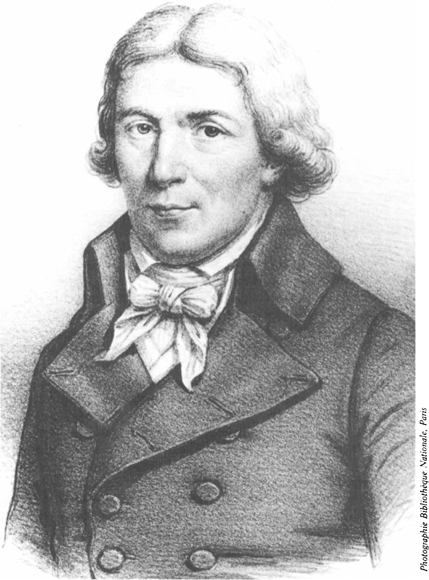
ABBÉ ROCH-AMBROISE SICARD
In 1789, about three years after the Bordeaux school had opened, the abbé de l’Epée died and the Commune of Paris, a precursor of the body that would so cruelly persecute Sicard three years later, appointed the abbé Masse as temporary director of the school; he had been with Epée for nearly a decade and was the master’s choice for successor.9 Sicard, however, published a memoir announcing his own candidacy for the position. In it he stated that there were only four suitable contenders in France to succeed Epée. He mentioned the abbé Masse, Abbé Antoine Salvan, who had worked with Epée and now directed a private school for the deaf in Auvergne, and, of course, himself, and proposed a public contest judged by distinguished scholars, in which each candidate would display his best student and explain his methods of instruction.* Sicard was staking everything on Massieu and on his own abilities as an orator.
The contest took place as Sicard had proposed, and he won the day, one might say by default.10 The abbé Masse refused to participate, contending that he was already the legal director, since Epée had chosen him as his successor; the abbé Salvan, whom I later came to know at the school, was a timid man and let it be known he would gladly accept the post of assistant director.11 Louis XVI confirmed Sicard’s appointment in April 1790.
When the abbé Sicard took over, he found his mentor’s school in desperate straits. A little over a decade earlier the king had taken the school under his protection and ordered funds to be provided, but his orders had not been executed, and in Epée’s declining years there had not been sufficient food or fuel for him and his pupils.12 Twenty deaf children had been returned to their families on his death, but forty-five remained and the abbé Masse had spent most of his time seeking funds to feed and shelter them. The Commune of Paris had backed his appeal with a petition to the National Assembly to sponsor the school: “The deaf-mutes who were the adopted children of the abbé de l’Epée,” they argued, “will thus be those of the Nation, and the Nation will do for them, for reasons of justice and social welfare, what the abbé de l’Epée had been inspired to do.”13The petition had had no immediate effect, however; the school remained short of funds even for the necessities of life.
Sicard responded characteristically to this predicament: a few months after his appointment, he appeared before the Committee on Mendicancy of the Assembly with four of his students, including Massieu.14 The committee was so impressed that it recommended he address the entire Assembly, and a week later Massieu presented a petition asking the Assembly to watch over the deaf and assure their welfare.15 The Assembly agreed to place the school under its protection and ordered its committee to prepare a report and decree. In the fall Sicard took up residence with his pupils in the largely uninhabitable buildings of the Celestine monastery, on the Right Bank, next to the armory,16 though it was not until the following year that the Assembly finally voted on the bill, declaring the school a national establishment, providing twenty-four scholarships and salaries for ten staff members, and placing the school officially in the Celestine monastery, along with the school for the blind.
These successful appearances with Massieu and other pupils, first in Bordeaux, then before the National Assembly in Paris, confirmed Sicard in a practice that would be the hallmark of his career: when he died, his successor at the French Academy asked rhetorically in his acceptance speech, “Who here has not witnessed the abbé Sicard’s naïve satisfaction as he unfolded his theories to the general public, taking delight in showing off his pupils to the gathered throng?”17 There were performances the third Monday of every month in the assembly hall of our school, once it had moved to Saint-Jacques,18 as well as special exhibitions: for the pope, as I described;19 for the archbishop of Paris a year later;20 for the duchess of Angoulěme; for Francis I, emperor of Austria; and, after I left Paris to come to Hartford, for the dukes of Gloucester and Angoulěme and the duchess of Berry.21 Moreover, Sicard took Massieu, me, and another pupil to London in 1815 for a dozen exhibitions, including one before Parliament, and thus it was through Sicard’s love of theater that I came to America, for it was in London that I first met Reverend Thomas Gallaudet—but that is another story.22
A typical demonstration at Saint-Jacques started at noon and ended at four. The semicircular benches of the assembly hall would be filled to overflowing with some three to four hundred spectators.23 The first rows were occupied by pupils of the school; just behind them were the elegantly dressed women and distinguished-looking gentlemen whose carriages attended in the adjacent courtyard; at the back sat the parents of the deaf pupils, often with the deaf or hearing brothers and sisters of my classmates. One of these demonstrations in particular comes to mind, the first time the abbé Sicard tested me before an audience; I must have been thirteen or fourteen.
The stage was bare except for a bust of the abbé de l’Epée. Since many came early to get good seats, the crowd awaited Sicard’s arrival for quite a while, some engaged in significant glances, others in animated conversation. Finally, the abbé entered and the teachers and répétiteurs rose in greeting. He made his way to the stage, where Massieu joined him.
“I have been waiting,” the abbé announced, “to introduce you to a new subject, almost an infant, a little savage, a block of unchiseled marble, or rather a statue, yet to be animated and endowed with intellect….” (Not long before Sicard began teaching the deaf, a leading philosopher, the abbé de Condillac, had published his Treatise on the Sensations, in which he imagined a statue that he brought to life progressively, endowing it with each of our senses in turn. Sicard thought the tale was partly realized before his very eyes: he portrayed deaf-mutes as living statues whose senses he would open one by one. We rarely judge our own behavior more severely than does the public, and thus Sicard was increasingly confirmed in this absurd opinion of the deaf by the steady flow of spectators and the double file of carriages on both sides of the courtyard, which attested to the high rank of his admirers.)
“This child has received no instruction,” Sicard continued. “I am as yet ignorant of his capacity, and his future prospects will be decided by the experiment I am about to conduct. I shall begin with one of my elementary lessons, and you will at once judge of my system and its effects.”
Massieu then suspended a key, a hat, and spectacles from three nails placed over the blackboard; he drew a sketch of each object just beneath it. A boy of about five was brought into the room; taken from the arms of his mother, he was carried onto the stage and up to the board. He gazed at the objects for some time with an air of utter indifference while three hundred faces regarded him expectantly. Sicard showed signs of distress. Just as the audience and instructor began to doubt the youth’s capacity and to despair of his salvation, the boy clapped a hand to his head and with a smile pointed to the hat drawn on the board.
“Enough,” cried the abbé. “This child may be snatched from the abyss of night, from the cheerless impermeable solitude in which thousands of his unhappy brothers are doomed to suffer.”
This experiment happily concluded and its subject carted off, the abbé signaled Massieu to demonstrate how the names of articles were first impressed on the mind and memory of the pupil—one of the introductory lessons to reading and writing. Massieu drew the letters of the word clef(key) on top of the sketch of the key but conforming to its outlines, so that the name had the shape of the object. These characters, thus united with the sketch, Sicard explained, were left for the pupil to study as an alternate sign of the thing they described; when the letters were firmly imprinted on memory, the line drawing was erased and the letters alone remained as the symbol or representation of the object. In the next stage, the letters were printed normally and the written word bore the full burden of signifying.
“I have shown you the foot of the ladder,” the abbé Sicard continued. “I will now take you to the top. I will thank any gentleman for a book or newspaper; we will exercise the talents of this young man, Massieu.” Someone in the audience furnished the day’s Gazette. The abbé signaled me to come onstage and sign the text of an advertisement.
“Clerc will dictate the passage to Massieu, who will show you that he is able not merely to comprehend the ideas, but to repeat the exact words appearing in the paper.”
I then communicated the passage in manual French while Massieu wrote it on the blackboard. He made only one error, writing arrondissement* for département. † I spotted the slip and signed NATION. He then wrote république. But before I could prompt further, he wrote département.
“I will now ask him,” the abbé explained while writing on the board, “to define two words. What is the difference between your word arrondissement and the word département?”
Massieu replied on the blackboard: “An arrondissement comprehends several communes, governed by a mayor; a département is a new province, part of the empire, under the dominion of a prefect.”
“You use the word ‘government,’” the abbé pursued. “What does it mean?”
“It is the power placed at the head of the community,” Massieu replied, “to maintain its existence by providing for its wants and defending it against harm.” Then, appearing dissatisfied, he added: “It is one man, or several, acting as the soul of the body politic and serving as the guide, the prompter,’ and the defender of the members.”
The audience was obviously pleased and impressed. “Ask him any question,” Sicard continued, “and I engage that his answer shall be prompt, clear, and correct.”
“Ask him what is music,” a gentleman in the audience called out.
Massieu shook his head when the question was put to him. He wrote on the board: “It is extremely difficult if not impossible for a deaf person to answer the question satisfactorily; our conceptions of music must be very imperfect. I can only say I conceive it to be an agreeable sensation excited by the voice or the sound of instruments.”
“Speaking of music,” said Sicard, “you no doubt recall the answer of the blind man Saunderson* when asked to what he could liken the color of scarlet; he replied, ‘To the sound of a trumpet.’ When I asked Massieu his conception of the sound of a trumpet, he answered: ‘I can explain my ideas of the sound of a trumpet only by comparing it to the florid and effulgent rays which irradiate and adorn the horizon after the setting of the sun.’ Each of you, ladies and gentlemen, entering this humble home of the poor deaf-mutes, must have come with sad reflections indeed on their present state and unhappy future. You must have had a thousand conjectures on the means employed to communicate with such singular pupils, who cannot hear and therefore know not how to speak. But although they may be deaf, they are not blind, and what we cannot cause to enter by the main door, to use the vivid metaphor of the abbé de l’Epée, we can send in through the window. If they do not have sound, voice, and spoken language, they have nonetheless light, facial expression, color, movement. They will therefore express their thoughts with gestures. The language of the deaf-mute will be the action of the oratorical art carried to the highest, essentially poetic and picturesque, painting what it sees, embellishing what it paints, a kind of exteriorized imagination and gesticulated etymology.”
“Now the model precedes the copy,” continued Sicard, who was fond of using analogies, “and thought is the model, speech the copy. Gesture is simply an adjective of speech. The first man was born with the ability to articulate sounds; he gave this gift to his child, who in turn gave it to his family, and language was born. But let it not be thought that there is some similarity between objects and the words that designate them; language is purely conventional. We can perhaps define thought as the attentiveness of the mind and divide this act, apparently so simple, into the initiation of thought, or reflection, and the use of thought, or judgment, just as we look in order to see and listen in order to hear. In the first moment of this rapid operation, the mind is purely passive, but it is active in the second. If we may hypothetically divide such an instantaneous point, these are two states of the same being: one is the doorkeeper of the other and alerts his master, or as Plato puts it more nobly, one is God, by virtue of thought, the other animal, by virtue of sensing, which recalls this beautiful definition of man, the mind served by the senses….”24
Here Sicard broke off his harangue to ask the assembly, especially the women, to excuse him for finding it necessary to go back to metaphysical principles in order to explain his art. The apology was hardly necessary, as few of the audience were paying attention to his discourse; they were looking at each other or, occasionally, at my classmates in the first rows, who were engaged, hands flying, in a host of discussions.
“Speech does not communicate thought,” the abbé went on. “Purely external, speech folds it in on itself, as it were, like an echo, so that it becomes strengthened. Thus the miserable being who is without hearing and voice, reduced to natural signs, living almost in isolation, does not enjoy this precious advantage—unless genius comes to his aid and helps him to perfect his signs, raising them to the dignity of written language, which alone can replace speech. Let us then put into action this difficult art of leading the deaf-mute from his natural signs to instructed ones, that is, from their primitive order to conventional form. We begin with a classification of all nomenclature. We proceed to notions of being and of objects, develop the origin of adjectives, of the verb to be, and of pronouns. Next comes the theory of the proposition….”
And so on and so on. If I were to try and reconstruct faithfully all the epistemological nonsense, all the incoherence, all the digressions, all the naïve effusions over his achievements that made the spectators smile—if I were to try and reproduce all that, it would test your patience and mine. And still I could not do justice to his high-blown style (in a Gascony accent, I am told). Suffice it to say that his name was enshrined forever in the French lexicon when it acquired the verb sicardiser, meaning to pontificate or discourse for hours. Some of the public thought, indeed, that Sicard was a charlatan and that the deaf could not be taught anything useful. But his age, his simplicity, candor, and basic goodwill, and above all the cause for which he labored will excuse him in the eyes of history as they did in the eyes of most of his contemporaries.25
The demonstration concluded with questions to Massieu from the audience, which Sicard translated.
—What is God?
—The necessary Being, the sun of eternity, the mechanist of nature, the eye of justice, the watchmaker of the universe, the soul of the universe.
(You understand that these questions were a kind of test of our intelligence, and if they particularly dwelt on abstractions, it was because hearing people were under the misapprehension that the deaf could deal only with concrete things.)
—What is the difference between desire and hope?
—Desire is a tree in leaf, hope is a tree in bloom, enjoyment is a tree with fruit.
The abbé then turned to me. “How do you answer, Clerc?”
I said: “Desire is a tendency of the heart; hope is a trust of the mind.”
Of Massieu he asked: “What is gratitude?”
“Gratitude,” Massieu signed, looking deeply into Sicard’s eyes, “is the memory of the heart.”
Perhaps I should have more gratitude; I certainly was grateful for the abbé Sicard at the time. But this long life has hardened me: I now see benevolent clergy in a harsher, less flattering light. There is no gainsaying that we, the deaf, paid a price for these spectacles enacted for the idle and curious public; that preposterous and cruel things were said about us to our faces; that the reason for our accomplishments was always the genius of some hearing person; that, in short, we were treated like the wise horse who at his master’s orders taps his foot on the public square as many times as the town clock shows hours. Massieu was wrong: bitterness can also dwell in the memory of the heart.
The coup de théâtre, as the French say, was always Sicard’s friend: it saved him from the cutthroats’ knives in the abbey of Saint-Germain; it incited Napoleon to release him from exile; it won him the post in Paris, the support of the government, and innumerable titles, domestic and foreign, which he amassed with the same childlike simplicity and satisfaction as Massieu collected watches. In 1795 he was appointed to the section on grammar in the French Institute when it was founded;26 it was reorganized a few years later and he was assigned to the section on literature, later known as the French Academy.27 (He helped lay the groundwork for the Academy’s famous dictionary of the French language, which is still in progress.)28 After the Reign of Terror, with Robespierre fallen, the Convention created the Ecole Normale, and staffed it with leading intellects of the time; Sicard was selected to teach in the department of grammar.29 He was a member of administrative boards30 overseeing the institution for the deaf,31 the institution for the blind,32 and all asylums in Paris collectively. The students and staff of the school for the blind came to Saint-Jacques annually to join in our celebration of Sicard’s saint’s day.33
The last such celebration I attended began in the early morning, when a group of us fired a cannon in the gardens to herald the day of Saint-Roch. At nine o’clock a parade of musicians arrived, boys and girls hand in hand, two by two—the blind children come to join the festivities. We rushed to meet them and guide them to the chapel. Some had learned to read fingerspelling in their hands and a few old friends became reacquainted. The girls in white linen with blue caps and belts, the boys in gray uniforms with high-collared jackets and blue cuffs, filed into the chapel in pairs and separated, girls to the benches on the right, boys to the left. The staffs of the schools and scores of visitors, including alumni, were present. The priest began the divine office, and from time to time the band went into motion. When the priest raised the host, a blind woman stood and sang an air.
From the chapel the cortège proceeded to the assembly hall, where the hero of the day received them, seated on the stage next to a curtain grasped by two pupils who, at the signal, tugged the veil, revealing a large bust of the abbé de l’Epée with the inscription: “Offered to the abbé Sicard by his children, the deaf.” Then the children filed past Sicard, the blind guided by the deaf, each wishing him long life in his own language, some proffering the communal gifts of flowers, paintings, vases, and the like. Sicard rose and invited the assembly to a family banquet. It was now three o’clock. As the audience filed out, the blind choir sang, “Where is life better than in the bosom of your family?” Dinner was gay and animated; after dessert Massieu toasted the health of the royal family and Valentin Haüy, teacher of the blind. A blind girl then offered a toast to Epée and Sicard.
At five o’clock, when the assembly had dispersed into the courtyard and gardens, a beautiful blue globe was seen to rise gently from the bushes, climb over the trees, and soar into the sky above the Montagne Sainte-Geneviève: the deaf had launched a balloon to celebrate Sicard’s day. With nightfall, the blind assembled in the court and marched away to a roll of drums, and then the deaf unleashed a dazzling fireworks: firecrackers and roman candles, those that exploded once and lit the night sky, and those that endlessly multiplied as they hurtled toward earth, tricolor, multicolor, blazing red, a crescendo of color at the end, and then we went to bed.
Sicard’s honors were not limited to membership in scholarly societies and charitable boards. He was also a member of the Grammatical Society,34 of the Academic Society of Sciences, and of the First Spanish Patriotic Society.35 When Napoleon was exiled to Elba in 1814, and the Bourbon monarchy was restored to the throne, Sicard received the Legion of Honor, which he had long coveted but which Napoleon had withheld,36 as well as the title of Honorary Canon of the Cathedral of Notre Dame, which the emperor had likewise refused to ratify.37 Louis XVIII awarded him the order of Saint-Michel.38 He received the order of Vasa,39 presented by the king of Sweden,* and when the allied Prussian, Austrian, and Russian forces invaded, expelling Napoleon, Sicard met the czar, who awarded him the Order of Saint Vladimir.40 If we smiled to see Massieu in class garbed in a riding outfit, pockets bulging with books and watches, we laughed at the roly-poly Sicard bedecked with all the medals and ribbons and sashes that came with his various honors.
The abbé Sicard’s naïveté about appearances—his theatricality, his love of titles—was a cause for mirth; his naïveté about power and money, however, were much graver matters: the former cost him years in exile, the latter robbed him of the peace of his old age. Perhaps it is unreasonable to expect a clergyman to sympathize with the anticlerical and antiroyalist Revolution, but many clergy, realizing the futility of resisting the tide, slipped below the surface, as it were, into less agitated waters; not Sicard, who thrashed about indiscreetly for years. As I have told, he refused to take the oath acknowledging the civil constitution of the clergy41 and undertook to edit the Religious Annals;42 he repeatedly had Massieu define God and His attributes at public exercises; and he himself discoursed on the immortality of the soul in public lectures. He struggled openly against the Revolutionary innovation of using the egalitarian tu form in addressing others and he managed to have it banished from the Ecole Normale. He kept up a brisk correspondence with the royal government in exile and he was naïve enough to believe that Napoleon was unaware of it.43Napoleon also knew of his correspondence with the duke of Enghien, whom he soon had shot for counterrevolutionary activity.*44 Thus, the emperor detested the director of our new school, never gave him an audience, withheld honors from him, and would never visit Saint-Jacques.45 You can imagine Sicard’s childish glee, which I witnessed, when the Allied Powers entered Paris and Napoleon was escorted to Elba. The invading princes were célestes, the king of Prussia excellent, the emperor of Austria très-bon. His strongest praise was reserved for the czar, however, whose name he could not utter without the adjective adorable.46 As soon as the French monarchy was restored in 1814, he went to see the new king to congratulate His Majesty on his happy return—and to secure the awards hitherto denied him. And, when Napoleon returned? When Napoleon quit Elba to return to France and seize power again in the spring of 1815,47 Sicard quit France to go to England, with Massieu and me. Bonaparte had his minister of the interior call us back from London, but by the time we reached Paris he had fought and lost at Waterloo and his new reign was over.
The remaining few years of Sicard’s life were his declining years.48 At just this time he found himself in serious financial difficulties for having cosigned bad debts. To pay his creditors, he was reduced to abject poverty. He sold his carriage and his furniture, and somehow let go the 30, 000 francs that Massieu had saved from his salary and deposited with him for safekeeping.49After a few years, he managed to pay off these debts, foolishly contracted, only to fall into new ones.50
Pure heroes exist in fiction but not in fact. No useful purpose will be served by idealizing this naïve, egotistical, and utterly devoted teacher of the deaf. It is ironic that the man who was to “restore the deaf to society,” as hearing people are fond of putting it, flapped about in that society like a beached fish, in and out of exile, in and out of prison, in and out of solvency. Ironic that our adoptive father, who was to sophisticate us children of nature, was as naïve as a child and imprinted that naïveté on his children, notably Massieu. Ironic that our grammarian overlooked the grammar of sign language, thinking its grammar would have to be supplied by French.51
A year before his death, when his behavior had become infantile, word spread that Sicard would soon resign; he published a denial in the newspaper: only death would remove him from his post.52 Death obliged on May 11, 1822. All the bells of the city tolled for hours and his body was on display in the cathedral of Notre Dame. How he would have loved to be there!53
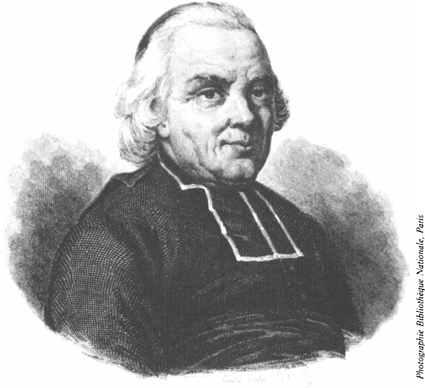
ABBÉ CHARLES-MICHEL DE L’EPÉE
*Sicard’s fourth contender, the abbé Deschamps, director of a school for the deaf in Orléans, was mortally ill.
*Municipal district.
†An administrative subdivision of France (there are at present one hundred).
*Nicholas Saunderson (1682-1739) was professor of mathematics at Cambridge University.
*Charles XIV (1763-1844), king of Sweden and Norway and French revolutionary general.
*The Bourbon-Condé duke of Enghien was executed March 20, 1804.