
THIRTEEN
Imperturbable among the sturdy trees that Austin had planted—magnolia and ginkgo and of course evergreen—the Evergreens was an eleven-room Victorian poem, ambitious and impersonal but whimsically indifferent, at least on the surface, to the staid Homestead next door. Painted in a serene buttery color, its trim finished in cranberry, its windows festooned with striped green awnings, and all this topped by a large square tower, the place was in its calm way quite self-assured, announcing itself these last twenty-five years as the home of Susan and Austin Dickinson.
Their elder son, Ned, had grown into a stylish man of twenty years, intense, romantic, and devoted to the distinguished Dickinson name. On Sundays one could glimpse him, cane in hand, his mouth severe and brooding, his head held high, as he walked to church and took his place in the Dickinson pew, proudly wearing his shiny beaver coat. At night, though, grand mal seizures tore through his dreams. Hearing him scream, Austin would sit up in bed and then leap over the footboard to run upstairs and lie atop the convulsing boy. Next morning Ned remembered nothing, and his family, with Dickinson reticence, told him as little as possible about why his tongue was sore where he had bitten it.
Yet Ned had to have known he would not walk in his father’s or his grandfather’s shoes. Partly because of his epilepsy, he took classes at Amherst College in 1880 as a special student who neither received grades nor matriculated. But measuring success with her iconoclastic stick, his aunt Emily could not have cared less. “‘Aunt Emily, speaking of someone who was a good scholar but not interesting,’” Ned carefully remembered her words, “‘ “She has the facts but not the phosphorescence of learning.” ’” He talked to her about Dickens and George Eliot and the news of politics and foreign affairs that she liked—he supplied her with illustrated reviews when her eyes were bothering her—and he entertained her with his satiric impersonations. He also reminded her of Austin, Ned’s sister later recalled, as if Austin “had gone back and become a young brother again.”
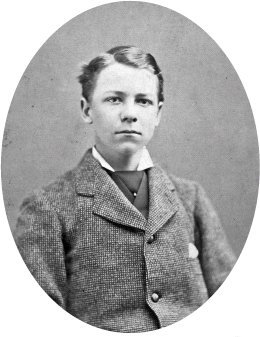
Edward (Ned) Dickinson, 20 years old, 1881.

Martha (Mattie) Dickinson.
Ned’s sister, Martha, or Mattie, as she was commonly called, turned fifteen in 1881. Like her brother, she was strong willed and feisty, and she, too, worshipped her eccentric aunt. If her brother and Aunt Lavinia, wrapped in warm woolen blankets, were sleigh riding on a cold afternoon, Mattie was just as happy to run over to the Homestead and Aunt Emily’s room, where little pots of hyacinth bulbs lined the four windowsills, waiting for spring. They talked about Mattie’s future, her beaux, books. It was a privilege almost as good as those gingery treats Aunt Emily slipped into her niece’s pockets when Mattie was a girl.
Ned and Mattie’s younger brother, a flaxen-haired boy named after Sue’s father, was born relatively late in the Dickinson marriage. Adored by his family and fussed over by the entire village, Gib, as he was known, pedaled about town on his iron velocipede with a huge, golden smile. “He gathered Hearts,” noted Emily, “not Flowers.” She petted and teased him. “Your Urchin is more antique in wiles than the Egyptian Sphinx,” Emily said in recounting one of his clever retorts to Gib’s mother: “‘Were’nt you chasing Pussy,’ said Vinnie to Gilbert? ‘No—she was chasing herself.’”
Gib also happened to be one of the few joys in his father’s pinched life. Having matured into a difficult man, Austin Dickinson never suffered fools, and to him most people were foolish. Frequently cold and acerbic, particularly in social situations, which bored him, he kept largely to himself, though he did like to be noticed. He raced his buggy down Main Street, and arriving at the Evergreens, swerved the vehicle hard onto one wheel before skidding to a stop in front of his carriage house. A yellow wide-brimmed planter’s hat atop his coppery hair, he spurned drab clothes, and while he often wore a light driving ulster in the carriage, at town meetings he reputedly donned lavender pants and a Prince Albert coat. His kid shoes had a strange, square cut, and he seldom smiled. He also loved art. He bought painting after painting, indistinguishable, stiff genre landscapes of the latter-day Hudson River school and notable English, French, and Dutch artists of high academic style. Foraging through picture galleries, his tired, hungry children in tow, he bid for pictures with a recklessness that pushed him way beyond his means. It was another form of fast driving.
A model citizen, respected and wealthy and in command of significant local projects, like the new building for the First Congregational Church, Austin hankered for the destiny he peevishly regarded as his due, for he believed himself underappreciated, just as his father and grandfather each had felt. But he wanted to ditch all of it, his patrimony, Amherst, those binding expectations, and yet he stayed near the college his grandfather had founded, took on his father’s practice, and lived in the house his father built, never free of its obligations. In this, he was unlike Emily, who, bending family expectations to her will, became more of who she was.
But like her, Austin disliked change in his immediate environment. He avoided confrontation. He hated going to court. And in time he blamed his wife for his aimless sense of failure, carping at her frills and furbelows and the empty life she and the children were leading. Ironically, his petulant eccentricities were themselves extravagant and expensive. He could not see the hypocrisy; instead he believed himself misunderstood. His one true solace was Gib.
Less conflicted in her attraction to rank and style, Sue gadded about town in the Dickinsons’ fine double carriage, snug in the comforting folds of her sealskin coat. Consorting with the elect, she snubbed the rest. At the sumptuous Evergreens, she entertained such eminent guests as Henry Ward Beecher, Wendell Phillips, the sculptor Daniel Chester French, and Frederick Law Olmsted, whom Austin consulted on town beautification. Ralph Waldo Emerson once sat in her armchair. It was like “meeting God face to face,” she later reminisced. (Emily evidently declined the privilege.)
Sue’s high-handedness earned her a reputation as “socially ambitious”—“perhaps a little too aggressive, a little too sharp in wit and repartee,” one Amherst chronicler observed. To a New England villager, this was a cardinal sin. “Sue saw no one as a child or a young woman,” sniped a rival; “she always longed for good society but was too obscure and too poor to have any. All this explains her wild craze for people and celebrities.” Regardless, her teas and musicales and receptions were locally famous, and invitations were greedily sought. One was invited for half past six, supper was usually served just after seven, and if the guests were few—only eight or so—they sat in the walnut-paneled dining room under a delicately carved ceiling. Sue scattered yellow flowers on the sideboard and in wintertime set fresh roses in vases throughout the parlor, where the party assembled if the number was large. Divided into groups of three and four, they pulled up to little tables while servants carried the oysters and coffee aloft on small trays.
Or she engineered bashes that lasted past eleven o’clock. These were remembered long afterward by friends as “rare hours, full of merriment, brilliant wit, and inexhaustible laughter, Emily with her dog, & lantern! Often at the piano playing weird and beautiful melodies, all from her own inspiration,” Catherine Anthon told Mattie. “Your dear Mother also—so witty and intellectual, & uncommon in every way—.” Amherst undergraduates similarly glowed over the memory of Mrs. Dickinson, “a really brilliant and highly cultivated woman of great taste and refinement.” And though she drew inward in later life, disappointed and aggrieved, in her eighties she was eager to learn about Einstein’s theories.
Emily Dickinson’s strong tie with Sue survived Sue’s marriage, the birth of Sue’s children, and Sue’s ascension on a social ladder that Emily herself disdained. If the salonnière sought the approval of the many and the eremitic poet preferred her privacy, so be it. Envious neighbors later speculated that, with little flourishes of Jamesian cruelty, Sue deeply hurt Emily, but as usual the evidence is scant, and it seems, rather, that Sue continued to appreciate her sister-in-law—she always had—for despite their physical proximity, Emily consistently showered her with notes and letters that, gathered together, tell of friendship, empathy, forgiveness, and sheer delight.
According to Sue’s daughter, both women were busy with household tasks and saw each other when they could, arranging private conferences in the back hall of the Homestead. Writing forged a lifelong connection between them. “The tie between us is very fine,” Dickinson said toward the end of her life, “but a Hair never dissolves.” And of all the extant poems Dickinson heaped on friends, she addressed more to Sue than to anyone else.
Dear Sue—
With the
Exception of
Shakespeare, you
have told me of
more knowledge
than any one living—
To say that sincerely
is strange praise—
What knowledge did Sue supply? Did it include the sexual? Dickinson’s early notes and letters to Sue, churning with unmistakable passion, ripened in later years but were not less affectionate, admiring, or pointed; Sue was, as Dickinson characterized her, the sister a hedge away:
One Sister have I in our house—
And one, a hedge away.
There’s only one recorded,
But both belong to me.
….….
I spilt the dew—
But took the morn;
I chose this single star
From out the wide night’s numbers—
Sue—forevermore!
Doubtless there were the frustrations, mishaps, miscommunications—pundits can be right—that exist in all families. “But Susan is a stranger yet—/ ,” Dickinson wrote Sue some time in the 1870s.
The ones who cite her most
Have never scaled her Haunted House
Nor compromised her Ghost—
To pity those who know her not
Is helped by the regret
That those who know her know her less
The nearer her they get—
THE HOMESTEAD, THE EVERGREENS, the dirt path in between; summers and winters and the yeasty-sweet fragrance of baking bread; Mrs. Dickinson’s helplessness and infirmity, Vinnie’s care and Emily’s kindnesses; the circus that came to town (“I feel the red in my mind”) and those flying, febrile visits from Judge Lord—externally, life in the gentle hamlet ran in a reliable groove, except, that is, for the occasional civic misfortune, like the fire that razed the wooden buildings downtown in a single night as if a hellion, raging after freedom, had broken the rules of village decorum.

David Todd and Mabel Loomis, engagement photograph, 1877.
“THE THINGS THAT NEVER can come back, are several—/ ,” Emily Dickinson sent her poem to Elizabeth Holland, recently widowed: “Childhood—some forms of Hope—the Dead—.”
She might have added the dependable surface of everyday routine.
It was in the fall of 1881 that a good-looking young couple from Washington, D.C., swooped down on bucolic Amherst. David Peck Todd was the new professor of astronomy, come to teach at the college and run the observatory, and with him was his adorable wife of two years, Mabel Loomis Todd, whose ample social skills were an undeniable asset. A good pianist always willing to perform in public, Mabel was also a trained soprano (she had studied at Boston’s New England Conservatory) and a budding artist who dabbled in watercolors and oils and exhibited her works with a burning urgency that bordered on the desperate. “I think everyone will exclaim over it,” large-eyed Mabel once confided to her diary on finishing a painted panel of poppies. “I do feel so much power & genius in myself, struggling for utterance in any way, of which these little pictures are hardly the loophole for it to peep out.”
This was a woman thirsty for attention. In Amherst she would find it.
That her father was a clerk at the United States Nautical Almanac Office in Washington did not stop her from claiming that he had rubbed shoulders with Alcott and Thoreau and Whitman or that her mother was descended from Priscilla Alden. But Mabel herself had not yet collected her literary giants; that would come. And even though her mother had preferred a more illustrious match for a daughter with such genius, in 1879 Mabel married David Peck Todd, whom she said she loved. Sober, smart, steady, and to Mabel sexy, he appreciated his new wife’s multiplying talents, and as Mabel also noted, was a direct descendant of Jonathan Edwards.
An assistant at the Nautical Almanac Office and Observatory in Washington, David Todd expected to rise toward his well-scrutinized stars, and with Amherst College offering what appeared to be a good opportunity—with the potential for an observatory in the offing—the couple placed their young daughter with Mabel’s parents and set out for Massachusetts. Meant for finer things, Mabel hated housekeeping and drudgery, and despite her considerable attraction for her lover-husband, as she called him—her journal brims with accounts of their lovemaking—she had been disconcerted by her pregnancy. “My little one will, I feel, be always secondary to my husband in my life,” she admitted with a touch of prescience.
Primed for adventure, the convivial twenty-five-year-old—born the same year Austin and Sue were married—leaped into the center of the town’s social life, the Evergreens, where she could play whist or perform Scarlatti, sing Schubert, and chat brightly with the crème de la crème. Having been “taken in” at once by the marvelous Dickinsons, Mabel was particularly smitten with the darkly beautiful Sue, gloriously arrayed in a scarlet shawl, who “stimulates me intellectually more than any other woman I ever knew,” Mabel rhapsodized. Sue was the hub around which all things orbited, and Mabel wanted to be everything Sue was, to have everything she had.
And Sue, appreciating Mabel in the ways that Mabel needed appreciation, placed her new friend at the center of the Dickinson picnics and lawn teas, their games on the grass and their noisy outings to Shutesbury or Sunderland Park during the dog days of summer. Or she invited Mabel to the Evergreens, and the grateful younger woman was soon passing part of every day there, either teaching Mattie to play the piano or merrily letting the love-besotted Ned, only five years her junior, waltz her about the dance floor.
Without much thought to the possible consequences, Mabel received Ned’s tokens of admiration with schoolgirlish pleasure: his bouquets of garden roses, his peremptory calls, his companionship on those languorous horseback rides through the countryside. She consented when he asked her to wear his father’s enameled fraternity pin; after all, she reasoned, more status was attached to the pin of one’s father than to one’s own. Sue, who considered Mrs. Todd an excellent escort for her untried, untutored son, suspected nothing, or so Mabel gathered. “She thinks it is such a fine thing for her young son to have a ‘brilliant & accomplished married lady for his friend,’ & likes to have him pay me attention.” But Mabel was fully aware that Ned, a serious chap declaring himself to be forever devoted, vowed he would never marry if he could not have Mabel, which he could not. “I could twist him around my little finger,” she gaily said; “he would go off and kill somebody if I bade him.”
When the disconsolate Ned died of a heart attack fifteen years later, he was in fact unmarried. And townsfolk gossiped that he never recovered from his infatuation with Mabel Todd, who, rapidly tiring of him, suddenly broke off what she called “their little affair” as soon as she could replace him. In pain and anger, Ned dashed to his mother to confess everything, which by that time included more than Mrs. Todd’s dalliance with him. The irrepressible Mrs. Todd had set her cap for Austin, and Austin had succumbed.
It had happened during those heated summer days when the regal Austin Dickinson, his bearing somber and aristocratic, his ice-blue eyes fixed on Mabel, stole away with her from the group picnicking at Sunderland Park. They leaned on the old rail fence, gazing out at the far-reaching view, aware of the smell of new-mown grass and each other close by. Ned suddenly seemed unfledged and virginal (Mabel’s word), and besides, as Mabel confidently declared in her diary, “dear” Mr. Austin Dickinson “is so very fond of me.” She was right, and on an indolent September evening they fell into each other’s arms—or crossed the Rubicon, as Austin martially called their declaration of love. (Consummation came later.) Mabel blazed with self-congratulatory pleasure: “to think that out of all the splendid & noble women he has known, he would pick me out—only half his age—as the mostly truly congenial friend he ever had!” Soon the couple were stealing away, wildly exhilarated (yet another of Mabel’s phrases) by those dreamy walks back to the Todds’ boardinghouse or out on the river road above South Deerfield in the Dickinson carriage.
When apart, they resorted to pen and paper. “It nearly broke my heart to go through the day yesterday with only that passing sight of you,” Austin wrote Mabel on one occasion; on another: “I love you, I admire you, I idolize you. I am exalted by your love for me.” On still another: “The sun cannot shine without you, the birds can make no melody. The flowers have no other beauty nor perfume—all is a meaningless waste. I love you darling, with my love, & my love is timeless & sleepless—cannot be divided—insatiable.”
As for Mabel, over and over she claimed she trusted Austin as she trusted God. “The way in which you love me is a consecration—it is the holy of holies,” she cried, elevating their longing for each other far above the commonplace or customary. No longer would she be fickle or flirtatious; no longer would she need to be: “The greatest proof I have ever had that I am different from ninety-nine others, & that my girlish hope—that I had something rare in me—was well-founded, lies in the great, the tremendous fact that I own the entire love of the rarest man who ever lived.” Professing her feelings without guilt, she seemed without the slightest concern that her infatuation might interfere with or otherwise compromise her relationship with her husband, to whom she remained naively staunch. Sue would soon accuse her of taking the best of two men.
That same torrid fall, 1882, David Todd had left Amherst for three months on an astronomical expedition to the Lick Observatory in California, and though Mabel was initially to accompany him, at the last moment David went alone. He should never have gone so far for so long, he reputedly admitted years later. Mabel had missed him for a while. “Ned has been very devoted—more so than ever,” she wrote in her journal. “But my only real joy in staying is because Mr. Dickinson is here, & looks out for me & has me on his mind.” By the time David returned, Austin Dickinson, though not yet Mabel’s physical lover, was portraying himself to the impressionable Mabel as the victim of a loveless misbegotten marriage with a woman who frequently refused him sexual intercourse and who so profoundly dreaded childbearing that she had aborted four pregnancies before Ned was born; and having tried to abort Ned, too, he morosely continued, she had caused the boy’s epilepsy. Austin could by his own lights then reasonably ask, “Where is the wrong in preferring sunshine to shadow! Does not the unconscious plant lean toward light?”
It would take another year of intense verbal foreplay before Mabel and Austin consummated their affair, and when they did, they chose the dining room, windows shut, blinds closed, of the ancestral Homestead.
WHAT DID EMILY KNOW? “Emily always respected real emotion,” Mabel Todd’s daughter recalled, adding that Emily was glad that her brother found some comfort in his abject life. But that’s a self-serving answer. Vinnie, on the other hand, knew a great deal. Captivated by Mrs. Todd and perpetually distrustful of Sue, Vinnie had been enlisted early in the clandestine romance. Mabel folded her love letters to Austin in envelopes addressed to Vinnie, which Austin surreptitiously picked up at the post office when fetching his sister’s mail. After reading them and destroying the originals, he tucked copies of the letters into a large envelope that he handed to Vinnie. “If anything happens to me,” he instructed her, “Burn this package at once—without opening.”
Emily kept her distance, much to Mabel’s frustration. During her first months in Amherst, Mabel had heard delicious stories about Austin’s batty sister, the one called the Myth by locals. “She has not been outside of her own house in fifteen years, except once to see a new church, when she crept out at night, & viewed it by moonlight,” Mabel breathlessly informed her parents. “She dresses wholly in white, & her mind is said to be perfectly wonderful. She writes finely, but no one ever sees her…. Isn’t that like a book? So interesting.” Sue read Mabel some of Emily’s strange, powerful poems. “All the literary men are after her to have her writings published,” Mabel bragged with a touch of envy.
But Sue had warned Mabel about the Dickinson sisters. “‘You will not allow your husband to go there, I hope!’” Sue reportedly counseled. “‘Because they have not, either of them, any idea of morality…. I went in there one day, and in the drawing room I found Emily reclining in the arms of a man. What can you say to that?’”
Sue’s cautionary tale probably had less to do with Emily and Judge Lord, the apparent target of Sue’s disapprobation, than with her unformed suspicions about the ubiquitous Mabel, but in any event Mabel did not enter the sacred precincts of the Homestead until the fall of 1882. Before Austin would cross another Rubicon, Mabel would have to cross this one.
Vinnie finally invited Mabel to the Homestead, where Mabel enthusiastically played the old Dickinson piano and sang in her warbly soprano for the strange creatures who listened from afar. The enfeebled Mrs. Dickinson heard the music from her room; Emily was of course invisible. “It was odd to think, as my voice rang out through the big silent house that Miss Emily in her weird white dress was outside in the shadow hearing every word, & the mother, bed-ridden for years was listening up stairs,” Mabel puzzled in her journal. “When I stopped Emily sent me in a glass of rich sherry & a poem written as I sang. I know I shall see her,” Mabel concluded with the blinkered brightness of youth.
Shortly after her musical introduction at the Homestead, Mabel painted Emily a picture of the flower commonly known as the Indian pipe, or ghost plant. A sturdy growth that, lacking chlorophyll, never turns green, the all-white Indian pipe was an inspired choice and doubtless a tribute to the legendary sister of her soon-to-be lover. Emily was touched. In thanks she slipped a copy of her “Humming Bird” poem (“A Route of Evanescence”) into the folds of her thank-you note. “That without suspecting it you should send me the preferred flower of life, seems almost supernatural,” she told a rapturous Mabel. “I have just had a most lovely note from my—I may call her—dear friend Miss Emily Dickinson,” Mabel wrote in her journal, flushed with what she considered unmitigated success. “It fairly thrilled me—,” she added, “which shows that my susceptibility to magnetic friendships is not entirely confined to men,—as I have occasionally thought of myself.”
Mabel Todd would never lay eyes on Emily Dickinson, not even at Mrs. Dickinson’s funeral a month later.

EMILY NORCROSS DICKINSON’S DEATH, at seventy-eight, was a shock to her two daughters even though, since her stroke, they had long expected it. No one was more surprised at her own grief than Emily. She had lost a compass she had not known she needed. And their years together had changed their relationship. She no longer resented or mocked her mother, as she had when she first contacted Higginson. “The great mission of pain had been ratified—cultivated to tenderness by persistent sorrow, so that a larger mother died than had she died before,” she explained to her Norcross cousins. But she herself had become a larger daughter. To Elizabeth Holland she elaborated: “We were never intimate Mother and Children while she was our Mother—but Mines in the same Ground meet by tunneling and when she became our Child, the Affection came—.”
The day of the funeral, November 16, 1882, Mabel Todd sat quietly with the mourners. Vinnie had placed a small bouquet of violets in her mother’s hand, but Emily, as was to be expected, did not leave her room. A cousin recalled that when she said good-bye, Emily opened the door a crack and, pale and worn, thanked her for coming so far.
Afterward the Homestead was strangely empty for the first time. Besides the two servants they continued to employ, it was just Vinnie and Emily—and, queerly, Austin. “My Brother is with us so often each Day, we almost forget that he ever passed to a wedded Home,” Dickinson noted, doubtless with a raised eyebrow.
“BLOW HAS FOLLOWED BLOW, till the wondering terror of the Mind clutches what is left, helpless of an accent.” It had been a season of loss. Ralph Waldo Emerson’s death the previous April had marked the end of an era. Colonel Higginson was one of the hundreds of mourners who boarded a special funeral train bound for Concord, where throngs of fans walked up and down the streets before crowding into the church to hear the service that Higginson dismissed as lacking the “coals of fire” only Emerson could supply.
Though Emily was saddened by Emerson’s death, the passing of her friend Charles Wadsworth cut more closely. She and the Reverend Wadsworth had stayed in touch—“a intimacy of many years,” she called it—and having returned to Philadelphia from the Pacific coast, he had visited her just two years before. “He rang one summer evening to my glad surprise—,” she told a friend of his. “‘Why did you not tell me you were coming, so I could have it to hope for,’ I said—‘Because I did not know it myself. I stepped from my Pulpit to the Train,’ was his quiet reply. He once remarked in talking ‘I am liable at any time to die,’” she added, “but I thought it no omen.”

Gilbert (Gib) Dickinson .
For comfort this time there was Otis Lord, not Wentworth Higginson. “Your Sorrow was in Winter—,” she wrote the Judge, referring to his wife’s death, “one of our’s in June and the other, November, and my Clergyman passed from earth in spring, but sorrow brings it’s own chill. Seasons do not warm it.”
Nor would sorrow cease, even during the warm months that Austin and his sisters loved. August was Austin’s favorite, when he could listen to the crickets—subject of Emily’s poem “Further in Summer than the Birds”—and the month when Gib was born. And Gib, who warmed all seasons, turned eight that summer of 1883. His little friends celebrated with cocked hats and banging drums, and when they marched over to the Homestead and around Emily’s garden, she stood by and smiled.
Just a month later, in late September, he was taken ill after playing with a friend in a nearby mudhole. It was typhoid fever. He died the afternoon of October 5.
The night before had been terrible. Emily had noiselessly gone over to the Evergreens—certain neighbors gossiped that she had not been inside the place for fifteen years—and, according to Vinnie, received a nervous shock when she saw Gib’s flaming cheeks. It was the odor from the disinfectants, neighbors speculated, that caused her to blanch and faint. It may have been the boy’s heart-piercing delirium. “‘Open the Door, open the Door, they are waiting for me,’” Emily recorded the boy’s deathbed words.
“Emily was devoted to Gilbert,” Vinnie sighed.
During the funeral, Emily lay in bed. Sue, too, missed the service—she could not bear to go—and for months saw no one. When she finally emerged from the Evergreens, she was wrapped in the black crepe of bereavement she wore forever after. Bereft and abandoned by her husband, she was never the same, and neither was Emily, who would herself die just three years later.
But she reached out to Sue, offering comfort where there was none. “I see him in the Star, and meet his sweet velocity in everything that flies—,” she told the sister beyond the hedge. “His Life was like the Bugle, which winds itself always, his Elegy an echo—his Requiem ecstasy.” Whatever she knew about her brother, whatever she felt about Mabel, she would not fail Sue.
And Austin? “Gilbert was his idol and the only thing in his house which truly loved him, or in which he took any pleasure,” Mabel lamented.
Within two months of Gib’s death, she and Austin were lovers at last. “I kept him alive through the dreadful period of Gilbert’s sickness and death,” Mabel justified herself. “He could not bear the atmosphere of his own house, & used to go to his sisters’, & then he or Lavinia would send for me—& it was on those oases from the prevailing gloom in life that he caught his breath & gathered strength to go on.”
They met as often as possible: Austin bundled Mabel into his carriage for long rides through the tall pines, or they rendezvoused mornings or afternoons, or both, at the Homestead. In the evening, Austin would stop by the Todds’, especially when David worked late at the college. Austin kept up appearances at the Evergreens, and for many years Mabel continued to have a physical relationship with her husband, who remains a cipher. When Mabel confessed everything to him, he seems not to have offered any objections. Perhaps he feared losing her, or maybe he feared Austin, a powerhouse in this small town and the éminence grise of the college who raised David’s salary when or if he saw fit. Years later his daughter herself wondered how “he, the youthful serious young scientist—how could he have accepted the situation—an old aristocrat twice his age, who looked down upon him as a plebeian, and preempted his wife as by the divine right of his august preference?” But likely David had affairs of his own. “I do not think David is what might be called a monogamous animal,” Mabel would later confide to her journal. “While I know that he loves me to the full of his nature, he is not at all incapable of falling immensely in love with somebody else, & having a very piquant time of it.”
And David was himself half in love with the hapless, arrogant Austin. Austin told Mabel that he and David confided in each other “beyond anything I have known among men.” After the two men built a Queen Anne–style cottage for the Todds in the Dickinson meadow, Mabel and Austin seem to have occasionally made love with a “witness”—David?—in the room. By the turn of the century, David Peck Todd was said to be acting strangely; in 1917 he retired from Amherst College, and in 1922, declared insane, he was permanently institutionalized. Adultery, he told his daughter in 1933, had ruined his life.
Not surprisingly, Mabel’s outraged parents were far less forgiving when they learned of Mabel’s affair. More baffling is the fact that Mabel’s reputation was unblemished for a fairly long time. She figured the reason was that Austin could consort with whatever ladies he liked because the town considered him beyond reproach. Besides, as she convinced herself somewhat contradictorily, “every one knows that he has been wretchedly disappointed in his domestic life, and all universally pity & respect him.” (Mabel thought nothing, years later, of circulating rumors about Sue: that her father’s alcoholism had killed him, for instance, and that a dalliance with Samuel Bowles had destroyed the Dickinson marriage.) As for herself, she refused to submit to base convention, with its primitive view of divorce—and, anyway, “the law of God is to me far higher than calf skin & parchment,” she declared, improvising on the transcendentalism of an earlier day.
Many awestruck undergraduates jostled one another to sign Mabel’s dance card at their various balls, and years later the story of her amorous adventure charmed the scholarly raconteur of Victorian sexual culture Peter Gay, who discovered that the thoroughly modern Mabel meticulously documented the frequency of her sexual intercourse and her orgasms with a set of symbols in her diary far easier to interpret than many of Emily Dickinson’s poems.
Mabel and Austin’s romance lasted for the remaining twelve years of Austin’s life. The couple tried to stay impervious to Sue and Mabel’s disapproving families and the cloaked gaze of their Amherst neighbors. This was easier for Austin than Mabel. “Our life together is as white and unspotted as the fresh driven snow,” Austin would reassure her. “This we know—whatever vulgar minded people, who see nothing beyond the body—may think—or suspect…. We were born for each other—and we will stay with each other.”
But the inhabitants of the Evergreens felt, as Ned later said, that they’d been sliced with a sword. And yet after his father’s death, Ned snuck Mabel into the Evergreens so she could view Austin’s body one last time. The family sat in the dining room while Mabel leaned over Austin’s casket and kissed his cheek. “The whole town weeps for him,” she grieved. “Yet I am the only mourner.”