
FIFTEEN
Death claimed her far too early, he later recalled, but she would persist.
Though himself frequently ill, Higginson kept up their correspondence as best he could. Still, there were long lapses between his letters to Emily. And hers to him, though when she could, she wrapped small gifts for his daughter—a Valentine, a poem, a book, a turquoise brooch in a square wooden box with roses painted on the lid—that have disappeared from public view. But since her nephew Gib’s death, in 1883, an unexplained illness had stalked her, and in the summer of 1884 she took a turn for the worse. She blacked out, fell, and when she woke, a physician was glooming over her. “The doctor calls it ‘revenge of the nerves,’” she quipped, “but who but Death had wronged them?” For several days she seemed delirious, or at least not quite rational. More herself by the following February, she sent John Cross’s George Eliot’s Life to Higginson, now piquantly observing that “Biography first convinces us of the fleeing of the Biographied—.”
She had begun to flee.
And she added to her letter the four lines of poetry originally written for Sue after the death of Gilbert:
Pass to thy Rendezvous of Light,
Pangless except for us—
Who slowly ford the Mystery
Which thou hast leaped across!
Not yet would she say good-bye, but this was a prelude.
“I WORK TO DRIVE the awe away, yet awe impels the work,” Dickinson had written her cousins the previous spring. Otis Lord had died in March; it was a severe blow, and it may be that she never quite recovered. “How can the sun shine, Vinnie?” Emily reportedly asked on hearing the news. “I have not been strong for the last year,” she then told a friend. “The Dyings have been too deep for me, and before I could raise my Heart from one, another has come.”
“The Crisis of the sorrow of so many years is all that tires me,” she explained to Elizabeth Holland, referring to the passing of her father, her mother, Charles Wadsworth, her darling nephew. “All this and more, though is there more? More than Love and Death? Then tell me it’s name!”
Working to drive the awe away, awe impelling the work: the remark echoes the one she had made to Higginson back in 1862, that “I sing, as the Boy does by the Burying Ground—because I am afraid.” Writing calmed anxiety and answered questions by posing them, particularly about love and death and what she had told Higginson was “the Flood subject,” or immortality. And immortality implied not just everlasting life in religious terms but poetry, “Exterior—to Time—.”
Awe impels the work. “Circumference, thou bride / of awe,—possessing, thou / Shalt be possessed by / Every hallowed Knight / That dares to covet thee”: these perplexing, evocative lines she sent Daniel Chester French, the architect and Amherst native, on the unveiling of his statute of John Harvard in Cambridge. “Success is dust, but an aim forever touched with dew,” she added, as if to remind him that the moment shall pass, fresh as it seems. And frequently she returned to those twinned subjects, poetry and immortality, in these last years. “My Business is Circumference,” she had informed Higginson so many years before, and that was still true. Circumference, the reaching of limits and beyond them, was its own form of immortality, which relieved both the joy and pain of living. For when undergoing some sort of crisis just before and during the war, as we recall, she had written an astonishing number of poems, many of her greatest, but afterward the quantity declined to as few as ten in a year. And before her last illness she had been writing again at a steady rate, twenty poems annually and, by the editor Ralph Franklin’s count, as many as forty-two in 1884, the year Lord died.
She had not been sending Higginson as many poems as previously: the year of Mary’s death she sent eight but only two in 1878, the year after, and one in 1879, when Higginson remarried. But she mailed six in 1880, two in 1881, and four in 1882. (These last include “How happy is the little Stone,” “Come show thy Durham Breast to her who loves thee best,” “Obtaining but our own extent,” and possibly “The Moon upon her fluent route.”) The next year, 1883, she sent “No Brigadier throughout the Year.”
No Brigadier throughout the Year
So civic as the Jay—
A Neighbor and a Warrior too
With shrill felicity
Pursuing Winds that censure us
A February Day,
The Brother of the Universe
Was never blown away—
The Snow and he are intimate—
I’ve often seen them play
When Heaven looked upon us all
With such severity
I felt apology were due
To an insulted sky
Whose pompous frown was Nutriment
To their temerity—
The Pillow of this daring Head
Is pungent Evergreens—
His Larder—terse and Militant—
Unknown—refreshing things—
His Character—a Tonic—
His Future—a Dispute—
Unfair an Immortality
That leaves this Neighbor out—
Though the subject of this poem is the blue jay—she had attached a clipping about birds to her manuscript—it is tempting to read it, once offered to Higginson, as a lighthearted homage to him, a brigadier in his own right as civic as the jay; a neighbor, a warrior, a “Brother of the Universe” intimate with “Snow” (Higginson’s essay) and with nature (“pungent Evergreens”), his character a tonic deserving, without doubt, of a certain immortality. He admired the poem enormously, but when he included it in Poems, Second Series, he placed it under the rubric of “Nature,” not “Life.” He was a shy, self-effacing man.
Had she changed her mind about publishing in these later years? Chiding Dickinson for her intractability, Helen Hunt Jackson flatly stated that “it is a cruel wrong to your ‘day & generation’” not to publish and asked to serve as Dickinson’s literary executor should Jackson outlive her. “Surely, after you are what is called ‘dead,’” Jackson pushed, “you will be willing that the poor ghosts you have left behind, should be cheered and pleased by your verses, will you not?”
Jackson had recommended Dickinson’s work to Thomas Niles, the editor at Roberts Brothers who had published the No Name Series. “The kind but incredible opinion of ‘H. H.’ and yourself, I would like to deserve—,” Dickinson wrote Niles in response to his inquiry, mailing him “How happy is the little Stone,” which she’d recently given Higginson: “How happy is the little Stone / ,” it begins in mock innocence, “That rambles in the Road alone, / And does’nt care about Careers / And Exigencies never fears—.”
A year passed. In the spring of 1883, as if to reopen the discussion, she mailed Niles “Further in Summer than the Birds” and “It sifts from leaden sieves,” poems Higginson had received in 1866 and 1871; perhaps his enthusiasm had encouraged her to try them out on Niles. She also sent him one of her favorite books, a volume of poems by the Brontë sisters: she was as serious as they.
Niles was nonplussed. “I would not for the world rob you of this very rare book,” he burbled. “If I may presume to say so, I will instead take a M.S. collection of your poems, that is,” he diffidently added, “if you want to give them to the world through the medium of a publisher.” Apparently she did not, although it’s not quite clear what she did want, for she kept mailing poems, sending “No Brigadier throughout the Year,” and when he said that “the Bird seemed true,” dispatching three more: “a Thunderstorm—a Humming Bird, and a Country Burial,” she called them, as if poems with titles—she did not ordinarily use them—might be more suitable for a benighted public.
Higginson had also read these—“The Wind begun to rock the Grass,” “A Route of Evanescence,” and “Ample make this Bed,”—and it seems he had praised them. No doubt she hoped Niles would too. “Ample make this Bed—/ Make this Bed with Awe—/ In it wait till Judgment break / Excellent and Fair,” she wrote. When mailed to Niles, the poem can be read as a covert bid for his good opinion. Yet it’s impossible to know if she would have consented, after all, to a book had Niles been keener. When he subsequently thanked her for the “specimens,” he noncommittally asked if he might hang on to them; possibly his polite apathy confirmed Dickinson’s dim view of publishers: insensitive and meretricious.
Higginson was different. For though she masqueraded as his student, both of them had acceded to the ruse, he admitting after her death that he knew he could teach her nothing. At the same time it does not seem as though she mentioned Niles to him. She kept her secrets well.
Writing Wentworth during that same spring of 1883—and calling herself his “Pupil” out of well-worn, reassuring habit—Emily revived their dwindling correspondence. “Emblem is immeasurable—,” she told him, “that is why it is better than Fulfillment, which can be drained.” Her prose more nimble than his, her poetry more audacious and trenchant, she continued to flatter and upstage him, dipping into his work and rewriting it for her own use, for as she noted, he said great things inadvertently. Listen to his long-winded comment on the line “And yet I live!” in Petrarch’s Sonnet 251, which he compares with Shakespeare: “What immeasurable distances of time and thought are implied in the self-recovery of those words. Shakespeare might have taken from them his ‘Since Cleopatra died,’—the only passage in literature which has in it the same wide spaces of emotion.” As was her habit, Emily briskly rephrased Higginson. “Antony’s remark to a friend, ‘since Cleopatra died’ is said to be the saddest ever lain in Language—,” she wrote to Otis Lord. “That engulfing ‘Since’—.”
In the spring of 1884, after Otis Lord had suffered his lethal stroke, she wrote to her cousins, “I hardly dare to know that I have lost another friend. Till the first friend dies, we think ecstasy impersonal, but then discover that he was the cup from which we drank it, itself as yet unknown.” Yet in spite of her own illness and the wearing horror of so many deaths, there was something indomitable about Emily Dickinson, who could still with scrupulous care watch the bobolinks in the meadow and reiterate that blossoms and books were the solace of sorrow. They were. “‘Supernatural,’ was only the Natural, disclosed—,” she had said to Higginson in one of her first, tantalizing letters:
Not “Revelation”—’tis—that waits,
But our unfurnished eyes—
Her robust passion for nature unimpaired almost twenty years later, she committed herself to joy in the very act of living, even if that commitment required necessary delusions that, as she and Higginson would both suggest, keep human behavior ethical. They had not abdicated belief; they redefined it. As Dickinson wrote in a late poem,
Those—dying then,
Knew where they went—
They went to God’s Right Hand—
That Hand is amputated now
And God cannot be found—
The abdication of Belief
Makes the Behavior small—
Better an ignis fatuus
Than no illume at all—
“FAITH IS DOUBT,” Emily told Sue. Perhaps in a bleak moment or when he wrote to her in the letters that do not survive, Wentworth had agreed with her. Mostly he did not. “What channel needs our faith except the eyes?” he had asked in an early poem, and in 1891 he said that “next to the yearnings of human affections, the most irresistible suggestion of immortality comes from looking up at the unattainable mystery of the stars.” Emily was more specific, more poignant. “I hear robins a great way off,” she lyrically wrote to her cousins, “and wagons a great way off, and rivers a great way off, and all appear to be hurrying somewhere undisclosed to me. Remoteness is the founder of sweetness; could we see all we hope, or hear the whole we fear told tranquil, like another tale, there would be madness near. Each of us gives or takes heaven in corporeal person, for each of us has the skill of life.”
And some, she might have added, possess the skill of poetry. She did include this ebullient poem about singing:
The most triumphant bird
I ever knew or met,
Embarked opon a twig today,
And till Dominion set,
I perish to behold
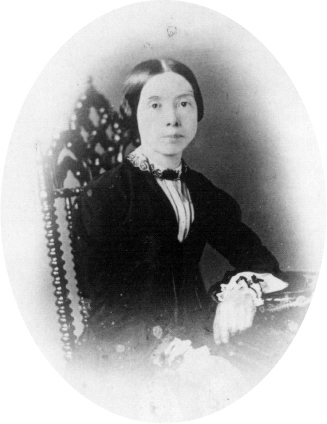
Emily Dickinson, in photograph marked “Emily Dickinson, died Dec. 1886,” from daguerreotype taken ca. 1853 and discovered by Professor Philip Gura.
So competent a sight,
And sang for nothing scrutable,
But impudent delight—
Retired, and resumed his transitive estate,
To what delicious accident
does finest glory fit!
One sings for nothing scrutable. Remoteness is the founder of sweet song.
THE UNBELIEVABLE RUMOR of Helen Hunt Jackson’s fatal illness prompted Emily to write Wentworth immediately. “Please say it is not so,” she begged him in the summer of 1885, afraid of what he might answer. The news was bad. Jackson died on August 12. Higginson published a memorial sonnet in The Century, which he sent in manuscript to Dickinson, who replied with her own farewell:
Not knowing when Herself may come
I open every Door,
Or has she Feathers, like a Bird,
or Billows, like a Shore—
Shortly afterward she contacted Wentworth again, enclosing an elegiac poem that quietly lauds him.
Of Glory not a Beam is left
But her Eternal House—
The Asterisk is for the Dead,
The Living, for the Stars—
For years he had been her living friend. And she thanked him.
EMILY RELAPSED IN THE FALL of 1885. Canceling a Boston trip, Austin sat at his sister’s bedside. By December she seemed to improve for a time but soon sank lower. She was breathing with difficulty. There were convulsions. Otis Bigelow, her physician, prescribed olive oil and chloroform. On Thursday, May 13, he stayed by her side all day, but as Austin scribbled in his diary, “Emily seemed to go off into a stark unconscious state toward ten—and at this writing 6 PM has not come out of it.” She never regained consciousness.
Bigelow diagnosed Bright’s disease, a kidney disorder, but it was not necessarily the cause of her death, for the symptoms that began shortly after Gib’s death—those terrible headaches, the vomiting—and the ensuing stretches of good health may be consistent with severe primary hypertension, leading to cardiac failure or stroke. Or with cancer. In 1886 there were no medical interventions that might have saved her.
“IT WAS SETTLED BEFORE MORNING BROKE that Emily would not wake again this side,” Austin noted on Saturday, May 15. “The day was awful. She ceased to breathe that terrible breathing just before the whistles sounded for six…. I was near by.”
“AUDACITY OF BLISS, said Jacob to the Angel ‘I will not let thee go except I bless thee’—Pugilist and Poet, Jacob was correct—,” Dickinson reconceived Genesis at the very end of her life, posting a final note to Wentworth Higginson, some of the last lines she was ever to write, tribute to a subtle friendship.
And though Higginson may have been the angel who saved her life, as she had often reminded him, when she retold the story of Jacob and the angel, it was she, both poet and pugilist—and a monarch of dreams—who would, could, will bless him, and who never let go these many, many years.