
NINE
A man of any feeling must feed his imagination;
there must be a woman of whom he can dream.
Thomas Wentworth Higginson, Malbone
Tuesday, August 16. The heat wave over, fresh rural breezes rustled the treetops when shortly after two o’clock Colonel Higginson sauntered over to Main Street from the Amherst Inn. He had never been to Amherst before. It struck him as a small, sweet, typical New England town framed by those lovely, lilting Pelham Hills—and deadly dull on a summer’s afternoon.
Slender, long legged, and in the bloom of middle age at forty-six, his hair black and without a glint of silver, Higginson, with his ramrod posture and positive step, kept his lapses of confidence to himself—that “inward darkness,” as he once called it. His public persona demanded the mask, and besides it wasn’t entirely false: he was a preternaturally hopeful man, tediously good-natured, polite, fastidious, gallant, and benign.
He had been hoping to make this visit for a while. Eight years had passed since he first opened Dickinson’s small envelope with its fantastic enclosures, but the war had intervened, and right afterward he had been busy rounding up contributors for the Harvard Memorial Biographies. He had written thirteen of the entries himself. And there were the speaking engagements he did not turn down and those essays he wrote almost compulsively, as if addicted to the immediate gratification of seeing his name in print. He wrote swiftly, easily; he would have liked to dig deeper into his imagination, but there was never time.
He also translated Petrarch’s sonnets and the discourses of Epictetus, the Stoic moralist born a slave, whose opening sentence in the Encheiridion reads, as Higginson put it, “There are things which are within our power, and there are things which are beyond our power.” We must let go the things beyond our power. But this seems to protect the status quo, Henry James pointed out in his review of the translation, though James also admitted that Epictetus was “a man among men, an untiring observer, and a good deal of a satirist”—rather like Higginson, as a matter of fact. “When you do anything from a clear judgment that it ought to be done, never shrink from being seen to do it, even though the world should misunderstand it,” Higginson had translated from book 35 of the Encheiridion. “For if you are not acting rightly, shun the action itself; if you are, why fear those who wrongly censure you?”
While Higginson’s Epictetus defined integrity for him, his translation of Petrarch’s sonnets revealed passions of a different stripe. “I seem to find her now, and now perceive / How far away she is; now rise, now fall.” To him, Laura was the incarnation of art and beauty, though these postwar days, he complained dolefully, “nobody comprehends Petrarch. Philosophers and sensualists all refuse to believe that his dream of Laura went on, even when he had a mistress and a child. Why not? Every one must have something to which his dreams can cling, amid the degradations of actual life, and this tie is more real than the degradation; and if he holds to the tie, it will one day save.” He dwelled in possibility.
Emily Dickinson may or may not have been Higginson’s Laura, but at home there was poor unhappy Mary, whose suffering he could hardly bear. Virtually paralyzed, her fingers so stiff she turned the pages of a book with a wand, she sat in her chair day after day, forgivably querulous and upset. His home had become a hospital, he confided to his diary, and Mary, crying for the pain he was powerless to relieve, begged him over and over not to leave her, and yet she chided him so mercilessly and so often his friends marveled he did not ship her off to a real hospital. “On the whole I think him an astonishing success under difficulties!—,” observed one. “What would become of you, for instance, or me, to sleep where he sleeps—embrace what he embraces!”
But that he and Dickinson had not yet met face-to-face, despite Higginson’s schedule and his obligations, was not entirely his fault. She had been difficult. Cajole as he might, she would not budge from Amherst. He had proposed that she come to Boston: “All ladies do,” he said. Doubtless he said just the wrong thing. “I had promised to visit my Physician for a few days in May,” she cordially replied to him in 1866, “but Father objects because he is in the habit of me.” He tried to reassure her, inviting her to one of the Radical Club meetings, perfectly respectable, taking place every third Monday of the month at the Sargents’ on Beacon Hill. Men—and women—presented papers on religion and science. Emerson was reading one. If that seemed too intimate or not to her liking, there was also the Woman’s Club on Tremont Street, which would be celebrating Margaret Fuller’s life and work. He himself would read a paper on the Greek goddesses, he added with some pride, although on that particular day, he reflected, he would not be able to pay as much attention to her as he’d like.
Dickinson politely rebuffed him. “I must omit Boston. Father prefers so,” she explained. “He likes me to travel with him but objects that I visit.” Her refusal didn’t deter him from asking again; she had to be more blunt: “I do not cross my Father’s ground,” she flatly stated, “to any House or town.” The incredulous Higginson would understand more, or think he did, when he met her father. “Thin dry & speechless,” he remarked with a tad of aversion.
In the summer of 1870, the death of his elder brother Stephen, who had been staying near Amherst, gave Higginson an opportunity to meet at last the strange poet who’d dropped into his world so abruptly, who seemed alternately fragile and sturdy, who bewildered him with an intelligence and a wryness and a will unlike that of anyone he had ever encountered. As far as he could tell, she confounded everyone. In Worcester he had spoken to one of her uncles, who shed no light at all, and though he would soon chat with the current president of Amherst College, he learned little more than he had already divined in their eight-year correspondence—that “there is always one thing to be grateful for—,” as she would tell Higginson, “that one is one’s self & not somebody else.” She was definitely her own self.
She cowed him. “Sometimes I take out your letters & verses, dear friend, and when I feel their strange power, it is not strange that I find it hard to write & that long months pass,” he admitted to her in one of the letters of his that do survive. “I have the greatest desire to see you, always feeling that if I could once take you by the hand I might be something to you; but till then you only enshroud yourself in this fiery mist & I cannot reach you, but only rejoice in the rare sparkles of light.”
What did he want to be to her? He hardly knew. “I am always the same toward you, & never relax my interest in what you send to me,” he told her. “I should like to hear from you very often, but feel always timid lest what I write should be badly aimed & miss that fine edge of thought which you bear. It would be so easy, I fear, to miss you.” He knew his limits.
If only he could see her, touch her hand, assure himself that she was real. Otherwise, she would remain a fantasy, even an obsession. How was it that she had such an unaccountable way of saying things? Perhaps because she lived with and for herself and her poetry? But to live so alone, so cut off from the rest of the world? “Of ‘shunning Men and Women’—,” she answered in an early letter, “they talk of Hallowed things, aloud—and embarrass my Dog—He and I dont object to them, if they’ll exist their side.” Higginson came to see she was not really isolated—it was as if he was thinking out loud: “It isolates one anywhere to think beyond a certain point or have such luminous flashes as come to you—so perhaps the place does not make much difference.”
It did not. Remarkable.
He now stood at the door of the frowning Homestead, brown brick, with its gracious side garden and its tall, unwelcoming trees—a country lawyer’s place, he noticed with uncharacteristic condescension. Dickinson said she would be waiting. “I will be at Home,” she had written him, “and glad.”
He pulled the bell. A servant opened the heavy door. Offering his card, he was shown to a dark, stiff parlor cluttered with books and decorated with the predictably dim engravings. The piano lid was raised, but what caught his attention was the table where someone had conspicuously placed his Out-Door Papers and his recently published novel, Malbone. He had been welcomed.
In a few minutes he heard what sounded to him, as he later said, like a child’s step rushing in the hall. Then an airy, slim form appeared: Emily Dickinson, her dress white, her shawl blue, her hair Titian red, parted in the middle and pulled back. She carried two daylilies in her hand, which she placed in his. “These are my introduction,” she whispered. “How long will you stay?”
FIVE YEARS HAD PASSED since the end of the war. She had continued to write poetry, but at a far slower rate. In his fine variorum edition of her work, Ralph Franklin, her most recent editor, estimates 229 poems in 1865 but not many more than 12 per year until 1870, when he counts 28. Of course, no one really knows: many poems may be lost or unrecovered or contained in letters themselves lost or unrecovered. One thing seems sure: after the flurry of poems published in 1864, “The Snake” (“A narrow Fellow in the Grass”) was the only other one ever to appear in print in her lifetime.
It first surfaced on February 14, 1866, on the front page of the Springfield Daily Republican. An implied rejoinder to Whittier’s more sentimental “Barefoot Boy,” the poem is a carefree account of a boy’s “transport / Of Cordiality” with “Nature’s People.” But nature also eludes him (this is a theme in Dickinson’s work), for when the boy stoops to pick up a snake that Whittier’s boy never even sees, “It wrinkled And was gone—.” And, as the speaker concludes, he
…never met this Fellow
Attended or alone
Without a tighter Breathing
And Zero at the Bone.
In that ravishing final image, “Zero at the Bone,” Dickinson manages in an instant to link the boy, chilled to the marrow, to the creature of backbone: our fears, ourselves. It’s a quick, condensed performance of Dickinson at her bristling best.
Again insisting to Higginson that she “did not print,” as she phrased it, she nonetheless enclosed a newspaper clipping of the poem when she wrote him, “lest you meet my Snake,” she explained, “and suppose I deceive it was robbed of me.” (She may have already given him a holograph copy of the poem and now worried lest he stumble across it in the paper.) But her scruple was a cover, for she seemed just as intent on demonstrating that the poem was worth publishing in the first place.
And like any professional writer, she objected to editorial glad-handing: “defeated too of the third line by the punctuation,” she complained to Higginson. “The third and fourth were one—.” In the Republican’s version of the poem, the first four lines read:
A narrow fellow in the grass
Occasionally rides;
You may have met him—did you not?
His notice instant is,
The question mark ending line 3 does in fact defeat the enjambment of lines 3 and 4 that exists in one of her manuscripts, as follows:
You may have met Him—did you not
His notice instant is—
But whether Samuel Bowles or his literary editor, Dr. Holland, another Dickinson family friend, mangled the poem, neither man robbed her of it. Josiah Holland, though more conservative than Bowles, was himself a writer of popular poems and essays, under the pseudonym Timothy Titcomb, and he, like Bowles, appreciated Dickinson’s privacy too much to betray it.
Yet to Higginson she pretended otherwise. The poem had been stolen, she had insisted, and of course she had no other mentor than he, certainly not Bowles or Holland, whose friendship with her she did not mention. “If I still entreat you to teach me, are you much displeased?” she asked, seemingly without guile. And if he was satisfied with her explanation, they could continue on the same footing as before, she said; she would be patient, constant, a good little girl welcoming his criticism (“your knife”).
As if to reiterate her willingness to undergo his scalpel, she enclosed another poem:
A Death blow is a Life blow to Some
Who till they died, did not alive become—
Who had they lived—had died but when
They died, Vitality begun—
Written by no little girl, the poem is about people who don’t know how to live, and she does, she suggests—through poetry, which released her, energized her, refreshed her, and relieved, as she had said, that awful palsy.
What did he answer? What could he? Unfortunately, Higginson did not want us to know, for though he saved and catalogued a huge inventory of correspondence, diaries, journals, and jottings, he evidently destroyed those personal papers he deemed too intimate for public consumption. But in a fragment of a letter to Dickinson that luckily survives, he sounds less like a colonel, a literary critic, or a buttoned-up editor than a beseeching lover, diffident before the individual he prized above all others. “Still, you see, I try,” he told her. He wanted to know her. “I think if I could once see you & know that you are real, I might fare better.”
“I would like to be what you deem me,” she humbly answered, inviting him to be her guest at the local inn.
“It is hard [for me] to understand how you can live so alone,” he said again, “with thoughts of such a quality coming up in you.”
These were honest letters; they spoke of heartache and pain, nature and art, and the consolations one may or may not find there. “To undertake is to achieve,” Dickinson reminded him in one of the poems she sent him. They spoke of what troubled them: loss, friendship; and more discreetly, far less directly, they spoke of their feelings. He must have opened himself to her. “You mention Immortality,” she noted. “That is the Flood subject. I was told that the Bank was the safest place for a Finless mind.”
Was Higginson’s mind finless? Did he dare tell her of the doubts or ambitions he generally kept to himself? of his desire for immortality? “The ‘infinite Beauty’—of which you speak comes too near to seek,” she replied.
“To escape enchantment,” she added, “one must always flee. Paradise is of the option.”
Though infinite Beauty was said to be Paradise, or so she had been taught, she was not so certain. Even if death is seductive—that promise of an eternal Paradise—one must nevertheless live. “Time is a test of trouble,” she wrote, including verse in the body of a letter to Higginson in the spring of 1866,
But not a remedy—
If such it prove, it prove too
There was no malady.
She sent him more poems: as well as “To undertake is to achieve,” there was “Blazing in Gold and quenching in Purple” (published in Drum Beat), “Ample make this Bed—,” and the tender lyric “As imperceptibly as Grief.”
As imperceptibly as Grief
The Summer lapsed away—
Too imperceptible at last
To feel like Perfidy—
A Quietness distilled
As Twilight long begun
Or Nature spending with herself
Sequestered Afternoon.
The Dusk drew earlier in
The Morning foreign shone
A Courteous yet harrowing grace
As Guest that would be gone
And thus without a Wing
Or service of a keel
Our Summer made her light escape
Into the Beautiful.
Her description of the summer may be her description of him: the guest that would disappear, if he ever came, and her idea of him never quite fulfilled by his presence. And he could assume that the diaphanous summer, making its light escape, is like Dickinson herself, a guest come for a moment to stay but a moment, her grace courteous yet unaccountably exacting, her life sequestered and yet not soundless—never that—but provocative and beautiful. Higginson could recognize her in the summer, and if he came to Amherst in the summer, he certainly would.
“Is it more far to Amherst?”
IN THE SUMMER OF 1867, she dashed off a few lines: “Bringing still my ‘plea for culture,’ would it teach me now?” she asked, referring this time to his recent Atlantic article, “A Plea for Culture.” Again she included another poem sure to flatter him:
The Luxury to apprehend
The Luxury ’twould be
To look at thee a single time
An Epicure of me
In whatsoever presence makes
Till for a further food
I scarcely recollect to starve
So first am I supplied.
The Luxury to meditate
The Luxury it was
To banquet on thy Countenance
A sumptuousness supplies
To plainer Days whose Table, far
As Certainty can see
Is laden with a single Crumb—
The Consciousness of thee—
He didn’t answer right away; wanting his reply to be perfect, he procrastinated. Then he begged, apologetic, for her to “write & tell me something in prose or verse, & I will be less fastidious in future & willing to write clumsy things, rather than none.”
She held firm. She wanted him to visit. “I would like to thank you for your great kindness,” she wrote stiffly, “but never try to lift the words which I cannot hold. Should you come to Amherst, I might then succeed, though Gratitude is the timid wealth of those who have nothing.” At the letter’s close, she returned, more emotionally, to her appeal. He had saved her life, she reminded him. “To thank you in person has been since then one of my few requests. The child that asks my flower ‘Will you,’ he says—‘Will you’ and so to ask for what I want I know no other way.”
Her request was direct and unequivocal. And she possessed a fine sense of drama.
THOUGH INTRIGUED, perhaps half in love (or so he may have fancied), and doubtless moved by this strange woman, he would not stand at the threshold of the Homestead for yet another year. He would never antagonize Mary with a special trip to see the poetess his wife regarded as crazy.
“Why do the insane cling to you so?” Mary had crossly asked. To Higginson that was a compliment. “The great reason why the real apostles of truth don’t make any more impression is this—,” he had explained to her many years before, “the moment any person among us begins to broach any ‘new views’ and intimate that all things aren’t exactly right, the conservatives lose no time in holding up their fingers and branding him as an unsafe person—fanatic, visionary, insane.”
He had not changed. “If every man who is accused of having a crack in his brain is to be silenced, which of us is safe?” he asked. Half-crack’d visionaries: they remained, always, his ideal.
And when he told Dickinson that he had to put off his trip to Amherst because of work, he had spoken the truth. To make ends meet, he clambered aboard trains to lecture in out-of-the-way places, for his writing could not pay all the bills even though Fields in 1866 had offered him one thousand dollars for ten Atlantic articles. But when Fields renewed the offer the following year, Higginson turned it down. He hated choosing subjects near at hand, he said, referring to his accounts of army life, which he reluctantly began publishing in 1864 and detested writing.
“I feel this strangely in turning over my army papers, they seem to belong to some one twinborn with me, but who led a wholly different life from me,” he had written his family. “It is hard to link ourselves to this something which was ourselves but is no longer & never will be again.” Although he missed the camaraderie of the men and the daily sense that he was doing good and that he was respected, even loved, for it, Higginson did not idealize the days of grisly war. To write of them—of himself during them—was difficult. “That I was in it [the war] myself seems the dreamiest thing of all,” he said.
I cannot put my hand upon it in the least, and if some one convinced me, in five minutes, some morning, that I never was there at all, it seems as if it wd. all drop quietly out of my life, & I shld read my own letters & think they were some one else’s. This is one thing that makes it hard for me to work on them, or write anything about those days.
But he forced himself because he had a mission: to educate the public about the heroism of the black troops. “Until it is done,” he knew, “the way will not seem clear for other things.”
Still, he was unhappy. He looked haggard. He had been slow to adjust to his new home in Newport, Rhode Island, the temperate seaside perch where Mary and her several cats had moved while her husband skirmished in South Carolina. Though she hoped the salty sea breeze would reinvigorate her, she had come for more than climate: paternal seat of the Channings, with its picturesque coastline, gambrel-roofed houses, and puffed sense of its history, Newport was, as Henry James would say, the “one right residence in all our great country.” For centuries it was also a hospitable spot for Quakers, antinomians, Jews, Unitarians, and other freethinking heretics, although the Irish philosopher Bishop George Berkeley, shortly after stepping ashore, took up the local custom and purchased himself two slaves. More recently artists and eccentrics and plutocrats included the James family, the architect Richard Morris Hunt, his brother the painter William Morris Hunt, the matchless John La Farge (one of Higginson’s favorites), and Longfellow’s witty brother-in-law, Tom Appleton, the man who reputedly said “Good Americans, when they die, go to Paris.” (Oscar Wilde later borrowed the remark—and credit for it; Higginson borrowed it too.) Writers also flocked to Newport: Julia Ward Howe, who with Higginson formed a Town and Country Club, the poet Kate Field, Mary Mapes Dodge (author of Hans Brinker), and the perky widow Helen Hunt, who, mourning her husband and son, had rented two dainty rooms in the place where the Higginsons boarded.
Higginson preferred the physical beauty of the place to the people and so stretched his long legs along the crooked streets near the shaggy warehouses or poked about the old hulks and fancy yachts in the cluttered mast yards. Ambling over the sturdy unpainted wharves, among rusty anchors and old barrels, he called this part of town Oldport to distinguish it from the more affluent section of the city, with its grand liveries and well-dressed hotels. Year-round residents like the Higginsons paid scant attention to the rich summer people, he wrote in The Atlantic, with their gowns and gossip. Instead he lived for the pale, hazy light that in winter played on the water when the sun narrowed and the sky turned the color of charcoal. He sat on the cliffs near the beach and watched red and green sailboats flash before him; he collected driftwood from sandy coves and repeated the names of the rock formations for the sound of them: Hanging Rock, Spouting Rock, Paradise Rocks. It wasn’t Massachusetts but would have to serve.
The Higginsons were staying at Mrs. Hannah Dame’s boardinghouse on Broad Street, a wide, leafy thoroughfare fronted by great elms and commodious eighteenth-century houses. Seated in a wide chair with its arms rigged as pear-shaped tables, Mary amused her guests with her crusty maxims and her innumerable barbs about people and books. Good-hearted Helen Hunt tried to entertain her, decorating Mrs. Dame’s back parlor with baskets of flowers for a musical evening of Mendelssohn, Haydn, and Beethoven, arranged both for Mary’s benefit and for Wentworth’s, so he could repay the courtesies of his neighbors without excluding his wife. Otherwise, he occasionally stepped out to this or that soiree with the vivacious Mrs. Hunt on his chaste arm.
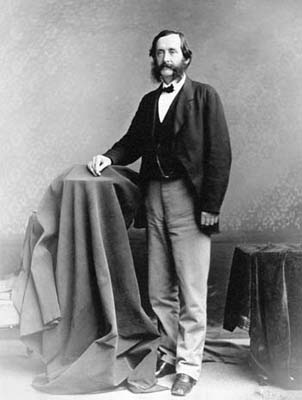
Thomas Wentworth Higginson at 46, in Rhode Island, 1870.
But he had no political traction. His appointment to the Newport School Committee was vetoed because one of its members assumed that, as a soldier in the First South Carolina Regiment of Volunteers of African Descent, he had to be black. Elected regardless (the mistake was discovered), in sweet retaliation Higginson abolished segregated schools in Newport. For his efforts, he lost the next election.
Proudly calling himself a Black Republican, Higginson viewed Reconstruction as the opportunity to eliminate discriminatory practices and laws; Reconstruction, to him, first meant the redistribution of the land of the former plantations to the freed slaves, for he was not eager to appease former Confederates and, less so, former slaveholders. He also launched a verbal campaign to end segregation in the North as well as the South, on the streetcars of Philadelphia, in the schools of New York, or in the special galleries reserved for black people in Boston theaters. “When the freedmen are lost in the mass of freemen, then the work will be absolutely complete,” he wrote. And he advocated full and immediate enfranchisement, which he termed simply fair play. The best preparation for freedom is freedom: “Fail in this result, and the future holds endless disorders,” he warned his readers, “with civil war reappearing at the end.”
Though he often spoke in public on behalf of the Freedmen’s Aid Society (his sister Anna was secretary of the Brattleboro, Vermont, bureau), he declined to join the New England branch as one of its officers. “I do not want to give any more years of my life exclusively to those people now, as much as I am attached to them,” he told his sisters. Also, he was dubious about the project: though intending to make good on General Sherman’s promise to give every family of former slaves forty acres and a mule, General Saxton, now assistant commissioner of the Freedmen’s Bureau in Florida, Georgia, and South Carolina, was blocked at every turn by white farmers who wanted to keep the black population from owning land. Precipitously mustered out of service in 1866, Saxton was replaced by the unscrupulous (Higginson’s word) Brigadier General John M. Brannan, a former military head of the Department of the South. “If it had been left to him,” Higginson complained, “the freedmen would not have had a house, nor a school, nor a musket, nor a friend; the colored women would have had no liberty, except to be the concubines of the United States officers; nor the men, but to be their servants.”
Confiscated land was soon handed back to its former white owners, ex-Confederates were reseated in Congress, and men like Nathan Bedford Forrest, after presiding over the capture—or the massacre—of black troops at Fort Pillow, went on to lead the newly founded Ku Klux Klan. Affairs in the president’s office weren’t much better. Andrew Johnson failed to carry out the mandate of the Radical Republicans, and Higginson wrote scornfully that “what most men mean to-day by the ‘president’s plan of reconstruction’ is the pardon of every rebel for the crime of rebellion, and the utter refusal to pardon a single black loyalist for the crime of being black.” In the North the situation was almost as bad. The expectations heaped on the freed slave were so unrealistic—a racism in reverse—that Higginson cried, “Do you suppose that black men are born into the world such natural saints that none of the vices of the white men are found among them?”
His outcries lost to the ephemera of journalism, Higginson’s lasting contributions to Reconstruction were his Atlantic essays on the war, collected in 1869 as Army Life in a Black Regiment. Including material copied directly from his journals as well as a narrative of his three expeditions, his ruminations on the valor of the black soldier—and his outrage that black soldiers had been underpaid when paid at all—Army Life is a minor masterpiece. Today considered gently racist, if not condescending, it nonetheless remains a striking, unusual, and empathetic social document; its account of daily activity in the army during wartime is riveting in its detail, compassion, and humor. Higginson’s very real affection for his regiment is evident on every page, as is his pride in what he and his soldiers were able to do, and his transcriptions of the spirituals sung by his men is itself a remarkable—and groundbreaking—contribution to African American folk culture.
At the heart of the book is the voluptuous Sea Islands, a tropical forest of Arden in a world of violence: “Galloping through green lanes, miles of triumphal arches of wild roses,—roses pale and large and fragrant, mingled with great boughs of the white cornel, fantastic masses, snowy surprises,—such were our rides, ranging from eight to fifteen and even twenty miles,” he wrote. “Back to a later dinner with our various experiences, and perhaps specimens to match,—a thunder-snake, eight feet long; an armful of great white, scentless pond-lilies. After dinner, to the tangled garden for rosebuds or early magnolias, whose cloying fragrance will always bring back to me the full zest of those summer days.”
Edmund Wilson, calling Army Life limpid and unaffected, likened it to the memoirs of General Grant, and praising Higginson’s lush description, Howard Mumford Jones, a twentieth-century literary critic, called Army Life a study in enchantment. But it is also an expression of disenchantment: frustration with stereotypes and pat assumptions, with empty promises and vainglorious men, and surprise at the revelation that you might not be the person you thought you were. It is therefore a book of lights gleaming in the dark, of Southern marshes and Northern confusion, of tangled vegetation and of fearsomeness and fragile hope.
Nowhere is this clearer than in “A Night in the Water,” a stunning, almost existential essay composed in Higginson’s most straightforward, pellucid style. Again his metaphor is of swimming into unknown territory, and this time he recounts a nighttime excursion when, swimming naked, he is suddenly clutched by fear:
Doubts trembled in my mind like the weltering water, and that awful sensation of having one’s feet unsupported, which benumbs the spent swimmer’s heart, seemed to clutch at mine, though not yet to enter it. I was more absorbed in that singular sensation of nightmare, such as one may feel equally when lost by land or by water, as if one’s own position were all right, but the place looked for had somehow been preternaturally abolished out of the universe. At best, might not a man in the water lose all his power of direction, and so move in an endless circle until he sank exhausted? It required a deliberate and conscious effort to keep my brain quite cool. I have not the reputation of being of an excitable temperament, but the contrary; yet I could at that moment see my way to a condition in which one might become insane in an instant. It was as if a fissure opened somewhere, and I saw my way into a mad-house; then it closed, and everything went on as before.
Like Dickinson, he too could find poetry in these deep, dark states of mind. They must have known this about each other. But for Higginson the vision of blankness passes. Everything goes on as before. He is a daylight man.
Yet there was more to him than sunshine and reform, and perceptive readers, like Dickinson, could sense it.
In 1869, William Dean Howells, preferring the book’s soldiering to its poetry, favorably reviewed it in The Atlantic, which he, not Higginson, would soon take over, and observed, rather ruefully, that the nation had grown tired of racial issues.

IN NEWPORT, HIGGINSON CHOPPED WOOD early in the morning for exercise. It staved off depression. In the afternoon he swung from parallel bars and taught calisthenics at the gymnasium he had helped found. At dusk he sauntered about town. He also sat at his desk for four hours each day, pen in hand. In addition to the promised articles for Fields, he reviewed books like Thoreau’s Cape Cod—he had hoped to edit Thoreau’s journals—and he continued to contribute a steady stream of articles to The Independent, The Radical, The Nation, and the New York Tribune, in which he called for the education and enfranchisement of the freed slaves.
And at the same time aching to do something completely different, he inched his way toward a novel.
But aside from the astonishing “Night in the Water,” Higginson’s finest work remained his political writing. Packing his outrage into sentences of force, grace, and civility that made his anger all the more pointed, he said exactly what he meant. He did not gussy up his prose with scholarly comment or learned allusions. “All Southern white men cannot be instantaneously convinced that their late slave is a man and a brother,” he declared in 1865, “nor is it necessary that they should be. It will be enough, for the present, to convince them that he must be treated like one.” He declaimed in strong, ringing terms fueled by ethical self-certainty, as when he excoriated northerners and liberals in Congress.
It is we who are permitting black loyalists to be disarmed, and white rebels to be armed again, under the name of “militia.” It is we who are permitting open proclamation of the re-establishment of slavery under the name of “apprenticeship.” It is we who consent to the exclusion from the courts and the ballot-box of those who have fought to reopen the ballet-box and re-establish the power of the courts. It is we who are reviving the old assumption that “the people” of the South means the white population, rebel or otherwise; and that the black loyalists are something less than “the people.”
Yet he devalued his political writing as unliterary. “It is not that politics are so unworthy, but that no one man can do everything,” he wrote in The Atlantic essay “A Plea for Culture,” which had prompted a note of approval from Dickinson. “There are a thousand roughhewn brains which can well perform the plain work which American statesmanship now demands, without calling on the artist to cut blocks with his razor. His shrinking is not cowardice,” he continued; “this relief from glaring publicity is the natural condition under which works of art mature…. A book is the only immortality.”
A book—not journalism, not politics, not the transient affairs of the everyday. This is what Emily Dickinson dreamed of. Perhaps he was thinking of her. (“A precious—mouldering pleasure—’tis—/ To meet an Antique Book—.”)
“In these later years, the arduous reforms into which the lifeblood of Puritanism has passed have all helped to train us for art,” Higginson observed, “because they have trained us in earnestness, even while they seemed to run counter to that spirit of joy in which art has its being.” Higginson caught the drift of what had happened to his—and Dickinson’s—Puritan heritage: that cleft between action and art, or what he called earnestness and joy. But he was also rationalizing his steady removal from the cause that had shaped his life, that had brought him to the church and thrust him out of it. Nurtured on the New, steeped in the exuberance of a just reform, Higginson had entered the war half-skeptical, half-hopeful: he saw his country sundered, its ideals politicized, its racism pervasive, and he understood, as if for the first time, how intractable institutions are, how difficult it is to change them. In Newport his political efficacy was nil. “I don’t believe there is a man here whom it cost more to come here than it did me,” he would reflect in his journal. “I don’t believe there has been a blacker Republican than I. I know for one that I have tried to find a sufficient sphere of duty inside the Republican party, and it has been nothing more or less than hard knocks and blows that drove me out of it.” His specific references are unclear, but the corruption and meretricious razzle-dazzle of postwar America—the era soon known as the Gilded Age—and the material excess so palpable in Newport disgusted him. “Nobody has any weight in America who is not in Congress,” he bleakly observed, “and nobody gets into Congress without the necessity of bribing or button-holing men whom he despises.”
Disillusioned by the military, by the government, by the intransigence of the South, he justified his withdrawal into art, claiming—incredibly—that “except to secure the ballot for woman, a contest which is thus far advancing very peaceably, there seems nothing left which need be absolutely fought for; no great influence to keep us from a commonplace and perhaps debasing success.” More and more he preferred a different, more creative writing. “My nature seems to be rather that of an artist than that of a thinker,” he had confided in Emerson, wishing it were so.
Restless, he also befriended Hawthorne’s eldest daughter, the lovely and star-crossed Una, who was briefly engaged to his favorite nephew, Storrow. Calling on Hawthorne’s widow and daughters at the Wayside, itself a vestige of former times, Higginson sat in their plain, chilly parlor—perhaps in the very chair where Hawthorne had sat—and thumbed through the great man’s notebooks. This was what he wanted: Hawthorne’s rectitude, his devotion to his art, his single-mindedness. If he had to ignore Hawthorne’s despair or his odd friendship with Franklin Pierce, so be it; all that paled next to the man’s achievement. The only immortality is a book.
If his commitment to social change prevented Higginson’s devoting himself to art, it also protected him from the fear that, without it, he might lose his sense of direction, as he suggested in “A Night in the Water.” But now his mother, recently deceased, was unable to censure him, and the war—and its disappointing aftermath—momentarily scraped his conscience clean, so he rolled up his sleeves and wrote three sketches of “Oldport,” the setting for his novel Malbone, and two short stories, “The Haunted Window” and “An Artist’s Dream.” These tales assuaged his guilt about writing Malbone because, in them, he punishes the protagonists for doing what he himself wished to do.
Flavored with atmospheric Gothic effects, “The Haunted Window” is interesting less for its contrived plot and moral pabulum than for the fact that the apparition’s name is Emilia, a name that Higginson will use again in his novel. Emilia is art, the tempting seductress who drives men mad. And in the other story, pseudo-Hawthorne even to the title (“An Artist’s Dream”), Higginson’s narrator visits a happily married artist and his beautiful wife, Laura—the Petrarchan reference meant to be self-evident—and realizes that while the couple are passionate about each other, they mostly ignore their child. “Is it,” asks Laura, referring to her marriage, “a great consecration, or a great crime.” This answer is conventionally obvious, and when she dies, her bereaved husband discovers that it is their child and not his art that can relieve his awful suffering: “the artist had attained his dream,” Higginson concludes his fable.
The apex of all this was Malbone, the Hawthornean romance he announced to his sisters not long after his second trip to the Wayside, jubilantly reporting that Fields would be printing it serially in The Atlantic during the first six months of 1869. This was the book, published later that year, that Dickinson had planted on the table at the Homestead when he came to call.
Malbone is the story of Higginson’s doppelgänger, the indolent and fickle Philip Malbone, whose good looks turn the heads of both sexes. Higginson admitted that he had modeled Malbone in part on William Hurlburt, but he is also based on Higginson’s nephew Storrow, whose unpardonable sin—a dalliance with another woman?—caused Una Hawthorne suddenly to break their engagement. But Malbone mostly sounds like Higginson himself, recast as the artist who falls in love with his fiancée’s untamed half sister, Emilia, often referred to as Emily.
When he wrote Malbone, Higginson had not yet met Emily Dickinson in person, so he freely imagined her as lovely but intangible, with “a certain wild, entangled look…, as of some untamed outdoor thing, and [with] a kind of pathetic lost sweetness in her voice, which made her at once and forever a heroine of romance.” And it is this Emily/Emilia that is his Laura, his ideal, his symbol of the unadulterated, untrammeled pursuit of art. For, as Malbone says, “Every one must have something to which his dreams can cling, amid the degradations of actual life, and this tie is more real than the degradation; and if he holds to the tie, it will one day save him.”
But, also like Higginson, Malbone cannot attain his dream lover: he cannot lose himself in his pursuit of the ideal, and thus the affair between Malbone and Emilia ends tragically, when late one night, Emilia drowns in a stormy, featureless sea.
Emilia gone, Higginson thus restores the order of things, as convention prescribes. But convention had nothing to say about the nooks and crannies of an unusual friendship.
THE LONG-ANTICIPATED MEETING: in the Homestead parlor after eight years of correspondence and tantalizing bafflement, Emily Dickinson and Colonel Thomas Wentworth Higginson stood together in the same room. “Forgive me if I am frightened,” she apologized. “I never see strangers & hardly know what I say—.” Nervous, she talked without stopping. Occasionally she paused to ask him to speak and then started all over again. “Manner between Angie Tilton & Mr. Alcott,” he noted, referring to the two gabbiest people he knew, “but thoroughly ingenuous & simple which they are not & saying many things which you would have thought foolish & I wise.”
He listed a few of her pungent observations:
“I find ecstasy in living—the mere sense of living is joy enough.”
“How do most people live without any thoughts.”
“Is it oblivion or absorption when things pass from our minds?”
“Truth is such a rare thing it is delightful to tell it.”
She told him more about her family. Her father read only on Sunday, “lonely & rigorous books,” she added for emphasis. She made bread for her father because he liked only hers, Higginson noted, “& says, ‘people must have puddings’ this very dreamily, as if they were comets—so she makes them.” Doubtless she was ironic. And hyperbolic. She claimed she had not known how to read a clock until she was fifteen. “My father thought he had taught me but I did not understand & I was afraid to say I did not & afraid to ask any one else lest he should know.” Her mother was weak. “I never had a mother,” she said. “I suppose a mother is one to whom you hurry when you are troubled.” Dickinson endured alone.
They discussed literature. She said that she and her brother had hidden Longfellow’s novel Kavanagh under the piano cover to outfox their strict father, who forbade it. A friend concealed other books in a bush by the door. To read was to defy with pleasure.
They discussed poetry. Suggestively. Here was another form of transgression and transformation, erotic and inflammatory. “If I read a book,” she declared, “[and] it makes my whole body so cold no fire ever can warm me I know that is poetry. If I feel physically as if the top of my head were taken off, I know that is poetry. These are the only way I know it. Is there any other way.”
Poetry, again, as explosive force: he must have felt the pull, the energy, her sexuality. He left exhausted but in the evening walked back to the house. Afterward, hinting at the sexual tension—and release—of the whole experience, he admitted he had never met anyone “who drained my nerve power so much. Without touching her, she drew from me.”
“I am glad not to live near her,” he concluded.
The remarkable encounter, far exceeding his expectations, was too much for him.
He had flirted with the writer Helen Hunt, he had flirted with others, but he had always chosen the straight and narrow. Emily Dickinson demanded nothing short of a full commitment. Irreducibly herself, without compromise, she took everything, drained the cup, was irresistible. And to Higginson, far too dangerous.
WHEN HE TOOK HIS HAT for the last time that day, he promised the poet he would come again sometime. “Say in a long time,” she mischievously answered, “that will be nearer. Some time is nothing.”
As usual she was right.