
Buried: LBJ Ranch, near Johnson City, Texas
Thirty-sixth President - 1963-1969
Born: August 27, 1908, near Stonewall, Texas
Died: 4:33 p.m. on January 22, 1973, near Johnson City, Texas
Age at death: 64
Cause of death: Heart attack
Final words: Unknown
Admission to LBJ Ranch: Free
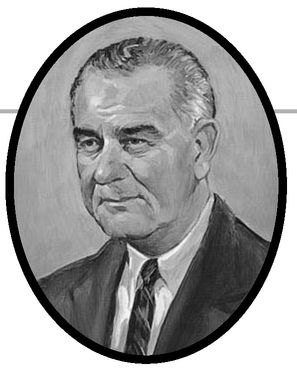
On November 22, 1963, Lyndon Baines Johnson became the thirty-sixth president of the United States. Vice President Johnson was riding two cars behind President John F. Kennedy in a Dallas motorcade when an assassin fired shots at JFK. Kennedy was pronounced dead at Parkland Memorial Hospital. A few hours later, as the plane carried the dead president’s body back to Washington, Johnson was sworn in by Judge Sarah Hughes aboard Air Force One. First Lady Jacqueline Kennedy and Johnson’s wife, Lady Bird, stood at his side. A stunned nation spent the weekend glued to television sets as news of John Kennedy’s assassination reached across the globe.
When he arrived in the capital, Lyndon Johnson made his first official statement as president: “This is a sad time for all people. We have suffered a loss that cannot be weighed. For me, it is a deep personal tragedy. I know the world shares the sorrow that Mrs. Kennedy and her family bear. I will do my best. That is all I can do. I ask for your help—and God’s.”
Johnson’s goal was a seamless transition. In a joint session of Congress five days after the assassination, he made an appeal for unity, invoking the memory of the slain president. The following year, he won reelection in his own right. Johnson went on to introduce a broad social program known as the Great Society which addressed poverty, Medicare and Medicaid, and civil rights. Overseas, Johnson agreed to escalate U.S. involvement in Vietnam.
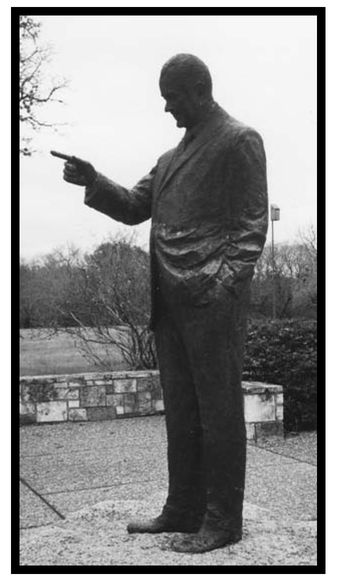
Statue of LBJ on the grounds of his ranch
On March 31, 1968, public outcry over U.S. involvement in Vietnam led Lyndon Johnson to announce his decision not to run for reelection. Instead, he pledged to seek an end to the war in Asia. He would not live to see that goal accomplished. Visibly worn, LBJ returned to his beloved ranch in the Texas Hill Country, making occasional public appearances. In December 1972, Johnson traveled to Independence, Missouri for Harry Truman’s funeral.
On January 22, 1973, LBJ was in his bedroom for his regular afternoon nap when he was stricken with a heart attack. He called the switchboard and asked for the head of his Secret Service detail. Two agents arrived with a portable oxygen unit and found Johnson on the floor beside the bed. One of the agents performed mouth-to-mouth resuscitation and an external heart massage in an effort to save the former president.
Johnson was quickly flown in a family plane to San Antonio International Airport where he was to be taken by ambulance to Brooke Army Medical Center. But it was too late. Lyndon Johnson was pronounced dead at 4:33 p.m. Lady Bird Johnson arrived moments later by helicopter. She was driving home from the Johnson Library when she learned of her husband’s heart attack.
Plans for his funeral had been set five years earlier. Funeral services began in Texas with Johnson’s body lying in state at the library. Tens of thousands filed past, including many who had known Johnson since childhood. His gray coffin was then flown to Washington to lie in state at the Capitol Rotunda. Forty thousand people passed by the catafalque where President Nixon laid a wreath of carnations.
To the strains of Chopin’s funeral march, a military procession led mourners to National City Christian Church, where Johnson often worshipped as president. The service was broadcast over a public address system for those gathered outside. Leontyne Price, the Metropolitan Opera soprano who had performed at Johnson’s inauguration, sang two solos.
Lyndon Johnson made a final journey home to his Texas ranch. A cold rain fell on the morning he was laid to rest alongside his parents. Reverend Billy Graham conducted the service under the oak trees on the northern bank of the Pedernales River. An army band played and Anita Bryant sang the “Battle Hymn of the Republic.” The Texas National Guard fired a twenty-one-gun salute. Dignitaries and local citizens alike watched as Lady Bird Johnson was given the flag that covered her husband’s coffin. Later that afternoon Hubert Humphrey, who had served as Johnson’s vice president, and actor Gregory Peck joined the family and other invited guests for coffee and sandwiches at the ranch house.
Lady Bird Johnson remained active in public life after her husband’s death, working with several organizations devoted to preserving the Texas landscape. She died in 2007 at the age of ninety-four and was buried at her husband’s side on their Texas ranch.
Touring Lyndon Johnson’s Tomb at the LBJ Ranch
The LBJ Ranch is located near Johnson City, Texas. The park headquarters and visitor center which give information about Lyndon Johnson’s life and presidency, are located in Johnson City. Both facilities are open daily except Thanksgiving, Christmas, and New Year’s Day. The visitor center is open from 8:45 a.m. to 5:00 p.m. Bus tours of the LBJ Ranch are available from 10:00 a.m. to 4:00 p.m. Admission to the LBJ Ranch is free. Go to the state park visitor center to receive a free permit to drive through the park. Admission to the Texas White House Office tour is $1.00 for adults and free for children seventeen and younger.
From Austin: Take Highway 290 West. At the traffic light in Johnson City, turn left (still on Highway 290) towards Fredericksburg. Drive three blocks and turn left on Avenue F, then go two blocks and turn right onto Lady Bird Lane. The parking lot and Visitor Center are located on the left.
From San Antonio: Take Highway 281 North until it joins Highway 290. At the traffic light in Johnson City, turn left towards Fredericksburg, drive three blocks and turn left on Avenue F. Go two blocks and turn right onto Lady Bird Lane. The parking lot and Visitor Center are located on the left.
From Fredericksburg: Take Highway 290 East to Johnson City. After passing the blinking traffic light, drive two blocks and turn right onto Avenue F. Go two blocks and turn right onto Lady Bird Lane. The parking lot and Visitor Center are located on the left.
To the LBJ Ranch: From park headquarters, take Highway 290 West fourteen miles to the LBJ State Historical Park. Tickets for the LBJ Ranch bus tour are purchased at the State Park Visitor Center.
Lyndon Johnson’s gravesite is beside the ranch house in the Johnson family cemetery along the banks of the Pedernales River.
For additional information
Lyndon B. Johnson National Historical Park
P.O. Box 329
Johnson City, Texas 78636
Phone: (830) 868-7128
Fax: (830) 868-7863
www.nps.gov/lyjo/
“If ever there were a Lion in Winter, it was Lyndon Johnson.”
—Richard Norton Smith
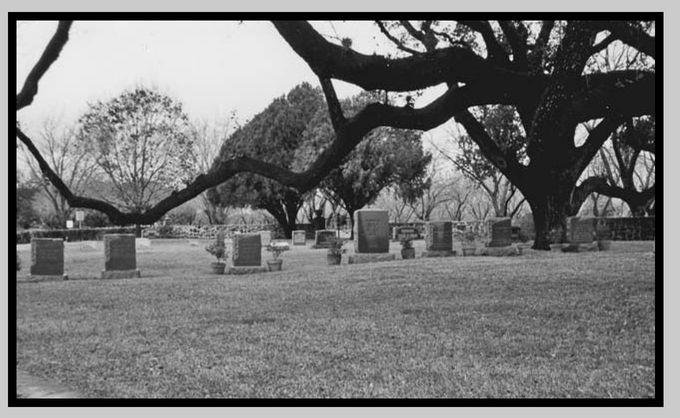
The Johnson family cemetery on the grounds of the LBJ ranch
If ever there were a Lion in Winter, it was Lyndon Johnson. His post-presidential kingdom shrank to the dimensions of the LBJ Ranch, his white hair grew to near-shoulder length, and memoir writing held little appeal. As he once informed Harry Middleton, the director of his presidential library, in a different context, “Good men have been trying to save my reputation for forty years, and not a damn one succeeded. What makes you think you can?” Haunted by Vietnam, Johnson feared that Richard Nixon’s conservative counterrevolution would scuttle his Great Society. “And when she dies,” he observed, “I, too, will die.”
Death was much on his thoughts. He took the Reverend Billy Graham out to the Johnson family cemetery on the banks of the Pedernales. “One day you’re going to be asked to preach at my funeral,” he told Graham. “You’ll come right here under this tree and I’ll be buried right there. You’ll read the Bible and preach the Gospel and I want you to. I hope you’ll tell people about some of the things I tried to do.”
One of the things Lyndon Johnson tried hardest to do was redress centuries of racial injustice. In December 1971, an obviously ailing former president attended a civil rights conference at the LBJ Library. In the audience were such giants of the movement as Thurgood Marshall, Roy Wilkins, Hubert Humphrey, and Earl Warren. His doctors urged him to stay away; if he had to go, by all means he should avoid the strain of public speaking. Being Lyndon Johnson, he overruled their objections. He had a valedictory message to deliver and it didn’t lack for point.
“Progress has been much too small; we haven’t done nearly enough,” Johnson told his countrymen. “To be black in white society is not to stand on level and equal ground. While the races may stand side by side, whites stand on history’s mountain and blacks stand in history’s hollow. Until we overcome unequal history, we cannot overcome unequal opportunity.”
It was his last public appearance. Among those filing by Johnson’s casket at the library six weeks later was a young, bearded man who on another day might have marched in protest of the Vietnam War. Bowing slightly before Lady Bird Johnson, he said simply, “My apologies.” Meanwhile, Harry Middleton assigned someone on the library staff to keep a careful count of the thirty-two thousand mourners who came to pay their respects. “I know that somewhere, sometime, President Johnson is going to ask me,” he explained.
—RNS