
THIS BOOK IS designed primarily as a contribution towards the understanding of the beliefs concerning witchcraft, and the resulting notorious trials of alleged witches, in early modern Europe. During the past forty-five years, this has become one of the most dynamic, exciting and thickly populated areas of scholarship, on a truly international scale. Among much else, it is a showpiece for the new cultural history, illustrating perfectly the role of the historian in interpreting, explaining and representing to the present world ideas and attitudes that are now officially, and in large measure actually, alien to the modern mind. In the process giant strides have been made in the understanding of the beliefs and legal processes concerned, but a gulf has opened between Anglophone and Continental European approaches to them.
Scholars based in English-speaking lands across the world have drawn upon insights furnished by criminology, psychology, literary criticism, cultural studies and the philosophy of science. They have been especially interested in structures of social and political power and in gender relations. In the process they have produced excellent work, in the British case that of James Sharpe, Stuart Clark, Diane Purkiss, Lyndal Roper, Malcolm Gaskill, Robin Briggs and Julian Goodare being outstanding. They have, however, been much less interested in insights gained from anthropology, folklore and ancient history, although these were especially popular among British historians of the subject in the first two-thirds of the twentieth century. In many ways the different foci adopted by their successors have represented a reaction, initially self-conscious, against these earlier approaches, created by changes in academic fashion, which will be explored in the book. One result of the shift has been a relative loss of interest in the popular ideas and traditions that contributed to early modern stereotypes of witchcraft, as opposed to those of intellectuals. Some Continental scholars, on the other hand, have retained a strong interest in the ancient roots of beliefs concerning witches and the relationship between these and the early modern trials. They have sought to connect the belief systems that underpinned those trials to pre-Christian traditions, especially as expressed in popular culture. These preoccupations have led them to take a much greater interest in classical studies, folklore and extra-European parallels than their English-speaking counterparts: notable exponents of this approach have been Carlo Ginzburg, Éva Pócs, Gustav Henningsen and Wolfgang Behringer. Their approaches have yielded a different set of valuable insights, but have in turn been susceptible to a different sort of criticism, of making use of modern folklore to fill gaps in knowledge of earlier societies, and of applying general models of archaic and worldwide belief systems without sufficient attention to local variation.
The purpose of this book is to combine both approaches with a view to enhancing the utility of each while taking account of its limitations. It is designed, in particular, to emphasize the importance of different regional belief systems concerning the supernatural and the way in which these support, qualify or negate universal models.
Its central question concerns the relevance of ethnographic comparisons and ancient and earlier medieval ideas, as expressed both in the transmission of written texts and in local popular traditions, to the formation of early modern beliefs in witchcraft and the patterning and nature of the trials that resulted. The book is constructed upon three narrowing circles of perspective, represented by its three different sections. The first of these is concerned with very broad contexts into which the early modern data can be, and have been, placed. It commences with a global comparison, based on ethnographic studies, of attitudes to witchcraft and the treatment of suspected witches in societies across the non-European world. It continues by considering the same phenomena in the societies of ancient Europe and the Near East for which we have records, and – as in the global survey – emphasizes in particular the great variation in them between cultures, and the relevance of most of these varieties of belief and practice to later European history. It concludes with a consideration of the question of whether pan-Eurasian shamanic traditions played a significant part in underpinning European beliefs concerning witchcraft and magic; which inevitably involves looking at different definitions of shamanism.
The second section shows how the insights of the first can be applied to a Continent-wide study of the medieval European background to the early modern witch trials, and the manner in which existing local traditions – and especially popular traditions – contributed to the patterning and nature of those trials. It commences by looking at learned ceremonial magic, a branch of magical activity that was in its origins and nature quite different from witchcraft, and rarely in practice confused with it. It was, however, often to become officially associated with witchcraft by orthodox medieval Christians, and so to provoke a growing hostile reaction, which was to become one of the sources of the early modern witch-hunts. The purpose of this chapter is to provide a concise history of this kind of magic from its ancient roots, using the wide-angle perspective of the first section, but concentrating on Europe and the Near East and specifically on the development of the late antique tradition of this magic into a medieval form. The next chapter deals with medieval beliefs concerning night-roving spirits and their human allies, another complex of ideas that fed directly into witch trials. The third in this sequence traces the evolution of concepts of witchcraft through the Middle Ages, considering successively the impact of Christianity, the incidence of witch trials in the medieval period, and the origins of the early modern stereotype of the satanic witch. The fourth examines the patterning and nature of the early modern trials themselves with a view to determining how far either was affected by regional popular traditions.
The third section of the book is intended to demonstrate how methods and data drawn from both the first two sections can be applied to a study of them in one particular region of Europe, in this case the island of Britain. It focuses in particular on three specific aspects of British witch trials, which have recently been the subject of interest and discussion, and attempts to make a fresh contribution to an understanding of each. The first is the relationship between witches and fairies in the early modern imagination, and accordingly in British witch trials, which entails an examination of the development and nature of early modern British beliefs concerning fairies. The second considers the incidence of such trials in areas of the British Isles which had Celtic languages and cultures, and asks if this reveals any significant pattern for which an explanation can be suggested using medieval as well as early modern material, and later folklore. Finally, this section engages with the particular phenomenon of the English witch’s animal familiar, and successively applies global, Continental European, ancient and medieval perspectives to it, with the intention of increasing an understanding of it.
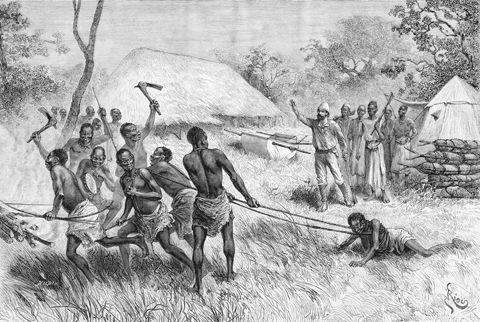
1. An (alleged) nineteenth-century witch-hunt in a native African society in Mozambique. The accused woman is being dragged to her execution, but is about to be saved by a strapping European gentleman bent on eradicating such practices.
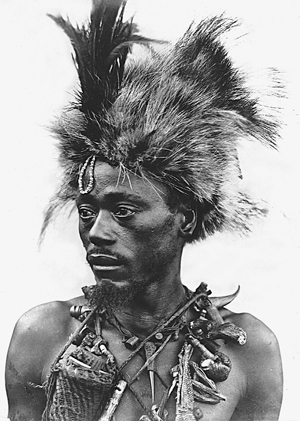
2. An African service magician, known to the British as a ‘witch-doctor’, photographed in the 1920s. The headdress and jewellery would have had symbolic importance. Such figures were prominent both in removing the alleged spells of witches and in detecting the presumed perpetrators.
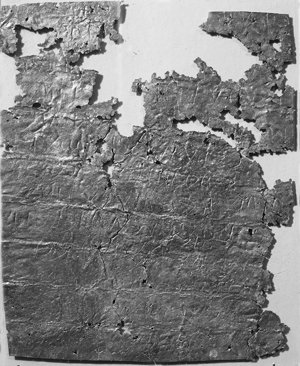
3. A Roman curse tablet, inscribed in the second or third century AD and buried at the amphitheatre of the northern frontier city of Trier.
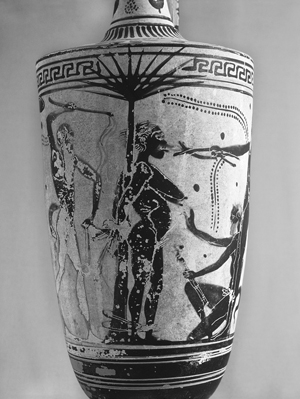
4. A Greek vase, of the fifth century BC, painted with a representation of a (or the) child-killing demoness, lamia, being tormented by (presumably vengeful) satyrs.
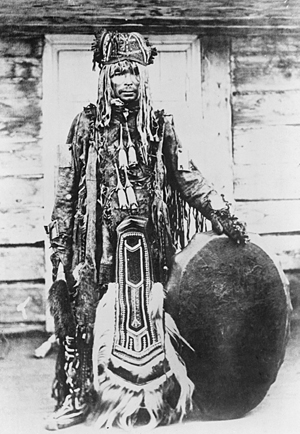
5. A classic Siberian shaman, from the Tungus family of peoples, whose language gave the world the word ‘shaman’. He is wearing his ritual costume, with decorations representing servitor spirits, and holding the drum that he used to induce a trance state. Both would have greatly enhanced the drama of the public performance, which was essential to Siberian shamanism.
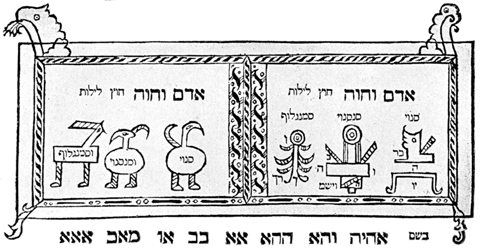
6. An amulet (actually to ward off the child-killing demoness, Lilith), prescribed in one of the most famous medieval books of ceremonial magic, the Hebrew Sepher Raziel, the Book of (the Angel) Raziel.
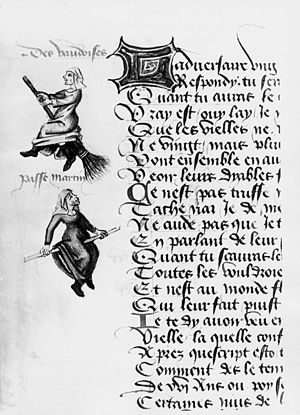
7. The first picture of a witch riding a broomstick, decorating a margin of a manuscript of one of the earlier texts to describe the witches’ sabbath (Le Champion des Dames, Martin le Franc, published in the 1440s). The real significance of it is that both the witches portrayed ride sticks, presumably anointed with a magical unguent, which was the main means of locomotion to the sabbath in the first accounts of it.
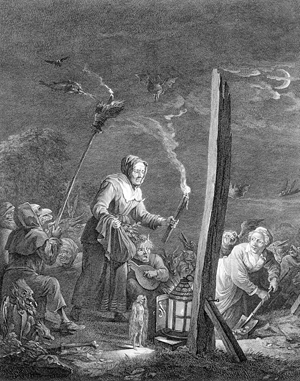
8. A classic early modern representation of the witches’ sabbath, produced by David Teniers the Younger.
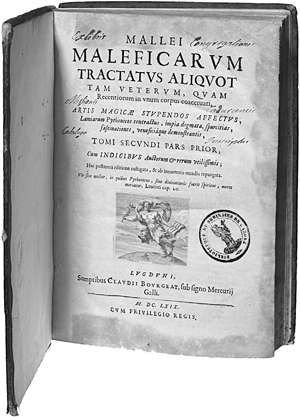
9. The most famous of all witch-hunting manuals, the Malleus maleficarum (Hammer of Evil-Doers) by Heinrich Kramer, first published in 1487. Despite its modern fame, it is atypical both in some of its beliefs and in its intense fear of women.
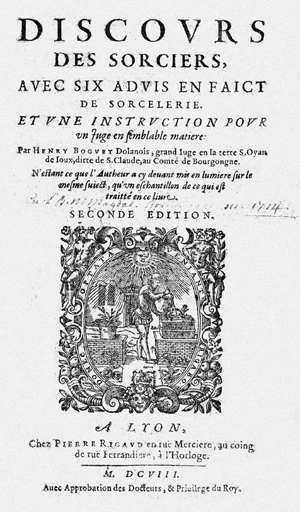
10. A later and more standard manual for witch trials, the Discours des sorciers by Henri Boguet, based partly on his own experience as a judge in Franche Comté, the part of Burgundy then ruled by Spain. The first edition is dated 1590.