
PICTURE SECTION

This portrait of the young Poggio Bracciolini appears in the preface to his Latin translation of Xenophon’s account of the education of the ideal ruler, the Cyropaedia.
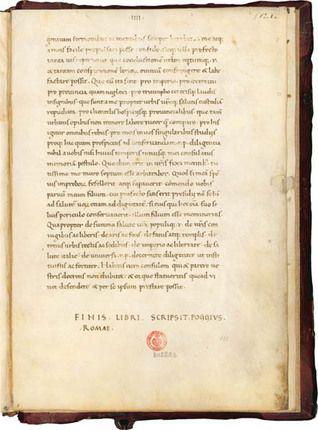
Proudly noting that he is the secretary to Pope Martin V, Poggio signs his characteristically elegant transcription of Cicero, made in 1425, and wishes the reader farewell. Poggio’s handwriting was prized in his own lifetime and was one of the keys to his advancement.
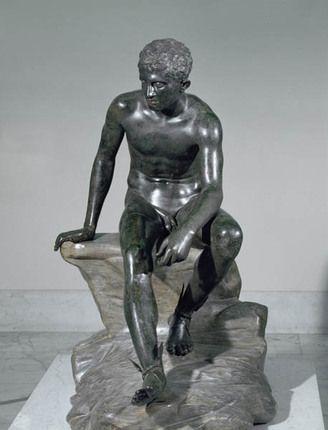
This bronze Seated Hermes was found in fragments in 1758 at the Villa of the Papyri in Herculaneum. A pair of winged sandals reveals his identity as the messenger god Hermes. To an Epicurean the figure’s elegant repose might have suggested that the gods had no messages to deliver to mankind.
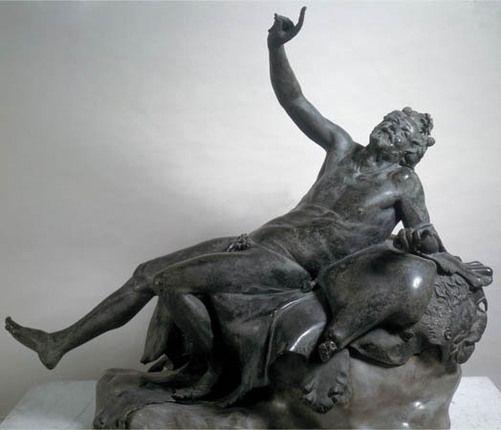
The enemies of Epicureanism associated it not with the thoughtful pose of the Seated Hermes but with the drunken abandonment of this Silenus, sprawled on a wineskin draped over a lion’s pelt, found near the Hermes sculpture at the Villa of the Papyri.
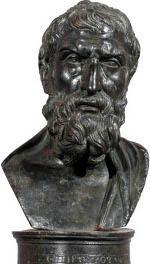
The small bust of Epicurus, which retains its original base with the philosopher’s name inscribed in Greek, was one of three such busts that adorned the Villa of the Papyri in Herculaneum. In his Natural History (chap. 35), the Roman author Pliny the Elder (23–79 CE) noted a vogue in his time for portrait busts of Epicurus.
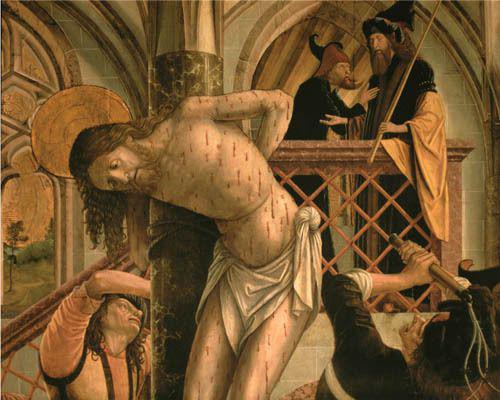
“Then Pilate took Jesus and had him flogged” (John 19:1). The biblical text inspired images like this painting by the Austrian Michael Pacher and helped promote not only sympathy for the cruelly mistreated Messiah and rage at his tormentors but also a fervent desire to emulate his suffering.

The heretic Hus, forced to wear a mock paper crown declaring his misdeeds, is burned at the stake. Afterwards, to prevent any sympathetic bystander from collecting a relic of the martyr, his ashes are shoveled into the Rhine.
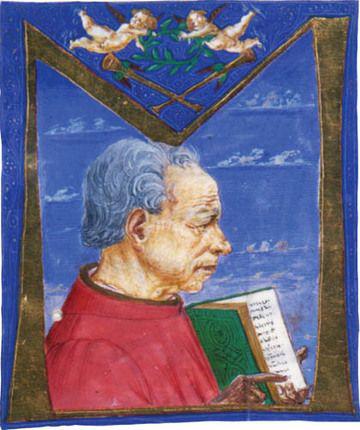
This portrait of Poggio appears in a manuscript of his work De varietate fortunae. The work, written when Poggio was sixty-eight years old, eloquently surveys the ruins of ancient Roman greatness.
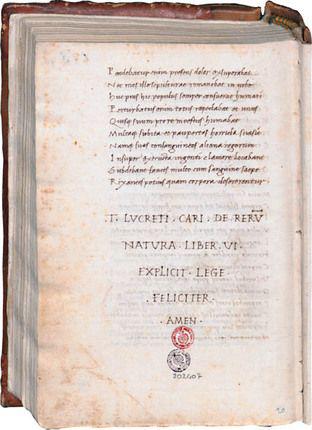
Poggio’s friend Niccoli here brings his long-awaited transcription of On the Nature of Things to a close with the customary word “Explicit” (from the Latin for “unrolled”). He enjoins the reader to “read happily” (“Lege feliciter”) and adds—in some tension with the spirit of Lucretius’ poem—a pious “Amen.”
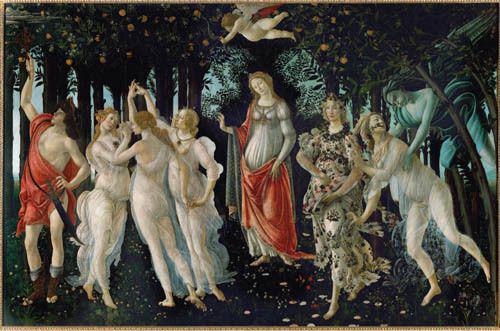
At the center of Botticelli’s painting stands Venus, surrounded by the ancient gods of the spring. The complex choreography derives from Lucretius’ description of the great seasonal renewal of the earth: “Spring comes and Venus, preceded by Venus’ winged harbinger, and mother Flora, following hard on the heels of Zephyr, prepares the way for them, strewing all their path with a profusion of exquisite hues and scents” (5:737–40).
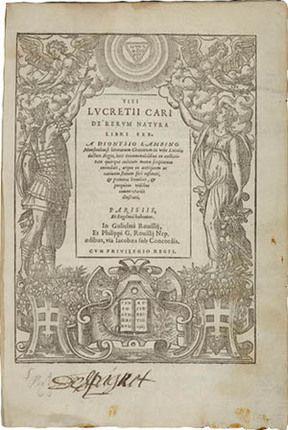
Montaigne’s signature on the title page of his heavily annotated Lucretius—the great edition published in 1563 and edited by Denis Lambin—was written over by a subsequent owner—“Despagnet”—and hence not identified for what it is until the twentieth century.
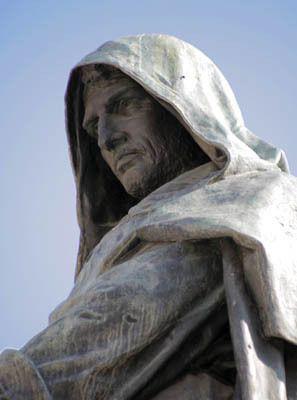
A bronze statue of Bruno, sculpted by Ettore Ferrari, was erected in 1889 in Rome’s Campo de’ Fiori on the spot where he was burned at the stake. In the monument, on the base of which are plaques devoted to other philosophers persecuted by the Catholic Church, the larger-than-life Bruno looks broodingly in the direction of the Vatican.
PHOTOGRAPH CREDITS
Portrait of young Poggio. Biblioteca Medicea Laurenziana, Florence, Ms. Strozzi 50, 1 recto. By permission of the Ministero per i Beni e le Attività Culturali with all rights reserved
Poggio’s transcription of Cicero. Biblioteca Medicea Laurenziana, Florence, Ms. Laur.Plut.48.22, 121 recto. By permission of the Ministero per i Beni e le Attività Culturali with all rights reserved
Seated Hermes. Alinari / Art Resource, NY
Resting Hermes. Erich Lessing / Art Resource, NY
Bust of Epicurus. By courtesy of the Museo Archeologico Nazionale di Napoli / Soprintendenza Speciale per i Beni Archeologici di Napoli e Pompei
The Flagellation of Christ, Michael Pacher. The Bridgeman Art Library International
Heretic Hus, burned at the stake. By courtesy of the Constance Rosgartenmuseum
Portrait of elderly Poggio. © 2011 Biblioteca Apostolica Vaticana, Ms. lat.224, 2 recto
Niccoli’s transcription of On the Nature of Things. Biblioteca Medicea Laurenziana, Florence, Ms. Laur.Plut.35.30, 164 verso. By permission of the Ministero per i Beni e le Attività Culturali with all rights reserved
La Primavera, Sandro Botticelli. Erich Lessing / Art Resource, NY
Montaigne’s edition of Lucretius. Reproduced by kind permission of the Syndics of Cambridge University Library
Ettore Ferrari’s statue of Giordano Bruno. Photograph by Isaac Vita Kohn