CHAPTER 24
IN THIS CHAPTER
Summary: The strengthening of European nation-states and the technological changes brought about by the Industrial Revolution gradually began to erode the European balance of power achieved by the Congress of Vienna. As European nation-states competed for power, they turned to colonies to supply them with raw materials and with markets for their manufactured goods. The rivalries among European nations were carried out in the territories of non-Western nations. The United States also realized its imperialist ambitions in Latin America and the Pacific.

Key Terms
Berlin Conference*
Boer War*
Boers*
economic imperialism*
Great Trek
imperialism*
Indian National Congress*
Manifest Destiny
Raj
Sepoy Rebellion*
sepoys*
Social Darwinism*
Spanish-American War*
Background of Imperialism
Imperialism , or the quest for empire, was in part a result of the Industrial Revolution. The mechanization of industry and resulting improvements in transportation brought new demands for raw materials, such as palm oil as a machine lubricant and rubber for tires. The industrial age also:
• Produced military weaponry such as the machine gun and the repeating rifle, which gave Western nations a military advantage over developing nations.
• Saw the application of steam to ships. Steamships could travel previously unnavigable rivers, allowing Europeans to reach the interior regions of continents.
• Brought the application of science to the study of health, resulting in preventative measures against the threat of malaria, a common tropical disease to which most Europeans were not immune.
In addition to the impact of industrialization, the concept of Social Darwinism contributed to the race for colonies. Social Darwinism was the application of Charles Darwin’s theory of natural selection to society to justify the conquest by European nations of non-Western societies.
Role of Nationalism
Nationalism, or intense pride in one’s national culture, also contributed to the new imperialism of the nineteenth and early twentieth centuries. Nationalism served as both a positive and negative force. In 1870, a common language and culture resulted in the unification of the Italian city-states into one nation. The following year, the German principalities also joined to form a single nation-state. In the mid-nineteenth century, the United States followed a policy of Manifest Destiny that led to its expansion from the Atlantic to the Pacific.
Within the Austrian Empire, by contrast, were a number of nations with different languages, religions, and institutions. Among them were Poles, Croatians, Czechs, Slovaks, and Hungarians. The Russian Empire also was ethnically diverse, including not only Slavs but also Turks, Poles, Finns, Estonians, and Jews, as well as other ethnic groups. Its diversity led Russia to try to impose the Russian language on all its subject peoples.
Scramble for Colonies
The main regions of European colonization were India and Africa. British influence in India began as commercial activity during the declining years of the Mughal Empire. The breakup of Mughal rule resulted in minor disputes among local princes. The British took advantage of this situation to help settle disputes, thereby gradually gaining greater influence in India. The Seven Years’ War (1756 to 1763), which also was fought in Europe and North America, was the first global war. It brought the British and French into conflict in India. British victories over the French in India gave them control of the country. Many of the Indian soldiers, or sepoys , were attracted to the higher-paying British army. India gradually emerged as Britain’s key source of raw materials and main colonial market for Britain’s manufactured goods.
British Colonial Society in India
The British who went to India created a stratified society with Europeans occupying the highest positions. English became the language of instruction in Indian schools. The British Raj (the Sanskrit name for the British government in India) set up telegraph lines to facilitate communications with Great Britain, and railways to carry troops and raw materials. For the most part, the British did not train the Indians in the use of the new technology that they brought to India. With the cooperation of the Western-educated Indian leader Ram Mohun Roy, the British outlawed sati .
British rule over India tightened after the 1857 Sepoy Rebellion . The cause of this revolt of Indian soldiers in the British army was the issue of new rifles that required the soldiers to use their teeth to tear open the cartridges. These ammunition cartridges were lubricated with animal fat. Muslims, who did not eat pork, were offended by grease that came from animal fat, while Hindus objected to grease from the fat of cattle. Even though the procedure for opening the cartridges was changed, the sepoys rebelled against British authority. The revolt was put down in 1858, but not before several hundred British men, women, and children were massacred.
Schools and universities established by British and American missionaries created an educated class of Indians with a strong nationalist sentiment. In 1885, they founded the Indian National Congress , which promoted a greater role for Indians in their country’s government. The new organization also sought harmony among Indians of diverse religious and social groups.
Imperialism in South Africa
The first European colonial presence in present-day South Africa was the Dutch way station established at Cape Colony in 1652. Eventually, the Dutch, or Boers , moved into the interior of the continent. There they enslaved the inhabitants, the Khoikhoi. Interracial mixing produced the South Africans known as “colored” today.
During the wars of the French Revolution, the British captured Cape Town and annexed it in 1815. A conflict between the Boers, who were slaveholders, and the British over the end of slavery caused many Boers to leave Cape Colony. Their migration, called the Great Trek (1834), took the Boers into the interior of South Africa. There they clashed with the Bantu peoples, especially the powerful Zulu. Under the leadership of their leader, Shaka, the Zulu nation fought back against Dutch, then British, rule, only to be defeated by the more advanced British technology.
In the 1850s, the Boers established two republics in the interior of South Africa: the Transvaal and the Orange Free State. When diamonds were discovered in the Orange Free State in 1867, the Imperialist businessman Cecil Rhodes and other British moved into the Boer republics. In spite of war between the Boers and the British from 1880 to 1881 that ended in Boer victory, the British continued to pour into South Africa. Migration was especially intense after gold was discovered in the Transvaal in 1885. Continued tension between the British and the Boers culminated in the Boer War of 1899 to 1902. After this conflict, the Boers began a period of dominance over native South Africans. In 1902, the individual Boer republics maintained their self-governing status as they were united into the Union of South Africa, controlled by Great Britain.
Partition of Africa
Intense rivalries among European nations played out on the African continent. As the need for raw materials and colonial markets arose, Africa was divided among European colonial powers. The Berlin Conference of 1884 to 1885 partitioned Africa into colonies dominated by Great Britain, France, Portugal, Spain, Germany, Belgium, and Italy. Only Liberia and Ethiopia were not colonized by Europeans. Absent from the Berlin Conference were representatives from any African nation.
The divisions of the Berlin Conference were carried out without regard for ethnic and cultural groups. Boundaries dividing the territorial possessions of one European power from another often cut through ethnic and cultural groups, placing members of a single group in different colonies dominated by different European powers. Traditional African life was disrupted as Europeans imposed on the continent their concept of the nation-state as the unit of government. These colonial divisions would affect African life to the present.
As in India, European imperialist powers in Africa contributed railways, roads, and other public works to the African landscape. Hospitals were set up and sanitation improved. Most of the improvements were intended initially for the welfare of the European colonists. As in India, Europeans in Africa failed to train natives to use the new technology they brought to the continent.
European businesses set up plantations and required local African natives to work long hours at extremely low wages to produce export crops for European benefit. Work on European plantations prevented Africans from tilling their home and village plots, a situation that led to decreased food supplies and malnutrition for their families.
Imperialism in Southeast Asia
Prior to the new imperialism of the nineteenth century, most of Southeast Asia consisted of independent kingdoms. The Malay States (present-day Malaysia) and Burma (presently Myanmar) came under British rule. Indochina was colonized by the French and the East Indies (now Indonesia) by the Netherlands. Siam (present-day Thailand) was the only Southeast Asian country that did not fall to imperialist ambitions. When native populations provided an insufficient labor supply, Europeans brought in immigrants from India and China.
Economic Imperialism
Another pattern of imperialist control was seen primarily in Hawaii and Latin America: economic imperialism . Economic imperialism involved the exertion of economic influence rather than political control over the region. In Hawaii, American companies exported Hawaiian-produced goods such as sugar and pineapple. Beginning in the early nineteenth century, missionaries from New England brought Christianity and education to the Hawaiians. Europeans and Americans also brought Western diseases to the islands, killing over half the population. Chinese and Japanese workers were brought in to work on Hawaiian plantations. American planters in Hawaii urged the United States to annex the islands. In 1898, the Hawaiian ruler was overthrown, and Hawaii was annexed to the United States.
The increase in Latin American trade (see Chapter 22 ) attracted North American and European investors. Businesses based in the United States, Great Britain, France, and Germany invested in Latin American banks, utilities, mines, and railroads. After World War I, U.S. business interests dominated in the region. The nations and islands of Latin America exported food products and raw materials and imported manufactured goods. Western perpetuation of this Latin American trade pattern kept Latin America dependent on the industrialized West.
In Cuba, U.S. economic imperialism turned to territorial acquisition. U.S. businesses had long invested in Cuban sugar and tobacco plantations. When the Cubans rebelled against Spanish rule in 1895, U.S. businessmen became concerned about their Cuban investments. When the U.S. battleship Maine exploded in Havana harbor, the United States went to war against Spain. U.S. victory in the Spanish-American War (1898) resulted in Spanish cession of Puerto Rico and Guam to the United States and the U.S. purchase of the Philippines. Cuba became an independent republic subject to control by the United States. The United States was now a world power.
U.S. Interests in Central America and the Caribbean
The nations of Central America and the Caribbean, both dependent on foreign loans, often were threatened by foreign intervention when they could not repay their loans. The United States intervened in Cuba three times during the early twentieth century. During the same period, U.S. troops occupied the Dominican Republic, Nicaragua, Honduras, and Haiti. U.S. support for Panamanian independence led to the construction and opening of the Panama Canal in 1914.
 Rapid Review
European nations colonized India and Africa, providing benefits such as improved medical care and more advanced infrastructures including better roads and railways. Most improvements were intended more for the benefit of imperialist nations than for native peoples. African village organization was disrupted as European nations divided the continent without regard to ethnic patterns, a practice that proved devastating to Africa’s future. Southeast Asia, except for Siam, came under the control of a number of European powers. Economic imperialism supported the interests of U.S. and European businesses and created continued dependence of nonindustrialized nations on the industrialized world.
Review Questions
1 . Imperialism in the late nineteenth and early twentieth centuries was a result of all the following EXCEPT
(A) militarism
(B) industrialization
(C) Social Darwinism
(D) socialism
2 . Economic imperialism
(A) did not lead to direct political control over new territories
(B) led to colonial dependence upon industrialized nations
(C) was the most common imperialist model in Africa
(D) led to industrialization of Latin America
3 . Which of the following pairs of nations and their imperialist interests is NOT correct?
(A) United States–Cuba
(B) Great Britain–India
(C) Japan–Hawaii
(D) Germany–Africa
4 . The new imperialism of the late nineteenth and early twentieth centuries
(A) brought technology created for the benefit of subject peoples
(B) created an egalitarian society in India
(C) resulted in some effects similar to those of the Columbian Exchange
(D) strengthened African village traditions
5 . South Africa
(A) was subjected more to economic imperialism than political control
(B) saw British enslavement of native peoples
(C) became an egalitarian society under Dutch rule
(D) saw the beginnings of racial divisions during colonial rule
6 . Nationalism
(A) brought tolerance for diversity within the Russian Empire
(B) eased tensions within the Austrian Empire
(C) delayed the unification of both Italy and Germany
(D) served as both a unifying and a divisive force
7 . European imperialism was facilitated by all the following EXCEPT
(A) medical advances
(B) the abolition movement
(C) the invention of the steam engine
(D) improved European weaponry
8 . Colonialism in India
(A) was facilitated by the breakup of the Mughal Empire
(B) brought an end to tensions between Muslims and Hindus
(C) brought greater self-rule to the subcontinent after the Sepoy Rebellion
(D) decreased nationalist feelings among Indians
Answers and Explanations
1 . D Socialism was a political movement that had no bearing on imperialism. Militarism (A) connected to imperialism by promoting the glories of one’s nation. Industrialization created a need for raw materials and markets that was supplied by colonies (B), whereas Social Darwinism provided the rationalization for industrialized countries to dominate the natives of developing regions (C).
2 . B Economic imperialism led to dependence on the imperialist country to provide manufactured goods. Sometimes, as in the case of the United States and Hawaii, economic imperialism led to direct political control (A). Direct political control was the common imperialist model in Africa (C). It led to Latin America’s continuation as a supplier of raw materials rather than an industrialized region (D).
3 . C The United States, not Japan, had imperialist interests in Hawaii. The other pairs are correct.
4 . C Hawaii is an example of native death from exposure to diseases brought by foreigners, as in the case of the diseases brought to the Americas through the Columbian Exchange. The new imperialism brought technology intended for the benefit of the imperialist nations (A). It created a stratified society in India (B). African village traditions were weakened by imperialism (D).
5 . D Social divisions based on race and skin color began in South Africa under Dutch rule. South Africa was subjected more to political control by the Dutch and British (A). The Dutch, not the British, enslaved native Africans (B). The Dutch stratified society according to the degree of African descent (C).
6 . D Nationalism served to unite Italy and Germany (C), but divided the Austrian (B) and Russian empires (A).
7 . B The abolition movement created conflict between the Boers and British in South Africa. Medical advances brought effective treatments for malaria, which aided imperialism (A). The invention of the steam engine allowed Europeans to navigate rivers to the interior of continents (C). Improved weaponry gave them power over developing societies (D).
8 . A The breakup of the Mughal Empire facilitated the entrance of Britain into India. Tensions between Muslims and Hindus were heightened by the British, leading to the Sepoy Rebellion (B). After the rebellion, British rule tightened (C), increasing nationalist sentiment among the Indians (D).
PERIOD 5 Summary: Industrialization and Global Integration (c. 1750 to c. 1900)
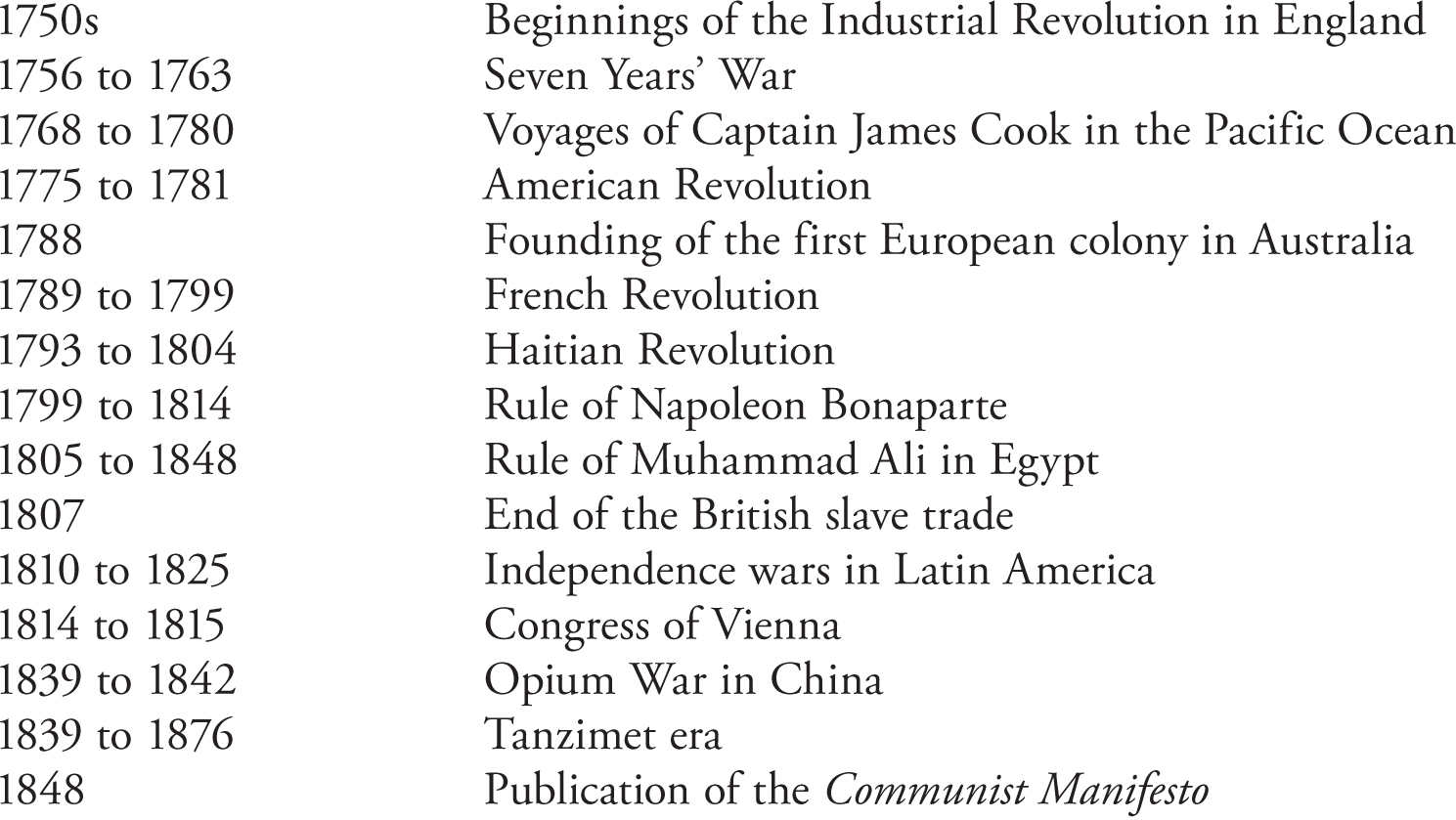
Timeline

Key Comparisons
1. Industrial Revolution in Europe, Russia, and Japan
2. Revolutions: American, French, and Haitian
3. Responses to Western influence in China, Japan, India, and the Ottoman Empire
4. Nationalism in Italy and Germany
5. Nationalism in the Austrian Empire and Russia
6. Imperialism in Africa and India
7. Forms of imperialism in Africa and Latin America
8. Roles of European women in upper and middle classes versus women in lower classes
9. Trade in the Atlantic and Indian Ocean basins
10. Trade in Western Europe and the Ottoman Empire
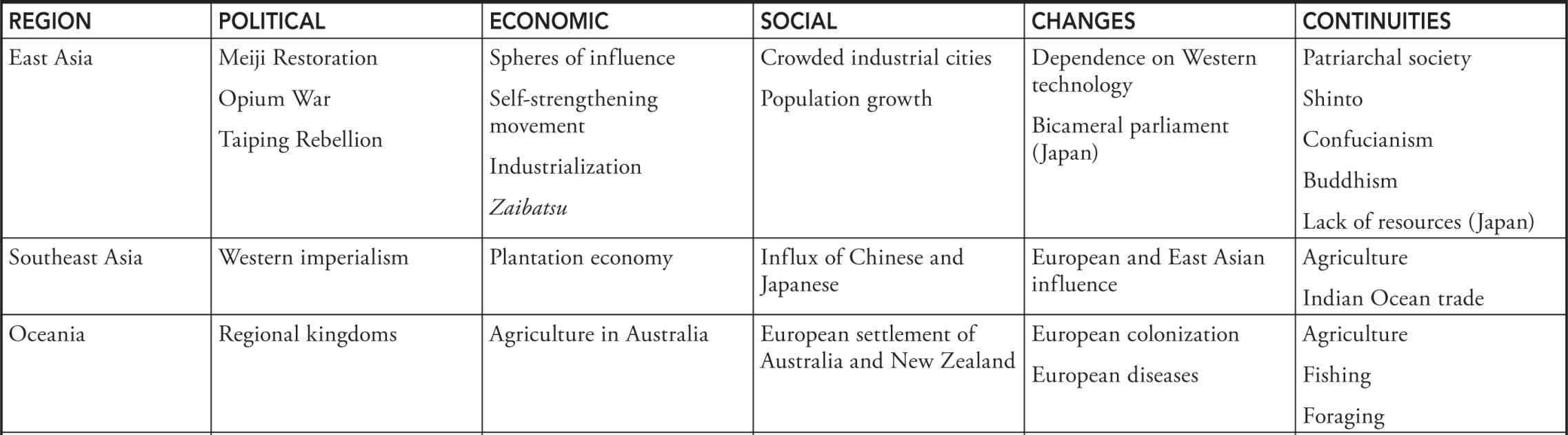
Change/Continuity Chart