
Part V
In this part . . .
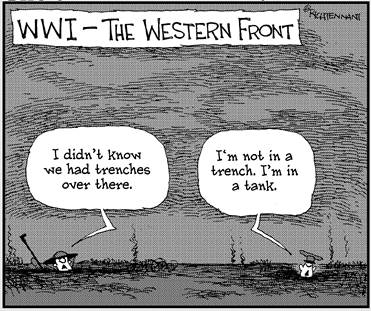
Technical advances produced a situation in which the powers of defence were greater than those of the attack, enabling defending armies to kill their opponents on an industrial scale. During the First World War the British Army expanded to its greatest size ever and sustained its heaviest casualties. It also found an answer to the deadlock of trench warfare - the tank, which did not become available in war-winning numbers until 1918.
During the last months of the war the British became the senior partner on the Western Front and led the final advance that resulted in the Armistice. In addition, the British and Indian Armies destroyed the Ottoman Empire, the collapse of which was followed by that of Germany’s remaining allies.
Chapter 17
In This Chapter
● The opening phases of the Western Front, 1914
● Trench warfare, 1914-1917
● The Battle of the Somme, 1916
● Other Western Front battles, 1917
When Archduke Franz Ferdinand of Austria-Hungary was assassinated in 1914, diplomacy failed to prevent a general drift into war. On the one side, initially, were Great Britain, France, Russia, and Serbia, joined later by Italy, Romania, and Greece. On the other were the German and Austro-Hungarian Empires, joined by the Ottoman Empire and Bulgaria. A major war had not taken place in Europe for 40 years, and cheering crowds greeted its outbreak in all the combatants’ capitals, not having the slightest idea of what the battlefield had in store for them. For more information on the complex causes of the First World War, see Sean Lang’s European History For Dummies (published by Wiley).
This chapter and Chapter 18 deal with the campaigns of the Western Front (France and Belgium). Chapter 19 tackles the British action spilling over into the rest of the world.
Of all the armies entering the war in 1914, only the British Regular Army consisted entirely of professionals and recalled reservists. It went to war wearing a practical, durable woollen khaki service dress. It had learned a great deal from the Boers (see Chapter 16). The infantry, for example, had perfected the technique of firing 16 aimed rifle rounds a minute, producing a firestorm guaranteed to shoot any attack flat, and learned the value of concealment. The First World War also saw the following developments in the British army:
● The introduction of the tank (for more see the section ‘The Battle of the Somme, 1916’, later in this chapter, and Chapter 19).
● Aerial warfare (see the sidebar ‘Enter the aeroplane!’).
● The vanishing role of cavalry on the modern battlefield.
Enter the aeroplane!
Great Britain entered the war with two air forces - the Royal Flying Corps, which belonged to the Army, and the Royal Naval Air Service, a branch of the Royal Navy. Both had operational squadrons in France and Belgium from the beginning. Air reconnaissance or scouting for the Army was an obvious role for the air forces and the generic name for the first fighter aircraft was Scouts. During the early days of the First World War, aircraft also dropped small bombs, grenades, and boxes of flechettes (small, weighted arrows) on the enemy's marching
columns. Inevitably, they encountered enemy aircraft. The observers from each side banged away at each other with pistols, rifles, and shotguns without doing much damage, then went home. Such contests became more serious when their cockpits were fitted with rearwardfacing machine guns, and downright dangerous when interrupter devices enabled pilots to fire forward-mounted machine guns through the propeller. This initiated the era of the dogfight, as each side sought to maintain air superiority over the trench lines.
The availability of machine guns, magazine rifles, quick-firing artillery, and barbed wire meant that the powers of the defence were stronger than those of the attack. The problem was that during the past 60 years fate had placed the generals under a tragic delusion: The side that kept attacking had won the American Civil War, the Austro-Prussian War, the Franco-Prussian War, the Russo-Japanese War, and even the Second Boer War, despite the fact that by far the heavier casualties were also among the attackers. The business of the generals was to win wars and they believed that they could only achieve this by doing likewise.
In due course, the British Regular Army was followed into action by the Territorial Force, as it was then known. Lord Haldane created the Territorial Army in 1907 from various volunteer units around the country. County associations became responsible for raising territorial units that ultimately formed 14 infantry divisions and 14 mounted brigades, based on the 14 military districts into which the country was divided. The old volunteer battalions became part of their county regiment, with the object of increasing efficiency by closer ties. This produced a regimental structure of, for example:
● 1st and 2nd (Regular) Battalions
● 3rd (Militia) Battalion
● 4th and 5th (Territorial) Battalions
Other roles for the air forces included spotting for the artillery, shooting down the enemy’s observation balloons, photo reconnaissance, and ground attack. The Royal Naval Air Service broke new ground by forming an armoured car division in 1914, the original objective being to rescue pilots forced to land between the armies. Most Royal Navy Armoured Car Division squadrons transferred to the Army and served in other theatres of war, although one squadron headed for Russia where it enjoyed an adventurous career both before and after the Revolution. In 1918 the Royal Flying Corps and the Royal Naval Air Service merged to form the Royal Air Force as an independent arm in its own right.
All Noisy on the Western Front
The British army that went to France in August 1914 was called the BEF (British Expeditionary Force, although Kaiser Wilhelm gave it a different name - see the sidebar ‘The Old Contemptibles’). Its first commander was Field Marshal Sir John French, who had relieved Kimberley with his Cavalry Division during the Second Boer War (see Chapter 16). It consisted of a Cavalry Division of five brigades under Major General E.H. Allenby, I Corps under Lieutenant General Sir Douglas Haig, and II Corps under General Sir Horace Smith-Dorrien. Following the first battles, III Corps under Major General W.P. Pulteney joined these. The recently formed Royal Flying Corps contributed the 2nd, 3rd, 4th, and 5th Aeroplane Squadrons.
The Battle of Mons, 23 August 1914
The German Schlieffen Plan (requiring the right wing of the German armies to swing round through Belgium, turning the left wing of the French armies with the object of pinning them back against the Swiss frontier) determined the course of the early fighting. The British Expeditionary Force came into the line on the left of the French and on 23 August 1914 II Corps became engaged with the IV, III, and IX Corps of General Alexander von Kluck’s German First Army. The fighting took place along the original line of the Mons-Conde Canal to the west and north of Mons, Belgium. By later standards, the battle was a mere skirmish, but British rifle fire inflicted some 3000 casualties and convinced the Germans that British infantry battalions possessed far more machine guns than the two that were standard issue. British casualties amounted to 1600 killed and wounded. The British Expeditionary Force then had to conform to the withdrawal of the French army on its right and pull back.
The Old Contemptibles
Kaiser Wilhelm II was said to have described the British Expeditionary Force as 'a contemptible little army'. Having hammered German conscript regiments into the ground, BEF members took a perverse pleasure in the title. Wilhelm later denied that he had ever made such a remark, but after the failure at Ypres he is on record as yelling hysterically at his generals that the British were 'trash and feeble adversaries, unworthy of the steel of the German soldier', and very foolish he must have felt afterwards. Strictly speaking, only members of the British Expeditionary Force that went to France in 1914 were eligible to call themselves Old Contemptibles, and they took immense pride in the fact for the rest of their lives.
The Battle of Le Cateau, 26 August 1914
Mons did not halt von Kluck’s advance, but it cost him time, and that was the one thing he could not afford. After a gruelling retreat in scorching weather, the British Expeditionary Force turned to give battle again at Le Cateau on 26 August. Although, once again, only Smith-Dorrien’s 40,000-strong II Corps was involved, it was the largest battle fought by the British Army since Waterloo (see Chapter 11). Von Kluck’s IV, IV Reserve, and part of III Corps, a total of 140,000 men, opposed the British. Hard fighting enabled the British Expeditionary Force to break out of a double envelopment and disengage, although the cost was 7812 casualties and 38 guns lost. The fighting also imposed a far more serious check on von Kluck, whose report paid the British Expeditionary Force an unintended compliment by claiming that nine divisions had engaged him when only three were present. He also made a serious error of judgement in believing that he had defeated the British Expeditionary Force and that it was retreating to the Channel ports. In fact, I Corps had not even been seriously engaged and the British Expeditionary Force was actually withdrawing south to conform with the movement of its allies.
The Battle of the Marne, 5-10 September 1914
The Battles of Mons, Le Cateau, and other factors seriously disrupted the German army’s plan. A series of engagements between 5 and 10 September, known collectively as the First Battle of the Marne, altered the whole complexion of the war on the Western Front. A newly formed French army attacked von Kluck’s right, forcing him to turn and meet the threat. As a result, a gap opened between his First Army and General von Bulow’s Second Army on von Kluck’s left. Into this marched the British Expeditionary Force, splitting the German line while the French went over to the offensive. German command ordered both armies to withdraw. The Schlieffen Plan (see ‘The Battle of Mons, 23 August 1914’, earlier in this chapter) had failed and no alternative plan existed.
The British Expeditionary Force’s part in the Allied advance enabled it to force a crossing of the river Aisne, but German resistance stiffened on the plateau beyond and both sides began to dig trenches for their own protection and construct barbed-wire entanglements in front of them. By 27 September no further movement was possible. During this three-week period estimates put each side’s casualties at half a million.
The First Battle of Ypres, 18 October-30 November 1914
After the first trenches were dug at the Marne, both armies made repeated attempts to turn the other’s northern flank, continually digging in until the trench lines eventually reached the sea. Because the British were sensitive about the Channel Ports falling into enemy hands (thereby cutting their supply lines), the British Expeditionary Force, now consisting of four corps and a cavalry corps, transferred to this sector. Continuous and very determined German attacks on the salient around the city of Ypres involved two armies (Duke Albrecht of Wurttemberg’s Fourth and Crown Prince Rupprecht of Bavaria’s Sixth), both of which were heavily reinforced. The battle lasted from 18 October to 30 November.
By the end of the battle the original British Expeditionary Force was ‘used up’. It had sustained 58,155 casualties (in addition to the 50,000 casualties that the two French corps holding part of the line incurred) and some of its units were indeed reduced to a handful, but enough remained to train and provide a stiffening for the huge armies that were in process of forming. German casualties spiralled to a shocking 130,000. Many were young, idealistic, but inexperienced recruits, including a high proportion of university students, serving in the newly raised reserve corps that formed Wurttemberg’s army. Against this, on 11 November the repulse of several regiments of the crack Prussian Guard, the elite of the Imperial German Army, provided convincing proof that the German offensive was doomed to failure.
Digging In to Trench Warfare
After the First Battle of Ypres (see the preceding section), little significant movement occurred on the Western Front for the next three-and-a-half years. The trench lines stretched from the North Sea to neutral Switzerland. They became deeper as the army dug reserve and communication trenches, and the barbed wire entanglements grew wider. In the hope of achieving a breakthrough, artillery bombardments became heavier and heavier. It became a gunner’s war in which some form of artillery activity took place every day, even when the generals were not contemplating major offensives.
Air-burst shrapnel shells were in use in such quantities that steel helmets made a return to the battlefield in 1915. Artillery officers became adept at controlling the fire of unheard-of numbers of guns of every type. The result was that the battlefield quickly began to resemble a moonscape, and the drainage that farmers had installed over centuries was so badly smashed that low-lying areas became quagmires in winter. Various weapons also came into their own in trench warfare - see the sidebar ‘The tools of the trench trade’.
Cavalry officers spoke wistfully of creating mayhem in the enemy’s rear areas once the army had achieved a breakthrough, unwilling to admit that a few machine guns and the simplest barbed-wire fence would soon put a stop to that sort of thing. In fact, logic dictated that for the moment a clean breakthrough was impossible. Even if they did penetrate the opposing trench lines, armies relying on horse-drawn artillery could not get their guns forward across the wastes of no-man’s land before the enemy rushed reinforcements into the area and sealed off the penetration. It was not a situation any of the generals had been trained to cope with, yet the politicians and the public insisted that they keep on trying.
Coping with shell shock
At a personal level, wounded men received better attention than ever before, but at first little understanding existed of minds unhinged by shellshock (mental disturbance induced by prolonged exposure to mortal danger, particularly artillery fire). Generals wondered why soldiers had not suffered from shellshock in earlier wars. The reason was that the soldiers of earlier wars had only been exposed to mortal danger for comparatively short periods, while modern trench warfare exposed men to it day in and day out for sometimes lengthy periods, steadily eroding their reserves of courage and shredding their nerves. The first to exhibit symptoms of shellshock received little sympathy and were actually accused of shirking.
The tools of the trench trade
It goes almost without saying that one of the objects of war is to make life as unpleasant as possible for the other side. Poison gas was used in the First World War, but its release was a haphazard affair that could go badly wrong if the wind direction changed; as the war progressed it became possible to fill shells with small quantities of gas and deliver them precisely on to an objective. The flamethrower, used mainly by the German army, was another weapon that men hated and feared. Conversely, no one was keen to volunteer to use a flamethrower because the back-pack fuel tanks identified the operator immediately and he became everyone's favourite
target. Other tools of trench warfare included grenades and mortars - both used in earlier warfare (see Chapter 7). Mining (again, used in earlier warfare - see Chapter 4) was tried as a method of destroying a section of the enemy's front line, beneath which huge quantities of explosives were detonated. Trench raiding at night was a regular feature of war on the Western Front, usually to take a prisoner for interrogation; in the narrow confines of a trench, rifles and bayonets were too cumbersome for trench raiding, so men armed themselves with knives, clubs, and axes that they could wield freely at close quarters.
Despite the horrors of trench warfare, many survivors recalled with sincere pleasure the comradeship they enjoyed during that period of their lives. The mental toughness of their generation was reflected in the black humour of their songs. For example, went the ditty, if one was looking for ‘the old battalion’ they could be found ‘hangin’ on the old barbed wire’ on the far side of no-man’s land, while one refrain sung cheerfully by burial parties was: ‘The bells of hell go tinga linga ling / For you but not for me’.
'Your Country Needs You!'
The poster showing Kitchener’s stern face and the slogan ‘Your Country Needs You!’ is still familiar today. During the early months of the war, Kitchener asked for 100,000 volunteers with which to expand the army, and then asked for another 100,000. He got them all, many times over, although some had to wait months before they received uniforms, weapons, and constructive training.
The government encouraged potential recruits to enlist with others from the same neighbourhood, occupation, or sporting interest, in what were termed pals’ battalions. They came from every social class and were indeed representative of the nation in arms. They received instruction from officers and non-commissioned officers who had already seen action, or older, experienced former soldiers who acted as instructors for the duration of the war. Enthusiasm was the hallmark of the New Army battalions. Some regular officers expressed doubts about the men’s abilities, which proved unjustified when the time came to test them.
By the beginning of 1916, the flood of volunteers had shrunk to a trickle that could not replace the daily wastage. The government therefore introduced conscription (enforced military service), initially for bachelors only.
The British First and Second Armies were formed at the end of 1914 and the Third Army in 1915. Territorial regiments were arriving at the front, but in the opinion of Kitchener, now serving as Secretary of State for War, the New Army would not be ready for active service until 1916. In the meantime, the armies in France and Belgium took over more of the front line and mounted several limited offensives designed to tie down German troops and take some of the pressure off the French and the Russians, who had already sustained several catastrophic defeats and were beginning to totter.
The Second Battle of Ypres, 22 April-25 May 1915
In March 1915 Sir Douglas Haig’s First Army captured the village of Neuve Chapelle, to the south of Ypres, in a three-day battle that cost 12,892 casualties and exhausted artillery ammunition stocks to the point that the French postponed further offensive action for two months.
On 22 April the Germans renewed their attacks on the Ypres salient, releasing poison gas for the first time on the Western Front. On the French sector, the better part of two divisions panicked and fled. Fortunately the Germans were slow to exploit this, but they did make some local gains. The burden of the fighting fell on Smith-Dorrien’s Second Army. On 27 April, Smith-Dorrien was replaced by Lieutenant General Sir Herbert Plumer following a clash of personalities between the former and Sir John French, the BEF’s commander. Plumer withdrew to a more tactically suitable line on 6 May.
The Second Battle of Ypres continued until 25 May. The Germans made some gains at the cost of 35,000 casualties, but were unable to eliminate the salient. In the long term, their use of gas released from cylinders was a serious tactical error, as the prevailing wind favoured the Allies. British and French losses were respectively 59,275 and approximately 10,000, one reason being that the more numerous German artillery dominated the battlefield.
The Battle of Loos, 25 September-8 October 1915
Haig’s First Army failed in its attempts to capture Aubers Ridge and the village of Festubert. The British sustained over 29,000 casualties and, once again, their stock of artillery ammunition came close to exhaustion. By September it had recovered sufficiently for the First Army to launch a major attack on Loos as part of the Allied effort to keep Russia in the war. The battle began on 25 September following four days of preliminary bombardment and saw the first British use of poison gas. The Allies made some gains on the first day, but the French failure to capture Vimy Ridge, overlooking the battlefield, prevented further progress. On the second day two exhausted divisions ran straight into German reinforcements, who shot the Allies to pieces.
The battle spluttered on until 8 October, when heavy autumn rain brought an end to the fighting. The First Army sustained 60,000 casualties, twice that of the enemy. As a result of recriminations following the battle, Haig replaced French as Commander-in-Chief of the British Armies in December.
The Battle of the Somme, 1916
The first half of 1916 brought no hint of light at the end of the tunnel. On 1 June the British Grand Fleet fought a major action with the German High Seas Fleet off the Jutland peninsular. The Germans fled back to harbour, never to emerge again, but they lost fewer ships and seamen than the British did. The general feeling among the British was that the result was not satisfactory. While the Royal Navy did still rule the waves, the enemy’s U-boats (submarines) were sinking more and more merchant ships, while the results of a British naval blockade were more apparent in Germany itself than at the front. Trouble in Ireland also gave some concern to the British (see the sidebar ‘The Easter Uprising, 1916’).
On 5 June 1916 Kitchener, leading a mission to Russia aboard the cruiser Hampshire, drowned when the ship struck a mine shortly after leaving Scapa Flow. He had seemed to be reassuringly permanent and the British public regarded his loss as a catastrophe, which perhaps overstated the case a little.
To relieve pressure on the French fighting the bloody battle of Verdun, an Allied offensive was launched on the Somme sector. It was decided that the objective was to be the high ground of the Thiepval-Pozieres ridge. General Sir Henry Rawlinson’s British Fourth Army would deliver the main attack, with two divisions of General Sir Edmund Allenby’s Third Army protecting his left flank. On the Allied right, General Fayolle’s French Sixth Army would advance either side of the river Somme. Once the offensive was under way, a breakout force, consisting of the Cavalry Corps and two of Rawlinson’s infantry divisions, would form under Lieutenant General Hubert Gough and be known as the Reserve Army.
This offensive was to be the first major test for Kitchener’s New Army divisions. Some regular commanders and their staffs so lacked confidence in the ability of these formations to execute such elementary tactical movements as controlled rushes by groups across fire-swept ground that they insisted on their attacking in straight lines at walking pace. Also available were ten Commonwealth divisions (five from Australia, four from Canada, one from New Zealand) and a South African brigade.
Starting the Somme offensive
The offensive was planned to commence on 29 June but was postponed until 1 July.
In places, the Germans had dug trenches on the reverse slopes of the ridge and concealed them, while air reconnaissance revealed that the front and second lines of defence extended to a depth of 450 metres (500 yards). Barbed-wire entanglements were 45 metres (50 yards) deep, sometimes shaped so that attacks were channelled into killing grounds swept by concealed machine guns. Hundreds of fortified machine gun posts existed, some of them inside reinforced concrete blockhouses. And huge dugouts lay some 9 metres (30 feet) or more beneath the surface, complete with running water, ventilation, electric lighting, and emergency rations. The attackers were told that the prolonged preliminary bombardment, audible in England, would cut the enemy’s wire, smash his strongpoints, destroy his communications, neutralise his artillery, and reduce his will to fight. On reaching the enemy trenches, it was unlikely that they would find anyone alive. As the bombardment lifted, officers’ whistles shrilled and the first British and French assault waves clambered out of their trenches.
Across no-man’s land (the area between the opposing trench networks), the Germans came tumbling up from their deep dugouts into fresh air and daylight, glad to be free from their claustrophobic subterranean prisons and anxious to hit back. The bombardment had failed.
The Easter Uprising, 1916
Tens of thousands of Irishmen served in the British Army and, whether their persuasion was for Home Rule (meaning Irish, not British, government) or not, they were prepared to wait for the war to end before pursuing the issues of their domestic politics further. But at Easter 1916, a group of Nationalists staged an armed rebellion in Dublin. Although the government put down the rising without undue difficulty, hanging the ringleaders was a mistake as it made martyrs of them. Discipline in the Irish regiments was not affected, but the incident left Irish soldiers unsettled in their minds as to what the future might bring (for more on what came to pass, see Chapter 20).
On the right, the French broke through the enemy’s first line with a series of disciplined rushes. On their immediate left two New Army divisions of XIII Corps, the 18th and the 30th, achieved the only British success of the day. They did it by ignoring their fatuous instructions to walk in extended lines and by using their initiative:
● The 18th had only 180 metres (200 yards) of no-man’s land to cross and they covered it at a run, arriving before the enemy had time to get their act together.
● The 30th had twice that distance to cover, but found that the wire had been sufficiently cut for them to press home their attack. However, even these gains cost XIII Corps some 6000 casualties.
Elsewhere, the story of the battle was one of supreme courage rewarded with terrible failure. Rifle and machine gun fire cut down each stolidly advancing wave of attackers as they appeared. The German artillery’s defensive barrages created impenetrable walls of blast and flying steel. Inexperienced groups crossed the enemy’s front-line trenches without clearing the deep dugouts, so they were shot down from behind when the defenders surfaced, or were cut off, surrounded, and forced to surrender. Wherever some small success was achieved, it was quickly eliminated by counter-attacks.
By 10 a.m. the action was all over. Along 30 kilometres (20 miles) of front noman’s land was strewn thick with khaki forms, sprawled among the thick growth of scarlet poppies or caught in the enemy’s wire entanglements. Of them, no fewer than 19,240 were dead. Survivors crawled or limped back to their own lines or waited patiently for darkness in whatever cover shell holes provided.
Everyone knew a major disaster had occurred, but its sheer scale was not apparent for some days. Roll calls revealed battalions reduced to company strength with just two or three officers left, companies reduced to platoons, and platoons to a handful of men. When at last the full extent of the carnage was apparent, in addition to the dead, 33,493 men had been wounded, 2152 were missing, and 585 were known to have been captured. At 57,470, the total casualties incurred on 1 July 1916 were the highest in the entire history of the British army.
Turning the tide
The battle continued over the next few weeks, with smaller attacks against local objectives. The German doctrine was to recover lost ground immediately with counter-attacks, which exposed their infantry to the same sort of fire that the British endured on 1 July. On 11 July the Allies had their reward: The Germans suspended offensive operations against Verdun. The French went over to the offensive, recovering much of the lost ground, and the British maintained their pressure on the Somme. Now they were bleeding the German army dry.
On 14 July Rawlinson introduced a new tactical concept, a night attack delivered behind a creeping barrage in which artillery fire advanced through the enemy position by agreed bounds in accordance with a timed programme. The infantry, aware of the timing, were able to follow the barrage closely.
By 8 a.m. the next morning the British had broken the German second line on a frontage of 5500 metres (6000 yards). Rawlinson ordered the cavalry forward to exploit the gap, but they were positioned some 16 kilometres (10 miles) behind the line. They did not arrive until 7 p.m. and by then the opportunity to take its designated objectives, Delville Wood and High Wood, had vanished because enemy reinforcements had plugged the gap.
On 15 July the Allied command ordered the 1st South African Brigade to take Delville Wood at all costs. They succeeded, although their casualties were high. The Germans were desperate to recapture the position, but failed. At one point estimates say that 400 shrapnel, high-explosive, or gas shells were blasting the wood every minute. Many of the South Africans were crack shots who collected five or six rifles from the dead and wounded and kept them loaded ready to repel the next attack. When the brigade was finally relieved on 21 July, its numbers had been reduced to 29 officers (only 8 of whom were unwounded) and 751 other ranks out of an original strength in excess of 2500.
Throughout the remainder of July and on into August and September, the Allies continued to mount local attacks eating away at the enemy’s front line. Having lost the protection of their deep dugouts, the Germans took to holding their line with a series of linked strongpoints and counter-attack groups just behind. This policy increased their casualties to even higher levels than before.
Bringing on the tanks
On 15 September 1916, Haig mounted an attack on the Flers-Courcelette sector that, while its results were insignificant by Western Front standards, changed the face of warfare: Haig used tanks (see the sidebar ‘Let’s call it a tank!’ for more on early armoured fighting vehicles) for the very first time.
Haig’s plan allocated 17 tanks each to XIV and XV Corps and divided a further 15 between III Corps and the Canadian Corps. Of these, only 32 reached the start line. Nine more broke down and five became ditched. Another nine were unable to keep up with the infantry but were able to assist with the subsequent mopping up. The remainder achieved results out of all proportion to their numbers. Zero hour was set for 6.20 a.m., but the main assault was preceded by a preliminary attack timed for 5.15 a.m. against an enemy position known as Hop Alley, to the east of Delville Wood. This was carried out by Captain H.W. Mortimore’s section of three tanks and two companies of 6/King’s Own Yorkshire Light Infantry. One of Mortimore’s tanks broke down immediately and another became ditched shortly after, but he continued across no man’s land in his own tank, D1. Ahead, machine guns opened up. His own gunners replied, evidently to good effect, because the infantry charged past with fixed bayonets and secured the objective. Mortimore then positioned his vehicle astride another trench, which he raked with his machine guns. He recalled that the enemy’s reaction was either complete bewilderment, fear, blind panic, or passive surrender. When the main attack began he joined the general advance, but had covered only 270 metres (300 yards) when a shell hit D1, broke the starboard track and blew in the sponson, killing two of the crew. Mortimore continued to engage targets until the infantry had passed through. Elsewhere, three tanks penetrated Flers and suppressed the opposition so effectively that the infantry were able to take possession of the village by 8 a.m. Later, two continued the advance to Gueudecourt, which would have fallen if the infantry had been able to keep up. As it was, the enemy’s artillery knocked out both tanks, but not before they had done considerable damage. The hamlet of Gueudecourt fell on 26 September, largely because of the action of a single tank, D4, commanded by Second Lieutenant C.E. Storey, which turned parallel to the formidable Gird Trench, crushing its wire and firing heavily into the trench itself.
The appearance of the tanks had caused panic among the enemy, but the experience was restricted to the few of them in the immediate vicinity. When the Germans carried out a technical evaluation of knocked-out tanks, they discovered that their thin boilerplate hulls were vulnerable to not only to field guns but also to a powerful type of ammunition used to engage armoured bunker slits. What was more, the tanks were obviously unreliable in the mechanical sense. The Germans therefore reached the disastrous conclusion that there was no point in embarking on a tank-production programme of their own. The British conclusions were simple and to the point. Where tanks had been used, success had followed and infantry casualties had been light. Where they had not been used, the reverse applied. As for the technical problems, they were resolved, and the British tank-production programme was accelerated.
During October a series of local attacks finally cleared the Thiepval-Pozieres Ridge. The autumn rains began to make movement on the battlefield difficult. During the third week of November, Gough’s Fifth Army, as the Reserve Army had become, took Beaumont Hamel, which had been one of the first day’s objectives. As a result of the battle of the Somme, the Allies had gained a strip of territory some 32 kilometres (20 miles) long and up to 11 kilometres (7 miles) deep, at a cost, respectively, of 418,000 British and 194,000 French casualties.
Let's call it a tank!
Ever since trench warfare set in, the British and French armies appreciated the need for a fully tracked vehicle to negotiate the shell-torn ground of no-man's land, crush barbed wire, cross trenches, and eliminate machine-gun posts with its fire. The British were ahead in the race and had produced a viable design within a year, a remarkable achievement when one considers that it can take up to 20 years to get a modern tank design into production.
No one person was responsible for producing the first British tank. Many people had a hand in the effort, including Colonel Maurice Hankey, Lieutenant Colonel Ernest Swinton, and Winston Churchill, then at the Admiralty, all of whom were then serving on the Committee of Imperial Defence. Swinton had actually proposed the sort of vehicle described above as early as September 1914 and the idea dovetailed with some of Churchill's own thoughts. On 20 February 1915 Churchill set up a Landships Committee under Eustace Tennyson d'Eyncourt, the Director of Naval Construction, the members of which included William Tritton, the Managing Director of William Foster & Co Ltd, agricultural machinery manufacturers from Lincoln; Colonel R.E.B. Crompton, whose experience of land traction went back as far as the Crimean War; Flight Commander T.G. Hetherington and Lieutenants W.G. Wilson and A. Stern, all of the Royal Naval Air Service, which was already actively employing armoured cars.
Swinton, a Royal Engineer officer, decided to compress the shape of the tracked wheel into a rhombus so that the bottom run was shaped like an arc taken from an 18-metre (60-foot) diameter wheel, while the vertical step from the ground to the forward track horns was more than adequate for surmounting parapets and crossing trenches. No one has yet succeeded in designing a tracked vehicle with a better cross-country performance. Armament consisted of two naval 6-pounder guns mounted in sponsons(projecting housings) on either side of the hull and four Hotchkiss machine guns.
Trials in January 1916 were satisfactory and the army ordered 100 of the vehicles. A dense cloak of security now enveloped the project while the vehicles were being built and crews and their instructors were recruited to man them. The word landship provided too obvious a clue to the vehicles' purpose, so the army spread a rumour that they were simply large mobile water cisterns or tanks intended for use by the Russian army. A photograph exists of one of the first tanks in Foster's yard, clearly inscribed in Cyrillic characters, 'With Care to Petrograd'!
Haig’s view was that victory could only be obtained by defeating the main mass of the enemy, and that lay in France. He had gone some way towards achieving that, for the 650,000 casualties inflicted on the German army during the battle of the Somme included a high proportion of professional junior officers and non-commissioned officers. Signs were also appearing that the German soldiers’ morale had begun to crack. Generals Hindenburg and Ludendorff concluded that German troops’ endurance of heavy artillery bombardments followed by sustained infantry attacks could not be maintained for much longer. In February 1917 they voluntarily gave up several more kilometres of territory and pulled back to a shorter but stronger defence line.
For the British, the consequences of the battle of the Somme were less apparent, although they marked a watershed in the nation’s history. The endless casualty lists in the local press suggested that the country had sent forth its best and they had been wasted. Innocence and idealism died together on the Somme. With only a few exceptions, the British never again quite trusted their leaders, political or military, in the way they had prior to the battle.
The Battles of 1917
Following the Battle of the Somme (see the previous section), British forces engaged in more major actions on the Western Front during 1917:
● Arras and Vimy Ridge. On 9 April 1917 two British armies, General Sir Edmund Allenby’s Third and General Sir Henry Horne’s First, opened an offensive to secure Vimy Ridge, near Arras. It succeeded primarily because of the meticulous planning that went into its preparation.
With 5000 guns, the British artillery outnumbered the German artillery by four to one. The British knew the position of the German batteries and neutralised most of them, while a newly developed gas shell greatly reduce the efficiency of the remainder. The Allies had dug miles of tunnels in which the assault troops sheltered immediately prior to the attack. Sixty tanks were available and, although most bogged down in the bad, shell-torn ground, the appearance of the remainder was decisive.
The capture of Vimy Ridge itself by Lieutenant General Sir Julian Byng’s Canadian Corps was one of the First World War’s most notable feats of arms - everything went according to plan and the attack succeeded. Having lost the summit, the Germans had to withdraw from their positions on the reverse slopes, which had become untenable. Only the British cavalry fared badly, an attempt by two of its brigades to exploit a breach in the line at Monchy-le-Preux being halted by machine gun fire that inflicted heavy losses.
By 15 April the offensive had run down. British and Canadian casualties amounted to 20,000, while General Baron von Falkenhausen’s German Sixth Army sustained 27,000 losses.
● The Nivelle offensive. General Robert Nivelle, who had replaced ‘Papa’ Joffre as French Commander-in-Chief, claimed that his methods held the key to successful offensives. When his army tried these between 16 and 20 April, all they produced were 120,000 casualties. As a result, between 29 April and 20 May the French army was in a state of mutiny, although it agreed to fight if attacked. Incredibly, the French concealed this fact from the enemy, although they requested increased British pressure to tie down the German reserves.
● Messines Ridge. Haig planned a major offensive out of the Ypres salient, but before this could take place General Sir Herbert Plumer’s Second Army had to secure Messines Ridge, south of the salient. Once again, the army took great care in the preparations for the assault. Extensive tunnelling beneath the enemy front resulted in the explosion of 19 mines packed with over 450,000 kilograms (1 million pounds) of explosive just before the main assault on 7 June. As a result, the British blew the Germans’ forward defences out of existence and made an advance of 4 kilometres (2.5 miles) on a 16-kilometre (10-mile) frontage the first day. The fighting continued for a week, by which time the British had sustained 17,000 casualties and the Germans 25,000, including losing 7500 men as prisoners.
● The Third Battle of Ypres (Passchendaele). The six-week delay between the capture of Messines Ridge and the opening of the Third Battle of Ypres, better known as Passchendaele, cannot altogether be justified, as much of it was taken up with bickering between the generals, and between the generals and the politicians. The first objective was a low ridge on which the village of Passchendaele stood. Once that was taken, the next steps involved a breakout from the salient to clear the Belgian coast of the enemy and continue as far as the Dutch border. At a time when an advance of a kilometre or two was hailed as a great achievement, this was ambition gone stark, staring mad.
Passchendaele, even more than the Somme, has come to epitomise the utter misery of trench warfare on the Western Front, as well as the courage and endurance of those involved. The battle began on 31 July and the Allies made good progress. Then the rain began, and it kept on raining. Years of shellfire had destroyed the countryside’s drainage system. The ground simply refused to absorb the continuous downpour. Whole areas turned into a bog in which men and horses vanished if they stepped off defined tracks. Tanks sank up to their roofs. The front line was a series of shell holes connected by flooded scrapes. Woods became a collection of shattered stumps. Farms and villages were reduced to fragments of wall or areas of mud stained with brick dust. Fighting apart, day-to-day living was a constant struggle.
The ordeal went on and on until the Canadian Corps finally took Passchendaele on 6 November, and the battle was officially declared to be at an end four days later. If anything good can be said about it, it succeeded in occupying the enemy’s attention at a period when the French armies were slowly recovering their ability to fight offensively. The British Second and Fifth Armies lost 80,000 men killed and missing, 230.000 wounded, and 14,000 captured. The French First Army, operating to the north of the salient, sustained approximately 50,000 casualties. The German Fourth and Sixth Armies had 50,000 men killed and missing, 113.000 wounded, and 37,000 captured.
● Cambrai. More than any other, the officers of the Tank Corps, now commanded by Brigadier General Hugh Elles with Major J.F.C. Fuller as his Chief of Staff, insisted that fighting wars in this way was no longer necessary. So far, tanks had been committed to the fighting in small numbers on ground that virtually guaranteed failure. All the Tank Corps wanted was a chance to show what it could achieve en masse over good going. General Sir Julian Byng, commander of the British Third Army, supported the idea and selected the firm chalk downland of the Cambrai sector for the attack.
At 6:20 a.m. on 20 November, following a short bombardment that did not spoil the going, 378 of 476 tanks available rolled forward into the assault, led by Elles personally. With little difficulty they smashed through the enemy wire and crossed the German trenches, forging on into their rear areas with guns blazing. By noon they had ripped a hole 9.5 kilometres (6 miles) wide and 6.5 kilometres (4 miles) deep through the front of the German Second Army. The total cost had been 4000 casualties, including 648 of the tank crews. A similar breach during the Third Battle of Ypres needed three months and approximately 250,000 casualties to achieve. Tank casualties at Cambrai included 65 written off or seriously damaged by enemy action, 71 broken down, and 43 ditched. German losses, including a high proportion of prisoners, came to 10,500. The captured equipment included 123 guns,79 trench mortars, 281 machine guns, and large stocks of ammunition and stores. For the only time during the war, the church bells in Britain rang out to celebrate a victory.
The celebration was short lived. On 30 November the Germans launched a counter-offensive that astonished everyone with its speed and weight. Using tactics pioneered against the Russians, they recovered much of the lost ground, and a little more besides. The technique involved a carefully orchestrated artillery programme after which specially trained storm troop units by-passed centres of resistance, leaving them to be dealt with by follow-up waves, and quickly worked their way into the opposing artillery and administrative zones, supported throughout by waves of ground-attack aircraft. By rounding up 63 assorted tanks and crews, the Allies halted the counter-offensive on 7 December. A further consequence of the battle was that the German army decided, very late in the day, to form its own tank units.
The year 1917 ended on an ominous note for the Allies. In October the Italian Army was routed at Caporetto. As a result of this, British divisions that could ill be spared from the Western Front were sent to Italy to help stabilise the line. The French army was gradually recovering its morale, but Russia had collapsed and was wracked by revolution and civil war. That meant that scores of German divisions could be transferred to the Western Front, lengthening the odds against the remaining Allied armies. On the other hand, the United States, with its huge manpower and material resources, had entered the war against Germany. The problem was that the American Regular Army was tiny. It would take time to raise and train new armies, and even when they had been shipped across the Atlantic they would still lack many of the things now considered essential in modern war, from tanks to steel helmets. On 31 December 1917 the shrewdest fortune teller with the highest-powered crystal ball on the market could not have predicted the outcome of events the following year, which are dealt with in Chapter 18.