
Chapter 17
In This Chapter
● Knowing how the Greeks viewed art
● Sculpting statues
● Embellishing pottery
● Considering clothing and other crafts
What is art? It’s an eternal question that nobody can ever really answer. Today, art comes in many different forms - painting, sculpture, photography, printing, film, and digital, to name just a few. Each art form offers a way of interpreting the world. Different people find different forms important or moving for different reasons.
In ancient Greece the types of art that existed were rather more formal and subject to rules. They fell into distinct categories, or mediums. The most obvious examples of ancient Greek art are sculptures and painted items, including plates, cups, and vases - which I look at in this chapter. Other forms of art existed too - like interior painting - but most of this work has been lost.
Rather than forms and mediums, however, what’s most recognisable about Greek art is its subject matter. The sculptures and painted works are dominated by the gods and heroes of Greek mythology (see Chapter 20 for more on this cast of characters). Other themes developed and began to appear later. By the Hellenistic period (see Chapters 10 and 11), artists began to take an interest in the ordinary world around them.
Loads of Greek art survives in hundreds of museums all over the world. In this chapter, I cover the basic forms, techniques, and details that can help you better understand the meaning behind all those ‘naked men with broken noses’.
Where did that come from?
One weird thing about Greek art is how it changed all of a sudden around about 500 BC. As Figure 17-1 shows, it was almost as if the Greeks had decided to start producing fantastic lifelike sculptures at the drop of a hat between the Archaic and Classical periods!
For years people wondered where this sudden expertise came from. The relatively recent work of scholars and archaeologists, notably Sir
Arthur Evans (1851-1941), points to the Mycenaean culture (see Chapter 2). The discovery of the Mycenaean world meant that historians could link an earlier Greek-speaking, art-producing people with the ancient Greeks. Although Mycenaean art was very different, being much less accurate in its portrayal of people and objects, the connection proved that Greek art wasn't just a sudden invention.
Defining Greek Art
The ancient Greeks didn’t really have a word that meant ‘art’. The closest equivalent was tekhne, which was more like ‘skill’. So the Greeks didn’t think of art as an abstract, inspired thing, more as a craft or technical ability.
In fact, many of the items that modern eyes would classify as Greek art were not really thought of as art objects back in the times when they were created. The Greeks used the plates and bowls that museums now display in glass cases to eat their dinner from, and they used the craters (like a cup) for drinking. In a sense, these were everyday objects to the Greeks. (Clearly, some plates are better than others, and the Greeks would’ve appreciated and paid more money for those with a superior design - just as you do today.)
Scholars classify Greek art into several periods, all of which date from after the Mycenaean period which finished around 1200 BC. Here’s a rough guide:
● The Geometric period (1100-700 BC): This earliest form of Greek art consists mostly of pottery with repeated geometric patterns and few representations of people or figures.
● The Archaic period (700 BC-480 BC): This art is heavily influenced by Egypt and Asia. Sculptural representations of people and animals are notably Eastern-looking. See the later section ‘Analysing Archaic sculpture: Naked Egyptians’.
● The Classical period (480-330 BC): Art from this period features idealised and beautiful representations of men and gods, very often naked with an emphasis on athletic physiques and postures. See the later section ‘Contemplating Classical sculpture: Even better than the real thing’.
● The Hellenistic period (330-30 BC): Greater realism and an interest in ordinary subjects typify art from this period. See the later section ‘Surveying Hellenistic sculpture: Art mirrors life’.
Surveying Greek Sculpture: Men with No Noses
Greek sculpture is the most famous form of art from the ancient world. Their big statues of men and gods with bits missing have influenced sculptors and painters for hundreds of years. Here’s the story behind one of the ancient Greek’s greatest artistic contributions.
Sculpting, old-school style
For the ancient Greeks, sculpting was a definite skill that was handed down through families. It was a full-time job and a very respected trade. Sculptors usually worked on their own although on large projects, such as a big statue for a temple, they might employ other sculptors to work with them.
Greek sculptors worked in two forms - marble and bronze:
● Marble sculptures were cut from large stone blocks. It was incredibly intricate work; with just a few incorrect strokes the sculptor could ruin a complete image.
● Cast bronze sculptures were even trickier than marble ones. The sculptor produced a clay or plaster model into which he poured molten bronze. After the metal cooled, he finished the piece, removing any blemishes and buffing the bronze. The final effect was very bright, shining almost like gold. Bronze statues nowadays look a little dull in colour due to the effects of time. The ancient Greeks, however, kept their bronze pieces polished and glowing. Bronze was much more expensive than marble and many popular bronze pieces were copied in marble.
These large statues were used in many ways. Some were set up in public (such as those of successful athletes); others were privately owned by rich householders. The most common use, however, was to decorate large public buildings like temples (see Chapter 18).
Analysing Archaic sculpture: Naked Egyptians
The earliest examples of ancient Greek sculpture come from the Archaic period (700-480 BC). These early Greek statues were like those the Egyptians produced, but they differed in two crucial respects:
● Greek statues were free standing, rather than sculpted onto a wall or column as is typical for Egyptian art of the time.
● The Greek figures were completely naked whereas the Egyptians preferred to show male figures wearing a kilt or skirt over their nether regions.
Take a look at the sculpture in Figure 17-1. This kouros, which means the naked figure of a male youth, was made around 550 BC. The human form is quite realistic and is about two-thirds the size of an actual human figure.
The skill of an ancient Greek sculptor was in his ability to accurately depict the human body, its contours, and its muscles.

Figure 17-1: A kouros.
What a beautiful fake!
Many of the Greek sculptures that survive aren't actually Greek at all. Very often these sculptures are high-class Roman copies of Greek originals. In particular, surviving marble pieces are frequently Roman versions of bronze Greek sculptures. The originals are usually lost to history as people melted down the bronze pieces to make other things. But because the originals were famous and celebrated, people wanted their own copies. Art lovers today are really fortunate that the Romans loved Greek sculpture, because at least copies exist to look at.
During this period, sculptors also produced female figures known as korai. These figures are much the same, apart from the crucial difference that they are fully clothed. This fits with the male Greek view that women should be modest and kept concealed (refer to Chapter 14).
The pose of the kouros is very rigid but also very symmetrical. This positioning became the standard pose in the Archaic period. The figure’s stance is particularly noteworthy - he looks like he’s stepping forward. This is a significant difference from rigid Egyptian sculptures and is an early attempt at portraying movement. The depiction of the face is still very Egyptian though: large eyes and hair in ringlets. Check out The Ancient Egyptians For Dummies (Wiley) by Charlotte Booth for more on the Egyptian aesthetic.
Contemplating Classical sculpture: Even better than the real thing
During the Classical period (480-330 BC), the Greeks raced ahead of other ancient civilisations in their ability to portray lifelike figures. The idea of mimesis, or imitation of life, became an important ideal. A sculpture was considered a success if it was close to life but also represented an aspirational image of how men and women potentially looked.
The sculpture in Figure 17-2 is a copy of one created around 444 BC by a man called Polyclitus. It’s a life-size representation of an athletic young man (a doryphoros, or spear bearer). Look at the differences between this and the Archaic kouros. The subject is the same but the treatment is completely different:
● Both sculptures convey movement in the pose, but the weight of the entire Classical figure is now carried on one leg.
● The muscles on the body of the Classical statue are a lot more defined - the kind of physique that it would take hours in the gymnasium to produce!
● The Classical sculpture’s face is different too. He’s more expressive, concentrating on something yet lost in thought. His features are much more Western than those of the kouros.

Figure 17-2: Copy of Polyclitus’s Doryphorus.
Women in art
Another important development during the Classical Period was that female figures were frequently portrayed naked, like their male counterparts. For the most part, these nude female figures represented Aphrodite, the goddess of sexual love, often shown emerging from a bath.
Other goddesses sculpted during this period (Athena, Demeter, and Hera were popular subjects) are often portrayed wearing clothes. Getting the drapery right was considered a massively important skill on the part of an artist, and the folds in the robes are incredibly realistic on sculptures from the Classical period.
Celebrity artists
During the Classical period sculptures became hugely popular as a way of decorating temples and other public buildings (see Chapter 18), and artists producing the most perfect works became celebrities themselves. Here are the most famous Greek sculptors:
● Pheidias (circa 460-400 BC): Probably the most famous of Greek sculptors, Pheidias had a permanent workshop in the sanctuary complex at Olympia for which he made the famous statue of Zeus that sat in the temple dedicated to him. The statue is long gone but Figure 17-3 shows a representation. He also worked on the Parthenon decorations (see Chapter 18). He was killed by the people of Elis who were jealous of his work at Olympia. Rather harsh critics, the Eleans.
● Polyclitus of Argos (circa 460-410 BC): Polyclitus worked exclusively in bronze and was most famous for his statues of mortals (like the Doryphorus in Figure 17-2). He is credited as being responsible for the creation of the standard form of depicting muscles in movement.
● Myron (circa 470-420 BC): Known as the great experimenter, Myron produced figures of gods and mortals in new and unusual poses. Myron was one of the first artists to depict people in actual movement. The best example is the Discobolus, or discus thrower, which is shown in Figure 17-4.
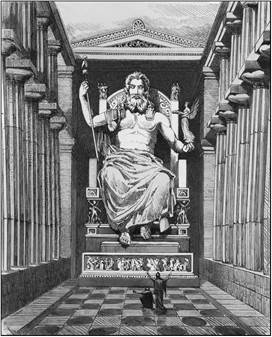
Figure 17-3: Pheidias’s statue of Zeus.
Bright-eyed and colourful
Two important elements in Greek sculpture of all periods were the use of colour and painted details. These days, when you visit a museum or look at photos of surviving figures, you see faded bronze and marble forms with big, open, sightless eyes. These sculptures were originally very different: Eyeballs and pupils were painted as well as the clothes (drapery) and any weapons or other items. Statues of the gods were meant to be intimidating; in their original painted form they would have been. Covered with red, black, and gold paint the images were meant to emphasise the awesome power of the gods.
● Lysippus of Sicyon (circa 370-315): Lysippus produced a huge variety of pieces at the end of the Classical era and the beginning of the Hellenistic. Mostly, these were new and different versions of gods, but his most famous image is the head of Alexander the Great (Figure 17-5), which ancient sources said was the most lifelike portrayal of the king.
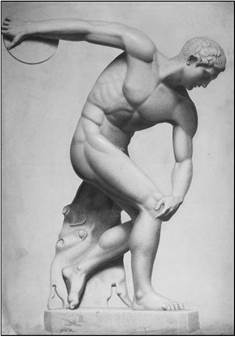
Figure 17-4: Myron’s Discobolus.

Figure 17-5: The head of Alexander the Great, by Lysippus.
Surveying Hellenistic sculpture: Art mirrors life
During the Hellenistic period (330-30 BC) a new aesthetic emerged. After Alexander the Great’s conquests broadened the horizons of the Greek world, the subjects and representations that sculptors chose changed too. While they still produced images of heroes and gods, they also developed an interest in more human subjects of a different type, such as children and older adults, than the idealised youths of the Classical period.
Although works still reflected an accurate portrayal of the human form, depictions became less stylised and more realistic. One of the most famous Hellenistic sculptures is of a drunken old woman - a subject and treatment that would never have interested earlier sculptors.
Take a look at the bronze sculpture of a boxer in Figure 17-6. This figure was produced in the second century BC. Although he’s an athlete, he looks tired after a bout - like you’d expect him to be. His physique is almost overdeveloped, like a WWF wrestler, and if you look closely you can see his broken nose and damaged ‘cauliflower ears’. This sculpture has some of the idea of mimesis (see the earlier section ‘Contemplating Classical sculpture: Even better than the real thing’) without anything aspirational. This is a worn-out, past-his-prime boxer, after one bout too many.

Figure 17-6: Second century BC bronze sculpture of a boxer.
Inviting the Gods to Dinner: Greek Vase Painting
Along with bronze and marble sculpture, the other major area of ancient Greek art was the painting of pottery. Clay was one of the biggest natural resources in Greece, used for roof-tiles, small sculpted figures, and house bricks. The quality of the clay varied depending on where you were in ancient Greece but the skill in using the potting wheel and correctly firing the pot was more influential on the quality of the finished product than the clay itself.
The trade of pottery was one of the most prevalent practices and the closest that the Greeks had to a modern manufacturing industry. Greek pottery was exported all over the Mediterranean. Different regions developed their own individual styles, some of which were quite sought after. Some of the vase-painters became renowned, although never as much as the sculptors because sculpture was perceived as being a much higher art form. In most cases painters also made the pots themselves.
Getting into shape
Although the patterns and designs on pottery varied, the actual objects themselves took the following forms:
● Amphora: This was the standard type of big vessel used to transport large quantities of wine or oil. The name came from its distinctive double-handle design.
● Crater: This vessel looked like a large cup, but the Greeks used it as a mixing bowl where water was combined with wine.
● Skyphos: This standard cup form usually featured a handle on each side. Often the bottom inside was also decorated with a painted image.
● Lekythos: These small delicate jars were used to keep oil or, occasionally, perfume although this was usually sold in much smaller quantities.
Many other popular pottery shapes existed during the age of ancient Greece, including numerous different types of vases such as hydria and even wine coolers known as psykters.
The beautifully decorated pieces that survive in museums are generally examples of the ancient Greeks’ most precious items that probably weren’t for everyday use. Think of these as the equivalent of the best dinner set that you get out for special occasions.
Vase painting basics
Just like sculpture (see the earlier section ‘Surveying Greek Sculpture: Men with No Noses’), the development of Greek vase painting went through a number of very clear phases, as the following sections explain.
Early vase painting (1050-700 BC)
Like sculpture, very early Greek vases mix geometric patterns with very Eastern-looking, Egyptian-style depictions of humans and animals. Sometimes the illustrations involved fantastical creatures from mythology such as the monsters that fought with Heracles (described in Chapter 20).
Black-figure painting (600 BC onwards)
The earliest form of truly Greek painting is known as black-figurepainting. Clay red vases from this period are decorated with figures in silhouette usually depicted in black with red or white highlighting. The artist delicately incised the details onto the painted figures and into the clay.
Modern scholars attribute the development of this style of painting to the city of Corinth (see the Cheat Sheet map) in about 720 BC. By the middle of the seventh century BC artists throughout the region used the technique.
The most popular subjects during this period are inspired by mythological stories. The images are usually depicted frieze style, meaning that one elaborate illustration stretches all around the pot and shows figures interacting with each other. Vivid and complex scenes capturing a range of emotions were often included in the illustrations.
Figure 17-7 shows black-figure details on an amphora that was painted by a man called Exekias in around 540 BC. The vessel shows the Greek warrior Achilles fighting the Amazon queen Penthesilea during the Trojan War (see Chapter 20). According to the myth, as Achilles struck the killing blow, his eyes met Penthesilea’s and he fell in love with her. The painter has managed to convey this complex and poignant moment by using a simple silhouette technique.
Another thing to notice about the vessel in 17-7 is Penthesilea’s very white face. During this period women were often painted with white faces, whereas men were portrayed totally in black. The reason was that upper class ancient Greek women were expected to spend most of their day indoors (see Chapter 14). Men were tanned by the heat and the sun, but women remained pale.

Figure 17-7: Example of black-figure vase painting by Exekias.
Apelles: The lost master
The most famous of the white-ground painters was a man called Apelles of Colophon, who was active in the fourth century BC. Later writers enthuse over Apelles's genius and talent for mimesis (see the section 'Contemplating Classical sculpture: Even better than the real thing'), claiming that his works were so lifelike that people tried to eat the fruit he painted and horses neighed at his equine images. Sadly, modern historians must take the ancient scribes' word for it; nothing of Apelles's work survives.
Red-figure painting (circa 525 BC onwards)
Around 525 BC a new style of painting - known as red-figurepainting-was developed in Athens. This technique was a complete reversal of black-figure painting, with the background now black and all the figures appearing in the red of the clay. This approach allowed the detailing to be much more intricate as details were now painted onto the clay instead of being incised as with black-figure work. Over time, the depictions of human anatomy and clothing become more precise - like the effects achieved by sculptors of this era.
Artists could also create much more complex scenes. Notably, red-figure painters began including more than one image on a piece, sometimes showing two or more scenes that may have some kind of linking theme.
A red-figure skyphos was painted around 470 BC showing the young Heracles on his way to school followed by an old woman. The image is incredibly detailed, and you can easily make out the difference in age of the two characters. Heracles stands in the style of Classical sculpture (see the earlier section ‘Contemplating Classical sculpture: Even better than the real thing’), and you can even see the tattoos on the old woman, suggesting that she may be from Thrace where this was a common practice.
White-ground painting (circa 475 BC onwards)
One last style of vase painting was inspired by a technique used by painters working on large-scale interior projects. Although little of this type of white-ground painting survives, historians believe artists covered interior walls or wooden panels with white paint or plaster to produce a neutral background.
During the fifth century BC, some painters began to adopt this style for working on vases. The most common use for white-ground painting on vases was to decorate the lekythos that the Greeks buried with their dead. These lekythos were filled with oil and accompanied the deceased to the underworld. (See Chapter 21 for more on ancient Greek burial practices.) Most white-ground vases haven’t survived very well because the vessels weren’t meant for frequent handling.
Finding Beauty Elsewhere: Other Arts and Crafts
Of course, the Greeks didn’t just produce pots and sculptures. They were expert at a number of other art forms:
● Clay figures were immensely popular. These mini sculptures followed the aesthetics of their large-scale counterparts. See the earlier section ‘Surveying Greek Sculpture: Men with No Noses’.
● Decorative bronzes were cast in the same way as larger metal sculptures. These pieces looked a bit like small versions of the friezes and metopes (smaller sculpted scenes) on temples (described in Chapter 18).
Smaller items like these would have been used as ornaments in houses and were also sometimes given as small offerings to the gods, possibly to represent the person that was asking for help.
The following sections cover a few other artistic endeavours of the ancient Greeks.
Getting dressed: Clothing
Dress-making and fashion weren’t really art forms in ancient Greece, but the garments Greeks wore while going about their daily business had a beauty and simplicity that continues to inspire designers even today.
Materials
Most ancient Greeks - male and female, rich and poor - wore pretty much the same items of clothing. What did vary was the quality of the material used.
Most garments were made of wool, although in some cases linen was used. (Linen was more common for tunics or underclothes; wool must have been a bit itchy for a hot day on the plain of Attica!) White was the standard colour but the Greeks also dyed their wool (Chapter 13 has more details). Wealthier Greek women could afford to wear silk, which was imported from Asia Minor on the silk route from the East.
Types of garment
Nearly all clothes took the form of a cloak or mantle - a single piece of material that could be worn in different ways. This garment was always sleeveless, but often during cold weather it was worn over the top of a tunic that served as an undershirt.
The standard garment for women was the peplos, which was a kind of combined cloak and tunic. It was a large, square piece of cloth, the top third of which the woman folded over and pinned on her shoulders. Most surviving artistic depictions of goddesses show them formally attired in peploi.
Women also often wore veils when they were outside to modestly hide their faces from men. The ancient Greek word for veil literally means ‘little roof’; even though women were outside, they were still kept inside the oikos, or home.
The Greeks didn’t wear trousers and thought them effeminate when worn by men. They were popular in the Persian Empire, and when Alexander the Great began wearing them after conquering Persia (see Chapter 11), this fashion choice proved unpopular with his Macedonian generals.
By the Hellenistic period both men and women wore simpler formal garments known as an himation. The himation was a very long piece of material (up to 3 metres by 2 metres) that you draped around the body and usually supported over the left arm. The gods in the Parthenon sculptures (see Chapter 18) wear them and the Romans later based the toga on this versatile garment.
Looking sharp: Jewellery
In addition to sculpture and vase painting, the other great manufacturing craft in ancient Greece, and elsewhere in the ancient world in general, was the production of jewellery.
The Greeks used precious metals (gold and silver) and semi-precious stones such as bezels in large quantities to produce rings, earrings, necklaces, and bracelets in designs that are still very recognisable today. The fashion for setting a precious stone in a metal band (like a modern ring) became fashionable only around the end of the fifth century BC.
Golden combs and hair slides were also very popular. Sometimes they featured small scenes of tiny figures not much more than a few centimetres high. Incredibly skilled and detailed work, these combs were very expensive.
A great number of examples of this work still survives in museums around the world. They’re hugely delicate and personal items that give a real sense of having been touched and cared for by people from 2,500 years ago.