
Part IV
In this part . . .
After Henry VIII, Elizabeth is the other Tudor everybody knows about; red hair, white face, big ruff, hell of a temper. She was her father’s daughter all right, and more of a man than many of her courtiers. She brought Protestantism and a bit of sanity back to religion, played house with at least two of her noblemen, had her cousin executed and went to war with Spain, the superpower of her age.
She was Gloriana, Orianna, Good Queen Bess. She only had the feeble body of a woman, but she wore the trousers in 16th-century England before trousers were even invented. A lot of people loved her (Leicester, Essex, Ralegh, Cecil, Walsingham) and a lot of people hated her too (Mary of Scots, Philip of Spain, most of Europe).
If Henry VIII was big, Elizabeth was bigger still, if only because she was a woman in a man’s world. Her death in 1603 marked the end of a family whose like England shall never see again.
Chapter 12
In This Chapter
● Making over the Council and Chamber
● Playing the marriage game
● Entertaining Elizabeth
● Playing pirates
● Annoying the king of Spain
Elizabeth took over the reins of government smoothly. Like a breath of fresh air, she cleared out her Court, negotiated with foreign powers, organised the navy and backed overseas voyages. Over it all, she kept everybody guessing about her marriage - would she? Wouldn’t she? Who to? When? Everybody asked and nobody got an answer.
But the first ten years of Elizabeth’s reign were nervy ones: the new queen lived on the edge as enemies closed around her.
Clearing Out the Court
The queen was crowned at Westminster Abbey on 15 January 1559. Paintings of the occasion show the 25-year-old with long golden hair flowing down her back, her dress and stomacher of gold cloth, holding the orb and sceptre in her hands. On her head is a glittering golden crown, set with rubies and emeralds. None of this stuff has survived today - the Crown Jewels in the Tower of London only date from Charles II (1660) - but check them out even so.
This was a different style of coronation to Mary’s or Henry VIII’s or Henry VII’s. Elizabeth’s service was performed by the bishop of Carlisle because the archbishop of York refused to go; and the ceremony was in English as well as in Latin. Protestant pageantry was everywhere you looked - a sign of things to come (see Chapter 13).
Elizabeth’s first job was to sort out her closest advisers.
Purging the Privy Chamber
The Privy Chamber was meant to comprise the queen’s most trusted confidantes (see Chapter 1), so all 23 of Mary’s closest circle got the elbow and were replaced with Elizabeth’s relatives, especially the Seymours, Dudleys and Greys.
Because the monarch was female, ladies-in-waiting were now closest to the queen. They dressed her, bathed her and put her to bed. She can’t have been able to keep many secrets from them. Katherine Ashley was her closest confidante, a sort of mother figure who’d been with Elizabeth since she was a child. Two new girls on the block were Lady Knollys (pronounced Noles) and Lady Carey. Others were the wives and daughters of new ministers (see below).
Some of the men of the Chamber stayed put, like Katherine’s husband John, the grooms and ushers (who looked after horses and opened doors).
Out of a total of 50 Chamber members under Mary, Elizabeth changed nearly 40. If that didn’t send a message as to how the new queen was going to operate, nothing would.
Choosing the Council
When it came to the Council , Elizabeth was more cautious (see Chapter 1 for the Council’s responsibilities). Courtiers could come and go but statesmen were important, and she chose men who hopefully would stay loyal for life. Here’s how the new queen shook up the Council:
● Kicked out: Principal Secretary John Boxall was fired - the man was an ardent Catholic. The dodgy Lord Paget (see Chapter 11 for his views on Elizabeth) was also shown the door, as was Nicholas Heath as lord chancellor.
● New blood: Elizabeth recruited two of the cleverest men of their generation. William Cecil (later Lord Burghley) became the queen’s secretary of state and right-hand man, and Nicholas Bacon became lord keeper of the great seal. Elizabeth tasked these two men with sorting out her Church (see Chapter 13).
● Retained: The old marquis of Winchester stayed as lord treasurer and Lord Clinton kept his job as lord admiral (even though he was a crony of Philip’s). Elizabeth also kept the earls of Arundel, Shrewsbury and Pembroke. They were Catholics, but not rabid, and were intensely loyal to the queen.
About a dozen of Mary’s advisers stayed on.
It was all about balance. When Elizabeth came to the throne she had a country that was broke, divided, unhappy and disease ridden. She had to mend fences as well as jump over them. So the old faces in the Council represented continuity and experience, and the new ones, like the earl of Bedford and Lord Cobham, stood for change. Elizabeth’s Council was 20 strong, half the size of Mary’s.
This Council was the first one without a single churchman in it. The councillors were mostly elderly (the marquis of Winchester was 85) and were either university men or lawyers from the London Inns of Court, but not one of them had a religious background. Even when Matthew Parker was appointed archbishop of Canterbury in 1559 he couldn’t join Elizabeth’s exclusive club.
Marrying the Job
From Sarah Bernhardt to Cate Blanchett, actresses have longed to play Elizabeth because her reign has it all - vicious politics, terrible tortures, naval battles on the high seas and discoveries of the New World. And the story of Elizabeth’s personal life is just as colourful - child molestations, sexual abnormality, did she/didn’t she, and if so, with whom . . .
Getting a picture of Elizabeth's sexuality
So what do we know about Elizabeth’s sex life?
● She was examined by doctors at the age of 13 and we don’t know a) why and b) what their findings were. Today we still wonder whether Elizabeth had some sort of physical abnormality that made sex difficult or impossible.
● She was seduced at 14 by Lord Thomas Seymour in 1548. He liked to chase her through the garden and slap her backside. In a bizarre scene, Catherine Parr once held the girl down while Seymour cut Elizabeth’s dress to gawp at her undies and presumably the body underneath.
Weird or what?
● Descriptions of the princess/young queen tell us she was attractive, with golden hair, a high forehead (considered a sign of intelligence) and very beautiful hands with long fingers that she fluttered while she talked.
She liked wearing particularly low cut dresses, not always on the most appropriate occasions.
● She was a notorious flirt, fluttering her eyelashes at ambassadors like Count Feria (see Chapter 11), courtiers like Robert Dudley (see the later section ‘Dallying with Dudley’) and even the odd servant.
Looking for Mr Right
It was expected - and Elizabeth’s first Parliament suggested - that the queen would marry. So it wasn’t a matter of whether but whom, and Elizabeth had a number of options:
● The duke of Savoy: Been there, done that. In Chapter 11 you see that this was Philip’s idea to shut up his sister-in-law and remove her as a threat to Mary.
● The earl of Arundel: A nice old boy, but at 46 he could’ve been Elizabeth’s father.
● Sir William Pickering: A handsome soldier but he made no effort.
● Philip of Spain: He put himself forward (largely as a matter of duty) as early as 10 January 1559, before the coronation. Elizabeth turned him down (politely) on the grounds of the Leviticus warning about marrying your dead wife’s sister that had caused Henry VIII so much grief (see Chapter 6).
Parliament wasn’t best pleased when they asked Elizabeth about marriage and her answer was, ‘And in the end, this shall for me be sufficient, that a marble stone shall declare that a queen, having reigned such a time, lived and died a virgin.’ Well, okay; Parliament had other problems just then, but they weren’t going to let the matter drop.
Wanting it all
Elizabeth didn’t want ‘a man about the kingdom’, as Mary had with Philip, but marriage and child bearing was still at the heart of the Tudor problem. She was the last child of Henry VIII and beyond her the line got very murky indeed.
Even if Elizabeth had no physical problems in conceiving, the idea of marriage can hardly have appealed. She’d seen Mary’s unhappiness first-hand and her life had been dominated by her father’s string of marital mess-ups (see Chapter 5).
The Enabling Act of 1554 had ungendered the crown - the queen was a man as far as the Constitution went. Even so, Mary’s marriage to Philip (see Chapter 11) had shown everybody the risks. A foreign husband would have his own agenda, and as king he’d be able to use England in any future alliance or war. A home-grown husband would be more acceptable to the foreigner-hating English, but he’d stir up the old family squabbles that had made the Wars of the Roses possible (see Chapter 2).
With hindsight, we can see that all Elizabeth’s flirtations with proposals (see the following section) were a bluff, but it wasn’t like that at the time. Each proposal seemed genuine and Elizabeth had weigh each up carefully.
The political and the personal
Tudor marriages weren't to do with love; they were all about politics. This is what was happening in the politics of 16th-century Europe:
● Spain was becoming the superpower, thanks to silver from the New World. Spain's power led to clashes with Barbary (North African) pirates, the Ottoman (Turkish) Empire in the east and the Dutch (see Chapter 15).
● France was falling apart. The accidental jousting death of Henri II in 1559 led to a power struggle and years of warfare called the Wars of Religion, which let in the English, the Spaniards and the Germans.
● The Counter-Reformation was a comeback by the Catholic Church that brought all kinds of problems involving Spain, England and of course the papacy. Elizabeth changed marital direction depending on who was top dog in Europe. By the 1560s the Roman Empire was on its way down, but Spain was on its way up. As Spain got pushier in the 1570s, however, Elizabeth went right off the idea of a Habsburg connection.
Toying with the talent
European princes were lining up as soon as Elizabeth was crowned.
● Eric XIV of Sweden: He’d already tried it on before Mary died but the Council turned him down because he was a Lutheran. Elizabeth rejected Eric, partly because his little brother, John, duke of Finland, was sent over to woo her. She may have known Eric was as mad as a March hare, paranoid and suspicious to the point of having several courtiers murdered. He was dethroned in 1569 and spent his last years writing psalms before somebody poisoned him with arsenic. Good call, Elizabeth!
● Charles of Austria: He was Philip’s cousin and the son of the new Roman emperor, Ferdinand. He was Catholic but ‘flexible’ and not in line for the throne so he was free to pop over for a life of bliss with Elizabeth. Charles wasn’t very keen but Elizabeth pretended to be (at first) and William Cecil liked the idea. After two years of Elizabeth putting religious and financial obstacles in the pre-nup, Charles gave up.
● Henri of Valois, duke of Anjou: He was the younger brother of King Charles IX of France and son of the terrifying Catherine de Medici. Elizabeth only considered him as a possible rebuff to the ever more threatening attitude of Philip II of Spain. Henri was only 18 at the time and a rabid Catholic. Negotiations dragged on between 1569 and 1572 when it all went to hell in a handcart when Elizabeth discovered that Catherine de Medici and Henri were up to their necks in the slaughter of 40,000 Protestants in Paris on St Bartholomew’s Day, 24 August. Another narrow escape!
● Francois, duke of Alen^on: Catherine de Medici (see the previous bullet) had other sons and wasn’t going to give up a crack at England that easily. As pushy mothers go, de Medici takes some beating.
Francois was her youngest boy and Secretary of State Lord Burghley was getting desperate. The queen was 39 - only three years younger than Mary when she died - and her biological clock may well have stopped already. Elizabeth was old enough to be Alengon’s mother, but by 1578 she seemed keen to start on him again. Spain was on the rampage (see ‘Sailing in New Directions’, later in this chapter) and the duke of Anjou (as Alengon was by now) seemed a likely prospect to keep Philip at arm’s length.
The protestant John Stubbs wrote The Gaping Gulf as an attack on the Anjou marriage. The poet Spenser had a go at it too in Mother Hubbard’s Tale but he got away with it, probably because he was usually buttering Elizabeth up with stories about the Faerie Queen. Stubbs had his right hand cut off (it was an Elizabethan belief that whatever body part had offended should be removed) but still had the guts to sweep off his hat with his left hand and shout ‘God save the queen!’ before fainting. Cool, or what?
Marriage negotiations with Anjou went on until 1581 (by which time Elizabeth was 48), and when he arrived in England Elizabeth went all schoolgirl over him, giving him a ring and telling everybody they were in love. This was either a rush of blood to the head or a scam of some kind all along, because days later Elizabeth told Anjou marriage was impossible. ‘Goodbye’ was all she wrote.
In this whirlwind ride through marriage proposals from foreigners, we’ve travelled over 24 years. As each one passed, the queen’s likelihood of pregnancy diminished and the succession faded. The quest for a groom was all about politics - Elizabeth’s heart, though not her head, lay elsewhere.
Dallying with Dudley
Did they? Didn’t they? The one man who undoubtedly held a special place in Elizabeth’s heart was Robert Dudley, whom she made master of the horse and earl of Leicester. This book contains so many Dudleys (check them out in Chapters 7, 8 and 9) that for clarity’s sake we’ll call this one Leicester, although he wasn’t given the title until 1564.
Childhood sweethearts?
Leicester was the fourth son of the duke of Northumberland and was almost exactly the same age as Elizabeth. They knew each other well and may have had joint lessons with the same tutor. At the age of 17 Leicester married Amy Robsart, the daughter of Sir John Robsart, a Norfolk gentleman.
Three years later Leicester was imprisoned in the Tower for his part in his father’s attempt to keep Mary off the throne (see Chapter 9) and he found himself a cell or two away from Elizabeth. The story goes that he lent her cash when they were released, although she was richer than he was. William Cecil, who watched over Elizabeth like a mother hen (he’d run her estates even before she became queen), found Leicester pushy and didn’t like him.
Favouring the favourite
When the queen made Leicester her master of the horse, ears at Court began to prick up.
The first master of the horse was Thomas Brandon, brother of William, who’d saved Henry VII’s life at Bosworth (see Chapter 2). Then, under Henry VIII at the Field of the Cloth of Gold (see Chapter 3), the master of the horse was Henry Guildford. Leicester held the job for 14 years. The job was a government appointment until 1924, changing with each ministry; since then it’s been permanent. Next time you watch the Trooping of the Colour on TV, check out the master of the horse - he’s the guy with a scarlet tunic and cocked hat riding the white horse. You can’t miss him.
Because the position involved running the royal stables as well as advising on cavalry horses for the army, it gave Leicester unlimited access to Elizabeth who, like her father, was very keen on riding and hunting. Elizabeth had Leicester’s apartments moved nearer hers and she popped in to see him at all hours. Her ladies, who’d usually be present as chaperones with any male visitor to the queen, were told to make themselves scarce.
So were they actually lovers? Here’s the evidence:
● The Spanish ambassador, de Quadra, saw the couple canoodling on a barge in 1561.
● When Elizabeth made him earl of Leicester, people noticed her tickling his neck as she put the collar on.
● In August 1565 Leicester rode under the queen’s window on his way back from a hunt. She appeared at the casement ‘undressed’ (relax, guys, that really means in her nightie, but in Tudor times nighties were naughty).
● The French ambassador told the Spanish ambassador in 1566 that Leicester had slept with the queen on New Year’s night.
● There were rumours that Elizabeth had given birth to a son - Arthur Dudley - who was spirited out of Hampton Court and brought up by somebody else.
When Elizabeth was ill with smallpox in October 1562 and thought she was dying she said that she loved Lord Robert dearly, as God was her witness, and that nothing improper had ever passed between them.
In the various films on Elizabeth, Leicester hardly gets a mention until Cate Blanchett’s version. Joseph Fiennes is a swaggering, petulant Leicester (and a hell of a dancer), childishly upset because the queen has to spend time with various suitors, but 21st-century audiences have to have it spelled out, so Leicester and the queen go to bed.
Did they really? Didn’t they really? We’ll never know. The important thing is this - whatever their relationship, Elizabeth kept Leicester in his place, once shouting at him, ‘God’s death [Elizabeth swore like a trooper] my lord, I will have here but one mistress and no master.’ The earl of Leicester kept a slightly lower profile after that!
The man most alarmed by the Leicester fling was William Cecil. Leicester was married and the scandal, if the affair was exposed, might well lose Elizabeth the throne (her first years were pretty insecure, with two serious illnesses and a Church to sort out; see Chapter 13.) Cecil knew that Leicester wasn’t very bright and was a poor judge of character. At the very least, any marriage would upset the Council’s apple cart and Cecil had set his sights on Archduke Charles of Spain.
Clearing the path for marriage: by foul means?
By 1560 the queen seemed to be in love. De Quadra, who’d taken over from de Feria as Philip’s watchdog, spread the rumour that Elizabeth and Leicester were planning to poison Amy Dudley so they could marry. He called Leicester ‘the king that is to be’.
On Sunday 8 September Amy told all her servants at the family home at Cumnor, Oxfordshire to go to a local fair at Abingdon. Only three ladies stayed with her and they ‘played at tables’ (probably chess or backgammon). At some point, Amy got up, left the room, tripped on her way out and fell downstairs. Her neck was broken. What are the options?
● Accident: You try walking in a heavy Elizabethan farthingale dress (on the other hand, Amy was used to it).
● Suicide: Had she heard the rumours about hubby and the queen and decided to end it all? On the other hand, throwing yourself down the stairs isn’t a certain way to kill yourself.
● Murder: If so, who? Leicester, obviously, but he wasn’t there at the time. Somebody suggested one of his cronies, Anthony Forster.
Whatever actually happened to Lady Dudley, the inquest jury returned an accidental death verdict. But the murder rumours wouldn’t go away. Leicester didn’t help himself by not going either to the inquest or the funeral, but nevertheless, as was customary, he had to stay away from Court. There were rumours of jury tampering and counter-claims that Amy Dudley had breast cancer that had caused depression.
Faking it as a pale redhead
Remember that scene at the end of Elizabeth when Cate Blanchett decides to dump her live-in lover Robert Dudley and become a professional virgin, complete with ghastly white make-up and curly red wig? Well, it never happened. The make-up and wig belong to a much later period in her life and were supposed to make her look more attractive, not less, and Dudley hung around until his death in 1588. Elizabeth only pushed the virgin queen bit when it was obvious she was past child-bearing age.
If it was murder and Leicester was behind it, the whole thing backfired because the scandal made Elizabeth see sense and the idea of marrying went out of the window.
Even so, on paper Leicester prospered. He got his earldom in the September of 1564 and was made a member of the Privy Council. This meant that Cecil could keep an eye on him but it didn’t stop the reckless Leicester from getting involved in a coup against Cecil in 1569. It failed; he apologised to the queen; they kissed (maybe!) and made up.
Stowing hot and cold
After 1569 the relationship between Elizabeth and Leicester changed with the seasons. In 1578 he secretly married the countess of Essex, Lettice Knollys - so she became Lettice Leicester! Elizabeth was very touchy about her ladies, expecting to be told their every move and whim. After the hush-hush wedding, the Leicesters were barred from Court for a while.
Later, in 1585, Elizabeth cooled down and made Leicester her agent in the Low Countries (today’s Netherlands). He was soon feathering his nest with the local Government, the Estates General. Elizabeth recalled him in disgrace.
When Leicester died in 1588, the queen was genuinely heartbroken. She always kept his last letter, a reminder of the nearest thing to a love affair she’d ever known.
Riding a Cock Horse
One way in which Elizabeth kept in touch with her country in the days before television and the queen’s speech at Christmas was to go on progresses, riding with half her Court through the south of England. She never went too far from London, probably because of the risk of a coup if she did.
The old nursery rhyme goes:
Ride a cock horse to Banbury Cross,
To see a fine lady upon a white horse.
Rings on her fingers and bells on her toes,
She shall have music wherever she goes.
And if the fine lady isn’t Elizabeth, who is it?
The company travelled less than 10 miles a day and put up at other people’s country houses, where they expected to be fed, wined and entertained - at ridiculous expense.
On 4 September 1566 the queen went to Oxford. What for?
● She listened to sermons and disputations by the university’s scholars. She understood their Latin perfectly and this impressed the scholars - their queen was intellectual, just like them.
● She watched a play, Palomon and Arcite, performed in Christ Church College, proving how much she loved the theatre and could identify with classical drama.
● She honoured Robert Dudley whom she’d appointed as chancellor of the University in September of 1564.
● Most importantly of all, she made sure that the town and the university accepted her as supreme governor of the English Church and let them know what she thought of heretics.
Just like her father, Elizabeth enjoyed glittering social occasions. In Coventry in 1565 she ‘won the hearts of all her loving subjects’, according to the town’s mayor, but the high points of her progresses came in the mid-1570s.
The queen was in Warwick in 1572 and Bristol in 1574, and in 1575 she pulled out all the travelling stops by visiting Worcester, Lichfield, Reading, Woodstock and Windsor. In Warwick the entire town turned out to see their monarch and the recorder of the town read out a five-page (count them!) history of the place. At the end Elizabeth sent for the man: ‘Come hither, little recorder.’ He knelt and kissed her hand. She said, ‘It was told me that you would be afraid to look upon me or to speak boldly, but you were not so afraid of me as I was of you.’
Next time you’re in Warwickshire, check out Kenilworth Castle. It’s a ruin today and if you stand in the low ground to the south of the curtain wall and shout, you’ll hear your voice come back to you - that’s because you’re in Echo Fields. The area was deliberately flooded in 1575 by Lord Leicester who lived there, and when the queen arrived there was boating on the lake and the whole place was lit up by fireworks. The knot garden where they walked is still there. Okay, so Leicester had the hots for the queen and wanted to marry her, but the three-week stay must have seriously damaged his bank balance. Leicester put on poetry by George Gascoigne, top poet of the day, bear baiting, hunting, music, dancing and incredible banquets. Somebody painted Elizabeth and Leicester dancing the Volta; the cheeky nobleman is throwing the queen in the air to wild clapping and music - and she’s loving every minute of it!
But the progresses weren’t just remembered for their lively parties. It was very unfortunate that the queen’s progress to Norwich in 1579 went horribly wrong. Norwich was delighted with the usual speeches, music, hunting and frivolities. But it was a bit like hosting the Olympic Games today - huge prestige but at a price. Thousands of townsfolk caught bubonic plague - the Black Death - from somebody in the entourage and thousands died before the disease burnt itself out.
For about six years before the Armada (1588; see Chapter 15) the progresses stopped. But they started again in the 1590s when the queen was old and perhaps wanted to recapture her youth - because she was worth it. She often ordered her coachman to drive her into the thickest of the crowds to talk to the ordinary people and she stood up on the carriage steps and thanked them.
On one of her later progresses Elizabeth took the opportunity to kiss and make up with an old acquaintance. She’d once put Edward Seymour, earl of Hertford, in prison for daring to marry Catherine, the sister of Jane Grey. When she arrived at his home in Odiham in Hampshire in September 1591, all seemed forgiven. After three days of fireworks, feasts and fun, a choir sang ‘Come Again, Fair Nature’s Treasure’ as the queen left.
Elizabeth made her last progress, through Middlesex and Buckinghamshire, in the last year of her life.
Sailing in New Directions
Ever since Christopher Columbus had gone West in 1492, Europe had been poised on the brink of a brave new world. Henry VII had famously backed the wrong ship (Cabot rather than Columbus - see Chapter 2), and government investment in overseas trade and exploration was slow to take off under Edward VI. Under Mary, the investment had ground to a halt because she had no interest in the trade and exploration and had clashed with the largely Protestant merchants of the City of London on religious grounds.
The livery companies of the City were like stockbrokers today. They made huge profits buying and selling and often lent money to the Crown. Leaders of the mercers’, goldsmiths’ and fishmongers’ companies were also courtiers, so close government links existed. Thomas Gresham continued as the crown agent in the Low Countries so business picked up again under Elizabeth (see Chapter 9).
Slaving with Hawkins
John Hawkins was the son of a Plymouth merchant who moved to London in 1554 to work closely with the Navy Board and the City, both of which invested in overseas voyages. He was determined to cash in on one of the biggest money spinners in history - the slave trade (see the nearby sidebar).
One problem was that Spain and Portugal had got the jump on the English and had already grabbed several markets. That would all change in 1562 when Hawkins hijacked a slave ship.
The queen is in her counting house
Elizabeth seems to have inherited her grandfather Henry VII's careful ways with money (see Chapter 2). Her prudence was quite handy in the Protestant days of Edward because she could wear the dull clothes that were the fashion of the time and these were cheap. Under Mary she was genuinely strapped and got used to checking her figures herself. She saved £1,500 in 1552 largely because she only gave away 7 pounds 15 shillings and 8 pence to charity.
In the year of the Armada (1588 - see Chapter 15) Elizabeth actually sold bullets to her own soldiers, and when the earl of Essex (see Chapter 16) came back from his expedition to Cadiz she wanted an account of every penny spent. She worked out that in 1599 the king of France owed her 401,734 pounds 16 shillings and 5 1/2 pence! She told her Parliament in 1566, 'I thank God that I am imbued with such qualities that if I were turned out of my realm in my petticoat, I were able to live in any place in Christendom.'
Elizabeth borrowed more and more from the City of London and less from Antwerp, but she always had ongoing cash flow problems.
The slave trade
Slavery was widespread in the ancient world of Greece and Rome, which Renaissance men looked back on with a mixture of awe and fondness. In Tudor England men like Hawkins were muscling in on an institution that was already making serious money in the Middle East, Africa and the Americas - the movement of black Africans, in chains, to wherever they were needed for back-breaking manual labour. Between 1450 and 1870 an estimated 11.5 million slaves were taken to the Americas, mostly from West Africa (then called, for obvious reasons, the Slave Coast).
Arabs and Europeans benefited from the slave trade and African development was held up. Nobody, even devout Christians, seems to have had a moral problem with buying, selling and owning somebody else in the Tudor period.
Voyage #1 (1561)
Hawkins got hold of slave cargoes on two ships and sailed them to Tenerife in the Canary Islands (a gorgeous holiday destination now - check the islands out!). He sold all his slaves to Spanish colonists in exchange for hides, sugar, ginger and pearls. The sales were illegal because Hawkins wasn’t a Spaniard (see Chapter 11 for Philip II’s ruling on this) and his goods were confiscated in Seville. The Spaniards called him a pirate (which is fair enough), but Hawkins still made a huge profit.
Voyage #2 (1564)
Nothing succeeds like success and suddenly everybody wanted in on Hawkins’ second trip. Several councillors, like Cecil and the earl of Pembroke, invested and the queen, ever with an eye to the main chance, gave Hawkins a fully armed ship stuffed with provisions - ‘God bless all who sail in her’.
This voyage took royal involvement to a new level. Monarchs had leased ships to merchants occasionally in the past, always going to European ports, but Elizabeth now showed a new commitment to sea power.
Once again the Spaniards and the Portuguese objected, and once again Hawkins bullied people into buying from him. At various places in the Caribbean, Hawkins claimed to be trading on behalf of the queen (not true) and his chat placed Elizabeth and England in troubled waters. But because most people were making loads of money out of the voyages, they thought it was worth the hassle.
The not-so-common market
Nearer to home Elizabeth faced commercial problems. After the slump in the 1550s English cloth exports had picked up a bit but not enough. Why?
● Dutch Protestants were complaining about Philip's high-handed government of the Spanish Netherlands and England sympathised with them. This in turn niggled with the merchants of Antwerp, who put petty restrictions on cloth being shipped through the port.
● Margaret of Parma, the regent of the Low Countries, put an embargo on English cloth in 1564, so trade now switched to Emden in Germany. Cecil thought the move would widen the market; the merchant adventurers disagreed. The embargo ended in 1566 but others had now grabbed the markets, and when Margaret was replaced by Philip's hardliner, the duke of Alba (see Chapters 10 and 11), the English had to leave again.
Giving Lovell a go
Anglo-Spanish relations were at a low in 1566 and the Spanish ambassador demanded that the queen stop Hawkins from his slave-trading raids by not letting him sail. A voyage by the inexperienced John Lovell was entirely backed by private enterprise and came back in September 1567 with a small profit. At least Lovell’s trip didn’t worsen the diplomatic situation.
Voyage #3 (1567)
Elizabeth changed her mind (she was good at that) and backed another Hawkins trip in October 1567. He sailed from Plymouth (one of the major ports in the West Country - check out the town’s links with Francis Drake and see his statue on the Hoe) with four of his own ships and two provided by the Crown. Again, he claimed to be sailing under the queen’s commission and again, it wasn’t true.
Things got tough for Hawkins in Guinea late in 1567. The Portuguese authorities there had had a tip-off and he lost men in a fire fight before getting involved in black tribal warfare in today’s Sierra Leone. He still got his slaves, though, and sold them at Cartagena in Columbia before heading home.
Harassing Hawkins
On the way back to England from his third voyage, Hawkins’ luck ran out.
One of the ships in his fleet, the Jesus of Lubeck, belonged to the queen. It was leaking badly and Hawkins put in to San Juan d’Ulloa, the port of Mexico City. Unfortunately, a Spanish fleet arrived at the same time, bringing the new viceroy of the Indies, Don Martin Enriquez.
All hell broke loose and Hawkins had to cut and run, leaving the Jesus and her crewmen behind. At sea, Hawkins’ remaining ships became separated, Francis Drake’s Judith making so much headway that Hawkins accused him of desertion (hot tempered lot, these sea dogs!). Hawkins limped into Vigo and got back to England in January 1569 with only a handful of his original crew.
Hawkins had a go at Drake and the Spanish authorities in Mexico, demanding huge compensation via the Admiralty Court. He hadn’t got a leg to stand on of course, because he shouldn’t have been in San Juan d’Ulloa in the first place.
Elizabeth had shot herself in the foot and relations with Philip went further down the tubes.
Menacing from Spain
Hawkins and Drake’s ‘Boys’ Own Adventures’ (see the nearby sidebar ‘El Draco’) didn’t impress the Spaniards. Philip demanded compensation for the looting of the Spanish colonies and this renewed aggression may have been why Elizabeth started smarming around France and the duke of Anjou again (see the earlier section ‘Toying with the talent’).
Elizabeth continued the complicated dance of diplomacy and marriage negotiations. She knew that her navy was fast becoming (thanks to John Hawkins - see Chapter 15) the best in the world and that Philip was probably behind various plots on her life (see Chapter14).
Turning a blind eye to the privateers
Since the 14th century ships had sometimes acted on behalf of the crown with letters ofmarque, the official green light to attack foreign ships and steal their goodies. A slice of the action went to these pirates, who called themselves privateers, and to the rest to the Crown. If challenged, as Elizabeth frequently was by Spain, she'd deny all knowledge and tut tut about her unruly subjects. The Hawkinses of Plymouth were at the cutting edge of this privateering and Elizabeth's attitude was typical of her fence-sitting for England.
Philip II had said that England couldn't take part in the American trade, which was exactly what Hawkins did. Francis Drake, Walter Ralegh, John Hawkins and Martin Frobisher were among the famous names (mostly from the stroppy West Country) who attacked Spanish and Flemish ships in the Channel and the Western Approaches. (See the map in Chapter 15).
Nearer to home, the captain of the Isle of Wight, Edward Horsey, was taking a cut from French smugglers and pirates operating out of Mead Hole on the island (it's now a tourist spot in the grounds of Queen Victoria's Osborne House - check it out). Elizabeth turned a blind eye to all of this, knowing that much of it would annoy Philip and that later, when the Dutch revolt in the Spanish Netherlands broke out, he'd keep his warships elsewhere.
El Draco
Francis Drake was making a name for himself by the 1570s. He hit a Spanish silver convoy near Nombre de Dios on the coast of Panama in 1573 with French Huguenots (Protestants), neatly offending Spain, Catholics and the French Government in one swift movement. Both his brothers were killed, but he was now feared by the Spaniards. El Draco was a clever pun on his name - in Spanish it means The Dragon or The Devil.
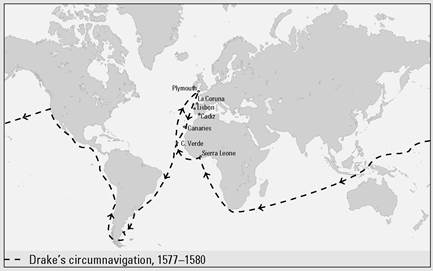
In November 1577 Drake set sail from Plymouth to explore the South Pacific. His investors included Leicester, Hawkins, the lord admiral and other members of the Council and Navy Board. The queen gave him one ship, the Swallow.
The exploration turned into a mega raid. Drake executed his number two, Thomas Doughty, for insubordination and hit the Spanish colonies' towns on the West Coast of South America. He got to Southern California, looking for the mythical Straits of Anian, which were said to link the Atlantic with the Pacific. Good seamanship and luck brought him across the Indian Ocean, round the Cape of Good Hope to Sierra Leone by July 1580.
Drake came home a hero, the best known privateer of his day and the first Englishman to sail round the world, and he brought back a lot of loot. The queen was delighted and knighted Drake on the deck of his ship, the Pelican (renamed the Golden Hind), at Deptford on the Thames in London.
Philip, on the other hand, knew that English pirates had been attacking his treasure ships for years. It could only be a matter of time before outright war broke out.