
2
On April 12, 1945, as cardiovascular mortality was nearing its peak in the U.S., President Franklin Delano Roosevelt succumbed to a massive cerebrovascular hemorrhage (stroke) at age 63. Although his death shocked the American public, which had just elected him to his fourth term as president five months earlier, we know that FDR was suffering from malignant hypertension (his last blood pressure was a sky-high 300/190 mmHg) and advanced heart failure.1 Indeed, one had only to look at the gaunt figure sitting between Churchill and Stalin at Yalta in February 1945, cigarette in hand, two months before his death, to realize that death was imminent.2
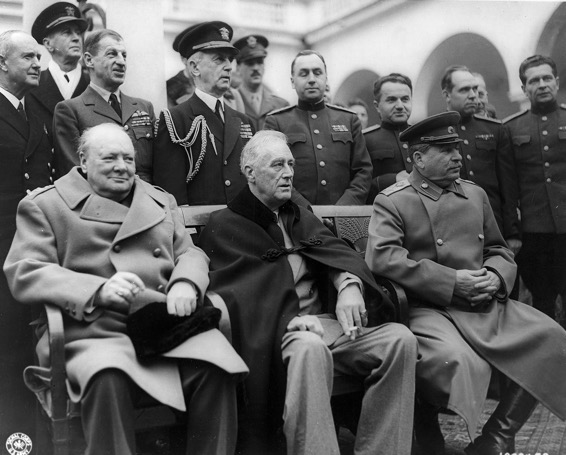
Crimean Conference. (From left) Prime Minister Winston Churchill, President Franklin D. Roosevelt, and Marshal Joseph Stalin at the palace in Yalta, where the Big Three met. National Archives, photo no. 111-SC-260486. http://loc.gov/pictures/resource/cph.3a10098/
From 1935 to 1937 to 1941, FDR’s blood pressure rose from 136/78 to 162/98 to 188/105—a level that would now be considered alarming. But at that time, although his 105 diastolic pressure (the blood pressure while the heart was between beats) was considered moderately elevated, his 188 systolic pressure (the blood pressure while the heart muscle is contracted) was considered a clinically inconsequential result of the normal arterial stiffening accompanying aging. No treatment was prescribed. No one advised him to stop smoking. It was not until 1944 when his chest X-ray showed an enlarged and failing heart, that the clinical significance of his high blood pressure was appreciated, and treatment—with digitalis and salt restriction—was initiated. It was perhaps the best that medicine could offer at that time, but it was too little, too late.
The profound ignorance and impotence of the most eminent medical specialists of the age to deal with the advancing cardiovascular pandemic, as illustrated by the fate of FDR, was the backdrop for the passage in Congress of the National Heart Act.3 This act, which was signed into law by Harry Truman in October 1947, called for the establishment of the National Heart Institute as part of the National Institutes of Health (NIH) and for the design of an epidemiologic study of cardiovascular disease. Framingham, a middle-class (mostly white) Massachusetts factory town of 28,000 residents about 23 miles west of Boston was selected as the site of that study, because of its geographic proximity to Harvard and Boston University and because of its enthusiastic participation in the Framingham Tuberculosis Demonstration Study two decades earlier. Framingham’s town hall style of government and its low rates of inward and outward migration also made it ideal for a long-term epidemiologic study. The Framingham study’s first medical director, Dr. Gilcin Meadors, examined its first study participant on October 11, 1948. In April 1950, the directorship passed to Dr. Thomas Dawber, who along with Patricia McNamara and Dr. William Kannel, were responsible for its major early publications starting in 1957.4
So what is epidemiology? It is a science, dating back to the mid–19th century, in which investigators attempt to understand and control the outbreak of a disease in a population by learning as much as possible about the characteristics, habits, and environmental exposures of the persons in that population who got the disease did versus those who did not. It is essentially detective work, in which all the evidence is circumstantial. One does not need prior knowledge or even a prior working hypothesis as to the biological cause or pathology of the disease, although analysis of epidemiologic data may yield important biological clues. The prototypical epidemiologic success story was that of John Snow who used epidemiologic methods to trace the source of a severe outbreak of cholera in London’s Soho district 1854 to contaminated water from the Broad Street pump.5 Snow did not know or need to know that cholera was caused by a specific microbe (Vibrio cholerae); Pasteur, Koch and others did not establish the germ theory of infectious disease until almost 30 years later. Snow did not even know that the contamination came from diapers washed in a nearby leaky cesspool. All he knew was that all the cholera cases occurred in people who drank water drawn from the Broad Street pump; Soho residents who got their water from other sources—even those living in close proximity to affected households—did not contract cholera.
Cardiologists of the 1940s had better working hypotheses on the causes of heart disease than John Snow had to work with on cholera, but not enough to formulate coherent strategies on how to stem the pandemic. So, taking a page from the book of their predecessors in infectious disease, they turned to epidemiology. In 1948, the Framingham Heart Study (FHS) was the first major epidemiologic study of cardiovascular disease undertaken in the U.S. and the centerpiece of the research portfolio of the newly established National Heart Institute.6 The study was quite simple in concept. Just over half (5209) of the town’s 10,000 adult residents (ages 28–62) were recruited and enrolled over a four-year period. Each volunteer completed a detailed history and physical exam at their initial visit, and appropriate blood and urine samples were collected. Some samples were analyzed immediately for cholesterol, glucose, and other putative cardiovascular risk factors, while others were frozen and stored for future analysis. Then, participants were brought back at two-year intervals to assess their overall well-being and to perform additional examinations. Hospital records were collected for participants who had suffered a cardiovascular “event” (heart attack, stroke, cardiac procedure, etc.), and death certificates were collected for persons who died. Then at periodic intervals, the data were analyzed to relate the likelihood of a cardiovascular event in a particular person over a defined interval to that person’s characteristics when they first entered the study. In this way, the study investigators could identify the “risk factors” that best predict a future heart attack, stroke, etc. Three major modifiable risk factors were identified—high systolic blood pressure, cigarette smoking, and high serum cholesterol level.7 Older age and male sex were the two major non-modifiable risk factors. Somewhere between modifiable and non-modifiable, diabetes was also associated with a three-fold elevation of cardiovascular risk.
In the seven decades since its founding, the National Heart Institute has grown to become the National Heart, Lung, and Blood Institute (NHLBI), and the town of Framingham has grown to an incorporated city of 72,000 residents.8 The NIH has funded a number of other epidemiologic studies in diverse populations—including Stamler’s early studies in Chicago’s Peoples Gas and Western Electric employees, the Jackson Heart Study in African Americans, the Hispanic Community Heart Study, the Strong Heart Study in Native Americans, the Honolulu Heart Study in Asian-Americans, the Cardiovascular Health Study in the elderly, the Coronary Artery Risk Development in Young Adults study, and the Women’s Health Initiative, among others too numerous to list here.9 Furthermore, although all of the original 5209 FHS participants have either died or have passed the age of 95, the study itself is alive and thriving, having spawned cohort studies of its second, third, and fourth generations, which have continued to contribute greatly to our modern understanding of genetic and familial patterns of cardiovascular diseases as well as expanding our understanding of patterns of cardiovascular risk. These studies have generated thousands of scientific research papers and have provided complex risk models. The newest models incorporate race, diastolic (as well as systolic) blood pressure, and high-density lipoprotein (HDL) (as well as total) cholesterol, as well as age, sex, diabetes, and cigarette smoking. Each of these risk factors is related in log-linear fashion to risk of adverse cardiovascular outcomes; that is, there is an approximate straight-line relationship between each risk factor and the log of the cardiovascular event rate. But there is no need to unearth your old Algebra 2 textbook! Instead, I have prepared a table of selected values of the 10-year risk of a heart attack or stroke in the model adopted by the American Heart Association (AHA) and American College of Cardiology (ACC) for defining risk categories in their current clinical treatment guidelines for high cholesterol and high blood pressure (Table 2.1).10 You can go to this website to calculate your own 10-year cardiovascular risk.
Without getting bogged down in the details of epidemiologic models, three “big picture” features emerge.
• Risk factors have a cumulative impact. For example, in 40-year-old White men, each single risk factor increases 10-year risk by only 2.0–3.5-fold, but in combination they increase risk 50-fold from 0.6% to 30.5%.
• Age is an extremely potent risk factor—i.e., cardiovascular diseases affect the elderly more than the middle aged. However, the incremental impact of most other risk factors tends to decrease with increasing age. High blood pressure is an exception, because of its strong relation to stroke, which most affects the elderly.
• The most obvious lifestyle trends correlated temporally with the rise of heart disease in the first half of the 20th century—the availability among the affluent of a rich and abundant diet and the replacement of hard physical labor with more sedentary occupations—are conspicuously absent from the list of risk factors.
Table 2.1. Ten-Year Risk of Heart Attack or Stroke
|
Risk Factors |
White Males |
White Females |
||||||
|
40 |
50 |
60 |
70 |
40 |
50 |
60 |
70 |
|
|
Low-Risk Index Subject* |
0.6% |
2.2% |
6.2% |
14.3% |
0.3% |
0.8% |
2.5% |
7.9% |
|
Diabetes |
1.2% |
4.2% |
11.5% |
25.8% |
0.7% |
1.6% |
4.7% |
14.8% |
|
Smoker |
2.1% |
4.9% |
9.8% |
17.3% |
1.4% |
2.4% |
5.3% |
12.9% |
|
BP =180/100 mmHg |
1.3% |
4.4% |
12.2% |
27.0% |
0.8% |
1.9% |
5.5% |
16.9% |
|
Cholesterol = 280 mg/dL |
1.5% |
4.1% |
9.2% |
17.7% |
0.9% |
1.5% |
3.6% |
9.1% |
|
HDL Cholesterol = 40 mg/dL |
1.1% |
3.4% |
8.2% |
17.1% |
0.8% |
1.4% |
3.3% |
8.7% |
|
All of the Above |
30.5% |
43.8% |
56.8% |
68.5% |
28.9% |
27.4% |
35.4% |
52.0% |
|
Risk Factors |
African American Males |
African American Females |
||||||
|
40 |
50 |
60 |
70 |
40 |
50 |
60 |
70 |
|
|
Low-Risk Index Subject* |
2.5% |
4.4% |
6.7% |
9.7% |
0.3% |
1.2% |
3.7% |
9.5% |
|
Diabetes |
4.8% |
8.1% |
12.5% |
17.7% |
0.7% |
2.8% |
8.7% |
21.3% |
|
Smoker |
4.3% |
7.4% |
11.4% |
16.2% |
0.6% |
2.4% |
7.3% |
18.1% |
|
BP =180/100 mmHg |
5.2% |
8.9% |
13.5% |
19.2% |
2.6% |
5.9% |
11.5% |
19.9% |
|
Cholesterol = 280 mg/dL |
2.9% |
5.0% |
7.7% |
11.0% |
0.4% |
1.8% |
5.6% |
14.1% |
|
HDL Cholesterol = 40 mg/dL |
2.9% |
4.9% |
7.6% |
10.9% |
0.8% |
2.1% |
4.7% |
9.2% |
|
All of the Above |
20.4% |
32.7% |
46.3% |
59.7% |
39.4% |
54.4% |
67.8% |
78.7% |
*Non-diabetic, non-smoker, BP = 120/80 mmHg, cholesterol = 180 mg/dL, HDL cholesterol = 60 mg/dL
Before we go any further, we need to remind ourselves of what epidemiologic models can and cannot tell us. Observational epidemiologic studies like the FHS tell us only which factors best predict certain outcomes, not if and where those factors fit in the causal chain leading to those outcomes. In order to win the “competition” among the candidate variables that are tried in an epidemiologic model, a variable must be precisely and reproducibly measured, and the true differences in that variable among the participants being studied must well exceed the variability of the measurement. For example, in a population like ours, where everyone buys their food from similar grocery stores and people cannot accurately recount the exact foods and the precise amounts of each that they ate during a particular day or week, a measurement of serum cholesterol will “outcompete,” say, dietary fat in any risk model, even if it is the fatty diet that raised the population cholesterol levels in the first place. Similarly, blood pressure is a far stronger risk factor than high salt intake, even though a high-salt diet is an important cause of high blood pressure and helps explain why high blood pressure was more prevalent in mid-century in Asian countries like Japan, which relied heavily on salt to preserve food, than in America, where refrigeration was more widely available. Even when a variable is readily and precisely measurable, it is often displaced from the model by risk factors that are more proximate to the outcome. For example, although obesity is a significant underlying cause of high blood pressure, high cholesterol, and type 2 diabetes in the U.S., these latter more proximate risk factors for heart attack and stroke drive obesity out of the Framingham and many other risk models.
On a more fundamental level, Framingham and other purely observational epidemiologic studies can demonstrate only the association of certain characteristics with certain subsequent disease outcomes, not whether those factors are contributing causes of the disease in question. Some risk factors—race for example—may be mere bystanders or “markers” for other biological characteristics or behaviors (diet, blood pressure, diabetes, etc.) that lie directly in the causal chain. Even more importantly, no purely observational study can tell us where to find treatments to ameliorate those risk factors or tell us whether any particular treatment will work. For example, if a study showed that 50% of bank robberies occurred on Fridays, it would be absurd to conclude that you could cut bank robberies in half by closing banks on Fridays. Thus, as useful and enlightening as epidemiologic models may be, they represented only a tentative first step in stemming the growing cardiovascular pandemic of the mid–20th century. By elucidating associations between certain characteristics and adverse cardiovascular outcomes like heart attack, stroke, and death, large cohort studies have been enormously valuable in pointing the way toward promising preventive and therapeutic approaches in at-risk persons. However, the heavy lifting of reliably identifying and proving which drugs or procedures will be beneficial in which patients requires something more definitive—clinical trials. Because cardiovascular disease is multifactorial and its clinical course may run years or even decades in a given patient, these trials may entail treating thousands of patients over nearly a decade. Clinical trials can be quite expensive and must be chosen with great patience and care. Sometimes their results are surprising—showing unexpected efficacy or, more often, lack of efficacy of seemingly promising treatments, as we shall see in the next chapter.
1. SS Mahmood, D Levy, RS Vasan, TJ Wang. The Framingham Heart Study and the Epidemiology of Cardiovascular Diseases: A Historical Perspective. Lancet 2014 March 15; 383 (9921): 999–1008; doi 10.1016/S0140–6736(13)61752–3; https://www.ncbi.nlm.nih.gov/pmc/articles/PMC4159698/pdf/nihms588573.pdf.
2. National Archives. Crimean Conference—Prime Minister Winston Churchill, President Franklin D. Roosevelt, and Marshal Joseph Stalin at the palace in Yalta, where the Big Three met, February 1945. http://loc.gov/pictures/resource/cph.3a10098/.
3. SS Mahmood et al.
4. Ibid.
5. K Tuthill and R Van Wyck (illustrator). John Snow and the Broad Street Pump: On the Trail of an Epidemic. Cricket Nov 2003; 31:23–31, https://www.ph.ucla.edu/epi/snow/snowcricketarticle.html.
6. Framingham Heart Study, https://en.wikipedia.org/wiki/Framingham_Heart_Study.
7. WB Kannel, TR Dawber, A Kagan, N Revotskie, J Stokes. Factors of risk in the development of coronary heart disease—six-year follow-up experience. The Framingham Heart Study. Ann Intern Med 1961; 55:33–50.
8. Framingham, Massachusetts, https://en.wikipedia.org/wiki/Framing ham,_Massachusetts#Geography.
9. SM Grundy, RB d’Agostino, L Mosca, GL Burke, PWF Wilson, DJ Rader, EJ Rocella, JA Cutler, LM Friedman. Cardiovascular risk assessment based on U.S. cohort studies: Findings from a National Heart, Lung, and Blood Institute Workshop. Circulation 2001; 104:491–496. P Sorlie, G Wei. Population-based cohort studies: Still relevant? J Am Coll Cardiol 2011; 58:2010–13, http://www.onlinejacc.org/content/accj/58/19/2010.full.pdf.
10. AHA/ACC Heart Risk Calculator, http://www.cvriskcalculator.com/.