
Chapter 1
Americans are proud of their democratic electoral system—justifiably proud, given its longevity. Yet, truth be told, few Americans and even fewer observers from other nations understand the American electoral process. The controversy at the end of the 2020 elections only added to citizens’ confusion about the process and raised questions about its sustainability.
Most citizens of democratic regimes evaluate other democracies according to the standard set by their own. But representative democracies come in many varieties. What is common across democratic systems is that citizens vote to choose those who are to govern them. In some cases they choose executives, legislators, and judges, but in others, only some of these. In some nations, voters choose national, regional, and local officeholders, but in others, only some of these. What is critical is that citizens can evaluate the performance of those who make the decisions that most directly affect their lives.
The world’s democracies are judged to be more or less effective based on a number of factors. Is the process open? Do those out of power have a chance to contest for office successfully? In Canada or Italy, party control of government has switched with some frequency. In the old Soviet Union or twenty-first-century Russia, such power shifting seems unimaginable.
Do citizens participate easily and freely in the political process? In Sweden, South Korea, and Israel, turnout in recent elections for the legislature averaged between 70 and 80 percent; in Japan and Switzerland, it is about 50 percent; and in recent US elections, around 40 percent have voted in midterm elections and about 60 percent in presidential ones.
How much information can citizens access before they reach their decisions in voting? How free are candidates and parties to express their views on the issues of the day? Democratic regimes span a wide spectrum in terms of how freely those in power can be criticized, by the press or by the opposition, on such issues as the openness of the process, the ability of those out of power to contest for office successfully, the level of participation among the citizenry, the amount of information to which citizens have access in reaching their judgments, and the freedom that candidates have to express their views and that citizens have to vote.
By all of these standards, the democracy in the United States scores quite high. In terms of citizen rights and procedures, American democracy is exemplary, but a higher standard is needed. Voters and candidates must be able to take advantage of these procedures and thus exercise their rights in a way that impacts governmental policy to conform with citizens’ expressed preferences. The recent experience in the United States has called the American system’s ability to meet this standard into question.
In this book we examine the ways in which the electoral institutions in the United States facilitate, often through voting, the granting of the consent of the governed to those who govern. We also look at when this process of generating citizens’ support (and thus that consent) for government policy breaks down. Many citizens who care passionately about policy—about the issues of war and peace; economic prosperity; care for the poor, the ill, and the elderly; equal treatment without regard to religion, race, gender, sexual orientation, physical handicap; protection of the environment; and so many others—are bored by the mechanics of the electoral process. But those are the questions that enthrall me. The rules by which elections are run often determine who will win and, therefore, whose policy preferences will be heard. Thus, understanding what may seem like procedural nuances is necessary to understanding both electoral and policy outcomes.
As a starting point in our examination of American democracy, we begin by discussing the aspects of the constitutional framework in the United States that have relevance not only to the electoral process but also to the policy impact of the elections themselves. We will look at how each of these basic aspects of American governance contributes to or detracts from the ability of citizens to give consent to the policies imposed by their government. Familiar concepts such as separation of powers and a federal system help explain how America uniquely solves the problem of democratic consent and thus have important consequences that bear revisiting.
A federal republic with separation of powers
The two defining characteristics of American democracy are the separation of powers (with constitutionally guaranteed checks and balances) and federalism. Although other nations share one or both of these traits, the ways in which they function under the US Constitution are unique. One cannot understand the American system without exploring their significance for politics and governance.
Separation of powers means that the executive, legislative, and judicial powers are housed in separate institutions. If an individual serves in the executive branch, he or she cannot serve in the legislature or on a court. At the level of the national government, two minor exceptions exist. The vice president of the United States (an executive branch elected official) serves as president of the US Senate. Her only functions are to preside over the Senate and to cast votes in case of a tie, not an inconsequential power in the 117th Congress in which the Democrats and Republicans each hold fifty seats. The Chief Justice of the United States presides over the Senate in the rare circumstance when the Senate is sitting as a court of impeachment for a sitting president; this has happened only three times in the nation’s history, though two of those (and the one time when a president was tried after leaving office) have happened in the past twenty-five years.
In governments characterized by separation of powers, the chief executive is elected separate from legislators. In the United States, not only are these officials chosen in separate elections, but also their terms of office, as specified in the Constitution—a four-year term for the president, two-year terms for members of the House of Representatives, and six-year terms of US senators—guarantee that they are elected by different electorates. A system with separation of powers is distinguished from a parliamentary system, such as that of Great Britain, in which the prime minister is an elected Member of Parliament chosen as leader by his fellow legislators.
The United States is a federal republic in that the nation is made up of distinct geographic subunits that have residual powers. The powers of the government of the United States are specified and limited in the Constitution; the Tenth Amendment to the Constitution specifies that “the powers not delegated to the United States by the Constitution, nor prohibited by it to the states, are reserved to the states respectively, or to the people.” These states have their own elected governments, also characterized by separation of powers. They differ from each other in ways that are specified in their own state constitutions.
A federated system with separated governing powers means that the ability of citizens to express their views through elections and the interpretation of elections are both difficult. Should citizens vote to re-elect a representative in Congress, of whose job they approve, if they feel that the entire Congress is not performing adequately? If citizens feel that governmental policies are leading the country in a wrong direction, but the president and the Congress have been at loggerheads over policy direction, how can citizens vote effectively to withhold their consent from future policies? Against whom are they dissenting? The president? The Congress? Or the failure of the two to agree?
In most elections in the American federal system, citizens vote for state officials and federal officials at the same time. If citizens feel that state government is not meeting their expectations because of actions at the federal level, how do they express those views? Because power is shared between the federal and the state governments, and because no one branch of either government can impose its will on the others, it is difficult to translate even clearly understood citizen preferences into subsequent policy. It is also difficult for citizens to cast blame when no one set of officials is fully responsible for policy outcomes.
The long ballot
Americans elect more than 500,000 public officials, more than in any other democracy. We separately elect executives, legislators, and in some cases judges (that varies from state to state) at the federal, state, and local levels. We elect many of them at the same time. For instance, on November 3, 2020, citizens of Rocky Mount, North Carolina, cast their votes for president and vice president, US senator, representatives in the US House of Representatives, governor and lieutenant governor and seven other statewide executive branch officials, five state judges and a number of local judges, state senator, state representative, and candidates for a variety of county or local offices. The so-called long ballot evolved in the nineteenth century as a way to extend democracy, but some claim that our system might have produced too much of a good thing.
Because the presidency is the largest prize in the system, the quadrennial election of the president of the United States dominates all other elections. As a result, citizens concentrate on the presidential election and pay less attention to other elections “down the ballot.” Some citizens vote only for those elections at the top and leave other choices blank. This phenomenon is called falloff and can amount to more than 25 percent on extremely long ballots.
Those running for less salient offices struggle to gain attention. One campaign technique is to bask in the glory of those above you on the ballot and hope that you can ride to office on their coattails; in 2020, Republican candidates who sensed that President Trump was popular among their constituents urged the president to visit their district—even during the COVID-19 pandemic—so that they could be seen as part of his entourage. As a consequence of the long ballot, it is difficult to forge the connection between votes cast for lower offices and citizens consenting to the governing policies of those officials. Rarely are the outcomes of elections near the bottom of long ballots determined by candidates’ views and records; factors that should be less significant according to democratic theory—name recognition, ethnicity, geographic proximity of the candidate’s home to the voter’s, and perhaps party affiliation—are often critical.
…or not so long
The second consequence of a federal system with separation of powers is that all ballots are not equally long; in fact, some might be quite short. Because federal legislators’ terms differ in length from that of the president, some legislators are elected at the same time as the president, but others are not. Because the fifty states have different governing structures and set their own rules, some state governors and legislatures are elected at the same time as the president, but some are not; some are elected at the same time as the Congress in nonpresidential years, and others are elected separately.
Which offices are contested at the same time as other offices has important consequences. Many states have changed their laws in recent years, so that their statewide offices are not on the ballot in presidential election years. One would hope that actions such as these would make it easier for citizens to express their views of the actions of those for whom they are voting. State issues, not national issues, should dominate political discussion. But, with the exception of citizens in the five states that hold elections in odd-numbered years, citizens elect federal legislators in the same election as state officials, even in these elections.
Table 1 shows the possible electoral scenarios that might face the electorate, with examples cited for each. Turnout in elections held in the off year, that is, the year in which a president is not being chosen, is typically 75 percent of that in presidential election years. Most attention is paid to the gubernatorial race when it is atop the ballot. US Senate and congressional races get the most attention only when no more visible offices are contested at the same time. All state issues gain primacy when no federal elections appear on the same ballot.
Table 1. Office contests at the top of the ballot
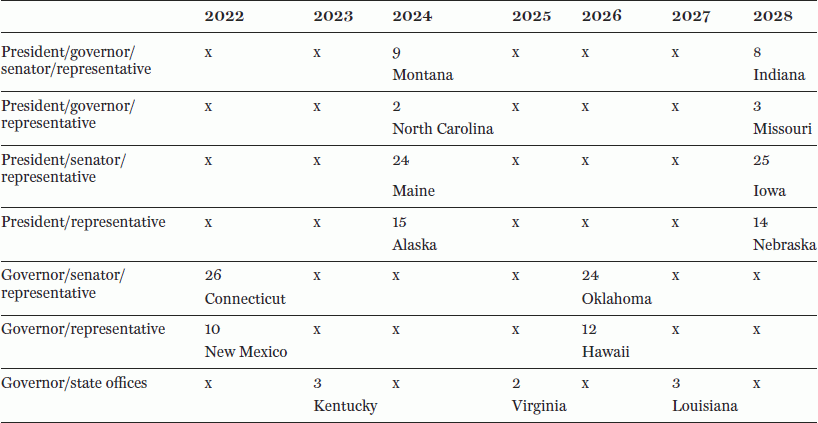

Note. These numbers assume no additional vacancies in the Senate due to death or resignation.
Table 1 could have been extended to include elections for local office, which in some communities are held separately from all federal and state elections, so that the electorate pays attention to the local issues. However, in those cases, although citizens face shorter ballots, they are asked to go to the polls much more often, with a consequent drop-off in turnout. Citizens in Baton Rouge, Louisiana, where state elections are held separate from federal elections and local elections are held separate from state elections, were asked to go to the polls eleven times in the 2019–20 biennium.
Citizens have the right to express their views, but because they are asked to do so so often, many choose not to exercise the franchise. Thus, frequent elections do not necessarily translate into citizens expressing their consent effectively.
In addition, calculating politicians think carefully about the implications of what offices are to be contested in a particular election before deciding whether to run. For instance, it is easier to raise money when running for US senator if a gubernatorial election is not held in your state in the same year, because candidates for governor would siphon off some of the money otherwise available. Such decisions have little relationship to effective democracy.
Fixed terms with regular elections
An additional consequence of the constitutional provisions that govern American elections, and that distinguish our system from many others, is that the terms of all offices in the United States are set and fixed. Thus, no American government can fall because of failure to respond to a crisis. The electorate does not have the opportunity to express opinions until the expiration of a set term.
To use federal offices as an example, elections are held the first Tuesday after the first Monday in November in even-numbered years, no matter what else is happening in the world. The term of the president is four years; if a president dies in office (or resigns, as was the case with President Nixon), a successor replaces him for the remainder of his term, but no new election is held until the next regularly scheduled date.
President Franklin D. Roosevelt was re-elected in 1944; a campaign was run despite the fact that the United States was engaged in World War II. When he died in April 1945, his little-known vice president, Harry S Truman, succeeded him, leading the nation in the war effort and postwar period without facing the electorate until November 1948. Congressmen serve fixed two-year terms and US senators six-year terms; if they die or resign, a successor fills the remaining part of that term, but the regular cycle continues. American governments cannot fall through votes of no confidence; elections cannot be timed to coincide with public opinion or world events.
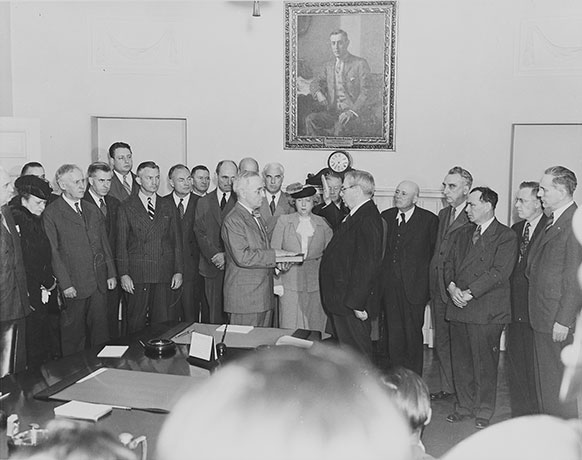
1. Harry S Truman takes the oath of office as president of the United States in the Cabinet Room of the White House, following the death of President Roosevelt in April 1945.
The electoral system in the United States includes a number of other facets that are taken for granted by American citizens but also have important implications for translating popular will into governmental policy. Among them are electing the president through the Electoral College, choosing representatives in single-member districts that are defined geographically, and declaring those with a plurality of the votes cast as the election winner, rather than requiring the support of a majority. Changing any of these might seem undemocratic to many citizens, but in fact each is but one means to the end of effective representation, each a means with implications for democracy that few consider.
The Electoral College system
Americans—and the world—became acutely aware of the Electoral College system for electing the president and vice president of the United States in November 2000. For months following the voting, in an election that seemingly would not end, courts debated whether George W. Bush or Albert Gore would win Florida’s twenty-five electoral votes. Despite the fact that Vice President Gore won more popular votes than had then-Governor Bush, neither candidate had won enough electoral votes to garner the needed majority without Florida’s twenty-five. The election was not decided until the US Supreme Court ruled that recounts should cease and the Florida votes be awarded to George Bush, thus determining that he would be the forty-third president.
Again in 2020 the Electoral College was in the headlines as the world watched a US presidential election unfold. In this case, President Donald J. Trump was urging Republican legislators in key states to instruct presidential electors to vote for him, rather than for Joe Biden, who had won more popular votes. When that tactic failed, President Trump urged Republicans in the Congress to challenge the electoral votes from those same states. Again, he failed, but American voters—and citizens around the world—were left to question whether the Electoral College system contained a fatal flaw that could doom American politics.
If political observers became aware of the Electoral College system and were confused by it, they certainly are not knowledgeable about why it exists, how it works, and, most important, what political implications follow from this system for any one race and for the future. That is what is really important. Yet American democracy is often defined by and either defended or criticized for the way in which the president is elected. It is essential to understand the Electoral College in order to evaluate American democracy because that feature of the election context determines how candidates campaign, to which voters they appeal, and ultimately how accurately citizen views are reflected in the result of the election. And the 2020 election shows how precariously the electoral system is balanced because of the less than transparent functioning of this uniquely American system of electing a president.
Why an Electoral College?
Put simply, the Electoral College was invented by the founders of the nation to solve political problems that they faced. Constitution writing is complicated business. The most important compromise in drafting the Constitution of 1787 was the so-called Connecticut Compromise that called for a House of Representatives, apportioned by population, and a Senate, with each state sending two senators. This compromise resolved the conflict between those states with large populations and those with small ones. Congressional representatives were to be popularly elected; the states were to determine how their senators were chosen with the norm at the time of adoption election by the state legislature.
But how was the president to be chosen? By the states? Not if the views of the states with large populations were to be heard. By popular vote? The “democrats” who wrote the Constitution were not that democratic; few were willing to entrust such an important decision to the masses. And even if one were to do so, what about the slaves? The slaveholding states wanted their slaves to count for population purposes—and the nefarious three-fifths compromise, counting each slave as three-fifths of a person for the purpose of representation—solved that problem. But although the slaves counted to increase the slaveholding states’ representation in the House, they were not to be allowed to vote. That was the farthest thing from the minds of the founders from those states.
The Electoral College was the resultant compromise. The system was a filter from pure democracy. Each state was to select a number of electors equal to the number of congressmen plus the number of senators (always two); this formula was a compromise between large and small states. Each state was to determine for itself how those electors were to be chosen, a concession to states’ rights and a clear means of avoiding the necessity to answer the question regarding the slaves. No elector could hold any other office of trust within the federal government; thus, worthy men without a conflict of interest would be chosen. Each elector was to cast two votes, one for an individual not from his state, an effort to avoid state parochialism because the assumption was that only favorite sons would receive votes without this provision. A majority would be needed to elect a president, preventing domination by one or two states. If no majority occurred, the House of Representatives would choose from among the top three finishers, but each state would have only one vote in this election, again compromising the interest of small and large states. The runner-up would become vice president, ensuring that a respected man would be in line for the presidency should anything happen to the president.
When looked at from the perspective of the founding generation and the political problems they faced, the Electoral College can be seen as an amazingly successful invention, one that guaranteed the election of a respected leader without violating any of the hard-fought compromises battled over as the Constitution was drawn. That everyone involved in the process knew that George Washington would be selected under this procedure—and that was the desired result—clearly contributed to the adoption of the procedure that in large part is still in place in the early twenty-first century. It is difficult to argue, however, that the Electoral College fostered democracy. It was a compromise crafted by a political elite to guarantee a desired result.
The Electoral College in the contemporary context
I am not aware of anyone who today would argue in favor of the Electoral College as the ideal way to select the president. Arguments are often raised against specific changes—in fact, these arguments have prevailed in all attempts to scrap the system—but no one is heard to proclaim, “Thank goodness the founders gave us the Electoral College. It is the best system we could have!” Merely saying that out loud demonstrates how ludicrous it is.
However, few are aware of how the Electoral College works—and, therefore, what changes could be made. The functioning of the Electoral College has evolved since the ratification of the Constitution. The most fundamental change followed the development of political parties as campaign organizations. As a result, the earliest candidates ran as tickets with the understanding that one candidate was the presidential candidate and the other the vice presidential. However, the Electoral College system did not allow for such pairings and resulted in no candidate receiving a majority in 1800. To rectify this problem, the Twelfth Amendment to the Constitution, ratified in 1804, provided that electors vote separately for president and vice president.
The second major change has been the adoption by states of a winner-take-all method of allocating the electors chosen within that state. The Constitution leaves the method of choosing electors to the states. By 1836, reflecting democratizing reforms, all states held popular elections of electors in statewide, not district, voting. Because of the power of political parties, this system led naturally to winner-take-all elections for pragmatic reasons. If a state were assured to be in one party’s column, then winner-take-all made sense to the party in power; the candidate who controlled the state would gain more by winning. Once supporters of one party adopted this system in their states, supporters of the other party had to follow suit in the states they controlled or lose votes in the process. State parties ran slates of candidates, with the number of potential electors on a slate equal to the number that the state was allowed; supporters routinely voted for all of the slate, guaranteeing the desired winner-take-all result.
In a parallel manner, state legislators in closely divided states realized that if the size of the prize were enhanced—all of the state’s electoral votes as opposed to just the margin between those allotted to the winner and those allotted to the loser under another system—candidates would concentrate more on that state. Again, when one such state went to a winner-take-all system, other states were pressured to do the same.
Today, the winner-take-all aspect of the Electoral College system, the most controversial part of the system, is used in forty-eight of the fifty states and in the District of Columbia. Each still is allotted a number of electors equal to the number of representatives plus senators. The citizens of the District of Columbia were given the right to vote for president by the Twenty-Third Amendment to the Constitution, ratified in 1961, with the specification that the District of Columbia shall have the same number of electors as the least populous state, that is, three. This allocation of electors means that citizens in the states with smaller populations are slightly overrepresented, even though the absolute number of electors in these states is low.
In all states except Maine and Nebraska, the plurality winner of the popular vote among the slates of electors pledged to the various candidates receives all of the electoral votes for that state. In Maine and Nebraska, the winner in each congressional district receives one vote, and the winner for the entire state receives the other two. In recent years the district system used in these states has resulted in Republicans winning one electoral vote in Maine (that of the more conservative northern district of the state’s two) and the Democrats winning one electoral vote in Nebraska (the electoral vote of the congressional district centered in the more Democratic Omaha area).
In 2020, political analysts became aware of procedural aspects of the Electoral College system previously all but hidden from public view. US law sets dates by which state officials must resolve any questions about the results of the election and certify those results, on which electors must physically cast their ballots, and on which the Congress, meeting in joint session, must receive and count those ballots. All of these steps have traditionally been viewed as largely administrative steps carried out in a ceremonial manner. However, President Trump used each stage in the process as an opportunity to call the results of the election into question. Election law specialists saw that the election results could in fact be subverted if politicians in key positions chose to do so. That this did not happen in 2020 is both testimony to the strength of democratic norms in the United States and a warning that the system’s functioning depends on officials adhering to those norms.
A majority of the Electoral College vote is needed to elect a president and vice president. If no majority exists, the president is elected by the House of Representatives from among the top three finishers, with each state casting one vote and a majority of the states’ votes needed to win. In that circumstance the vice president is elected by the Senate.
The significance of the Electoral College system
That the Electoral College system for choosing the chief executive is unique among democracies does not make it significant. In evaluating American democracy, however, the system by which the president is chosen is noteworthy for a number of reasons.
•Because of the two electoral votes given to each state beyond those reflecting the state’s population, each citizen’s vote does not count equally in presidential voting.
Californians in 2020 had one electoral vote for every 318,198 voters; Wyoming residents had one electoral vote for every 92,834 voters. California’s total was fifty-five electoral votes and Wyoming’s was three.
•Because of the winner-take-all nature of electoral voting, candidates do not campaign frequently in states in which they are ensured either victory or defeat; as a consequence, some states and their citizens see active campaigns for the presidency, while others (including some of the largest) see virtually none.
In the 2020 election, seven of every eight dollars spent on television advertisements were used in the same six states: Florida, Pennsylvania, Michigan, North Carolina, Wisconsin, and Arizona. Variation exists within these six states as well, with Florida seeing $258 million in spending, more than double the amount spent in Arizona. By contrast, little to no money was spent in California, New York, or Texas.
•Because electoral votes are cast on a state-by-state basis and not nationally, two candidates with virtually the same vote total might receive significantly different electoral vote counts; the system benefits candidates who are strong in one state or region and weak nationally as opposed to those whose strength nationally is the same but spread evenly among the states.
In 1948, two minor-party candidates, Strom Thurmond of the States’ Rights Party and Henry Wallace of the Progressive Party, each received approximately 2.4 percent of the vote. Thurmond received thirty-nine electoral votes because his votes were concentrated in southern states. Wallace, whose votes were spread throughout the nation, received none.
•Because the margin of victory in a state does not alter that state’s prize, that is, all of its electoral votes, it is possible that the candidate who receives the most votes for president does not win the election, as was the case with Hillary Clinton in 2016.
In addition to President Trump in 2016, George W. Bush (2000), Rutherford B. Hayes (1876), and Benjamin Harrison (1888) were elected to the presidency despite receiving fewer votes than their opponents.
The system came under a great deal of criticism in 2000 and again in 2016 and 2020 because of the closeness of the results, the fact that Bush in 2000 and Trump in 2016 won despite losing the popular vote, and the recognition that switching a very few votes in a small number of states would have reversed the results. Despite that criticism, however, momentum has yet to be found for a shift to any other system—the district plan as used in Maine and Nebraska, a system of awarding the electors within a state proportionately to the votes received, or, most radically, direct election of the president. As a result, the Electoral College system continues to have strategic implications for running presidential campaigns. Certainly, if one believes that the person who receives the most votes should win, the implications for democracy are evident.
Single-member, geographically defined districts with plurality-winner elections
When Hillary Rodham Clinton moved to New York to run for the US Senate in 2000, she was accused of being a carpetbagger, a colorful term from the Reconstruction era, referring to Yankees who moved to the South (rolling their belongings into a carpet) for exploitative reasons, with no intention of staying. If Clinton wanted to serve in the Senate, she had to reside in the state from which she ran.
Representatives and US senators must reside within the state that sends them to the House or the Senate. But that is the only constitutional requirement regarding residency. Nothing requires that legislators live within the districts they represent, that only one representative represent each district, or that gaining a plurality of the votes, that is, one more than the next highest vote-getter, is sufficient for victory. Yet these norms have important consequences for American politics, determining, in essence, who may run for a seat in a legislature and who wins. Without these restrictions, it can be argued, the electoral process could produce more accurate reflections of citizen preferences, at least on a national level.
Single-member, geographically defined districts
Americans assume that they will have “their” representative in the legislature; that is, one member will be elected from a geographically defined district to represent the people who live within its confines. Although such a system is mandated by federal law for the House of Representatives, multimember districts exist in some states and in many local communities. Why is one system seen as superior to the other? Does one lead to better representation?
The history of single-member districts in the United States is instructive. Single-member districts were discussed at the 1787 Constitutional Convention. In one of his articles presenting the case for ratification of the new Constitution, published as Federalist 56, James Madison argued that single-member districts would “divide the largest state into ten or twelve districts and it will be found that there will be no peculiar interests…which will not be within the knowledge of the Representative of the district.” Essentially, local representatives would understand and therefore could defend local interests.
By the time the party system came into play, it became apparent that single-member districts would allow for better representation of partisan interests; although one party might dominate a state’s politics, the other party might have strength in certain geographic regions. Despite these arguments, six of the twenty-eight states with more than one representative in the House were still using at-large elections when Congress passed the Reapportionment Act of 1842, mandating single-member districts. In the next election, four of those states ignored the law, which some felt was an unconstitutional infringement on states’ rights, with total impunity.
The Congress continued to pass reapportionment acts every decade; most included requirements for single-member districts. In 1929, Congress passed a law that set up permanent means for reapportionment; but three years later, in 1932, the Supreme Court in Wood v. Broom ruled that any reapportionment act could have effect only for the decennial reapportionment for which it was enacted. Most states continued to use single-member districts, but as late as the Kennedy years, more than twenty members of Congress were elected from multimember districts.
In 1967 Congress passed, and President Lyndon Johnson signed, a new law prohibiting states from electing representatives in multimember districts, a practice that was being used only by Hawaii and New Mexico at the time of that legislation.
The impetus for the new law was the passage of the Voting Rights Act of 1965, extending the franchise to more Black citizens, particularly in the South, and the fear that southern state legislatures would revert to multimember districts as a means of diluting Black voting power. In addition, some members feared that the courts would order at-large elections when state legislatures had difficulty redistricting—and that such elections might jeopardize their seats in Congress. The 1967 law remains in effect in the early twenty-first century.
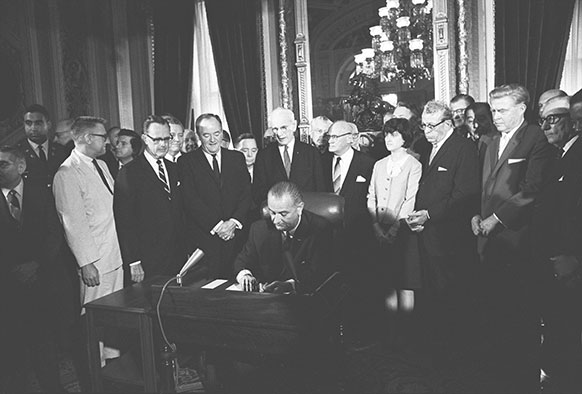
2. President Lyndon B. Johnson signs the Voting Rights Act of 1965 into law, banning racial discrimination in voting practices by the federal government as well as by state and local governments.
Redistricting laws were thus implemented as a means to improve representation—to allow for representatives to know their constituents in the early days, to permit party members who were in a minority statewide but dominant in some regions to elect representatives, and to ensure the influence of newly enfranchised Black voters. Do any of these reasons pertain today?
Twenty-first-century congressional districts average over 700,000 residents. Whereas the founders’ vision was of homogeneous populations in relatively small districts represented by one of their own who knew their interests, many of today’s districts have extremely diverse populations—in racial, ethnic, socioeconomic, and religious terms—with heterogeneous views on the issues of the day; other districts, however, particularly rural districts in the South and urban districts in northern states, present more homogeneous views on the most salient issues, conservative in the South and liberal in the North. In the early days of the Republic, geographic districts were necessitated by the difficulty of traversing long distances; today, with air travel and electronic communication, contact with constituents does not require close physical proximity.
While single-member districts were designed to enhance effective and fair representation of partisan interests, today those who draw district lines often do so with the express purpose of restricting competition and guaranteeing the desired partisan result. Partisan gerrymandering, drawing lines for the express purpose of gaining partisan advantage, has been challenged in lawsuits before the Supreme Court, with petitioners claiming their rights of equal representation have been violated. But the court has not prohibited such gerrymandering, thought by many to be responsible for the lack of competition in congressional races, at least in some of the more populous states.
The use of single-member districts to increase the influence of Black voters, deemed an important goal after the passage of the Voting Rights Act nearly six decades ago, is also called into question today. Increased racial diversity in most districts, and the mobility of our population that makes predicting district demographics problematic, both raise the possibility that the means is no longer an effective route to the end.
Yet the norm continues. Even citizens whose state representatives or city councilors are elected in multimember districts cling to the notion that their US congressperson should represent their local geographic unit and protect their interests. Should the concept of single-member, geographically defined districts be re-examined? Claims and evidence that this “pillar” of American democracy might in fact be counterproductive toward achieving fair representation, competitive elections, and ultimately improved democracy meet stiff resistance from a citizenry that sees this relatively recently mandated provision of election law as somehow fundamental to what American democracy entails.
Plurality election winners
Americans believe in majority rule, except that for the most part election winners are determined by a plurality of those voting, not a majority. If true majority rule were the norm, the results of many elections might be changed. It is worth questioning whether a more effective representation would be the result.
We have already noted that Donald Trump and George W. Bush were elected with fewer votes than their opponents, despite the majority provision of the Electoral College system. Nonmajority winners are common in American elections, though losers among those who have won a plurality and did not face a runoff are more rare. Despite the fact that the American system is dominated by two parties, in every election year a number of winners poll fewer than half of the votes—and minor-party or independent candidates receive enough votes to hold the balance of power. This result is particularly true in primary elections, elections held to determine a party’s nominees, in which more than two candidates often vie for a party nomination.
Think about Dino Rossi. As the Republican candidate, he lost the 2004 gubernatorial election in Washington State to Democrat Christine Gregoire by just over 100 votes of 2.8 million votes cast. Neither candidate had a majority. Libertarian candidate Ruth Bennett, whose supporters might be presumed to have favored Rossi over Gregoire, polled over 63,000 votes, only 2.3 percent, but enough to influence the result. If a majority had been required, a runoff election might well have favored Rossi.
Again, changing from the current system of “first-past-the-post” winners (that is, the person with the most votes [a plurality] wins, whether that is a majority or not) strikes many Americans as strange, despite its obvious undemocratic implications. Two alternative systems (with variations) are often examined as ways to alter the current practice.
In many southern states and in scattered locales throughout the rest of the nation, runoff elections are held if a majority winner does not emerge. (In a few areas of the nation runoffs are called for if a “superplurality” is not obtained, e.g., if the winner does not achieve at least 40 percent of the vote in the first election.) This practice is more common for primary elections than for general elections; it was put in place in part because the primary was the functional equivalent of the general election in the South for many years when the Democrats dominated southern politics. However, runoffs are not without problems. Turnout is normally much lower in runoff elections than in the first-round election; intense ideological groups tend to dominate, because they are better able to mobilize their share of the electorate. Experience has also shown that minorities fare poorly in runoff elections. And, of course, runoffs are expensive for candidates to contest and for jurisdictions to administer.
More recently reformers have pushed for ranked choice voting (RCV), also referred to as instant runoff voting (IRV). A variety of alternative means have been proposed to implement a system such as this, but the basic concept is that, in races with more than one candidate, citizens cast votes in which they express their preferences for a first choice, a second choice, and so on. After the voting, if no majority is achieved, the candidate with the least support is eliminated, his or her votes are reallocated to the second-choice preference, and totals are recalculated. In multicandidate fields, this procedure is repeated until a majority winner is declared.
RCV has certain obvious democratic advantages. Spoiler candidates no longer impact the result as they do in plurality elections; at the same time, voters can show their preferences for minor-party or independent candidates without fear that such votes will aid the candidate they favor least. Candidates do not have to raise vast sums of money in short periods of time to contest runoffs. And most importantly, majority will prevails. But others point to disadvantages, notably that the procedure seems complicated, especially to an electorate that is not terribly well informed as it is.
IRV is used in Ireland and a number of other democracies. Maine voters approved RCV for all primaries and federal elections, including the choice of presidential electors. Alaska will use RCV starting in 2022, under a different set of rules. A number of states have given municipalities the power to implement such a system should they so desire—and many cities have done so in states from Vermont to California. To the public, however, IRV still seems strange. Fundamental reform such as implementing RCV will not happen overnight, but its appeal—that it more closely meets the democratic goal of majority rule—is appealing in an age in which many interests seek recognition at the voting booth.
The two-party system
After each election of the twenty-first century, some Americans have questioned the nominating system that presented voters with what many felt were less than ideal choices, and others questioned the Electoral College system. But few questioned the fundamental aspects of the electoral process, and even fewer called into question the system that has allowed the Democrats and the Republicans to dominate politics for over 160 years. Yet the fact that two—and only two—parties can compete effectively for power in the United States has clear implications for the linkage between citizens and their government.
The American electoral system is frequently described as a two-party system. But political parties are not mentioned at all in the Constitution. No laws mandate that elections be contested by the Democrats and the Republicans. Minor-party candidates or independent candidates run for many offices in each election cycle; some of them even win, and many more have an impact on the election’s outcome. But two parties do dominate American politics. Of the 535 legislators in Congress in 2020, only senators Bernie Sanders from Vermont and Angus King from Maine were not either a Democrat or a Republican; each of the fifty state governors ran with either a “D” or an “R” next to their name; more than 7,300 of the approximately 7,375 state legislators in the forty-nine states that hold partisan elections for that office are either Democrats or Republicans. (Nebraska’s legislature is unique in two ways. First, it has only one house, while all of the others have two. Second, state legislators run without partisan affiliation on the ballot. Nonpartisan elections are much more common at the municipal level, following the old adage that “there is neither a Republican nor a Democratic way to clean the streets.”)
The discussion of the electoral context says a good deal about why a two-party system has evolved in the United States. First, the presidency is the big prize in the United States. It is either won or lost. The winner-take-all nature of voting for the Electoral College exacerbates this effect. A system characterized by separation of powers, in which the chief executive is chosen by a series of plurality-winner elections, does not allow for coalition governments or electoral deal-making; therefore, coalitions are formed before votes are cast in order to achieve majority status and win the presidency.
Second, single-member districts with plurality winners for legislative seats have much the same effect. Again, only one winner emerges; votes for minor-party candidates are viewed as wasted votes or even counterproductive votes, if the least favored candidate wins because of votes cast for someone with no chance of electoral success. A system of multimember districts with proportional representation would encourage additional parties, because they could achieve some level of electoral success and might be able to form coalitions with like-minded parties in the legislature, but such a system has never existed in this country. Similarly, RCV would encourage the formation of minor parties, as a means of forcing major-party candidates to pay attention to their issues, even if they did not win. But politics in the United States is a long way from that scenario as well.
The two parties, while in office, have passed additional measures that go far toward ensuring their continued dominance. Most prominent among these is the system of campaign financing that puts minor parties and their candidates at a significant disadvantage. In a similar vein, the debates during recent presidential campaigns have been administered by a bipartisan, not a nonpartisan, commission. The commission, cochaired by former heads of the two major parties, has adopted a series of rules regarding participation by minor-party candidates that those candidates see as decidedly unfair. The situation has been compared to the proverbial “fox guarding the chicken coop,” especially by those anxious for minor parties to have more of a say in American politics.
That the system favors two parties does not mean that all Americans are satisfied with the result. In a number of recent presidential elections (particularly those of 1992 and 2000) and in some statewide races many citizens have expressed dissatisfaction with the choices offered by the two major parties. But to say that there is dissatisfaction is not the same as to say that the system is likely to change. Whether one favors a two-party system or a multiparty system, it is difficult to argue against the proposition that the current institutional context leads almost inevitably to dominance by two parties. And that is different from at least discussing the implications of a two-party system for representation.
At the same time, however, the continued existence of a two-party system does not imply that the electoral system—particularly at the state level—remains stagnant. The American party system is a competitive two-party system nationally; that is, the Republicans and the Democrats are the only competing parties that have a chance to win elections, and the outcome of the election between these two parties is in doubt.
But the nature of their competition has changed. For much of the twentieth century, for example, the South was solidly Democratic, a holdover from the Republicans being viewed as the party of Lincoln that promulgated the Civil War and freed the slaves. The Republican Party did not even exist in much of the South until after the elections of 1964. Today, the Republican Party dominates the South; the Democrats find their strengths in urban centers, particularly on the two coasts and in the industrial Midwest.
After the 1960 elections, all 22 US senators from the southern states and 99 of the 106 US representatives were Democrats; after 2020, 18 of the 22 senators and 90 of the 139 representatives (the number had increased as a result of population shifting to the region) were Republicans.
Although the two major parties contest for offices in all states, tremendous variation exists, both between states and by region within states. Illinois, for example, is competitive statewide, but Chicago is dominated by the Democrats and downstate is dominated by the Republicans. New York is generally safe for the Democrats in normal circumstances, but competitive elections abound in many of the rural areas. And these patterns have clearly changed over time and are responsive to the political issues of the day and to the mobility of the population. Nuance is often lost in overgeneralizing about any aspect of American politics.
The context of elections in the United States
Understanding the implications of the framework and rules under which elections are run is critical to appreciating how well the electoral system achieves the ultimate democratic goal—allowing the citizens to express their consent to the officials who govern them and, by implication, to the policies implemented by those officials. The American creed is laid out in the Declaration of Independence, which outlines the basic tenets of democracy, the “self evident truths” on which democracy in the United States is based and which have been continuously professed since the founding. The most basic truth is that “all men are created equal” and that they are “endowed by their Creator with certain inalienable rights.” The purpose of the government is to secure those rights; and the power of the government depends on the consent of the people.
How the people give that consent is determined by the electoral process. And how the electoral process functions, how effectively it facilitates the people granting their consent to those who govern, is determined by the institutional framework laid out in the Constitution. The most important aspects of that framework are the separation of powers, with a single executive who is separate from and elected separate from the legislature, and the federal system with residual powers left to the states. The initial means of choosing leaders followed from these elements that were central to the Constitution. The current political system—and the role played by political parties in that system—evolved from those original decisions. To understand the current system and to evaluate American democracy in today’s world, it is necessary first to look at that evolution.