
Chapter 5
In November and December 2000, when citizens of the world waited for weeks to find out whether George W. Bush or Al Gore had won the American presidential election, analysts and citizens agreed on two observations. First, the system was terribly flawed. A country that views itself as a beacon of democracy, a model for nations emerging as democracies, could not be proud of an electoral system that left the result in doubt for weeks, with the clear implication that the winner would be determined based on judicial interpretations of questionable ballots. That conclusion was reinforced in 2020, when Donald Trump refused to accept his defeat at the hands of Joe Biden and encouraged his supporters to invade the US Capitol as lawmakers were meeting to ratify the election’s results.
Second, again in 2020, as well as in 2000, few people truly understood the system. Not only Americans but also those throughout the world who point to the democratic principles of the United States as ideals to be emulated were amazed to learn that George W. Bush was elected even though Al Gore received more votes or that Donald Trump could ask state legislators loyal to him to overturn the votes cast by their constituents. Throughout the United States after each of those elections, civics teachers talked to their students about the Electoral College, and those students went home and explained it to their parents. Television journalists who thought they understood the system stumbled often as they tried to explain what was happening as the election results were confirmed to their audiences.
If the means by which citizens of the United States elect their president is complex, flawed, and misunderstood, the means through which the two major parties choose their nominees is even more so. Citizens know that the nominees are chosen at party conventions, but they also know that the identity of the nominee is known well in advance of those gatherings. How? Which states have primaries and which caucuses—and what difference does it make? How do they work? Who are the delegates to the conventions? How are they chosen? What do they do?
The nominating process is not some abstraction, of interest only to political junkies. The way in which the nominating process works determines which candidates will be viable and which have no chance. This process winnows the field of potential presidents from a large number down to two—the two major-party nominees. One cannot understand the results of American elections if one does not understand how the candidates are chosen.
Similarly, the rules of the general election are not neutral. The Electoral College system favors some candidates and disadvantages others. George Bush was elected because of how this system works; so too was Donald Trump in 2016. Both won the presidency despite polling fewer votes than the candidates they beat. They might not have been elected had an alternative system been in place. But maybe they would have won in any case; candidate strategies would have changed had the rules been different. Financial backing plays a huge role in presidential nominations and elections; campaign contributions are regulated—and the strength or weakness of these regulations also contributes to determining who will win and who will lose. One can only critique the system in terms of democratic values if one understands the ways in which it functions and the likely consequences of alternatives.
The nominating process
Barack Obama was twice nominated by the Democratic Party as their candidate for the presidency, in 2008, when President George W. Bush was leaving the White House, and in 2012, when seeking re-election. Those two nominations stand as examples of two of the possible varieties in a typology of party nominations for president. Mitt Romney’s nomination in 2012, the Republican nomination to oppose an incumbent Democrat, stands as a third type.
Table 4 presents a number of variables that one must consider in analyzing presidential nominations. The key contextual variable is the presence or absence of an incumbent president seeking re-election. Related to that is the second factor, whether the nomination under examination is for the nod of the party of the incumbent or for the “out” party nomination. The process clearly runs differently if one candidate is the presumptive nominee early in the nominating season compared with those instances in which no such favorite emerges.
Table 4. Typology of competition for presidential nominations (with the number of serious contenders for the nomination in parentheses)
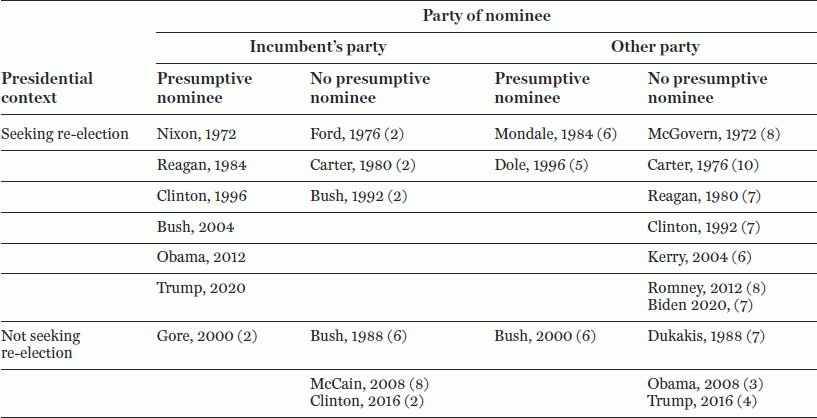
A number of conclusions about intraparty competition can be drawn from Table 4. First, few nominations other than those for re-election have gone to candidates who were presumptive nominees early in the campaign season. But those four are of interest. Two were to run against incumbent presidents thought to be invulnerable; that is, the nominations were not seen as very valuable. Walter Mondale in 1984 and Bob Dole in 1996 were each respected party leaders who, in a sense, were due the nomination; however, it is likely that they would have been more strongly challenged within their own parties if other potential candidates thought that the sitting president seeking re-election might lose. Al Gore in 2000 was a sitting vice president and heir apparent; he was to carry on the legacy of the Clinton–Gore team.
However, the nomination of George W. Bush in 2000 is quite different. Bush was all but anointed by party leaders—not the formal party organization but elected leaders within the party, including Republican governors, and major contributors to the party, including many in his native Texas. He became the presumptive nominee because he had such a huge advantage going into the actual primary season, a financial advantage that caused many other potentially serious contenders to drop out.
The 2008 Democratic nomination is perhaps the starkest case in recent years in which the front runner at the beginning of primary season did not ultimately go on to win the nomination. With an initial advantage, both monetarily and in the polls, Hillary Clinton was the clear front runner in the lead-up to election year. However, as Barack Obama gradually caught up to—and eventually surpassed—Clinton in fundraising and went on to win the Iowa caucuses, the inevitability of Clinton’s nomination fell into doubt. Still, the contest remained competitive throughout primary season, until Clinton conceded the race in June.
It is important to look at the strategies of candidates who run in different contexts. Before one can understand the strategies, however, it is necessary to have a sense of the rules under which these campaigns are run.
The rules of the game
The bottom line is simple: The presidential nominee of a party is that candidate who receives a majority of the votes cast on one ballot at his or her party’s nominating convention. The vice presidential nominee is that candidate who receives a majority of the votes for vice president at the nominating convention. What could be simpler?
For more than half a century, the nominating conventions have been the frosting on the cake. Delegates chosen well in advance of the convention are pledged to one candidate or another. The nominee becomes clear once one candidate has accumulated enough pledged delegates to guarantee that majority vote. And, to complete the ticket, the delegates routinely vote for the candidate for vice president suggested to them by the presidential candidate.
Who, then, are these delegates and how are they chosen? The two major parties differ in a number of important details as to how they apportion delegates among the states and how the actual delegates are chosen. Each party has a formula that determines how many delegates each state should send to its national convention; the formulas, which can change from convention to convention, are generally based on two factors: voting population of the state and the party’s success in recent elections within the state. Democratic National Conventions are generally larger than Republican National Conventions.
The Democrats also ensure that certain groups of elected officials are represented as delegates on the convention floor—members of Congress, governors, state officials, party leaders, and the like. The role of these automatic delegates, known as superdelegates, was challenged by the supporters of Senator Bernie Sanders after he lost the 2016 nomination; Sanders’s supporters argued that the influence of superdelegates was undemocratic, thwarting the will of Democrats who had voted. Though superdelegate votes have never resulted in a nomination different from that determined by party voters, their potential influence was reduced in 2020 with the stipulation that superdelegates could not vote on the first ballot at a convention.
Means of selecting delegates also vary between the parties and, within the parties, among the states. Generally, the Republicans give state party organizations more leeway in selecting the means through which delegates are chosen; the Democrats impose certain guidelines on state leaders.
Two principal means are used to select delegates: presidential preference primaries and caucuses. In a presidential preference primary, the names of the candidates for a party’s nomination appear on the ballot, and citizens cast a vote for one of the candidates. The results of this vote are used to select the delegates who attend the convention. Again, it seems simple, but the variations in systems reveal how complex it is.
First, who are the citizens who vote? Is every registered voter eligible or just those who are members of the party? What is meant by “member of the party” in an organization that has no formal membership? Some states, Wisconsin as an example, have so-called open primaries, primaries in which any registered voter may participate. Other states, like New Hampshire, permit independents who have not enrolled in either party to vote in either party’s primary, but Democrats cannot vote in the Republican primary and Republicans cannot vote in the Democrats’. Still other states, like Maryland or New York, have closed primaries, primaries in which only those who have enrolled in one of the major parties or the other may vote, effectively excluding independents from participation. States vary in enough ways that a continuum exists between open and closed systems, with few states running pure primaries of either type.
Those who believe in democracy, the rule of the people, in its purest form should favor more open systems, right? Not so fast. In an open system Democrats might determine who the Republicans’ nominee should be. Is that not a decision that Republicans should make? If party means anything, does it not seem right that those who adhere to the party’s principles should choose its candidates? That logic argues for a more closed system.
The same logic also argues that a more open system, with citizens crossing party lines to vote in a primary election, should lead to more centrist candidates. Candidates in primary elections would have to appeal across party lines. A more closed system would lead to candidates whose views were more divergent and easier for the voters to distinguish in the general election, but some might also claim they are more extreme. Choices in rules lead to differences in outcomes.
A second variation deals with who wins the primary. A prior question to that concerns the geographic size of the voting area. Delegates may be elected to the national convention from districts or they may be elected statewide—or a state may opt for a combination of the two. Within whatever unit is chosen, in the Democratic Party, delegates to the national convention are divided among the candidates proportionately according to the percentage of votes received in the primary. In the Republican Party, the Democrats’ system of proportional representation is used in some states, but in other states the winner of the primary wins all of the delegates.
Again, which system is to be preferred? Which is “fairer” or “better” is not clear. A system of proportional representation allows the district or state delegation to the national convention to reflect the voting preferences of those who cast primary votes more precisely. That certainly is a valid goal for a voting system. But a winner-take-all system allows a front-running candidate to cement a lead more quickly, to unify the party behind his or her candidacy, and perhaps to have an advantage going into the general election. That too is a valid goal for a primary voting system. The trade-off between a system more likely to produce a winner in the general election and one that is more democratic is one that has separated party professionals from party reformers for decades. That battle has been fought openly in the Democratic Party in a series of reform commissions that have struggled with party governance, rules, and procedures. The Republicans have been very willing to let Democrats battle internally over these concerns, while they use a system that has, more often than not, produced candidates who can lead a unified party.
Although many states decided not to hold primaries in the past, the move to more primaries was hastened by the campaigns of insurgent candidates—Trump in the Republican Party and Sanders in the Democratic Party—in 2016. By 2020, forty-five states held primaries for the Republicans and forty-seven for the Democrats. The remaining few held caucuses.
Caucuses are essentially meetings of party members, people who are enrolled in one party or the other. In caucus states, party members throughout the state gather in their home locales on the same day. At these local caucuses, representatives of the various contending candidates make the best case they can, and then those assembled discuss the campaign and the strengths and weaknesses of the contenders and vote openly for their choice. The outcome of a local caucus is the election of delegates to a county or state convention, pledged to the various candidates in proportion to their support at the caucus. Caucus attendance is generally much lower than primary turnout. However, caucus supporters argue that the level of commitment to the process demonstrated by attending a meeting that might last a number of hours and discussing the campaign argues for the merits of this system of choosing among candidates. Although caucuses once were a critical part of the nominating process, the implied backroom politics seems inherently undemocratic and inappropriate for the twenty-first century. It seems likely that they soon will be a relic of nominations past.
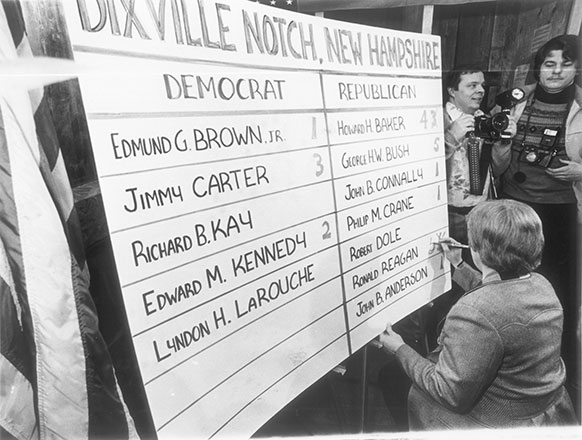
8. Officials tally votes at the presidential primary in Dixville Notch, New Hampshire, traditionally the first town in the state to report its results.
The most contentious issue debated by those who analyze the presidential nominating process relates to the calendar of events. For more than half a century, the New Hampshire primary has been held before any others; for nearly as long, the Iowa caucuses have opened the official nominating season. Leading candidates tend to concentrate on these contests, giving those states significant influence, many argue too much influence for states that are not representative of the nation as a whole or of the supporters of either party. States, either acting on their own or in consort with other states from their same region, have moved their primary or caucus dates early in the process in order to increase the attention paid to their contests. As a result, the entire nominating process is “front-loaded.”
Concentrating on the early states can work if such a strategy leads to accumulating enough delegates to secure the nomination. That is how Donald Trump eliminated most of the Republicans running against him in 2016 and how Joe Biden secured the Democratic nomination in 2020. But one has to go back only to 2008 to see the danger in that strategy. In that year, Hillary Clinton, the front runner, was not able to secure enough delegates to force Barack Obama to retire. Rather, he hung on, competing everywhere and winning some delegates even in contests he lost; he won some key victories, raised money and gained momentum, and eventually upset Clinton in the longest and most expensive nominating contest in recent years.
Strategic considerations
Increasingly, money motivates strategic decisions. In an effort to compete in almost every state’s nominating contests in 2008, the Obama campaign revolutionized the use of the internet, building a massive grassroots organization online and attracting millions of small donors to overcome Clinton’s initial monetary advantage. That strategy has been copied by most successful candidates since.
Primary campaigns are funded in one of two ways. The Federal Election Campaign Act calls for matching public funds to pay for the presidential primaries. Nearly all candidates opted for this means of funding their nominations from the time that the act took effect in 1976 until the 2000 nomination of George W. Bush. The system was viewed as successful in keeping the escalating cost of nominating contests in check and in leveling the playing fields among the contenders.
Strategies changed in 2000, however. Then–Texas governor George W. Bush adopted a preemptive approach, using the other means of funding primary campaigns—raising money privately, without restrictions on subsequent spending. Building a coalition of party leaders that included elected officials (especially his fellow Republican governors), supporters from his father’s campaigns, and wealthy Texans, Bush raised more money than had been thought possible before that time, $70 million before the first primary vote had been cast. A number of prominent Republicans who had considered running for the nomination, such as former Tennessee governor Lamar Alexander and former cabinet secretary Elizabeth Dole, dropped out before Iowa and New Hampshire, recognizing that they did not have the ability to compete for resources with the Texas governor. Observers worried that the effectiveness of the Federal Election Campaign Act was destroyed and that big money would once more dominate presidential politics.
In part they were right, but in part fundraisers for candidates for presidential nominations adjusted with ingenuity. They are also right in that money as a resource has become a key element in presidential nominating contests, in a very different way from what it was between 1976 and 2000. In the early period, candidates used qualification for federal matching funds as a means of demonstrating the viability of their candidacies. In the early twenty-first century, candidates must make a decision whether they will use the matching-fund route or raise more money on their own, knowing full well that at least some candidates will raise private money and thus be permitted to spend more than those running federally funded campaigns. The decision is both practical and strategic. In a practical sense, can they raise significantly more than the federal matching sum would give them? In a strategic sense, do they want to be viewed as someone raising and spending huge sums of money? To succeed, does their campaign need to spend money in ways prohibited to federally funded candidates, such as by exceeding the limit imposed in some states? The answer to that question increasingly has been “yes.”
However, those who worried about the move to private funding necessarily thinking that campaigns would be dominated by those who could raise money from donors with huge bankrolls were wrong. Relying on private wealth, as Steve Forbes did in 1996 and 2000, or on contributions from wealthy individuals, as Bush did in 2000, were the known means to raise huge sums of money. Countering that, first John McCain, in the 2000 GOP primaries, and then Howard Dean and later John Kerry, in the run-up to the 2004 Democratic nomination, demonstrated that the internet could be used to generate large sums of money in relatively small donations from hundreds of thousands of citizens. Barack Obama, Bernie Sanders, Donald Trump, and eventually Joe Biden have all demonstrated that massive amounts of money can be raised relying on internet appeals to small donors; although large donations are still important, the fear that large donors would dominate the campaigns has proven to be exaggerated.
Beyond the decisions regarding how to fund their campaigns, the most important strategic decisions by candidates for presidential nominations and their staffs involve where to campaign and how much of their effort should be devoted to which states. These decisions are governed by the resources available, the rules in effect in each state, the ideology of the candidate and the electorate in each state, and the calendar.
Candidates with more money can campaign effectively in more states; candidates with more limited resources—either financial or in terms of staff and organization (which is often a function of money)—must decide to concentrate their efforts on some states and to forgo others. Candidates with a wider appeal, especially an appeal to independents, concentrate their efforts in states with open primaries; that was John McCain’s strategy in the 2000 Republican race and Bernie Sanders’s in 2016 and 2020. Those with a more traditional party appeal focused on caucus states in the past and now on those states with closed primaries; that was the strategy followed by Al Gore in beating Bill Bradley in the Democratic Party in 2000. Candidates who are identified with a clear ideology often focus on states in which they feel their views will be welcomed and sidestep other states; centrist candidates can appeal more broadly but run the risk of losing to conservative candidates in some states and to liberals in others. Finally, because momentum is so important and because the political calendar is concentrated in the early months of the process, candidates must find places in which they can succeed among the early states with the earliest contests.
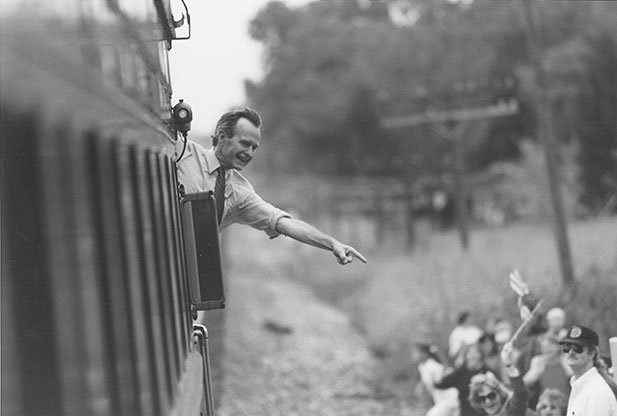
9. President George H. W. Bush waves from the back of the train outside Bowling Green on a whistle-stop campaign trip through Ohio in September 1992.
Critiquing the nominating process
In looking at these strategic notions, one is struck by a lack of connection between the variables at play here and those that make either a good president or, with the possible exception of appeal to independents, a good general election candidate. And therein lies the problem in the nominating process and the cause for criticism.
If one were to design a nominating process from scratch, one would seek a system that resulted in the choice of two candidates who had demonstrated the ability to lead the nation and who showed broad appeal both within the party and to a wider audience. The current system does little to test the ability or even the experience of the nominees; it is skewed in favor of those who do well in Iowa and New Hampshire, two states that are not representative of the nation in demographic terms or in terms of the issues that are most important and that are not representative of either party, in terms of ideology or their party constituents. although the Democrats have moved two states—South Carolina and Nevada—up in the process to have early states be more representative, the early states still do not reflect the nation as a whole. Nominees are chosen by relatively few voters (the turnouts in the presidential primaries, even most of the early ones, are quite low and in caucuses are even lower), with voters in many states—those selecting convention delegates late in the process—having no influence at all. Finally, because the process is so condensed, because candidates are not tested over an extended period of time on a range of issues, and because most of this occurs well in advance of the time when the average citizen is thinking about presidential politics, citizens are often dissatisfied with one or both of the major-party nominees by the time the fall general election campaign begins.
The parties and the media have noted this problem. But solutions are difficult to find. As noted, the Democrats moved more states into the early period of the process to increase representativeness; the Republicans, in the prelude to the 2016 nominating process, discouraged front-loading. After a flawed process in the 2020 Democratic caucuses, the role of Iowa as an early contest has been questioned. But most seriously considered changes have been at the margins. No one would design a system like the one in place, but no one has proposed a fundamentally different system that can achieve widespread acceptance.
The 2008 and 2016 presidential nominations
Recall Table 4. The 2008 and 2016 presidential nominating contests were similar and in some ways represent the pure case, when an incumbent was leaving office and neither party had a presumptive nominee. For the Republicans in 2008, Arizona senator John McCain, who had been the runner-up for the 2000 Republican nomination against George W. Bush, was at the top of the field. Despite losing the first contest, the Iowa caucuses, to former Arkansas governor Mike Huckabee, McCain managed to overcome Huckabee and other well-known Republicans, including former Massachusetts governor Mitt Romney and former New York City mayor Rudy Giuliani. By early March, McCain had secured the nomination.
For the Democrats, the nomination process proved to be significantly longer and more competitive. New York senator and former First Lady Hillary Rodham Clinton was the front runner, but after Illinois senator Barack Obama won three of the four earliest nominating contests, it became clear that Clinton’s path to victory was not guaranteed. Over the next few months, Clinton and Obama each won delegates in different states; by the spring, Obama had opened a substantial lead over Clinton in delegates. Yet Clinton continued her campaign, convinced that she could still overtake his delegate count at the August convention by garnering support from “superdelegates”—party leaders and elected officials who serve as delegates at party conventions but who are free to pledge their support to any candidate, because they are not elected in primaries and caucuses. The Democrats would not secure their nominee until after the last primaries in early June, when Obama’s delegate count surpassed the 2,118 needed to win the nomination and Clinton conceded the race.
On the eve of the first caucuses in 2016, Hillary Clinton again appeared to be the favorite for the Democratic nomination. Still, as her loss in 2008 proved, her nomination was certainly not set in stone. Vermont senator Bernie Sanders had run a spirited campaign and led in some early polls, and former Maryland governor Martin O’Malley remained in the race. O’Malley dropped out early but Sanders held on, fighting an insurgent campaign that went nearly to the convention. Sanders used the campaign to spearhead a movement, the goal of which was to move the Democratic Party to the left. And though he lost the nomination, his influence continued in the years ahead.
By contrast, the Republican field appeared to be much more scattered, with prominent Republicans like former Florida governor Jeb Bush, New Jersey governor Chris Christie, Texas senator Ted Cruz, former Arkansas governor Mike Huckabee, Ohio governor John Kasich, Kentucky senator Rand Paul, Florida senator Marco Rubio, and former Pennsylvania senator Rick Santorum still on the ballot as the first contests approached. Outsiders like business magnate Donald Trump, retired neurosurgeon Ben Carson, and former chief executive officer of Hewlett–Packard Carly Fiorina were also running, with Trump emerging as the leader as the voting began. Trump ran his campaign as an antiestablishment outsider. The establishment candidates never caught fire—and were unable to settle on one candidate to take Trump down. Not only did he win the nomination, but also he brought new voters into the Republican primaries and to the party. Using social media to reach voters and to build a network of support, Trump redefined how to win a hotly contested primary and, in many ways, recreated the Republican Party as a party of his supporters, not traditional party followers.
The general election campaign
The concern expressed in the late fall of 2000, when the result of the presidential election was still in limbo, was multifaceted. Surely, American citizens—and those viewing the process throughout the world—were concerned because the outcome was in doubt; Americans did not know who the leader of the most powerful nation in the world would be. In part, perhaps this was exacerbated because neither of the two contenders had generated much enthusiasm among the electorate; the world was waiting anxiously to see which of two candidates would become president.
In part, concern was expressed because of the process of the recount. Should the American presidency really be decided by how some unelected judges interpret voter intentions on flawed ballots? No one had heard of a “hanging chad” before November 2000. No one knew who the election officials who were making these decisions were. In the past, no one cared, but given the tightness of the race, the results were crucial.
The concern in late 2020 and into January 2021 was a different matter altogether. For more than two centuries, the losing candidate in American presidential elections had accepted the result of the election; if the loser was the incumbent president, he peacefully turned over power to the winner. The precedent set by John Adams in 1801 was broken by Donald Trump after the election of 2020; he refused to admit defeat, questioned the legitimacy of the process, and asked his supporters to carry his fight right up to the counting of the electoral votes by the Congress. His actions exacerbated the polarized division of the nation between Democrats and Republicans, those who voted against Donald Trump and those completely loyal to him.
Perhaps President Trump’s refusal to accept the result of the election was merely a function of the man, not the process. But in any case, it still called the process into question, not only the way the votes were finally counted, but also the nature of how citizen votes are converted into electoral votes.
The Electoral College
Without dismissing the issues raised by the actions of Trump as the losing candidate, the fundamental concern centers on the process itself, the unique but rarely understood institution of the Electoral College. The average American knows that the Electoral College system exists but not how it works. Americans hold that majority rule is a good thing; few understand that a majority (or even a plurality) of the voters might not elect a president.
The technical workings of the Electoral College are simple. Each state is allotted a number of electoral votes equal to the number of representatives it has in the House of Representatives plus the number of senators (two in each case). Each state determines how its electors will be chosen, with the stipulation that no elector may hold any other office of trust under the Constitution. In forty-eight of the fifty states and in the District of Columbia, the electors pledged to the candidates for president and vice president who receive a plurality of the popular votes in the general election are elected and cast their votes accordingly. Presidents like George W. Bush in 2000 and Donald Trump in 2016 can be elected even though another candidate wins a plurality of the nationwide popular vote if one candidate (e.g., Bush in 2000) wins some of his states by narrow margins (e.g., Florida by 537 votes, New Hampshire by 7,211 votes) while the opponent wins his states, roughly comparable in terms of electoral votes, by wide margins (Gore: in Rhode Island by 118,953, in Illinois by 569,605 votes). Donald Trump’s win in 2016 also shows that, in the current political context, a Republican candidate can win the Electoral College vote by winning most of the states with smaller populations while losing the larger states overwhelmingly. This situation is often oversimplified—some smaller states like Rhode Island or Delaware frequently support the Democratic candidate and some larger states like Florida and Texas often favor the Republican—but the concern is real in any case. The two extra electoral votes given to each state (reflecting their senators) gives those states proportionately more power than larger states have.
Alternatives to the Electoral College system
A number of alternatives have been proposed to the Electoral College system. The most obvious alternative would be to switch to a system of direct election of the president, simply counting the votes cast nationwide. Others claim that the best system would be a system in which the slight advantage to the small states given by awarding them electors for their two senators was maintained, but the electoral votes should be awarded proportionally, reflecting the popular vote in the state. Still others feel that the system in place in Maine and Nebraska, the district plan, should be implemented nationally. Some claim that the system should stay in place, but that the elector votes should be cast automatically, ridding the system of the problem of the faithless elector—or of the kind of machinations attempted by Donald Trump in 2020.
Faithless electors
Nine electors have cast votes for presidential candidates other than the person to whom they were pledged since 1948. Some of these have apparently voted in error, as in the unnamed Kerry elector from Minnesota, who voted for Kerry’s running mate, John Edwards, instead, apparently mixing up his “Johns.” Others, like the District of Columbia’s Gore delegate, Barbara Lett-Simmons, who left her ballot blank in 2000 and thus broke faith with the electorate, did so purposefully, in her case as a protest of the district’s “colonial” status—without representation in Congress.
Numerous variations of each of these alternatives have been proposed. They all reflect dissatisfaction with the system that currently exists and often an estimate of the most radical reform that could be adopted. The direct election of the president most closely resembles the democratic ideal. Whoever receives the most votes wins the election, just like in most other elections in this country. That sounds simple enough.
But what if three or four major candidates were running for president? Some claim that the Electoral College system, with its winner-take-all feature, especially when combined with single-member district, plurality winners in almost all legislative seats in the country, discourages serious third parties from forming. If the Electoral College system were eliminated, these analysts reason, additional parties might form, and votes might be spread more or less evenly among a number of candidates. Should someone be elected president with only 30 or 35 percent of the vote? Would it be wise to have a system in which a president is elected with far more than a majority voting against him or her? It is one thing to have legislators, one member in a body of 100 or 435, be elected with only a plurality; it is quite another to choose the leader of the most powerful nation in the world that way.
Some claim that the system should be a direct popular vote, with a runoff if no candidate receives a majority of the votes cast. Others say that there should be a runoff if no candidate receives more than a superplurality, say 45 percent. Those systems would still meet the democratic value of each vote counting, but they would also deal with the problem of minority rulers. Each of these systems might well lead to frequent runoffs in a reconstituted party system. In recent years some states and many localities have adopted ranked choice voting, also known as instant runoff voting. This system essentially allows a voter to rank all of the candidates for an office according to their preference and would conduct a runoff automatically, if no candidate receives a majority of first-place votes, by eliminating the candidate with the fewest votes and assigning their supporters’ voters to their second-choice candidate. Would this system be an improvement over the current system, which has had the advantage in nearly all cases of reaching a decisive result in a relatively short time?
These philosophical questions are not easy to resolve, but even if consensus could be reached, political realities argue against a shift to direct election. First, on a very practical level, the kinds of ballot counting issues that appeared in 2000 frighten many politicians. Put simply, they do not trust those in the other party in areas in which their opponents dominate. Stories abound of attempts to steal elections. The 2020 machinations of disappointed Republicans have only exacerbated these concerns. The post-election claims of Trump and his supporters may be without factual basis, but they are believed by enough politicians to give pause about going to direct election. Each state’s officials feel they can keep tabs on what happens in their area, but they worry about the opportunity for fraud as the electorate expands.
Minority voters are adamantly opposed to reform of the Electoral College system. African Americans and Hispanics together make up approximately 25 percent of the American electorate, but those citizens are not spread evenly throughout the nation. Although an African American or Hispanic voting bloc might not get much attention in a national election, if it is concentrated in certain important areas, where it can make the difference between winning a state’s electoral votes or losing them, that influence is enhanced.
Finally, some small states would resist change. On the one hand, one could argue that small states have so few electoral votes that no one cares about them. After all, Wyoming and the other of the smallest states have only three electors; even midsized states like Connecticut, Iowa, or Oklahoma have only seven; their numerical influence pales compared with the fifty-four for California, forty for Texas, thirty for Florida, and twenty-eight for New York (all numbers after the 2020 census). What difference do the two extra electoral votes that each state automatically receives make when the gap is so large? But, on the other hand, closely contested small states in close elections receive much more attention than they otherwise would. Their representatives want to keep the small advantage that they have.
Strategic considerations because of the Electoral College system
If the average citizen is not aware of the implications of the Electoral College system, every campaign strategist certainly is. Presidential campaigns do not look for every last popular vote; they look for the magic number of electoral votes—270. On Election Night 2000, as the Florida electoral votes were first thought to be in the Gore column, then the Bush column, then in limbo, television viewers saw how campaign strategists think. Analysts like NBC News Washington bureau chief Tim Russert plotted the course of the election: “If Vice President Gore does not win Florida, then he has to pick up [a variety of combinations of states still too close to call] to reach the magic 270.” Those are the calculations campaign managers make.
They start with their base: the states they know they will win or at least that they cannot afford to lose if they are going to win the election. For the Democrats those are the New England states, New York, and California; for the Republicans, they are the heartland, Bible Belt states, and much of the South. They know that it will take only a minimal effort to secure their base and that no effort, no matter how valiant, will dent the base of the other party. The strategy follows naturally; do not invest many resources in either of these sets of states; the result is essentially predetermined.
Then the real fun begins. Which states are truly “in play”? Which states might you win with a maximum effort? How many electoral votes do they hold? How many of those states must be won to reach the magic 270, a majority of the Electoral College? Of course, the two campaigns are running on parallel tracks. If the Democrats go after New Hampshire, then the Republicans must make a decision—how much is it worth to them to defend that state? If the Republicans make a pitch for North Carolina, how will the Democrats respond? Judgments are checked and rechecked throughout the campaign. Both camps poll in the pivotal states. If the polls are tightening, they invest more resources. If they are pulling away or falling behind, they adjust accordingly.
In the most recent elections, by early fall the two parties had reached the same conclusions about which states were seen as true contests: the battleground states. In each election, the battle was fought in approximately fourteen states. Closely divided states in one election tend to be closely divided in the next. Colorado, Florida, Indiana, Iowa, Michigan, New Hampshire, North Carolina, Nevada, New Mexico, North Carolina, Ohio, Pennsylvania, Virginia, and Wisconsin have been among the battleground states in recent contests—some more or less in one election or the next; these states had 151 electoral votes among them in 2012, 2016, and 2020. If one looks at the states in the two parties’ bases, the Democrats are about 77 electoral votes short of 270 and the Republicans, 90. Each side understands that it needs to concentrate its effort on these pivotal states and the few others that become competitive in any particular election. Donald Trump’s victory in 2016 and loss in 2020 reflected how well he did in these states, particularly those in the industrial Midwest—Michigan, Pennsylvania, and Wisconsin—all of which he won (for 46 electoral votes) in 2016 and lost in 2020.
What are the strategic implications of concentrating on such few states? Americans who lived in the battleground states in 2016 and 2020 were overwhelmed by visits to their states by the presidential candidates, their running mates, their wives, and other surrogates. Americans living in the other thirty-six states rarely had campaign visits. Television viewers in the battleground states could hardly turn on their sets without seeing campaign ads sponsored by the two candidates, their parties, or other organizations supporting them. Viewers in other states rarely saw a presidential campaign commercial. Polling data revealed that interest was higher in the battleground states and that voter knowledge of and opinion about the issues and candidates was higher; and on Election Day, turnout was higher as well.
Were the Electoral College system not in place, candidate strategies would be different. Candidates would concentrate on major media markets, because they could reach most voters in that way. They would concentrate on areas of their strength, because turnout of supporters would be important. Intriguingly, they would not concentrate on states or on areas in which the vote was likely to be close; they would be afraid of drawing their opponent’s supporters to the polls. If one won a state by 5,000 votes or lost it by the same margin, it would mean less than attracting an additional 15,000 voters in a state you were already going to win in a landslide.
Is one system better than the other in terms of optimizing the linkage between voters and the government? In a macro sense, no answer is apparent. It is clear that the current system favors those states in which the election is likely to be close; candidates spend time and resources there and, one could argue, incumbent candidates seek support in those states by directing favorable actions their way while in office. It is equally clear that a system with direct election of the president would favor citizens in larger cities—and such a system would also favor citizens in a state that leaned in the direction of an incumbent’s party, because he or she would curry favor in order to improve turnout. In politics, where one stands on a policy controversy is often determined by where one sits. Reformers will continue to agitate over the Electoral College system, but major reforms in American politics only come on the heels of demonstrated problems that strike the public consciousness. If the 2000 result did not lead to Electoral College reform, it is unlikely that any change is on the horizon. Similarly, it is unclear if the challenges to the system evident in 2020 will lead to reform in the way states’ votes are recorded and counted.
Funding presidential campaigns
During the 2000 and 2004 presidential campaigns, political journalists and reformers were more concerned about how these races were funded than about how the votes were counted or tabulated. The Federal Election Campaign Act established a system of full public funding for presidential campaigns; the two major parties receive the same amount of money ($74.6 million in 2004); minor parties receive funds in proportion to the vote they received in the previous election, once a minimum threshold of 5 percent of the vote was reached.
After years of demands for reform, the McCain–Feingold bill, the Bipartisan Campaign Reform Act, passed Congress in 2002. National parties were restricted from accepting soft money—money spent on politics but not regulated and largely not reported; to offset this restriction somewhat, hard-money limits were raised. Limits were placed on organizations that mentioned federal candidates in their advertisements. Opponents’ arguments that the law unconstitutionally limited the free speech rights of those seeking involvement in the process were rejected in 2003 by the Supreme Court in McConnell v. Federal Election Commission. Arguments that the reforms would sound the death knell for parties fell on deaf ears.
The 2004 elections were the first run under the limits imposed by the Bipartisan Campaign Reform Act. A number of lessons were quickly learned—or perhaps relearned for those who had followed campaign finance reform for some time. First, those seeking to influence the political process through spending money will find a way to do so. Political activists found a loophole in the Internal Revenue Service code that allowed them to establish groups—so-called 527 groups, named for the section of the code that described them—that could spend huge sums of money to influence the election. Groups such as the Swift Boat Veterans for Truth, which supported President Bush, and America Coming Together, which supported Senator Kerry, spent more money in battleground states did than either of the two candidates’ campaign committees.
Yet in a January 2010 decision, Citizens United v. Federal Election Commission, the Supreme Court ruled that the Bipartisan Campaign Reform Act’s prohibition on corporate and union independent expenditures—money spent on behalf of a candidate but not contributed to or in coordination with that candidate—unconstitutional. A decision in the case of Speechnow.org v. Federal Election Commission two months later asserted that such groups could collect unlimited and undisclosed donations. Consequently, the 2012 election revealed massive amounts of outside spending through super PACs—independent expenditure-only groups. In 2012, outside groups, excluding party committees, spent over $1 billion, compared with under $340 million just four years earlier, in 2008. Although some have pushed for reform, given the court’s two rulings and current composition, significant campaign finance reform limiting such outside spending is unlikely, because it would require a constitutional amendment—an extensive and lengthy process. Moreover, the amount of money candidates have been able to raise through small-dollar donations has reduced concern about the issue of outside money controlling politics.
Future presidential elections
What, then, do we know about American presidential elections going forward? Perhaps the most obvious point is that little in the process has changed since that much-criticized election of 2000. Presidential elections in the years ahead will continue to be dominated by the two major national political parties; minor parties or independent candidates will play little or no role.
The nominees of the parties will be chosen through a process that confuses most of the electorate at a time when few citizens are focusing on presidential politics. The timing of the process will be such to guarantee that some states, most likely Iowa and New Hampshire, will have influence far disproportional to either the size of their populations or the extent to which those populations are representative of the nation as a whole. The vagaries of the primary and caucus calendar will create a situation in which some additional states have a good deal of influence and others none at all. Very few citizens will participate in the nominating process, but those who do—not formal leaders of party organizations—will be most influential in choosing the nominees. The ability to raise money will be a critical factor in narrowing each party’s field to a small number who will eventually have real shots at the nomination. And finally, if history is any guide at all, the ability to govern will be much less important than will be other factors, such as the ability to appeal to the electorate on television or the extent to which the candidate finds the correct nuance in expressing his or her position on controversial and salient issues, a subset often different from issues vital to the national interest. We can also be certain that the nominees will be exposed to relentless attacks based on their records in office, their public statements, and perhaps their personal lives and those of their families—and that in at least some cases, these attacks will be unfair, irrelevant, and still decisive.
Once the nominees are chosen and the fall campaign begins in earnest, another set of factors comes into play. The contest will be fought in a relatively small number of states. Although the campaigns will each discuss a wide variety of issues, the most important appeals will be on a small number of concerns that divide the candidates—and the voters in battleground states. Debates will be held between the candidates, but we have no guarantee of whether substantive differences between the candidates will be revealed in these debates. However, whether based on substance or style, on overall impression or one reached because of a momentary lapse, the public will form opinions based on these debates.

10. Moderator Jim Lehrer and Republican candidate George W. Bush listen to Democratic candidate Al Gore as he answers a question during the presidential debate in Wait Chapel at Wake Forest University in October 2000.
A great deal of money will be spent in the general election. We know that the two parties will spend tens of millions and that outside groups will again play a major role, collecting unlimited amounts from anonymous individuals, corporations, and unions. In recent years, individual donors have become especially important. Given that wealthy individual donors tend to give to outside groups that often do not disclose their donors, it is difficult to measure their exact contributions, though groups like OpenSecrets make estimates. But we also know that campaigns will raise hundreds of millions of dollars in small donations, that citizens will show their support for their candidates with these donations, and that they too will be influential in determining the eventual result.
We know with some certainty that, at most, slightly over 60 percent of the eligible voters will cast a ballot, hardly an overwhelming endorsement considering that on average around 75 percent of the eligible voters exercise the franchise in most modernized democracies, even excluding those with compulsory voting.
We know that Donald Trump has shown that a candidate can gain passionate followers—and even win an election—by drawing on those issues that divide Americans, often pitting one group of citizens against another. And we know that Joe Biden showed that one can win an election by attempting the opposite, by asserting that he wants to bring people together, to find common ground rather than points of difference. What we do not know is which view of how politics should be contested will prevail.
While citizens in the United States point to their democracy with pride, while the president assiduously works to export American democracy, clearly some aspects of the system fail to reach the ideal to which a truly effective democracy should strive.