
The Battle of Bunker Hill (17 June 1775) unfolded as a spectacle before thousands of onlookers, searing their memories along with those of future Americans. In this first pitched battle of the American Revolution, the finest troops of the British army stormed a hill occupied by exhausted, disorganized, inexperienced New Englanders. Both sides experienced heavy casualties. As a result, the British would prove more cautious in their subsequent movements against Americans, while Americans came to realize their need for organized leadership now that they had begun an open, violent revolt.
During the two months after the Battles of Lexington and Concord in April 1775, the Massachusetts provincial government assembled an army of fifteen to twenty thousand New Englanders around British-occupied Boston. General Thomas Gage, royal governor of Massachusetts, had done nothing during this time to dislodge these forces or extend his effective control beyond Boston. On the night of 16 June 1775, fearing a British movement, Colonel William Prescott and his detachment of New Englanders occupied an important position atop Breed's Hill on Charlestown peninsula (though the Massachusetts Committee of Safety had ordered them to Bunker Hill, for which the battle was named). This untrained army, insufficiently equipped with artillery, could not hope to hold the hill, yet did so for two and a half hours on 17 June.
The battle gave three British generals their first taste of fighting against Americans: the cautious William Howe; the tenacious yet unheeded Sir Henry Clinton; and the self-important John Burgoyne. The commanders unwisely decided to throw a frontal assault against the New Englanders' lines when flanking maneuvers would have dispatched the Americans more effectively. The British troops attempted the defensive fortifications three times, and the Americans cut them down in droves with sustained musket fire. Meanwhile, the Royal Navy cannonaded the empty town of Charlestown, reducing it to cinders. The New Englanders demonstrated remarkable resolve as they held their position without ever receiving reinforcements. As the New Englanders ran out of ammunition, the British finally routed the defenders with a bayonet charge and commanded the heights of Charlestown peninsula.
General Clinton described the battle as "a dear bought victory, another such would have ruined us." About half of the 2,200 British troops (including 92 officers) sustained wounds or died, compared to approximately 400 of their American enemies killed or wounded. The British came to the sickening realization that quelling the American rebellion would come with a terrible price in casualties. Any hopes for reconciliation, or, alternatively, for military occupation of inland Massachusetts, were now fading.
Americans, meanwhile, lamented their failure to occupy the peninsula and the death of Patriot leader Dr. Joseph Warren, who fell during the battle. They howled with outrage at the destruction of Charlestown; Benjamin Franklin disingenuously accused the British of having "barbarously plundered and burnt a fine, undefended Town." The authors of the Declaration of Independence would later explicitly list such destruction among their grievances against the king. The Battle of Bunker Hill marked out heroes, cowards, and martyrs, giving both sides much to ponder during this first year of the American Revolution.
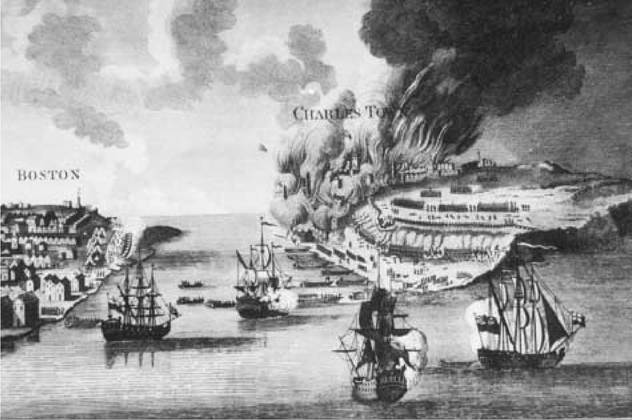
The Attack on Bunker Hill. The Battle of Bunker Hill, shown here in John Lodge's View of the Attack on Bunker Hill, with the Burning of Charles Town, June 17, 1775 (1783), was actually fought on nearby Breed's Hill.