
In 1749 a small fleet of British ships anchored in Chebucto Harbour and disembarked 2,500 passengers to begin the establishment of Halifax as the new capital of Nova Scotia and as the North American base for the Royal Navy. In Newfound land, Captain George Brydges Rodney, governor and naval commodore posted to the island for the fishing season, undertook a major overhaul of the system of naval governance. Back in Britain, Parliament held inquiries on the Hudson's Bay Company (HBC), with a particular focus on whether it was fulfilling its charter obligations to search for the Northwest Passage.
These simultaneous developments reflected a heightened British interest in overseas enterprises, particularly after Britain's poor showing in the War of the Austrian Succession (1740-1748). They also represented policies originating in Britain, whether from the Ministry, Parliament, or the Admiralty, and that were implemented in colonies acquired in the eighteenth century, such as Nova Scotia, and commercial enterprises, such as the fishery and fur trade. This trend of overseas involvement became even more pronounced and widely applied after the Seven Years' War (1756-1763), but in the older colonies settled in the seventeenth century the metropolitan government met serious resistance. Acceptance of those policies or resistance to them reflected two distinct political geographies in British North America. One encompasses the colonies settled in the seventeenth century, which became the United States. The other encompasses the commercial territories and the colonies acquired by conquest in the eighteenth century, which eventually became the modern state of Canada.
At the start of the Seven Years' War, which unofficially began in the Ohio River Valley in 1754, Britain held more territory than France in the northern half of North America. France's control of Canada (the colony along the St. Lawrence and Great Lakes) and Île Royale (or Cape Breton), however, made it the dominant power. Britain's control over Nova Scotia had remained tenuous since its conquest in 1710 and its cession in 1713. By 1754 the number of Englishspeaking, Protestant settlers had declined to approximately 2,000, although supplemented by 2,500 "Foreign Protestants." The French-speaking, Catholic Acadians were numerically dominant at approximately 15,000 persons. The native peoples in the region numbered around 2,000, but remained a redoubtable military power. Newfoundland had over 5,000 permanent settlers, but they were scattered in outports along hundreds of miles of coastline and were oriented to a transatlantic, not continental North American, world. The Hudson's Bay Company, despite its detractors, was a remarkably stable British presence in North America. All of its trading forts, however, were on the shore of the bay, and it assiduously avoided involvement in military conflicts either as allies of native peoples or against the French. Thus these northern British territories were no match for the more integrated parts of New France, particularly the port of Louisbourg on Île Royale, the commercial and administrative centers of Quebec and Montreal surrounded by their well-populated agricultural parishes, and the extensive network of military and trading forts in the St. Lawrence-Great Lakes watershed.
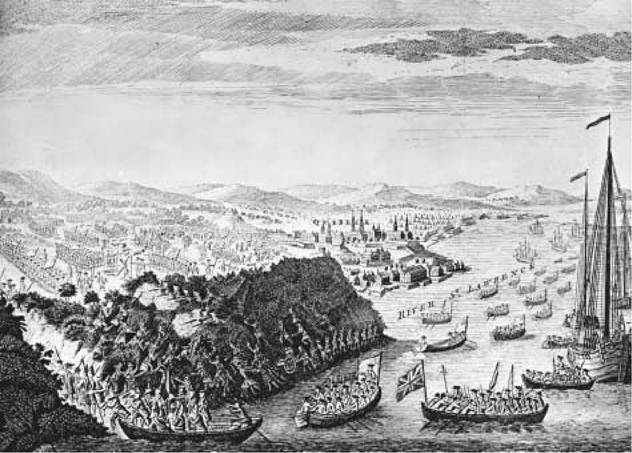
A View of the Taking of Quebeck by the English Forces Commanded by Gen. Wolfe, Sep 13, 1759. This engraving from a 1760 issue of London Magazine shows the fall of Quebec to the British in 1759, a conquest that added thousands of French-speaking Catholic residents to the British Empire.
With the outbreak of Anglo-French hostilities in 1754, British officials in Nova Scotia decided to attack Fort Beauséjour, which the French surrendered in June 1755, along with two other forts in the region. Governor Charles Lawrence then issued orders for the deportation of Acadians to colonies from New Hampshire to Georgia. By 1756, when war was declared in Europe, a new British imprint was impressing itself on the cultural and political landscape of the Northeast.
Deportations of Acadians continued from 1755 to 1762, leaving vacant thousands of acres of fertile farmland along the Bay of Fundy. After the fall of Louisbourg in 1758, Governor Lawrence invited New Englanders to move to Nova Scotia, and by autumn 1760 approximately 7,000 had settled either on vacated Acadian lands or in South Shore fishing ports. Meanwhile refugee Acadians, both those who eluded deportation and those who returned, settled in remote areas, such as the upper reaches of the Saint John River, on the north shore of Cape Breton, and along the Bay of Chaleur.Large communities of Irish Catholic fishermen congregated in Halifax and Canso, while Irish Protestant farming families settled among New Englanders, along with immigrants out of Yorkshire. In Lunenburg, German and Swiss Protestants put down deep roots.
The Island of St. John (renamed Prince Edward Island in 1799) was added to Nova Scotia in 1763, but politicking in Britain resulted in its division into 20,000-acre townships and their distribution by lottery to wealthy proprietors, who agreed to settle the island. They then asked to be separated from Nova Scotia, which the Ministry agreed to do in 1769 if the proprietors agreed to finance the colonial government through quitrents (land taxes paid to proprietors). By 1775 approximately 1,500 tenants from Scotland, Ireland, and England had settled on the island. To the north in Newfoundland, the permanent population grew to over 12,000 by 1780, dividing itself between Irish Catholics along the Avalon Peninsula and West Country settlers along Conception, Bonavista, and Trinity Bays.
The fall of Quebec and Montreal in 1759 and 1760, respectively, added approximately 70,000 French-speaking, Catholic residents to the British Empire, as well as thousands of native peoples, many of whom had previously been allies of the French. The British devised distinct policies for inhabitants in these newest territories of the empire, articulated most prominently in the Proclamation of 1763 and the 1774 Quebec Act. Native peoples were to be self-governing, and their right of occupation on the land could not be extinguished except through an agent of the Crown. The Quebec Act provided for the continuation of French civil law and thereby the seigneurial system of landholding, and it allowed Catholics to hold public office and the Catholic Church to collect tithes.
A few Britons and British Americans moved into Quebec, most prominently Highland Scots who quickly came to dominate the ownership and management of the Montreal-based fur trade. The Hudson's Bay Company had anticipated that the French defeat in North America would attenuate fur trade competition. Instead, the Highland Scots proved to be every bit as, if not more, aggressive than their French predecessors. The Montreal-traders pushed northwestward around Lake Winnipeg, traveled west along the Saskatchewan River system (even though they were on lands included in the HBC charter), and by 1778 had crossed into the Arctic watershed. This aggressive expansion finally forced the HBC to establish inland posts after a century of trading from forts on the Bay.
The American Revolution reconfigured the cultural landscape of North America once again. Approximately 100,000 Loyalists chose to leave the United States, half of whom resettled in the northern loyal colonies. Approximately 35,000 came to Nova Scotia, 20,000 of whom settled in peninsular Nova Scotia. The other 15,000 landed in ports in mainland Nova Scotia and by 1784 persuaded the British government to set them off as the colony of New Brunswick. Among them were 3,000 free blacks, who soon learned that freedom did not bring equality in the distribution of land, in political rights, or in treatment by the courts. In 1792 over a thousand left for Sierra Leone, part of the first resettlement of free blacks in West Africa. Another 15,000 Loyalists settled south and west of Montreal, and soon were agitating for an elected assembly and English common law rather than French civil law. In 1791 Parliament obliged them by passing the Constitutional Act, which divided Quebec into Lower Canada and Upper Canada, the former predominantly French Canadian and the latter English Canadian. In Newfoundland, privateering during the American Revolution disrupted the migratory fishery, prompting a rise in permanent settlement on the island. Similar disruptions during the French Revolutionary and Napoleonic Wars (1792-1815) effectively ended the migratory fishery.
Unrelated to but simultaneous with the American Revolution was the third and last exploratory expedition of James Cook to the Pacific (1776-1780). Among the expedition's significant landfalls was Nootka Sound on the coast of Vancouver Island, where western Europeans got their first glimpse of the highly lucrative but short-lived trade in sea otter pelts. Reports from the expedition unleashed a race for the Pacific, both by water routes and across North America from Montreal. In 1793 an overland expedition led by the Highland Scot Alexander Mackenzie reached the Pacific, and his published account influenced Thomas Jefferson's decision to commission an American overland expedition led by Meriwether Lewis and William Clark.
At the turn of the nineteenth century, there were seven British North American colonies. Nova Scotia, New Brunswick, Prince Edward Island, Lower Canada, and Upper Canada were established jurisdictions. In 1841 the Canadas were combined as one colony with two halves, Canada East and Canada West. Cape Breton became a separate colony in 1784, but political dissent and attempts at imperial economy prompted the British government to reunite it with Nova Scotia in 1820. Newfoundland had long had more inhabitants than some colonies, but not until 1824 did a governor reside on the island year-round and oversee the institutionalization of a more comprehensive colonial government.
Rupert's Land, the Mackenzie Basin, and the Oregon Country were under the administration of the HBC after 1821. In 1811 the Scottish earl of Selkirk, Thomas Douglas, received a grant from the HBC of 116,000 square miles south of Lake Winnipeg to establish the colony of Assiniboia (or Red River). The arrival of Scottish and Swiss settlers prompted armed resistance from the North West Company and the local Métis community, that supplied pemmican and buffalo meat for the fur trade. The conflict contributed to the merger of the North West Company and the Hudson's Bay Company in 1821, when Red River came under HBC governance. Although the settlement did not initially attract immigrants, it became a major settlement of Métis and retirees from the HBC.
Political culture in post-1783 British North America was strongly influenced by the decision of the British government to enhance the executive powers of governors. Colonists were soon agitating for greater access to political power. As noted above, the complaints of Loyalists in Quebec resulted in the division of the colony with the 1791 Constitutional Act and the establishment of assemblies in both Lower Canada and Upper Canada. With the end of the Napoleonic Wars and the coming of extended peace, colonists became outspoken, and at times militant, critics of executive powers. Governors and executive councils controlled contracts for public works—such as roads, canals, post offices, and schools—as well as the distribution of public lands, which became a significant issue with the surge in immigration after 1815. Gubernatorial control of executive council appointments also institutionalized biases, particularly ones based on ethnicity, religion, and family connections.
In Lower Canada and Upper Canada, political pressure for reform erupted in armed uprisings in 1837 and 1838. After the suppression of the rebellions and the transportation of some of the French Canadian rebels to Australia, the British government dispatched Lord Durham to the Canadas to investigate the causes of the uprisings and possible solutions. His famous Report on the Affairs in British North America (1839) recommended the legislative union of the Canadas, which occurred in 1841, with the untenable objective of assimilating French Canadians to Anglophone (English-speaking) culture. He also recommended implementing responsible government, in which the executive council would be appointed from elected members of the provincial assemblies. Nova Scotia received responsible government in 1847, the Canadas in 1848, Prince Edward Island in 1851, New Brunswick in 1854, and Newfoundland in 1855.
Movements for political change in British North America were more progressive than similar movements in Europe, and generally more conservative than movements in the United States. But in some respects the British North American colonies were more liberal than their neighbor to the south. Most particularly, they eliminated slavery before the empire abolished it in the 1830s and decades before the United States abolished it in the 1860s. Nineteenth-century British North Americans were also aware that their relevant standards of comparison for social change were in Britain, other white settler colonies in the empire, and the United States. Thus while societal changes in both the United States and British North America suggested that their development was converging, the particularities of their histories reaching back to the seventeenth and eighteenth centuries often proved more determinative of distinctive identities than their shared occupation of North America.