
It is hardly an exaggeration to observe that the character of a nation is formed in its nurseries. What is so striking about the nurseries of America are the differences among them. At least three distinct childhood cultures can be discerned, sources of intranational conflict as well as whatever richness such diversity may contribute to the country.
Indian children were born at approximately four-year intervals as a result of protracted breastfeeding, prohibitions on sexual relations while nursing, and abortion. A 50 percent death rate among the children, partly due to infanticide, stabilized the size of the population.
The aim of Native American parents was to train male hunter-warriors, who would be required to act individualistically yet always conform to the demands of a communal, conservative, homogenous society. Females were instructed as planter-gatherers and had to possess wilderness survival skills as keen as the males.
An Indian mother fondly cared for her child. For three years or even longer she nursed, and in the case of her death the father might be expected to assume the feeding. She kept her offspring close to her, usually transported on a cradle board. In these early years the child was unlikely to experience the intrusion of a sibling.
The world of young Indians changed dramatically at the age of three, when they were thrust onto their own resources and expected to discover their own ways, neither coerced by parents nor struck by them, a permissiveness that Europeans found amazing. Nevertheless, these young children must have remained under the watchful eyes of their parents and, probably, of the whole village community. With the mother as a secure base, the child could explore any strange situation, which is what it was expected to do by way of building confidence and moving toward autonomy.
Along the way, children were fit into clearly defined gender roles. Girls learned games that led to the performance of household duties, while boys' activities—ball games, archery, and fishing—were antecedents to a hunter-warrior occupation. Scantily clad in winter, boys hardened their bodies as they did their minds; their elders expected of them self-control and absence of womanly emotion. The example of parents, especially warrior-fathers, repudiating corporal punishment must have contributed to the exercise of restraint by their children, particularly sons.
In a social environment that placed a premium on the ability to withstand suffering without flinching, pain could not be used as a coercive force. Not only did children thus feel protected from punishment by their families, but—being specially linked to the spiritual world—they received kindness and respect. Furthermore, the patience and stoicism fostered by an infancy in the cradle board made the Indian child receptive to an indulgent early training.
Self-restraint and stoicism were closely linked to the development of autonomy, a major adult goal. In the Indian cosmos, power was invisibly gained and lost; it was best to avoid others for fear of antagonizing. Thus, the presentation of a stoical exterior was linked to autonomy. Psychological literature at the turn of the twenty-first century leaves no doubt that the absence of corporal punishment nurtures autonomy.
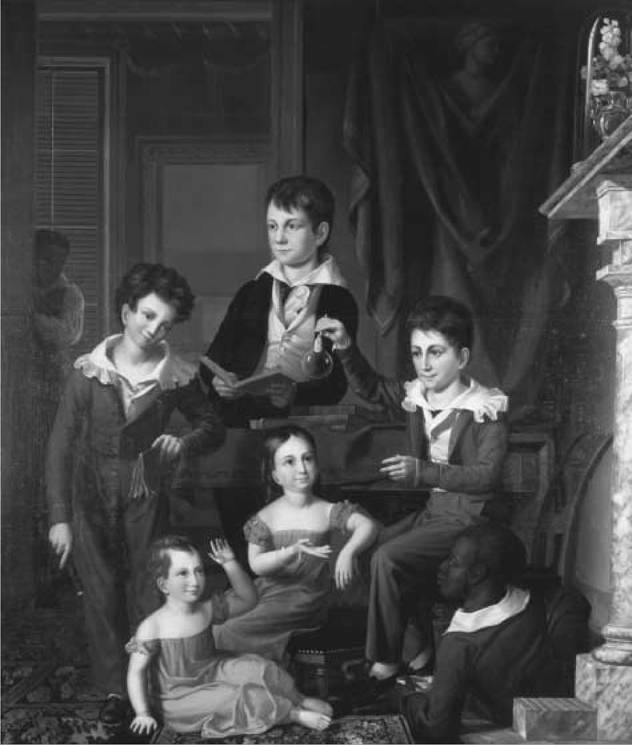
Children of Commodore John Daniel Danels. A portrait of the children and two servants of John Danels, a Baltimore merchant, ship owner, and naval officer (c. 1826). the Maryland historical society, baltimore, Maryland.
Education of the young was not only imparted by the example of elders but also was explicitly transmitted by storytelling. This oral literature was entertaining, but more important it conveyed cultural beliefs and practices.
The transit from childhood to adulthood was well defined. For girls there were sometimes rituals surrounding the onset of menstruation. For boys, whose passage through puberty was less biologically evident, there were more elaborate ceremonies: the huskinaw and the vision quest. Both involved isolation as well as sensory deprivation and stimulation. The purposes were to begin life on a new course, though without forfeiting the training of childhood, or to locate through visions the spirits that dominated the young person's life.
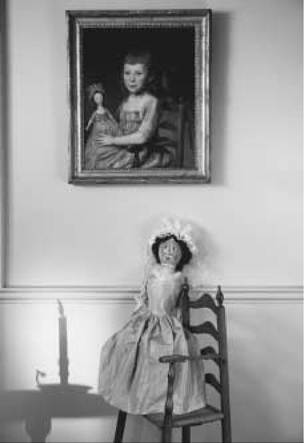
Portrait of Ann Proctor. Six-year-old Ann Proctor displays her favorite doll in this portrait, painted in 1789 by Charles Willson Peale. Ann's doll was later exhibited with her portrait in the Hammond-Harwood House in Annapolis, Maryland.
The Europeans who settled along the Atlantic seaboard in the seventeenth century were mostly English. They established themselves in villages and on isolated farms. New England was distinguished by a patriarchal religion that was duplicated by the commanding presence of the father in a large, stable nuclear family. In the Chesapeake region a high mortality rate led to constant reshaping of the household in a smaller form. In both regions the neonate was swaddled for about three months, whereas breastfeeding continued through the first year. When it ceased, conception became easier and probably occurred within the next several months.
Until the baby walked it was carried in the arms of its parents, one or both of whom could be expected to die early in the life of the Chesapeake child. The trauma of parental loss in the Chesapeake was paralleled in New England by the drama of breaking the child's will, a systematic suppression of early attempts at self-assertion accomplished by a mental manipulation of the youngster that was sanctioned by religious ideology.
Corporal punishment, an English inheritance, was pervasive in both regions, administered to boys and girls by either parent. Clothing was a badge of age and sex. At seven or eight years old, boys moved from skirts into breeches, marking their entrance to manhood as well as into the workforce. Girls remained skirted, symbolizing their continuing—indeed, lifelong—subordination to males; they were also initiated into chores appropriate to their gender. Church membership was customarily not granted until young adulthood, though the age was lowered as church elders became worried about the salvation of youth and the future of the church.
Apprenticeship was directed at older children, and so was education. Masters, like fathers, were required to feed and clothe as well as teach their charges. Among the New England Puritans, reading was considered a necessary complement of childhood, since it provided access to Scripture. Such issues as spirituality, leaving the home, and education, focused as they were on youth, helped to create a transitional stage between childhood and adulthood that, by the late seventeenth century, can be called adolescence.
The eighteenth century was characterized by the growth of population and wealth, the latter contributing significantly to the lengthening of childhood.
Non-English immigrants—Dutch, German, and Scots-Irish—flowed into the colonies, another development that altered childhood.
Those colonists who remained deeply influenced by religion, most typically members of nuclear families living in isolated rural areas, can be labeled Evangelicals; they persisted in believing that children were depraved and in attempting to break their wills. A new secularism, often associated with the Enlightenment as well as the emerging world of commerce, enabled other mothers and fathers, more moderate than the Evangelicals and most often found in affluent farming villages and commercial towns, to deal in a gentler way with the young, expecting responsibility without demanding submission. Yet a third group of parents, genteel in their circumstances with a prosperity based on landownership and slaveholding, indulged their children, not in order to nurture them, but out of indifference to them.
But all European American households shared the belief that children must be controlled, even if the War for Independence both reflected and contributed to some loosening of household authority. Far more than the American Revolution, the industrial revolution altered domestic life in the United States. During the early nineteenth century, the movement from traditional agricultural communities into industrial towns and cities was characterized by the emergence of two distinctly different sorts of childhoods—middle-class and working-class—a process that was only beginning in 1829, primarily in the Northeast.
The urban middle-class household was characterized by the absence of the father, now at his office or factory, and the dominance of the mother. Her emphasis was less on corporal punishment than on internal control of her children, often enough through the employment of guilt (whereas shame had been the instrument of social control in traditional rural society). Insular though this family was in the new mass society, upward social mobility was a goal to be accomplished through education outside the home. Schooling took on a new urgency, and the age-graded classrooms that emerged in the cities reflected and intensified division in all aspects of a society once organically unified.
In the working class, the factory replaced the home as the place of employment. Children had always toiled as part of the household. Now they became wage earners and major supporters of families struggling simply to survive. Although still dominated by their parents, they were less susceptible to control, especially in immigrant families where children grasped American culture unburdened by the Old World past and, thus, appeared wiser than their parents.
Most of the Africans brought to North America originated in west and west-central Africa, where women nursed their children for two to three years and abstained from sexual intercourse until weaning was complete, yielding a birth interval of three to four years in the manner of Native Americans. There were few African American children until several decades into the eighteenth century, when the slave population began to reproduce itself naturally. Then nursing lasted only a year, suggesting that slaves acculturated to European American practices or were forced by work requirements to adjust.
On the plantation, only one of several slave experiences, mothers were expected to return to work soon after giving birth. They had either to take their infants into the fields or return to the slave quarters three or four times a day to feed them. The death rate of black infants was exceptionally high compared to that of their white counterparts.
Once weaned, babes were under the watch of other children, frequently siblings, only a few years older than themselves. (Babysitting chores usually ended at seven or eight.) This child-care practice was sanctioned by African tradition. But while in Africa these child caretakers were part of the village social structure, in America they were largely unsupervised and cannot have been trustworthy.
On the plantation, then, the mother was frequently inaccessible to the African American child. Such separation must have engendered fear in the youngster, although the presence of a familiar companion-caretaker in a recognizable place probably mitigated the bad feelings.
In the Chesapeake area, mothers appear not to have been separated by sale from their young children and so could expect to see them in the evenings. On large plantations, over half the fathers might also be present. Other fathers and older, working children were likely to reside on nearby farms. Furthermore, a kinship network appeared during the course of the eighteenth century similar to that in Africa, allowing most children to live in the presence of familiars.
The games slave children played were the consequence of a dawning recognition of their enslaved condition. Whipping and auction provided ways of acting out so as to neutralize the real events. Also a portent of the future was the way meals were served to them: in troughs, as though they were animals.
The diet was poor and did not improve until they were adult workers. The master treated them less as stock than as his little pets (though he treated his own children similarly), spoiling them while their parents attempted to enforce discipline by whipping them in anticipation of their future.
African American parents were training chattel slaves to be submissive workers, conforming (at least in appearance) to the demands of house mistresses, drivers, and owners who felt free to interfere in the child-rearing process. Some historians believe that parents were able to instill self-esteem in children, but given the limited time old and young spent together, this seems unlikely.
Despite the beatings and perhaps because of the patronizing attitude of the master, childhood did not demand more than light work until about the age of twelve, when many of the children left home and the harsh field life began. Even the cushioning effect of the kinship system could not protect the young at this point, which surely marked the movement from childhood into adulthood. It was an abrupt change. The separation of the child from his or her family as a pre-adolescent could only intensify the fears of early childhood, a situation that served the interest of the slaveholder if only by investing the alternative, escape, with terror. Separation would have served as an obstacle to the normal socialization of a young person.
Of the three separate childhoods described here, it was the European American variety that changed most from 1754 to 1829, and that transformation was prompted by shifting economic conditions. The European Americans were dominant in North America, not only due to their numbers but also their economic, social, and political power. Their culture flourished, and they consciously suppressed the cultures of the Indians and the African Americans. The model of domination-submission was learned in the nursery.