
The Declaration of Independence of 1776 was both the culmination of a decade of protests against what the colonists saw as arbitrary British policies and a statement of political principles that shaped public life in the United States long after its adoption. In order to understand the Declaration, then, one must understand both the historical circumstances that created it as well as the influence it has had in the years since independence.
When the Second Continental Congress met in Philadelphia in May 1775, the dispute between Great Britain and its American colonies had the preceding month erupted into open warfare at Lexington and Concord. What had begun as a dispute over parliamentary taxation escalated into a conflict that would soon tear the British Empire apart.
Despite the seriousness of the crisis they faced, many of the delegates to the Congress were still wary of outright independence. Instead, they wanted to maintain an allegiance to King George III while disavowing any connection to the British Parliament. As a result, even as they were preparing a military campaign against Quebec in the summer of 1775, many delegates sought reconciliation with the crown.
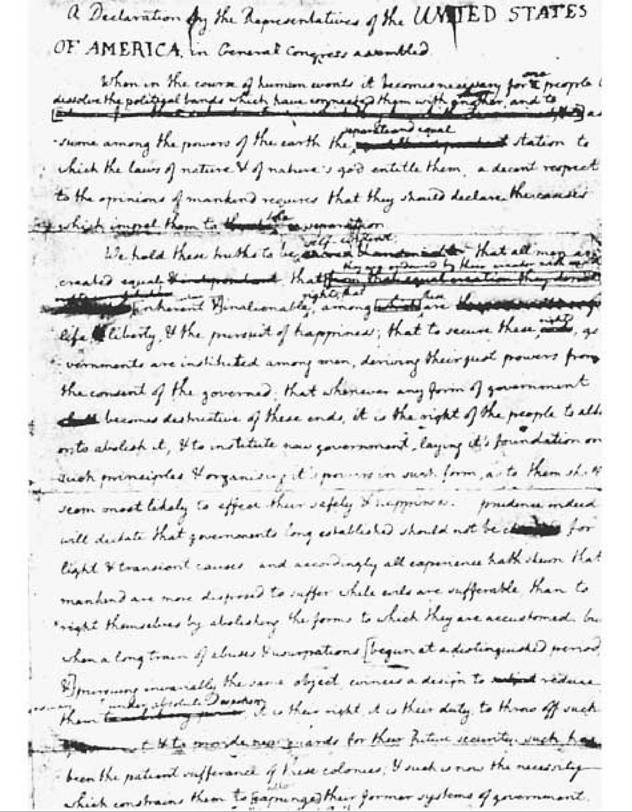
First Draft of the Declaration of Independence. Thomas Jefferson's initial draft of the Declaration of Independence was written in June 1776 during the Second Continental Congress. library of congress.
The king played a crucial role in the escalating crisis. Instead of using his prerogative to disallow parliamentary legislation, he chose to act as a constitutional monarch and concur with Parliament in its attempts to control the empire. As such, the king refused to receive the Olive Branch Petition sent by Congress in July 1775. Rather, the following month he declared all of the colonies in open rebellion. In December 1775 the king gave royal approval to the Prohibitory Act, which built on earlier restrictions on colonial commerce by declaring all trade with the colonies illegal and putting colonial shipping out of his protection.
As a result of these actions by crown and Parliament, the delegates from the two most populous colonies, Massachusetts and Virginia, both recommended that the Congress formally declare independence. In May 1776 the Congress recommended that the various colonies disavow the governing authority of the crown and "adopt such government as shall, in the opinion of the representatives of the people, best conduce to the happiness and safety of their constituents." On 7 June, responding to instructions from the Virginia House of Burgesses, its senior delegate, Richard Henry Lee, moved "that these United Colonies are, and of right ought to be, free and independent States." At the same time as the Congress was deliberating, a host of other declarations were issued by local and state authorities, each making the case for independence from the crown in similar terms.

The Declaration of Independence, 4 July 1776 (c. 1787-1819). John Trumbull's painting of the Assembly Room in the Pennsylvania State House (now Independence Hall) was based in part on Thomas Jefferson's account of the day's events. Jefferson stands at the center, surrounded by (left to right) John Adams, Roger Sherman, Robert Livingston, and Benjamin Franklin. They face John Hancock, who sits at the right.
Due to the hesitancy of delegates from Pennsylvania and New York, Congress decided to put off the vote on Lee's resolution until early July. However, on 11 June 1776 Congress appointed a small committee consisting of Benjamin Franklin, John Adams, Thomas Jefferson, Roger Sherman, and Robert Livingston to create a draft declaration which, if approved, would implement Lee's call for independence. This committee then appointed Jefferson as the chief author, most likely because, as Adams argued many years later, he was a Virginian and thus untainted by the rebellious reputation of Massachusetts. As Adams also noted, Jefferson had acquired a reputation within the Congress as an uncommonly gifted writer.
Jefferson wrote quickly, submitting a draft to the committee on 28 June. The committee then made a few changes, mostly stylistic, and submitted it to Congress sitting as a committee of the whole. After delegates from all of the states but New York voted to approve Lee's resolution for independence, Congress turned its attention to Jefferson's Declaration, which they approved with changes on the evening of 4 July.
The committee of the whole left Jefferson's now-famous introductory paragraphs relatively untouched. However, it made several changes to the body of Jefferson's draft. In the process, it eliminated about a quarter of the text and, most scholars agree, significantly improved it in the process. In its final form, then, the Declaration of Independence was a collective effort, as much the work of the Congress as it was of Jefferson.
The most striking change that the Congress made to Jefferson's draft was its decision to eliminate an entire passage in which Jefferson had made a forceful critique of the king's role in the Atlantic slave trade. According to Jefferson, the king had "waged cruel war against human nature itself, violating it's [sic] most sacred rights of life and liberty in the persons of a distant people . . . captivating and carrying them into slavery in another hemisphere." Jefferson further accused the king of using "his negative" to prevent "every legislative attempt to prohibit or restrain this execrable commerce." Having accused the king of being responsible for the slave trade, Jefferson, referring to the Virginia governor Lord Dunmore's offer of freedom to slaves if they supported the crown, also accused him of "exciting those very people to rise in arms among us, and to purchase that liberty of which he has deprived them, by murdering the people upon whom he also obtruded them."
The passage exemplified Jefferson's ambivalence about slavery. Although it contained a strong moral condemnation of human bondage based on an argument from natural equality, it was a critique primarily of the slave trade and not of the institution of slavery itself. In addition, it undermined even this qualified antislavery message by then condemning the king for inciting the slaves to seek their liberty.
Jefferson, who was generally unhappy with the revisions made by the Congress, blamed the elimination of this passage on the proslavery sentiments of the delegates from South Carolina and Georgia. Although this was certainly a factor, it is also likely that the Congress did not want to draw attention to the widespread colonial practice of chattel slavery in a document that was premised on the theory that "all men are created equal."
In order to make the case for independence, the Declaration had two main parts. One was a theoretical preface that stated the intellectual argument upon which the colonists were declaring their independence. It was followed by a lengthy list of colonial grievances against the crown.
Intellectual foundation. The theoretical part of the Declaration drew heavily on John Locke's political philosophy, of which Jefferson gave an uncommonly eloquent and succinct rendering. Beginning with the claim that "the Laws of Nature and Nature's God" justified the colonies assuming a "separate and equal Station" among the nations of the world, Jefferson then offered his reasons for this claim: "We hold these Truths to be self-evident, that all Men are created equal, that they are endowed by their Creator with certain unalienable Rights, that among these are Life, Liberty, and the pursuit of Happiness."
Having offered this powerful claim for equal rights, Jefferson—following Locke—offered a theory of the origins of government: "to secure these rights," he argued, "Governments are instituted among Men, deriving their just Powers from the Consent of the Governed." Drawing again on Locke, Jefferson argued "that whenever any Form of Government becomes destructive of these Ends, it is the Right of the People to alter or abolish it, and to institute new Government, laying its Foundation on such Principles, and organizing its Powers in such Form, as to them shall seem most likely to effect their Safety and Happiness."
Although Jefferson, like Locke, held that "Prudence" dictates "that Governments long established should not be changed for light and transient causes," he argued that "when a long Train of Abuses and Usurpations . . . evinces a Design to reduce them under absolute Despotism, it is their Right, it is their Duty, to throw off such Government, and to provide new Guards for their future Security." In this one sweeping paragraph, Jefferson outlined a comprehensive theory of the origins and purpose of government, along with a justification of the colonists' right to dissolve their allegiance to the crown and to create new governments in the several states in such a form as would best secure their natural rights.
Grievances. The remainder of the Declaration is devoted to a lengthy list of indictments of royal policy toward the colonies. Although often overlooked today, they were crucial to the Declaration's argument, as they constituted the proof that, as Jefferson put it, "The History of the present King of Great-Britain is a History of repeated Injuries and Usurpations, all having in direct Object the Establishment of an absolute Tyranny over these States." They were, as Jefferson insisted, the crucial "Facts" that needed to be "submitted to a candid World." A careful attention to these grievances also provides valuable insight into the mind-set of the Revolutionaries on the eve of independence.
These grievances can be grouped into several broad categories. The first set accused the king of violating the rights of the colonial legislatures by, among other things, using his prerogative powers to suspend colonial laws from taking effect until he had approved them. It also denounced him for dissolving colonial legislatures because of their opposition to "his Invasions on the Rights of the People" and for then failing to call new ones in their place.
The Declaration also accused the king of undermining the independence of the colonial judiciary by continuing to insist that colonial judges sit at his pleasure instead of during good behavior, as had been the practice in England for most of the eighteenth century. In a series of further charges, many of which referred to the Coercive Acts directed against Massachusetts in 1774, the king was held responsible for abolishing trial by jury, taxing the colonies without their consent, violating colonial charters, forcibly quartering troops in colonial homes, and maintaining standing armies in the colonies during peacetime.
Thejuxtaposition of the Declaration's theoretical introductory paragraphs with this lengthy list of specific legal grievances demonstrates the extent to which the American Revolutionaries were able to combine an intense concern for English constitutional rights—many of which would appear in state and federal bills of rights in the decades following independence—with a philosophical argument for resisting constituted authority when these rights were violated.
Although it had eliminated Jefferson's lengthy denunciation of the slave trade, the Congress retained his charge about royal involvement in slave revolts with a reference to the king having "excited domestic Insurrections." In the same passage, the Congress also accused George III of inciting the American Indians to make war on the colonies. Both of these actions had served to alienate the colonists from the king in the years leading up to independence.
The Congress concluded its brief against the king by noting that the colonists had repeatedly made their "British Brethren" aware of these injustices to no avail. Having received no redress, the Declaration stated that "the Representatives of the UNITED STATES OF AMERICA . . . do, in the Name and by Authority of the good People of these Colonies, solemnly Publish and Declare, That these United Colonies are, and of Right ought to be, Free and Independent States." The Declaration then contended that these new states were fully sovereign under the law of nations, with "full Power to levy War, conclude Peace . . . and to do all other Acts and Things which Independent States may of right do."
Unlike earlier English and colonial petitions to the king, the Declaration was a truly revolutionary, indeed treasonous, document, proclaiming as it did a sundering of all allegiance to the crown. It thus required some courage for the members of Congress to sign their names to it, and as the final sentence reads, "pledge to each other our Lives, our Fortunes, and our sacred Honor."
After agreeing upon the final version of the Declaration on 4 July, the Congress distributed copies to the Continental Army, where Washington insisted that it be read to the troops. Beginning in Philadelphia on 8 July, this process was repeated with civilian audiences throughout the colonies. News of the Declaration was also spread by broadsides. By the end of July, it had also been printed in thirty colonial newspapers.
The reception that the Declaration met in Britain was not rapturous. Much ink was devoted to a detailed refutation of the Declaration's specific charges against British authority. In addition, some commentators—influenced by a nascent skepticism about political arguments based on natural law—criticized what they saw as the philosophical incoherence of Jefferson's claims about rights and equality in the Declaration's opening paragraphs. However, the foreign reception of the Declaration outside of Britain was more positive. The Declaration was translated into many foreign languages, and starting in the late 1770s, it began to influence revolutionary movements in Europe and around the world.
Within the new United States, the formal work of the Declaration was done once independence had been proclaimed. However, the fact that the Declaration derived its right to revolution from a political philosophy of equal natural rights and government by consent meant that its ideals could be employed by a multitude of groups within American society seeking justice. In 1848 advocates of women's rights issued a declaration at Seneca Falls, New York. Explicitly based on the Declaration of Independence, it proclaimed that "all men and women are created equal." Also in the nineteenth century, abolitionists invoked the Declaration's ideals in their crusade against human bondage. In turn, antebellum defenders of slavery began to attack the Declaration and the very idea of equal natural rights. In response to these proslavery arguments, Abraham Lincoln, with great eloquence, made the Declaration into a moral standard for judging existing society, calling it "the leading principle—the sheet anchor of American republicanism." In this guise, the Declaration has continued to shape the nature of political debate in the United States into the twenty-first century.