
In a little over two hundred years, a few tiny, beleaguered English settlements evolved into a mighty nation that would soon extend its boundaries across the entire North American continent. Although "expansion" accurately describes the geographical transformation that would continue throughout the nineteenth century, the term connotes passivity and inexorability. The growth was so rapid, deliberate, energetic, and violent that it could just as well be described as an "explosion" that overwhelmed those colonists' five rivals—the French, Spanish, Dutch, British, and Native Americans.
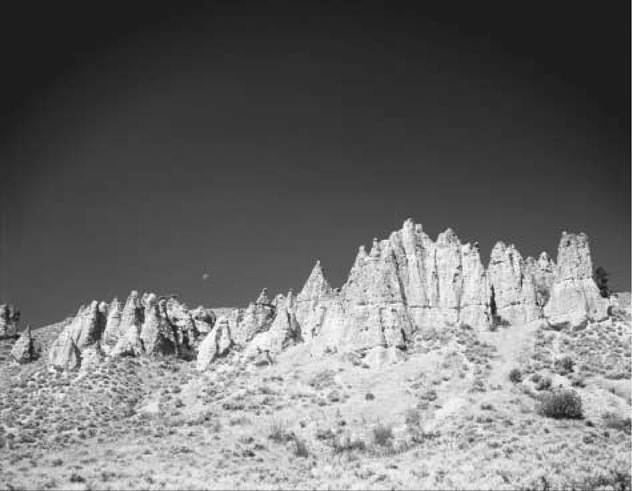
Towering Rock Formations. In August 1805 the Lewis and Clark expedition stopped near these rock formations along Tower Creek in Idaho.
The English colonists had several competitive advantages over their opponents, the most important of which was their rapidly expanding population. The Spanish lusted after silver and gold, which they failed to use as the foundation of a system of public credit and private power. Generous agricultural subsidies failed to attract many Spanish colonists because there was a shortage of labor in Spain. Although the French engaged in some farming, they primarily sought such natural resources as beaver skins in North America and sugar in the West Indies. For instance, French leaders thought they had acted wisely when they did not pursue England's tentative queries about trading all of Canada for the sugar island Guadeloupe after the French and Indian War ended in 1763. This diplomatic blunder reminds historians how fortune (as well as particular decisions by particular leaders) plays a major role in history. If France had controlled Canada at the time of the American Revolution, the Revolutionaries might have won more easily and then successfully conquered Canada.
The Dutch simply did not have a large enough population at home to compete against the swarms of English who rushed over to the New World in four discrete waves during the seventeenth and eighteenth centuries. The English colonists quickly turned to agriculture and trade (even as some continued to look for gold), activities that transformed the landscape and provided sustenance for a populace that grew from about one million settlers in 1740 to four million in1790. They imported the dynamic, flexible common law system of rural capitalism: a free market in land, labor, and goods. Lightly taxed and well fed, the colonists were soon much taller than their European counterparts. Fully aware of their growing power and needs, the colonists chafed at the constraints the British put upon them after the French and Indian War: although the British had given them rights and access to all lands east of the Mississippi, they banned any further migration. Caught between these four competing European empires, the Native American tribes had neither the technology nor the cultural traditions to overcome numerous plagues, internal disputes, and the vast number of determined colonists.
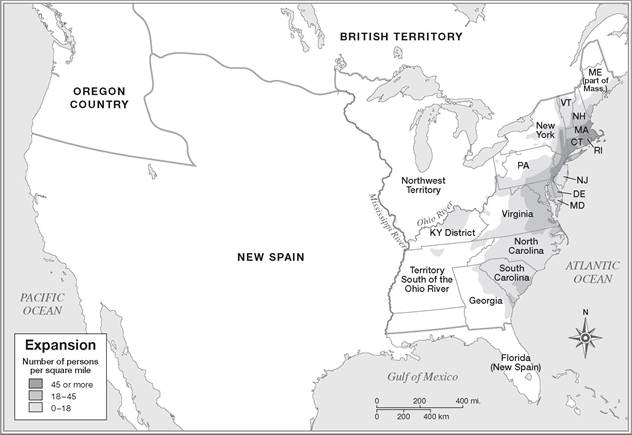
From the beginning, the English colonists had continental aspirations, for which they had several ideological justifications beyond immediate self-interest and providing for one's family. Virginia governor Alexander Spotswood's expedition in 1716 to the Blue Ridge Mountains was self-consciously nationalistic; he foresaw "a new English nation" sweeping across the frontier. Both Europeans and Americans preferred to wrap up their imperial ambitions in legal rhetoric. The king of England granted his colonists royal charters extending from the Atlantic to the Pacific, a grant covering not only Native Americans but also the French. The king authorized these grants on the legal theory that the English had "discovered" these lands even though Native Americans already lived there. Like his European rivals, the king based this circular, self-serving argument on the theory that non-Christian leaders had no capacity to establish their own title and that the Europeans were the first Christians to discover and thus legitimately own the lands.
When Chief Justice John Marshall faced the question of title in Cherokee Nation v. Georgia, he did not rely on euphemisms or noble principles. He invoked the doctrine of "conquest," bluntly stating that the Native Americans had lost a "contest for empire" because of their inferior military capacities. Sovereignty is a phenomenon described by the philosopher Thomas Hobbes: "In the exercise of sovereign right, the sovereign is the sole arbiter of his own justice. The penalty of wrong is war and subjugation." The philosopher John Locke provided a jurisprudential justification for English title: the Native Americans had no natural law property rights to the land because they had not cultivated the land (even though many tribes actually had extensive agriculture).
For most of the colonists, religious beliefs were not a pretext for a land grab. Many of the English left their native land to pursue their religious beliefs in the new country. The Puritans' desire to practice their religion (and suppress other religious views) enabled them to endure the harsh environment of New England. John Winthrop Jr.'s famous claim that the Puritans were establishing "a Citee on a Hill" combined religious and political aspirations. William Penn created Pennsylvania to protect the freedom of conscience. Many of the English sought to save the souls of the heathen natives, while others sought to eliminate them or at least move them out of the way. Thus, the early colonists believed in "Manifest Destiny" long before John O'Sullivan invented that phrase in 1845 to describe how Americans "overspread the continent allotted by Providence for the free development of our yearly multiplying millions." English racism also was a tool of empire. Unlike the French, who often went "native" in every sense of the word, the English remained more culturally and sexually isolated from their local rivals. They quickly embraced race slavery throughout the colonies, a system that achieved a high level of productivity at relatively little cost because the black slaves could not easily escape. The "rights of Englishmen" to representation, the common law, and the jury did not apply to anyone else.
All the contestants paid a high price in terms of lives lost during these protracted struggles for control of the continent, which did not cease until the end of the nineteenth century. The list of atrocities, ranging from the slaughter of entire villages to isolated murders, is agonizingly long. During King Philip's War in 1675, Wampanoag Indians killed more than six hundred whites. The colonists retaliated by killing over four thousand Wampanoags—40 percent of the tribe. A century later, John Floyd described to Thomas Jefferson the hard life on the Kentucky frontier:
We are all obliged to live in forts in this country,
and notwithstanding all the caution that we use,
forty-seven of the inhabitants have been killed and
taken by the savages, besides a number wounded,
since the first of January last. . . . Whole families are destroyed without regard to age or sex. Infants are torn from their mothers' arms, and their brains dashed out against trees.
Thus, for almost three hundred years, the colonists engaged in a "total war" that included civilians as well as combatants.
While the colonists continued their long war with the Native Americans, they faced a more dangerous threat from the French, who were wealthy, far better organized, and generally more effective in developing alliances with the Indians. The French sought to contain British expansion by building a ring of forts along the western frontier. When George Washington, a leading speculator in western lands, tried to negotiate with the French, they told him of "their absolute Design to take possession of the Ohio, and by G—they would do it." On his return trip in 1754, Washington helped trigger the French and Indian War by ambushing a French scouting party at Great Meadows (in what is now southwestern Pennsylvania).
England's eventual victory over France revealed that one of the perils of empire is ingratitude. The British had spent a great deal of money to defeat the French and maintained the Americans should help reduce the resulting national debt. The Americans, no longer threatened by the French and their Native American allies, saw no reason to pay any additional taxes without their own consent. After all, they had spilled their own blood to help Britain expand its empire. But the controversy extended beyond taxation without representation. In 1763 the British tried containment once again by proclaiming that colonists could not move into western lands already occupied by the Indian tribes, who now were also British subjects engaging in a lucrative fur trade, and by building forts to enforce the mandate. Even worse, in 1774, the Quebec Act extended Canadian jurisdiction to the Ohio River while also protecting loathed French Catholicism. In 1775 the Continental Congress responded to these constraints (as well as the escalation in the use of force by both sides) by invading Canada, knowing that such an act made reconciliation all but impossible. One year later, Thomas Jefferson turned those actions into the enduring words of the Declaration of Independence. The king's efforts to combat colonial expansion were listed among the Declaration's complaints justifying armed revolution: "[The king] has endeavored to prevent the population of these states; for that purpose obstructing the laws for naturalization of foreigners, refusing to pass others to encourage their migrations hither, & raising the conditions of new appropriations of land."
Benjamin Franklin and Jefferson were geopoliticians of the first rank. In 1748 Franklin described Captain Christopher Middleton's arduous attempt to find the fabled North-West Passage to the South-Sea, a quest to facilitate the shipping of furs and other valuables to growing markets in Asia. Franklin would later fund another failed effort to find the nonexistent river route. As soon as Europeans began conquering the New World, they also started constructing a global market tying together Europe, Asia, and the Americas. Franklin understood sooner than most of his fellow colonists the need for coordination between the different colonies; his newspaper published the first political cartoon, a drawing of a snake cut into many pieces that were marked as various colonies, resting above the admonition "Join or Die." Less noticed is the snake's hissing recommendation to "Unite and Conquer." That snake would later consolidate, warning "Don't tread on me." Franklin envisioned dramatically increased colonial coordination when he drafted the Albany Plan of Union, which described itself as a "Plan of a proposed Union of the Several Colonies . . . For their Mutual Defence and Security, and for extending the British Settlements in North America." Even more important, Franklin developed the revolutionary premise that England's constitution must apply equally throughout the empire. Jefferson would transform this notion into an "Empire of Liberty" offering unlimited opportunities and equal rights to any white males who would venture into the wilderness. In 1801, soon after Gabriel's slave revolt reminded Southerners of their vulnerability, Jefferson described his hemispheric vision to James Monroe in terms intimating political, cultural, and even racial uniformity:
However our present interests may restrain us within our own limits, it is impossible not to look forward to distant times, when our rapid multiplication will expand itself beyond those limits, and cover the whole northern, if not the southern continent, with a people speaking the same language, governed in similar forms, and by similar laws; nor can we contemplate with satisfaction either blot or mixture on that surface.
Jefferson, the son of a surveyor, understood the necessity of exploration as precondition to establishing title and sovereignty. He organized the Lewis and Clark expedition to satisfy both his insatiable scientific curiosity and to begin the process of establishing sovereignty as far as the Pacific Ocean.
These examples of American leadership should not obscure the role that untold thousands of unknown, individual American settlers made throughout this era to change the face of the continent. Whatever the French, the British, the Native Americans, or American leaders said or did, the pioneers relentlessly risked their lives and fortunes to explore and develop new lands. Just before the Revolution, Lord Dunmore, governor of the Virginia colony, described this force to the Earl of Dartmouth, colonial minister and secretary of state for the colonies:
The Americans acquire no attachment to Place: But wandering about seems engrafted in their Nature. . . . In this colony Proclamations have been issued from time to time that restrain them. But . . . they do not conceive that Government has any right to forbid their taking possession of that Vast tract of Country, either uninhabited, or which serves only as a Shelter for a few scattered Tribes of Indians. Nor can they easily be brought to entertain any belief of the permanent obligation of Treaties made with those People, whom they consider but little removed from brute Creation.
Embracing rather than fighting the inevitable, Dunmore issued a proclamation granting title to new settlers who moved beyond the Allegheny Mountains and provided surveyors to facilitate development.
Heavily influenced by the economist Thomas Malthus and the French physiocrats, Madison and Jefferson believed the United States' population surge was a short-term boon that would eventually undermine their ideal of agrarian republicanism. Explosive population growth would enable the Americans to spread the "empire of liberty" across the continent. As Madison argued in The Federalist Number Ten, this increase protected the Republic because a large republic is less prone to factionalization and tyranny than a small one. Thus the fortuitous Louisiana Purchase from Napoleon, which doubled the size of the new nation, not only augmented American power but also protected republicanism by providing an essential outlet for continued growth. Dissenting Federalists accurately observed that the purchase also provided new opportunities for the slave economy. The two Virginians understood that there was only a finite amount of arable land. Eventually, a surplus populace would move to the cities, which would turn that overflow into a dependent, corrupt faction, vulnerable to demagoguery. However, the steadily swelling populations of numerous urban centers indicated that many Americans did not perceive their cosmopolitanism to be incompatible with republicanism. In the meantime, Jefferson required that any growth be of the right kind of people. He refused to let the new citizens of Louisiana immediately elect their own representatives because they were not of Anglo-American stock, preferring to wait until enough Anglo-Americans moved into the new territories before permitting elections. Jefferson also believed (or more accurately, blindly and self-servingly hoped) that expansion would resolve the slavery issue. Somehow slavery would disappear or at least become diluted as it spread westward. He never explained how his admired yeoman farmers could easily coexist with the new plantations, which would increase the demand for slaves.
While Jefferson preferred to enlarge the country and take residual title from Native Americans through negotiations and purchases, Madison preferred conquest. Twice Americans invaded Florida, only to retreat for diplomatic reasons. American leaders started the War of 1812 with the hopes of conquering Canada. Like most American military operations during that war, the invasion failed miserably. But a diplomatic return to the status quo obscured profound victories for expansionists. Andrew Jackson had effectively crushed any residual Native American resistance east of the Mississippi before he defeated the British at the Battle of New Orleans. Madison partially rejected the traditional Republican Party antipathy to the powerful federal government that Alexander Hamilton had argued was necessary to support and protect this union; Madison supported a second national bank but vetoed a bill to build federal roads to link the newly settled lands with the Atlantic Coast.
Aided by Secretary of State John Quincy Adams, President James Monroe paved the way for continued American expansion, both formal and informal. In 1819 the Monroe administration purchased Florida from Spain. In 1821 Russia attempted to forbid all foreign shipping as far south as Vancouver Island. Bluffing brilliantly, Adams convinced the British not to invade Alaska. When the British minister asked if the Americans were planning to invade Canada again, Adams replied, "Keep what is yours, but leave the rest of the continent to us." Relying on suggestions from the British, Adams next persuaded Monroe to declare in the Monroe Doctrine that no European nation could expand anywhere in either hemisphere, a dramatic step toward Jefferson's vision of hemispheric hegemony. Having secured the northern flank, Americans turned to the Southwest. Once again, individual settlers made foreign policy on the ground by moving in large numbers into Texas and pouring into the lands west of the Mississippi, thereby guaranteeing more conflicts with Native American tribes and the Spanish. The historian Henry Adams best described the Americans' assessment of their next opponent:
In the end, more than half the territory of the United States was the spoil of the Spanish empire, rarely acquired with perfect propriety. To sum the story up in a single word, Spain had immense influence over the United States; but is the influence of a whale over its captors, —the charm of a huge, helpless, and profitable victim.
But the coming victories carried with them another peril facing successful empires: virulent internal dissension.
Territorial expansion aggravated the sectional fault line of slavery, an issue swept off the table since the Constitutional Convention. When Southerners originally agreed to join the Union, they mistakenly thought their region would grow more quickly than the North. But thanks to immigration and the attractions of a free market culture, the North's population quickly outpaced the South's. The constitutional compromise giving Southerners three-fifths of a vote for every slave enabled Virginians to be president for twenty-four years; but events quickly revealed that the South could not control the House of Representatives. Consequently, the South desperately defended equality in the Senate, demanding that half of any new states, with their invaluable two senatorial seats, be admitted as slave states. In 1820 Representative James Tallmadge Jr. of New York broke the taboo by proposing that Missouri be admitted into the Union only if it banned the importation of new slaves and emancipated all slaves born there at the age of twenty-five. Tallmadge explained that slavery's "baleful consequences would surely conquer the West." Tallmadge's victory in the House demonstrated the loss of southern influence. Senator Henry Clay averted immediate conflict by pushing through the Missouri Compromise, which admitted Missouri as a slave state and Maine as a free state.
The historian Vernon Parrington offers one interpretation of the unstable situation of the United States. The nation was torn, he argues, between three rival forms of imperialism, each with its emerging utopian vision. The North was starting to create the world's second "industrial capital order." The South relied on cotton to create a "dream of expanding fields of white bolls and black slaves, reaching into Mexico and embracing the West Indies." The West preferred an individualistic society for whites only, seeking "county-seat towns where land holdings mounted in value with every new wave" (p. xiii) of immigrants. No longer seriously concerned about external opposition, the growing country would turn on itself in a gruesome civil war to resolve this sectional competition.