
Both as a concept and a changing array of consumer goods and cultural practices, fashion served as an important means of social communication in eighteenth-century British America. Composed not only of objects and styles, but also of behaviors and the arenas in which such items and actions were displayed, fashion provided for connection as well as personal distinction. It possessed intensely local significance as a tool for distinguishing among and within social groups, yet also expressed participation in a cosmopolitan Atlantic world. While most inhabitants of the colonies recognized the symbols of power that fashion conveyed, they did not necessarily regard or respond to those markers in the same ways. Thus, fashion was a primary register of cultural and political contest.
For Anglo colonists, England was the locus and source of all things fashionable, although many modes actually originated in France. A burgeoning Atlantic trade made the adoption of European fashions, from fabrics and fans to teapots, possible, while waves of immigrants, many trained in the fashion trades, also spurred the transmission of modes. Newspaper advertisements for imports regularly deployed the adjective "fashionable" as a powerful selling point for the rising volume and selection of items that suffused even middling colonial households by the middle of the eighteenth century. Indeed, the British Empire's smooth operation depended on consumption of fashionable goods in colonial outposts and the consumer appetites for novelty that changing fashions fed. As social critic Bernard Mandeville (1670-1733) observed, fashion was a "strange, ridic'lous vice" that nonetheless "turned the trade." This trade reached across the Atlantic and into the heart of North America, as diplomatic and social relations on the frontier created amalgams of Indian, Anglo, and French fashions.
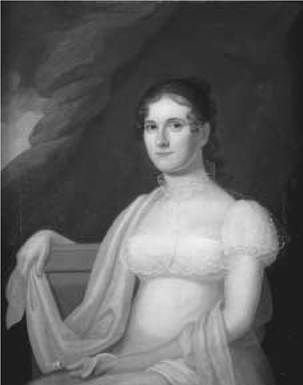
Alice Lawrason Riggs. Cephas Thompson painted this portrait of a fashionable American woman around 1815. The sitter, the wife of a prominent Baltimore merchant, wears a high-waisted Empire-style gown.
In contrast to more recent cycles, fashions in dress changed slowly during the eighteenth century, indicated by seasonal variety in fabrics and more glacial shifts in the widths of hoop-supported skirts or the cuts of sleeves—changes subtle enough to be acknowledged and adopted by the people "of fashion." Likewise, the display of fashionable practices, from dancing the minuet to drinking tea, the imperial good par excellence, and the social spaces in which those occurred (and in which fashionable dress could be displayed to great advantage) signified high status and participation in the empire. While fashion's appropriation and refashioning by slaves, servants, and other "lower sorts" due to theft and an underground trade in stolen and secondhand goods made it an unstable marker of rank, other forms of social distinction, such as speech and carriage, countered fashion's democratizing potential. Thus was the very idea of fashion rife with contradiction: desirable as an expression of high rank, yet disdained as the province of mere pretenders to status; displaced onto consuming women, but avidly pursued by both sexes; connected to other celebrated concepts such as gentility, taste, and refinement, yet also suggesting luxury, appetite, and effeminacy; and fueling commerce through consumption, but creating a potentially uneasy dependence on markets.
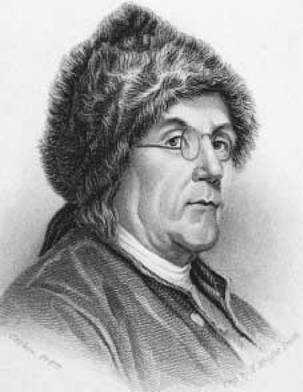
Benjamin Franklin (1794). Franklin donned the persona of a rustic American, along with the beaver hat and homespun suit that conveyed it, when appearing before the French court at Versailles to plead for French assistance.
Due to its considerable influence, fashion served as a flashpoint for cultural and political contests during the revolutionary era. By the end of the Seven Years' War in 1763, some Anglo colonists and Indians alike, facing ailing postwar economies after more than a decade of increasing consumption, called for retrenchment and a lessening of dependence on foreign "luxuries," even as English bourgeois styles in dress and furnishings grew more restrained. By 1764, when Britain's Parliament moved to diminish its war debt by collecting taxes on items such as sugar and French fabrics, the climate was ripe for calls to reject imports and the fashions they expressed. In response to the following year's Stamp Act, which levied a one-pence duty on all paper and paper transactions, merchants in the northern port cities of Boston, New York, and Philadelphia pledged not to import goods until the bill was repealed, and outraged colonists swore not to consume such articles. Supporters used the public prints to enforce the boycotts, promoting the virtuous behaviors of genteel "people of fashion" while attempting to create new "American" fashions, namely homespun cloth, domestic tea, and minimalist mourning garb. Yet after the Stamp Act's much-celebrated repeal, colonists jettisoned the new modes, never widely adopted but symbolically important nonetheless.
With Parliament's passage of the Townshend Act of 1767, designed to raise revenue through the assiduous collection of duties on certain items, including beloved tea, some colonists revisited boycotts. Resistance leaders called upon Anglo women in particular to discipline their appetites and thus prove themselves good female patriots, foregoing fashion's cultural power while gaining a new kind of visibility, yet also scrutiny. Extravagant display, from the form-fitting macaroni mode for men to high, ornamented hairstyles for women, characterized the period between the repeal of all Townshend duties except the tea tax in 1770 and 1773, demonstrating that many colonists had little use for asceticism and understatement. The Tea Act of 1773, which gave Britain's East India Company a monopoly on the sale of tea to the colonies, defined tea, once the hallmark of female-orchestrated gentility and participation in the empire, as a symbol of subjugation, and the colonists who consumed it complicit in a despotic, tyrannical regime. In 1774 the First Continental Congress's Association enacted colonywide nonimportation and nonconsumption resolutions, clamping down on appetites for all things fashionable in language that decried forms of "extravagance and dissipation," which undermined professed American values of virtue, simplicity, and sacrifice. Such regulation persisted through the onset of hostilities between Britain and the colonies in 1775, as hunting shirts and leather breeches joined traditional military uniforms. Benjamin Franklin himself donned the persona of rustic American, along with the beaver hat and homespun suit that conveyed it, when appearing before the French court at Versailles to plead for French assistance. Yet the American Revolution resolved little in the battle over fashion, which shaped the contest not only between England and the newly created United States of America, but between Whigs (Patriots) and Tories (Loyalists), merchants and artisans, slaves and masters, men and women—all competing to see who would define fashion for the new nation.
Revolutionary leaders had cast fashion as a threat to the Republic while promoting an American antifashion stance that was itself a fashion, one that they often failed to adopt. The new nation and its leaders needed to appear legitimate in the eyes of the world, and European modes retained their ability to communicate power and status, locally and internationally. Many Anglo Americans continued to regard Europe as the seat of the mode (the fashionable) as goods flooded an American confederation of states powerless to enact national commercial policy in the mid-1780s. Social critics pinned the Republic's potential demise on appetites for fashionable "gewgaws."
Fortunately for Americans faced with the dilemma of signifying both prestige and virtue, European fashions themselves grew more understated in the final decades of the eighteenth century, the so-called age of democratic revolutions. The Empire-style gown that became popular in the 1790s served the image of American, republican simplicity well, projecting it onto white women clad in simple white gowns, standard-bearers of virtue, if not rights. Meanwhile, the displacement of Indians beyond the literal and figurative borders of the nation made the interpretation of Indian-influenced frontier dress as an American folk form possible, and unthreatening.
With the emergence of partisan politics in the 1790s, Democratic Republicans used fashion to attack ostensibly foppish, elitist Federalists. Whereas George Washington had donned a suit of homespun for his 1789 inauguration, in 1793 he appeared in velvet. The cut and cloth of a man's breeches, and the color of one's cockade—ribbons worn during the French Revolution—signified political allegiance, in fact, created it. The influx of refugees from the slave revolt in Saint Domingue to cities such as Charleston and Philadelphia helped create a distinct African American style that recalled the French Revolution's contagion of social upheaval. With Thomas Jefferson's election to the presidency in 1800, the fashion of genteel understatement triumphed; Jefferson would famously greet guests donned in a banyan (a robelike garment), the height of genteel fashion for the learned, leisurely set. Into the nineteenth century, Anglo American men traded knee breeches and brocade for long trousers and somber cloth, while the high-waisted, corset-free Empire dress for women persisted into the 1810s. Indeed, men's and women's "fashionable" garb steadily diverged throughout the latter half of the eighteenth century, mirroring the rise of an ideology of separate "male" and "female" bourgeois spheres of influence as white men abandoned obvious ornamentation in favor of other representations of power available to them alone.