
The institution of the "first lady," meaning the role of the wife of the president of the United States, did not take its modern form in the era of the new American nation. However, some of the salient features that have historically surrounded presidential wives—popular interest, leadership of Washington society, and ambivalence about the status of these women—emerged in these years. In the case of Dolley Madison, the first celebrity assumed the position of wife of the president. Elizabeth Monroe and Louisa Adams did not, however, build on what Madison had done. The wife of the president in 1829 remained a potential source of political and cultural influence but had not yet emerged as a figure in her own right.
The first presidential spouse, Martha Washington, lived in New York and then in Philadelphia for the eight years of her husband's administrations. She conducted receptions for the president's guests each week on Friday evenings and otherwise was a practiced hostess on numerous social occasions. Martha Washington had some direct correspondence with the wives of diplomats and officials of foreign countries, most of which others drafted for her to send. Although she was a semipublic figure, she did little to satisfy any appetite of her fellow citizens to know about her or to have her reveal her private thoughts.
Abigail Adams is one of the most famous women in the nation's history, but the four years from 1797 to 1801 when her husband was president did not represent a high point in her life. She spent some time in Philadelphia in its last years as the capital, but she also returned to her Massachusetts home for extended periods. Abigail received numerous letters from office seekers and sought to publicize the president's achievements in the press. In 1800, as the Adams administration wound down, the family moved to Washington and took up residence in the still uncompleted presidential mansion. Her husband's defeat in the election of 1800 made her stay in the executive mansion a short one, but she has the honor of being the initial first lady to live there.
Thomas Jefferson was a widower when he became president in 1801, and for eight years the nation did not have a first lady in the usual sense. During the Jefferson presidency, however, an important woman stepped onto the national stage. Dolley Payne Todd Madison was the wife of James Madison, the secretary of state. She was thirty-three years old in 1801 and had been married to Madison for more than six years. Jefferson did a minimum of entertaining on a large scale. As a result, the Madisons became surrogates for the president in a social sense. The couple lived two blocks from the White House. Dolley helped with official entertaining and became renowned for her skill as a hostess. In so doing, she helped to define a world of Washington society that lent a special style to the new American Republic. After Jefferson had served two terms as president, James Madison succeeded him in 1809. Now Dolley Madison had the task of putting her own stamp on the executive mansion.
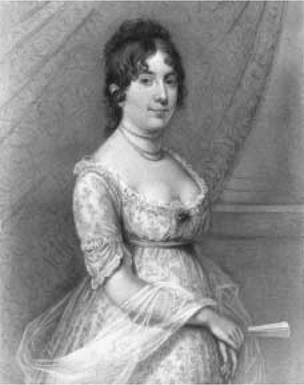
Dolley Madison (1768-1849). The wife of President James Madison, in an engraving (1804-1855) based on a painting by Gilbert Stuart.
Her work went forward in two areas. In the president's house itself, her husband gave Dolley Madison the authority to handle the task of decorating the new mansion. Working with Benjamin La-trobe, an architect for the government, she took the limited fund that Congress appropriated for that purpose and set to work. She emphasized the use of American-made furniture and avoided any taints of the aristocratic Federalist style that her husband's political party disliked. Madison succeeded in striking the right balance of simplicity and elegance that made the executive residence a testament to her good taste.
As far as formal entertaining was concerned, the Madisons held parties on a regular basis and sought to invite as wide a circle of guests from the Washington area as possible. The tradition of receptions that they established remained a distinctive feature of the presidency for one hundred and twenty years. These events enabled politicians and diplomats to meet on a neutral ground while allowing the president and his wife to create better relations with members of Congress. Some foreign diplomats chafed at the relatively simple style of these affairs, which lacked the rituals and formality of the European courts. Americans applauded Dolley Madison's ability to make all her guests feel at home. Under her direction, the practice of using the social aspects of the executive mansion for the political ends of the president began to emerge. The duties of her position were exacting and time-consuming, but she impressed the nation as the embodiment of what a president's wife should be.
The most famous moment of Dolley Madison's years as the first lady came during the summer of 1814. As the War of 1812 continued, British troops invaded and then moved toward Washington. As the military threat grew, Madison packed as much of the silver and as many of the other important possessions as she could and then dispatched the wagon to a nearby bank for protection. She also saw to it that the celebrated Gilbert Stuart portrait of George Washington was removed for safekeeping. Madison then left Washington while the British troops burned the mansion. In the wake of the British invasion, Dolley Madison played a large role in lobbying to retain the capital in Washington City. The presidential mansion was reconstructed during what remained of the Madison presidency and repainted white. James Monroe and his wife moved back into what was now the White House once the work was completed during 1817.
Dolley Madison's conduct during the war and her rescue of the Stuart painting became part of the personal legend that followed her until she died in 1849. She symbolized the era when the United States felt itself becoming a nation, and she embodied the distinctive republican style of the time. For the rest of the nineteenth century, she remained the most famous presidential wife.
The two women who followed Dolley Madison did not even approach having her impact on the institution of the first lady. Elizabeth Monroe was a far more reserved and less outgoing person than her pre decessor. Her experience as the wife of an American diplomat in European courts led her to adopt protocols for entertaining and receiving guests that relied more on formality and etiquette than had been Dol-ley Madison's practice. Uncertain health also disposed Elizabeth Monroe to limit her commitment to entertaining. These changes in style at the White House led to several social battles among women in Washington, including a boycott by Mrs. Monroe's critics in 1819 and 1820. The resulting tensions spilled over into the masculine world of politics. Eventually, the president's wife prevailed; her policy of limiting the number of visitors that she needed to receive proved enduring for future first ladies. Her worsening health reduced her public appearances still further during her husband's second term. During her eight years in the White House, the position of the presidential wife lost some of the luster that Dolley Madison had imparted to it.
Louisa Catherine Adams continued the downward trend of participation in social affairs during her husband's single term in office from 1825 to 1829. Her marriage to John Quincy Adams had had its rocky moments before he won the disputed presidential contest of 1824. Nevertheless, she had used her political skills effectively in his efforts to become president during the election and in the proceedings of Congress that resolved the election. Once in the White House, Louisa Adams did not do much entertaining, nor did she reach out to political Washington. Instead, she went into a shell, regarding the executive mansion more as a prison than as a place to make a reputation as a hostess. Her husband was preoccupied with the cares of office and devoted little time to his wife. The two became more distant from each other as the Adams presidency unfolded. They spent some months apart when they took separate vacations in 1826. Poor health, perhaps arising from menopause, dominated her existence.
In 1827 a newspaper friendly to Andrew Jackson, whom John Quincy Adams had defeated in 1824, attacked Louisa for her English origins and made her a target for political invective. In response, she authored an anonymous essay countering her critics and outlining her own virtues. That was a departure for a presidential spouse. Louisa hoped that her husband would be reelected in 1828, but the tide of support for Jackson sent the couple into private life. The four years of Louisa Adams left little impact on the issue of what a president's wife should do and how she should behave.
Over the next twelve years two widowers, Andrew Jackson and Martin Van Buren, occupied the White House. In the 1840s, interest in presidential wives revived with the presidencies of William Henry Harrison, John Tyler, and James K. Polk. However, with the new, more democratic politics of the midnineteenth century, the power of presidential wives receded. The first ladies of the new American nation from Martha Washington to Louisa Adams displayed some of the future roles of the institution—hostess; decorator of the White House; and in the case of Dolley Madison, political celebrity. They form part of the tradition of presidential wives that now stretches into the twenty-first century. If their contributions to the evolution of the position were modest, they worked hard in pursuit of the success of their husbands' administrations. They were all interesting women who helped to develop popular fascination with the relation of the president and his family to the rest of their fellow citizens. In that respect, their influence and example continues down to the present time.