
The establishment of the first permanent English settlement in North America at Jamestown in 1607 was immediately followed by the planting of the first permanent French colony in North America at Quebec in 1608. As colonists from both nations arrived in the New World, they brought with them the rivalries of the old, where their respective mother countries were emerging great powers in Europe whose interests more often collided with one another than coincided. Beginning with the War of the League of Augsburg (King William's War) from 1689 to 1697 and continuing through the Seven Years' War (French and Indian War) from 1756 to 1763, a series of massive conflicts between France and Britain raged, dominating the affairs of Europe. They also directly impacted the lives of their colonists in North America, who found themselves swept up into these wars. The Spanish were a major factor in North America as well, but their power declined steadily throughout this period and, after the War of the Spanish Succession (1701-1714) placed a Bourbon prince on the Spanish throne, the French and Spanish were allied in their conflicts against Britain, with the French serving as the dominant player in the coalition.
In this Age of Reason, religious differences were becoming less of a factor in European politics, yet religion still exercised a heavy influence in defining cultural and political identity. Nowhere was this more true than in the North American colonies. The rivalry between Catholic and Protestant remained alive and well in North America, and much of the anti-French rhetoric that came from the British colonies was laced with anti-Catholicism. The colonists tended to equate Catholicism with despotism and viewed the French, with their powerful monarchical system of rule, as the very epitome of autocracy and the complete antithesis of the British with regard to individual rights and liberty and parliamentary government.
The feelings of animosity of most British colonists toward the French during this long period of warfare went far beyond traditional patriotism or religious belief, but rather were born from the unique situation and circumstances confronting the colonists in the New World. The French were the commercial rivals of the British colonists in the booming economic trade of the North American continent, and in particular in the lucrative fur trade over which the French exercised a powerful hold. French explorers were among the first to penetrate into the interior of North America, and while their settlements were small and scattered, they nevertheless established a claim to the land west of the Alleghenies, which effectively hemmed the British colonists into the Eastern seaboard and prevented their westward expansion. In the agrarian economy of the frontier, land represented money, power, and status to the colonists, and the French hold on the continent's vast interior was deeply resented.
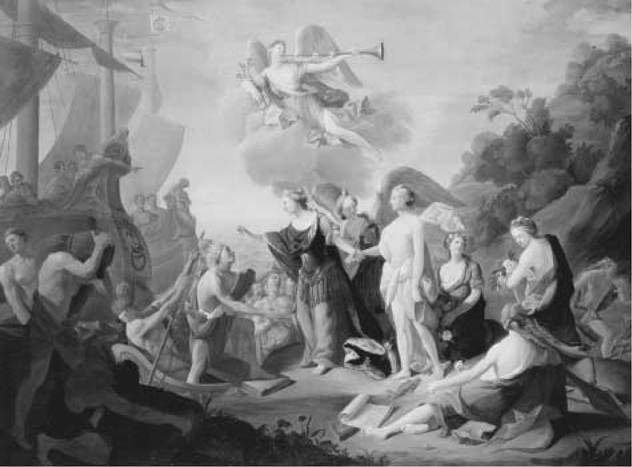
Allegory of France Liberating America. In addition to geopolitical and nationalistic reasons for supporting the United States, many French saw in the infant Republic the first real attempt to place the ideas of Voltaire and Rousseau into practice. This painting (c. 1784) by Jean Suau expresses this ideal symbolically as France takes the hand of liberty and presents him to the Americans.
Another major factor in colonial animosity toward France was the close relationship that the French established with Native Americans. Indeed, of all the European powers to establish colonies in the Americas, none was more able to win the affection and loyalty of the indigenous peoples as the French was. The French worked to introduce Catholicism to the Indians, but their priests did so through peaceful persuasion rather than with the sword, in contrast to their Spanish coreligionists. Unlike their British rivals, the French were respectful of native culture, treated the tribes as sovereign nations, and established meaningful alliances with them. Frenchmen routinely married Indian women at a time when the Church of England heavily frowned upon interracial marriage. Whereas British colonists generally practiced a policy of exclusion toward the Indians, the French established ethnically diverse settlements in the midst of the various tribes they called their friends, and virtually every French town in North America included a sizable population of Native Americans living peaceably in and around the area.
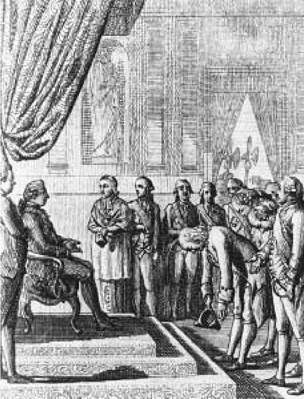
Benjamin Franklin at the French Court in Versailles. Benjamin Franklin, shown here in a 1784 engraving by Daniel Berger after the German artist Daniel Chodowiecki, became an instant celebrity after his arrival in France, where he traveled to solicit French support for the American cause.
The British colonists viewed such behavior as not only morally abhorrent but threatening. Besides France, the great enemy the colonists faced in North America was the Indians, and throughout the long struggle for possession of North America, most of the major Indian tribes were allied with France. Indian war parties—armed, organized, and sometimes led by the French—terrorized the frontier during the colonial wars.
The Treaty of Paris in 1763, which ended the final Anglo-French colonial war in North America, resulted in the eviction of France from the continent and a sudden removal of the French as a menace to the American colonists. Ironically, the British government quickly replaced the French as a target of American ire, as it was now Parliament that restricted the colonists' westward expansion and even courted favor with the Indian tribes, who were still viewed with hostility and suspicion by Americans on the frontier. As relations between Britain and its American colonies deteriorated sharply during the decade from 1765 to 1775, the image of France as an enemy sharply receded in the minds of many colonists, who now viewed the enemy as residing in London rather than Paris.
The outbreak of the American Revolution in 1775 found the Continental Congress facing a full-scale war against Great Britain but lacking the most basic essentials for waging such a conflict. The Americans had no means of producing cannon or gunpowder and only a limited ability to manufacture small arms. The colonial militias had relied upon the mother country for these necessities, and with that source gone, a new means of procuring the implements of war had to be found quickly. In addition, the Continental Congress faced a chronic shortage of funds with which to procure weapons, uniforms, shoes, food, and other essential supplies for George Washington's Continental Army. Thus, the Americans were forced to look overseas for military and economic support from Britain's European enemies and France, with its vast treasury and massive armaments industry, was the natural choice. In 1776 the Continental Congress dispatched a diplomatic mission to Paris headed by Silas Deane (later to be joined by Benjamin Franklin and John Adams) to solicit French support for the American cause.
The French viewed the outbreak of the American Revolution with a certain pleasure as they saw the mastery of North America by their archenemy, Britain, threatened by its very own subjects. The news of American victories at Lexington and Concord in April 1775, as well as the heavy casualties suffered by the British at Bunker (Breed's) Hill in June 1775 had been greeted with wild jubilation in the streets of Paris. Thus, Deane was warmly received the following year at the court of the young King Louis XVI, and in particular by the king's influential foreign minister Charles Gravier, comte de Vergennes. The cunningly ambitious Vergennes believed that the American Revolution offered France many possibilities to avenge its humiliating defeat in the Seven Years' War, acquire valuable colonies in the West Indies and severely harm the power and prestige of its main rival, Britain.
In short order, Vergennes and Deane concluded an agreement by which the United States could purchase arms and munitions from France; in addition, Vergennes threw open French ports to American privateers. The materiel thus acquired from the French in 1776 and 1777 was indispensable to the American war effort and enabled the Continental Army to continue to remain an active force despite the best efforts of the British to destroy it. Even more importantly, the French government granted the Americans the diplomatic status of a belligerent nation, as opposed to viewing them as British rebels, which was an important first step toward establishing a formal relationship and, eventually, a military alliance between the two nations.
France initially avoided a direct confrontation with Great Britain while taking all steps short of war to provide aid to the Americans. The actions of the French government won wide approval throughout the kingdom, receiving the support of the nobility as well as the common people. The reasons for such widespread French backing for the American cause were deeply rooted in traditional Anglo-French hostility. While few believed in the opening stages of the conflict that the United States could actually win, many French hoped that a long and debilitating war would significantly weaken Britain, regardless of its final outcome. In addition to geopolitical and nationalistic reasons for supporting the United States, many French saw in the infant Republic the first real attempt to place the ideas of Voltaire and Rousseau into actual practice and thus believed for ideological reasons that the Americans should be supported in their rebellion.
French army officers were soon clamoring to serve in the American cause, an action encouraged by Vergennes to provide the Continental Army with badly needed professional officers as well as to increase French influence and control over the American war effort. Among the numerous French officers seeking a commission in the Continental Army was an idealistically romantic nineteen-year-old nobleman, the Marquis de Lafayette. Though he spoke little English and had virtually no military experience, the young man was politically well-connected at the court of Louis XVI, and the American representatives in Paris were impressed by this as well as his idealism and zeal for the American cause.
Lafayette arrived in America in June 1777 and soon attached himself to the staff of General George Washington. The dour and irascible Washington was besieged by foreign officers of all stripes seeking commands in his army, and consequently he was initially dismissive of the young marquis. But Lafayette's boyish enthusiasm for the cause and eagerness for battle against the British impressed Washington, and soon a close bond developed between the two men. Indeed, as time went by, Lafayette became like a son to Washington, and the former eagerly returned this paternal affection with a deep devotion and fierce loyalty to the American leader. Lafayette served with distinction at the Battles of Brandywine (11 September 1777) and Germantown (4 October 1777) and endured the privations of Valley Forge in the winter of 1777-1778. His services were rewarded with command of a division, making him one of the principal field commanders of the Continental Army and one of the very few foreign officers with whom Washington entrusted American troops.
Shortly after his arrival in America, Lafayette had begun to bombard the French government with letters praising the Americans and their cause and appealing for King Louis XVI to enter the war at their side. Lafayette's reports added traction to the American diplomatic mission in Paris, which was now headed by the charismatic Benjamin Franklin. Already famous in France for his scientific discoveries and writings, Franklin had become an instant celebrity after his arrival at the French court, and his dalliances with the ladies of Paris soon became legendary. Yet he was also a forceful speaker and relentless diplomat who sought to turn French covert assistance for the American cause into an actual military alliance between the two nations.
Vergennes was eager for Franklin's proposals, but King Louis XVI still waited for some tangible sign that the American cause was worth supporting. That sign came in the autumn of 1777, when word arrived in Paris that the British army under General John Burgoyne had been defeated and forced to surrender in the field at Saratoga, New York, on 17 October 1777. The American victory sent shock waves throughout Europe. It was the worst defeat suffered by the British army in decades, and it had come at the hands of the "backward" and "ill-trained" Americans. King Louis XVI reasoned that if the Americans could pull off such a feat on their own, they could do far more with a real ally in the field alongside of them. With visions of restoring the lost prestige of France and wreaking a terrible vengeance on France's ancient enemy, Louis XVI informed Franklin that the French government would enter into a formal economic, political, and military alliance with the United States with the express aim of securing American independence from Great Britain. These agreements being signed, on 17 June 1778 France formally went to war against Britain and entered the American Revolution as a full ally of the infant United States.
French military support. The French immediately extended badly needed financial and military aid to their embattled ally and also dispatched an expeditionary force and powerful naval squadron under the command of Admiral Jean Baptiste d'Estaing to North America. The French entry into the conflict forced Britain to reconsider its grand strategy, withdraw its forces from Philadelphia and other exposed outposts, and essentially go on the defensive for the rest of the war—except in the southern colonies, which they still believed could be retained under British rule.
Joint military operations between the Continental Army and French expeditionary forces were at first problematic. A Franco-American attack on Newport, Rhode Island, in August 1778 was initially successful but ultimately failed due to bad weather and poor cooperation between the Americans and French. In September 1779 d'Estaing's forces linked up with American troops under General Benjamin Lincoln for a joint attack on Savannah, Georgia. After a month-long siege failed to bring about results, d'Estaing ordered a full-scale assault; it was bloodily repulsed, with the French and Americans compelled to withdraw in defeat. Although the formal military forces sent by France failed to achieve initial successes, other French were proving their worth to the American cause. In 1779 Colonel George Rogers Clark began a desperate campaign to win control of the future Northwest Territory. Clark was ably assisted in this endeavor by the support of the French population of the region. The French were by far the most numerous nonnative population in the area, and their support for Clark and the American cause proved vital to the eventual American victory in this critical theater of the war.
By 1781 the French expeditionary forces in America had been reinforced and reorganized. A French army numbering approximately seventy-five-hundred men was under the command of the Comte deRochambeau, while a powerful fleet under the Comte de Grasse, including twenty-eight ships of the line, was deployed to the West Indies. In the summer and autumn of 1781 Washington, Rocham-beau, and de Grasse masterfully coordinated their allied forces in a campaign designed to isolate and destroy the British forces under Lord Cornwallis in Virginia. Admiral de Grasse defeated the British at the Battle of the Virginia Capes in September. Then Washington, with ninety-five-hundred Americans, and Rochambeau (who had placed himself under Washington's orders), with seventy-eight-hundred elite French troops, rapidly marched south from New York, trapping Cornwallis's army at Yorktown, Virginia. After a brief siege, Cornwallis surrendered his entire force on 19 October 1781. The British cause in America had been dealt a death blow. Negotiations began shortly afterward, and the Treaty of Paris was ratified by Congress in 1783, bringing peace and independence to the United States.
Just six years after the conclusion of the American Revolution, the French Revolution erupted with the storming of the Bastille on 14 July 1789. Initial American reactions to the Revolution were almost universally positive, with many Americans embracing it as a natural outgrowth of their own revolt. Lafayette became a significant leader in the new French government and sent his mentor, President Washington, the key to the Bastille as a symbol of unity between the two revolutions. That unity was severely challenged, however, when the French Revolution entered upon a more radical phase under the leadership of the Girondins, replaced in June 1793 by the still more radical Jacobins. Attacks upon the nobility and clergy increased dramatically, and King Louis XVI was tried for treason and executed in January 1793. This action set off a wave of imprisonments and executions by the new French republic during the time known as the Terror, which would last into 1794. Lafayette himself, who was a member of the nobility, was accused by the Jacobin rulers of France of being an enemy of the republic and was forced to flee for his life.
As France became convulsed by internal turmoil, it was also invaded by the other great powers of Europe, who were intent on destroying the revolution in its cradle while simultaneously taking advantage of perceived French weakness to seize territory and enhance their own power and position. Faced with war against virtually all of Europe, the French republic invoked the terms of the Franco-American alliance and called upon the United States to wage war at its side as a sister republic. While no one in France believed the infinitesimal American military could wage war in Europe, it was hoped that the Americans could attack British and Spanish possessions in North America and thus pin down and distract the military forces of those nations. While substantial numbers of Americans, including Secretary of State Thomas Jefferson, favored supporting France in its war on ideological grounds, cooler heads prevailed. President Washington refused to honor the alliance, claiming that it was no longer valid as it had been concluded with the government of King Louis XVI, not the French republic. Washington's decision was certainly in the best interest of the United States, which had little to gain and much to lose by launching into a major war so soon after independence, but the failure of the United States to honor the alliance was seen by the French as a betrayal of their friendship.
Deteriorating relations. In an effort to secure American cooperation, the French Girondin government in 1793 dispatched a diplomatic mission headed by Edmond Genet to press Washington into some form of support for France in its hour of need, but Washington remained intransigent on the matter. Sensing quite correctly that, in spite of Washington's avowed policy, large numbers of Americans supported France, Genet took his cause directly to the American people. He helped stir up pro-French feelings as Democratic Republican clubs throughout the United States held demonstrations supporting and celebrating the triumphs of the French Revolution. Genet also issued letters of marque to American privateers, urging them to attack British merchant shipping while simultaneously attempting to organize a mercenary army of Americans to attack Spanish Louisiana, an idea that originated with American Revolutionary War hero George Rogers Clark. Genet's activities brought a formal protest from Washington and a demand that the French government recall him immediately. Before this could happen, however, the Jacobins overthrew the Girondins. Fearing for his life, Genet sought political asylum in the United States, which Washington granted.
Support for or opposition to the French Revolution increasingly became a major issue in the emerging rival political ideologies of the early Republic. Democratic Republicans favored the French while the Federalists were adamantly anti-French and desirous of better relations with Great Britain. Jay's Treaty of 1794 brought about a rapprochement between the United States and Great Britain, and this was followed by the ascension of the staunchly anti-French John Adams to the American presidency in 1797. The Directory, which had come to power in France during 1795, viewed the warming relations between its erstwhile ally America and its current enemy Britain with deep hostility and suspicion, and French privateers were given license to attack American ships. President Adams sent a delegation to negotiate an end to these attacks and a formal renunciation of the Franco-American alliance. The American diplomats were treated disrespectfully by the French foreign minister Charles Maurice de Talleyrand, who demanded a personal bribe under the table and a large loan for the French government before he would even begin negotiations. These demands were presented to the Americans by a group of agents known as X, Y, and Z. The American mission refused to pay the bribes and returned home without an agreement, as American newspapers roared with indignation over the XYZ Affair and Franco-American relations reached their nadir.
Unable to reach a diplomatic agreement, President Adams authorized the U.S. Navy to protect American shipping from French depredations, and so the Quasi-War with France commenced in 1798. The conflict resulted in a few dramatic victories for the infant American navy and the seizure of a number of French merchant vessels, but French privateers continued to prey on American shipping and relations between the two republics remained hostile. A full-scale war, however, never broke out.
In November 1799 General Napoleon Bonaparte seized power in France, proclaiming himself first consul, supreme head of the republic. Unlike the government he toppled, Napoleon had warm feelings for the United States and believed the Americans were a natural ally against his enemy, Great Britain. He was also an ardent admirer of George Washington, keeping a bust of the American general in his office and presiding over a special memorial service when he received news of Washington's death in 1799. Napoleon was also an ardent expansionist, and among his dreams for empire was the notion of resurrecting a French presence in North America which, after a halt in hostilities with Britain in 1801, seemed a real possibility. Toward this end he bullied his new ally, Spain, into ceding the Louisiana Territory to him in 1800. Spain acquiesced to Napoleon's demand, but only on the condition that he never allow the territory to fall into the hands of the United States. Napoleon's ardor for a new French empire in North America quickly cooled in the wake of a failed campaign by French troops to control the island of Hispaniola and the threat of a new war with Britain. With Britain's mastery of the seas, it would be impossible to maintain control of any overseas possessions, and Britain would be able to swoop down from Canada and grab the Louisiana Territory with ease.
Louisiana Purchase. As Napoleon contemplated these issues in 1803 a delegation arrived from the United States seeking to purchase the port of New Orleans and West Florida for $10 million. He offered instead to sell the entire Louisiana Territory for $15 million, a deal eagerly accepted by the Jefferson administration and formally concluded on 30 April 1803. The Louisiana Purchase was a mutually beneficial bargain, for not only did it almost double the size of the United States and open up the Mississippi River to American commerce, but it also prevented the territory from falling into the hands of the British who, like the Spanish, sought to prevent America's westward expansion. Napoleon received badly needed funds for his wars of conquest from the sale of territory he would have probably lost anyway, while simultaneously enhancing the power and prestige of the nation that he believed would frustrate Britain's colonial ambitions more than any other in the Western Hemisphere. In later years Napoleon would take great pride in the part he played in the growth of the United States.