
"Frontier," one of many English words that took on new meanings in North America, has assumed as well a role in explaining the continent's history during the past five hundred years. In time the word has acquired other connotations, both positive and negative, and with that a power to kindle high emotions about the course and consequences of North American history.
In England and Europe, "frontier" has meant a border or boundary, usually between nations, and thus by nature is static. Across the Atlantic it became dynamic, referring to the outer edge of European settlement and influence intruding into the continent.
Among historians, the term "frontier" is most closely associated with Frederick Jackson Turner, whose essay "The Significance of the Frontier in American History" profoundly influenced American historiography for forty years after its publication in 1893. Here and in subsequent essays Turner drew heavily for inspiration and examples from the early years of the American Republic and the frontier's advance from the Appalachian Mountains to just beyond the Mississippi River.
Reacting against historians such as his mentor, Herbert Baxter Adams, who considered American history essentially an outgrowth of British and European institutions, Turner argued that Old World customs and attitudes broke down and reformed in America's radically different physical and social environment. The prime site of that transformation was along the cutting edge of advancing settlement, "the line between civilization and savagery." First in England's Atlantic colonies and later in the United States, the opportunity of "free land" drew pioneers westward into settings that required them to modify or scrap entirely many of the institutions and values of their previous lives. The result was a "composite nationality," a distinctive culture and people. The frontier, as both a process and a condition, thus "ex-plain[s] American development," Turner wrote.
The "frontier thesis" remained hugely influential until the 1930s. It jibed with several intellectual trends, including the evolutionary theories of Charles Darwin and Herbert Spencer and, by stressing how a people's material foundations shaped their values, the ideas of Karl Marx. Turner also reflected his generation's conflicted feelings about its nation. On the one hand his descriptions of evolving frontier societies after the Revolution thrummed with highly positive traits he considered essentially American—among others, a democratic individualism, inventiveness, toleration, and a restless striving. Thus in Turner's day the early Republic's frontier spoke both to a desire for unity, as the United States grew beyond the Civil War and its contentious aftermath, and to a growing pride as it emerged as a leading world power.
Turner also noted, however, that the frontier was coming to a close. As defined in the federal census, the frontier was a north-and-south line separating an area with two or more persons per square mile from one with fewer than two. The census of 1890 showed for the first time no unbroken frontier line across the nation. As the frontier came to an end, the process that had produced the American character presumably would no longer do its work. By implication the nation would enter a new era, perhaps one of decline. Turner's thesis expressed a nation's anxiety about its future as well as a pride in its past.
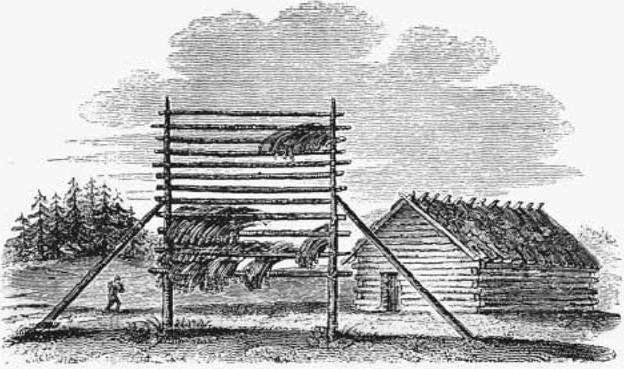
Swedish Log Cabin. The first American log cabins were modeled after the simple log homes of Scandinavian peasants. This engraving from 1824 shows a cabin built by Swedish immigrants to the New World. The wooden rack in the foreground was used to dry corn.
As Turner conceived and described it—a westward advance of settlement—the frontier began on the Atlantic coast with the first English settlements of the seventeenth century. By the time of the Revolution and the birth of the Republic it had moved across the Appalachians into Kentucky, Tennessee, and western Pennsylvania. By the 1820s it had rolled through the Ohio Valley and Gulf coastal region and across the Mississippi River into Missouri, Arkansas, Louisiana, and his own native Wisconsin. There it paused before jumping to the Pacific coast in the 1840s, then advancing from both east and west into the interior of the American West after the Civil War.
The frontier of the early Republic was predominantly agrarian. Most who moved west were families establishing small farms, although cotton plantations and slavery were a large part of the advance through the Gulf Coast region. By 1829 the quest for farmland had driven the frontier as well into eastern Texas and the first tier of states beyond the Mississippi River. Over the next two generations the same hunger would draw frontier farmers to western Oregon and central California, to Mormon settlements near Utah's Great Salt Lake, and finally to the Great Plains.
In the earliest stage of frontier farming, settlers hacked out a clearing, built a rude dwelling, planted corn around tree stumps, and began the long process of clearing enough land for a working farm. They were subsistence farmers, producing only for themselves and neighbors. They borrowed heavily from Indian peoples, from clothing to such techniques as girdling to kill trees before felling them. In fact, early white frontier families lived as much by a hunting-gathering economy as did their Indian neighbors. As settlement thickened, more land was cleared and farms improved; settlers gradually turned to crops meant for distant markets. An exception to this pattern was on the Gulf Coastal frontier, a region beautifully suited for growing short-staple cotton to meet the voracious demand in English textile mills. Planters consequently established cotton plantations almost from the start as the southern frontier was opened to settlement after 1815.
Popular images of solitary frontiersmen to the contrary, the family was ubiquitous. Success, even survival, depended on all its members contributing and cooperating. Wives performed not only household and nursing duties but also heavier labor, and children of both sexes worked at all but the most physically taxing tasks. As a result widows and widowers rarely remained single for long, and the birth rate was by most calculations far higher than in more settled parts of the nation.
Frontier farming should not be defined too narrowly. Cattle raising, linked in the popular imagination mostly with later frontiers in the far West, was crucial to the eastern agricultural frontiers before 1830, for instance. The term "cowboy" appeared first in the Carolinas, already with a tone of wild independence. Scots-Irish settlers of the Gulf Coastal frontier were especially accomplished at herding cattle; on plantations in many parts of the southern frontier, including the rich farming region of the Mississippi delta, slaves sometimes spent as much time tending cattle as cultivating cotton. Many of the techniques of cattle raising applied later on far-western ranches evolved first on the southeastern frontier. Other animals were raised to be sold and slaughtered. Pigs, which prospered in the woodlands with little supervision, were especially popular. There are even accounts from the southern frontier of turkey drives, with hundreds of the large fowls herded to market.
The need for markets made towns and urban centers also a vital part of the moving frontier. Coming to life as trading and transportation centers, they further facilitated the westward flow of people and goods, supported farms and other settlements nearby and provided the ground where political, educational, religious, and cultural institutions could take root and grow. In these frontier towns appeared a region's earliest light industry, not only slaughterhouses—Cincinnati earned the nickname "Porkopolis" for all the swine processed there—but the manufacture of goods impractical to import, such as glassware, barrels, rope, and flat-boats.
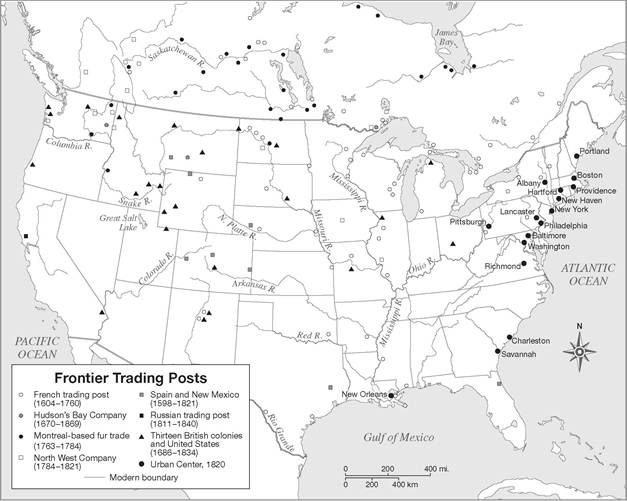
Towns most often sprang up along trade routes, and on frontiers of the early Republic that usually meant rivers. Pittsburgh first drew settlers because of the protection of Fort Pitt, then for its prime location at the headwaters of the Ohio River. Farther downstream Cincinnati and Louisville served as collecting and distribution points for trade north and south of the river. Several important urban centers were founded along water routes by England's imperial rivals, in particular France, which established St. Louis, Detroit, Natchez, New Orleans, Biloxi, Mobile, and many somewhat lesser towns to service its far-flung fur trading empire. In 1763 these passed to Spain and England, and by the 1820s all had been pulled within the expanding United States. Overland trade routes, typically following trails taken by Native American traders and warriors, produced some towns. The Wilderness Road connected the first frontier towns in the Kentucky interior to North Carolina. The Natchez Trace ran from Natchez, Mississippi, to Nashville, Tennessee, which in turn was connected by trails to the Ohio River at Maysville and via Zane's Trace across Ohio to Wheeling, West Virginia.
The importance of these arteries to commerce and life is a key to understanding the frontier's role in early American diplomacy. Concerns about interference with settlers' use of the Mississippi led to confrontations with Spain in 1795 and with France in 1803. The young Republic turned these crises to its advantage, particularly the conflict with France, which resulted in doubling the nation's size and propelling the frontier toward the Pacific.
Without question frontier conditions did reshape society. People of many ethnicities and from a variety of places were tossed together. At first, institutions imported from mother cultures were poorly rooted or wholly absent. The tentative nature of settlements combined with a high rate of mobility to make for a social fluidity and a fuzziness of hierarchical order. With the notable exception of areas where the plantation system appeared early, there was considerable economic leveling. Turner argued that these and other conditions produced the admirable traits he cited as essentially American. The need to cope with unfamiliar challenges, plus a relative lack of tradition, bred an inventiveness and pragmatism. Greater individualism was a natural outgrowth of strangers thrown together, measuring one another by personal capacity rather than lineage or social position. With fewer economic and social distinctions, politics tended to be more democratic and innovative.
Although he emphasized the positive, Turner observed that the same conditions had less desirable effects. An unsettled society short on institutional controls promoted violence as well as individualism and democracy. The pressing demand to meet immediate physical needs brought a cultural atrophy and anti-intellectualism. Some critics stressed a theme that ran against Turner's argument—a strong conservative impulse on the frontier. Settlers often felt a powerful urge, even an obsession, to transplant what they considered cultural essentials. Because they had to create political forms almost on the fly, early governments were less likely to innovate than to copy what they knew from the past. In particular, constitutional forms often mimicked those of the East. The tension between change and tradition was played out in gender relations. Frontier conditions often required women to take on roles usually reserved for men, but the crushing load of work and the need for children made women's lives difficult and dangerous and left little room for individual fulfillment outside their labors.
By Turner's death in 1932, more fundamental critiques of his ideas were being heard. Some stressed that many other factors—among them patterns of immigration, American society's middle-class nature, and the ferment of ideas in eastern cities—influenced the national character at least as much as the frontier. Others argued that class divisions and social and economic hierarchies have been much more a part of American life than implied in the celebration of frontier-inspired egalitarianism. Still others found Turner unclear on the mechanisms of the frontier's influence and specifically questioned how an area by definition thinly populated could transform an entire society. In the 1980s and 1990s practitioners of the "new" Western history argued that, as the frontier's influence had been described thus far, it presented a doubly deficient narrative. It downplayed or ignored the terrible costs of expansion—dispossession and cultural destruction of native peoples, environmental calamity, dashed hopes, and an obsessive acquisitiveness. And as a story dominated by Anglo-Saxon males, it neglected the vital parts played by women and the many ethnic groups active in westward expansion.
The effect of these various critiques has been paradoxical. No longer considered the primary formative force on continental history, and thus narrower in influence, the frontier has been more broadly defined and its explanatory power has grown. An especially revealing line of research has explored the interactions among Europeans, Euro-Americans, and Indian peoples. Along the various frontiers there developed what the historian Richard White has called a "middle ground," syncretic cultures of overlapping customs and mutual borrowing in which all sides created new terms of understanding and exchange and new means of accommodation. One native response to frontiers was ethnogenesis—the creation of new collective identities. Many tribes assumed to have existed on the frontiers at the time of European contact, such as the Catawbas of the Carolinas, were in fact smaller related groups that merged and consolidated to meet the threats and opportunities posed by the newcomers.
A frontier in this sense was not a line dividing one condition from another, and certainly not a division between "civilization and savagery," but rather a place where peoples, ideas, cultures, and institutions came together and interacted on many levels, sometimes mixing and sometimes conflicting but always in mutual influence. The interaction included the environment. Clearing the land and introducing domestic animals and new farming methods, settlers set loose chains of environmental changes and undermined native economies. Drawn to opportunities of trade, Indians depleted populations of deer, beavers, and other animals. Perhaps the most profound environmental interaction came with the introduction of Old World pathogens and waves of epidemics that devastated native populations.
The frontier has proved most persistent as a term in popular culture summoning up images of opportunity, adventure, challenge, courage, danger, and innovation. The first such images emerged from the early Republic. By 1829 Daniel Boone stood as the nation's first paragon of frontier virtues. James Feni-more Cooper had created a wildly popular frontier character in his Leatherstocking tales. Upon his election to the presidency, Andrew Jackson's unprecedented political appeal was inextricably tangled with his image as backwoods hero. The frontier's mythic power has continued in forms as varied as Western novels and films, subgenres of science fiction, political rhetoric and slogans, and advertising, where its references are used to sell everything from computers and toothpaste to automobiles and tattooing. This allure is a reminder of the frontier's enduring hold on the imagination among scholars and the public at large.