
Furniture made in the American colonies in the two decades prior to the American Revolution (1775-1783) was modeled after the prevailing style of furniture in Europe, namely the French or English rococo. The importation of European furniture and the immigration of European-trained craftsmen fostered the spread of this style to the colonies. Pattern books also had a profound influence on American furniture, particularly on the costliest furniture commissions in major urban centers. Among the pattern books available in the colonies were Thomas Chippendale's The Gentleman's and Cabinetmaker's Director (1754), William Ince and John Mayhew's The Universal System of Household Furniture (1762), and Robert Manwaring's The Cabinet and Chair-Maker's Real Friend and Companion (1765), all published in London. Although only a few surviving examples of American furniture are known to have been copied directly from engraved plates in these pattern books, much American furniture owes a debt to the stylistic features depicted in them, such as curvaceous forms, ornate foliate carving, and exotic motifs, which are hallmarks of the rococo style in furniture. Furniture made for average consumers also bears similar stylistic origins, although it typically appeared slightly later and generally used less costly materials than the most expensive furniture made in the colonies. Certain forms, such as Windsor chairs, were popular among all levels of consumers throughout the eighteenth and early nineteenth centuries.
The major colonial population centers—Boston, Newport, New York, Philadelphia, Annapolis, and Charleston—developed distinctive regional furniture styles. Furniture makers in Philadelphia, the largest city in the American colonies in the second half of the eighteenth century, produced some of the most elaborately carved furniture in colonial America. One well-known set of examples is a matching suite of mahogany furniture made around 1770 for the Philadelphia townhouse of John Cadwalader, who later served as a general of the Continental Army, and his wife Elizabeth Lloyd Cadwalader, a wealthy Maryland heiress. Made under the direction of the Scottish-born cabinetmaker Thomas Affleck, who contracted London-trained carvers James Reynolds, Nicholas Bernard, and Martin Jugiez, all recently immigrated to Philadelphia, the suite included among other forms sofas, card tables, chairs, and fire screens in the high-style London taste. Some of the wealthiest American colonists had the means to acquire fine furniture and other luxury goods directly from the merchant houses of Europe; however, most patronized local craftsmen for at least some of their furniture. The nonimportation movement prior to the Revolution encouraged colonists to support local craftsmen.
Not all furniture made in North America adhered to the cultural norms of the dominant Anglo society. Significant pockets of settlement by the Germans in Pennsylvania, North Carolina, and the Shenandoah Valley of Virginia, the French in Canada and Louisiana, the Dutch in New York and New Jersey, and the Spanish in Florida and far to the west in New Spain contributed to the diversity of furniture-making traditions in North America.
Following the Revolution, the economic disruption caused by the war soon gave way to increased prosperity as populations in cities grew and settlement into the hinterlands of North America created new customers for furniture. The lifting of the colo-nial-era trade restrictions imposed by the British allowed American craftsmen to seek international markets for their products. Woodworking craftsmen used valuable raw materials, including native woods such as maple, walnut, cherry, and pine, as well as fine imported mahogany and rosewood from the Caribbean, to produce marketable finished products for both local consumption and export. Some of the most successful American furniture makers became merchants or retailers of furniture.
In general, furniture made in America beginning in the last decade of the eighteenth century reproduced the new international style of neoclassicism in architecture and interior furnishings that was already popular in Europe. In furniture, this "antique" or "classical" style found expression in a wide variety of classically inspired forms and ornamentation. Derived in part from examples of classical architecture and decorative arts uncovered during recent archaeological excavations in Italy and Greece, the details of this style of furniture were thought to be more correct than earlier Renaissance interpretations of classical designs. This style of furniture often employed gilded and painted surfaces and inlays of wood and metal, which required specialized skills. The English-trained architect Benjamin Henry Latrobe designed a painted, Grecian-style klismos chair with incurvate front and rear legs in 1809 for Dolley Madison to be used in the oval drawing room of the President's House. English pattern books continued to influence American craftsmen even after the Revolution. The Cabinet-Maker and Upholsterer's Guide (1788), by George Hepplewhite, and The Cabinet-Maker and Upholsterer's Drawing-Book (1792), by Thomas Sheraton, promoted designs of classically inspired furniture. So did Thomas Hope in his book Household Furniture and Interior Decoration (1807), which introduced a mix of Roman and Egyptian motifs, and Thomas King in Modern Style of Cabinetwork Exemplified (1829). Despite international political tensions and a thriving market for locally produced furniture, Americans continued to turn to European sources for this style of furniture, which was popular well into the 1830s.
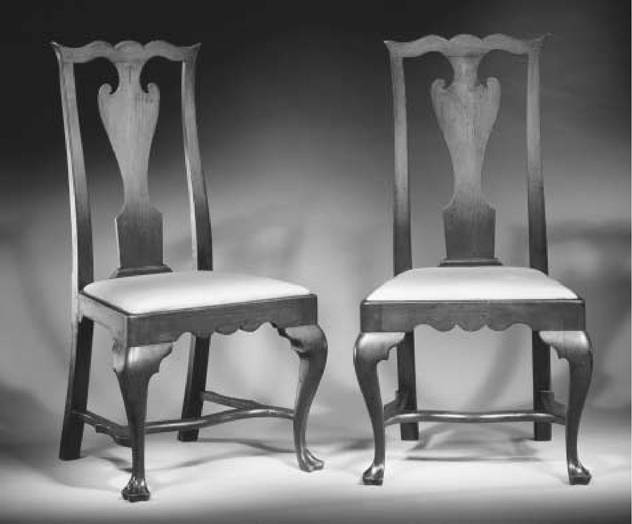
Queen Anne Side Chairs. Furniture made in the colonies in the decades prior to the American Revolution was modeled after the prevailing styles of furniture in Europe. These American Queen Anne style chairs, with their characteristic cabriole legs, were produced around the 1760s and would have been popular with wealthy Americans.