
Rapid and extensive technological change was not one of the hallmarks of the colonial era, but the pace increased noticeably during the early national period. Except for the evolution of the American felling axe and Benjamin Franklin's promotion of an efficient heating stove (1742) and lightning rod (1752), notable contributions by Americans had to wait until the era of the Revolution. Then, energized by the example of British inventions in manufacturing and fired by the ideals of American independence, entrepreneurs, inventors, and legislators aggressively promoted innovation.
True, most innovations came from the workbenches of now-anonymous workmen and nearly all were the product of incremental change rather than the inventor's mythical "eureka!" moment of inspiration. Still, in the early decades of the nineteenth century, individual innovators multiplied in numbers, expanded their range of work, transformed the material conditions of society, and earned an international reputation for their storied "Yankee ingenuity."
In his Proposal for Promoting Useful Knowledge among the British Plantations (1743), Benjamin Franklin wrote of encouraging studies that would increase the power of men over matter and multiply the conveniences and pleasures of life. Most of the earliest learned societies, such as the American Philosophical Society in Philadelphia, promoted practical knowledge as much as literary, philosophical, or scholarly pursuits. Recognizing that their members commonly pursued multiple enterprises, occupations, and intellectual interests, these societies supported the Enlightenment ideal of useful learning.
A proliferation of local societies for the promotion of agriculture, natural history, and arts and sciences culminated with the establishment at Philadelphia in 1824 of the Franklin Institute and its journal specifically for the increase and spread of practical knowledge. The Institute became a de facto public-private research laboratory, bureau of standards, and educational institution.
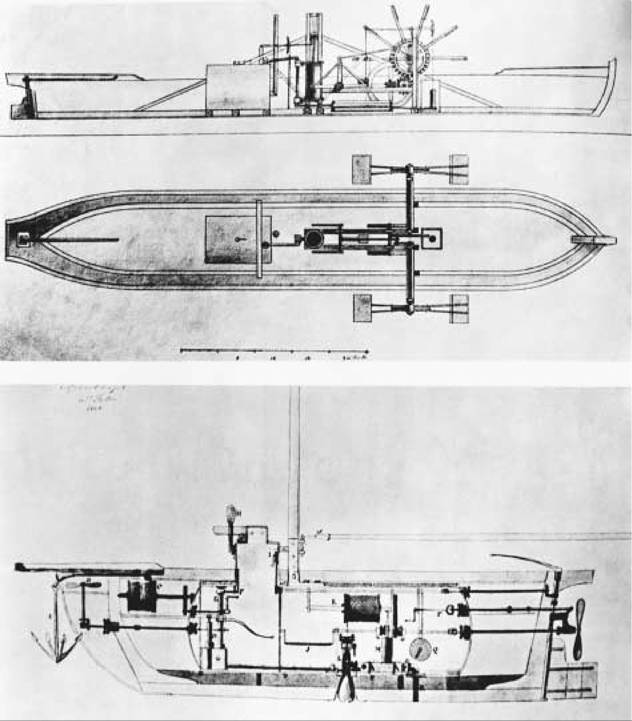
Fulton's Steamboat and Submarine. Although Robert Fulton did not invent the steamboat, he was the first to dramatically illustrate its financial potential. He designed his first experimental steamboat (top) in 1803 to travel the Seine River in France. Fulton also designed submarines (bottom).
The colonists found themselves in an ambiguous situation, subject to British mercantile restrictions on manufacturing but anxious to improve the colonial economy. A handful of colonies passed legislation offering incentives such as bounties and subsidies for profitable inventions. Some colonies, prominently Connecticut and South Carolina, offered monopolies or land grants for the establishment of new industries such as ironworks. The situation was difficult for inventors since they had to obtain a patent in each colony in order fully to protect their rights.
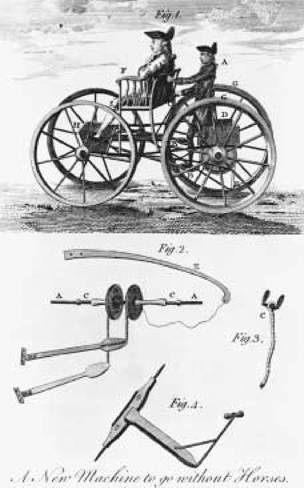
"A New Machine to Go without Horses." A 1774 version of a horseless carriage.
After the Revolution several state governments, following the theories of Alexander Hamilton and Tench Coxe, actively promoted innovations by granting patents or monopolies. Most often these monopolies were offered as much to promote economic development for the state as a whole as to reward individual achievement, a distinction worth noting. In the 1790s Georgia established a commission to promote the invention of a device to remove the seeds from cotton. Still, the lack of a uniform patent system frustrated inventors and created difficulties for economic promoters.
The framers of the Constitution debated a number of incentives for authors and inventors, but ultimately included in Article I, section 8, congressional power to grant them "the exclusive Right to their respective Writings and Discoveries" for a limited period of time. While disliking monopolies, the framers felt the need for a uniform system covering all the states. Enacted in 1790, the first patent law proved cumbersome, since each application had to be examined for originality and utility by a commission headed by Secretary of State Thomas Jefferson. Substantially revised in 1793, the new system required no examination or proof, only the inventor's assertion that the idea was original and useful, leaving the courts to decide which claims were justified. Further, this law required that patents be granted only to native-born citizens, a significant limitation given the number of talented immigrants arriving from more technologically sophisticated England and Europe. Not until 1836 was the patent system revised again, this time putting it upon the solid basis of professional patent examiners. By this time,just 9,957 patents had been granted, only a small fraction of which actually proved useful.
The impact of the continent's vast forests on American inventiveness cannot be overstated. As early as the late seventeenth century, Americans excelled in constructing water-powered sawmills since nearly every community near a suitable waterway had one. The American felling axe is a classic case of anonymous technical evolution. No one invented it, but over time its handle was given a curve and length to fit the individual user rather than the standard European straight shaft. The iron cutting-edge was made shorter than the European versions while the poll or flat edge was longer. This balanced the axe and made it three times as efficient as its European cousins, a fact of no small consequence.
Jacob Perkins's water-powered nail-making machine, patented in 1795, was said to be capable of producing 200,000 nails a day and helped lower the cost of nails by 85 percent over the next thirty years. The introduction in 1819 of Thomas Blanchard's copying lathe for the production of rifle stocks was a landmark of American armory practice that contributed to the manufacture of interchangeable parts. By 1829 America was a leading producer of woodworking machinery—saws, planers, lathes.
Intrigued by the complaints of Georgia plantation owners, Yale-educated Eli Whitney in 1793 devised a simple mechanical device to remove seeds from short-staple cotton. His problem-solving approach was practical, not theoretical; his machine was easy to build and to operate by hand. Exports of cotton increased by a multiple of fifty to nearly twenty-one million tons in less than a decade.
In the mid-1780s Oliver Evans developed an automatic flour mill in which grain was ground into flour without any human intervention. The mill was the most dramatic early illustration of automation, replacing human labor with machinery, and it encouraged flour production around the nation.
While Robert Fulton did not invent the steamboat, in 1807 he was the first to dramatically illustrate its financial potential and social impact. Earlier, between 1787 and 1790, John Fitch had designed from scratch, constructed, and operated a steamboat on the Delaware River. Fulton's demonstration on the more heavily traveled Hudson River proved more financially successful and more inspiring to others seeking to improve inland transportation, the sine qua non for westward trade and expansion.
There were any number of unsuccessful inventions, some developed by the unknown and some by the famous. David Bushnell, a renowned mechanic, attempted to construct a submarine during the Revolutionary War. Thomas Paine, the Revolutionary pamphleteer and author of Common Sense (1776), proposed using incendiary arrows to attack warships and patented a prefabricated iron bridge. Charles Willson Peale (1741-1827), the painter, experimented unsuccessfully with a telescopic sight for rifles. Oliver Evans developed an ineffective machine for inserting wire spikes into a leather pad used to unsnarl wool or cotton fibers. In 1813, Philadelphian George E. Clymer produced the first hand printing press made of iron, the patriotically ornamented and named Columbian Press. Weighty, awkward to move, and elaborately decorated, it never found favor in the United States but was popular in England and Europe for more than fifty years, a testament to the peculiar requirements for success in the new nation.
In 1744 Benjamin Franklin, a printer by trade, published An Account of the New Invented Pennsylvanian Fire-Places, beginning an extraordinary career as a promoter of technical innovation. Franklin's original cast-iron stove was based on scientific principles but was technologically unsound and filled many a room with smoke. Later, he and others modified the original design and the misnamed "Franklin stove" became a common household device. Franklin began his experiments with electricity at about the same time and in 1753 published directions for constructing lightning rods to protect houses, a practical application of his scientific experiments. He later developed bifocal eyeglasses and promoted technical improvements in papermaking and printing.
Thomas Jefferson was less an inventor than an enthusiastic polymath interested in all sorts of intricate devices and technical improvements. His one public invention, a moldboard plow he devised in 1788 and introduced at his Monticello plantation in 1793, found little favor among the yeomen farmers he championed. Though wary of the social impact of manufacturing and cities, Jefferson was a significant promoter of technological innovation in the new nation.
Benjamin Banneker (1731-1806), an African American, was not technically an inventor. But his mathematical skills, his construction of a selfdesigned clock, and his publication of an almanac rank him among the most celebrated innovators of his time. Banneker's abilities directly challenged Thomas Jefferson's assumptions about racial inferiority and induced him to a grudging recognition of the intellectual potential of some blacks. Thomas Jennings, a free black resident of New York City, may have been the first black to receive a patent, granted him in 1821 for a dry cleaning process.
Oliver Evans, the prototypical ingenious mechanic, repeatedly demonstrated the economic benefits of mechanization, the substitution of mechanical for human labor. His automatic gristmill, his improvements in machine shop practice, his application of steam engines to manufacturing and transportation, and his well-read publications on these nascent industrial practices make him one of the most significant technologists in American history.
Robert Fulton may be best known for his successful demonstration of the steamboat on American rivers. But he also developed a rope-making machine, underwater bombs (torpedoes), and an inclined plane for moving barges from one level of a canal to another. Indeed, his description in 1796 of the inventor as a poet combining old mechanisms into new ideas stands as an early, signal description of inventive creativity.
Though historians question his claims for originality and success with both the cotton gin and interchangeable parts, Eli Whitney remains one of the most important technologists in American history. Whitney's optimism, practical approach to innovation, and very public promotion of interchangeability mark him as an early advocate of technological progress.
Samuel Slater (1768-1835) invented little of note but represented a significant source of technological innovation, the transfer of technology from England and Europe to the United States. Slater's success at bringing new technical ideas into use in the textile industry marked the beginnings of the industrial revolution in the United States.