
In the 1750s the Iroquois Confederacy (or League) comprised 8,500 individuals spread across some forty-five villages and hamlets west of Albany in New York and in northern Pennsylvania. Despite their modest numbers, the Iroquois were powerful players in the struggles for control of the Great Lakes region and enjoyed more success in preserving their cultural viability and territory than most aboriginal societies did south and east of the lower Great Lakes before the War of Independence. Yet, in its wake, Americans forced them onto reservations in an effort to assimilate the tribes-people and open their lands for Euro-American settlement.
The confederacy began to form around 1450, primarily to end intertribal strife among five member nations, and secondarily to engage in common foreign policies. However, achieving league-wide agreements in external affairs was difficult. Decisions arose out of a consensual political process that incorporated the opinions of most adults, with the result that agreements regularly could not be achieved above the village level, where regional relationships with the outside world dominated people's views.
In the mid-1700s the league embraced the five original confederates—Mohawks, Oneidas, Ononda-gas, Cayugas, and Senecas—plus the Tuscaroras, an Iroquoian people who fled settler persecution in North Carolina in the 1710s to settle among the Five Nations and become the confederacy's sixth nation in 1722 or 1723. Other aboriginal refugees, such as the non-Iroquoian Tutelos and Delawares, settled among or near the Iroquois and fell under league suzerainty. Beyond tribal divisions, confederacy communities were multicultural: as a result of intermarriage, in-migration, and the adoption of prisoners. various red, white, and black people entered Six Nations society, typically as full members, although some were treated as inferiors. In addition to immigration into Iroquois territory, people emigrated to New France, beginning in the mid-1600s, to live in mission communities along the Saint Lawrence and Ottawa Rivers. Along with other natives, they formed the Seven Nations of Canada, of whom fifteen hundred were Iroquois in the 1750s. Beginning in the 1720s other Iroquois moved west to the Ohio country to form the Mingo nation, which had five hundred to six hundred people by 1750.
Iroquois people primarily were horticulturists who also fished, hunted, gathered, and traded. Through contact with Euro-Americans, they grew foreign crops in addition to such indigenous plants as corn, beans, and squash. Some individuals in the 1700s adopted animal husbandry or worked for wages in the fur trade and in other realms of white-native interaction. The importance of these new activities increased after the American Revolution, and people in the late eighteenth century also turned to lumbering and milling.
By 1750 most Iroquois no longer lived in the stockaded villages of earlier times. Instead they occupied less dense settlements, typically spread out along waterways. Many individuals, especially toward the east, had begun a process, which would encompass almost all Iroquois by 1800, of abandoning longhouses for smaller, often single-family dwellings that outwardly (and sometimes inwardly) resembled the homes of white settlers. Although the externals of material culture changed dramatically during the colonial and early national periods, core interior beliefs and customs remained strong, with the majority of Iroquois embracing traditional faith and social practices. Nevertheless, Christianity made inroads, particularly among Mohawks, Oneidas, and the Seven Nations of Canada.
In their relations with other natives and with Euro-Americans, the Iroquois wanted to preserve their land, independence, and culture, prevent outsiders from monopolizing their trade (and acquire large quantities of gifts from colonial powers), and exercise some control over other indigenous peoples to prevent them from becoming threatening rivals. They pursued these goals during the first half of the eighteenth century mainly through diplomacy rather than war. For instance, while serving as intermediaries between the crown and the natives of the Ohio country, they gained privileges from the British and inhibited the power of other tribes to compete against the league.
In the Seven Years' War (1754-1763 in America; 1756-1763 in Europe), the Iroquois adopted a military approach to defending their security, especially the Mohawks and Senecas who sided early in the conflict with the British and French respectively because of trade and other associations that they had built up with them over previous decades. However, the British succeeded in improving their standing with the Iroquois during the conflict, largely through the efforts of the crown's superintendent to the Six Nations, Sir William Johnson (c.1715-1774), who worked from his Mohawk Valley estate to cultivate Anglo-aboriginal alliances. Then in 1758 the confederacy as a whole allied with Great Britain, primarily to harness ascending British power to exercise suzerainty over native people in the Ohio country who resented Six Nations interference in their lives and whose emerging regional alliance posed a challenge to Iroquois ambitions. Thus Six Nations forces, including Senecas, participated in the British capture of Fort Niagara in 1759 and in the subsequent move against Montreal that led to the capitulation of Canada in 1760. (As New France foundered, the formerly French-allied Iroquois of the Seven Nations negotiated treaties with the British to defend their rights and independence.)
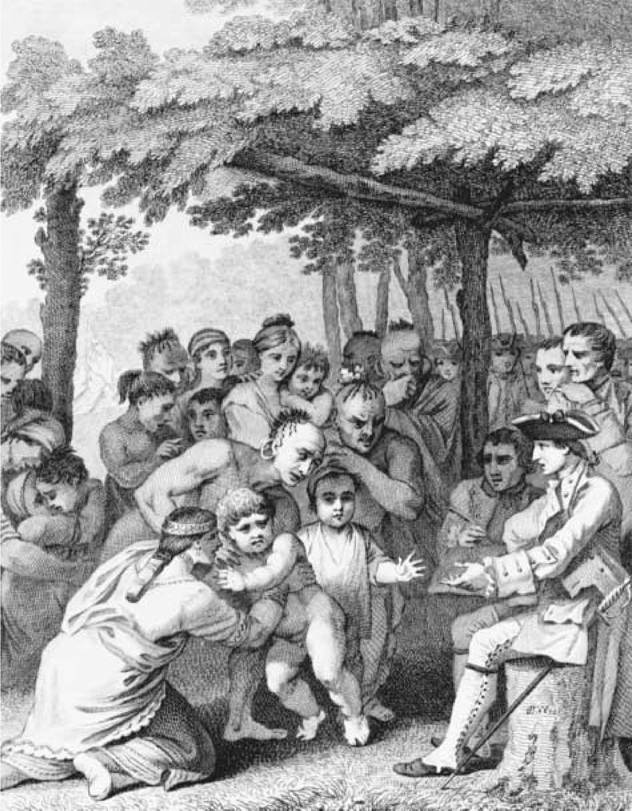
Returning Captives. In this illustration from circa 1766, a party of Indian warriors returns captives after Colonel Henry Bouquet marched up the Ohio River to put an end to Pontiac's rebellion in 1764.
In Pontiac's War (1763-1764) many Senecas, and closely allied Delawares, participated in the wider rising against the growing British colonial menace to aboriginal aspirations in the wake of France's expulsion from North America. In contrast, the Mohawks helped white forces suppress the native alliance while the other confederates generally stayed neutral. For their hostility, the Senecas lost land along the Niagara River to enable the crown to secure communications between Lakes Ontario and Erie. Then in the 1768 Treaty of Fort Stanwix, the confederacy united with the British to sell the territory of tribes south of the Ohio River, especially the Shawnee, which had risen in the late war and which had resisted Iroquois efforts to manage its foreign affairs. To make this transaction possible, the Six Nations claimed the region through a tenuous ancient conquest, which white officials agreed to acknowledge. Aside from giving the Iroquois the proceeds of the sale, the treaty opened the region south of the confederacy's heartland for white settlement and thereby reduced the pressure to alienate league homelands, although some losses did occur at the eastern end of the Six Nations territory in New York.
At the outbreak of the Revolution, many Mohawks sided with the crown because of their connections to loyalists through such individuals as the Mohawk matron, Molly Brant (c.1736-1796) and her halfbrother, the war and diplomatic chief, Joseph (17431807). However, the rest of the confederacy adopted a neutralist stance. Then, in January 1777, an epidemic killed three important league chiefs, which brought confederacy business to a halt until new leaders could be "raised up" to replace them. This problem, combined with the degenerating wartime situation and pressure from the white combatants to join their respective causes, led the confederacy to "cover" its great league council fire and free the member nations to choose their own course of action. The Onondagas opted for neutrality, the majority of Tus-caroras and Oneidas sided with the revolutionaries, and the Cayugas and Senecas joined the Mohawks in a Loyalist alliance. Logic suggested that, as most of the threats to Iroquois liberties came from people associated with the rebellion, the crown offered a better future. London promised to protect aboriginal property and freedom in return for help in suppressing the revolt. Nevertheless, the Tuscaroras and Oneidas, influenced by their pro-rebel missionary, Samuel Kirkland (1741-1808), chose to support the revolutionaries.
Divisions among the Iroquois had a brutal impact when pro-and anti-Loyalist warriors fought each other at the battle of Oriskany in August 1777. In subsequent campaigning—raiding rebel districts in New York, Pennsylvania, and the Ohio country alongside Loyalist forces to destroy crops and settle-ments—the crown-allied Six Nations had the greater influence on the course of events. In response, revolutionary armies invaded Iroquois territory in 1779 to knock the confederacy out of the war by burning most of its villages (including those of the neutral Onondagas). Yet even as the rebels forced people to flee from their homes, warriors continued to fight effectively until 1782, when hostilities wound down. During the latter part of the conflict, most Iroquois ended up in squalid refugee camps, with the prorevolutionaries concentrated at the eastern end of their traditional homelands, and the pro-Loyalists sheltered around Fort Niagara in the west. (Most Seven Nations Iroquois had negotiated peace with the rebels when they controlled Montreal in 1775; but when crown forces reasserted their dominance along the Saint Lawrence River in 1776, most then entered the war on the Loyalist side. The Mingos helped the Loyalists, although they had fought against the British during Pontiac's War.)
The Treaty of Paris of 1783, which ended the Revolutionary War and created the current Canadi-an-American border, put Six Nations land inside the United States. One-third of the Iroquois in New York chose not to live in the new Republic but moved to Canada, beginning in 1784, to settle at Tyendinaga on Lake Ontario and along the Grand River north of Lake Erie. Modest numbers of others moved to Ohio, either to join the Mingos or to form a separate "Sandusky Seneca" community. (The Iroquois in Ohio later participated in the frontier war of 1790-1795 against the Americans; the rest of the Iroquois fundamentally stayed aloof, believing they would only suffer if they fought the United States.)
Within a year of the Treaty of Paris, Americans began to force the Iroquois in the United States to give up land and move onto reservations. Tragically, it was the pro-Revolutionary Tuscaroras and Onei-das who first were dragooned into signing away substantial territories. By 1797 all of the Iroquois in New York and Pennsylvania had been restricted to reservations that encompassed only a tiny fraction of their former homelands.
Aside from acquiring territory for settlement, Americans hoped that confining the Iroquois to reservations would lead to assimilation: surrounded by newcomers, the natives would be forced to adopt Euro-American ways of life in a rapidly changing environment. The result was the opposite: reservations, with their small but concentrated populations, became heartlands of aboriginal identity and resistance. Yet they also became economically desolate places where intense levels of alcohol abuse and family violence erupted, symptoms of the oppression and poverty their residents suffered in the 1780s and 1790s.
Toward the end of the eighteenth century, reformers within Six Nations society—and missionaries from without—offered ways for the Iroquois to overcome their problems and make their way in the shifting environment. The most famous reformer was the Seneca prophet Handsome Lake (17351815). Beginning in 1799 he demanded that people renounce alcohol, witchcraft, and other vices and exercise moral restraint within a rekindled but reformed indigenous faith. He also promoted Euro-American farming and craft production, not so his people could assimilate (as the missionaries wanted), but so they could achieve economic independence and thereby reject unwanted white influences on their lives. He also preached that Six Nations interests lay in standing aloof from any future hostilities that might occur between Britain and America. Through his and other people's work, the Iroquois rebuilt their society after 1800 to regain some of the prosperity and self-esteem that they had lost since 1775.
In the War of 1812, the Six Nations again pursued actions that they thought best protected their interests. Except for the Mingos, who joined the British, most Iroquois in the United States allied cautiously with the Americans, although many of Handsome Lake's followers remained neutral. In Canada both Six and Seven Nations warriors fought, mainly on the British side, and made an important contribution to defending Canada from U.S. annexation.
After 1815 the Iroquois in both the United States and Canada continued to be pressured to give up land and assimilate. The problem was worse in the United States, where powerful land interests, a flood of newcomers, and the construction of New York's Erie Canal (opened 1825) combined to force the loss of more territory as well as the removal of many Iroquois to British territory or to the West between the 1820s and the 1850s. Yet others hung on, physically and culturally. As a result, Iroquois communities survive not only in Quebec, Ontario, Wisconsin, and Oklahoma, but also in New York, thus making the Iroquois one of the few aboriginal peoples to occupy land in their traditional territory in what is now the eastern United States.