
Thomas Jefferson (13 April 1743-4 July 1826) was the most gifted writer among the founding fathers. He was, among other things, the principal author of the Declaration of Independence, governor of Virginia, minister to France, secretary of state, vice president, president, founder of the University of Virginia, president of the American Philosophical Society, naturalist, architect, and philosopher of democracy. A sentence from his prologue to the Declaration has become a sacred text for Americans and many others: "We hold these Truths to be self-evident, that all Men are created equal, that they are endowed by their Creator with certain unalienable Rights, that among these are Life, Liberty, and the Pursuit of Happiness."
Jefferson's father, Peter, was a pioneer of Albemarle County, Virginia, a successful planter, surveyor, lieutenant of militia, and member of the General Assembly. He died when Thomas was fourteen, leaving a fine estate, a small library, and an example of personal distinction. Less is known about the talents of his wife, Jane Randolph, who belonged to one of the most prominent families in Virginia. Young Thomas was blessed with advantages and opportunities available to very few of his contemporaries. What set him apart even among those few was the remarkable use he made of them. Well prepared through his own appetite for study and the guidance of the Reverend James Maury, Jefferson in 1760 entered the College of William and Mary in Williamsburg, Virginia. His wide learning, musical abilities, polished manners, and active mind won him the friendship of the lieutenant governor and de facto governor, Francis Fauquier and two outstanding teachers, William Small (mathematics) and George Wythe (law).
After college, Jefferson returned often to Williamsburg, studying and then practicing law. Beginning in 1769 he sat in the House of Burgesses. In 1772 Jefferson married a young widow, Martha Wayles Skelton, who brought land and slaves in abundance, but also debts that would plague Jefferson for the rest of his life. The newlyweds settled in a cottage on the little mountain near Charlottesville that would eventually be world famous as Jefferson's Monticello. Martha Jefferson died after ten years of marriage and six children. Three daughters survived her: Martha (Patsy) and Mary (Polly, Maria), who would live to marry and have children, and Lucy, who lived less than three years.
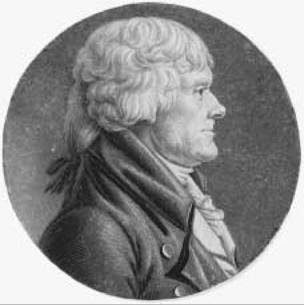
Thomas Jefferson. The third president of the United States, in an engraving by Charles Balthazar Julien Févret de Saint-Mémin. Jefferson sat for this portrait by Saint-Mémin in 1804.
Jefferson's political fame spread beyond Virginia in 1774 with the publication of his pamphlet, A Summary View of the Rights of British North America. He argued, powerfully if not quite accurately, that England's colonists had settled, developed, and defended their American homes with their own lives and treasure and were under no obligation to accept taxation from an imperial government already enjoying great profits from commerce with the colonies. Jefferson's literary powers earned him membership in Virginia's delegation to the Second Continental Congress meeting in Philadelphia in 1775. Before departing he helped draft a plan for organizing the militia of Virginia and wrote a firm reply to Lord North's proposal for peace, based on submission to parliamentary taxation. In Philadelphia he collaborated with John Dickinson on A Declaration of the Causes and Necessity of Taking Up Arms (1775). In June 1776 he became the principal draftsman of the Declaration of Independence. Benjamin Franklin and John Adams modified it slightly; the full Congress eliminated an entire section that denounced the slave trade and blamed the King of England for continuing it. Historically the charge was doubtful, and many members of Congress owned and traded slaves.
For the next several years Jefferson labored in Virginia. Resuming membership in the House of Burgesses, he served with George Wythe and Edmund Pendleton in undertaking a thorough revision of the laws of Virginia. Jefferson succeeded immediately in abolishing the entailing of landed estates, a practice tending toward hereditary aristocracy. He also moved to abolish primogeniture, but that reform had to wait several years before Madison and other allies accomplished it. That was also true of Jefferson's Statute for Religious Freedom (1786), which completed the disestablishment of the Church of England in Virginia and guaranteed that all religious organizations would be voluntary and separate from government. The assembly rejected Jefferson's proposals for universal public education, for reducing suffrage requirements, and for representation on the basis of population. He succeeded, however, in liberalizing the criminal code. Though Virginia's slave code remained much as it had been in colonial times, the state did outlaw the further importation of slaves in 1778. Jefferson also reported, in his book Notes on the State of Virginia, completed and first published in France in 1785, that he drew up a proposal for the gradual emancipation and deportation of Virginia's slaves. But this proposal never came before the assembly.
In June 1779 Jefferson followed Patrick Henry as governor. Virginia's constitution gave very little independent authority to its governor, whom the General Assembly elected for one-year terms, with three consecutive terms the maximum allowed. During his two terms, Jefferson was able to support George Rogers Clark's military successes in the West and managed to send some Virginia forces to the defense of the Carolinas. Unfortunately, a series of British invasions overtaxed the resources of the state. Jefferson spent much of his time searching for arms, supplies, and manpower while moving state papers and military supplies from one place to another, trying to evade British troops. Considering that his fellow Americans had been unable to hold New York City, Philadelphia, Charleston, or several other key positions, Jefferson's military failures were fairly typical of the Revolutionary War, but some legislators demanded an inquiry into his actions. Vindicated but still offended, Jefferson refused the third year offered to him.
Jefferson's retirement in June 1781 proved relatively brief and was marred by the death of his wife in September 1782. Though immobilized with grief for several weeks, Jefferson soon agreed to serve again in the Continental Congress. In only five months his legislative achievements were remarkable. He worked out the plan for U.S. currency that has been the basis of American money ever since: a decimal system based on the Spanish dollar. He developed plans for the survey and future government of the western territories ceded by various states. His two ordinances of 1784—Congress adopted one, concerning local self-government and the means toward statehood, but rejected the second, dealing with land surveys and sales—were changed in many details by the Land Ordinance of 1785 and the Northwest Ordinance of 1787, both written when Jefferson was in France. But most of the essential principles originated with Jefferson, including the rights of people to form states that, once admitted to the Union, would be equal to the original thirteen. Jefferson, following a suggestion from Timothy Pickering, wished to prohibit slavery in all western territories after 1800; the Northwest Ordinance prohibited slavery immediately, but only north of the Ohio River.
In July 1784 Jefferson left for France to assist in the drafting of commercial treaties with European powers. In 1785 Congress made him U.S. minister to France; Benjamin Franklin, seventy-nine and in declining health, was eager to return home. In Paris, Jefferson enjoyed a commodious dwelling, a French cook, a growing circle of political and philosophical friends, and sufficient leisure to travel. He completed his only book, Notes on the State of Virginia, intended for European philosophers and printed privately in an edition of two hundred copies. A pirated edition appeared in Philadelphia in 1788, somewhat embarrassing the author for its severe strictures on slavery and slaveholders. Jefferson also enjoyed a long flirtation with an English painter, educated and steeped in Italian culture, Mrs. Maria Cosway. As a diplomat Jefferson tried vigorously to advance the interests of the United States, but was frustrated by the fact that neither he nor the Congress could bind individual states to commercial agreements with foreign nations. He was also furious that Congress, lacking a navy, had to pay protection money to Morocco and other Muslim states in North Africa to permit American merchant ships to sail in the Mediterranean Sea. Corresponding with friends in the United States, Jefferson criticized certain aspects of the Constitution of 1787. However, his experience in France caused him to advocate a far stronger government for the United States, with powers to pass and enforce commercial regulations and a power of taxation sufficient to build and maintain a navy as well as guarantee the security of western territories. Before leaving France in October 1789, Jefferson enjoyed witnessing and playing an advisory role in the early stages of the French Revolution. His close friendship with the Marquis de Lafayette enabled Jefferson to contribute advice on the Declaration of the Rights of Man (1789) and other matters.
Expecting to return to his diplomatic post in the spring of 1790, Jefferson was surprised when President George Washington nominated him secretary of state in September 1789. Jefferson accepted and, assuming the post the following March, became an actor in most of the great political events and controversies of the next eighteen years. The new government began its career in New York City, where Jefferson joined his friend Madison in brokering a political deal in mid-1790: a few less Virginia votes against the assumption scheme of Secretary of the Treasury Alexander Hamilton (the federal government would assume responsibility for all state debts incurred during the Revolution) in exchange for a few Pennsylvania votes supporting the permanent location of the U.S. capital on the Potomac River. Before moving to the Potomac, however, the government would settle in Philadelphia for ten years.
Jefferson and Madison came by degrees to oppose the policies of Hamilton, who they believed exerted an improper influence on Washington. In fact, Hamilton's view of things had long been more in harmony with Washington's than with theirs. When Hamilton late in 1790 asked Congress to charter a National Bank, Jefferson argued that the Constitution gave no such authority to Congress. Hamilton advocated conciliatory diplomacy with Britain; Jefferson preferred strengthening the alliance with France while taking a tough line against Britain and Spain. In 1791 Jefferson hired Philip Freneau as a translator in the State Department, but his real job was editing an anti-Hamilton—and eventually an anti-Washington—newspaper, the National Gazette. Jefferson shared confidential papers with Freneau and ghostwrote some of his material. This was part of a larger policy of organizing an opposition party, the Democratic Republicans, from whom Jacksonian Democrats later claimed direct descent.
Following the creation of a French republic, Jefferson advocated immediate recognition and meeting scheduled debt payments, while Hamilton urged delay and caution. President Washington took Jef-fer son's position, maintaining diplomatic relations with France. However, when France declared war on England, Washington issued a Proclamation of Neutrality (1793). In Jefferson's view, this gave protection to Britain without requiring any reciprocal concessions. The energetic new French diplomat, Edmond Charles Genet spent much of 1793 using the United States as a base for attacks on Spanish territory and British shipping. This was too much even for Jefferson; he had to spend much of his last year as secretary of state restraining Genet and trying to repair the damage done to Franco-American relations. He hoped that his final Report on Commerce would move Congress to take a firmer line against British trade restrictions, and encourage increased trade with France.
Jefferson resigned at the end of December 1793, weary of partisan politics and eager to look after his family and estates. Since 1784 he had spent but a few months of vacation at his beloved Monticello. He maintained an extensive political correspondence, however, and in 1796 became his party's candidate for president against Federalist John Adams, Washington's vice president. Under the terms of the Constitution in its original form, the odd result was Jefferson's serving a full term as vice president under his increasingly bitter rival, Adams, having received the second-highest number of electoral votes. Jefferson was discreet about his opposition. Many years passed before the world learned that he had written the Kentucky Resolutions of 1798, claiming the right of a state to nullify acts of Congress that were un-constitutional—in this case the Alien and Sedition Acts (1798). In public, he was a model vice president, systematizing the Senate's procedures with rules that are still in use.
The election of 1800 produced an unexpected result when Jefferson and Aaron Burr received the same number of votes in the electoral college. This threw the election into the lame-duck, Federalist-controlled House of Representatives. Burr, whose probably treasonable acts were still in the future, appeared a preferable candidate to many Federalists, so a deadlock persisted from 11 February to 17 February 1801. Finally, on the latter date, two Federalists—possibly influenced by Hamilton—stopped voting for Burr, permitting Jefferson's victory. Hamilton had the satisfaction of seeing Jay's Treaty (1794) honored until its term (and Hamilton himself) had expired. Jefferson also retained the Bank of the United States, which established additional branches under the new secretary of the Treasury, Albert Gallatin of Pennsylvania.
Jefferson's first term was extremely successful. Trade expanded, Ohio entered the Union as a state in 1803, the Indiana Territory grew, revenues improved, and expenditures were reduced. A serious crisis in relations with France ended spectacularly when Napoleon sold the vast Louisiana Territory to the United States (1803). Instead of continuing the practice of paying bribes, Jefferson sent a small fleet to the Mediterranean in 1801, eventually forcing the pasha of Tripoli, by a treaty in 1805, to leave American commerce alone. The Lewis and Clark Expedition (1803-1806), originally conceived as military reconnaissance, turned into a valuable exploration of new U.S. territory. Congress repealed the tax on distilled liquors and the Federalists' lame-duck Judiciary Act of 1801, which created judgeships for many otherwise unemployed politicians. The Twelfth Amendment, ratified in 1804, provided that the president and vice president should be elected separately. During the same year, Congress removed an incompetent federal judge, John Pickering of New Hampshire, by impeachment in the House and conviction in the Senate. An attempt to remove a justice of the Supreme Court, Samuel Chase of Maryland, failed. Chase had proved anything but impartial when presiding over a trial under the Sedition Act. But while he was impeached late in 1804, early the next year his opponents failed to muster two-thirds of the Senate to convict. Meanwhile, Jefferson was not amused by Chief Justice John Marshall's assertion of the Supreme Court's right to nullify federal laws (euphemistically known as judicial review) in Marbury v. Madison (1803).
Jefferson won the election of 1804 in a landslide victory, with fair hopes for a second term as successful as his first. It was not to be. At war once more, France and Britain each tried to prevent the United States from trading with the other. Because thousands of British sailors sought safer and higher-paid employment with the commercial ships of the United States, the British navy increasingly stopped American ships on the high seas and impressed sailors they identified, correctly or not, as British subjects. Failing to secure recognition of neutral rights from the belligerents and following the attack of a British warship on the new, not fully fitted United States frigate Chesapeake (22 June 1807), Jefferson resorted to an embargo, lasting from 22 December 1807 to 15 March 1809. Unfortunately the United States suffered more from this measure than either France or Britain. Another distraction was Aaron Burr's western conspiracy, his arrest in 1807, and his trial for treason later that year, at which he was acquitted. Historians still dispute Burr's intentions, if indeed he ever had a distinct plan. However, it is known that he proposed to a gullible British minister a plan for separating the western states from the United States and sought money from Spain to engineer a coup d'état in Washington, D.C. John Randolph of Virginia, a pillar of strength in the House of Representatives during Jefferson's first term, became a caustic and persistent critic of the administration during the second. Nevertheless, James Madison easily won the election of 1808.
Jefferson enjoyed an active retirement. He continued to maintain an extensive correspondence, notably with a reconciled John Adams. Perfecting Monticello occupied him, as did designing an elegant, new, octagonal house for his Poplar Forest plantation. Jefferson wished his grandson Francis Eppes, the only child of Polly, who had died young, to inherit Poplar Forest; he designated Monticello for the most accomplished of Patsy's children, Thomas Jefferson Randolph. The University of Virginia was Thomas Jefferson's last major achievement. He cajoled funds from the General Assembly, chose the location in Charlottesville, designed the buildings, and recruited faculty. The nation noticed with awe that Jefferson and John Adams died on 4 July 1826, the fiftieth anniversary of the Declaration of Independence.
Jefferson opposed any sort of hereditary privilege or established religion; he also advocated the free exchange of ideas, natural science, universal education, and political democracy. In other respects he was not so progressive: he thought freedom would last only so long as Americans owned and worked their own farms; he thought himself a friend of Native Americans, but ran them off their land as fast as any president before or since; he wrote eloquently about the evils of African American slavery, but did nothing effectual to limit its growth after 1800, let alone to begin its unwinding. There was one notable exception: he secured from Congress and promptly signed a law as soon as the Constitution permitted outlawing the importation of foreign slaves (1808).
Recent DNA evidence has given added credence to the story that Jefferson was the father of the children of his slave Sally Hemings. Although Jefferson brushed the charge off when it was first made in 1802 by the journalist James Thomson Callender, it long circulated in abolitionist circles and in the black community, as well as among those who claimed descent from Jefferson and Hemings, including one of Hemings's sons, Madison, who told his family's story in his 1873 memoirs. Sally Hemings was the half-sister of Jefferson's deceased wife and both the daughter and granddaughter of white men. Her children with Jefferson were seven-eighths white, making them legally white at the time, but still legally Jefferson's slaves. Presumably in accordance with the pledge he made their mother, Jefferson freed Hemings's four surviving children when they reached the age of twenty-one, and after his death, Jefferson's daughter Martha quietly freed Sally Hemings as well.
Thomas Jefferson's incomparable phrases have been repeated for over two centuries: by Whigs and Democrats, by the new Republicans of 1854 and by the founders of the Confederate States of America, by capitalists and communists, and by segregationists and integrationists. His benign pronouncements can be claimed by virtually anyone. On other points his messages remain clear. He favored reason over revelation, feared religious establishments, promoted natural science, advocated education at all levels, and favored the fine arts. His actual practices regarding freedom of the press were no better than those of his contemporaries, but his pronouncements in favor of intellectual freedom ring through the ages.
The spirit of Jefferson illuminates his restored mansion and plantation at Monticello and the buildings he designed for the University of Virginia, two miles away in Charlottesville. Poplar Forest has also been restored and is now open for visitors; it is located near Lynchburg. Jefferson sat for many portraits, which have been reproduced in countless books and prints. Among the finest are those of Mather Brown (1786; National Portrait Gallery, Smithsonian Institution); Charles Willson Peale (1791; Independence National Historical Park, Philadelphia); Rembrandt Peale (1800; White House); Gilbert Stuart (1805; Colonial Williamsburg); and Thomas Sully (1821; American Philosophical Society, Philadelphia). Jean-Antoine Houdon executed a fine marble bust in 1789 (Museum of Fine Arts, Boston). On the bicentennial of Jefferson's birthday, 13 April 1943, the United States dedicated the Jefferson Memorial on the banks of the Potomac River in Washington, D.C. John Russell Pope captured Jefferson's own style in the architecture, and Rudolph Evans executed an imposing bronze statue, nineteen feet tall. Jefferson's likeness is rarely seen on paper money: someone assigned him to two-dollar bills. This neglect is redeemed by the five-cent coin, with its fine profile of Jefferson on one side and his home at Monticello on the other.