
While the population of New York City at the beginning of the French and Indian War (1756-1763) was just under fourteen thousand, slightly trailing its two rival seaports, Boston and Philadelphia, it would not have been difficult to predict that this community would prosper. New York was fortunate to possess the best natural harbor of the colonies. Protected by the Verrazano Narrows, Manhattan Island offered sheltered docks along both the North (Hudson) River and the East River. It was centrally located among the colonies. Founded in the 1620s by the Dutch as New Amsterdam, the center of their North American trade, it had a unique heritage of commerce and cosmopolitanism that neither Pennsylvania nor Massachusetts could match. The English conquest in the 1660s did not decrease the city's devotion to commerce, and it remained a mixture of nationalities known for its tolerance of minorities, though dominated by the Dutch and increasingly English population.
The French and Indian War was a turning point in the city's history. The decision of William Pitt to drive the French out of North America led to an immense influx of wealth into the city. The British stationed 25,000 soldiers in North America and a fleet that included 14,000 sailors, all of whom had to be provisioned. In addition, New Yorkers could now legally capture French and Spanish ships and keep the spoils. Merchants such as Peter Livingston and Oliver De Lancey made fortunes unheard of prior to the war.
New York too became the center of British trade with North America, now worth 50 percent of its exports to the thirteen colonies, sending flour and livestock and a variety for foodstuffs to the islands in return for molasses for the growing sugar refining industry and bills of exchange. By 1762 its population had reached eighteen thousand. Hanover Square grew famous for its retail wares, and coaches—once a rarity—crossed the city's streets regularly. Numerous elegant mansions arose, such as that of Captain Archibald Kennedy, with its grand staircase and fifty-foot parlor.
Aside from the city's mercantile elite, New York had a large artisan population, ranging from the elite trades of silversmith and carriage maker to the lower trades of tailoring and shoemaking. There were also a number of white unskilled laborers, including cart-men who hauled goods from ship to shore, and the largest black and slave population of all the colonies outside the South, constituting about 16 percent of the population. The wealthy tended to live in the center of town on Broadway and around Bowling Green, while the artisans and laborers lived in the outer wards, nearer the rivers.
Following the end of the French and Indian War, the British enacted legislation to tighten the organizational structure of their empire and increase their income. The Sugar Act (1764), Stamp Act (1765), and Tea Act (1773) met with resistance in all seaports where the tea was sent. Tensions in the street between soldiers at the British army garrison and citizens remained high, resulting in violence at the Battle of Golden Hill in which a seaman was killed when the British tried to prevent construction of a liberty pole. In addition, during the riots caused by passage of the hated Stamp Act, New Yorkers refused to allow the distribution of the dreaded stamps; attacked the home of British commander, Major Thomas James; and held their own tea party in 1774. The artisan population was central to resistance, demanding radical measures against the British, much to the chagrin of the more conservative merchants who, while opposing British measures, were focused on reconciliation. The Sons of Liberty, men who enforced anti-British measures, was composed largely of artisans or merchants of nonelite background such as Alexander McDougall, John Lamb, and Isaac Sears.
As British rule collapsed, two separate committees emerged, a Mechanics Committee and a governing Committee of Fifty-One, that worked together, though not without tension. While artisans did not dominate the governing committee, their pressure for more radical action had to be considered, because their votes held the keys to political power. Their shift of support from the mercantile De Lancey bloc to the landholding, Presbyterian Livingston faction reflected the Livingstons' Revolutionary stand as the De Lanceys moved steadily toward loyalism and exile.
A year after war broke out in April 1775, New York became the center of action. Following Bunker Hill in June 1775, the British shifted their attention to the middle colonies, attempting to divide New England from the rest of their dependencies. Their first move would be an invasion of New York City. General Charles Lee had constructed a series of forts, batteries, and interior barricades for the Americans early in 1776, but there was no way to fully defend the many approaches to Manhattan Island. In March 1776 Washington moved his army from Cambridge, Massachusetts, to New York and divided it between the city and Brooklyn, across the East River. Brooklyn was protected by its hilly topography, with only a few passes that would permit an army to advance.
The British brought a major show of force to New York. It included 32,000 soldiers, 14,000 seamen, two men of war, and twenty-four frigates. Washington had 23,000 men and no navy to speak of. In August 1776 the British attacked Brooklyn in an all-night march, going through the virtually unguarded Jamaica Pass to the east and forcing Americans to withdraw to Brooklyn Heights, where a final retreat was cut off by the East River. Had Admiral Richard Howe quickly moved his ships into the river, cut off the troops, and forced their surrender, he might have dealt a mortal blow to the army. But he hesitated, and Washington moved his troops back to the city on the night of 29-30 August. Once again, Howe could have trapped the army by blockading the island through a quick landing of troops, but once more he hesitated, and the American army retreated, eventually into New Jersey and Pennsylvania. The British made New York their headquarters from September 1776 to the end of the war.
The city remained under harsh martial law throughout the war, enforced by a British administration characterized by considerable corruption and ineptitude. The occupation was made all the worse by a major conflagration that destroyed five hundred buildings and created a constant housing shortage for British soldiers, Loyalists, and slaves who had come in search of freedom. British cruelty was sadly apparent in the treatment of the thousands of American prisoners held captive in the city, most appallingly in leaky ships in the harbor including the notorious Jersey, almost all of whose inmates died of disease or starvation. The last city to be freed of British rule was New York; the British pulled out on 25 November 1783, a day that would be a major civil holiday for the next hundred years.
After the British exodus, republican government was established in New York City, an urban center of just over 33,000 inhabitants by 1790. It was a conservative republican tide that held sway, however. Tory lands were confiscated, especially the De Lancey holdings, but most of these lands were bought by wealthy merchants. The new president of Columbia College (formerly Kings College) was William Samuel Johnson, son of the college's first president and a quiet revolutionary. New York was the home of one of the nation's strongest antislavery associations, the Manumission Society, founded in 1785, headed by John Jay and including prominent citizens such as Alexander Hamilton. Even so, in the 1790s the absolute number of slaves in the city increased by 25 percent: the number of white homes using some form of black labor tripled. Artisans continued to use slaves during the 1790s, but their use gradually decreased from one in eight to one in seventeen by 1800.
New York played a central role in the political life of the new nation. It was a focus of debate over the new federal Constitution. As opposed to upstate farmers, its residents were largely in favor of a strong central government that would protect commercial interests and uphold national honor; the Federalist Papers, the most important defenses of the new Constitution, were published in New York. It was also the nation's first capital; George Washington was inaugurated on 30 August 1789 on the steps of City Hall, which was converted into the first federal building.
Washington spent a year in New York before the capital was moved to Philadelphia in 1790 as part of a political deal between Jefferson and Hamilton. But although New York was no longer the political capital, Hamiltonian economic policy—which the deal preserved—and the monetary capital and commercial expertise of the city's astute mercantile elite allowed the city to remain the nation's financial hub. Gotham, as the city was dubbed, became the home of the country's first stock exchange in 1792 and its center of trade. It housed the nation's most banks and largest credit capabilities (fourteen banks and $35 million in capital in 1825), the most reliable insurance brokers ($16 million in capital in 1827), the most dependable harbor, and the most reliable packet service. British merchants had their best contacts in New York, and as early as 1810, one-fourth of the nation's cotton trade moved through the city. By 1825 New York's exports ($175 million) nearly equaled those of Boston, Philadelphia, and Baltimore combined. Merchants residing in the city included the likes of John Jacob Astor (1763-1848), Anson Phelps (1781-1853), and Arthur (1786-1865) and Lewis (1788-1873) Tappan. Trade grew so rapidly that wide new streets, West Street and South Street, were built from landfill. Shipbuilding flourished, and it was on the Hudson River that Robert Fulton put his steamboat, the Clermont, on display and into operation in 1807.
American republicanism meant new economic horizons for all classes. Artisans expanded their businesses, arranged credit, and sponsored their own banks; a number, including cabinetmaker Duncan Phyfe (1768-1854), became major entrepreneurs. Yet economic growth also meant a greater stratification of wealth. New York was a venue for the growth of the American labor movement as the increasingly large number of long-term wage earners engaged in citywide walkouts, demanding a republican wage, a salary commensurate with American citizenship.
Opponents of slavery, influenced by the Revolution's republican legacy, gained passage of New York's Gradual Emancipation Act in 1799, a decade after the launching of the new government. Although it did not grant immediate release, most bondsmen were now able to purchase their freedom; the number of slaves dropped precipitously as the free black population increased. Blacks did the city's most difficult and undesirable work, including emptying privies and sweeping chimneys, but they also worked in a number of artisan crafts, formed their own churches, newspaper (Freedom's Journal), and theaters, and exercised republican rights, including the right to vote—until the Democratic Republican Party disenfranchised most of them in 1821.
Republicanism meant change in municipal government. In the colonial era, the Corporation of the City of New York acted as a private body concerned with real estate and waterfront tracts. The new Common Council aggressively pursued the interest of the city's entire population. So that it could do so, the state granted it the power to tax its citizens. A new city hall was erected, the grandest structure in town, built with sandstone and marble on a Palladi-an, classical republican, plan. The city took on its future design, initiating the famous grid plan, based on the idea of reason and order, that gave modern New York its shape. The city supported the poor in a three story Almshouse (1797), then built a new Bellevue complex on the East River in 1816 that included an almshouse and pesthouse, soon to be a hospital, and was responsible for local courts and constables. It paved streets and collected garbage (though the pigs left to roam often did a better job in the poorer neighborhoods); it allocated water supply to a private firm, the Manhattan Company, that proved more adept at banking than pipelines, leaving the city with chronic plumbing and water shortages.
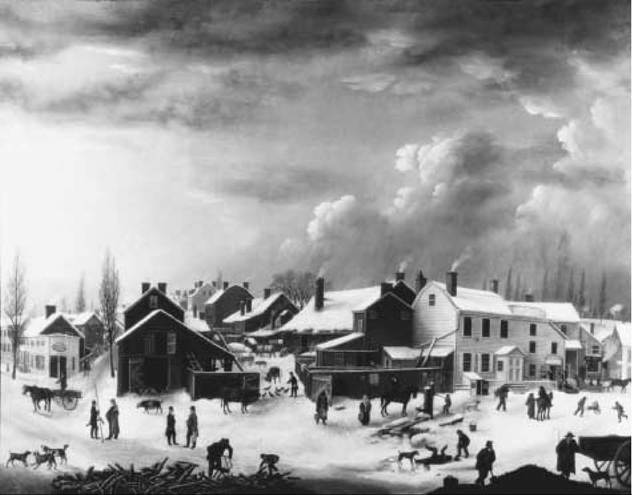
Winter Scene in Brooklyn. A painting by Francis Guy depicting a bustling neighborhood in Brooklyn as it looked in the 1817 to 1820 period.
With two elections each year, one for federal and state office, one for city offices, political conflict was nearly constant. The two parties, the Hamiltonian Federalists and Jeffersonian Democratic Republicans, fought for competing legacies of the Revolution. Ultimately, the egalitarian Jeffersonians triumphed over the deferential expectations of the mercantile Federalists among the pivotal electoral bloc: artisans and young, ambitious merchants. The key victory came in 1800, when the city's ballots brought New York State's electoral votes into the Jeffersonian column, making possible Jefferson's victory. Making the political fights even more intense were the conflicts with France and Britain as they engaged in the Napoleonic Wars. America's quest for freedom of the seas, leading to the War of 1812, was echoed in the streets and on the docks of New York, as the harbor was refortified for the first time since 1776.
With the aid of immigrants from Ireland and the city's hinterlands, New York's population grew to just under 100,000 residents by 1810 and to a metropolis of 197,000 by 1830, dwarfing every other American city. By then, it housed the nation's most elegant residences on Broadway and Park Place, while seeing the growth of severe areas of poverty,
including the Five Points. It became a mecca of the arts with a lively theater scene, hosted numerous musical concerts, and housed the New York Academy of Fine Arts (soon called the American Academy of Fine Arts), headed by the noted painter John Trumbull. With the completion of the Erie Canal in 1825, New York became the portal for immigrants of the coming generation and the center of the country's import and export trade. It was the only world-class metropolis in the new American nation.