
The brothers Joseph Michel Montgolfier and Jacques-Étienne Montgolfier launched the air age on 4 June 1783 when they flew a hot air balloon measuring thirty-five feet in diameter from the town square of Annonnay, France. Over the next seven months, one spectacular ascent followed another, culminating in the first free flight of human beings from Paris in both a hot air balloon (21 November 1783) and a hydrogen gas-filled balloon developed and flown by Jacques Alexandre César Charles (1 December 1783). A number of Americans in France, including Benjamin Franklin and the other diplomats negotiating the Treaty of Paris ending the American Revolution, witnessed these events and spread the news in letters and pamphlets sent to friends and family across the Atlantic.
American newspapers carried the first articles describing these pioneering flights as early as November 1783. Dr. John Foulke, recently returned to Philadelphia from Paris, launched small balloons to the delight of the crowds attending his lectures in May 1784. Peter Carnes, a lawyer and innkeeper from Bladensburg, Maryland, unveiled his American Aerostatic Balloon in June 1784. Standing thirty-five feet tall, the craft was too small to lift the portly inventor. He did, however, send thirteen-year-old Edward Warren up on a tethered flight from Baltimore on 24 June. Just a month later, the Massachusetts Spy, or, Worcester Gazette (22 July 1784), reported that "the taste for Air Balloon matters has grown to such an extravagant pitch that nothing can pretend to have any intrinsic value in it, unless it has this name as an appendage."
Dr. John Jeffries, a Boston-born Loyalist living in England, became the first American to make a free flight on 30 November 1784, when he ascended from London, England, with the French aeronaut J. P. F. Blanchard. The two men made the first balloon flight across the English Channel on 7 January 1785. Blanchard later made the first free, or untethered, flight in the United States, ascending from Philadelphia on 9 January 1793 before a large crowd that included President George Washington and members of his cabinet. Blanchard traveled to a safe landing in Woodbury, New Jersey.
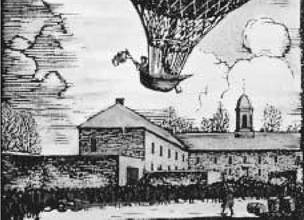
America's First Balloon Flight. French aeronaut J. P. F. Blanchard made the first untethered balloon flight in the United States when he ascended from a prison yard in Philadelphia on 9 January 1793, before a large crowd that included George Washington. the granger collection, new york.
The French created a military balloon corps that saw active service from 1794 to 1799. As early as 1804, Joseph Louis Gay-Lussac ascended to an altitude of over twenty thousand feet to study conditions in the upper atmosphere. In antebellum America, Joseph Henry, secretary of the Smithsonian Institution, encouraged the use of balloons to study meteorology and as aerial observation platforms in time of war. For the most part, however, ballooning remained the province of itinerant aerial showmen who traveled across the nation, performing feats of aerial derring-do, or setting off on long-distance balloon voyages whenever and wherever they could collect a crowd of paying spectators to witness an ascent.
The popularity of ballooning as mass entertainment was established by European aeronauts, notably Louis-Charles Guille and Eugene Robertson, who toured the United States between 1819 and 1834. Charles Ferson Durant, a native New Yorker who understudied Robertson, emerged as the first American-born aeronautical professional. He inaugurated a "golden age" of ballooning in the United States with a number of notable ascents in New York, Philadelphia, Baltimore, and elsewhere from 1830 to 1834. Pennsylvanian John Wise, who made some 463 ascents during forty-four years as an aeronaut, and Thaddeus Sobieski Constantine Lowe, who organized and led a balloon corps that operated with the Union Army from 1861 to 1863, were the best-known American airmen active before 1860.