
The Barbary Wars (1801-1815) resulted from interference by the Barbary States of Tripoli, Algiers, and Tunis with U.S. merchant shipping. Piracy had long been a source of income for the Barbary States, whose leaders ordered their ships to seize merchant ships and their crews and then hold them for ransom. Like many European nations, the infant United States adopted a system of paying tribute to the Barbary powers to ensure the safety of their shipping.
Beginning in 1796 the United States negotiated treaties with the Barbary States that freed American captives, protected U.S. mercantile trade against attack and seizure, and provided an annual tribute in naval stores. Despite these treaties, the situation in the Mediterranean deteriorated. Demanding a new arrangement with the United States that would increase payments, in May 1801 Yusuf Karamanli, the pasha of Tripoli, repudiated his treaty and declared war on the United States.
Meanwhile, President Thomas Jefferson found himself under domestic pressure to redress an insult to American honor when the dey of Algiers, Bobba Mustapha, in 1800 commandeered Captain William Bainbridge's frigate George Washington and turned it into a floating hotel and zoo under the Algerine flag for a voyage to the Ottoman sultan at Constantinople. Unaware of Tripoli's declaration of war but concerned about the deteriorating situation for the United States on that sea, in May 1801 Jefferson ordered a naval squadron to the Mediterranean. Commanded by Commodore Richard Dale, it consisted of only four ships. Dale's restrictive orders virtually assured that he would accomplish nothing. Ordered to protect American commerce in that sea, he had no authority to engage in combat unless he caught a warship in the actual process of trying to take a U.S. ship.
In late July Dale sailed to Tripoli and opened negotiations with the bashaw through an intermediary. Dale ruled out naval bombardment as a means of dealing with Tripoli. In truth he had too few ships for such an operation and lacked the specialized bombardment vessels, known as bomb ketches, that were highly desirable in such actions. Even had such vessels been available, bombardment would have required a sustained effort. Dale also lacked small shallow-draft vessels for work in shoal waters close to shore.
The Tripolitan War dragged on. In February 1802 Congress authorized Jefferson to use the thirteen frigates in the navy to defend the nation's commerce. Because naval enlistments were then limited to one year, Jefferson was obliged to send out another squadron to replace Dale's. He named Captain Richard Valentine Morris to command it. In the spring of 1802, with the enlistments of his seamen expiring and his ships in need of repair, Dale left for home.
Morris had at his disposal a more powerful squadron of six ships and financial resources not available to Dale. Unfortunately he proved a less than aggressive commander. Morris spent most of his time and kept most of his vessels at Gibraltar, one thousand miles removed from Tripoli, which he was supposedly blockading.
Morris was called home in the summer of 1803 and forced from the service. A third squadron, this one of seven ships led by Commodore Edward Preble, arrived at Gibraltar in mid-September. A far more aggressive and capable commander, Preble made a show of force at Tangier and met with the sultan, forcing Morocco, which was then threatening hostilities, to maintain the peace. Preble also actively blockaded Tripoli.
Preble's hopes of bringing the war to a successful conclusion werejolted by the loss of the frigate Philadelphia, his second-most powerful ship. It had run aground near Tripoli at the end of October and its crew was taken prisoner. The Tripolitans succeeded in refloating the frigate and towed it to Tripoli, where they began refitting it, threatening in the process to upset the naval balance of power in the Mediterranean. In February 1804, however, Lieutenant Stephen Decatur led a crew of volunteers on a daring raid into Tripoli harbor and burned the Philadelphia without losing a man. As a result of this action, Decatur became the youngest man in U.S. Navy history to be promoted to captain.
That summer Preble mounted a number of attacks against Tripoli, bombarding its ships and shore installations and capturing some smaller Tripolitan vessels. Meanwhile Jefferson sent out more ships and, although Preble had performed well, gave command to Preble's senior, Captain Samuel Barron. William Eaton, the former consul to Tunis, accompanied Barron and came up with a plan to end the war. The United States agreed to support Hamet Karamanali, brother of the bashaw, in an expedition from Egypt against Tripoli. In March 1805 Eaton set out with several hundred men, including eight U.S. Marines, across the desert. Finally reaching Derne, they capture this second-largest Tripolitan city, and in June Bashaw Yusuf agreed to peace. He accepted a $60 thousand ransom for the release of the more than three hundred American prisoners but agreed to renounce all future tribute from the United States.
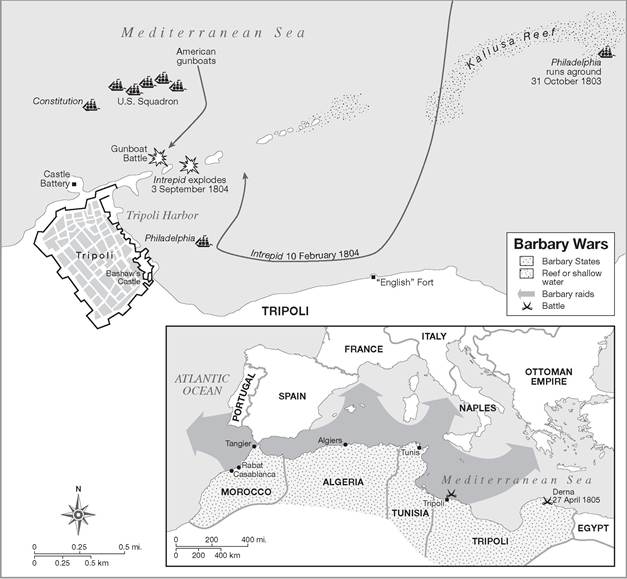
The Tripolitan War was inexpensive for the United States in terms of lives lost, claiming only thirty dead. The war created a strong esprit de corps in the young U.S. Navy and cemented in it traditions of discipline and pride. It also trained the leaders who would lead the navy in the far more difficult test with Britain that lay ahead.
In 1815 the United States again went to war with one of the Barbary States, this time with Algiers. In the summer of 1812 the British had encouraged the dey to seize American ships. With the end of hostilities with Britain, in March 1815 Congress authorized President James Madison to equip, man, and deploy such warships as he deemed necessary for operations against Algiers. The administration decided to send two squadrons to the Mediterranean, one under Captain William Bainbridge and the other under Captain Stephen Decatur. With ten ships, Decatur sailed first; his actions were decisive. Decatur arrived in the Mediterranean before Algiers could learn of the U.S. action and almost at once captured two Algerine warships. He then dictated peace to Algiers at the end of June. The terms provided for the release of prisoners, reparations to the United States, and an end to all tribute. On his own initiative, Decatur sailed to both Tunis and Tripoli and forced these two states to pay reparations for U.S. vessels that had been improperly seized and also to restore normal relations. Decatur's 1815 Mediterranean foray marked the end of troubles between the United States and the Barbary States and indeed the termination of the latter's piratical activities.