
On the evening of 5 March 1770, British troops and Boston townspeople clashed on the street in front of the customhouse. This skirmish, known as the Boston Massacre, marks the first blood to be shed in the American Revolution.
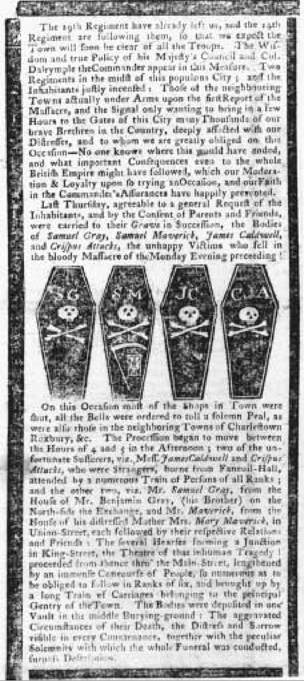
The Boston Massacre. This page from the 12 March 1770 edition of the Boston Gazette and Country Journal includes an article describing the Boston Massacre, along with illustrations of coffins bearing the initials of four men who died: Samuel Gray, Samuel Maverick, James Caldwell, and Crispus Attucks. A fifth man, Patrick Carr, died later.
On 1 October 1768, British regulars had arrived to support American customs officials. Bostonians, already hostile to demonstrations of imperial rule in general and standing armies in particular, reacted angrily to their presence. Over the next eighteen months, civilians and soldiers physically and verbally abused each other. The city was suffering an economic recession, and relations between soldiers and civilians were harmed by underpaid soldiers who supplemented their small stipends by moonlighting and by British officers who delayed paying bills to tailors and other artisans. When rope workers got into a fight with soldiers looking for work in the beginning of March, several days of off-and-on brawling ensued. Then, on 4 March, some officers performed an unauthorized search of a rope factory, looking for a missing sergeant; they feared he had been kidnapped, although in fact he had spent the night in a brothel. For several days before the Massacre, gossip circulated between men and women in kitchens and parlors that events would soon come to a head. Rumors spread that the soldiers planned to take their revenge on the next night.
Early on the evening of 5 March, a wigmaker's apprentice taunted the customhouse guard by scoffing that the regiments' officers were no gentlemen, as at least one of them did not pay his bills. The sentry swung his musket at the boy, who ran off crying. Someone rang the nearby church bells as a fire alarm, and soon a large mob formed around the guard, who yelled for support. Captain Thomas Preston led seven grenadiers from their barracks. The crowd jostled closer, throwing ice chunks and oyster shells and taunting the soldiers with, "Fire, fire, you durst not fire." Preston ordered his soldiers not to fire, but in the confusion, five of them discharged their guns. Three townsmen died instantly; two more died later. One of the five was Crispus Attucks, a free mixed-race sailor.
Governor Thomas Hutchinson forestalled more violence by issuing a warrant for Preston's arrest that night and by moving the soldiers out of the city of Boston. Radicals and Loyalists alike rushed to get their version of events into print. Samuel Adams immediately dubbed the event a "horrid massacre," and with other Sons of Liberty he appointed a committee to take depositions from sympathetic witnesses. The city of Boston published the depositions and claimed to have sent all the copies to London, but many of them were kept for potential jurors to read. At the same time, Henry Pelham created an inaccurate but highly inflammatory drawing of the event. Without Pelham's permission, Paul Revere copied and widely distributed the drawing as an engraving entitled "The Bloody Massacre."
Preston and the soldiers stood trial for murder in the fall of 1770. John Adams and Josiah Quincy Jr. defended them; Josiah's brother Samuel argued the case for the prosecution. Despite their radical politics, Adams and Quincy believed that all men were entitled to a legal defense. Three years later, Adams recorded in his diary that his defense of the soldiers was "one of the most gallant, generous, manly and disinterested Actions of my whole Life, and one of the best Pieces of Service I ever rendered my Country." Their legal aid was approved by the Sons of Liberty, who were convinced of their guilt and yet wanted to ensure that the trials were not tainted by charges of partiality.
Preston and the soldiers were tried separately. The lawyers mounted two different defenses: for Preston, they argued that he had not given an order to fire; for the soldiers, they argued self-defense against a threatening mob. Due to this skillful strategy and a jury that was comprised of men entirely from outside the city of Boston, Preston and six of the soldiers were acquitted. The two others were convicted of manslaughter rather than murder. As the result of a legal privilege called "benefit of clergy," they were branded on the thumb and released.
Samuel Adams, alert to the propaganda value of the riot, arranged to have 5 March celebrated as an annual day of mourning. From 1771 through 1784 (when it was replaced by 4 July), orators such as John Hancock and Joseph Warren inveighed on the anniversary of the massacre against the tyranny of the British ministry and the evils of a standing army.