
Chapter 9
Paul Rhys
Origins
As a teenager, late one night I watched a television broadcast of Beckett’s Not I quite by chance and was both terrified and mesmerized. The words came too fast to understand what was being said, but the image of Billy Whitelaw’s mouth surrounded by darkness and the urgent intensity of communication were captivating. Later I found a slim volume on my father’s bookshelves containing Beckett’s First Love, Not I and Imagination Dead Imagine. It had been a Christmas gift from the composer, Roger Marsh, to my father, and, leaving to study at Oxford, I took the book with me. During my second year at university I read Not I, recalled the earlier TV viewing and, for the first time, properly understood the play. I was overwhelmed by the originality of the work and its psychological insights and fascinated by its structure, with its intriguing mixture of patterning and repetition. I understood a self-reflexive or self-referential quality in the writing which seemed to bring about an enhanced awareness of the present moment-in-time during the act of reading the text. Abbott’s analysis certainly echoes this second of my encounters with the work:
In summary, what I am proposing is a fundamental categorical shift in our reading of Beckett, one that moves him out of fiction altogether and relocates him in that rarely occupied subset of autography. … These texts are as distant from fiction as they are from conventional autobiography. … Beckett’s subset is writing governed not by narrative form or any species of tropological wholeness but by that unformed intensity of being in the present which at every point in the text seeks to approach itself.1
I continued to read Beckett’s work whilst studying for a PhD in composition and computer music at Keele (UK) and Northwestern Universities (US). During this period I became acquainted with Luciano Berio’s large-scale Sinfonia, which sets spoken fragments of Beckett’s novel The Unnamable alongside other texts in a dense polyphony of voices and instruments. I studied the settings of Mallarmé in Boulez’s orchestral song-cycle Pli Selon Pli with a view to understanding how the poetry could exert such a force on the music, even when the soprano fell silent for long stretches of time. In the US, I first encountered the music of Morton Feldman through the duo for piano and cello Patterns in a Chromatic Field and then the ensemble work, For Samuel Beckett. I learned of Feldman’s use of a Beckett text for his opera, Neither, but only heard this work much later. I became acquainted with the condensed expressivity of György Kurtág’s music, although it was nearly a decade later that I heard his moving setting of Beckett’s late text, What is the Word. In 1995, ten years after reading Not I and with my PhD nearly complete, I came across a newspaper advertisement published by the Annenberg-Beckett Foundation, inviting applications from creative artists and scholars to respond to Beckett’s work in any shape or form. I proposed to write a piano solo that would be a direct transcription of Beckett’s Not I, attempting to copy its structure in musical form. It was around this time that I first met the pianist Ian Pace, when he played a very simple synthesizer part in a performance of my ensemble work Chicago Fall. I soon became aware of the full extent of his abilities when I attended a solo recital by Pace including a performance of Brian Ferneyhough’s Lemma-Icon-Epigram. This was a work that I had studied whilst in the US, and I was aware of the considerable technical demands it placed upon the performer, not least the realization of polyphonic textures in which each line is characterized independently by its own rhythmic complexities. Pace performed this challenging work with a precision and commitment that were exhilarating, quite the equal of any recording that I had listened to previously. I resolved to write my piano solo for Pace and was delighted when he agreed.
Analysis of Beckett’s Text
My admiration for Beckett’s writing and my fascination with the structure of the monologue in Not I left me with a determination to understand that structure and to embody it in the music that I would compose. So I set about analysing the text in two complementary ways: first a search for repeating text fragments, then a semantic analysis which sought to reveal narrative continuity and interruption. The printed text of Not I consists of a succession of short phrases separated from one another by three dots or ellipses. Other than this, there is almost no other punctuation and a bare minimum of directions for performance. When one reads the play or witnesses a performance one becomes instantly aware of a web of competing trains of thought that constantly interrupt one another, or occasionally develop unimpeded before being cut short in turn (see Figure 9.1). My first step towards understanding the structure of the text was to use a word-processor to search for repeating text fragments or groups of fragments. This approach was a natural extension of habits I had acquired as a computer programmer. I was unaware of the work by literary scholars, such as Rabinovitz,2 who have used a computer concordance to analyse individual works of Beckett and to investigate their relationship with other works in his oeuvre.
This first analysis made it clear which text fragments repeat (‘imagine!..’ occurs nine times in the course of the play, and the refrain ‘what?..who?..no!..she!..’ five times) and established which fragments do not. It revealed chains of fragments that develop or vary on recurrence (‘all that early April morning light…/for on that April morning…/that April morning…/morning sun…/April…/April morning…/April morning…’). It also became clear that the opening of the printed text (‘out…into this world…this world…tiny little thing…’) is recapitulated twice towards the end of the work. Beckett clearly wishes the audience of Not I to receive the impression that they are witnessing part of a continuous unending torrent of words, reinforced by his directions for the performer to ad-lib extra material before the start and after the end of the written text. But anyone who reads the complete monologue encounters sufficient repetition of its varied themes to have a good idea of how it might continue. It is as if Beckett has given us sufficient enough a fragment of a complex weave to be able to extrapolate its pattern. For all the open-endedness of this text, the author has carefully ensured that the audience receive an experience which may equally be understood as complete.
My second analysis of Mouth’s monologue also took its approach from computer programming. In the C programming language and many others like it,3 indentation of text, associated with the opening or closing curly brace – { or } – is used to delineate the control flow of a programme and to clarify its structure to the human reader. Instructions indented to the right are ignored during the execution of a programme if a conditional statement that precedes them is not fulfilled, or they may be repeated in a loop until a conditional statement is fulfilled. To gain an overview of its structure, a programmer reads only that text situated on the left margin of a programme and ignores the rest. Having been immersed in computer programming to achieve musical results, it seemed logical for me to use this indented text style to interpret and to clarify the complex web of ideas contained in Mouth’s monologue. Figure 9.1 demonstrates a section of Beckett’s text interpreted in this fashion (although it omits the curly braces that a programmer would use):
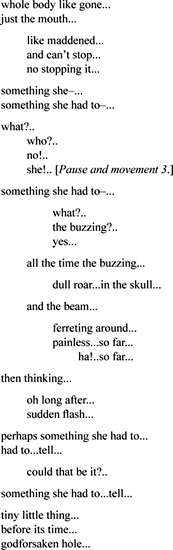
Figure 9.1 Interpretation of a section of Beckett’s text for Not I
This use of indentation helped to identify continuous trains of thought that are interrupted and then resumed. But it also led to a hierarchical organization of Beckett’s text, with the primary narrative thread on the left of the page and threads that are progressively less important situated to the right, much in the same way that a Schenkerian analysis of music separates the primary line, or urlinie, from what it considers to be secondary detail. When reading the text of Not I for the first time, one receives the impression of a web of multiple trains of thought, all of equal importance. But a careful reading of the text reveals that there is a hierarchy, including asides which interrupt and sometimes comment on the preceding material. Thus in Figure 9.1 the text ‘ferreting around…painless…so far…’ comments on the fragment preceding it ‘and the beam…’ which clearly interrupts the thread of greatest persistence, uniting fragments ‘something she had to–…/then thinking…/perhaps something she had to…had to…tell’. On the evidence of the text in my example, the fragment ‘ferreting around…’ is clearly of less structural importance than ‘something she had to…tell…’. This identification of continuity and interruption and clarification of the semantic content and structure of Mouth’s monologue, would prove to be critical when it came to the task of representing that text as music.
Beckett’s Text as Music
An understanding of the text fragment as the fundamental building block of Not I led me to conceive of a musical work built as a mosaic of small musical fragments. Whenever a fragment of speech repeats in Beckett’s text, a corresponding musical fragment would repeat in the piano solo. If a fragment of speech is developed or varied as it recurs in the course of the play, so too the musical fragment is developed or varied on its recurrence. The duration of each musical fragment is matched to the duration of its corresponding speech fragment, but, rather than working as a film composer, noting elapsed chronometric time from a video of Billie Whitelaw’s performance, I chose the expedient of counting syllables in each text fragment and allocating each syllable the musical duration of one demisemiquaver at a tempo of quaver = 54. This approach was far from exact, but it was practical. It led to a total duration for the musical work slightly in excess of the 12 minutes of Billie Whitelaw’s television performance. The counting of syllables was a rule that I carried out with some flexibility since the context and flow of musical ideas often demanded it.
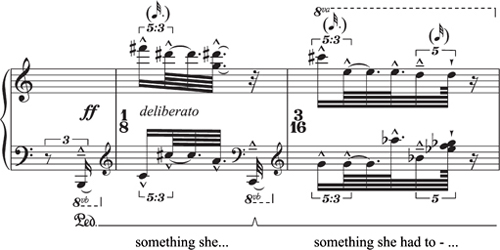
At key moments in the musical work, when there is a particular urgency in Mouth’s delivery or an unusual poignancy, Beckett’s speech rhythms serve as the source of the music’s rhythm (Examples 9.1, 9.2). A whole generation of composers, myself included, had gradually become familiar with the complex rhythmic style of Brian Ferneyhough, and it proved well suited to the task of capturing Mouth’s speech rhythms. In this style a slow external pulse is subdivided into several parts, which may then be regrouped. Each of the resulting durations is then subjected to the same process of subdivision and regrouping. The procedure may be carried out repeatedly, provided that the resulting rhythm can be understood and performed by a musician. With the addition of ties to join durational units together and create syncopation, a great richness of rhythmic characterization becomes possible. The rhythmic diversity that in earlier styles might have occupied a whole bar of music now becomes embedded in a single quaver or crotchet pulse.
Example 9.1 Paul Rhys, Not I, bars
335–6
Example 9.2 Paul Rhys, Not I, bar 303
Example 9.3 Paul Rhys, Not I, bar 367
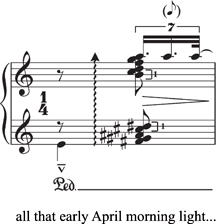
Example 9.4 Paul Rhys, Not I, bar 31
The first half of Example 9.3 demonstrates this style at its simplest: the right hand of the piano part divides the quaver pulse into three; first and last thirds are divided again into three, whilst the middle third is divided into four and regrouped as three-plus-one. I was fortunate that Ian Pace could realize these rhythms with relative ease. It was the flexibility of this rhythmic style, its capacity for capturing the most subtle of rhythmic nuances and metrical displacements, that made it such a valuable tool for representing Beckett’s speech rhythms. Occasionally, as in Example 9.2, right and left hands of the piano present slightly different versions of the same speech rhythm; more commonly the hands are synchronized in emphatic statement of the same speech rhythm.
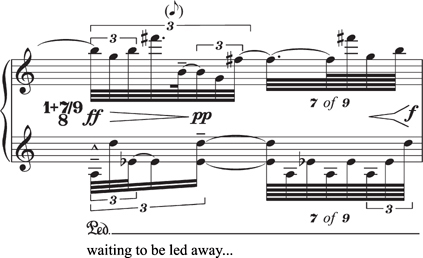
For the greater part, it is the division and syncopation of an external pulse that generates rhythmic variety in the piano music of Not I. But occasionally the momentum of this internal division acquires such force that the external pulse is briefly forgotten, and time signatures such as (1+7/9)/8 are a natural consequence (Example 9.3). Such complex time signatures were simplified in my later musical works (Five Preludes,4 Dialogues5) by a revaluation of the pulse so that the crotchet becomes the unit of duration, and is represented as 1/1 instead of 1/4. This is one example of how the experience of working on Not I led me to subsequent musical discoveries.
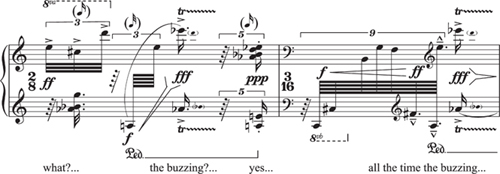
Whilst Beckett’s speech rhythms sometimes serve as the basis for musical rhythm, at other times it is the visual or sonic images of Beckett’s writing that serve as inspiration for a musical fragment. As already mentioned, Mouth makes repeated references to ‘April morning light’ prior to her immersion in darkness, and the resonances of a closely spaced twelve-note chord, spread between the hands of the pianist, seemed to achieve this bright, luminous sonority (Example 9.4). Likewise, the buzzing that Mouth repeatedly says she can hear, whether in the ears or in the skull, is represented as a double trill (Example 9.5).
Example 9.5 Paul Rhys, Not I, bars 108–9
The narrative continuity that lies hidden within the text of Beckett’s Not I is understood, I suggest, on a subconscious level when we witness a performance of the work. My semantic analysis (above) aimed to bring these continuities to the fore, sometimes uniting fragments of text separated by large intervening spans of time. It was through the use of harmony and voice-leading6 that I was able to express these continuities and interruptions in the musical version of Not I.
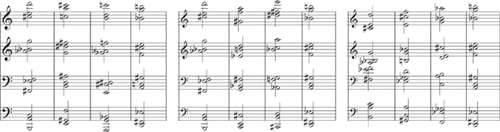
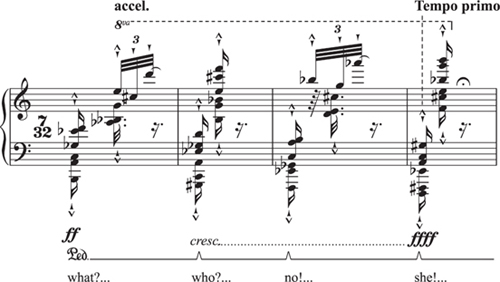
Building on the experience of my previous musical works (Chicago Fall, String Quartet No. 1) the harmony in Not I is drawn from a carefully selected twelve-note all-interval series7 (Example 9.6). Twelve trichords (three-note chords) are excised from the series (Example 9.7) and are used in prime and inversion to construct symmetrical twelve-note chords. Sequential harmonic progressions are then created between pairs of these twelve-note chords, in which each of the voices moves the total distance of a minor third. Example 9.8 shows the progressions between one such pair: in spanning a minor third, all twelve voices move either by semitones and fifths (Examples 9.8a and 9.8b) or by minor thirds (Example 9.8c). It is the last of these progressions that serves as the musical material for the most important refrain of the work, ‘what?..who?..no!..she!..’ (Example 9.9).
Example 9.6 The all-interval series

Example 9.7 Twelve trichords drawn from the series

Example 9.8a, b, c Progressions of twelve-note chords
Example 9.9 Paul Rhys, Not I, bars 337–40
The family of trichords drawn from the all-interval series (Examples 9.6 and 9.7) serve to establish a referential tonality8 in the piano solo. The harmonic progressions of Example 9.8 and others like them, lead away from and back to this referential, tonic level. Since these progressions are sequential, the ear is able to project their movement forwards in time. By making use of progressions such as these, it thus became possible to convey the narrative continuity in Beckett’s text through continuity of harmonic motion and through the fulfilment, or postponement, of predictable voice-leading.
The schemes in Examples 9.8a and 9.8b span a minor third in four sequential steps and result in rather small-scale harmonic motion. But by moving in the opposite direction around the chromatic circle they occupy ten steps. These progressions of ten chords last longer than the progressions of four chords and, by using them, much longer-term harmonic motion is achievable. Thus the first ten lines of text on the left margin of Figure 9.1 (from ‘whole body gone…’ up to the start of the recapitulation ‘tiny little thing…’) are expressed musically as a sequential harmonic progression in ten steps, with the bass of the piano rising chromatically from A to F#, leading the music back to the tonic level as it reaches the recapitulation. It is through the careful use of register that the intervening music – representing those text fragments to the right of Figure 9.1 – is heard as subsidiary in importance to this principal thread.
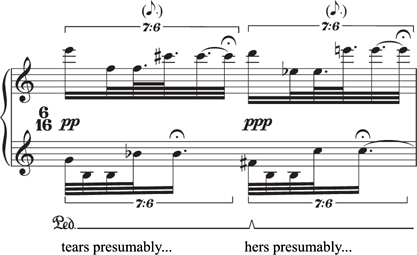
An altogether different quality of harmony based on rather more consonant six-note chords (Example 9.10) is reserved for those sections of the monologue that are clearly memory flashbacks. This contrasts with the more dissonant twelve-note harmony that forms the substance of much of the work, as in Example 9.8. Beckett depicts Mouth’s mind in a state of frenzy, hurling out one idea after another and retrieving fragments of memories, whether real or appropriated, from every stage of her conscious existence. Indeed the tension and ambiguity in this dialogic story-telling of the self can be understood as part of the reason for Mouth’s refusal to acknowledge the account as fully her own, as constituting ‘I’. Yet when Beckett writes ‘suddenly saw it wet…the palm…tears presumably…hers presumably…no one else for miles…no sound…’9 it is clear he would have us believe that this is an authentic memory. In sections such as these the gentler harmony of Example 9.10, which also calls for a gentler rhythmic style, is used for the musical substance of the work.
In my piano solo, great care was taken to represent the structure and dramatic contour of Beckett’s Not I. Yet I always intended for the musical work to have an independent existence in its own right: familiarity with Beckett’s play is not considered a necessary condition for appreciation of the music. Nonetheless, the piano score does carry Beckett’s text alongside the musical notation, in the hope of inspiring the pianist and guiding his or her interpretation. Indeed the pianist who performs the work takes on a role rather like that of Mouth, possessed with an urgent desire to communicate, yet ultimately frustrated in his or her attempt to do so. The piano solo follows the same emotional contour as the stage work, with its moments of humour, its poignant but fragmented and tenuously caught flashbacks, its build of intensity towards each recapitulation and its robust refrain (‘what?..who?..no!..she!..’). Transitions to and from the memory flashbacks are more emotionally charged, I suggest, in the music than in the stage version on account of the change from one harmonic area to another (Examples 9.8 and 9.10). Analogy may be drawn to the memory recall (Comme un tendre et triste regret) in the key of G , in Debussy’s piano prelude Des pas sur la neige, a work which is otherwise situated in an icy D-minor and surely makes a nodding reference to Schubert’s famous Winterreise.
Example 9.10 Harmony for memory flashbacks

Beckett’s stage directions request that the performer should ad-lib material prior to the start of his printed text as the curtain rises and that she should ad-lib once again after the curtain is down and house-lights rise. What we witness, therefore, is a fragment of a much larger unfolding and Mouth’s torment may be without end. The entire work should be considered a fragment, in just the same way that it is built of fragments of text. Yet I was never tempted to ask the pianist to improvise material at start and end of the musical work or to ask for a curtain to drop in order to conceal the pianist whilst he or she plays ever more quietly, thus replicating Beckett’s fade-in and fade-out on an ongoing torrent of words. In contrast to the written/performed text, the open-endedness of the musical work is achieved by an abrupt start without preparation, and by an abrupt end in which none of the harmonic or thematic processes set in motion find any resolution. As one reviewer described it, this produced ‘a curious halt in media res’.10
Performance and Reception
The completed score of Not I was delivered to Ian Pace on 21 November 1995. On that occasion I met with the American composer and cellist Frank Cox who showed me a collection of his scores, many of which demonstrated the same freedom of time signatures that I had just begun to explore in my music. A private play-through of the work took place roughly a week later at the home of Ian Pace. The public premiere followed on 9 December in the Great Hall at Reading University. At the time of writing, Pace has delivered a total of nine performances of the work: throughout the UK, in Chicago, and in Strasbourg where the performance was supported by funds from the British Council. Although Pace is the only person yet to have performed the work in public, pianist Nicolas Hodges wrote a clear-sighted appreciation of the work in a letter dated 1 November 1996:
I was particularly struck by the way you achieved such a differentiated object despite tying yourself so closely to the Beckett. Your solution to that ever-more-frequent association seems to me a strong one in that it avoids charges of vagueness, a fault which one could never attribute to Beckett himself. So much Beckett related music seems to hang on just a few quotes to set the scene: such music is more associated with Beckett’s mood than his thought … it would be interesting to present it without mentioning Beckett. I’m sure it would have a life of its own, but perhaps one’s perception of it would change.
My original intention had always been that the work should ‘have a life of its own’. Indeed the work is conceived as a tribute to Beckett, and I suggest that the tribute is made all the more powerfully by an independent work which stands on its own merits and for which I can claim full responsibility. I have toyed with the idea of presenting the piano solo as a multimedia work, performed live on stage at the same time that a video of Billie Whitelaw’s performance is projected onto the underside of the raised piano-lid. There is no doubt that the timing of music and video would drift apart, although I believe that correspondences between the two media would still be recognizable. Yet such a presentation would compromise the standing of my work as a separate entity: in all likelihood such multimedia experiments will await a future project.
Mary Bryden has written about the work and referred to other composers, including Morton Feldman, Heinz Holliger and Richard Barrett, who have written music inspired by Beckett.11 In direct contrast to my own approach, Bryden quotes Richard Barrett on the composition of his 1988 string quartet I Open and Close as stating that there was ‘no question of a direct “translation” of formal or expressive attributes from Beckett’s words into the music that I was writing, even if that were possible’. Indeed Barrett is one composer who uses quotes from Beckett’s work to ‘set the scene’ as Hodges describes it. His 1986 solo for amplified cello Ne songe plus à fuir is prefaced by a short quote from Molloy and ends with a longer quote from As the Story Was Told.
Bryden quotes Ian Pace on the importance of a sense of ‘space’ in any artwork: ‘a sense that the medium is being used to create some sort of dialogue with that which exists outside of itself’. On the relationship between Beckett’s text and my music Pace said:
Beckett’s text is breathless, an agglomeration of phrases. Paul’s Not I, on the other hand, is relentless. It’s a continuous stream which is made up of many different sections which join on to the end of each other. … Before I received it, I expected Paul’s piece to bear some resemblance to the Beckett-related works by Holliger. That was the aesthetic world I imagined. However, I was wrong. Paul’s piece is quite unlike any other Beckett-inspired work that I’ve heard.12
Retrospect
There is no doubt that Beckett’s Not I proposes an extreme theatre event. The audience experience a reduction of the visual field to a spotlit mouth in a pitch-black theatre. They witness a speed of vocal delivery that defies intelligibility and a sustained emotional tension that finds no release. Production of the work pushed Billie Whitelaw to extremes of physical endurance. Her memorization of a text containing such an admixture of exact and inexact repetitions and her high-speed delivery were no less a feat. In like fashion, the piano solo based on Not I is intentionally an extreme musical work, and a point from which I have retracted to explore other avenues and directions. The technical demands involved in learning and performing the piano solo are considerable, due largely to the rhythmic complexities involved, and the music sustains the same emotional tension and speed of delivery as does the play. It is gentler harmony, such as that demonstrated in Example 9.10, which has come to form the substance of my later works including Piano Concerto No. 1.13 A simpler rhythmic style, sometimes enlivened by time signatures that represent the crotchet as 1/1, has come to dominate my more recent music. But the experience of working with Beckett’s text was formative, bringing a narrative flow into my music that had previously been lacking from earlier, more contrapuntal works which seemed to present more architectural forms.
Beckett’s work has exerted its influence on many composers, and I was aware of only a small proportion of the music inspired by his example when I embarked upon the composition of Not I for solo piano in 1995. Of particular relevance to this discussion are two other musical responses to the same text. A commission from IRCAM in 1979 prompted the renowned conductor, oboist and composer, Heinz Holliger, to compose a 35-minute monodrama for soprano and magnetic tape, also called Not I, which premiered on 15 July 1980 at the Avignon Festival with soprano Phyllis Bryn-Julson. Holliger sets the complete text of Beckett’s monologue in a spacious time-frame, almost three times as long as Billie Whitelaw’s television performance. His vocal line is sometimes drawn towards recitative, occasionally to real speech, but more often the angularity of Holliger’s vocal melody demands a rhythm that is far removed from natural speech. Occasionally Holliger employs expressive melismata, for example when setting the word ‘merciful’ in the context of Mouth’s words ‘brought up as she had been to believe…with the other waifs…in a merciful…[Brief laugh.]…God…[Good laugh.]’ The soprano is accompanied by a tape part comprising recorded segments of her vocal line, thereby creating canonic arrangements of the material. As the piece proceeds, the recorded material is subject to increased electronic processing, suggesting ever-increasing psychological disorientation. Holliger himself describes the piece as being composed ‘from the basis of a human being who can no longer manage to be an individual: that led me to write a polyphony for as many as sixteen voices’.14
More recently the British composer Mark-Anthony Turnage responded to a BBC commission with a work for amplified solo flute and orchestra entitled Five Views of a Mouth. The concerto premiered on 18 April 2009 in Glasgow, conducted by Ilan Volkov with Dietmar Wiesner on flute. On this occasion the actress Fiona Shaw delivered a performance of Not I as a prelude to the musical work, her pacing of the text much slower than Billie Whitelaw’s yet arguably well-suited to the resonant acoustic of a large concert-hall. The five movements of Turnage’s work are allocated titles taken from progressively further into Beckett’s text, suggesting that there is an underlying programme (1. Out…into this world, 2. Found herself in the dark…, 3. Realised…words were coming, 4. Something she had to…, 5. Out before its time…’15). The solo flute, which sometimes plays unpitched breathing sounds into a microphone, seems cast in the role of Beckett’s Mouth.
The inherent musicality of Beckett’s writing is undoubtedly one of the reasons why it proves to be so alluring to composers, capable of exerting an influence on those as stylistically opposed as Philip Glass and Richard Barrett. Beckett himself spoke of hearing his works in his head prior to committing them to paper and claimed this in particular for Not I. It is equally well known that he consciously adopted musical models for some of his works. As Melanie Daiken observes ‘much of Beckett’s work is music itself: Waiting for Godot is operatic repartee; Lessness creates development through miniscule block forms like Messiaen’s Neumes rhythmiques; Not I is an elaborated rondeau’.16 Yet I must admit to a certain sense of defeat when pondering in retrospect this circularity of influence: I had sought a literary model as the basis for a musical composition, but that literary work might well have been based on a musical model. John McGrath is perhaps slightly more balanced in his assessment of this issue and makes it clear how Beckett’s creative practice remains distinct from musical composition when he observes that ‘the crucial element that Beckett borrows from music is the possibility of semantic fluidity; the creation of a language that is both “intelligible” and “inexplicable” at the same time’.17
The work of Beckett has not directly served as the basis for any of my other musical compositions since Not I. From around 1998 it has been the writings of Baha’u’llah (1817–92), founder of the Baha’i faith, which have gently recast my aesthetic orientation and directed my musical sensibility. The Fruits of One Tree18 uses quartertones to evoke melodic styles of the Middle East alongside music that is more clearly Western in origin. In allusion to Baha’u’llah’s symbolism which in turn alludes to Attar’s Conference of the Birds, my two Dialogues of 2001 and 2010 combine the slowed-down recording of birdsong with a solo wind instrument. If I were to return now to Beckett’s work, it would undoubtedly be to some of the later, slower-paced writings with their ever more tenuous connection to the physical world.
1 H. Porter Abbot, Beckett Writing Beckett: The Author in the Autograph (Ithaca, NY, 1996), pp. 17–18.
2 Rubin Rabinovitz, Innovation in Samuel Beckett’s Fiction (Urbana and Chicago, 1992).
3 Brian W. Kernighan and Dennis M. Ritchie, The C Programming Language, 2nd edn (London, 1988).
4 The Five Preludes for piano were commissioned jointly by Reading University and Southern Arts and given their first performance by Ian Pace in the Great Hall at Reading University in November 1999.
5 The Dialogue for clarinet and birdsong has been recorded by Andrew Sparling on the Lorelt CD label (Andrew Sparling, A Place in The Sky © 2012 Lontano Records Ltd. LNT 135). The ‘Dialogue’ for alto recorder and birdsong was first performed by Rachel Barnes on 19 November 2010 at the Mumford Theatre, Cambridge.
6 ‘Voice-leading’ refers to the motion of each of the lines of music (or voices) in a composition, typically constrained by harmonic considerations. A ‘voice’ is often understood to be sounding in the mind of the listener, contributing to their understanding of the harmony, even when it has ceased to sound physically (as in Bach’s solo cello suites, for example).
7 An all-interval series contains each of the possible intervals (1, 2, 3, 4, 5, 6, 7, 8, 9, 10 and 11 semitones) between adjacent notes, as well as each of the twelve pitch-classes. The convention is to reckon all intervals as if they were ascending; hence the descending fifth in Example 9.6 is labelled +5 or a rising fourth.
8 Whereas the major or minor triad is the chord to which a piece of tonal music repeatedly returns, a wide variety of other chords or pitch-collections fulfil a comparable role in some twentieth-century repertoire. The pitch collection used in this way is described as a ‘referential sonority’ or a ‘referential tonic’ and the work that uses it is said to have a ‘referential tonality’. For example the pitch collection C–C#–E–F#, known as the ‘all-interval tetrachord’, serves as the referential sonority in a number of the works of Elliott Carter (1908–2012).
9 Beckett, Not I, in The Complete Dramatic Works (London, 1986), pp. 380–81.
10 Charles Krance, ‘Review of Inaugural Concert, International Beckett Colloquium of Strasbourg, 31 Mar. 1996’ (typewritten translation by colloquium organizer Marek Kedzierski).
11 Mary Bryden, ‘Reflections on Beckett and Music, with a Case Study’, in Lois Oppenheim (ed.), Samuel Beckett and the Arts: Music, Visual Arts, and Non-Print Media (New York, 1999), pp. 83–102.
12 Ibid., p. 93.
13 Piano Concerto No. 1 was first performed on 8 December 2012 in London conducted by Paul Rhys with Ian Pace playing the piano solo.
14 Philippe Albera, ‘Beckett and Holliger’, in Mary Bryden (ed.), Samuel Beckett and Music (Oxford, 1998), pp. 87–97 (p. 94).
15 Mark Anthony Turnage, Five Views of a Mouth (London, 2007).
16 Melanie Daiken, ‘Working with Beckett Texts’, in Bryden (ed.), Samuel Beckett and Music, pp. 249–56 (p. 250).
17 John McGrath, ‘Musical Repetition in Samuel Beckett’s Ill Seen Ill Said’, in Mario Dunkel, Emily Petermann and Burkhard Sauerwald (eds), Time and Space in Words and Music: Proceedings of the First Conference of the Word and Music Association (Frankfurt, 2012), pp. 31–41 (p. 36).
18 The Fruits of One Tree for flute, viola, horn and harp was commissioned by the Arpège Ensemble with funds from Reading University, the Holst Foundation and the Britten-Pears Foundation. The work was first performed on 1 March 2002 in the Great Hall, Reading University.