
Chapter 14
Catherine Laws
Introduction: Beckett, Schubert and Romanticism
Beckett’s love of music is frequently commented upon, and Schubert is the composer to whom he refers most frequently in his works. Specific compositions by Schubert are invoked alongside those of Beethoven, particularly in some of the early novels and short stories, and throughout his life Beckett held a particular love for Schubert’s lieder, sometimes singing them himself at the piano.2 However, it is only in the radio play All That Fall (1956) and the television play Nacht und Träume (1982) that we hear actual extracts of Schubert’s music. In All That Fall we twice hear music from ‘Death and the Maiden’, early and late in the play, while Nacht und Träume is named after a Schubert lied, and the only sounds in the play are a few bars from the end of the song.
A number of writers have considered the significance of Schubert to Beckett, observing a certain commonality of thematic concerns: lone figures journeying through barren landscapes, ambiguous encounters along the way, the persistent desire for the comfort of company in the face of ultimate isolation, and the hovering presence of death. However, this commentary is mostly characterized in very broad terms, musically speaking, and is often heavily influenced by Beckett’s comment to his cousin John: ‘I think the opening of Schubert’s String Quartet in A minor is more nearly pure spirit than any other music.’3 (The exception here is Franz Michael Maier, whose analyses are more detailed but take a different tack to my own.4)
Paul Lawley comments on the recurrence in both Beckett and Schubert of the idea that ‘the comfort of company is itself the occasion for suffering’.5 Both repeatedly evoke situations in which the companionship provided by another is complicated by ambiguity with regard to his or her status or intentions. As Lawley says, Beckett clearly took comfort in Schubert’s music, but he still referred to his repeated listenings to Winterreise as ‘shivering through the grim journey again’.6 There is certainly no simple solace to be found for Beckett in Schubert, just as, following Mary Bryden, music in general in Beckett is ‘never a rapturous or transformatory force’.7 I argue that this is certainly the case in Nacht und Träume.
More broadly, as has recently been much discussed, Beckett’s relationship to Romanticism is complex and contradictory. He is distrustful of heroic transcendence and, as Mark Nixon has noted, dismissive of the sentimentalism of much Romantic writing, taking delight in mockery and misquotation.8 However, Beckett’s reading of Romantic literature was wide. As Nixon and Dirk van Hulle point out, ‘no matter how tongue-in-cheek Beckett’s references to Romanticism are, they keep recurring with a remarkable persistence throughout his work’.9 In particular, as Nixon and Matthew Feldman have shown, in the 1930s his focus on German literature and philosophy was extensive and his note-taking substantial.10 Nixon identifies Beckett’s particular association of German literature, music and philosophy with qualities of seriousness, tragedy and a specific relationship to ideas of love and sex. The use of Beethoven in his first novel, Dream of Fair to Middling Women (and then again, much later, in Ghost Trio) is part of this, and the influence of German Romantic music, most especially that of Beethoven and Schubert, emerges in a number of works but is itself complex and differentiated: the music of these composers is employed for very different purposes.
Of course, despite both being generally subsumed under the category of early musical Romanticism, Beethoven and Schubert hold very different positions in the Western musical canon. In terms of historical musicology, Beethoven is the archetypal humanist pioneer, pushing classical ideas to their limits, if not beyond, and extending the scope of music’s ambition to seriousness and grandness of scale. In contrast, and despite his own symphonic achievements, Schubert’s music is characterized – sometimes overtly negatively, especially historically – as intimate in its concerns and detailed in its mapping of emotional territory. Concomitantly, and following the influence of an essay by Schumann, Schubert’s music has often been characterized as feminine in quality, contrasted with the ‘virile power’ of Beethoven.11
Given his background and musical experience, Beckett is likely to have been at least vaguely aware of these general characterizations: his use of music supports this. With Schubert, as with the paintings of Caspar David Friedrich, Beckett finds a close affinity with the decidedly unheroic strain of German Romanticism, which focuses on the melancholic figure isolated in an indifferent world.12 There is, then, a strong link between Beckett’s sense of the gap between the self and the world and his attraction to particular strains of Romantic art, music and literature. If Beethoven’s music seems to offer the young Beckett confirmation of the limits of rational thought and the irreconcilability of subject and object, Schubert’s seems to reinforce the paradox that results: absolute isolation coupled with the impossibility of finally relinquishing traces of the idea that encounters with others, real or imagined, might produce temporary distraction and even comfort.
My own interest lies in what the music does in the works, exploring the relationship between Beckett’s use of music and other characteristics of his work. In both All That Fall and Nacht und Träume, the writer’s understanding – and use – of the specific qualities of Schubert’s music is apparent. As with his use of Beethoven in Ghost Trio, Beckett here seems interested in what we do with music, how active listening involves an imaginative engagement with the expressive content of (especially Romantic) music. This engagement can be perceived as productive, constituting a working through or imaginative enactment of selfhood in the world.
In All That Fall the precise features of the soundscape were of great concern to Beckett.13 However, it is the framing of Maddy’s journey with extracts from Schubert’s ‘Death and the Maiden’ – the lied or quartet movement14 – emanating from the ‘ruinous old house’ of a ‘very old woman’ that supports the themes of the play: birth, youth and fertility versus barrenness, sterility, physical decline and death. As in Ghost Trio, the music operates not entirely realistically: it is apparently located in the house, yet continues to grow louder or softer even when Maddy stops moving. It is as if the degree of attention to the music brings it into focus, rather than the acoustical fact of its relative proximity. The music again projects absence – death during childhood and the ‘poor woman’ – but also invokes the productive powers of the imagination, in this case through Maddy’s conjuring of her own ambiguous other(s): the suffering woman and the looming figure of Death. This creates a lyrical and affective counterpart to what cannot quite be said.
Music provides a similar counterpart in Nacht und Träume, but here there are no words; the music operates in relation to the visual composition and its specific televisual qualities. Examining this helps to elucidate what Schubert means in Beckett’s work, in this instance what his music signifies in Nacht und Träume. This is a slightly different question to the one that is more often touched upon: what Schubert means to or for Beckett. While one might argue that Beckett’s personal affinity with Schubert’s music is responsible for the passing references in his work, it is hard to believe that this in itself would warrant inclusion of the music as part of the dramatic fabric, especially with a writer as fastidious as Beckett. This is not to deny that there are connections between Beckett’s love of the music and the ways in which he uses it. But the more complex question is quite how the music contributes to the overall effect of the television play. There are two sides to this: the detail of Beckett’s musical choices – exactly what he takes from Schubert and why – and the impact of his particular use of the voice.
‘To close the eyes and see that hand’: The Context of Nacht und Träume
Nacht und Träume was written in 1982 for Süddeutscher Rundfunk at the request of its then director, Reinhart Müller-Freienfels. Beckett directed the production, which was viewed in 1983 by an audience of two million.15 At around 10 minutes it is one of Beckett’s shortest plays, and one of very few with no spoken text (alongside Quad and Breath). The only sound is the humming and then singing of a few bars from the close of the Schubert lied from which the play takes its title.
The scene is almost static, formally composed and dimly lit by ‘evening light’. In the foreground of a room, to the left, light fades up just sufficiently for us to see the upper body, right profile, of a man (A) seated with his head bowed and hands resting on a table in front of him. The last seven bars of the vocal part of Schubert’s ‘Nacht und Träume’ (D827) are heard, hummed quietly by a male voice. The light fades, leaving only a little light on A. The very last three bars of the Schubert are then heard again, this time sung with words, and after this the light fades on A as he bows his head to rest on his hands.
Just enough light remains to confirm the man’s continued presence while his dream commences: light fades up on an identical figure, B, seated as A but suspended in the top right of the picture and seen in left profile. Aside from the profiling, at this point the only difference between the images is that B is lit by ‘kinder light’ than A. Out of the dark above and beyond B, a hand appears and rests gently on his head. It moves away, disappearing from view, and then its pair appears and holds a cup to B’s lips. This hand withdraws, reappears with a cloth and gently wipes B’s brow, then moves away and disappears. B raises his head and gazes upwards, as if at the face of the invisible figure with the hands. He then raises his right hand towards the figure, with the palm upwards, and one of the ministering hands reappears and rests on B’s. B gazes at the joined hands, and then raises his left hand and rests it on the joined pair. The hands are lowered to the table, B lowers his head to rest on them, and the other hand of the ministering pair reappears and rests on B’s head. The light then fades out on this image and the evening light and light on A fade up. From this point onwards, we are presented with a complete reprise of these events, including the humming and singing. The only difference is the focus and the speed: everything takes place in slightly slower motion, and this time the camera zooms in to observe the action around B in close-up. At the end of the action the camera pulls out again, slowly, to the original position, the dream fades out, and then the light on A fades, leaving a dark screen.
The origins of the play lie in Beckett’s abandoned Mime du rêveur from 1954, a mime play which repeatedly stages a dream though with far more peripheral and semi-comic action than Nacht und Träume.16 However, Ruby Cohn and Mark Nixon both point out the additional relationship to an unpublished poem in Beckett’s 1977 ‘Sottisier Notebook’: ‘one dead of night/in the dead still/he looked up/from his book/from that dark/to pore on other dark’.17 As he peers into the dark, the man seems to project himself, or another version of himself, into that space and sees by ‘taper faint’ that his book is ‘faintly closed’ by ‘a hand not his/a hand on his’.18 As Nixon says, in this poem, as in A Piece of Monologue (begun around this time), Stirrings Still and some of the fragments of late poems in English, the phrases seem to suggest ‘existence brought to a kind of threshold by projecting death into the darkness as well as releasing dream and alternate existential states’:19 this remains central to Nacht und Träume. James Knowlson points out the additional relationship to a line in Company, written just a couple of years earlier: ‘What a help that would be in the dark! To close the eyes and see that hand!’20
For some, the scenes of comfort in this play are too maudlin.21 However, most critics seem to agree with Knowlson that the abstract formal symmetry, the schematic working through of the actions, and the full-scale repetition all operate so as to undercut the sentimentality.22 As Ulrika Maude points out, the self-consciously virtual quality of the scene, with its apparently free-floating images, softly lit and carefully framed and re-framed, has a similar effect.23 David Pattie makes the same point, adding that, as the dream emerges, ‘the image takes on a kind of precariousness, an increased fragility, because it seems to have no secure relation to the rest of the screen’.24 Moreover, as Jonathan Kalb says, the specificity of the actions, simple but attended to with intense focus, renders the experience at once familiar and strange.25
There are similarities here with techniques used in Beckett’s other television plays. The scrutinizing of a simply and formally constructed scene, viewed first from far off and then close up, is a feature of Ghost Trio in particular. Enoch Brater argues that the paring down of the elements in Beckett’s television plays – the reduction of language, minimizing of spatial contextualization and use of geometric forms – produces pieces which are in part about the mediating power of the art form itself and its effect on perception.26 Certainly, Beckett exploits the properties of filming to self-conscious effect, but as Jonathan Bignell points out, this kind of metacommentary has more in common with avant-garde film and video art than the broadcast drama of the time.27 Moreover, some of the techniques are already to be found in the stage plays, although the television context makes the effects a little simpler to achieve technically. The placing of images in separate pools of light was explored in earlier stage plays such as Not I, Play and That Time (as well as appearing again around the same time as Nacht und Träume in the initial, stage version of What Where (1983), and slightly later in the SDR television production, Was Wo, filmed in 1985.28 Similarly, the complete repetition of events had been examined earlier in Play and in the SDR production that had preceded Nacht und Träume, Quadrat I and II (originally entitled Quad).
The formalized qualities of Nacht und Träume contrast with the lyricism of the Schubert melody. At the same time, the apparently stark and simple imagery produces an array of symbolic and cultural associations. The offering of the drink and wiping of the brow inevitably suggest the Eucharist, and this is emphasized by the chalice-like shape of the cup used in Beckett’s production. James Knowlson notes that the chalice, cloth and comforting hand are images often found in religious painting and points out the relationship to the painterly tradition in which ‘a vision often appears in the top corner of the canvas, normally the Virgin Mary, Christ ascended in his glory, or a ministering angel’.29 Herren goes further, arguing that the play explicitly invokes Christ’s prayer in the Garden of Gethsemane on the night before his crucifixion, as related in the Gospels of Mark, Matthew and Luke and subsequently depicted in a whole range of Italian and Dutch Old Masters. Herren cites the examples of Bellini, Mantegna, El Greco, Correggio and Gossaert, pointing out the frequent inclusion of the cup, cloth or ministering hands, the tradition of depicting Christ with hands and gaze raised upwards towards an angel and the spotlighting techniques (the latter used more broadly in these schools of painting so loved by Beckett and reproduced in much of his work for theatre and television).30 Herren also traces the conceptual importance of Dante to the genesis of the play, drawing a specific link to Dante’s depiction of worshippers gazing upwards to the Virgin Mary in Paradiso.31 Additionally, Beckett apparently told the cameraman, Jim Lewis, that the cloth was an allusion to the veil that Veronica used to wipe Jesus’ brow on the way to Calvary which was then believed to retain the imprint of Christ’s face.32
Beckett’s works are infused with religious references, primarily Christian – this was his educational and cultural inheritance, after all – but the images of Nacht und Träume are the most explicit. However, as Herren acknowledges, the play is not ‘about’ these things in any simplistic way.33 Beckett distils the essentials from these sources, distancing the symbols from their explicit Christian context. The concentration on the figure of the dreamer and the dreamt self and, I will argue, the use of the music are such that it is the act of longing, of imagining and re-imagining the comfort of the hands, that becomes the prime focus, rather than the substance or context of the act: the what, the who or the why. Moreover, as Herren says, the effect is to emphasize the confluence of the experiences of the artistic subject and the viewer: as Beckett noted in his German diary, ‘the art (picture) that is a prayer, releases prayer in the onlooker’.34 Just as the subject strains towards the heavens for comfort, solace, absolution, we gaze at the screen, hoping for – what? Illumination? Catharsis? Some form of transcendence? And, of course, Beckett re-enacts a game all too familiar from other works:
Nacht und Träume replicates the conditions of its own creation. Just as A envisions a replica of himself (B) receiving the succor he longs for, so, too, does Beckett conjure up a character (A) capable of such a vision. In other words Beckett dreams up a dreamer dreaming his dream.35
We are reminded of lines from Company (written a couple of years earlier, in 1979), where Beckett invokes the ‘Devised deviser devising it all for company’.36 This mirroring, then, is another productive strategy that adds layers of complexity to the apparently simple and abstract play, complicating its sentimental surface.
The laying on of hands has a clear religious symbolism, especially in the traditions of religious art that Beckett draws upon (and Knowlson comments on Beckett’s general fascination with images of hands in paintings, noting that a reproduction of Dürer’s etching of praying hands hung on the wall of his room at Cooldrinagh37). However, aside from the religious connotations this signals a more general desire for the company of or union with another that is so prominent in Beckett’s work, the late work especially. As Herren points out, actual touch is relatively unusual in Beckett’s plays,38 but even here, yet again, the physicality of this moment is undercut by the disembodiment of the hands. We are denied the subjective context of fully drawn ‘characters’ – or even full bodies – touching one another. Instead, as Catherine Russell says, Nacht und Träume offers ‘an enactment of a relationship qua relationship’,39 distilled to a phantasmal minimum, without individuation. The hands are possibly female, as would be expected from the implied association with the Virgin Mary or Veronica, though this is uncertain. The published script does not specify, and, in letters to Müller-Freienfels prior to the production, Beckett initially stated a preference for creating an androgynous impression, but then decided upon female though with the caveat that there should still be some ambiguity (‘I think no choice but female for the helping hands. Large but female. As more conceivably male than male conceivably female’40). Surprisingly, then, it turns out that the cast list given at the end of his SDR production is all male. Yet the effect is pretty much as described by Beckett: to me, the hands and wrists appear more female in shape – relatively narrow – but in the close–up the fingers are surprisingly long. The dim lighting helps to preserve the uncertainty. So whereas in Ghost Trio the awaited other is definitely female, here it is only probably so. But even this is enough to evoke Beckett’s many other depictions of figures anticipating or re-imaging the presence of a woman; these include Krapp’s Last Tape, Ghost Trio, Footfalls, …but the clouds… and Rockaby. Moreover, in this respect the choice of Schubert’s music with its gendered associations or, at the very least, its comparable interest in evoking the female presence, seems particularly appropriate.
Beckett’s reference to the veil wiping the brow reminds us that true images of Christ’s face subsequently become known as Veronicas – vera icons or true images. Here, though, there is no such thing as an unquestionably ‘true’, unambiguous image, either on the cloth or more generally. The formal structuring of space and time, along with the ‘foregrounded virtuality’ of the images discussed by Maude41 ensure a sense of suspended reality. The release from suffering is projected as an imaginative possibility, but into a liminal space mediated and circumscribed by technology. Anna McMullan discusses the tension in Beckett’s late work between the controlling force of technology, over both the body and the powers of perception, and its production of virtual bodies as a ‘strategy of survival and creativity … as a kind of prosthetic imagination’.42 This is apparent in Ghost Trio but is also certainly the case in Nacht und Träume where the locus of power and authority, in the form of the production of images – and, I will argue, the music – is equally complex and ambiguous, but the repeated conjuring of the dream of solace offers a trace of creative resistance to its own impossibility. Both plays use music to summon the virtual company of an absent other, though this is nothing so substantial as an assertion of transcendence, redemption or the suspension of suffering. Rather, it suggests the endlessly re-played echo of the refusal to abandon that possibility.
‘Come again …’: Beckett and Schubert’s Lied
Beckett’s use of Schubert, then, has an important role to play in all this, perhaps in seeming to trigger the dream but more particularly in the state of suspension, or in-betweenness, that is produced through the tension between the self-conscious constructedness of the images, the complexities of their origin and the ambiguities of authority. The coupling or doubling of figures is a much remarked upon feature of Beckett’s work, but the specific mirroring of visually identical figures is perhaps most reminiscent of Ohio Impromptu, written two years earlier. In Nacht und Träume, as with many of Beckett’s other pairings, the status of the relationship seems clear at first, with the sequential precedence of A suggesting priority over the ‘copy’ B. However, as Graley Herren points out, this is undermined by the fact that our understanding of A, such as it is, becomes dependent upon B:43 what we see happen to one figure informs what we know of the other, but all of this remains uncertain, unsettled, ill–defined. Many of Beckett’s earlier plays cast couples in the form of a speaker–listener duo – obvious examples are Winnie and Willie in Happy Days, the present and past selves in Krapp, or the speaker and auditor in Not I – but here we experience a slightly different version: two identical, silent listeners. This produces a variation on what Pierre Chabert refers to as Beckett’s representations of ‘the tension present in the act of listening’.44 In Nacht und Träume the music is hummed and sung softly, drawing us into the world of the play, but it is nevertheless quite clearly heard, and in general the idea of intense listening to small sounds is something that becomes more prevalent in Beckett’s later work. Beckett commented more than once that, as he grew older, the sense of hearing was becoming more important.45 In Sounds (1973), for example, a contrast is set up between straining to hear even the tiniest sounds of a still night (‘never quite for nothing even stillest night’) and the possibility that complete stillness might allow the listener to ‘let himself be dreamt away to where none at any time … where no such thing no more than ghosts make nothing to listen for no such thing as a sound’.46 The combination of dreaming and listening prefigures that in Nacht und Träume.
Critics comment on the affective power of the lied and its role in creating the ‘strange, haunting beauty’ of the work47 (though those for whom the play is too sentimental often attribute this to the music, too48). James Knowlson suggests that the play ‘evokes perhaps more clearly than any other of Beckett’s plays that “purity of spirit” that had long been important in his life as well as his work’.49 In echoing Beckett’s own words about the ‘pure spirit’ quality of Schubert’s music (quoted earlier), Knowlson seems to imply that the two bodies of work are united in intention and affective power. C.J. Ackerley is more explicit, attributing the characteristics of this work to Beckett’s adoption of Schubert: Nacht und Träume has a ‘strange romantic beauty – a quality to which B responded in Schubert’s lyricism and made very much his own’.50 Ackerley goes as far as to suggest that Beckett’s late prose and drama are ‘like’ lieder in their ‘intricate fusion of words and music’.51 However, Beckett never really does ‘fuse’ words and music, and certainly not in Nacht und Träume: the two are rarely heard together. More often, music contributes to the discourse, sung or listened to in the gaps between the words (as in Ghost Trio, for example, or Words and Music, Cascando and most of the time in All That Fall), and if they do come together it is only when both are taken from another source, as is the case here: the fusion is Schubert’s.
Instead, I would suggest that Beckett draws on the Romantic sensibility of the music, threading it into the fabric of the work, using its expressive power but also showing us how it is used. He reflects back the ways in which we use music for sentimental succour, to call up and recall the affective qualities of particular ideas or memories. In this respect the play is both sentimental and not: the sentiment is simultaneously directly invoked and offered up as an object for reflection.
The question, then, concerns the specifics of quite how the music is used to contribute to this. The song was composed probably in 1822 or 1823, but only published in 1825.52 The text, slightly modified from that published by Heinrich Josef von Collin,53 appeals for suspension of being in the atemporality of sweet dreams: ‘Kehre wieder, heil’ge Nacht/Holde Träume, kehret wieder’ [Come again, hallowed night/Sweet dreams, come again]’.54 The song evokes this moment of liminality in the refuge of dreams, between ordinary consciousness and its absence, between day and night (it is ‘evening light’ that comes and goes in the play) and perhaps between life and death. While Beckett’s love of Schubert was ongoing throughout his life, it is perhaps worth noting that this play emerges after what Mark Nixon describes as the renewed importance of German poetry to Beckett in the late 1970s.55
It is Schubert’s lied, each time, that precedes the fading of the light on A and the commencement of the dream. Moreover, the implication of the only words we hear, from the last three bars of the song (‘Holde Träume, kehret wieder’) is that the music prompts the dream, and that its first appearance to us is in fact a repetition of many prior conjurings. Thus the particular use of the music subtly underlines the residual creativity of the imagination. But whose imagination is this? Importantly, the source of the voice is somewhat uncertain, a point that seems to elude most commentators.56 On the one hand, seeing a lone male figure and hearing a male voice implies the association of the two, and the fact that the music is hummed confirms that it is not background music played from a recording. Similarly, the sequencing, with the music appearing to prompt the dream, might suggest that the music is produced by the dreamer. On the other hand, Beckett specifies only that a male voice hums and sings but not whether this is the voice of the seated figure. As Erik Tonning says, the voice is ‘unplaceable’ in this sense.57 Importantly, to my mind, in Beckett’s production the visual image does not operate quite as a representation of the sound: the voice is relatively soft, but nevertheless quite clearly projected, with a good tone and a little vibrato – it sounds trained or at the very least considerably practised. It is hard to imagine this sound produced by an entirely still body, such as on the screen. In this sense the diegetic status of the voice is uncertain. It seems curiously disembodied, but nor is it fully disconnected from the viewed figure. It is not produced in such a way as to imply external objectivity: not a narrator, overseer of the action (such as the female voice in Ghost Trio) or another kind of authority figure. The association with the images is too weak to assume a simple equation of voice and image, but too strong for us to suppose a ‘stand–in’ for the author. The music does not seem to be produced by the dreamer or the dreamed self, but nor does it seem to be part of the dream: it hovers, with uncertain agency and origins.
Tonning makes a similar point, arguing that Beckett demonstrates a kind of ‘double vision’ through the enfolded layering of objective process and subjective engagement. The cycle of dreaming, light, images and music seems to offer a meditative, ‘desire-driven’ mode of participation in an impersonal, endless pattern, but the residues of subjectivity remain in the enactment from one representation to the next. As Tonning says, ‘a need to engender consolation is poignantly evoked, but the need is simultaneously shown as the very means by which the serial pattern unfolds and reproduces itself’.58 As with the complexities of the image production, then, the music creates an ambiguity with regard to subjective and authorial intentionality. This, to my mind, is what finally undercuts the possibility of unalloyed sentimentality: the expressive content of the music is present but free-floating, operating as if personalized and from within the fabric of the play but untethered to a specific body or consciousness.
Importantly, the extract from the song is heard without piano accompaniment. Unlike the use of the cassette in Ghost Trio or the record in All That Fall, this is not a recording of a professional performer imported into the play. The fact that the music is produced within the play has a rather different effect, as with Maddy’s humming of the ‘Death and the Maiden’ theme. Heard through the voice of someone within the play, the music operates more intimately, as part of a personal expressive vocabulary. Instead of forming part of the scene or the environment of the play, hummed or sung music is adopted, becomes part of what that individual is or has to say within the play. This effect is one that Beckett uses elsewhere when characters hum or sing – Winnie, for example, or Krapp – but in Nacht und Träume the voice is decoupled from the figure. Similarly, the absence of the harmonic context usually provided by the piano uproots the melody. Noel Witts comments on the ways in which the piano accompaniment often acts a kind of landscape for the lone singer/traveller in Schubert’s lieder.59 But here the wanderer has no landscape to traverse. The vocal line, like the partial, floating images, lacks context: the figure lacks ground. Catherine Russell describes the play as producing a ‘refuge of subjectivity … the subject here is suspended in time, in space and in discourse’.60 The use of the music is central to this.
The impact of this absence of piano accompaniment needs further consideration. Graley Herren is the only commentator to pay real attention to this matter. He argues that while ‘the piercing beauty of Schubert’s score works in part to mitigate Collin’s lyrical distress’,61 Beckett’s splitting of vocal line from accompaniment and his use of only the last few bars pushes in the opposite direction, denying us what Herren perceives as the consolatory effect of the full musical context:62 ‘Beckett’s adaptive strategies all work to exacerbate the very threat that Schubert had sought to ameliorate’.63 I agree that Beckett’s compositional choices serve to underscore the uncertainty and ambiguity but for rather different reasons.
However beautiful Schubert’s song is, it is hard to agree that the divorcing of vocal line from harmony in itself concentrates the anguish. Heard alone, the vocal phrases incorporated by Beckett have a melancholic lyricism and simplicity. Melodically, the song is remarkably solid. From the opening phrase (sung to ‘Heil’ge Nacht’) onwards, the vocal line stays very much within the same, relatively narrow range, many of the phrases simply finding different ways to wander around the same territory of a fourth, between the D# of the first note and the A# that follows (see Music Example 14.1). The third and fourth lines of the first verse are sung to exactly the same melody as those of the second (the lines we hear in Beckett’s play). And in both verses the final melodic line starts lower, initially rising through a B-major chord but then essentially restating the same melody as the third line, but in a steadier, more drawn out rhythm. The only real deviation from any of this material takes place at the opening of the second verse (‘Die belauschen sie mit Lust’), where the music makes an unusual harmonic shift, apparent in both vocal line and accompaniment. However, we do not hear this passage in Beckett’s play. As Charles Rosen notes, one of the ways in which Schubert’s music differs from Beethoven’s is the preference for melodic sequences that do not lend themselves easily to motivic development (and Rosen chooses ‘Nacht und Träume’ to exemplify his point64). Melodically, then, one might argue that Beckett actually chooses the most stable musical material for use within the play.
Moreover, heard out of the context of the Schubert song, the melody used by Beckett implies simpler harmonies than those provided by Schubert, if still somewhat ambiguous.65 On hearing tonal melodies, listeners tend to ‘fill in’ implied harmonies, at the very least experiencing a sense of harmonic direction or ‘pull’ towards implied cadence points. This experience is not dependent upon a technical understanding of harmony or the ability to articulate it in musical terms, it derives from our ongoing, everyday experience of hearing music of the Western tonal tradition, in classical, jazz, folk and pop musics. In this instance, I argue, the ways in which a listener is likely to ‘fill in’ or imagine the harmonic context of the melody are somewhat different to what Schubert actually does, and the impact of Beckett’s decision to omit the accompaniment is significant in this respect.
Example 14.1 Schubert, ‘Nacht und Träume’, melody

With melody only, the imagined harmony implied by the initial, hummed, phrases (from bar 21) is likely to be very simple: a straightforward perfect cadence in C#-minor, stated twice. The rising and falling phrase of the last three bars (to ‘holde Träume, kehret wieder’) are clearly in B-major, and retrospectively (or on the repetition of events) this might then colour the way one hears the preceding phrases. It is possible, for example, to start to hear the preceding phrases in B, with C#-minor harmonies under the descending phrase and F# under the final note of each of these initial phrases. But these minor variations on quite how one ‘fills in’ the implied harmonies are insignificant here, nor is it important whether or not the listener is aware of the musical detail: what matters is that one is unlikely to imagine the harmony that is, in fact, provided by Schubert, since his choices are not obvious or easily predictable. While the implied harmonies are reassuringly simple, the reality of Schubert’s accompaniment is quite different. In the full context, with piano accompaniment, the harmonic effect of those first phrases is more unexpected and unsettled, due to Schubert’s use of a chromatic rising passage in the tenor part of the piano left hand, F#–F –G# (see Music Example 14.2). In particular, the chord under the first hummed notes incorporates the F: we start on a chromatic passing chord, with bass notes that are the leading note and tonic of B-major but harmony that instead operates some distance from this main key, as a cadence from D#7 to G#-minor: the submediant of B-major. This resolves in a relatively straightforward manner, through a circle of fifths (D#–G#-minor–C#–F#–B) to take us back into the solidly B-major rising and falling line with which the vocal melody ends. The musical analysis helps to explain the different impacts of the unaccompanied vocal line used by Beckett compared to the same section in the accompanied song. Put simply: while Beckett starts his melody from what is, in the full context, a moment of uncertain, transitory harmony, the decision to omit the piano accompaniment leave us blissfully unaware of this.
Example 14.2 Schubert, ‘Nacht und Träume’, bars 21–7 (excerpt used by Beckett without accompaniment)
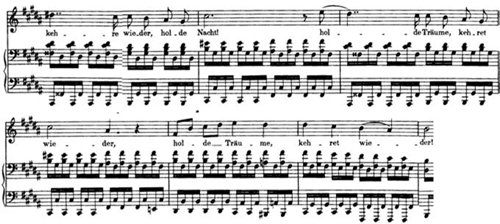
Beyond this, considering Schubert’s harmonic choices more carefully reveals the ways in which Beckett’s ambiguous doubling of dreamer and dreamt self is reflected in his decision to use only the end of the lied and to omit the accompaniment. The particular harmonic inflection described above, involving the F in Schubert’s harmonization of the closing lines, is not new in the lied: it is hinted at in the piano prelude and used in the equivalent section of the first verse. Additionally, at this later stage in the song the F is significant in its enharmonic echoing of the striking harmonic contrast employed by Schubert in bars 15–19, for the opening of the second verse (see Music Example 14.3). At this point, the harmony shifts unexpectedly to G-major, a surprising modulation in B-major (even if prefigured by the F#–F–G# progression in the piano bass line in the first verse, bars 7–8). This progression is disconcerting – again, any listener familiar with Western tonal harmony will recognize this on some level – and yet it takes us into the reassuring harmonic world of the major chord. The experience is ambiguous in quality for the listener. Carl Schachter argues that this harmonic change might be seen as a musical mapping of the dreamworld evoked by the words. As he says, the short section around G-major operates simultaneously on two levels: it ‘crystallizes around a most transitory musical event’,66 creating an unsettling, floating harmonic moment, and yet ‘while we are immersed in it, it assumes the guise of the most solid of harmonic entities’: a major triad.67 For Schachter, this dual use of the F/G, as the bass passing note (as F) and the root of a major triad (G), combines ‘in a single sonority two different and contrasting orders of reality’ and so ‘gives this song a great central image; the song embodies a musical symbol of dreams’.68
Example 14.3 Schubert, ‘Nacht und Träume’, bars 15–19

Of course, Beckett omits this section. In this sense, in musical terms he decouples the dreamer and the dreamt, splitting one from the other. This mirrors the visual undermining of the priority of A over B, the ‘between’ state of the imagery and the resulting uncertainties over the status and origin of the play’s material. Similarly, in the lieder, the F heard under the ‘kehre’ in bar 21 – the point at which the humming in Beckett’s play begins – is significant, subtly recalling the more substantial evocation of the dream state in bars 15–19. But again, in Beckett’s version we do not even hear this echo: the melodic line carries no indication of the harmonic complexities underneath, but is left to float freely, without grounding. If the melody projects a solidity or serenity, Schubert uses the unsettling harmonic recontextualizations to undermine this, whereas Beckett provides a comparable effect through the specific use of the voice within the context of the film.
Overall, in terms of the melodic content, the decision to leave out the accompaniment, and the omission of the middle part of the song, Beckett’s choices simplify the musical impact, if anything minimizing the more disturbing elements. This contrasts with Herren’s argument that the lied is incorporated precisely so as to undermine its redemptive spirit.69 Nevertheless, I agree with Herren that Beckett’s strategies undermine the possibility of simple solace from music and that the ultimate effect is one of instability and uncertainty. But the sentiment and the possibility of solace are real and present. It is not Beckett’s musical selections from the Schubert that undermine these (unlike in the re-compositional strategies apparent in Ghost Trio70) but the particular deployment of that material. Perhaps this is what Deleuze means when he writes: ‘The monodic, melodic voice leaps outside the harmonic support, here reduced to a minimum, in order to undertake an exploration of the pure intensities that are experienced in the ways the sound fades. A vector of abolition straddled by music.’71 To my mind the simple beauty and repetitive quality of the lines Beckett chooses to include produce a meditative quality that matches that of the visual images and their pacing. Moreover, I would argue that this decision emphasizes the more sentimental and romantic side of the music, compared to the unsettling harmonic changes of the Schubert song, but that Beckett needs to invoke this effect and then undermines it in other ways. It is the free-floating decontextualization of the voice, the use of humming and the relationship between these aspects of the music and the approach to scene-making that are significant in this respect.
‘A voice comes to one in the dark. Imagine’
Beyond the musical detail, Beckett’s decision to use an untrained male voice of uncertain origin and to incorporate humming as well as singing, lends a particular quality to the music in Nacht und Träume. What takes place when I sing to myself or hum a tune composed or sung by another? On one level, the individual is always drawing up something that has soaked into his or her memory, often without conscious intent. Either the repeated hearing of a tune or something in the tune has resonated with me, embedding it in my head and making it part of me. It then sometimes emerges without conscious intent: I ‘find myself’ humming or singing the tune for no apparent reason. And in then singing it for myself, I embed it further, re-voicing it in my own vocal timbre, re-composing the melody into the fabric of my self. In this respect, Beckett’s decision to use an unaccompanied voice of uncertain origin, rather than a recording of the song, is a manifestation of his production of memory and subjectivity as material for re-creation: the song emerges from someone’s voice, someone’s memory and is reproduced as undiluted presence, a pure manifestation of selfhood. As Steven Connor writes, ‘giving voice is the process which simultaneously produces articulate sound, and produces myself, as a self-producing being’.72 The embodied moment of recalling the song through vocal production itself brings memory into being, in that moment, without apparent cause and effect yet with some connection to the context or situation. This forms a musical counterpart to what David Pattie characterizes as broadly typical of Beckett’s television plays from Ghost Trio onwards:
The world presented in these plays has no depth; there is no strong sense of another space beyond the lit area, no clear idea of a world beyond the image, no sense of a past beyond the consciously willed creation of a past – in fact, no suggestion beyond simple assertion that past and future are anything other than empty.73
At the same time, this vocality is not, can never be, a manifestation of undivided selfhood. Firstly, it is provoked by another; the song comes from someone else (Schubert, in this instance, but also from the performers who manifest the song in sound – those who have been heard singing the song, primarily Dietrich Fischer-Dieskau for Beckett). In this sense, embedded in one’s own vocalizing is that of at least one other. Secondly, in singing aloud to ‘myself’, the sound goes out into the world and I hear it as external to me. As Connor says, ‘if I hear my thoughts as a voice, then I divide myself between the one who speaks, from the inside out, and the one who hears the one who speaks, from the outside in’.74 This is as true of any vocalized sound, not only speech. Finally, from another’s perspective, listening in to someone singing is, outside of the situation of performance, both peculiarly intimate and strangely distancing. That is, we seem to be granted temporary access to an unselfconscious manifestation of the individual, but the very act carries connotations of eavesdropping, a transgression of boundaries that makes us all too aware of our outsider status, our otherness.
In this way, ‘singing to myself’ produces a situation which doubles identification and estrangement. Individual subjectivity and memory are deeply entwined within the vocalizing, expressed by the action of humming or singing, but the provocation for the very action of self-expression comes from another, and that action effects an estrangement from the voice, its externalizing. When humming or singing a tune to myself, I produce a version of myself at the same time as listening in to myself as if from outside, and as soon as I listen as if from outside, it is no longer quite myself that I hear. In this sense, I am always a ventriloquist, my own voice carrying the traces of others, received back into myself as somewhat other. Yet that trace of selfhood and of individual memory is material: I still seem responsible for the vocal action. Beckett rehearses this familiar situation, which evokes selfhood and otherness, but at the same time he retains the ambiguity as to quite who sings. He invokes the patterns by means of which vocal subjectivity and the solace of company are produced, but the uncertain presence leaves the experience without depth or origin. In this he exploits to great effect music’s ability to carry subjectivity without specificity of character.
Hearing the melody first without words has a particular impact. Lawrence Kramer asks: ‘Isn’t it true that most of us can recall … occasions on which song became deeply moving, not as an expressive fusion of text and music, but as a manifestation of the singing voice, just the voice, regardless of what it sang?’75 On such occasions, he suggests, the text does not matter, but a particular understanding, empathy or affinity is produced, a quality Kramer characterizes as ‘songfulness’. By including the humming, Beckett momentarily produces this quality. Briefly, we experience that free-floating sense of expression without semantics, and hearing someone singing to himself resonates with one’s own sense of voice, producing a connection beyond the individual. But again, the repetition of the vocalizing within an ongoing cycle and with ambiguous origin undercuts the immersion in this moment of identity.
The particular use of music in the play, then, mirrors the doubling of images and the ambiguities of agency, action and identity. This uncertainty of status is emphasized by the repetitive cycle in which the images and the vocalizing are caught up: the creative agency of the imagination persists in the determination to carry on (re-)producing the dream and the song, but this content can never be clearly tethered to an individual consciousness or body. The cycle seems to take on its own mechanistic objectivity, yet cannot exist without the trace of the subject.
Overall, then, it is hard to agree with Jonathan Kalb that the Schubert in ‘Nacht und Träume’ lulls the dreamer to sleep,76 or that, as Sidney Homan suggests, the music offers pure comfort (‘If A lacks B’s woman, he has the lovely Schubert lied’77). As with the use of ‘Death and the Maiden’ in All That Fall, the comfort and identification – company of a kind – is part of what is offered by the use of Schubert’s music, but the details of Beckett’s choices complicate our reception of the expressive aural surface.
As Mark Nixon says, ‘if Beckett’s late work tends to move towards an inevitable end, it also frequently projects that point in imagination or dream’.78 Here, as in All That Fall, music is used as a means of trying to imagine the unimaginable – the inexpressible is conjured partly by the excision of words. In All That Fall, though, the music frames numerous attempts to negotiate and even defuse the coming of death by talking about or otherwise evoking it, both directly and indirectly. In Nacht und Träume the emphasis is on the productive imagining and re-imagining of release, transcendence and absolution. This contrast is exemplified by the qualitative difference between Maddy humming the ‘Death and the Maiden’ theme, with its direct thematic associations and identificatory powers, and the sustained ambiguities of voice and image in Nacht und Träume. In both plays, the significance and expressive impact of Beckett’s use of music reveals his subtle understanding of the qualities and associations of Schubert’s songs.
1 For a full discussion of the role of music in Beckett’s work, see Catherine Laws, ‘Headaches Among the Overtones’: Music in Beckett/Beckett in Music (Amsterdam and New York, 2013).
2 Chris J. Ackerley and Stanley E. Gontarski, The Grove Companion to Samuel Beckett (New York, 2004), p. 515.
3 Mary Bryden, ‘Beckett and the Sound of Silence’, in (ed.), Samuel Beckett and Music (Oxford, 1998), pp. 21–46 (p. 42).
4 In particular, see Franz Michael Maier, ‘Two Versions of Nacht und Träume: What Franz Schubert Tells Us about a Favourite Song of Beckett’, in Dirk van Hulle and Mark Nixon (eds), ‘All Sturm and no Drang’, Samuel Beckett Today/Aujourd’hui 18 (Amsterdam and New York, 2007), pp. 91–100; Franz Michael Maier, ‘The Idea of Melodic Connection in Samuel Beckett’, Journal of the American Musicological Society 61/2 (2008): 373–410.
5 Paul Lawley, ‘“The Grim Journey”: Beckett Listens to Schubert’, in Angela Moorjani and Carola Veit (eds), Samuel Beckett: Endlessness in the Year 2000, Samuel Beckett Today/Aujourd’hui 11 (Amsterdam and New York, 2001), pp. 255–67 (p. 258).
6 James Knowlson, Damned to Fame: The Life of Samuel Beckett (London, 1996), p. 682; see also p. 685.
7 Bryden, ‘Beckett and the Sound of Silence’, p. 42.
8 Mark Nixon, ‘Beckett and Romanticism in the 1930s’, in Van Hulle and Nixon (eds), All Sturm and no Drang, pp. 61–76 (p. 64).
9 Dirk van Hulle and Mark Nixon, ‘Introduction’, in (eds), All Sturm and no Drang, pp. 9–11 (p. 9).
10 Mark Nixon, ‘“Scraps of German”: Samuel Beckett reading German Literature’, in Matthijs Engelberts, Everett Frost and Jane Maxwell (eds), ‘Notes diverse holo’, Samuel Beckett Today/Aujourd’hui 16 (Amsterdam and New York, 2006), pp. 259–82; Matthew Feldman, Beckett’s Books: A Cultural History of the Interwar Notes (London, 2006).
11 Susan McClary, Feminine Endings: Music, Gender, and Sexuality (Minnesota and Oxford, 1991), p. 18.
12 For full discussions of Beckett’s complicated relationship to Romanticism, see Van Hulle and Nixon (eds), ‘All Sturm and no Drang’.
13 Clas Zilliacus, Beckett and Broadcasting (Åbo, 1976), p. 69.
14 Beckett specifies Schubert’s ‘Death and the Maiden’, but there is some uncertainty as to which work he was referring to: the lied to a text by Matthias Claudius, composed by Schubert in 1817 (D.531) or the String Quartet in D Minor (D.810) from 1824, which uses the theme from the lied as the basis for the second-movement variations. Critics do not agree on this. The original BBC production by Donald McWhinnie used extracts from the string quartet. In researching his American production for Voices International, Everett Frost found no comments on the choice of music in the BBC Written Archive. Frost used the lied (Everett Frost, e-mail, 7 Mar. 2007).
15 Knowlson, Damned to Fame, p. 683. A DVD of the production is now available from Suhrkamp Verlag (Frankfurt, 2008).
16 Ruby Cohn, A Beckett Canon (Ann Arbor, MI, 2005), pp. 210–12.
17 Mark Nixon comments on the prevalence of ‘dead of night’ situations in Beckett’s late work, noting the recurrence of the phrase in …but the clouds… and A Piece of Monologue. However, in the context of plays that incorporate Schubert’s music, this reference calls up Beckett’s 1956 letter to Nancy Cunard in which he describes coming up with the idea of All That Fall ‘in the dead of t’other night’ (Mark Nixon, ‘“Unutterably Faint”: Beckett’s Late English Poetry’, Fulcrum 6 (2007): 507–21 (p. 511); George Craig et al., The Letters of Samuel Beckett, vol. 2: 1941–1956 (Cambridge, 2011), p. 631.
18 Quoted in Nixon, ‘“Unutterably Faint’ ”, p. 511; also noted in Cohn, A Beckett Canon, p. 374.
19 Nixon, ‘“Unutterably Faint’”, p. 511.
20 Knowlson, Damned to Fame, p. 682.
21 Martin Esslin, for instance, finds the play ‘too sentimental’ (‘Towards the Zero of Language’, in James Acheson and Kateryna Arthur (eds), Beckett’s Later Fiction and Drama (Basingstoke, 1987), pp. 35–49 (p. 46)).
22 Knowlson, Damned to Fame, p. 683; Jonathan Kalb, Beckett in Performance (Cambridge, 1989), p. 97.
23 Ulrika Maude, Beckett, Technology and the Body (Cambridge, 2009), pp. 128–9.
24 David Pattie, ‘Coming out of the Dark: Beckett’s TV Plays’, Journal of Beckett Studies NS 18/1–2 (2009): 123–35 (p. 133).
25 Kalb, Beckett in Performance, p. 97.
26 Enoch Brater, ‘Towards a Poetics of Television Technology: Beckett’s Nacht und Träume and Quad’, Modern Drama 28 (1985): 48–54 (p. 51).
27 Jonathan Bignell, ‘Beckett in Television Studies’, Journal of Beckett Studies NS 10/1–2 (2001): 105–18 (p. 106). Bignell explores Beckett’s television work (primarily the pieces produced by the BBC) in the context of television drama of the 1960s and 1970s.
28 Nevertheless, it is important to note the different impact of the televisual context for the viewer, compared to live performance in a theatre. David Pattie explores this in some depth (‘Coming out of the Dark’).
29 Knowlson, Damned to Fame, p. 682.
30 Graley Herren, ‘Nacht und Träume as Beckett’s Agony in the Garden’, Journal of Beckett Studies NS 11/1 (2002): 54–70. Chris Ackerley has also produced a set of annotations to Beckett’s TV plays, tracing Beckett’s numerous textual and visual references and highlighting relationships across the oeuvre. Chris Ackerley, ‘“Ever Know What Happened?”: Shades and Echoes in Samuel Beckett’s Television Plays’, Journal of Beckett Studies NS 18/1–2 (2009): pp.136–164.
31 Graley Herren, Samuel Beckett’s Plays on Film and Television (New York, 2007), pp. 151–8.
32 Knowlson, Damned to Fame, p. 682.
33 Herren, ‘Nacht und Träume as Beckett’s Agony in the Garden’, p. 56.
34 Ibid., p. 55.
35 Graley Herren, ‘Splitting Images: Samuel Beckett’s Nacht und Träume’, Modern Drama 43/2 (Summer 2000): 182–91 (p. 186).
36 Samuel Beckett, Company (New York, 1980), p. 46.
37 Knowlson, Damned to Fame, p. 682.
38 Herren, ‘Splitting Images’, p. 187.
39 Catherine Russell, ‘The Figure in the Monitor: Beckett, Lacan, and Video’, Cinema Journal 28/4 (Summer 1989): 20–37 (p. 32).
40 Knowlson, Damned to Fame, p. 683.
41 Maude, Beckett, Technology and the Body, p. 130.
42 Anna McMullan, ‘Virtual Subjects: Performance, Technology and the Body in Beckett’s Late Theatre’, Journal of Beckett Studies NS 10/1–2 (2000–2001): 165–72 (p. 168).
43 Herren, ‘Splitting Images’; id., ‘Nacht und Träume as Beckett’s Agony in the Garden’, pp. 54–70.
44 Bernard Beckerman, ‘Beckett and the Act of Listening’, in Enoch Brater (ed.), Beckett at 80/Beckett in Context (New York, 1986), pp. 149–167 (p. 150).
45 Charles Juliet, Conversations with Samuel Beckett and Bram van Velde, trans. Janey Tucker (Leiden, 1995), pp. 147, 152.
46 Samuel Beckett, Sounds, in The Complete Short Prose 1929–1989 (New York, 1995), pp. 267–8.
47 Ackerley and Gontarski, The Grove Companion to Samuel Beckett, p. 398.
48 Daniel Albright, for example, gives Nacht und Träume as the prime example of what he sees as Beckett’s occasional tendency to sentimentalize music (Beckett and Aesthetics (Cambridge, 2003), p. 148).
49 Knowlson, Damned to Fame, p. 683.
50 Chris Ackerley, ‘Inorganic Form: Samuel Beckett’s Nature’, Journal of the Australasian Universities Modern Language Association 103–4 (2005): 79–102 (p. 101).
51 Ibid., p. 100.
52 Carl Schachter, ‘Text and Motive in Four Schubert Songs’, in David Beach (ed.), Aspects of Schenkerian Theory (New Haven and London, 1983): 61–76 (p. 71).
53 Carl Schachter suggests that Schubert perhaps held a manuscript copy of the text, and that changes were made to the published version (ibid.).
54 James Knowlson gives the translation as ‘Return, sweet night!/Return, O you sweet dreams’ (Damned to Fame, p. 682); Noel Witts offers ‘Come back, hallowed night/Gracious dreams, come back again’ (‘Beckett and Schubert’, Performance Research 12/1 (Mar. 2007): 138–144 (p. 140); Ackerley and Gontarski have another variant: ‘Sweet dreams, come back’ (The Grove Companion to Samuel Beckett, p. 398).
55 Nixon, ‘“Unutterably Faint”’ p. 509. James Knowlson notes that Beckett’s working title for the play was originally ‘Nachtstück’, and Graley Herren speculates that Beckett may, therefore, have originally planned to use the Schubert lied of that name. As Herren says, there are similarities between the two lieder but the lyrics of ‘Nachtstück’ are explicitly concerned with death and finitude, compared to the more ambiguous dreamscape of Collin’s ‘Nacht und Träume’ (Knowlson, Damned to Fame, p. 681; Herren, Samuel Beckett’s Plays on Film and Television, p. 146).
56 Graley Herren acknowledges this point, as does Erik Tonning (Herren, ‘Splitting Images’, p. 183; Erik Tonning, Samuel Beckett’s Abstract Drama (Oxford, 2007), p. 249).
57 Tonning, Samuel Beckett’s Abstract Drama, p. 249.
58 Ibid., p. 250.
59 Witts, ‘Beckett and Schubert’, p. 142.
60 Russell, ‘The Figure in the Monitor’, p. 31.
61 Herren, Samuel Beckett’s Plays on Film and Television, p. 147.
62 Ibid., p. 148.
63 Ibid., p. 147.
64 Charles Rosen, ‘Schubert’s Inflections of Classical Form’, in Christopher H. Gibbs (ed.), The Cambridge Companion to Schubert (Cambridge and New York), pp. 72–98 (p. 95).
65 Franz Michael Maier describes the content of the melody in similar terms, though with a somewhat different contextual emphasis (‘The Idea of Melodic Connection in Samuel Beckett’, pp. 399–400).
66 Schachter, ‘Text and Motive in Four Schubert Songs’, p. 73.
67 Ibid., p. 74.
68 Ibid., p. 73.
69 Herren, Samuel Beckett’s Plays on Film and Television, p. 148.
70 I discuss this in Catherine Laws, ‘Beethoven’s Haunting of Beckett’s Ghost Trio’, in Linda Ben-Zvi (ed.), Drawing on Beckett: Portraits, Performances, and Cultural Contexts (Tel Aviv, 2003), pp. 197–214.
71 Gilles Deleuze, Essays Critical and Clinical, trans. Daniel W. Smith and Michael A. Greco (London and New York, 1998), p. 172.
72 Steven Connor, Dumbstruck: A Cultural History of Ventriloquism (Oxford, 2000), p. 3.
73 Pattie, ‘Coming out of the Dark’, p. 134.
74 Connor, Dumbstruck, p. 6.
75 Lawrence Kramer, ‘Beyond Words and Music: An Essay on Songfulness’, in Walter Bernhart, Steven Paul Scher and Werner Wolf (eds), Word and Music Studies: Defining the Field (Amsterdam and Atlanta, GA, 1999), pp. 303–19 (p. 304).
76 Jonathan Kalb, ‘The Mediated Quixote: The Radio and Television Plays, and Film’, in John Pilling (ed.), The Cambridge Companion to Beckett (Cambridge, 1994), pp. 124–44 (p. 141).
77 Sidney Homan, Filming Beckett’s TV Plays (Lewisburg, PA, 1992), p. 114.
78 Nixon, ‘“Unutterably Faint”’, p. 516.