
CHAPTER 13
One year after the 1933 World’s Fair closed, Benito Mussolini used a flimsy pretext to order the invasion of Ethiopia (then known as Abyssinia). This move, coupled with Japan’s earlier invasion of Chinese territory in Manchuria,* tested the will of the international order erected by Woodrow Wilson at Paris in 1919. Without active U.S. involvement, the League of Nations did little more than investigate and condemn with words aggression that only would have respected force. Ethiopia’s emperor, Haile Selassie, addressed the League at its impressive new headquarters in Geneva, appealing for assistance, but his plea fell on deaf ears. Fear of sparking a second world war in Europe over struggles in distant lands trumped doing the right thing. It was that simple.
Italo Balbo had returned to Italy in the summer of 1933 to a welcome that rivaled the triumphs held for victorious generals in ancient Rome. Mussolini indulged in an orgy of self-congratulatory Fascist spectacle. The official propaganda—which Balbo loyally parroted—was that the Chicago flight had been a demonstration of the superior will of Il Duce. One could easily forgive Italians of the time for thinking it was Mussolini, and not Balbo, who had led the seaplane squadron across the Atlantic to the Windy City. When the cheering faded away, Il Duce, recognizing that “there was room for only one eagle in the Fascist nest,”1 dispatched Balbo to the rugged Italian colony in North Africa known as Libya to be its new governor. The Ministério da Aeronautica, which Balbo had painstakingly fashioned in his own image, was unceremoniously taken away from him. The official line was that it was a promotion for the Fascist aviator par excellence, but in reality this explanation fooled no one. Back in Chicago, the Chicago American made it crystal clear what most believed: “IL DUCE ‘EXILES’ BALBO TO POST IN AFRICA.”2 The American’s man in Rome, Guglielmo Emanuel, reported: “While there was no confirmation of reports abroad that Marshal Balbo was being shelved because of the immense popularity he won as a result of his aeronautical feats,”3 it was commonly understood that this was in fact the case. For Balbo this was a crushing disappointment, but it couldn’t have come entirely as a surprise. Mussolini was moving increasingly toward becoming a totalitarian dictator. With Hitler, Stalin, and Japanese militarists all ascendant and acting with less and less restraint, history seemed to favor Mussolini’s megalomaniacal instincts. Emanuel reported: “With Il Duce scheduled to abolish the Chamber of Deputies in the near future and do away with all institutions even remotely linking fascist Italy to the tenets of democratic rule, he is now in a position to carry out his projected constitutional reforms virtually unhampered.”4
As the new governor of Libya, Italo Balbo was more cheerleader than participant in the events that occurred in the ancient, mountainous country of Ethiopia in 1935. Despite a valiant defense, the Ethiopians were ultimately defeated. The use of poison gas and military aircraft greatly aided this show of Fascist might. It was undoubtedly better for Balbo’s later historical reputation, in this instance, that he had been sent to Libya in 1933. If he had stayed as head of the Aeronautica, Balbo would have presided over the atrocities Italy meted out from the air on the Ethiopians. This would have greatly complicated things for Balbo’s apologists who later on looked to position him historically as the “good” Fascist. This thesis has some merit. But in examining Balbo’s role in history, one has to ask: would Balbo have said “no” to Mussolini when attacks on civilians were ordered, when the use of poison gas was authorized? But sidelined, his waist growing steadily thicker, Italo Balbo was not forced to make these decisions. As the world moved inexorably toward catastrophe, this talented man languished in Libya. His efforts, like so much water poured into the desert sand, were largely wasted in a backward land ruling over a surly, subjugated people. Meanwhile, Hitler—rapidly rearming in violation of the Versailles Treaty—looked to test his strength without fully committing Germany to all-out war. The civil war in Spain provided him with just such an opportunity. The Condor Legion, composed of German aircraft and pilots, gave nationalist leader Francisco Franco a decisive edge over his Republican opponents. Mussolini piled on. The year after Spain’s capital city of Madrid began being bombed relentlessly from the air, the Japanese moved against mainland China and used similar aerial tactics in bombing Shanghai. That spring, the Condor Legion left Guernica in ashes.
At approximately the same time in central Europe, an emboldened Hitler absorbed his native Austria. Hysterical crowds of adoring Viennese gave him a welcome more closely associated in historical memory with that accorded the Beatles in a later decade. It was mass hysteria, giving lie to the postwar Austrian claim that they were having none of it. At the Munich Conference later that year, Hitler bullied the timid British prime minister, Neville Chamberlain, into conceding to the dismemberment of Czechoslovakia before absorbing all of it in March 1939. He next set his eyes on Poland. Mussolini, not to be outdone, looked greedily toward military conquests in Albania and the Aegean.
Americans, still locked in an isolationist mindset, looked on with grim fascination. Some recognized that the United States must abandon neutrality in a world that was becoming increasingly dangerous for democratic-minded nations. Others, led by hero-pilot Charles Lindbergh, argued that a policy of “America First” must be maintained and that Europe’s problems would have to be sorted out by Europeans. The moral equivalency drawn by Lindbergh and others between Hitler’s Third Reich and the British Empire had some merit, but was decidedly pro-Nazi on closer inspection. Other groups, notably the German American Bund and Italian American Fascist organizations, used pacifism as a mechanism to give Hitler and Mussolini free rein to do as they pleased abroad without fear of American military intervention.
It was during these years that James Hilton’s novel, Lost Horizon, reached millions of readers across the globe. In 1937, as war raged in China and Spain, a film adaptation of the book was released in theaters. Hilton had hit a nerve. His story of a group of highjacked air travelers being brought to Shangri-La, where peace, learning, and civilization remained untouched, spoke to a yearning that many felt as they watched the world about them descend into a new darkness. Chicagoans recalling the Great Fair of 1933 could look back on it as a lost idyll at best, a lie at worst. The future didn’t belong to the high-minded men of science and aviation and their contemporaries in the arts; it belonged to goose-stepping bullies marching in unison to force concessions by threatening to unleash war. Soon they would.
The final horrifying act in the story of the great zeppelins occurred in front of a large crowd at the airfield in Lakehurst, New Jersey on May 6, 1937. The images of the beautiful airship breaking into a giant ball of flame imprinted itself in the minds of those who were eyewitnesses, certainly, but also in the minds of those who heard the live account of the tragedy unfolding on radio or who saw the graphic images of the tragedy blaring across the front pages of newspapers around the world. Many pointed to sabotage. There certainly was motive for such an act of terror. However, the evidence was elusive, and remains so. Hitler’s henchman, Joseph Goebbels, had eagerly used the zeppelin commercial fleet as he had used the 1936 Berlin Olympics, as a propaganda tool to glorify the Third Reich and its “inevitable” rise to world domination. The fiery ball in New Jersey foreshadowed a different future for Germany.
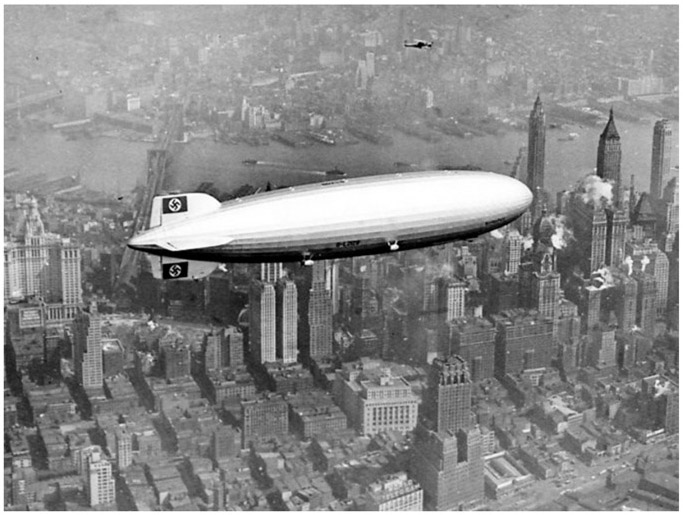
The Hindenburg, symbol of a cruel new order.

For Hugo Eckener, the years after his return from the great Chicago Fair in 1933 had been awkward, even dangerous. Initially, Joseph Goebbels had been willing to put the full power of the state behind Eckener’s vision of a larger zeppelin fleet and establish a regular trans-Atlantic service to New York/Lakehurst. The propaganda value of these ever-larger silver behemoths, now emblazoned with swastikas on both the port and starboard sides, was not lost on him. For his part, Hitler was not a fan—in fact, any talk of naming an airship after him was quickly quashed, as his superstitious nature worried that any accident could be perceived as an ill omen attaching itself to him personally.5 The chief of the Luftwaffe, the ex-fighter pilot Hermann Goering, was also not a fan for obvious reasons. But Goebbels carried the day, and the construction of what would become the Hindenburg went ahead. The largest airship ever built was named for World War I hero and former president of the Weimar Republic, Paul von Hindenburg, who had died at the age of eighty-six in 1934.*

May 6, 1937.
Goebbels and his master, Hitler, expected gratitude from Eckener. What they got instead was a continued oblique reticence to go along with the Nazi plan; his poking fun at the official “Heil Hitler” greeting expected between citizens of the Third Reich, for example. A foreign journalist had asked Eckener about this, and he had jokingly confirmed it: “Yes, that’s right! When I get up in the morning, I don’t say ‘Heil Hitler!’ to my wife, but rather ‘good morning.’”6 When asked by the Nazi regime to make a public pronouncement supporting Hitler’s 1936 reoccupation of the Rhineland in violation of the Versailles Treaty, he again demurred. This led to his being declared persona non grata by Joseph Goebbels. The plebiscite that was put before the German population to gain official sanction for the reoccupation was being carefully stage-managed by the Nazis. At the zeppelin headquarters, Eckener ordered that “election posters be removed from the hangar,” and at a press breakfast “the words ‘Hail Deutschland’ [and not “Heil Hitler”] were used for the drinking greeting.”7 These might seem like small gestures for those of us who have never lived under a totalitarian regime. But in a totalitarian regime there are no such things. The New York Times also reported on Eckener’s unwillingness to have his name used to push the plebiscite vote, noting that he was “a man of rugged independence.”8 On the other hand, the year after his Chicago appearance, Eckener made a public statement in support of Hitler’s 1934 plebiscite to the German people seeking approval for his continued (and indefinite) dictatorial rule. Could the fact that Joseph Goebbels had offered Eckener 2 million marks toward construction of his next airship—to be the ne plus ultra in size and design—have been a determining factor? It’s hard not to reach this conclusion. In the event, Hitler won approval of 90 percent of votes cast. He didn’t need Hugo Eckener’s public support to carry the German electorate. His popularity inside Germany was enormous, and growing. However, a recognized moderate with name value, coming out in support, lent a degree of respectability Hitler neither possessed nor deserved. Eckener himself later made it crystal clear that he understood the transactional nature of his relationship with him: “Herr Hitler never did anything without demanding compensation either beforehand or afterwards.”9 This was the price of continuing to be involved with the zeppelin project. Hugo Eckener would have to “play ball” to a certain degree—and accept an increasingly diminished status, at least publicly, in the airship program. But as the Hindenburg neared completion, it became more and more difficult for Eckener to maintain his independence of mind on the one hand, and continue to be associated with the great enterprise of his life on the other. Privately he could confide, as he did to the Berlin-based American journalist, Louis Lochner, that Hitler was a “venomous toad,”10 but publicly he was forced to be increasingly circumspect in his remarks.
He was infuriated when Joseph Goebbels, with Ernst Lehmann as willing accomplice, cut the Hindenburg’s test trials short in order to use it in an aerial display of Nazi political omnipotence. The airship was brought out of its hangar in high winds and suffered damage to one of its lower fins. This first experience with the Hindenburg—this magnificent piece of engineering—being pimped out as a tool for Nazi propaganda, convinced Eckener that it “sailed under an evil star.”11 And so it did.
The night of the disaster in Lakehurst, Hugo Eckener was in Graz, Austria, a guest of the city’s local aeronautical club. His celebrity in neighboring Austria at least had not been dimmed by Hitler’s demotion. After the meeting, the famous sculptor Gustinus Ambrosi invited Eckener to his studio. Eckener had been an admirer of Ambrosi’s work for some time. Ambrosi had gone deaf at the age of seven, but had overcome his disability to produce hundreds of works of sculpture that conveyed both physicality and emotion. Eckener later recalled his impressions on meeting the deaf genius: “in his expressive face there shone a pair of overpoweringly illuminated eyes in which there burned an almost mystical fire. And what was it he wanted to show me? It was a vision of Icarus plunging into the sea.”12 As he entered the space, Eckener, never one to embrace paranormal phenomena, was struck with an overwhelming sense of foreboding as he viewed a statue of a broken Icarus. Ambrosi wanted to convey the pain of Icarus’s noble failure off the island of Crete. The son of Daedalus, torso impossibly twisted in pain as he hits an oncoming wave, was the image that met Eckener’s eyes. In that moment, he was certain something was wrong—terribly wrong—but what? Later, a call in the middle of the night confirmed what he already suspected. Icarus was broken.
What was broken? The Hindenburg, the Zeppelin project as a whole, the dream of aviation as a force for global unity and progress: all of these. Immediately, the recorded public spectacle of the giant luxury liner of the skies being consumed by angry-looking flames jarred the public (and it was shown repeatedly). Herbert Morrison’s famous description of the event—his distorted voice filled with both horror and empathy—became an icon of the radio age. Filmmaker Robert Wise’s treatment of the explosion in his 1975 film is worth watching to gain a sense of what it must have felt like to be there witnessing it in person. His use of actual footage—replayed over a number of times for better effect—with the sound of the Naval Station’s shrill klaxons blaring over the sounds of burning hydrogen gas and twisting metal, lends itself to nothing if not dread. It is very disturbing to watch. Something like that happening so publicly, being recorded and so widely distributed, doomed not just one ill-fated airship, but all airships. No one in their right mind after watching the film footage would purchase a ticket for travel on a zeppelin.
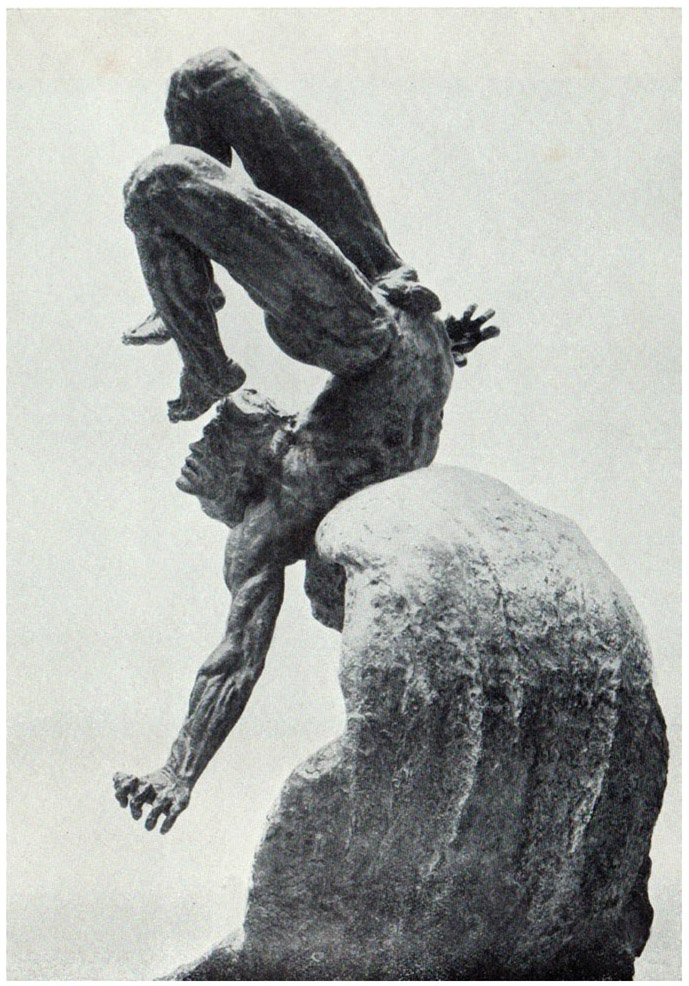
Falling Icarus, Gustinus Ambrosi (1937). Courtesy of Dr. Uwe Eckener.
Hugo Eckener didn’t seem to grasp this at first. Even though he had been sidelined in official Germany,* he was immediately dispatched by Berlin to lead the German investigation of the disaster. His findings pointed not to sabotage, but rather to an electrical discharge igniting hydrogen gas that had leaked from one of the Hindenburg’s gas cells. Most serious studies of what happened in the decades since have generally concurred with Eckener’s estimation. What if it had been helium in those cells instead? Eckener had been trying throughout the 1930s to convince Franklin D. Roosevelt to authorize the sale of helium to the Zeppelin Company. In fact, FDR’s predecessor, Herbert Hoover, had been an ardent fan of Hugo Eckener—meeting with him in person and referring to him as a veritable Magellan of the skies.13 If Hugo Eckener had exhibited a greater sense of urgency earlier, perhaps he could have convinced President Hoover to try to use his authority to move matters in this direction.† The United States at that time had a near-monopoly on this wonder gas. Its lift wasn’t as great as that of hydrogen, but it was close, and more importantly, it was safe. However, the Roosevelt administration that came to power in 1933, peopled with left-leaning progressives—“New Dealers”—was in no hurry to sell helium to a company based in Hitler’s Germany. As “Der Führer’s” foreign policy grew increasingly aggressive, and his anti-Semitic rants became ever more unhinged, FDR’s administration and many in Congress simply weren’t interested in accommodating German interests, even if it involved a safety issue, as was so painfully evident after what happened over Lakehurst. There was sympathy for Hugo Eckener as an individual in his efforts to negotiate a deal for U.S. helium, but he was a German and there was little sympathy for Germany. In retrospect, this position could be seen as small, mean-spirited even, of the United States. Secretary of the Interior Harold Ickes in particular was intractable on this point.14 Thirty-five passengers and crew had died in the Hindenburg disaster, as well as a member of the ground crew. Many more had suffered burns and other injuries. Airships should not rely on hydrogen for lift; it was simply too dangerous. By denying Eckener helium, the Americans were effectively killing the zeppelin project as a whole.
The Graf was completing what would be its final air voyage from South America when news reached the bridge of what had happened in New Jersey. Captain Hans von Schiller made the decision to keep it from the passengers until they had safely landed back in Germany.15 Three years later, that amazing airship that had awed Chicagoans as it came out of the sunrise over Lake Michigan in 1933 was unceremoniously dismantled for scrap on the orders of Hermann Goering. Goering wanted the aluminum in its skeleton for use by the Luftwaffe, which had by then been unleashed on the rest of Europe by Hitler. Nothing could have been further from what the Graf Zeppelin had stood for at its best: that is to say, a better world.
Footnotes
* For its part, Japan had staged a contest at the 1933 Chicago World’s Fair for a roundtrip ticket to “Manchukuo.” It was won by one Miss Francis Robinson of 2231 East 67th Street. No mention was made, however, of how the Japanese Army was trafficking opium to finance its operations in Manchuria, or about its plans to establish a secret biological weapons facility there to conduct experiments on live human beings.
* An interesting story relayed by J. Gordon Vaeth in his 1958 book on Eckener claims that a doctor attending Hindenburg in his final days was told by Hindenburg himself that in 1933, he had extracted a promise from Adolf Hitler to leave Eckener alone. On the other hand, what good were Hitler’s promises?
* It’s worth noting that Eckener had been “rehabilitated” by the Nazi propaganda ministry following his successful crossing of the Atlantic at the helm of the Hindenburg on its maiden voyage to Lakehurst, in 1936. On the passenger list only his name appeared, without a title, even though he was commanding the airship. It was Ernst Lehmann—a reliable Nazi sympathizer—who was listed as “Captain.”
† To be fair, Hoover was president for less than two months after Hitler became chancellor of Germany. Perhaps if Hoover had won re-election in 1932, he would have taken a similar stance as that of the Roosevelt administration.