
Chapter 2
The American Founding Fathers leveraged Chinese technologies. They wanted to create a better quality of life and to move the newly independent republic forward. Benjamin Franklin, George Washington, Thomas Jefferson, Benjamin Rush, Alexander Hamilton, and Gouverneur Morris, among others, regarded China as a resource for both knowledge and inspiration. While fighting for independence from British rule, the founders used Chinese inventions to develop innovative technologies. Immediately after the Revolutionary War’s conclusion, they used the example of the Great Wall of China as a model for maintaining national independence. In the following pages, I will first present the founders’ efforts to make use of various Chinese technologies. Then I will provide several examples of the impact that Chinese technology had on the early history of the United States, including Benjamin Franklin, George Washington, and the Great Wall of China, Thomas Jefferson and Chinese architectural designs, Benjamin Franklin’s efforts to promote sericulture in North America, and Franklin and Chinese heating technology and medical theories. Finally, I will survey Franklin’s exertions to study Chinese navigation and papermaking technologies.
THE FOUNDING FATHERS AND CHINESE TECHNOLOGY
The Founding Fathers drew inspiration from Chinese innovations. Facing the task of developing a new and flourishing society for American colonies, they paid particular attention to what they could benefit from—such as Chinese agricultural and technological innovations. Charles Thomas (1729–1826), secretary of the Continental Congress and later the U.S. Congress, emphasized the sophistication of Chinese industry, such as advancing the arts of living and improving in husbandry and native plants.1 The American Philosophical Society, founded in 1768, told the American people if they could “introduce the industry of the Chinese, their arts of living and improvements in husbandry, America might become in time as populous as China.”2
Chinese inventions in areas such as heating technology, silk production, porcelain ware, manufacturing, navigation, canal construction, and even the construction of the Great Wall found their way to North America via Europe. The founders understood this information could be used to promote social and economic development.
Benjamin Franklin was eager to borrow valuable and practical technologies from China. His interests were wide-ranging, from the creation of everyday goods to the intricacies of commerce. In 1763, Franklin sent prominent American academic and Congregationalist minister Ezra Stiles copies of Chinese prints illustrating silk production to promote the creation of a colonial silk industry. Franklin was interested in Chinese painted candles; he tried to analyze “of what are they made.” In addition, Franklin recorded solar eclipses in China and the gifts of the emperor to his subjects. He wrote down the following notes in 1762:
Oct. 17. 1762 between 5 and 6 PM. an Eclipse of the Sun
Nov. 12. 1761 A total Eclipse of the Moon near Canton, between 6 and 10 aClock PM
Nov 2. 1762 An Eclipse of the Moon at 4 in the Morning. Fees paid on a Gift from the King of £200 amounted to £23 5s. 6d.3
To develop American commerce, Franklin also studied the technology used to preserve Chinese tea during transport to North America. The tea that was shipped from China to Europe, then to America, was well-preserved, dry, and crisp, although it “comes all the way by sea in the damp hold of a ship.” Franklin reasoned that this technology could be used to preserve grains. He told Peter Franklin, “by this method, grain, meal, &c. if well dry’d before’tis put up, may be kept for ages sound and good.”4 Scarce energy resources also led Franklin to examine Chinese ship construction, prompting him to publicize the Chinese development of watertight compartment technology. Franklin also explored Chinese windmills. He said that it was a “pleasure to see the Contrivance of horizontal Wind mills become generally useful” and “that almost every Farmer may execute without the help of any Workman, and which, or something like it, I have had an imperfect Account of as used in China.”5
Finally, Franklin turned his attention to Chinese food. In 1770, he was animated upon learning about Chinese Doufu (bean curd). He sent to John Bartram (1699–1777) “some Chinese Garavances, with Father Navaretta’s account of the universal use of a cheese made of them, in China.” Franklin attempted to discover what “the Tau-fu is made of.” He shared the information with Bartram, “that some runnings of salt (I suppose runnet) is put into water when the meal is in it, to turn it to curds.”6 He even wanted to understand the base ingredient for Chinese vinegar, Liche, asking “What is it?”7
Thomas Jefferson employed Chinese technological practices to develop his own clock. A letter from Jefferson to Benjamin Franklin Bache (1769–1798) in 1794 revealed that Jefferson made use of the Chinese gong from Benjamin Franklin “as the bell for a chateau clock.”8 Jefferson used the Chinese gong for “calling people together.” Margaret Bayard Smith (1778–1844), an American author and political commentator in the Early Republic of the United States, visited Jefferson at his home and recalled that she saw the Chinese gongs in Monticello. She reminisced, “I cannot tell, except it is on account of its newness and originality. Another was placed in a tree on the lawn, to summon the workmen to their meals.”9
Innovations in Chinese technology for trade infrastructure and agriculture, the founders observed, could be utilized. In 1777, Alexander Hamilton had understood the function of the Chinese Grand Canal, reporting that “There is an immense canal in China 1000 Miles long which traverses the whole Chinese empire from Canton to Pekin.10 George Washington also thought to build a canal in the Cheat River (figure 2.1).11
After survey of the river, he surmised that a canal of fifteen miles long should be constructed “from the Dunkers bottom, along the river.”12
In order to open a gateway to the West (specifically, the Ohio Valley) for settlement and trade, Washington created the Shenandoah & Potomac Navigation Company—one of the first stockholder companies in the United States. Washington’s goal was to construct a canal on the Virginia side of the Potomac so that shallow, pole-driven vessels could bypass the Great Falls.13 In 1762, Thomas Johnson, an early and active promoter of commercial navigation on the upper Potomac, became a manager of the navigation company and began correspondence with Washington on the feasibility of opening a canal above the great falls of the Potomac River.14
John Ledyard (1751–1789), an American explorer and adventurer who visited China with Captain Cook’s third voyage to the Pacific, noticed that the Chinese were very eager for furs and were willing to pay a great deal for them. Under his encouragement, American traders looked for furs in the Northwest, bought them from the Indians, and shipped them to China. Washington’s letter to David Stuart evidenced that Washington adored the idea of bringing furs from the Ohio Valley and sending them to China.15
![Figure 2.1 A Scene of the Grand Canal of China in the Eighteenth Century. This picture, Junks on the Canal, was by Xu Yang, eighteenth-century painter from Suzhou, China. It depicts the flourishing commercial scene on the Grand Canal (大运河). The first construction of the canal dates to the fifth century BC, but the various sections were linked during the Sui dynasty (581–618 AD). Since then, the later dynasties restored and rebuilt the canal and altered its route to supply their capital. It spans 1,100 miles [1,770 km], making it the longest canal system in the world. The canal provided safe transportation for China by insulating from the threats of storms and pirates on the high seas.](china-founding-united-states-influence-traditional-chinese-civilization.files/image002.jpg)
Figure 2.1 A Scene of the Grand Canal of China in the Eighteenth Century. This picture, Junks on the Canal, was by Xu Yang, eighteenth-century painter from Suzhou, China. It depicts the flourishing commercial scene on the Grand Canal (大运河). The first construction of the canal dates to the fifth century BC, but the various sections were linked during the Sui dynasty (581–618 AD). Since then, the later dynasties restored and rebuilt the canal and altered its route to supply their capital. It spans 1,100 miles [1,770 km], making it the longest canal system in the world. The canal provided safe transportation for China by insulating from the threats of storms and pirates on the high seas.
In 1770, Franklin grasped the importance of canals in the colonies as well. He told Thomas Gilpin (1728–1778), a Quaker merchant and manufacturer, of “the Advantages of Canals for internal Navigation in our Country, to which I heartily wish Success.”16 Franklin then told Gilpin that he was extremely pleased at the idea “of the Practicability of navigating down Sasquehanah.”17
Gouverneur Morris (1752–1816), a prominent founder of the republic, further studied China’s Grand Canal. With his encouragement, the New Yorkers built the Erie Canal, connecting New York to the Midwest. The canal played a role in New York City’s rise, triggered an explosion in canal building, facilitated economic growth, and linked the Northeast with the region of the new nation that would later be known as the Midwest.18
As an agrarian society during the Early Republic years, the founders turned to China, a nation with a remarkably successful agriculture, to learn from some techniques that Chinese farmers invented in their farming experience. James Madison revealed to American farmers that, according to Chinese farming experience, perpetual fertility was compatible “with an uninterrupted succession of crops.”19 He expressed to members of the Agricultural Society of Albemarle that the Chinese would laugh at
at the idea that land needs rest, as if, like animals, it had a sense of fatigue. Their soil does not need rest, because an industrious use is made of every fertilizing particle that can contribute toward replacing what has been drawn from it.20
He continued that “the Chinese example, where the cultivated crop is restored to the earth, all pronounce that such would be the effect.”21
Finally, some Chinese artisan technologies were used to advance certain political agendas even before American independence. For example, some colonial leaders viewed porcelain manufacturing as essential to national economic self-reliance. Chinese porcelain, like tea, had been a major colonial import. Benjamin Rush was among the first group of people who advocated building a porcelain factory in North America with the intent of overcoming the colonies’ dependence on British imports. The excerpt that follows from one of Rush’s letters illustrates porcelain to be but one component of a grand strategy:
I have many schemes in view with regard to these things. I have made those mechanical arts, which are connected with chemistry the particular objects of my study and not without hopes of seeing a china manufactory established in Philadelphia in the course of a few years. Yes, we will be revenged by the mother country. For my part, I am resolved to devote my head, my heart, and my pen entirely to the service of America, and promise myself much assistance from you in everything of this kind that I shall attempt through life.22
The colonists’ pursuit of domestic Chinese porcelain ware became a powerful call for patriotic support of American economic independence. Franklin, in London when Rush was promoting colonial porcelain production, echoed this sentiment in a letter to his wife: “I am pleased to find so good progress made in the China Manufactory. I wish it Success most heartily.”23 The American China Manufactory in Philadelphia became noted for its quality, and more importantly, succeeded in cultivating patriotism as it challenged Britain’s monopoly of the product and indirectly contributed to the struggle for independence.
Explicit examples of Chinese architectural influences are present in one of America’s most historic buildings. Jefferson developed a new type of architecture by incorporating certain Chinese designs into his famous neoclassical-style home, Monticello. Jefferson used Chinese lattices in many buildings, including Barboursville, the home he designed in Orange County, Virginia. Jefferson also planned to build a Chinese pavilion when he remodeled Monticello in the last decade of the eighteenth century.
BENJAMIN FRANKLIN, GEORGE WASHINGTON, AND THE GREAT WALL OF CHINA, 1756–1776
The Great Wall of China—an iconic symbol of Chinese civilization—has enjoyed an unexpected and yet substantial impact. In recent years, the idea of the Great Wall has frequently been employed in the context of former president Donald Trump’s controversial Mexico-U.S. border wall. However, the notion of the “Chinese Wall” extends beyond this context and into fields as disparate as business, education, and the military. The Great Wall has cultural roots originating in America’s colonial era, when Founding Fathers Benjamin Franklin and George Washington recommended that a similar barrier be constructed to protect and maintain independence. Alexander Hamilton fully realized the example of the Great Wall to China’s border safety. In 1777, he told his fellow Americans the Chinese “immense wall of 600 leagues long” served as “a barrier against the tartars.”24
I will examine the Great Wall’s influence on American culture, with the intent of exploring how broader Chinese cultural elements have imprinted the nation’s history. I will begin this chapter with a brief history of the Chinese wall, and then discuss its impact on the young United States prior to and immediately following the American Revolution.
A Brief History of the Great Wall of China
The Great Wall of China, as the world’s largest defensive structure, stretches over approximately 6,400 kilometers (4,000 miles). The earliest foundations of the Great Wall can be traced to China’s Warring States period (481–221 BC), a tumultuous era in which seven rival kingdoms battled for territorial advantage. Many of the smaller walls built by these states to protect their borders would lay the groundwork for the eventual Great Wall. Construction of a unified wall began under the reign of Emperor Qinshihuang (259–210 BC), who conquered the rival states and began the Qin dynasty (221–206 BC). As the first emperor to unify China, he had sections of earlier fortifications extended to form the Great Wall, a coordinated defense system against raids by Hunic, Mongol, Turkic, and other nomadic tribes from the north. Construction continued for more than a thousand years until the Ming dynasty (1368–1644 AD). Subsequent Chinese rulers would continue to build, modify, and extend the wall that had started to form under Emperor Qinshihuang.
The immediate impact of the wall was to safeguard farmlands from northern invaders, thereby improving the stability of ancient Chinese culture and society. In later centuries, the Great Wall promoted the transmission of goods and information between China and her trade partners by defending key routes, including the Silk Road. The Great Wall would become a symbol representing the “nation’s spirit, [its] working people’s wisdom, their perseverance to become stronger, and the ability to fend off enemies’ intrusion.”25 In addition to its military influence, the Great Wall has played an important role in the evolution of Chinese civilization.
Like a giant belt, the wall has held China together, unifying the country from past to present. The importance of unification has been a continuing theme since the construction of the Great Wall. Yet somewhat paradoxically, the wall also served as a physical and metaphorical divide between civilizations. It served to insulate imperial China from what were regarded as inferior nomadic and European cultures.
The Great Wall of China in the West before the End of the Eighteenth Century
The earliest Western records of the Great Wall can be found in brief descriptions from Roman and Arabic manuscripts extending as far back as the fourth century. Ammianus Marcellinus, a historian who wrote one of the earliest accounts of the Roman Empire, recounted “summits of lofty walls” enclosing the land of Seres, the country that the Romans believed to lie at the end of the Silk Road.26 Later Arab writers and travelers, such as Rashid-al-Din Hamadani (1248–1318) and Ibn Battuta (1304–1377), would also mention the Great Wall of China.27
Interestingly, Italian explorer Marco Polo (1254–1324), the first European to have left a detailed chronicle of China, neglects to mention the Great Wall in his Book of the Marvels of the World.28 Polo’s accounts were not unique in this regard; many European visitors to China during the Middle Ages, including John of Plano Carpini, William of Rubruck, Giovanni Marignolli, and Odoric of Pordenone, seem to have left no records of the wall. A possible explanation for this apparent discrepancy is that Polo and others stayed in China under the Yuan dynasty (1279–1368), which had been established by the Mongolians. The ruling class may have been reticent to show Europeans the structure that had been constructed to keep them out.
European records of the Great Wall became more widespread during China’s Ming dynasty, during which the kingdom increased commercial activities with foreign states. Gaspar da Cruz’s (c. 1520–1570) A Treatise of China and the Adjoining Regions notes “a Wall of a hundred leagues in length.”29 Another early account by Bishop Juan Gonz á lez de Mendoza (1550–1620) reported a wall spanning five hundred leagues, but advised that only one hundred leagues were man-made, with the rest being natural rock formations.30 The Jesuit priest Matteo Ricci (1552–1610) described “a tremendous wall four hundred and five miles long” that formed part of the Ming Empire’s northern defenses.31 The book 1563 Asia postulated that the wall had been constructed to defend against Mongolian invaders. In 1754, English antiquarian William Stukeley (1687–1765) described the Chinese wall as “a considerable figure upon the terrestrial globe [which] may be discerned at the moon.”32
Perhaps the first recorded instance of a European entering China via the Great Wall occurred in 1605, when the Portuguese Jesuit brother Bento de G ó is (1562–1607) reached the northwestern Jiayu Pass from India.33 In a separate account sixty years later, Jesuit Martino Martini (1614–1661) described atypical stretches of the Great Wall and generalized such fortifications to exist along China’s entire northern frontier in his Atlas Sinensis. Martini believed that the entire wall had been built under the Qin dynasty, which historical records suggest was a common misperception at the time.34
The Great Wall would later draw the attention of several philosophers during the European Enlightenment of the eighteenth century. For example, French revolutionary Voltaire proclaimed the Great Wall to be “a monument to fear” in the same manner that the Great Egyptian Pyramids were “monuments to vanity and superstition.”35 Jean-Baptiste Du Halde (1674–1743) offered a more tempered perspective: “Two hundred and fifteen years before the Coming of Christ this prodigious Work was built, by order of the First Emperor of the Family of Tsin, to defend three great Provinces against the Irruption of the Tartars.”36
Westerners would again explore the Great Wall during the 1793 McCartney Embassy, the first British diplomatic mission to China. The envoy, led by George McCartney (1737–1806), surveyed the wall to gather intelligence.37 McCartney would later envision China during the time of construction as not only a “powerful empire, but also a very wise and virtuous nation.”38
However, several negative perceptions of the Great Wall also existed in the West. For some, the wall was the emblem of an inward-looking people, a closeted “Middle Kingdom.” German philosopher Johann Gottfried Herder (1744–1803) disparaged it as the symbol of the feudal autocracy. Others would dismiss it as a display of “Chinese exceptionalism.”
The Great Wall in North America, 1700–1800
The British Parliament endorsed the idea of a “Great Wall” along the Appalachians with the intent of maintaining order among its colonies, specifically by limiting potential territorial conflicts with Native American tribes. The colonial Americans were, at times, similarly drawn to the prospect of barricading their cultivated soil from the boundaries of nature. Such a wall might prevent the “incalculable loss of life and property” and, in their view, the “lust of territory [and] wealth… which has poured out streams of innocent blood.”39
The Founding Fathers recommended the construction of such a wall on the eve of the American Revolution and again after the fledgling nation won independence from England. During the French and Indian War (1754–1763), Franklin introduced the notion of the Great Wall of China into the public debate, maintaining that building an American Great Wall was the most efficient way to protect the thirteen colonies. Franklin again raised the notion of the Great Wall during the Revolutionary War.40 George Washington also found the value of the Great Wall in keeping the newborn United States a consolidated nation. Although no wall was ever constructed, one can better appreciate the founders’ mindset by surveying the background from which such ideas were formed.
Proclamation of 1763: Great Britain’s Plan to Contain the Colonists
The rapid growth and unification of the thirteen colonies during the 1700s set the stage for a momentous shift in the balance of power between England and her North American provinces.41 In 1700, England had twenty subjects for each colonist; only seventy-five years later, the colonial population had ballooned to 2.5 million, approximately a third the size of the English. The thirteen colonies had also established close trade relations with each other, cultivating a sense of shared American identity. Early displays of unity were evident in instances such as the 1754 Albany Congress, during which Benjamin Franklin proposed the creation of a union for the colonies’ joint defense.42
Throughout the 1700s, the colonists also began venturing further from the Atlantic seaboard. Pennsylvania, Virginia, Connecticut, and Maryland had all laid claim to territory in the Ohio River Valley, with elite families investing in the Ohio Company to promote settlement of the region.43 The colonists’steady encroachment drew the ire of Native Americans. In 1763, a coalition of American Indians known as the Ottawa Nation campaigned to drive the colonists from the region, leading to the death of thousands of settlers and British soldiers. Parliament passed a series of stringent edicts to curtail further attacks and recoup financial losses suffered from the Ottawa, in conjunction with the recently ended French and Indian War. Among these edicts was the Royal Proclamation of 1763, which prohibited westward expansion beyond the Appalachians; the Stamp Act, an internal tax levied on all printed paper used by the colonists; and an order to retain a large standing army in North America.
These edicts caused tensions to flare between England and its colonies. Many colonists decried the new taxes that had been imposed, in part, to pay for Britain’s unsolicited standing army. Many colonists also ignored the Royal Proclamation. In 1773, the Virginia Gazette proclaimed that not even “a second Chinese wall” could “prevent the settlement of the lands on [the] Ohio [River] and its dependencies.”44 Throughout the mid-eighteenth century, various settlements continued to form beyond the Appalachians in disregard of England’s new laws.
Parliament eventually responded by passing the Quebec Act of 1774, which reinforced its 1763 Royal Proclamation and punished the colonists for various transgressions that had transpired over the past decade, including the Boston Tea Party. The Quebec Act expanded the boundaries of the Quebec province to include land in the Ohio River Valley and west of the Mississippi River, effectively voiding the colonists’ land claims in the region. The Quebec Act sent a clear message to the colonists by establishing a “border beyond which, for the advantage of the whole empire, [the colonists] would not extend [themselves].”45
Many colonists opposed the Quebec Act, both because the edict had been intended as a punishment and because it degraded the “proper superiority of Protestant Britons by favoring [the Quebec] Catholics.”46 In October 1774, Founding Father Richard Henry Lee (1732–1794) declared the Quebec Act to be the “the worst grievance” suffered by the colonists.47 Some British politicians supported Lee’s stance. Charles Pratt, Earl of Camden (1714–1794), proposed a bill in the House of Lords to repeal the Quebec Act.48 Camden believed that if Britain were to draw “the limits of that province close along the interior settlements of all the old English colonies, so as to prevent their further progress,” then it would effectively oppose “the further extension of civil liberty and Protestant religion.”49
The colonists rejected parliamentary authority soon after the passage of the Quebec Act, leading to the outbreak of the American Revolution in 1775. To the colonists, the proposed Appalachian wall—like the Great Wall of China—did more than just separate territories and civilizations. Both walls could be seen as manifestations of the political ideologies of the ruling class. Just as the Great Wall helped metaphorically insulate China from external influences, the “American Wall” was perceived as an extension of “the shackles of arbitrary power and of Property over all the future settlements and colonies of America.”50
Benjamin Franklin and the Great Wall of China, 1756–1776
The newly declared United States faced tremendous military pressure, for Great Britain had mobilized its considerable military to suppress the rebellion. The Founding Fathers were faced with the seemingly impossible task of protecting the nascent nation. Franklin turned to Chinese military strategy immediately following the beginning of the American Revolution.
Benjamin Franklin had recommended that a fortification like China’s Great Wall be constructed in North America before the founding of the United States. During the French and Indian War, Pennsylvania came under threat from the French Indians shortly after the war broke in 1754, and the leaders of the colony were debating between active retaliation and defense fortification. In this time, Franklin suggested before the British Parliament that the best means to protect the colonists’ interests was to construct a great wall like that of China.51 In 1760, Franklin stated (figure 2.2),
The second kind of security—A security of our planters from the inroads of savages, and the murders committed by them—will not be obtained by such forts, unless they were connected by a wall like that of China, from one end of our settlements to the other.52

Figure 2.2 Allen Well, the Only Relics of Franklin’s Great Wall. Following the order of the governor of Pennsylvania, Franklin went to the front and built Fort Allen, which included two blockhouses and a well. It was used as a base of supplies and as a rendezvous for troops during the period of the French and Indian War in the winter of 1756. The well is the only trace left of the fort. (Photo by the author.)
Franklin often applied practical and valuable elements from Chinese civilization in his effort to build a flourishing new society in North America.53 Given Franklin’s propensity to often draw insight from Chinese civilization, it is unsurprising that he turned to Chinese military strategy in a time of need. However, Franklin’s recommendation of a great wall raises several important questions, the most important being why Franklin thought such a proposal was necessary. To understand this, it is necessary to review the historical context behind Franklin’s plan.
The eighteenth century saw the rapid expansion of the British colonies in North America. In 1700, the Caucasian population in the English colonies was 250,000; just twenty years later, the population had almost doubled. While this period was one of rapid growth, it was also filled with various hardships and conflicts. The French and Indian War began in the Ohio River Valley in 1754, and Pennsylvania was under threat by the French Indians a year later. Franklin’s letters from separate occasions indicate that he was familiar with China’s Great Wall. For instance, Franklin had once sent rhubarb seeds to his friend, botanist John Bartram, with the message that the seeds had come from near the Chinese wall.54 From his personal experiences constructing fortifications in the Blue Mountain region, combined with accounts of China’s Great Wall, Franklin believed that connecting individual turrets into a line of forts would provide the greatest security.
The leaders of Pennsylvania were split between two approaches on how to most effectively protect the colony. Some leaders advocated a policy of aggressive retaliation, believing that they should invade French Indian territory. Others advocated for a defensive “chain of forts” to safeguard the British colonists from attack. Franklin left us the vivid description of the debate:
The Commissioners were of Oppinion, that the best means of Securing our Inhabitants, was to Carry the warr into the Enemys Country, and hunt them in all their Fishing, Hunting, Planting and dwelling places: But having sent for Croghan and others, in order to obtain their Oppinion; and they Advising that by a Chain of forts the Frontier should first be in some degree secured before we Acted Offencively, the same was agreed to, and the Building of Forts immediately set about, which took up much more time than was expected.55
Franklin did not agree with bringing the war into Indian Territory. While Franklin sided with the second idea, he was not satisfied with the chain of forts; instead, he imagined a “line of forts.” Governor Harris of Pennsylvania endorsed Franklin’s approach and entrusted him with the authority to make decisions on defensive affairs.56
Realizing the speed with which he had to implement his strategy, Franklin immediately rushed to the front, “which was infested by the Enemy.”57 He was to build a line of forts between the Delaware and Susquehanna Rivers. Along the Blue Mountains, some forts had already been built to defend the colonies. As the commander for defense, Franklin envisioned connecting these forts to form a barrier between the French Indians and the British. However, it was impossible for him to establish a new line of forts with the French Indians rapidly approaching.
Pressed for time, Franklin decided to “execute more speedily the first Design of erecting a Fort near Gnadenhutten.” So on January 14, 1756, Franklin arrived with more than two hundred men in force to the devastated New Gnaden Huetten settlement to build Fort Allen, the first of his defensive structures. With this force, Franklin hoped to complete construction within three weeks. Upon his arrival at New Gnaden Huetten, he expressed his optimism to his wife, Deborah: “I hope in a Fortnight or three Weeks, God willing, to see the intended Line of Forts finished.”58
By January 26, Franklin had almost finished the construction of Fort Allen. He relayed this progress in his letter to Samuel Rhoads (1711–1784).59 He told Rhoads that they had constructed a “pretty strong Fort,” and they were going to complete two more forts in a week. Franklin hoped that they would “compleat the projected Line from Delaware to Susquehanah.”60
In order to “complete the Projected Line,” Franklin would have to build two more forts. After he finalized construction of Fort Allen, Franklin sent his troops to build Fort Norris and Fort Franklin. Therefore, as soon as Captain Hays returned with the Convoy of Stores and Provisions, Franklin decided to “send Orndt and Hays to Haeds to join Capt. Trump in erecting the middle Fort there.”61 He reasoned that
with those two Forts may be finished and the Line of Forts compleated and garrisoned, the Rangers in Motion, and the internal Guards and Watches disbanded, as well as some other Companies; unless they are permitted and encouraged to go after the Enemy to Sasquehannah.62
After Franklin erected the three forts between the Susquehanna and Delaware Rivers, he effectively created a line of forts and strengthened the defensive fortifications. Franklin believed that the defense line for Philadelphia was consolidated and was better “than that of any other Colony on the Continent.” The reason was that it was “being guarded by a Line of Forts at no great Distance from each other, all strongly garrisoned.”63
After Franklin finished construction on Forts Allen, Norris, and Franklin, both he and the governor realized that it was no longer necessary for Franklin to remain there.64 And so, Franklin left Fort Allen after entrusting its defense to Colonel Clapham, a man skilled in military affairs. Franklin believed that as soon his line of forts was completed, the people in the area “may be secur’d.” He assured the governor, it was “absolutely necessary to get the Ranging Line of Forts completed.” He reasoned that otherwise, “the Expence and Loss to the Province will be intolerable.”65
After leaving the frontline, Franklin was still concerned about Fort Allen. In 1758, two years after the forts were completed, Franklin asked for information regarding the fort from Charles Thomson (1729–1824),66 a supporter of Franklin’s policies in the French and Indian War.67 On January 4, 1760, shortly before he made his recommendation for constructing fortification similar to the Great Wall of China public, Franklin exchanged information on Fort Allen with Isaac Norris (1671–1735).68 Norris told him, “At our last sitting in December our House reduced our Forces to 150 Men intended to Garrison Fort Augusta Littleton and Fort Allen with a Design to protect our Indian Trade.”69
Within nineteen days, Franklin had effectively established a line of forts in Lehigh Valley by constructing Forts Allen, Norris, and Franklin. This line was comparable to a great wall; indeed, many would regard this as Franklin’s version of the Great Wall of China. Franklin would later use his personal experience with his line to strengthen his argument for a great wall in the colonies.
Certain people, both in the North American colonies and in the English Parliament, believed that the colonies would be “sufficiently secure” if they would simply “raise English forts.” However, Franklin argued that more needed to be done. From his personal experiences constructing a line of fortifications in the Blue Mountain region, Franklin believed that the security of the colonies “will not be obtained by such forts” unless they should be connected into “a wall like that of China, from one end of our settlements to the other.” Franklin supported his assertion by drawing from the French and Indian War:
They [the Indians] go to war, as they call it, in small parties, from fifty men down to five. Their hunting life has made them acquainted with the whole country, and scarce any part of it is impracticable to such a party. They can travel thro’ the woods even by night, and know how to conceal their tracks. They pass easily between your forts undiscover’d; and privately approach the settlements of your frontier inhabitants. They need no convoys of provisions to follow them; for whether they are shifting from place to place in the woods, or lying in wait for an opportunity to strike a blow, every thicket and every stream furnishes so small a number with sufficient subsistence. When they have surpriz’d separately, and murder’d and scalp’d a dozen families, they are gone with inconceivable expedition thro’ unknown ways, and’tis very rare that pursuers have any chance of coming up with them. In short, long experience has taught our planters, that they cannot rely upon forts as a security against Indians.70
Franklin described the dangers faced by the colonists in order to alert the public to their need of a great wall. The French Indian strategies described by Franklin were exactly the same as those used by the nomadic intruders who plundered Chinese settlers. The patterns of warfare that the colonists confronted in North America were similar to those the Chinese faced before the completion of the Great Wall. Franklin’s recommendation demonstrated his knowledge of Chinese history. He not only understood the wall’s function but was also knowledgeable about its historical context, according to his correspondence with John Bartram, dated August 22, 1772.71
Although Franklin never completed his vision during the French and Indian War, he would continue to draw inspiration from China’s Great Wall. More than a decade later, in the midst of the American Revolution, Franklin again proposed the idea in a letter to Chevalier de Kermorvan (1740–1817), an engineer in the Continental Army. Kermorvan was involved with fortifications at Billingsport, located below Philadelphia along the Delaware River, and at Perth Amboy, located opposite Staten Island.72 However, Kermorvan “made himself ‘disagreeable’to General Washington and his army staff with his criticism of all military operations” during the 1777 Philadelphia Campaign, and was invited to leave Washington’s army before any further action could have been taken.73
In his reply to Franklin, Chevalier de Kermorvan ridiculed the recommended great wall. Kermorvan believed Franklin lacked full knowledge on the history of the Great Wall of China. In his letter, Kermorvan told Franklin that the great wall was useless, for the Great Wall of China “did not preserve this empire from being conquered by the Tartar ones.”74
It is unclear whether Franklin ever responded to the Chevalier. The chevalier’s knowledge was flawed. The Tartars, or the Manchu people, successfully entered the China proper because the Han Chinese who defended the wall willingly opened the doors for the invaders. Their invasion was not due to the ineffectiveness of the Great Wall itself. In any case, Franklin continued to regard the Great Wall of China as a valuable example for safeguarding American interests during the Revolution.
Several circumstantial differences existed between Franklin’s two recommendations, owing to dramatic political changes between the French and Indian War and the American Revolution. Yet looking beyond such differences, Franklin’s proposal of a “Chinese wall” reflected his understanding of the wall’s function in defending China. Franklin’s proposal remained a constant throughout his transformation from a subject of the British Empire to an American Founding Father, suggesting the enduring applications of such a wall.
George Washington and the Great Wall
Following America’s successful War of Independence, the Founding Fathers were confronted with the challenge of maintaining unity within their fledgling nation. George Washington, the primary architect of American foreign policy during the founding era, feared that continued conflicts with Native American neighbors would threaten the independent nation. His concern was not unfounded. Shortly after the Treaty of Paris ended the war in 1783, some American settlers made inroads into Native American territories in disregard of prior negotiated treaties. Washington was concerned about the ramifications of this unchecked westward expansion beyond the Appalachian Mountains.
Washington appreciated the importance of maintaining viable relationships with powerful Native American confederacies and spent much of his first term in diplomacy with various tribes. He understood that if the federal government failed to “restrain the turbulence and disorderly conduct” of its citizens, then the new nation could not expect peace with the Native Americans.75 Managing westward expansion might also provide an opportunity to “force the state-based members of the confederation to behave collectively, thereby giving the political foundation for the nation-in-the-making.”76 As such, in the summer of 1790, Washington signed the Treaty of New York with twenty-six other chieftains to establish a Creek Nation and set aside new lands for American expansion. Shortly thereafter, Washington issued the Proclamation of 1790, an executive order that forbade private citizens, corporations, and states from encroaching upon Indian lands.
However, the frontier states generally disregarded the federal government’s management of Indian affairs. Many Indian tribes were suspicious of Washington, the so-called Great Father. During the Revolutionary War, Washington attacked perhaps as many as forty Native American villages allied with the British.77 In addition, Britain retained several outposts in limited U.S. territories following the war and “continued to incite Indian tribes into the Ohio Valley to attack American frontiersmen.”78 Confronted with these circumstances, Washington sent statesman John Jay (1745–1829) to broker a treaty with Britain and avoid another war. For many Americans, this treaty, signed in November 1794, was a humiliation. However, Washington believed that such a treaty was necessary; another serious conflict would jeopardize the new nation.
Washington lacked the manpower to adequately defend the western front. According to Secretary of War Henry Knox (1750–1806), the new nation needed five thousand soldiers to patrol the border, but had less than half at the time.79 By 1796, a much-discouraged Washington had begun to doubt that the federal government was capable of establishing a lasting peace with the Native American peoples. It was in this grave time that Washington suggested that the federal government might control the situation by building a wall like China’s. Washington said to Secretary of State Thomas Pickering (1745–1829), “I believe scarcely anything short of a Chinese wall or a line of troops will restrain land jobbers and the encroachment of settlers on Indian Territory.”80 In 1796, Washington instructed Pickering to consider the proposal and revert with a recommendation on when such work should commence.81
For Washington, such a wall would be mutually beneficial by demarcating the border. It occurred to him that this wall could help keep Americans on their side of the border and maintain peace with the natives. As he expressed, “The Indians urge this; the Law requires it; and it ought to be done.”82
Washington’s recommendation of a wall should not be taken out of context. Washington sought to manage, but not curb, the western expansion. He worried that a “widely dispersed westward migration” would weaken the country’s defenses against British power.83 Like the Great Wall, Washington’s proposed American wall might separate the two civilizations and preserve the cultural integrity of his fledgling nation. It was also because Washington had read about China. For example, he owned a copy of Louis le: Compte’s Travels thro. China—1 vol. [Louis Daniel Le Comte. Memoirs and remarks… made in above ten years travel through the empire of China. London, 1738.].84
Summary
The impact of China’s Great Wall on the young United States was more metaphorical than architectural. For the British, this psychological wall was employed as a means of maintaining control of its colonies and shielding against the Native Americans. Benjamin Franklin and George Washington had similar visions for a wall that could secure the young nation against external threats—in Franklin’s case, both the natives and the English—while simultaneously serving as a unifying force.85
From its beginning, the United States embraced an “us-against-them” mindset reflected in its approach. The intention behind building the wall changed with the situation. The founders tore down the wall that restricted the country’s expansion while simultaneously building another for protection. Despite distance in time and space, the founders’ wall directly echoes the framework of the Great Wall of China. Even today, the wall mindset continues to penetrate American beliefs. On the one hand, the United States believes that it should build a wall to keep “us as a quiet home-dwelling under our vine and fig tree”; on the other, it also firmly believes that “there is for us no Chinese wall against trade or intercourse or political influences.”86
THOMAS JEFFERSON AND CHINESE ARCHITECTURAL AND GARDEN DESIGNS
Chinese influence on American architecture arrived through Europe in the early eighteenth century. Some residents built their houses with “Chinese trim.” Others adopted the style known as Chinese Chippendale. Some followed the designs of British builders called Chinoiserie—a style of ornamentation that “represented an Occidental interpretation of China.”87
Initiated in 1755, Chinese Chippendale patterns started appearing in many homes in Southern colonies like South Carolina and Virginia, which “displayed Chinese fretwork or trellis railings on roof, porches and stairways.”88 In the 1760s, the influence of Chippendale’s “Chinese” manner was apparent in roof balustrades. An advertisement in the South Carolina Gazette, dated April 1, 1757, shows that at that time some Americans had used Chinese-style design as a great attraction to potential buyers. The advertisement describes the James Reid house offered for sale, as the “new-built, strong and modish” house built “after the Chinese taste.” The house was “remarkably commodious in many respects; it is both warm in winter and deemed the most airy in summer of any house in the province.”89
At Woodside House, Berkshire in 1752, Hugh Hamersley brought Gothic style by laying out a Rococo-style wildness with an elegant Chinese kiosk. This seems to have been inspired by the House of Confucius at Kew, which was designed by Chambers and decorated by the fan-painter Joseph Goupy. The decoration of the Miles Brewton House, completed in 1769, is full of Chippendale motifs, in which Rococo, “Gothic,” and “Chinese” are mingled. Some researchers prove that Jefferson preferred such forms of construction in 1782.90
Chinoiserie took inspiration from the irregularity of Chinese gardening, particularly temples. Numerous pattern books on how to build Chinese gardens were produced at this time. Among them were William Halfpenny’s New Designs for Chinese Temples &c (1750) and Chinese and Gothic Architecture Properly Ornamented (1752).91 Burlington’s purchase of Ripa’s engravings in 1724 confirmed the style, and some “remarkable fruit” began to appear in the 1740s and 1750s. At Grove House, Old Winds, Dickie Bateman (c. 1705–1773) had lived like a “pseudo-Mandarin” during the 1730s and by the end of the decade had laid out a whimsically designed irregular garden adorned with a Chinoiserie bridge and a China House that combined Chinese and English styles.
The Chinese influence on architecture remained conspicuous after the formation of the United States. At Croyden, close to Philadelphia, Andreas Everardus van Braam Houckgeest (1739–1801), a member of the American Philosophical Society, built a home known as China’s Retreat during the 1790s. The building adopted a Chinese-style cupola on the roof. The windows, similar to screens in Chinese homes, were double leaves that slid into pockets in the walls. The buildings that used Chinese “touches” added “decorative embellishments to an otherwise Occidental plan and structure.”92 Julian Ursyn Niemcewicz, a Polish visitor, described the house as “immense, surmounted with a cupola and decorated with golden serpents in the Chinese manner. Six tabourets of porcelain were arranged in a circle in the peristyle.”93
Jefferson had a great affection for architecture, regarding it as “a passion of country gentleman in all countries and ages.” Jefferson was also interested in gardening as a natural extension of architecture and studied various Chinese garden styles as he began to construct a garden in his own estate. Jefferson especially loved a particular style of Chinese railing design popularized by Chippendale and Chambers. He decided on a garden in which “objects are intended only to adorn… the Chinese style.”94 He used the railings below the dome of his main building and surrounding the walkways.95 Jefferson treasured the Chinese railing so much that he applied the technique throughout his estates from 1756, such as the Woodford, Schuyler, Orne, and Morris houses, and onward after the Revolutionary War concluded.
Monticello is widely considered one of the greatest architectural treasures in the United States.96 Jefferson considered Monticello his “architectural ideas and experiments.”97 He made Chinese railings a recurring motif at Monticello. In his main building, Jefferson adopted the Chinese style, making drawings of Chinese lattices in the early 1770s.98 In the late 1790s and early 1800s, he designed Chinese lattices for houses in Edgehill, Farmington, and Barboursville. In the Swan House in Dorchester, the open panels contained Chinese lattices, which Jefferson continued to use in balcony railings until his death in 1826.99
In addition to the lattice, Jefferson considered building one of his rooms with a Chinese roof.100 In 1771, Jefferson recorded a plan to build “a square ‘Chinese Temple,’… two stories high with four columns on a side in the lower story.” He then decided to “set back behind a balustrade also of Chinese form.” Later, Jefferson wrote, “I think I shall prefer to these Chinese temples two regular Tuscan ones.”101 Jefferson also intended to build a few Chinese pagodas on his property.102
The vast numbers of memos dealing with temples indicate Jefferson’s deep interest in and aesthetic appreciation of this Chinese style. In his 1804 memo, Jefferson planned to build a number of different temples. “At the Rocks” was to be “a turning Tuscan temple 10 f., diam. 6. Columns. Proportions of Pantheon,” and over the offices, he planned to erect “the Chinese pavilion of Kew garden.” Then along the lower edge of the garden he proposed to place four small temples: models of the Gothic style; the Pantheon, which he regarded the masterpiece of spherical building; a “model of cubic architecture,” such as the Maison Carree; and “a specimen of Chinese” architecture.103 Jefferson also planned to build a Chinese pavilion when he worked to remodel Monticello in the last decade of the eighteenth century and built the university in the second decade of the nineteenth century.104
Jefferson fell in love with designing gardens immediately after his inheritance of Monticello in 1757.105 Jefferson wanted to construct the gardens of Monticello from his own naturalistic point of view. Under the influence of Designs of Chinese Building by William Chambers, Jefferson decided to have “a specimen of Chinese” architecture in his garden. He thought of constructing a Chinese Ting and Chinese temples when he made plans for this garden.106 In fact, Jefferson indeed built a Chinese pavilion “at the center of the long walk.”107 The pavilion made of bricks fell in 1828. It “was twelve feet, six inches square, with arches on all four sides covered by a pyramidal roof with a Chinese railing”108 (figures 2.3 and 2.4).

Figure 2.3 Chinese Pavilion in William Chambers’s Designs of Chinese Buildings, Furniture, Dresses, Machines and Utensils, Published in London in 1757. The pictures of the Chinese Pavilion that Jefferson used as references when he built his pavilion.
As the first great architectural style in North America, Jeffersonian architecture is well known. It was particularly popular during the early American period. These designs typically feature octagonal forms, red bricks, and Chinese railings. It is still very popular today, as evidenced by publications such as Taunton’s Fine Homebuilding Journal that continue to introduce the style to the American people.109

Figure 2.4 Thomas Jefferson’s Drawing of a Typical Pavilion the Albemarle Academy in 1814. Jefferson’s August 1814 drawing of a typical pavilion for the Albemarle Academy. N-309, Albert and Shirley Small Special Collections Library, University of Virginia.
However, the implication of Jefferson using the Chinese railing goes beyond the architecture itself. He deemed that architecture was “the heart of the American cause.” For him, “a building was not merely a walled structure, but a metaphor for American ideology.”110 In other words, to construct a building was akin to creating a nation. Therefore, “the architecture of any American building should convey the American desire to break cultural—as well as political—ties to Europe.”111 The implicit consensus among the founding generation of American statesmen was to “pursue a political destiny separate from Europe.”112 Jefferson was determined to make a new nation in North America rather than a replica of a European country. He understood that the elements from Chinese culture could play a particularly important and positive role in his efforts to develop the new nation. He viewed the integration of Chinese elements in his own building as an attempt to develop a new identity for the nation. He purposely incorporated Chinese designs into his buildings and refused to copy English styles.
Jefferson had “a national audience in mind” when he built his home at Monticello.113 He told James Madison,
You see, I am an enthusiast on the subject of the arts. But it is an enthusiasm of which I am not ashamed, as its object to improve the taste of my countrymen, to increase their reputation, to reconcile them to the rest of the world, and procure them its praise.114
As the principal writer of the Declaration of Independence, Jefferson’s formation of the new style with Chinese architectural features has captivated many Americans. As a founder of the United States with national prominence, he was visited daily by numerous guests from all over the country. It was at this point that one author stated that the Chinese railing included on the exterior of Monticello “became a public expression of Jefferson’s regard for Chinese culture through its inclusion in the private space of his home.”115
BENJAMIN FRANKLIN’S EFFORTS TO PROMOTE SERICULTURE IN NORTH AMERICA
Americans have always loved silk. By the twentieth century, the United States had become the leading customer for raw silk, and New York had become the leading international silk center.116 According to the Silk Association of America’s report, the United States had imported about 60 percent of the total silk trade internationally.117 Benjamin Franklin would have been happy to hear such fashion headlines as Alice Roosevelt getting married in a wedding gown of American silk,118 or the selection of a new range of silk colors for the inaugural gowns of Mrs. Woodrow Wilson and her three daughters.119
Silkworms were first imported to Virginia as early as 1613.120 During the colonial era, Chinese silk was widely admired by wealthy colonists. George Washington wrote numerous times that he bought some Chinese silk in 1764.121 By the middle of the eighteenth century, silk consumption in the colonies had reached “considerable proportions.”122
Franklin worked tirelessly and consistently to promote the sericulture, or silk production, in North America as early as 1729. At the age of twenty-three, Franklin bound the value of silk making to the economic and social progress of the colonies. He told his fellow colonists that if they thought that “raising Wheat proves dull, more may (if there is money to support and carry on new Manufactures) proceed to the raising and manufacturing of silk.123 He told the colonists,
If it is asked, what can such farmers raise, wherewith to pay for the manufactures they may want from us? I answer, that the inland parts of America in question are well-known to be fitted for the production of hemp, flax, potash, and above all silk.124
In order to make his proposal more valid and attractive, Franklin used the success of sericulture in China as an example to encourage the colonists to engage in the business. He told them sericulture was so developed in China that the country “clothes its Inhabitants with Silk, while it feeds them plentifully and has besides a vast Quantity both of raw and manufactured to spare for Exportation.”125
Franklin recognized that encouragement with the example of China was not powerful enough to have sericulture developed in North America. People would say that sericulture had developed in China for 2,500 years already. It was crucial to borrow the experience from other countries that had introduced Chinese sericulture successfully. In 1749, Franklin took the opportunity in England and visited the Derby silk factory.126 He published his portrayal of the achievements the British businessmen had achieved in the Pennsylvania Gazette: “there are 26,586 wheels, 97,746 movements; 73,728 yards of silk wound every time the water-wheel goes round, which is three times every minute; 318,504,960 yards of silk in one day and night; and consequently 99,373,547,550 yards of silk in a year.”127
For the purpose of inspiring the colonists to be interested in sericulture, Franklin relayed the history that silk culture transmitted from China to other parts of the world. He wrote an essay titled “Memoirs of the Culture of SILK” based on his research and published it in the Pennsylvania Gazette. Franklin told his readers:
About 2,500 years before Christ, the Empress Siling began the Culture of Silk in China, where it was confined near 2,000 years, before it reached India and Persia.
A.D. 555 This Silk Culture first brought into Greece, particularly Athens, Thebes, and Corinth.
1130 Roger, King of Sicily, established it at Palermo and Calabria, by Work men brought from Athens and Corinth, at the Time of the Crusades.
1300 The Italians received it from Sicily.
1600 It was established in France.
1740 Begun in America.128
Franklin further pointed out the significance of sericulture. American colonists learned from Franklin that sericulture had been an important economic factor in China for centuries, and that the potential for it to be so in the American colonies was substantial. He revealed that the Chinese imperial court received over 955,000 lbs. as revenue annually.129 He recommended the planting of mulberry trees in Pennsylvania. Franklin predicted, if “One Million of Trees disposed into Mulberry Walks, in Pennsylvania,” in a few years, the colony would “enable a yearly Remittance to Great-Britain of a Million Sterling, and no Ways interfere with the other necessary Branches of Labour in the Community.”130
Knowing the history and understanding the economic significance of sericulture were vital in Franklin’s advocacy. However, the more crucial factor was to provide the American colonies with the technology for sericulture to be successful. Without it, cultivating silk in North America would have been an empty pursuit. Franklin paid particular attention to silk cultivation technology in China and emphasized Chinese expertise in sericulture. Mulberry tree leaves are important elements in keeping silkworms strong. Over the centuries, Chinese silk keepers had developed successful standard industry practices. Franklin shared the results of his research with some colonists who were interested in the field. He informed them that the Chinese
prune their Mulberry Trees once a year as we do our Vines in Europe, and suffer them not to grow up to high Trees, because thro’ long Experience they have learn’d that the leaves of the smallest and youngest Trees make the best Silk.131
He also advised interested colonists on how to find “a good deal on the Chinese Management of the Silk Business.”132
Franklin tried everything he could to support the colonists in their endeavors to master Chinese technology in silk cultivation. He provided with them all the related information he could obtain. On December 7, 1763, Franklin sent Ezra Stiles (1727–1795), president of Yale College, “the Prints copied from Chinese Pictures concerning the Produce of Silk.”133 In 1764, Franklin followed up on the pictures he sent and made sure that Mr. Stiles had received “a Set of Chinese Prints, or rather Prints taken from Chinese Pictures, relating to the Culture of Silk in that Country.”134 Stiles conducted experiments with silkworms and production, going so far as to give some of his worms monikers such as General Wolfe and Oliver Cromwell.135 In February 1772, Franklin told Cadwalader Evans that he had some knowledge of the technology of Chinese silk in the form of pictures. He told Mr. Evans that “Dr. Fothergill has a number of Chinese drawings, of which some represent the process of raising silk, from the beginning to the end.”136 Franklin told him that he had tried to get the pictures and Dr. Fothergill promised to “send them as a present to the Silk Company.”137 In 1773, Franklin strove to make an arrangement for Joseph Clark, a silk technician, to go to Philadelphia to help with the advancement of its sericulture. He wrote a letter to the Committee of the Managers of the Philadelphia Silk Filature:
I beg leave to recommend him to the Notice and Encouragement of the Silk Committee, as far as they may find him deserving. For tho’ it may be most advantageous for our Country, while the Bounty continues so high, to send all our raw Silk hither; yet as the Bounty will gradually diminish and at length cease, I should think it not amiss to begin early the laying a Foundation for the future Manufacture of it; and perhaps this Person, if he finds Employment, may be a means of raising Hands for that purpose. His Name is Joseph Clark.138
With Franklin’s encouragement, sericulture started to flourish in Pennsylvania. In November 1771, the managers of the Philadelphia Silk Filature reported the progress of their silk industry to Franklin. According to the report, “Managers of the Contributions for promoting the Culture of silk in Pennsylvania” had achieved such a great success that “in the course of the last Season,” they had secured “at the Filature erected here such a quantity of Cocoons as have produced about 155 lbs. of raw Silk proper for Exportation.”139
Despite early successes, there was no easy way for American colonists to develop the silk industry. Franklin had grasped that they needed constant assistance and inspiration. He appealed to them not to be deterred by difficulties (figure 2.5):
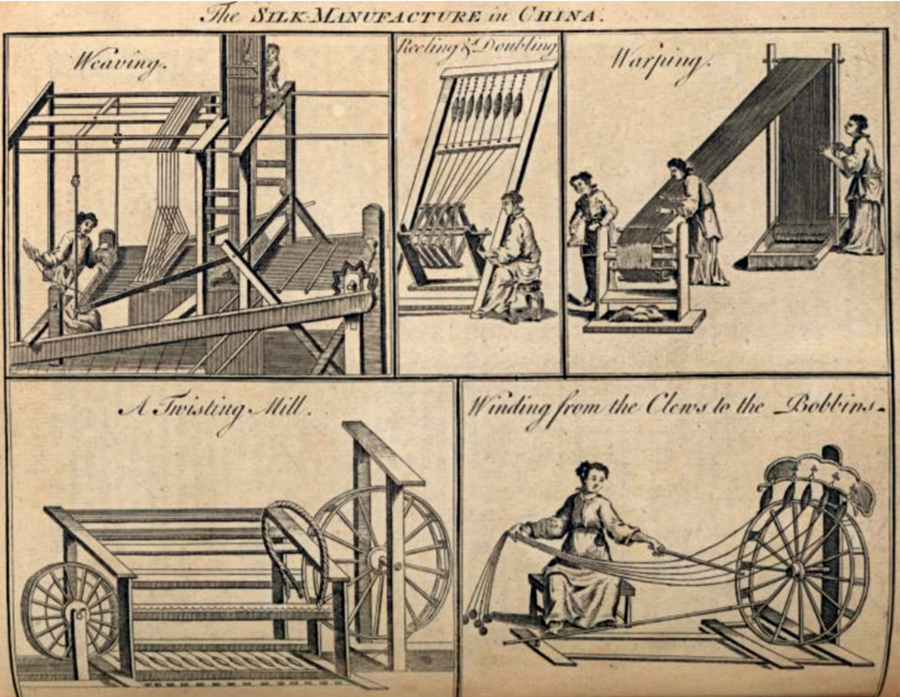
Figure 2.5 Silk Production in China in the Eighteenth Century. John Greene and Thomas Astley, “The Silk Manufacturing in China,” c. eighteenth-century engraving, New York Public Library Collection.
I hope our People will not be disheartened by a few Accidents, and such Disappointments as are incident to all new Undertakings, but persevere bravely in the silk Business till they have conquer’d all Difficulties. By Diligence and Patience the Mouse ate in twain the Cable. It is not two Centuries since it was as much a Novelty in France as it is now with us in North America, and the People as much unacquainted with it.140
The objective of an industry is to find a market for its product. It was no different for silk production. In order to facilitate sericulture, Franklin personally searched for silk markets. The following quote illustrates Franklin’s efforts at acquiring a market for silk products in North America:
Two Months’ Time was given to the Buyers, and I have now received the Money. You may therefore draw for the Ballance of the Account £210 10 s. 5½ d. on me, or in Case of my Absence on Browns & Collinson, Bankers, with whom I shall leave an Order to honour your Bill. I hear by several Hands that our Silk is in high Credit; we may therefore hope for rising Prices, the Manufacturers being at first doubtful of a new Commodity, not knowing till Trial has been made how it will work.141
With a remarkably busy schedule in Europe, Franklin did not have time to locate potential buyers. He worked with brokers in promoting the sale of silk. One time he told the silk company that the American silk he received should be sold soon. Following recommendations from a broker, Franklin “has sorted it into 4 Parcels, according to his opinions of its Difference in Perfection.”142
In 1782, at the age of seventy-six, Franklin remained concerned about marketing silk produced in North America. He commented to Edmund Clegg, a silk manufacturer, information on the silk prices in Europe. He told him that
when I was in London I had several Trunks of it consign’d to me for sale, and I remember it fetched at a publick Sale as high a Price within 6d. in the pound weight, as the Italian sold at the same time.143
Franklin’s efforts in promoting silk production in North America won him appreciation and respect from silk businessmen. Rebecca Haydock Garrigues, a silk businesswoman in Philadelphia, summarized their sentiments by saying that “I shall always esteem myself much obliged by Doctor Franklin’s kindness, in taking so much Trouble as he has done in getting the Silk made.”144 The Committee of the Managers of the Philadelphia Silk Filature were moved by Franklin’s efforts and showed their appreciation in a letter addressed to him:
We are sensible how much the promoters of the Culture of Silk are Obliged to Doctor Franklin for the trouble he has taken in the business; in their behalf, we thankfully Acknowledge it, and remain with perfect Esteem, his Assured ready Friends.145
Franklin had the whole of North America in his concern when he advocated for sericulture. For Franklin, having silk in Philadelphia and New England was not enough. He tried to push production throughout the colonies in North America. He pointed out that in Carolina and further south, “there is good hope for silk, as mulberry trees can grow even in New England. The bounty for silk culture continues.”146 In order to stimulate sericulture in New Jersey, he wrote to his son from London in May 1772: “I am glad to find such a Progress in [the making?] of Silk in Pennsylvania. I hope your Pro[vince will] take a Part in it. I think you sh[ould encou]rage the raising Cocoons in all your Towns.”147
In 1831, forty years after Benjamin Franklin passed away, J. H. Cobb published a manual on sericulture. The Congress of the United States bought copies of the manual and distributed it to its members. From that point on, “there was a determined effort to establish silk culture on a firm basis in the United States. This interest in silk culture soon led to what was known as the ‘Mormus multicaulis craze.’”148
Above, we briefly introduced Franklin’s great contribution to developing sericulture in North America. A question that might come to a reader’s mind would be why Franklin made such a great effort to push sericulture in North America. The readers who are familiar with Franklin know that silk had contributed to Benjamin Franklin’s scientific research in the field of electricity. In 1752, Franklin made an important experiment with electricity. The important instrument—the kite—was made of silk. Franklin well understood that “silk is fitter to bear the Wet and Wind of a Thunder Gust without tearing.”149 However, this episode of Franklin’s personal use of silk cannot alone answer this question. The best answer is from his correspondence with the Committee of the Managers of the Philadelphia Silk Filature. In Franklin’s mind, sericulture was a “great service to our country.”150
FRANKLIN USED CHINESE HEATING TECHNOLOGY AND MEDICAL THEORY TO IMPROVE HIS STOVE
During colonial times most Americans warmed their homes by building a fire in a fireplace. It was dangerous, and much wood was needed. Franklin surmised that there had to be a more efficient means for heating homes.151 By the 1740s, the growing population of the Colonies resulted in noticeable inroads on the great forests, which supplied fuel. The heating of houses was growing more expensive, while the wood used was very inefficient. This led to much of the heat—five-sixths, Franklin estimated in many cases—being lost up the chimney.152
Franklin carefully studied the Chinese technology of heating houses in the cold winters. He found that the northern Chinese had an ingenious method of warming their ground floors. Franklin told Jan Ingenhousz (1730–1799), a Dutch physiologist, biologist, and chemist, that
Europeans may still learn something about the use of stoves… from the Chinese, whose country being greatly populous and fully cultivated, has little room left for the growth of wood, and having not much fuel that is good, have been forced upon many inventions during a course of ages, for making a little fire go as far as possible.153
In the process of working on a new and efficient heating system, Franklin explored Chinese heating technology. In August 1785, he learned:
It is said the northern Chinese have a method of warming their ground floors, which is ingenious. Those floors are made of tiles, a foot square and two inches thick, their corners being supported by bricks set on end, that are a foot long and four inches square; the tiles, too, join into each other, by ridges and hollows along their sides. This forms a hollow under the whole floor, which on one side of the house has an opening into the air, where a fire is made, and it has a funnel rising from the other side to carry off the smoke. The fuel is a sulphurous pit coal, the smell of which in the room is thus avoided, while the floor, and of course the room is well warmed.154
Franklin did not just copy the Chinese technology. He examined it first, and then adopted the most suitable part of the technology. He noticed that the Chinese heating technology had some problems. For instance, “the underside of the floor must grow foul with soot, and a thick coat of soot prevents much of the direct application of the hot air to the tiles.”155 Franklin found the cause of this problem. Franklin found that the colonists’ way of warming their houses by “burning the smoke by obliging it to descend through red coals” was the reason.156
Franklin was not satisfied with finding the reason. He continued to investigate to find the solution to make Chinese heating systems more effective. He thought, if “the funnel close to the grate” was erected and “only an iron plate between the fire and the funnel, through which plate, the air in the funnel being heated, it will be sure to draw well, and force the smoke to descend.”157
Based on his analysis of Chinese heating technology, Franklin invented the Pennsylvania Fireplace. He dealt with the problem by integrating a number of passages and vents so that the apparatus drew in cold fresh air from outside the building and, after warming the air in a passage kept hot by the escaping gases of the fire, finally discharged it into the room.158
The main advantage of his new stove, Franklin maintained, was that the whole room was equally warmed; therefore, “people need not crowd so close round the fire, but many sit near the window, and have the benefit of the light for reading, writing, needle-work, &c.” People would be able to “sit with comfort in any part of the room.”159
It is interesting to imagine that Franklin used traditional Chinese medical theory as a guide when he renovated his stove. He told the colonists of the theory from the Tchang seng (The Art of Procuring Health and Long Life), a Chinese medical book:
As of all the Passions which ruffle us, Anger does the most Mischief; so of all the malignant Affections of the Air, a Wind that comes thro’ any narrow Passage, which is cold and piercing, is most dangerous; and coming upon us unawares, insinuates itself into the Body, often causing grievous Diseases. It should therefore be avoided, according to the Advice of the ancient Proverb, as carefully as the Point of an Arrow.160
Franklin then informed his readers that his newly invented Pennsylvania Fireplace aimed to avoid “these harms”161 This is fascinating. It would be a hasty conclusion to say that Franklin mastered traditional Chinese medical theory based on this single case. However, it is astonishing that Franklin was so familiar with the theory that he could apply it adroitly to justify the benefits of improving his fireplace. His improvement aimed to keep people not only warm in the cold winters, but physically healthier as well.
BENJAMIN FRANKLIN AND CHINESE NAVIGATION AND PAPERMAKING TECHNOLOGY
Franklin recognized the potential of Chinese technologies to improve their Western counterparts. Even near the end of his life, Franklin was impressed by Chinese navigation technology, and in particular, the traditional Chinese practice of “[dividing] the hold of a great ship into a number of separate chambers by partitions tightly caulked.”162 He recognized immediately that this Chinese technique of making vessels safer could be used to boost interaction between people in the world. “This being known would be a great encouragement to passengers.”163
He likened the method of “the division of ships into watertight sections to a proposal to institute passenger service between France and the United States.”164
Franklin stated that since the bottoms of vessels were used to “be laden with goods,” therefore, “their holds may without inconvenience be divided into separate apartments after the Chinese manner, and each of those apartments caulked tight so as to keep out water.”165 In a time when “a leak should happen in one apartment, that only would be affected by it, and the others would be free.” As a result, “the ship would not be so subject as others to founder and sink at sea.”
Franklin then wrote down Chinese innovations in shipbuilding and sent to a friend of his that using the Chinese method in ship making “had come to him in the seven times he had crossed the Atlantic.”166
Besides shipbuilding technology, Franklin also researched Chinese knowledge on rowing a boat. For Franklin, rowing a boat was not something new. He had showed his capability “to manage a boat” when he was a child.167 In old age, he was astonished by the Chinese way of rowing a boat. He recognized that the Chinese approach “differed from that customary in the West.” In the Chinese way, “the oars being worked two a-stern as we scull, or on the sides with the same kind of motion, being hung parallel to the keel on a rail and always acting in the water.” In Europe, rowing was perpendicular to the sides and lifted out at every stroke. As a result, the traditional European way “is a loss of time, and the boat in the interval loses motion.”168 In the end, Franklin concluded, the Chinese “see our manner, and we theirs.” However, neither the Chinese nor the Americans “are disposed to learn of or copy the other.”169
Franklin was not content with European paper manufacturing. He studied in detail the procedures, techniques, and equipment that Chinese workers used to make paper. Franklin wrote down the complete process of papermaking in China. First, the Chinese workers prepared “two large vats, each five ells long and two ells wide, made of brick, lined with a plaster that holds water.” Then they made pulps ready by the side. Next, between the vats was a kiln or stove with two sloping sides larger than the sheet of paper. The sloping covers were “with a fine stucco that takes a polish, and are so contrived as to be well heated by a small fire circulating in the walls.”170 He carefully examined the mold. He observed that
the mould is made with thin but deep sides, that it may be both light and stiff: It is suspended at each end with cords that pass over pullies fastened to the ceiling, their ends connected with a counterpoise nearly equal the weight of the mould.171
The most important part was the operating procedure. He discovered that in China’s paper mills, two workers at each end of the mold would lift “it out of the water by the help of the counterpoise, turn it and apply it with the stuff for the sheet, to the smooth surface of the stove, against which they press it.” After the paper was dried by the hot wall, a worker would take off “the dried sheet by rolling it up.” Because of that “the side next the stove receives the even polish of the stucco, and is thereby better fitted to receive the impression of fine prints.”172 Because the kiln had two polished sides and the two vats by the side, therefore, “the same operation is at the same time performed by two other men at the other vat; and one fire serves.”173 The operation would allow workers to get a great sheet of smooth and well-sized paper, with as a result “a number of the European operations saved.”174
To conclude, Chinese knowledge had produced deep and far-reaching influence on American society during the colonial and early republic periods. China became an essential center of resources for the founders’search for suggestions on technical innovation. When Franklin intended to upgrade certain technologies that the Americans carried over from Europe, he would seek illumination from the East. They would find whether there was any related information from China that could benefit them with their efforts. In order to establish the silk industry in North America, Benjamin Franklin put great energy into familiarizing himself with Chinese silk technology. The scope of his borrowing from Chinese inventions was extremely broad, from daily necessities, such as candles, bean curd, and vinegar, to essential industry, including silk production, heating, and navigation technologies. The time span over which Franklin used Chinese technology stretched from his youth to his senior years. The fact that Franklin studied Chinese navigation and papermaking technologies in his senior years, merely a couple of years before his death, tells that Franklin had trained in himself a habit of looking for insight from Chinese sources throughout his life.
When assimilating Chinese architectural design into his work, Jefferson understood that the elements from Chinese culture could play a particularly important and positive role in his efforts to develop the new style of architecture. He viewed the integration of Chinese elements in his own building as an attempt to develop a new identity for the nation. Therefore, he refused to copy the English style in his buildings. All these activities illuminate the Founding Fathers’ initiative in using Chinese civilization to facilitate social development in North America.
NOTES
1. Leonard W. Labaree and William B. Willcox, eds., The Papers of Benjamin Franklin (New Haven: Yale University Press, 1959–), 9:82, 10:182–88, 389, 11:230, 12:11–12, 17:107, 18:188, 19:69, 136, 138, 268, 20:442–43; Albert H. Smyth, ed., The Writings of Benjamin Franklin (New York: MacMillan, 1905–1907), 8:24; John Bigelow, ed., The Works of Benjamin Franklin (New York: G. P. Putnam’s Sons, 1904), 11:177–78; Jonathan Goldstein, Philadelphia and the China Trade, 1682–1846: Commercial, Cultural, and Attitudinal Effects (University Park: Pennsylvania State University Press, 1978), 7, 15; George W. Coner, ed., The Autobiography of Benjamin Rush (Princeton, NJ: American Philosophical Society, 1948), 175–76. Others outside Philadelphia also looked to China as a model. James Madison took an interest in the intensive agricultural techniques of the Chinese. The James Madison Letters (New York, 1884), 3:80, 90, 209.
2. Kenneth Latourette, The History of Early Relations between the United States and China (New Haven: Yale University Press, 1917), 124.
3. The three eclipses noted here are also listed in Poor Richard for 1761 or 1762, with Philadelphia times very roughly corresponding to those given here after allowing for the difference in longitude from Canton. See “Notes on Reading an Account of Travel in China, [1762?],” Founders Online, National Archives, https://founders.archives.gov/documents/Franklin/01-10-02-0098. Original source: The Papers of Benjamin Franklin, ed. Leonard W. Labaree, vol. 10, January 1, 1762, through December 31, 1763 (New Haven and London: Yale University Press, 1959), 182–83.
4. “From Benjamin Franklin to Peter Franklin, [1762?–1764],” Founders Online, National Archives, https://founders.archives.gov/documents/Franklin/01-10-02-0099. Original source: The Papers of Benjamin Franklin, ed. Leonard W. Labaree, vol. 10, January 1, 1762, through December 31, 1763 (New Haven and London: Yale University Press, 1959), 183–84.
5. “From Benjamin Franklin to Thomas Gilpin, March 18, 1770,” Founders Online, National Archives, https://founders.archives.gov/documents/Franklin/01-17-02-0053. Original source: The Papers of Benjamin Franklin, ed. William B. Willcox, vol. 17, January 1 through December 31, 1770 (New Haven and London: Yale University Press, 1973), 103–9.
6. “From Benjamin Franklin to John Bartram, 11 January 1770,” Founders Online, National Archives, https://founders.archives.gov/documents/Franklin/01-17-02-0010. Original source: The Papers of Benjamin Franklin, ed. William B. Willcox, vol. 17, January 1 through December 31, 1770 (New Haven and London: Yale University Press, 1973), 22–23. The account he mentioned was by Domingo Fernandez Navarrete (1618–1686), a Jesuit missionary to China, who published his work in Spanish in 1676. It was translated into English by Awnsham and John Churchill, published in 1704, and subsequently republished; Franklin probably encountered it in the third edition: A Collection of Voyages and Travels… (6 vols., London, 1744–1746), i, 1–311. Tau-fu or teufu was there described (p. 252) as a paste of kidney beans, as it was in the original Spanish; where bf got hold of garavances we have no idea. (The above notes from original source: The Papers of Benjamin Franklin, ed. William B. Willcox, vol. 17, January 1 through December 31, 1770 (New Haven and London: Yale University Press, 1973), 22–23.
7. “Notes on Reading an Account of Travel in China, [1762?],” Founders Online, National Archives, https://founders.archives.gov/documents/Franklin/01-10-02-0098. Original source: The Papers of Benjamin Franklin, ed. Leonard W. Labaree, vol. 10, January 1, 1762, through December 31, 1763 (New Haven and London: Yale University Press, 1959), 182–83.
8. “From Thomas Jefferson to Benjamin Franklin Bache, 29 September 1794,” Founders Online, National Archives, https://founders.archives.gov/documents/Jefferson/01-28-02-0121. Original source: The Papers of Thomas Jefferson, ed. John Catanzariti, vol. 28, 1 January 1794–29 February 1796 (Princeton: Princeton University Press, 2000), 168–69.
9. “Margaret Bayard Smith’s Account of a Visit to Monticello, (July 29–August 2, 1809),” Founders Online, National Archives, https://founders.archives.gov/documents/Jefferson/03-01-02-0315. Original source: The Papers of Thomas Jefferson, Retirement Series, ed. J. Jefferson Looney, vol. 1, 4 March 1809 to 15 November 1809 (Princeton: Princeton University Press, 2004), 386–401.
10. “Pay Book of the State Company of Artillery, [1777],” Founders Online, National Archives, https://founders.archives.gov/documents/Hamilton/01-01-02-0350. Original source: The Papers of Alexander Hamilton, ed. Harold C. Syrett, vol. 1, 1768–1778 (New York: Columbia University Press, 1961), 373–412.
11. “September 1784,” Founders Online, National Archives, https://founders.archives.gov/documents/Washington/01-04-02-0001-0001. Original source: The Diaries of George Washington, ed. Donald Jackson and Dorothy Twohig, vol. 4, September 1, 1784–June 30, 1786 (Charlottesville: University Press of Virginia, 1978), 1–54.
12. Ibid.
13. Ibid.
14. “[July 1774],” Founders Online, National Archives, https://founders.archives.gov/documents/Washington/01-03-02-0004-0013. Original source: The Diaries of George Washington, ed. Donald Jackson, vol. 3, January 1, 1771–November 5, 1781 (Charlottesville: University Press of Virginia, 1978), 259–64.
15. Craig R. Hanyan, “China and the Erie Canal,” Business History Review 35, no. 4 (1961): 558–66. https://www.jstor.org/stable/3111758?seq=1.
16. “From Benjamin Franklin to Thomas Gilpin, March 18, 1770,” Founders Online, National Archives, https://founders.archives.gov/documents/Franklin/01-17-02-0053. Original source: The Papers of Benjamin Franklin, ed. William B. Willcox, vol. 17, January 1 through December 31, 1770 (New Haven and London: Yale University Press, 1973), 103–9.
17. Ibid.
18. Hanyan, “China and the Erie Canal.”
19. “Address to the Agricultural Society of Albemarle, May 12, 1818,” Founders Online, National Archives, https://founders.archives.gov/documents/Madison/04-01-02-0244. Original source: The Papers of James Madison, Retirement Series, ed. David B. Mattern, J. C. A. Stagg, Mary Parke Johnson, and Anne Mandeville Colony, vol. 1, March 4, 1817–January 31, 1820 (Charlottesville: University Press of Virginia, 2009), 260–85.
20. Ibid.
21. Ibid.
22. Benjamin Rush to Thomas Bradford, April 15, 1768, in Letters of Benjamin Rush, ed. L. H. Butterfield (Princeton: Princeton University Press, 1951), 1:54.
23. Philadelphia Museum of Art Exhibition, Colonial Philadelphia Porcelain: The Art of Bonnin and Morris, March 8–June 1, 2008.
24. “Pay Book of the State Company of Artillery, [1777],” 373–412.
25. See https://cn.nytimes.com/china/20161230/great-wall-china/en-us/.
26. Arthur Waldron, “The Problem of The Great Wall of China,” Harvard Journal of Asiatic Studies 43, no. 2 (1983): 652.
27. Arthur Waldron, The Great Wall of China: From History to Myth (Cambridge and New York: Cambridge University Press, 1990), 203–4; J. A. Boyle, “The Alexander Legend in Central Asia,” Folklore 85, no. 4 (1974).
28. Livre des merveilles du monde (Book of the Marvels of the World, also known as The Travels of Marco Polo).
29. Waldron, Great Wall of China, 204.
30. Ibid.
31. Ibid.
32. Private letter published in the Family Memoirs of the Rev. William Stukeley (1887), vol. 3, 1754, 142.
33. Henry Yule, ed., “Cathay and the way thither: being a collection of medieval notices of China.” Works issued by the Hakluyt Society, issues 36–37 (London: T. Richards, 1866), 579. This section is the report of G ó is’s travel, as reported by Matteo Ricci in De Christiana expeditione apud Sinas (published 1615, annotated by Henry Yule).
34. Waldron, Great Wall of China, 206.
35. Voltaire, The Philosophical Dictionary, selected and trans. H. I. Woolf (New York: Knopf, 1924), https://history.hanover.edu/texts/voltaire/volancie.html.
36. J. B. Du Halde, The General History of China (London: J. Watts, 1741), II:76.
37. Alain Peyrefitte, The Immobile Empire (New York: Knopf Doubleday, 2013), 183–85.
38. George L. Staunton, An Authentic Account of an Embassy from the King of Great Britain to the Embassy of China (London: G. Nicol, 1797), 184.
39. Mercy Otis Warren, History of the Rise, Progress, and Termination of the American Revolution (Indianapolis: Liberty Fund, 1805), 313–14.
40. Dave Wang, “Benjamin Franklin and the Great Wall of China,” Franklin Gazette 18, no. 1 (Spring 2008).
41. David M. Kennedy and Lizabeth Cohen, The American Pageant, vol. 1 (Boston: Cengage Learning, 2012), 78.
42. Richard Middleton and Anne Lombard, Colonial America: A History to 1763, 4th ed. (Hoboken, NJ: Wiley-Blackwell, 2011), 390–91.
43. Daniel Richter, Before the Revolution: America’s Ancient Pasts (Cambridge, MA: Belknap Press, 2011), 373–74.
44. A friend to the true interests of Britain in North America, Williamsburg Virginia Gazette, January 14, 1773. Jonah Bader, The Failure of America’s First “Chinese Wall,” http://thepolitic.org/the-failure-of-americas-first-chinese-wall/; Benjamin Lieberman, Remaking Identities: God, Nation, and Race in World History (Lanham, MD: Rowman & Littlefield, 2013), 173.
45. Alan Taylor, American Revolutions: A Continental History, 1750–1804 (New York and London: Norton, 2016), 85.
46. Ibid.
47. Ibid, 86.
48. Great Britain, The Proceedings Before the Judicial Committee of Her Majesty Imperial Privy Council on the Special Case Respecting the Westerly Boundary of Ontario: Argued 15 th, 16 th, 17 th, 19 th, 21 st and 22 nd July 1884, with Notes of Explanation and Correction. Printed by Order of the Legislative Assembly of [Ontario].
49. Great Britain, The Parliamentary History of England from the Earliest Period to the Year 1803, vol. 18 (London: T. C. Hansard, 1813), 657.
50. Ibid.
51. “To Benjamin Franklin from the Chevalier de Kermorvan, [August 12, 1776?],” Founders Online, National Archives, http://founders.archives.gov/documents/Franklin/01-22-02-0328.
52. Benjamin Franklin, The Interest of Great Britain Considered, with Regard to her Colonies, And the Acquisitions of Canada and Guadaloupe. To which are added, Observations concerning the Increase of Mankind, Peopling of Countries, &c. London: Printed for T. Becket, at Tully’s Head, near Surry-Street in the Strand. MDCCLX. (Yale University Library); draft (five scattered pages only): American Philosophical Society, http://franklinpapers.org/franklin/framedVolumes.jsp.
53. As for Franklin’s efforts to draw positive elements from Chinese civilization in his efforts to build North American colonies, please see Dr. Dave Wang’s published papers in the following: “Exploring Benjamin Franklin’s Moral Life,” Franklin Gazette, Spring 2007; “Benjamin Franklin and Chinese Civilization,” U.S. – China Relation Series, No. 2 (New York: Outer Sky Press, August 2006); “Benjamin Franklin’s Attitude toward Chinese Civilization,” Social Science Journal of Harbin Institute of Technology, Issue 4, 2006; “Benjamin Franklin and China: A Survey of Benjamin Franklin’s Efforts at Drawing Positive Elements from Chinese Civilization during the Formative Age of the United States,” which is published since 2005 by the Official Website of the Tercentenary Commission, http://www.benfranklin300.org/etc_essays.htm.
54. Benjamin Franklin, to John Bartram, ALS: Central Library, Salford, England; draft: American Philosophical Society, London, August 22, 1772, in the Papers of Benjamin Franklin, http://franklinpapers.org/franklin/framedVolumes.jsp.
55. Benjamin Franklin, Provincial Commissioners to Robert Hunter Morris, June 13, 1756. Pennsylvania Historical and Museum Commission.
56. Memoirs of the Life & Writings of Benjamin Franklin (London: J. M. Dent & Sons Ltd.; New York: E. P. Dutton & Co., 1908), 174.
57. Ibid.
58. Benjamin Franklin, to Deborah Franklin, ALS: American Philosophical Society Bethlehem, January 15, 1756.
59. His brief biography is available at http://en.wikipedia.org/wiki/Samuel_Rhoads.
60. Benjamin Franklin, to Samuel Rhoads, reprinted from the Historical Magazine, 2nd series, I (May 1867), 284–85. Fort Allen, January 26, 1756.
61. Benjamin Franklin, to Robert Hunter Morris, Pennsylvania Historical and Museum Commission. Fort Allen at Gnadenhutten, January 26, 1756.
62. Ibid.
63. Benjamin Franklin, Pennsylvania Assembly: Reply to the Governor, Printed in Votes and Proceedings of the House of Representatives, 1755–1756 (Philadelphia, 1756), 92.
64. The Autobiography of Benjamin Franklin, Poor Richard’s Almanac and Other Papers (Reading, PA: Spencer Press, 1936), 196–97.
65. Benjamin Franklin, to Robert Hunter Morris, LS: Historical Society of Pennsylvania Bethlehem, January 14, 1756.
66. His brief biography is available at http://en.wikipedia.org/wiki/Charles_Thomson.
67. Benjamin Franklin, to William Parsons ALS: American Philosophical Society Philadelphia, February 22, 1757.
68. His brief biography is available from http://en.wikipedia.org/wiki/Isaac_Norris.
69. From Isaac Norris, Fairhill, January 4, 1760, Letterbook copy: Historical Society of Pennsylvania, in the Papers of Benjamin Franklin.
70. Franklin, Interest of Great Britain Considered.
71. Benjamin Franklin, to John Bartram, ALS: Central Library, Salford, England; draft: American Philosophical Society London, August 22, 1772. In The Papers of Benjamin Franklin, http://franklinpapers.org/franklin/framedVolumes.jsp.
72. The correspondence from Chevalier de Kermorvan (1740–1817) tells that he received Franklin’s recommendation that a wall like the Great Wall of China should be erected in defending the independent nation. Franklin’s letter has disappeared. See “To Benjamin Franklin from the Chevalier de Kermorvan, [12 August 1776?],” Founders Online, National Archives (http://founders.archives.gov/documents/Franklin/01-22-02-0328).
73. See “The French Volunteers and Supporters of the American Revolution,” http://xenophongroup.com/mcjoynt/volunt.htm.
74. Chevalier de Kermorvan, from the Chevalier de Kermorvan, ALS: American Philosophical Society [August 12? 1776.]. In The Papers of Benjamin Franklin, http://franklinpapers.org/franklin/framedVolumes.jsp.
75. Harrison Clark, All Cloudless Glory: The Life of George Washington, vol. 2: Making a Nation (Washington, DC: Regnery Publishing 1996), 197.
76. Joseph J. Ellis, American Dialogue: The Founding Fathers and Us (New York: Alfred A. Knopf, 2018), 181.
77. Roger Ginn, New England Must Not Be Trampled On: The Tragic Death of Jonathan Cilley (Lanham, MD: Rowman & Littlefield, 2016), 14.
78. Robert Remini, A Short History of the United States (New York: Harper Perennial, 2008), 61.
79. Ellis, American Dialogue, 191.
80. “From George Washington to Timothy Pickering, July 1, 1796,” Founders Online, National Archives, http://founders.archives.gov/documents/Washington/99-01-02-00674. This is an Early Access document from The Papers of George Washington.
81. Ibid.
82. Ibid.
83. Ellis, American Dialogue, 180.
84. “Appendix D. Inventory of the Books in the Estate, c.1759,” Founders Online, National Archives, https://founders.archives.gov/documents/Washington/02-06-02-0164-0026. Original source: The Papers of George Washington, Colonial Series, ed. W. W. Abbot, vol. 6, September 4, 1758–December 26, 1760 (Charlottesville: University Press of Virginia, 1988), 283–300.
85. Great Britain, Parliamentary History of England.
86. Albert Bushnell Hart, “The Monroe Doctrine and the Doctrine of Permanent Interest,” American Historical Review 7, no. 1 (October 1901): 77–91.
87. William J. Brinker, “Commerce, Culture, and Horticulture: The Beginnings of Sino-American Cultural Relations,” in Aspects of Sino-American Relations since 1784, ed. Thomas H. Etzold (New York and London: New Viewpoints, A Division of Franklin Watt, 1978), 5.
88. Ellen Paul Denker, After the Chinese Taste: China’s Influence in America, 1730–1930 (Salem, MA: Peabody Museum, 1985), 7.
89. Alice R. Huger Smith and D. E. Huger Smith, The Dwelling Houses of Charleston, South Carolina (Philadelphia and London: J.B. Lippincott Company, 1917), 357–58.
90. Fiske Kimball, Domestic Architecture of the American Colonies and of the Early Republic (New York: Charles Scribner’s Sons, 1927), 138. See Kimball, Thomas Jefferson: Architect, Original Designs in the Coolidge Collection of the Massachusetts Historical Society with an Essay and Notes (New York: Da Capo Press, 1968), 35.
91. David Watkin, The English Vision—The Picturesque in Architecture, Landscape and Garden Design (London: Breslich & Foss, 1982), 31–33.
92. Brinker, “Commerce, Culture, and Horticulture,” 11–12.
93. Julian Ursyn Niemcewicz, Vine and Fig Tree: Travels Through America 1797–1799, 1805 with some Further Account of Life in New Jersey, trans. and ed. with an introduction and notes by Metchie J. E. Budka (Elizabeth, NJ: Grassmann Publishing Company, Inc, 1965), 62–63.
94. Marie Kimball, Jefferson: The Road to Glory, 1743 to 1776 (New York: Coward-McCann, Inc., 1943), 148; Thomas Whately, Observations on Modern Gardening (London: Boydell Press, 1770), 120 and 127–28.
95. Kiesten Larsen Davis,” Secondhand Chinoiserie and the Confucian Revolutionary: Colonial America’s Decorative Arts ‘after the Chinese Taste’” (master’s thesis, Brigham Young University, 2008), 17.
96. “Architectural Side of Thomas Jefferson,” USA Today Magazine 122, no. 2583 (December 1993), 8.
97. Ibid.
98. Kimball, Thomas Jefferson: Architect, 130.
99. Kimball, Domestic Architecture, 234.
100. Kimball, Jefferson: The Road to Glory, 162.
101. Kimball, Thomas Jefferson: Architect, 126.
102. Thomas Jefferson, Thomas Jefferson Papers (Boston: Massachusetts Historical Society), 2003.
103. Kimball, Thomas Jefferson: Architect, figs. 161–62.
104. Karl Lehmann, Thomas Jefferson: American Humanist (New York: Macmillan, 1947), 170.
105. “Attending to My Farm”—Thomas Jefferson’s Monticello, https://www.monticello.org/thomas-jefferson/a-day-in-the-life-of-Jefferson/attending-to-my-farm/.
106. Claus Daufenbach, “Jefferson’s Monticello and the Poetics of Landscape Gardening,” Soundings: An Interdisciplinary Journal 78, no. 3/4 (Fall/Winter 1995): 405–6.
107. Ibid., 406.
108. Ibid.
109. Scott McBride, “Building a Chinese Railing,” Taunton ’ s Fine Homebuilding, July 2006, 76–77.
110. Thomas Jefferson: The Architect of a Nation, http://xroads.virginia.edu/~cap/jeff/jeffarch.html.
111. Ibid.
112. Robert W. Tucker and David C. Hendrickson, “Thomas Jefferson and American Foreign Policy,” Foreign Affairs 69, no. 2 (Spring 1990): 136.
113. Kenneth Hafertepe, “An Inquiry into Thomas Jefferson’s Ideas of Beauty,” Journal of the Society of Architectural Historians 59, no. 2 (June 2000), 221.
114. To James Madison, September 20, 1785, The Papers of Thomas Jefferson, ed. Julian Boyd, vol. 8, February 1785 to October 1785 (Princeton: Princeton University Press, 1953), 535.
115. Davis, “Secondhand Chinoiserie,” 61.
116. Silk Association of America, Annual Report, 1900, 32; Silk Association of America, Annual Report, 1908, 923–24.
117. Ibid., 1917, 19.
118. Ibid., 1906, 69.
119. Ibid., 1913, 36.
120. Bob Wyss, Connecticut’s Mulberry Craze, https://connecticuthistory.org/connecticuts-mulberry-craze/.
121. “Enclosure: Invoice of Goods to Robert Cary & Company, September 27, 1763,” Founders Online, National Archives, https://founders.archives.gov/documents/Washington/02-07-02-0153-0002. Original source: The Papers of George Washington, Colonial Series, ed. W. W. Abbot and Dorothy Twohig, vol. 7, January 1, 1761–June 15, 1767 (Charlottesville: University Press of Virginia, 1990), 253–57. “Invoice from Robert Cary & Company, February 13, 1764,” Founders Online, National Archives, https://founders.archives.gov/documents/Washington/02-07-02-0175. Original source: The Papers of George Washington, Colonial Series, ed. W. W. Abbot and Dorothy Twohig, vol. 7, January 1, 1761–June 15, 1767 (Charlottesville: University Press of Virginia, 1990), 287–95.
122. Charles M. Andrews, The Colonial Period of American History, England’s Commercial and Colonial Policy, With a New Introduction by Leonard W. Labaree (New Haven and London: Yale University Press, 1969), 330.
123. Benjamin Franklin, The Nature and Necessity of a Paper-Currency, A Modest Enquiry into the Nature and Necessity of a Paper-Currency. Philadelphia: Printed and Sold at the New Printing-Office, near the Market. 1729. (Historical Society of Pennsylvania). In The Papers of Benjamin Franklin, http://franklinpapers.org/franklin/framedVolumes.jsp.
124. Franklin, Interest of Great Britain Considered.
125. Benjamin Franklin, to Cadwalader Evans, reprinted from Samuel Hazard, ed., Hazard ’ s Register of Pennsylvania, XVI, no. 5 (August 1, 1835): 66–67, extract in American Philosophical Society Minutes. London, September 7, 1769. In The Papers of Benjamin Franklin, http://franklinpapers.org/franklin/framedVolumes.jsp.
126. In the eighteenth century, Thomas Lombe built the famous silk-throwing mill at Derby—built allegedly with Italian designs smuggled to England by his brother. This mill employed hundreds of workers and set the pattern for the spinning factories of future years. See M. Dorothy George, England in Transition, rev. ed. (Baltimore: Pelican, 1953), 103. See also Lilian M. Li, China ’ s Silk Trade: Traditional Industry in the Modern World, 1842–1937 (Cambridge, MA: Harvard University Press, 1981), 66.
127. Benjamin Franklin, Poor Richard improved: Being an Almanack and Ephemeris…for the Year of our Lord 1749… By Richard Saunders, Philom. Philadelphia: Printed and Sold by B. Franklin, and D. Hall (Yale University Library). In The Papers of Benjamin Franklin, http://franklinpapers.org/franklin/framedVolumes.jsp.
128. Ibid.
129. Benjamin Franklin, “Memoirs of the Cultures of Silk,” in The Papers of Benjamin Franklin, ed. Leonard Labaree, vol. 12 (New Haven and London: Yale University Press, 1968), 12.
130. Ibid.
131. Benjamin Franklin, to Cadwalader Evans, London, July 18, 1771, reprinted from Samuel Hazard, ed., Hazard ’ s Register of Pennsylvania, XVI, no. 5 (August 1, 1835): 92–93. In The Papers of Benjamin Franklin, http://franklinpapers.org/franklin/framedVolumes.jsp.
132. Ibid.
133. Benjamin Franklin, to Ezra Stiles, ALS: Universit ä tsbibliothek Leipzig, Sammlung Kestner, Philadelphia, December 12, 1763. In The Papers of Benjamin Franklin, http://franklinpapers.org/franklin/framedVolumes.jsp.
134. Ibid.
135. Wyss, Connecticut’s Mulberry Craze.
136. Benjamin Franklin, to Cadwalader Evans, Reprinted from Jared Sparks, ed., The Works of Benjamin Franklin… (10 vols., Boston, 1836–1840), VIII, 3–4. London, February 6, 1772. In The Papers of Benjamin Franklin, http://franklinpapers.org/franklin/framedVolumes.jsp.
137. Ibid.
138. Benjamin Franklin, to a Committee of the Managers of the Philadelphia Silk Filature ALS (letter book draft): Library of Congress, London, March 15, 1773. In The Papers of Benjamin Franklin, http://franklinpapers.org/franklin/framedVolumes.jsp.
139. From the Managers of the Philadelphia Silk Filature to Franklin and John Fothergill LS: American Philosophical Society, Philadelphia, November 8, 1771, http://franklinpapers.org/franklin/framedVolumes.jsp.
140. Benjamin Franklin, to Cadwalader Evans, London, July 4, 1771, reprinted from Samuel Hazard, ed., Hazard ’ s Register of Pennsylvania XVI, no. 5 (August 1, 1835): 92–93. In The Papers of Benjamin Franklin, http://franklinpapers.org/franklin/framedVolumes.jsp.
141. Benjamin Franklin, to a Committee of the Managers of the Philadelphia Silk Filature ALS: Historical Society of Pennsylvania; letter book draft: Library of Congress, London, July 14, 1773. In The Papers of Benjamin Franklin, http://franklinpapers.org/franklin/framedVolumes.jsp.
142. Benjamin Franklin, to Cadwalader Evans, ALS (letterbook draft): Library of Congress, London, April 6, 1773. In The Papers of Benjamin Franklin, http://franklinpapers.org/franklin/framedVolumes.jsp.
143. Benjamin Franklin, to Edmund Clegg, ALS: Elisha K. Kane, Pennsylvania (1956), Passy, April 26, 1782, http://franklinpapers.org/franklin/framedVolumes.jsp.
144. From Rebecca Haydock Garrigues, “ALS: American Philosophical Society, Philadelphia 5th Mo 20th 1773.” In The Papers of Benjamin Franklin, http://franklinpapers.org/franklin/framedVolumes.jsp.
145. From a Committee of the Managers of the Philadelphia Silk Filature, LS: American Philosophical Society Philadelphia, November 17, 1772, http://franklinpapers.org/franklin/framedVolumes.jsp.
146. Gottfried Achenwall, “Some Observations on North America from Oral Information by Dr. Franklin,” translated from “Einige Anmerkungen über Nordamerika, und über dasige Grosbritannische Colonien. (Aus mündlichen Nachrichten des Hrn. Dr. Franklins.),” Hannoverisches Magazin, 17tes, 18tes, 19tes, 31tes, 32tes Stücke (Feb. 27, Mar. 2, 6, Apr. 17, 20, 1767), cols. 257–96, 482–508 (Princeton University Library), http://franklinpapers.org/franklin/framedVolumes.jsp.
147. Benjamin Franklin, to William Franklin, ALS (letterbook draft): American Philosophical Society, London, May 5, 1772, http://franklinpapers.org/franklin/framedVolumes.jsp.
148. For more information regarding the history of the sericulture, see Sericulture by Dr. Ron Cherry, http://www.insects.org/ced1/seric.html.
149. Benjamin Franklin, “The Kite Experiment, I.” Printed in The Pennsylvania Gazette, October 19, 1752; also copy: The Royal Society. II. Printed in Joseph Priestley, The History and Present State of Electricity, with Original Experiments (London, 1767), 179–81, Franklin’s Statement, Philadelphia, October 19. In The Papers of Benjamin Franklin, http://franklinpapers.org/franklin/framedVolumes.jsp.
150. Benjamin Franklin, to a Committee of the Managers of the Philadelphia Silk Filature. ALS: Historical Society of Pennsylvania; letterbook draft: Library of Congress, London, July 14, 1773. In The Papers of Benjamin Franklin, http://franklinpapers.org/franklin/framedVolumes.jsp.
151. Benjamin Franklin: Glimpses of the Man, https://www.fi.edu/benjamin-franklin/resources.
152. Ronald W. Clark, Benjamin Franklin: A Biography (New York: Random House, 1983), 55.
153. Albert Henry Smyth, ed., The Writings of Benjamin Franklin, vol. IX, 1783–1788 (New York: McMillan, 1906), 434.
154. John Bigelow, ed., The Complete Works of Benjamin Franklin (New York: G. P. Putnam’s Sons, 1888), 243–45.
155. Ibid., 244.
156. Ibid., 243–45.
157. Ibid., 244.
158. Clark, Benjamin Franklin: A Biography, 55.
159. Ibid.
160. “An Account of the New Invented Pennsylvanian Fire-Places, [November 15, 1744],” Founders Online, National Archives, https://founders.archives.gov/documents/Franklin/01-02-02-0114. Original source: The Papers of Benjamin Franklin, ed. Leonard W. Labaree, vol. 2, January 1, 1735, through December 31, 1744 (New Haven: Yale University Press, 1961), 419–46. See also Du Halde, General History of China, IV:75.
161. Ibid.
162. Benjamin Franklin, to Julien-David LeRoy (unpublished), 1784. In The Papers of Benjamin Franklin, https://franklinpapers.org/framedVolumes.jsp.
163. Ibid.
164. Ibid.
165. Ibid.
166. Edmund S. Morgan, Benjamin Franklin (New Haven and London: Yale University Press, 2002), 7–8.
167. Louis P. Masur, ed., The Autobiography of Benjamin Franklin with RelatedDocuments, 2nd ed. (Boston and New York: Bedford/St. Martin’s, 2003), 34.
168. Benjamin Franklin, to Julien-David LeRoy.
169. Ibid., 89.
170. Benjamin Franklin “Description of Making Paper in the Chinese Manner” (unpublished) Friday, June 20, 1788. In The Papers of Benjamin Franklin, https://franklinpapers.org/framedVolumes.jsp?tocvol=45.
171. Ibid.
172. Ibid.
173. Ibid.
174. Ibid.