
APPENDIX
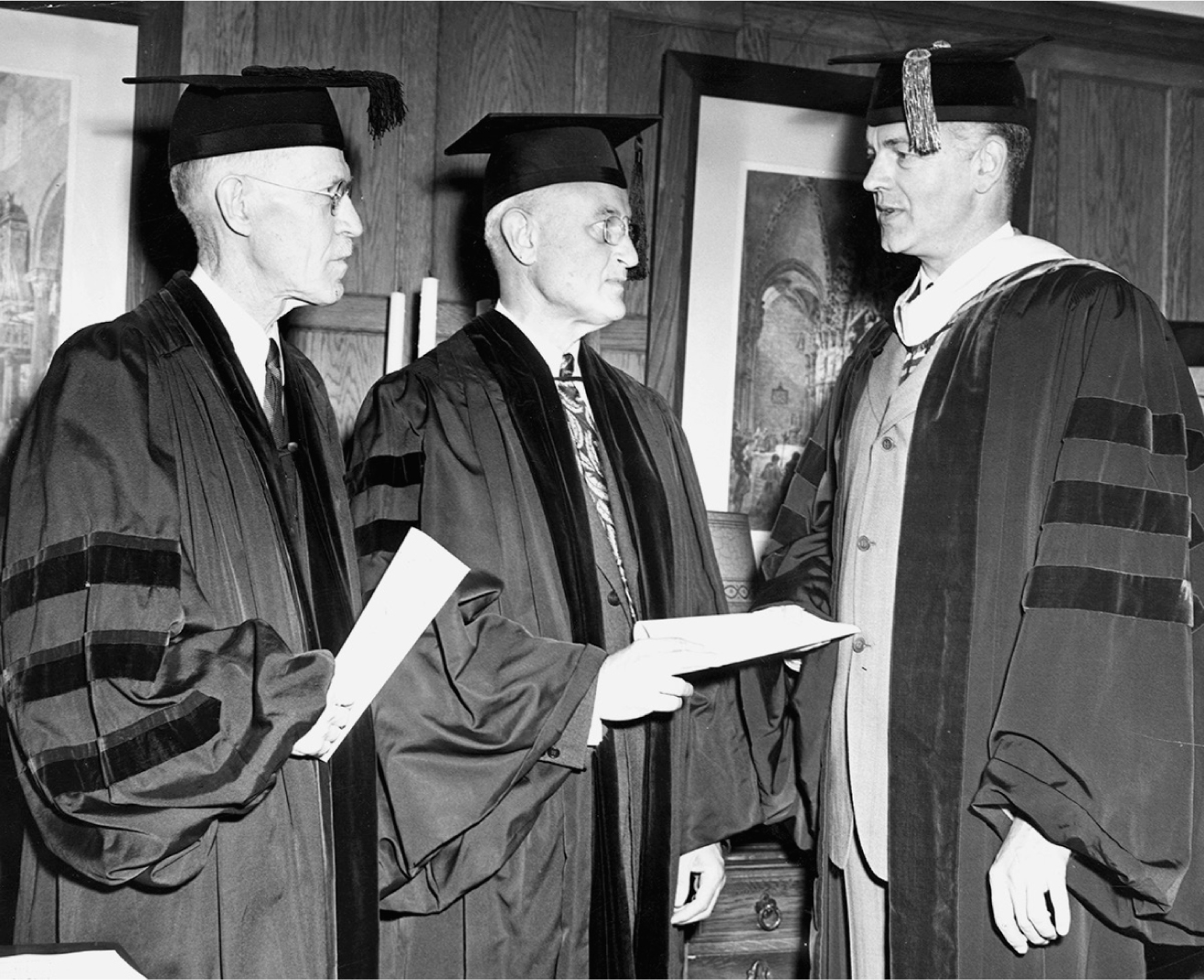
In the 1930s and 1940s, University of Chicago trustees (chairman Harold H. Swift, center) instructed chancellor Robert Maynard Hutchins (right) to ensure that neighborhoods near the campus were segregated. His father, William James Hutchins (left), president of the interracial Berea College in Kentucky, unsuccessfully advised his son to reject the demand.
A DECADE HAS PASSED since I began considering the account this book sets forth. During that time, I’ve consulted with friends, colleagues, and housing specialists. These discussions have influenced my thinking and, in some cases, modified my argument. But I’ve also encountered some objections that did not cause me to change my views. In what follows, I share many of these objections and my response to them.
You have painted a portrait of unconstitutional policies to segregate metropolitan areas, pursued in the twentieth century by government officials from the president to local police officers. But that was then; this is now. You can’t apply today’s standards to yesterday’s leaders, can you?
We can judge yesterday’s leaders by standards that were readily available to them in their own time. Whether from cowardice, expediency, or moral failure, they ignored prominent contrary voices.
African Americans consistently denounced their unconstitutional treatment. If you dismiss their protests on the ground that whites’ “standards of the time” meant ignoring black opinion, consider that many whites also condemned government promotion of segregation.
In 1914, as Woodrow Wilson was segregating federal offices, the National Council of Congregational Churches adopted a resolution condemning his policy. Howard Bridgman, editor of The Congregationalist and the Christian World wrote to Wilson that his actions violated Christian principles; the editor told his readers that protesting the administration’s segregation of the civil service was the “Christian white man’s duty.” Wisconsin Senator Robert La Follette’s magazine (now known as The Progressive) published a series of articles protesting Wilson’s racial policy.
During the New Deal, although Interior Secretary Harold Ickes oversaw segregated housing projects, he also desegregated the dining room in his department—reversing Wilson’s policy. Franklin Roosevelt’s labor secretary, Frances Perkins, did the same in her department. The army refused generally to accept skilled African Americans in the Civilian Conservation Corps, but Ickes and his deputy Clark Foreman hired skilled African Americans in CCC camps that were located in national parks, which were controlled by the Interior Department. Foreman also enraged influential politicians by hiring an African American secretary, the first in the federal bureaucracy. In radio broadcast attacks, Georgia governor Herman Talmadge excoriated Foreman for elevating a woman who, in the governor’s view, should properly be a janitor.
First Lady Eleanor Roosevelt, at times an outspoken integration advocate, occasionally challenged her husband’s administration policy. In 1939 she resigned her membership in the Daughters of the American Revolution after it barred the African American singer Marian Anderson from performing in its hall. She was the first white resident of Washington, D.C., to join the local NAACP chapter. Mrs. Roosevelt’s opposition to segregation was so well known (notorious, in many circles) that the FBI sent agents through the South to attempt to verify rumors that black domestic workers had formed “Eleanor Clubs” to advocate for higher wages and the right to eat at the same tables as the families they served.
During World War II, the Boilermakers excluded African Americans, but the United Auto Workers did not. Martin Carpenter, director of the U.S. Employment Service, reacted to Roosevelt’s 1941 fair practices order by consolidating separate white and African American employment offices in Washington, D.C. Congressmen threatened to hold up appropriations unless Carpenter abandoned his plan. He did so, but his attempt illustrates that segregation was not a uniform “standard of the time” but only a standard of many.
Some twentieth-century segregationists acknowledged their own hypocrisy. University of Chicago president Robert Maynard Hutchins worked to keep African Americans away from the university vicinity but claimed privately that he disagreed and was only following wishes of the university trustees. Hutchins later said that he “came nearer to resigning over this than over any other issue,” but he did not. He understood that invoking “standards of the time” could not justify acquiescence to the trustees’ views; he knew better.
If we excuse past leaders for rejecting nondiscrimination standards that were held by some, we undermine our constitutional system. The Bill of Rights and the Civil War Amendments exist to protect minorities and individuals from majority opinion, not from unanimous opinion. But it really doesn’t matter whether we blame Woodrow Wilson, Franklin Roosevelt, or their appointees for supporting segregation. No matter how conventional their racial policies were, they violated African Americans’ constitutional rights. The consequences define our racially separate living arrangements to this day, so it is up to our generations to remedy them, whether or not we fault particular historical figures.
I looked up the deed to my home and found it has a restrictive covenant prohibiting “non-Caucasians” from living there. Although the clause is unenforceable, it still bothers me. How can I remove it?
The difficulty and expense of eliminating restrictions from deeds varies by state. But even where it is practical, deleting them may not be the best approach. The covenants are an important reminder and educational device, which we still need. If you can modify a deed in your state, rather than removing it, you might consider adding a paragraph like this:
We, [your name], owners of the property at [your address], acknowledge that this deed includes an unenforceable, unlawful, and morally repugnant clause excluding African Americans from this neighborhood. We repudiate this clause, are ashamed for our country that many once considered it acceptable, and state that we welcome with enthusiasm and without reservation neighbors of all races and ethnicities.
I wasn’t even born when all this stuff happened. When my family came to this country, segregation already existed; we had nothing to do with segregating African Americans. Why should we now have to sacrifice to correct it?
Sherrilyn Ifill, president of the NAACP Legal Defense Fund, once responded to a similar question, saying, “Your ancestors weren’t here in 1776, but you eat hot dogs on the Fourth of July, don’t you?” What she was trying to convey is that Americans who preceded us fought for our liberty, sometimes giving their lives for it, yet we benefit without making similar sacrifices. When we become Americans, we accept not only citizenship’s privileges that we did not earn but also its responsibilities to correct wrongs that we did not commit. It was our government that segregated American neighborhoods, whether we or our ancestors bore witness to it, and it is our government that now must craft remedies.
It is normal for people to want to live among others with whom they share a common history and culture. There are neighborhoods that are mostly Jewish, or Italian, or Chinese. We African Americans want our own neighborhoods, too. Why are you trying to force us to integrate?
I cannot imagine a policy that would “force” African Americans to integrate, but we can offer incentives to do so. There should be subsidies for low-income African Americans who could not otherwise afford to leave minority neighborhoods. Middle-class African Americans who now live in lower-middle-class segregated areas should also receive incentives to move to integrated communities. Still, it is appropriate to wonder why we should go to great expense to persuade people to follow a policy that nobody, black or white, seems to want.
Surveys show that most African Americans prefer integrated neighborhoods. So do whites. But African Americans define an integrated community as one in which from 20 to 50 percent of residents are African American. Whites define it as one where they dominate—and in which only 10 percent of residents are African American. When a neighborhood exceeds an African American presence of more than 10 percent, whites typically start to leave, and soon it becomes overwhelmingly African American. If this is the likely result of attempts to integrate, it is hardly worth the bother.
Ten percent African American, though, is an insufficient integration goal because our major metropolitan areas have greater African American presence than that. In the Atlanta area, African Americans are 32 percent of the population; in Chicago, 17 percent; in Detroit, 23 percent; in New York–New Jersey–Connecticut, 15 percent. If we say that the share of African Americans in a stable integrated community is the average in their metropolitan area, plus or minus 10 percent, then if whites depart a suburb whenever it exceeds 10 percent, stable integration will be impossible. Integration can’t work if we try it only where African Americans remain invisible, or nearly so.
The idea that African Americans themselves don’t want to integrate is a white conceit. Many thousands of African Americans risked hostility, even violence, when daring to move into predominantly white neighborhoods. This history has generated considerable reluctance by other African Americans to try to follow them. When African Americans move to predominantly white neighborhoods today, they remain more likely to be stopped by police when driving home or kept under unusual surveillance in retail stores when shopping. Teachers are more likely to expect their children to be less capable and to be unqualified for challenging classes. African American pupils are often disciplined severely in integrated schools for minor misbehavior that, in the case of whites, schools ignore.
It is reasonable to expect that many, perhaps most African Americans will choose segregation unless they are welcomed into white communities whose interracial hospitality becomes widely known. Until then, African Americans’ avoidance of integration cannot be considered a free choice. Reform of police practices and school academic and disciplinary policies in predominantly white areas is essential, together with incentives for African Americans to take the chance of believing that those reforms are real.
But incentives alone will not suffice. To achieve an integrated society, African Americans too must take greater risks. A partner in a prestigious law firm once explained to me why she opposed my advocacy of integration: “I am a middle-class African American professional woman, and I want to live where I can be comfortable, where there are salons that know how to cut my hair, where I can easily get to my church, and where there are supermarkets where I can buy collard greens.”
No affluent middle-class suburb can be fully integrated overnight. So if my lawyer friend moved to an all-white suburb now, she won’t find the hairdresser, church, or supermarket she seeks. But once the neighborhood integrates, salons specializing in African American hair will open, and the supermarket will stock greens. She may initially have to return to her old neighborhood for church; this may be a price paid for the benefits of integration to herself, her children, and our nation.
Many white middle-class neighborhoods today have supermarket aisles with traditional Jewish, Italian, and Asian foods, even when Jews, Italians, or Asians remain a minority in the area. These items were not found, though, when the first members of these groups arrived. Some had to be pioneers. The law partner with whom I spoke may not want to be a pioneer, and she shouldn’t have to be if that is her choice. But to solve the economic, social, and political problems that de jure segregation perpetuates, some will have to go first. Although nobody should be forced to move out of a segregated neighborhood if he or she chooses to remain, government creates many incentives to persuade people to abandon harmful his narrow victory was a watershed event for that reason. Kennedy’s election, perhaps more than Barack Obama’s, shattered the white Protestant elite’s near-monopoly hold on political power.
The bigotry of this elite was not based merely on social class but also on race. After all, it was the integration of middle-class, not lower-class, African Americans, that most aroused FHA officials. In 1939, the National Association of Real Estate Boards, whose members furnished appraisers to the FHA, prepared a handbook for use in preparing brokers to take exams for licensure by state governments. The handbook warned brokers to be on guard against “a colored man of means who was giving his children a college education and thought they were entitled to live among whites.”
Don’t black people have to take more responsibility for their own success? Crime rates in black neighborhoods are high, and so whites will resist integration because they don’t want African Americans bringing crime into white neighborhoods. Young men join gangs and will sell drugs, even when jobs are available. Doesn’t black ghetto culture have to change before we can consider integration?
Certainly everyone—black, white, and others—should take greater responsibility for their own success. African Americans are no exception, and neither are white Americans.
Having agreed on that, let’s review some facts.
Most African American youths do take responsibility for their own success, and many work “twice as hard” to succeed. This responsibility and added effort frequently pay off—although the payoff is less than it is for whites. In 2014, of young (ages 25–29) adult African Americans, 21 percent of men and 24 percent of women were college graduates. High school completion rates are over 90 percent. This suggests that a focus on the antisocial behavior of a minority of African Americans is too convenient an excuse for not taking steps to integrate the majority.
The “war on drugs,” including the mass incarceration of young men and adolescent boys living in low-income African American neighborhoods, began in the 1970s. Current trends predict that as many as one in three African American men born today can expect to spend some time in prison during their lifetimes, most for nonviolent crimes. Considering this, it is surprising that the African American college graduation rate is as high as it is.
As Michelle Alexander reports in her important book, The New Jim Crow, young African American men are less likely to use or sell drugs than young white men, but they are more likely to be arrested for drug use or sale; once arrested, they are more likely to be sentenced; once sentenced, they are more likely to receive long jail terms. African American automobile drivers are no more likely than white drivers to change lanes without signaling, but they are more likely to be stopped by police for doing so, and once stopped, they are more likely to be caught up in the penal system, including jail time for inability to pay fines. The Justice Department’s investigation of Ferguson, Missouri, police practices found that African Americans were stopped by police more frequently than whites, but of those who were stopped and searched, more whites were found to be carrying illegal drugs than African Americans. If police wanted to increase their chances of finding drugs, they would be better off conducting “stop and frisk” operations in white than in black neighborhoods.
Imprisoning nonviolent offenders in low-income minority neighborhoods has a multigenerational effect. A parent’s absence harms a child’s early development and academic performance. Once young men leave prison, even after short sentences (and many are not short), they may have permanent second-class status, be unable to vote, get evicted from public housing, and be ineligible for food stamps. Their family relationships are likely frayed if not irreparably broken. Most companies won’t hire them. Barred from legitimate jobs, they are exposed to further incarceration when they attempt to earn a living in the underground economy.
We should not overemphasize the extent to which behavioral change can overcome ghetto conditions for which we, the broader community, are responsible. Lead poisoning is an example. Nationwide, African American children have dangerous and irreversible lead-in-blood levels at twice the rate of white children. The difference is attributable mostly to being trapped in neighborhoods with deteriorated housing stock, where lead paint peels from walls and lead pipes deliver water to homes and schools. When developing brains absorb lead (which then blocks necessary calcium), children’s ability to develop self-control diminishes. Lead poisoning predicts teenagers’ risky behaviors and young adults’ greater violent or criminal activity. Because Flint, Michigan, used a lead-polluted water supply in 2014 and 2015, for example, we can reasonably predict an uptick in violence when the city’s children (most of whom are African American) reach adolescence and young adulthood.
Certainly, it would be better if every young African American man resisted adopting an oppositional and alienated stance. But for all of us, reform of the political and economic institutions that encourage that posture is essential. Neither can wait upon the other.
Isn’t the real reason that African Americans can’t escape the ghetto that so many are single mothers who can’t or don’t raise their children properly? Shouldn’t we encourage them to wait until marriage to have children, so they will be better able to raise their children properly?
Government policies that segregated this nation were directed primarily at African American working- and middle-class two-parent families with children. Frank Stevenson and his family who were prohibited from living in Milpitas, Vince and Robert Mereday and their families who were prohibited from living in Levittown, Wilbur and Borece Gary, Bill and Daisy Myers, Andrew and Charlotte Wade, and thousands like them who were met with police-protected violence when they attempted to occupy their homes, were not single mothers with children. Single parenthood as a reason to resist integration is an afterthought, a rationalization for inaction.
Birth rates of African American women have been declining, much more rapidly for teenagers than for adults. Better education about contraception has helped delay first pregnancies. So have school programs that raise girls’ expectations about careers. But women of any race will not delay voluntary pregnancy indefinitely; their childbearing goals cannot be suppressed by moralizing or by education. Higher single-parenthood rates in low-income African American communities mostly result from a shortage of marriage partners for young adult women. Excessive incarceration and joblessness of young black men bear responsibility.
We may think of marriage as a romantic commitment, but it is also an economic institution. Two-parent families are likely to have a higher joint income to support and nurture children. A recent survey found that 78 percent of never-married women of all races who hoped to be married were seeking a spouse with a steady job; this characteristic was more important than having similar religious beliefs, child-rearing philosophies, education, or race. If a community’s young men have high unemployment (or only low-wage work), the mothers of their children will have little incentive to marry them. Today, among African Americans between the ages of twenty-five and thirty-four who have never been married, there are fifty-one employed males for every hundred females. For whites, Asians, and Hispanics, the number of employed men is approximately equal to the number of women. Unless the number of working, criminal-record-free men in African American neighborhoods increases, we are unlikely to succeed in reducing the number of women there who have children without the means to support and nurture them well.
White women have rising single-parenthood rates, but they also frequently have resources to hire assistance they need to raise children on their own. Also, a larger proportion of white than black “single” mothers are cohabiting with their children’s father; the institution of marriage has been declining among whites faster than the rate of intact two-parent families.
A curious aspect of white racial bigotry—the greater tendency of white women than men to marry black partners—exacerbates the problem. Of African American men who married in 2010, 24 percent married a woman who was not African American. But of African American women who married in that year, only 9 percent married a man who was not African American. This unique imbalance among race and ethnic groups has been consistent since the early twentieth century, when interracial marriages were even rarer than today. When gender-based intermarriage differences are added to higher incarceration and unemployment rates of young African American men, it is apparent that single motherhood among African Americans will remain high.
There are well-designed educational programs that aim to teach better parenting skills to low-income African American mothers, but Congress has not funded them on more than a token experimental scale. It is a bit cynical to say that we can’t support the integration of African American women into middle-class neighborhoods until they become better mothers, then fail to provide the support they want and need. And we have no right to wait until every low-income and poorly educated mother develops perfect parenting skills before we move to desegregate metropolitan areas. Middle-class whites aren’t perfect caregivers either, but for their children to succeed, the mothers only have to be half as good.
Why do you only talk about African Americans? Don’t other minorities face discrimination as well? Don’t Hispanics also live in segregated communities?
Two distinct problems are easily confused. One, the subject of this book, is the de jure segregation of African Americans that has yet to be remedied. The other is growing economic inequality, including housing prices and rents that are unaffordable in many middle-class communities to families of all races and ethnicities.
Although our history includes government-organized discrimination and even segregation of other groups, including Hispanics, Chinese, and Japanese, it was of a lesser degree, and is in the more distant past, than the de jure segregation experienced by African Americans.
First- and second-generation Hispanics (mostly Mexican but also from other Latin American countries) frequently live in ethnically homogenous low-income neighborhoods. But for the most part, few have been “segregated” in those neighborhoods—forced to live there by private discrimination or by government policies designed to isolate them.
Low-income immigrants have always lived for the first few generations in ethnic enclaves where their language is spoken, familiar foods are accessible, ethnic churches are nearby, and rent is relatively cheap for overcrowded apartments. This was the history of Irish, Jewish, Italian, Polish, Greek, and other immigrant groups that came to the United States with few skills but were willing to work hard at low wages to achieve economic security and ensure better lives for their children. It could not have been otherwise. Unskilled and poorly educated immigrants could not easily survive if dispersed throughout a foreign, unfamiliar, native population. In the third generation and beyond, descendants of immigrants typically have left ethnic neighborhoods and assimilated into the broader society. Assimilation does not mean losing a cultural identity, but the primary identity of these later generations has been as Americans.
To a considerable extent, this pattern characterizes twentieth-century Hispanic immigrants as well. Data are sparse that disaggregate results by immigrant generation, but what little we have supports this conclusion. For example, in 2010, 26 percent of all Hispanic newlyweds married non-Hispanics; for those born here (the second and subsequent generations), the rate was 36 percent. For the third generation and beyond, the rate is likely to be 40 percent and perhaps more. But data for black families, who have been Americans for centuries, are quite different: theirs is less than half the intermarriage rate of second-generation Hispanics.
Some studies conclude that Hispanic (and in particular Mexican) educational and economic improvement “stalls” after the second generation and that immigrants are not blending into the “white” middle class. These studies are flawed because they rely on surveys that ask respondents if they are “white,” “African American,” “Hispanic,” or “Asian” (or some other category). If third-generation-and-beyond Hispanics reply that they are “white,” data on their education and income are not included in the “Hispanic” category. The most assimilated descendants of Mexican immigrants—those with the most education or highest incomes and those who have married non-Hispanics—are more likely to cease identifying themselves as Hispanics, resulting in underestimates of the third-generation-and-beyond’s assimilation.
Mexican immigrants, Mexican Americans, and Puerto Ricans were also sometimes segregated de jure by government policy, brutalized by police, prohibited from entering white eating, retail, or entertainment establishments, and mistreated when they served in the armed forces. In some cases, especially in Texas, they were segregated in schools. Today many low-income Hispanic youth living in neighborhoods of concentrated disadvantage have a toxic relationship with police that is similar to that of African American youth, and for many of the same reasons.
Yet horrific though our treatment of Mexican immigrants and Puerto Ricans has sometimes been, it is not comparable to our treatment of African Americans. In many communities, restrictive covenants prohibited sales not only to African Americans but also to Hispanics (and frequently to Jews, the Irish, Asians, and others deemed “non-Caucasians”). Yet judges often deemed Mexican Americans to be “Caucasians” and not subject to exclusion by restrictive covenants. As the twentieth century progressed, property and residency restrictions mostly faded away for all except African Americans. Only African Americans have been systematically and unconstitutionally segregated for such a long period, and with such thorough repression, that their condition requires an aggressive constitutional remedy.
Certainly, Hispanics still suffer discrimination, some of it severe. Bilingual education programs smooth the transition to English for low-income immigrant children, but nativist-driven campaigns have severely restricted the use of this proven pedagogy. Nearly one in four Hispanics seeking to buy or rent homes still meet with discrimination from real estate agents or landlords. In some cases, municipal officials target Hispanic immigrant households for selective building code enforcement. Under the eye of regulators, banks discriminatorily marketed subprime loans to Hispanic as well as to African American families.
Although in many respects the experience of low-income immigrant Hispanics is similar to that of earlier European immigrant groups, those groups experienced periods of broadly shared prosperity. After European immigrants, or their descendants, returned as veterans from World War II, production and nonsupervisory workers experienced a quarter-century of wage growth that averaged 2.3 percent a year, helping them to establish firm footings in the American middle class. Since 1973, there has been no wage growth whatsoever for production and nonsupervisory workers.This trend, not unremedied de jure segregation, is what may prevent late twentieth-century immigrants from fully following in the path of those who came before.
In metropolitan areas, many first- and second-generation Hispanics live in neighborhoods with high proportions of poor and low-income families. Good social policy should facilitate their movement, as soon as they are ready, out of such low-opportunity neighborhoods. The reforms needed to restrain the Section 8 and Low-Income Housing Tax Credit programs from confining African Americans to high-poverty and poorly resourced neighborhoods should do the same for recent Hispanic immigrants.
Creating greater opportunity for low-income Hispanic immigrants is sound social policy; creating greater opportunity for African Americans is sound social policy as well but is also constitutionally required to remedy de jure segregation.
A healthy American society requires both desegregation of African Americans and a more egalitarian, growth-oriented economy to benefit all low-income families. De jure segregation and blocked economic opportunity are two distinct problems. We should address each one.
Isn’t all your talk about desegregating neighborhoods a form of “social engineering”? When government tries to enact such transformations, aren’t there often unintended and harmful consequences?
Desegregation would attempt to reverse a century of social engineering on the part of federal, state, and local governments that enacted policies to keep African Americans separate and subordinate. Too few whites were terribly concerned with that kind of social engineering, and it’s a bit unseemly to make that objection now.
Without minimizing the unfairness that some may suffer as an unintended consequence of desegregation, we should not be more concerned with that unfairness than with the harm that befalls African Americans, and all of us, when we fail to cleanse the nation of a residential organization that is incompatible with the letter and spirit of our Constitution.
The biggest problem facing African Americans today is the gentrification of their neighborhoods, leaving low-income families nowhere to go. What can we do about that?
As higher-income whites rediscover the benefits of urban life, demand for housing in many formerly African American and immigrant neighborhoods is rising. Higher rents and property taxes force lower-income families to leave. Before all leave, gentrification seems to create integrated communities. But this phenomenon is mostly temporary, lasting only until the replacement of lower-income with higher-income families is complete.
Most low-income families forced out of gentrifying neighborhoods have nowhere else to go, except to a few segregated suburbs where they soon become concentrated because other locales prohibit or excessively restrict the construction of affordable units. If apartments exist in middle-class suburbs, rents are usually too high for families displaced from urban areas, or else landlords are permitted to discriminate against African Americans and Hispanics in the guise of refusing to accept Section 8 vouchers.
Gentrification would be a positive development if it were combined with inclusionary zoning policies to preserve affordable housing in every neighborhood. But such policies are rare or weak. Inclusionary zoning should also be required of presently exclusionary suburbs. Were that to happen, all neighborhoods could make progress toward integration.
The writer Ta-Nehisi Coates says we should pay reparations to African Americans. Is that what you are proposing?
In several articles in The Atlantic, Ta-Nehisi Coates has made a “case for reparations” to African Americans who continue to suffer the effects of slavery and segregation. In a January 2016 article, Coates reported surveys showing that 64 percent of white Americans think the legacy of segregation is either a “minor factor” or “no factor at all” in today’s white-black wealth gap. Until Americans overcome this collective amnesia, Coates writes, it is pointless to debate specific proposals. If we do overcome this amnesia, then we can have productive conversations about how to address that legacy.
I prefer the term remedies to reparations to describe policies that could make African Americans, and all Americans, whole for the constitutional violations that segregated the nation. To my ear, and it may only be mine, reparations sounds more like a generalized one-time payment to African Americans for their exploitation.
We cannot compensate for de jure segregation through litigation—rather, it will require a national political consensus that leads to legislation. But the concept of remedies to make victims whole is a familiar one in our legal system. I also prefer the term remedies because they also include policies that do not involve payments. While we should subsidize homeownership for African Americans in suburbs from which they were once banned, we should also require repeal of exclusionary zoning ordinances that prevent the construction of affordable homes in such suburbs. “Affirmative action” in education and employment is also constitutionally required to remedy de jure segregation.
But I have no quarrel with Coates’s preference for the term reparations. If you prefer to think of the policies we should follow as being reparations, not remedies, I won’t disagree. What’s important is that until we arouse in Americans an understanding of how we created a system of unconstitutional, state-sponsored, de jure segregation, and a sense of outrage about it, neither remedies nor reparations will be on the public agenda.
Isn’t your argument completely unrealistic? Supreme Court justices will never go for it.
The observation that the Supreme Court “follows the election returns” may be too simple, but Supreme Court justices certainly do come to new understandings only after a substantial portion of informed opinion has done so. Yet although reparations cannot be won by lawsuits, the courts do have a role. Were Congress, for example, to enact a “Fair Share Plan,” opponents would challenge it, insisting that such a policy would be “reverse discrimination” and violate the Fourteenth Amendment. A future, better-educated Court would be called upon to reject this argument, as well as to rule that the plan was an appropriate exercise of congressional power under Section 2 of the Thirteenth Amendment, the clause that authorized Congress to abolish the badges of slavery, of which none other is as important as segregated neighborhoods.
Whether a future Court is better educated is entirely up to us.