
FOREWORD
Emerald Street: A History of Hip Hop in Seattle by Daudi Abe is a title that speaks directly to someone like me, since the legendary Emerald Street Boys were my first local inspiration. Their vocal delivery, sense of spacing and organization on stage, and professionalism were ahead of the curve and inspired me to take making music seriously. This book is the first detailed account of the rich history that is almost four decades of hip hop in Seattle—a story I have had a unique view of for nearly the entire time. Dr. Abe’s thorough research and straightforward writing has created a well-rounded narrative that allows readers from anywhere to get a true sense of Seattle flavor.
What is Seattle flavor? The uniqueness of being yourself. During the early and mid-1980s there was so much local talk about who would be the first to “make it” from Seattle. In a lot of ways, at the time I think that carrot being out there pushed the entire scene to try new things. I was fortunate enough to have my music break into the mainstream by doing something different. “Square Dance Rap” and “Posse on Broadway” weren’t about New York or living the gangster life; they were about being from Seattle.
As hip hop continued to grow in Seattle, it wasn’t just about rap. DJs from Seattle have gone on to produce for some of the biggest names in music. Massive Monkees from Beacon Hill are worldchampion breakers, and local graffiti artists have had their work shown in galleries. Over the years this community has continued to challenge and support the creative energy of its young people.
I am proud to have a place in Emerald Street. A big part of hip hop is representation, and I have always done my best to let people know where I’m from. When my records first started selling, I had the opportunity to tour with legends like Public Enemy, NWA, and Ice-T; they constantly told me what a great place Seattle was. Performing live and in videos was a chance to highlight the city. Look at the “Baby Got Back” video and see all the gear with the names of local teams.
Things have definitely changed throughout the years. When I won the Grammy Award for “Baby Got Back” in 1993, that presentation was not a part of the televised ceremony. Since then, hip hop has become more of a cultural force, not only in the United States but around the world with Seattle a definite contributor the entire time. Locally, hip hop has remained connected to what’s going on at home. From 206 Zulu to the Seattle Hip-Hop Summit Action Network (SHHSAN) to Pro Brown’s 2012 op-ed in the Seattle Times responding to a number of shootings in the city’s South End, the consciousness of local hip hop has remained an important part of the scene.
In 2011, I literally handed a baton to Macklemore on stage at a show and told him to run with it. Man, did he ever! But so have many others. Although it was symbolic, he and I know that one person could never fully represent all of hip hop in Seattle. Although lots of people from the outside looked at Mack and me as overnight successes, both of our stories are rooted in the Seattle hip-hop experience, which, just like every other local scene, is unique. What the rest of the world suddenly heard was simply a product of all the people, places, sounds, and ideas that made up our environment.
Hip hop’s competitive spirit can get in the way of the cooperation that is necessary for any scene to thrive, and at times this was the case in Seattle. But it’s that same sense of competition that has pushed the culture to such incredible levels. Dr. Abe does a great job of capturing the details of local hip hop that contributed both to what worked and what did not. I love my hometown of Seattle, and after all of the history found in Emerald Street, I can’t wait to see what we come up with next.
ANTHONY “SIR MIX-A-LOT” RAY
Auburn, Washington, USA
ACKNOWLEDGMENTS
This project would not have been possible without the amazing assistance I received from numerous members of the community. Thank you all for making the effort and sharing your time, insights, expertise, and stories. Props and respect to the journalists and writers (whether cited here or not) who put in work covering the scene, and a special shout-out to anyone not mentioned enough or at all—still an important part of this great history.
These incredible people and organizations include: Anna Banana Freeze, Ante Up, Art Primo, BPC at Monroe, Roc “Select-A-Roc” Caldwell, James “Captain Crunch” Croone, Casey Carter and MissCaseyCarter.com, Cedric Prim, Colleen Ross, Damico Parker, Dan Satterberg, David Toledo, Derrick X (aka Silver Shadow D), Eric “Professor E” Davis, Guy “DJ Uncle Guy” and Chris “Ferl” Davis and Another Record Store, DeVon Manier, Draze, DV One, DVS, Earl Debnam, Fever One, Bob Fisher, Fleeta Partee, John “Frostmaster Chill” Funches, Funk Daddy, Gabriel Teodros, Jason Gavin, Georgio Brown, Ghetto Prez, Gifted Gab, Chul Gugich and 206UP, Heidi Jackson, Ish, Jace, Jazmyn Scott, J. Moore, Jake One, Jeromeskee, Julie C, Kelli Faryar, Erika “Kylea” White, Omari Tahir-Garrett, Kevin Gardner, Susan Giffin, King Khazm, Kun Luv and Seaspot, Larry Mizell Jr., Lisa Loud, Logic Amen, Mac Slug, Massive Monkees, Andrew Matson, Megan Jasper, Meli Darby, B-Mello, Mike Clark, the City of Seattle Office of the Mayor, MOHAI (the Museum of History and Industry), Charles Mudede, Nissim, Notework, Northwest African American Museum, Northwest Folklife Festival, Patrick Lagreid, Pablo D, Paul de Barros, Alison Pember, Prometheus Brown, “Nasty” Nes Rodriguez, Rachel Crick, Rell Be Free, Robert Newman, Georgia Roberts, Porter Ray, Ricardo Frazer, Sam Chesneau, Samson S, Sean Malik, the Seattle Police Department, Seattle Public Library, Sheila Locke, “Shockmaster” Glen Boyd, Simon Robinson, Sir Mix-A-Lot, Sista Hailstorm, Jeff “Soul One” Higashi, SPECSONE, Spin Nycon, Steve Sneed, Sub Pop Records, Edward “Sugar Bear” Wells, Supreme, The Station Café, Third Andresen, Tony B, Topspin, Keith Tucker, Damisi Velasquez, Vitamin D, Vivian Phillips, Akil Washington, the University of Washington Hip Hop Student Association (UWHHSA), Aaron Walker-Loud, the Wing Luke Museum of the Asian Pacific American Experience, Inye Wokoma and Wa Na Wari, Kitty Wu, Wyking Garrett, Yirim Yiddim Seck, Zach Quillen, Zeb “ESTEEM 1” Hill, and 206 Zulu.
Love to Sheba, Simone, Savannah, Damico Jr., Harlowe, Alex Jr., Alexis, Grayson, Dr. Quintard Taylor and BlackPast.org, Kevin Powell, Tonya Mosely, Florangela Davila, David Shields, Brian Coleman, Mike Gastineau, Garfield High School Class of 1988 and the 88 Posse, Zaki Barak Hamid, Humanities Washington, Keith Ervin, and the families Canty, Woo, Hall, Monterrosa, Allah, Phillips, May, Seraile, McDonald, Harris, Williams, Breland, Hill, Andresen, Leong, Hubbard, Robinson, Griswold, Parker, Puzzo, Salisbury, Harden, Frank, Weeden, Parnell, Paige, Stewart, Mosley, Arunga, Cunningham, Forrest-Parramore, Nowell, Burns, Small, Nelson, and DeCuire. Also, love to my supervisory committee members in the College of Education at the University of Washington—Dr. Geneva Gay, Dr. James Banks, Dr. Ed Taylor, and Dr. Albert Black—and to my people in the Cultural and Ethnic Studies Department at Bellevue College and the Arts, Humanities and Social Science Division at Seattle Central College.
Much love and respect to Elizabeth Wales and Wales Literary Agency, Larin McLaughlin and the entire staff at the University of Washington Press, and Charles Mudede, whose request in 2006 to write an article for The Stranger on early Seattle hip hop became the beginnings of this work. Shoutout to all my students—former, current, and future: you’re the reason I love what I do.
Rest in peace Demetri High, Hugh Harris, Roosevelt Hubbard, Chris “Big Boss” Cross, Edward “Sugar Bear” Wells, Jeff “Soul One” Higashi, Eric “E-Double” Jerricks, Jonathan “Wordsayer” Moore, Randy Hubbard, Dorian “Solo Doe” Dinish, “Big” Mike Nowell, Wayne “Lover B” Burton, Pastor Eugene Drayton, and Zion Preparatory Academy.
And last, I say peace to the Central District, the South End, and the entire 206. Let’s find that HBM (Hated By Many) tape, please . . .
DAUDI ABE
Seattle, Washington, USA
EMERALD STREET
EAST Coast, West Coast, and the “Dirty” South have all become well-marked regions on the hip-hop map. In hip-hop parlance the “Northwest Coast,” as it is sometimes referred to, geographically represents the portion of the United States that borders the Pacific Ocean, specifically north of California. This book tells a story of hip hop in Seattle, the capital of this vast, and until relatively recently, largely unfamiliar region. Its purpose is twofold: (1) to shine light on a rich but often overlooked and underappreciated aspect of Seattle’s cultural history, and (2) to position Seattle’s contribution within the larger national and international narrative of hip hop. Emerald Street represents a first-of-its-kind record of the intersection of Seattle, a culturally distinguished, world-class city, and hip hop, the foremost youth culture of the post–civil rights era. Sonic and conceptual innovations from the Pacific Northwest have coexisted with the ability to hold on to not just rap music, or MCing, but also the remaining three basic founding elements of hip hop— DJing, graffiti, and breaking—in ways that other, more well-known regions have failed to maintain.
Hip hop entered the mainstream in the 1980s, became the driving force behind popular culture in the 1990s, and remained both a social fixture and economic dynamo in the 2000s. During these four decades the scope of hip-hop scholarship has increased significantly, thanks to contributions such as Black Noise: Rap Music and Black Culture in Contemporary America (1994) by Tricia Rose, Making Beats: The Art of Sample-Based Hip-Hop (Music/Culture) (2000) by Joseph Schloss, Rap Music and Street Consciousness (2004) by Cheryl Keyes, and Prophets of the Hood: Politics and Poetics in Hip-Hop (2004) by Imani Perry. Numerous books, including Can’t Stop Won’t Stop (2005) by Jeff Chang, have been written about the overall history of hip-hop culture. Emerald Street is part of the next phase of hip-hop scholarship: the historic examination of specific regions or cities, which has already seen several contributions, including Third Coast: Outkast, Timbaland and How Hip-Hop Became a Southern Thing (2007) by Roni Sarig, Bounce: Rap Music and Local Identity in New Orleans (2012) by Matt Miller, 6 ’n the Morning: West Coast Hip-Hop Music 1987–1992 and the Transformation of Mainstream Culture (2013) by Daudi Abe, and Hip-Hop in Houston: The Origin and the Legacy (2013) by Maco Faniel.
Best known nationally for software, coffee, and grunge, Seattle may seem an unlikely place for a thriving hip-hop scene, with artists like Sir Mix-A-Lot and Macklemore viewed by the mainstream as “surprising” success stories. One recent jab from a cable music channel drives this point home: while the 2012 song “Same Love” by Macklemore and Ryan Lewis, featuring Mary Lambert, played on the channel Hit List, the following graphic appeared:
DID YOU KNOW?
Macklemore grew up in the spoken word community due to Seattle’s barely-there hip-hop scene.
These dismissive attitudes from outside sources about hip hop in Seattle are almost as old as hip hop itself. In 1986, Billboard magazine mockingly referred to Seattle as a “hip-hop hotbed.” This perception persisted despite the fact that nationally and internationally recognized figures from various aspects of the local hip-hop scene have emerged from the Northwest Coast over the course of nearly forty years.
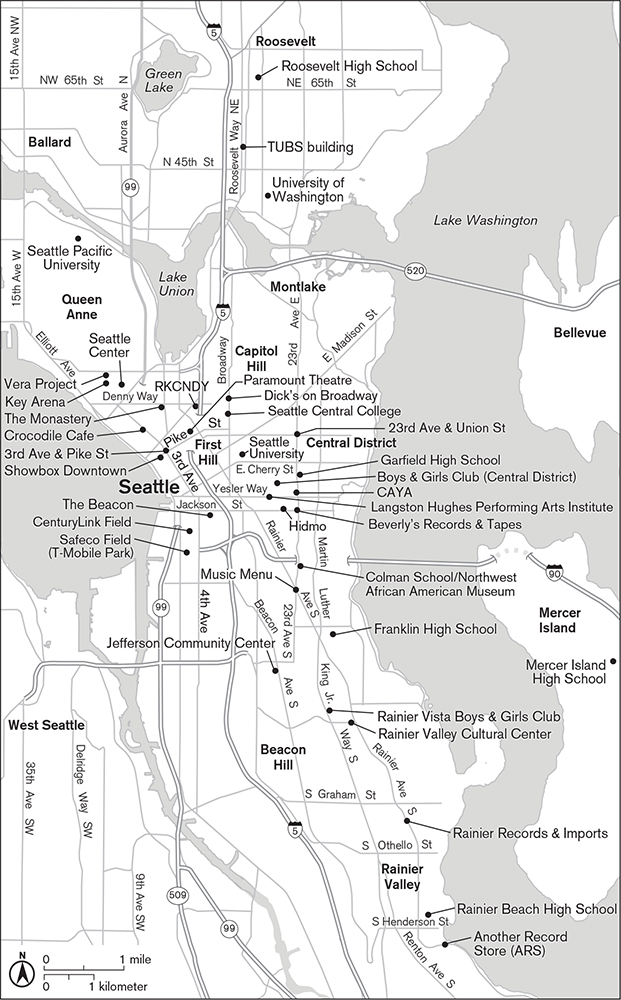
Any discussion about the roots of Seattle hip hop must begin in the Central District (CD), the traditional home of Seattle’s African American community. As Dr. Quintard Taylor wrote in his book The Forging of a Black Community: Seattle’s Central District from 1870 through the Civil Rights Era, “Black Seattle through much of the twentieth century was synonymous with the Central District, a four-squaremile section near the geographic center of the isthmus that constitutes the city.”1 Although Seattle’s first Black resident, Manuel Lopes, from Cape Verde, arrived in 1858, the city did not have a significant African American presence until the World War II migration, which increased the population from 3,789 in 1940 to 15,666 in 1950. By 1970, Seattle had 37,868 African Americans, with the vast majority living in the Central District. Beginning in 1970, Seattle’s Black population expanded south into the Rainier Valley, doubling the geographic area but not the population of African Americans in the city. As those Blacks moved south, they integrated previously white neighborhoods. They were joined by new immigrants from Southeast Asia, Latin America, and the African continent.
By 2000 southeast Seattle, known locally as the South End (zip code 98118), had become one of the most racially diverse neighborhoods, not only in Seattle but in the entire United States. Hip hop arrived in the city in the 1980s amid these rapidly changing ethnic and racial dynamics. In many ways the rise of Sir Mix-A-Lot in the 1990s or Macklemore in the 2010s reflects the unique social climate in which each emerged. Beginning with the release of “Rapper’s Delight” by the Sugarhill Gang on New Jersey–based Sugar Hill Records in 1979, hip hop sent cultural shockwaves through young people in the CD and the South End, which would eventually travel to other parts of the city. As neighborhoods transformed and gentrification became an issue, local hip hop documented the changes.
Over time, MCing, or rapping, became the most commercially viable aspect of hip-hop culture. This was also true in the Pacific Northwest, and several local artists have achieved mainstream hip hop’s ultimate symbol of validation—a rap Grammy, first awarded in 1989. In fact, Seattle-bred artists claimed back-to-back rap Grammys, in 1993 when Sir Mix-A-Lot’s “Baby Got Back” won the Grammy for Best Solo Rap Performance and in 1994 as Ishmael “Butterfly” Butler and Digable Planets won the Grammy for Best Rap Performance by a Duo or Group for their song “Rebirth of Slick (Cool Like Dat).” At the Fifty-sixth Grammys in 2014, Macklemore and Ryan Lewis walked away with four awards, including Best Rap Performance and Best Rap Song for “Thrift Shop,” Best Rap Album for The Heist, and Best New Artist. Macklemore’s run of independently released music eventually reached number one on the charts, gained supporters worldwide, and won accolades as the ultimate do-it-yourself rags-to-riches music story. However, this was not exactly uncharted local territory. Although Sir Mix-A-Lot was signed to Rick Rubin’s Def American Recordings at the time he won his Grammy, he’d already made his bones at NastyMix Records.
Formed in 1985, NastyMix became perhaps one of the most unlikely success stories in the history of music. In an era when New York City was still the center of the hip-hop universe, serious doubts were cast on the legitimacy of nearly all material that came from elsewhere. The fact that an independent rap label, based in Seattle of all places, had released two platinum Mix-A-Lot albums in the late 1980s shocked the hip-hop world. In addition to a do-it-yourself ethos, Mix-A-Lot and Macklemore also shared a willingness to musically go against the grain of their respective eras. In his breakout hit “Posse on Broadway,” Mix-A-Lot reversed field on the rising popularity of super-macho West Coast “gangsta” rap by calling out domestic violence in his reference to using mace to defend a woman from her abusive boyfriend. Similarly, Macklemore and Ryan Lewis’s songs “Thrift Shop” and “Same Love” countered two of hip hop’s most popular and oldest norms: bling (the celebration of expensive jewelry and name-brand clothing) and homophobia.
In addition to its lyrical diversity, the unique nature of hip hop from Seattle has continued to defy any particular label or sonic aesthetic. Whereas New York hip hop, for example, had traditionally been associated with Roland 808 drum machines, and California hip hop relied heavily on synthesized and funk-based samples, no dominant style ever took hold in Seattle. It has long been maintained there is no specific way to categorize Seattle hip hop. This is in stark contrast to the grunge rock movement of the 1990s, which initially was known as the “Seattle sound.”
Although Grammy Awards function as a standard means of recognition, this book also explores the radio booths, community centers, social protests, nightclubs, immigrant communities, and dance studios in Seattle that made all of this possible. The full story of hip hop in Seattle reflects the variety of activities and achievements that formed the fabric of community and helped to create the music. In the mid-1990s, for example, local legend B-Boy Fever One became the first breaker from Seattle to join the pioneering, world-famous New York– based Rock Steady Crew. Fever eventually returned to the Seattle area, and while spending time mentoring young people at Jefferson Community Center, he met young Jerome “Jeromeskee” Aparis. Fever saw a special quality in Jeromeskee, who in 1999 co-created and led the Beacon Hill–based breaking crew Massive Monkees. Massive went on to win world championships at international break-dance competitions in London in 2004 and Seoul in 2012.
Seattle has also produced a stable of DJs and producers who have collaborated with and created songs for some of the biggest names in music. Central District legend Vitamin D has worked with many local and national hip-hop acts as well as rhythm and blues artists. An incredibly versatile producer, Vitamin D has such diverse credits as arranger, audio engineer, audio production, executive producer, horn arrangements, keyboards, mixing effects, cutting, and piano. Among younger generations, he is known for producing the theme song for Power, a popular cable TV urban drama series. Vitamin D protégé Jake One has produced for the likes of De La Soul, E-40, 50 Cent, Cypress Hill, T.I., Ghostface Killah, Snoop Dogg, G-Unit, Wale, and Drake. Jake One received Grammy nominations in 2012 for production credits on the album Some Nights by the group Fun and the single “3 Kings” from the Rick Ross LP God Forgives, I Don’t, nominated for Best Rap Album.
In addition to world-renowned artists, Seattle also produced The Flavor, an internationally read hip-hop magazine, published by Alison Pember and Rachel Crick between 1992 and 1996. Beginning as a quarterly before becoming a monthly, The Flavor at its peak distributed more than ten thousand free copies every month at record stores across the United States as well as in Denmark, Great Britain, and the Netherlands.
Since hip hop’s beginning, fashion and style have been signature aspects of the culture. From Run DMC’s shell-toe Adidas sneakers to baggy jeans and hoodies, the physical presentation of clothing choices was a way to express an allegiance with hip hop. Seattle natives Tony Shellman and Lando Felix helped define street fashion when they launched the urban clothing company Mecca USA with Evan Davis in 1994. Creative differences with their corporate partners in 1996 led Shellman, Felix, and Davis to walk away from Mecca USA, after which they simply turned around and started the fashion line ENYCE in 1997.
Despite the rap stars, the Grammy Awards, break-dance championships, magazines, and fashion boutiques, the true foundation of the Seattle scene is something different. Grassroots organizing and engagement of the community by individuals and organizations has been the defining element of local hip hop. In the early 1980s a young Sir Mix-A-Lot made a name for himself playing parties at the Boys & Girls Club in the Central District. In the late 1990s the event known as Sure Shot Sundays, produced by Jonathan “Wordsayer” Moore in response to a lack of live all-age hip-hop events in Seattle, created a space for youth, including a young Ben “Macklemore” Haggerty, to perform on stage for the first time. The Seattle chapter of Russell Simmons’s Hip-Hop Summit Action Network (HHSAN) was created in 2002 by Wyking Garrett, and in 2004 Daniel “King Khazm” Kogita established the local chapter of Afrika Bambaataa’s New York–based Universal Zulu Nation. For more than a decade, 206 Zulu has partnered with numerous schools and nonprofits in Seattle providing youth-centered activities, informational forums, educational workshops, leadership development, and documentation of local hip-hop history.
Hip hop in Seattle offers a lens for some of the changes that have shaped the region over the past several decades. For example, gang violence that accompanied the crack epidemic of the mid-1980s was discussed in “Union St. Hustlers” by Ice Cold Mode. Draze used “The Hood Ain’t the Same” to outline the gentrification of the Central District. The growing local East African and Asian/Pacific Islander immigrant populations were represented by such artists as Malitia MaliMob and Prometheus Brown, respectively. Although Referendum 74 legalized recreational marijuana in Washington State in 2012, local hip hop had long before embraced cannabis culture with songs like DMS’s “Sunshine,” album titles such as Nacho Picasso’s Blunt Raps, and groups like the Stay High Brothers. Also on that ballot in 2012 was the same-sex marriage measure Initiative 502, which passed using Macklemore and Ryan Lewis’s “Same Love” as the theme song.
Ultimately, the story of Emerald Street is the story of community. The compilation albums, hip hop–themed forums and conferences, countless talent shows and open mic sessions, willingness to collaborate with potential competitors, and an emphasis on serving youth have all combined to produce a vibrant, diverse hip-hop scene in Seattle on nearly every level. The range of this community exists not only in a racial and socioeconomic sense but also in the various styles, energies, and ideologies that different participants have continued to bring to the collective.