
10
‘When I was a boy, I was already dreaming of America. A great, wonderfully rich land! So large it reaches two seas. Mountains as big as anything you’ve ever seen. Snow, like wheat flour, covers the mountains of America in winter….’
‘What else is there in America?’ the boy inquired…
‘Everything, everything.’
Alfred Lewis, Home is an Island, 144
The beginnings
On Christmas Day 1866 a festive ball was being held at Fort Laramie in Wyoming. Around midnight a large figure clad in a buffalo skin coat with cap and boots strode into the room to give the news of a disaster that had overtaken a US force headed by Captain Fetterman. The newcomer had ridden 190 miles through hostile Indian country in appalling weather, a ride that became one of the legends of the American West. The rider, John Phillips, was in fact Portuguese. He had been born Manuel Felipe Cardoso on the island of Pico in the Azores and had come to the United States in 1850 to make his fortune on the gold diggings in the West. He later became a mail courier, rancher and hotel owner, dying in 1883.1
Before the nineteenth century Portuguese who found their way to North America were few and far between—in fact the only notable community of Portuguese origin were Sephardic Jews who had not come from Portugal itself but from Brazil or the Caribbean. However, the Portuguese had been very active in the slave trade and in the eighteenth century slaves were often brought by Portuguese ships into Britain’s North American colonies. One route was from the Cape Verde Islands, and a number of cases arose where free Cape Verdeans were treated as slaves in American ports.
The beginnings of migration from Portugal to the United States are closely linked to the American whaling industry, which began to expand from about the middle of the eighteenth century. As the industry grew, the shortage of seamen skilled in whaling led American ships to call at the Azores and Cape Verde Islands to take on experienced crews. Once communities of whalers from the islands became established in New England ports, the way was open for further migration of families and neighbours. Because whale hunting was a hard life, which attracted few native-born Americans, the Portuguese came to play a disproportionately large role in its development. According to Sandra Wolforth, by 1880 a third of the whalemen working out of New Bedford were Portuguese.2 When whaling declined, the Portuguese remained prominent in the fishing industry based in the New England seaports until that also went into steep decline during the depression of the 1930s.
If emigration from the islands, linked often to the fishing and whaling industries, provided one stream of migrants, another stream was created by the American economy’s hunger for cheap labour. During the second half of the nineteenth century Portuguese came to the United States in the same way that Italians, Irish and northern Europeans came, in search of land and employment. Although the majority of the Portuguese settled in New England, a significant number went to California, and these were to remain the two principal areas to which Portuguese would in future migrate.
Numbers of Portuguese immigrants
From the start Portuguese emigration to the United States was largely a migration of islanders, a characteristic that has marked the Portuguese American community until the present. Even during the 1960s when tens of thousands of Portuguese were emigrating to France or Germany, islanders from the Azores, Madeira and Cape Verde preferred to go to the United States or Canada. Arroteia estimated that from 1955 to 1974 56.9 per cent of Portuguese emigrants to the US came from the Azores.3 One factor which helped to bind the Azoreans to the United States was the existence of the airbase at Lajes on the island of Terceira, which provided access for many Azoreans to the English language and to American networks that aided emigration to the United States.
With the history of the Portuguese in the United States, numbers move around as in a kaleidoscope with each author giving the data a shake. Some authors attempt to count annual immigration, others try to count the numbers of the Portuguese community in the United States at any one time, but neither set of figures attains the exactitude that statisticians desire. The United States censuses seek to record the national identity of United States residents, though the count depends on the self-description of those counted. The 1870 census recorded 8,971 Portuguese.4 Thereafter numbers increased both by new immigration and by natural increase. In the 1880 US census there were 15,650 Portuguese, rising to 114,321 in 1920.5 These figures are impressionistic, if only because it is not clear exactly what is being counted—whether it is people born in Portugal or whether the numbers include those born in the United States to Portuguese immigrants. Nor is it clear whether first and subsequent generations are being counted or if Portuguese emigrants and settlers in Hawaii are included, or whether the numbers always include Cape Verdeans.
If exact numbers are elusive, there are clear general trends. These show that prior to 1870 there was very little emigration to the United States, and thereafter numbers increased but only to around 1,500 a year. The big influx occurred between 1900 and 1920, continuing during the war in spite of the difficulties in obtaining passages by sea.
Maria Baganha has described the period from 1875 to 1920 as one of increasing state ‘intervention and regulation’. Laws introduced during this period tried to exclude criminals, prostitutes, those carrying disease, polygamists and Asians. These measures had little impact on the numbers of Portuguese migrants, though the ban on unaccompanied children and on contract labourers might have been framed to prevent the abuses so prevalent at that time in Brazil, of which the Portuguese were very much the victims. In 1917 a regulation banned the immigration of illiterates. This may well have been intended to screen out Cape Verdean and Azorean migrants but it appears that the Portuguese, among whom illiteracy was indeed high, found ways of evading this regulation. Maria Baganha noted that in 1915 54 per cent of the Portuguese immigrants had been classified as illiterate; but in 1920, although the numbers had grown four times, only 6 per cent were illiterate. As she points out, there had not been any dramatic improvement in Portuguese education during these five years.6
Table 6: Portuguese Emigration to the United States, (1820–1929)
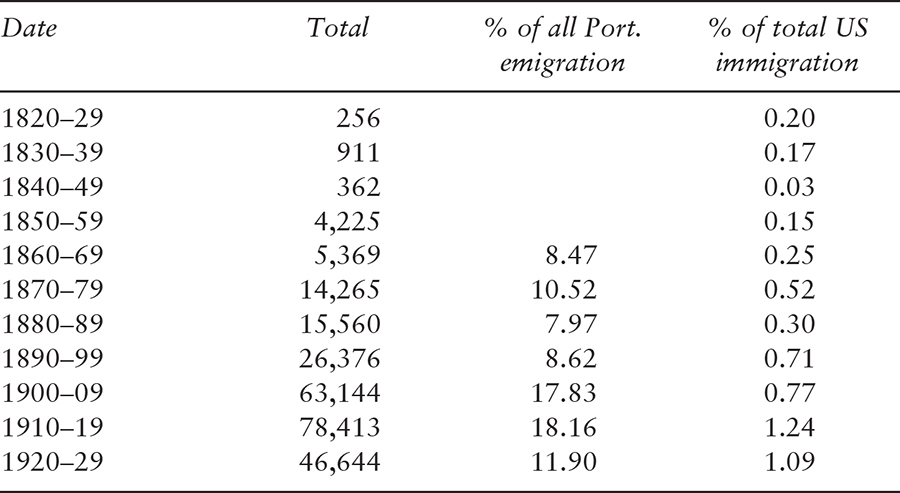
Source: Baganha, Portuguese Emigration to the United States 1820–1930, 256.
From the 1920s to the 1960s immigration was restricted by the American policy of national quotas, which pressed heavily on the migration from Portugal. The quotas were relaxed somewhat in 1958, following the volcanic eruption of Capelinhos in the Azores, when the Azorean Refugee Act (2 September 1958) authorised the immigration of 1,500 people from the islands. A major change took place in 1965 when quotas were reallocated and a policy of unifying families and allowing relatives to settle was adopted. This led to the second great influx of Portuguese, which lasted from 1965 till 1979, when immigration was again greatly reduced.
As these figures demonstrate, Portuguese emigration to the US was not large by comparison with other national groups. In Edward Alsworth Ross’s notorious study of immigration, The Old World in the New published in 1914, are figures for foreign-born immigrants for the year 1910 which show that only Belgium, Spain, Turkey and the Balkan states had fewer than Portugal.7 Even Finland sent a larger number of immigrants to the US. However, if Portuguese numbers were small, there were high concentrations of Portuguese in certain areas, which gave them a higher profile than their overall numbers would warrant. There were significant concentrations of Portuguese in Massachusetts and Rhode Island, where a substantial community of Portuguese origin settled in coastal towns and was involved in the fishing industry and the textile mills. By 1919 half the Portuguese were working, as Caroline Brettell puts it, in
Table 7: Portuguese Emigration to the United States (1930–1996)
|
Date |
Number of immigrants |
Average per annum |
|
1930–54 |
16,939 |
678 |
|
1955–74 |
121,037 |
6,052 |
|
1975–96 |
89,291 |
4,058 |
Source: Peixoto, ‘A Emigração’, 155.
unskilled mill jobs as combers, spinners, carders, and doffers, or in low wage jobs in coal yards, produce houses, slaughter houses, small grocery, fruit, fish, or bakery shops, or as farm laborers. The overwhelming majority… were from the Azores. They were young, unmarried, largely illiterate, and unskilled.8
This concentration of the Portuguese in New England has remained largely unchanged. According to Jerry Williams, New England in 1980 was home to 66.5 per cent of the Portuguese American population.9 There were 190,298 ‘people of Portuguese ancestry’ in Massachusetts, 31.5 per cent of these had been born in Portugal and 63 per cent were living in Portuguese speaking homes. ‘In 1980 Rhode Island was home to 61,756 individuals of Portuguese ancestry, and continued to account for about 10 per cent of all Portuguese Americans.’ Connecticut had 26,977 people of Portuguese ancestry of whom 14,525 were born outside the United States.
The Portuguese of Gloucester, Massachusetts
The port of Gloucester in Massachusetts was one of the earliest places where Azoreans settled, and the story of this community is the story in miniature of Portuguese migration to the US. In the mid nineteenth century Gloucester was one of the most important fishing ports on the east coast with some 400 schooners operating out of the port. It was easy for skilled seamen to get work, and by 1850 a dozen young Azorean men were working on Gloucester vessels. ‘Their number grew tenfold over the following decade. The men worked hard, saved what they could, and even sent money home to pay for the passage of loved ones to Gloucester.’ In the late 1880s ‘a type of two-masted fishing schooner known as the “Gloucesterman” roamed over the western North Atlantic. These vessels, the handsomest, fastest, and strongest of their size ever built, derived their name from the port of Gloucester.’10 These boats carried dories on board and the fishing was done from these small open boats. The hardship of this type of fishing was extreme and one Portuguese doryman was stranded at sea for ten days, surviving on a bottle of water and a haddock which he cooked by lighting a fire in the bottom of his boat.11
This was work at which the Azoreans excelled and many rose to become schooner captains, eventually building and owning their own boats. Most famous was Joseph Mesquita, who had arrived in the US with 50 cents in his pocket. In 1899 Mesquita commissioned his own schooner, named the Mary P. Mesquita after his wife. The last of the big schooners was built by the Portuguese in 1926 and thereafter the conversion to trawling began, the last schooner being converted in 1943. Some ten fishing vessels out of Gloucester were sunk by German submarines during the war; after the war fishing went into decline, and with it the prosperity of the Azorean community.
Meanwhile, however, the Azoreans had put down roots.
Over time, they bought small house lots on a rough, unsettled hill overlooking Gloucester’s inner harbor known locally as Lookout Hill. Everyone was to soon call it “Portagee Hill”—the home of Gloucester’s Azorean immigrants. In preparing their lots on the Hill, the men used simple tools to split rocks, prepare the ground, and frame their homes. They planted trees and vines—pears, apples, and grapes. They laid out small vegetable and flower beds: no home was complete without the morning glories, lilacs, roses, and elderberries. Chickens walked about the grounds, their coops adjoining the backyard pens for the many pigs kept on the Hill. In the fall, families slaughtered the pigs, putting up salt pork, lard and Portuguese sausages for the long New England winter.12
In 1893 work began on a church to be dedicated to Our Lady of Good Voyage. This church soon became the heart of the community, and when it was destroyed in a fire in 1914 money was collected and a new and much grander church was built in 1915. For the first two generations, at least, religion defined the Azorean community.
Men such as Mesquita lived in a world governed both by the Catholic Church and by traditional Azorean superstitions. Their faith was reflected in the building of the church, while their superstitions could be seen in many aspects of daily life. People attributed bad luck at sea to a bewildering assortment of superstitions. Bad luck followed if a woman set foot on a fishing vessel, or if a fisherman met a woman on the way to the ship, or even if the ship left on a Wednesday or Friday. Bad luck also befell a vessel if one of the crew mentioned the word ‘priest’ or ‘pig’ while fishing on the Banks. On the other hand, men believed that the throwing of rosary beads into rough waters could calm the raging sea.13
In 1900 Joseph Mesquita’s newly built schooner was sunk in a collision with the liner Saxonia. All the crew bar one were saved, and as an act of thanksgiving Mesquita ordered a silver crown to be made in Portugal and to be sent for the performance of the ritual of crowning an ‘emperor’ for the traditional Azorean Holy Ghost celebrations. The crown was blessed by Pope Leo XIII and the first crowning took place in 1902, supposedly the first ‘crowning’ to take place in New England. Thereafter the ceremony was performed annually by different Azorean organisations. In 1931 the Fraternity Club held its first ‘crowning’ and the ‘imperator, Manuel P. Domingos Jr, kept the magnificent silver crown on a flower-decorated altar in his home where he held open house each evening for members and friends’.14
Like other immigrant Portuguese communities, the Azoreans of Gloucester formed their own associations. Most important, and still in existence, was the Fraternity Club which was founded in the 1920s as a drum and bugle band and raised funds from the community to build its own premises.
The life histories of many of the Portuguese immigrants have been recorded and from them emerge tales of extreme hardship, by no means ending with their safe arrival in the US. Many continued to work long hours for very low pay and to struggle with language problems. Their survival depended on family and community solidarity. According to Filomana Dasilva,
“When they [the immigrants] come over here, the first thing they do is save money to buy a house,” she said, noting that young American families do not take that approach. “They get their paycheck and that’s it” and her husband added “the American dream of an easy climb up the social ladder [is] a bunch of baloney”.15
Madeirans and Hawaii
One striking feature of the emigration to New England was the comparative absence of Madeirans. Whereas approximately 68,000 migrants left the Azores for the United States between 1955 and 1974, only 993 came from Madeira during the same period. It was not that Madeirans were not emigrating, rather that they were following their compatriots to other destinations, and among these were the Hawaiian Islands. In the 1980 census 26,447 people resident in the Hawaiian Islands claimed Portuguese descent, even though only 274 of these were actually born outside the US. Clearly Portuguese emigration to Hawaii had at one time been substantial but had run its course by 1980.
Sugar growing in the Hawaiian Islands began to develop as a commercial enterprise in the 1840s and increased dramatically in profitability during the American Civil War. As sugar was a labour-intensive crop, planters had to find labour and the Portuguese Atlantic islands were amongst the regions where they, like their counterparts in the Caribbean, sought recruits. Between 1878 and 1899 12,780 Portuguese arrived in Hawaii as contract labourers.16 Azoreans and Madeirans were recruited by agents in roughly equal numbers but, unlike migrants to Brazil at this time, the islanders tended to emigrate as whole families. The last arrivals from Portugal came in 1909, and in 1913 it was calculated that a total of 23,578 Portuguese—7,806 men (34 per cent), 5,536 women (23 per cent) and 10,236 children (43 per cent)—had gone to Hawaii.17
The journey from the Atlantic islands to Hawaii involved a voyage of up to six months in a sailing ship—a journey of appalling hardship. Some migrants stowed away on board Hawaii-bound ships, one account telling of eleven stowaways on a single ship who were put to work by the captain when they were discovered. The ship took 33 days to round Cape Horn and in the course of a five-month voyage 16 people died and 16 babies were born.18 Most Portuguese workers arrived under contracts that bound them to work for five years and as a result they had a very low social status, which placed them in a position somewhere between Asian ‘coolie’ immigrants and white Europeans.19 Until 1940 the Hawaii census distinguished Portuguese from ‘other Caucasians’. At the expiry of their contracts many left the sugar plantations seeking to establish themselves in low-skilled urban occupations or as smallholders. Honolulu was a favourite location and in 1898 4,000 out of a total city population of 28,000 were Portuguese.20 Others left the islands altogether and headed back to the American mainland, the distance of Hawaii from Europe effectively preventing any move to return to their homeland. As a result the ‘Portuguese’ community in Hawaii ceased to grow commensurate with the population of the islands themselves, and in 2010 people of Portuguese ancestry constituted just 4.3 per cent of the non-Hawaiian (Haole) population of the islands. Even so, this community maintained a strong ethnic identity with its own churches and its own religious festas. As with many other diasporic communities, there is a strong interest in family origins among Hawaiian Portuguese which can be followed on their internet sites, and it is often considered that the Portuguese made a major contribution to the culture of Hawaii by introducing the guitar, which was locally developed into the characteristic Hawaiian ukulele.
Cape Verdeans emigrating to the United States
The emigration of Cape Verdeans to the United States followed a similar trajectory to that of the Azoreans. The Cape Verde Islands lay at the crossroads of shipping lanes in the Atlantic and were regularly visited by sailing ships bound for India or Brazil. They were also used as a holding area for slaves brought from mainland Africa before being shipped across the Atlantic. The population of the islands was ethnically very mixed, and as the climate was precarious Cape Verdeans became accustomed to seek employment as crew in passing sailing ships. Like the Azoreans, the islanders also became expert hunters of whales.
In the early nineteenth century whale hunting greatly expanded in the waters round Cape Verde and visiting whaling ships, especially those from North America, made use of sheltered island anchorages and took on Cape Verdeans to supplement their crews. In the course of the nineteenth century many American whalers were largely crewed by Cape Verdeans, some of whom came to captain the whaling ships. Many of these settled permanently in the whaling ports of North America like Nantucket and New Bedford and formed communities that then acted as poles of attraction for other emigrants.
Frank Bullen (1857–1915) was one of the most prolific authors to record in memoirs and fiction the life at sea in the last days of sail. One of his best known books, The Cruise of the ‘Cachalot’, describes life on an American whaler sailing out of New Bedford in 1875. The crew of the whaler had been assembled from a motley crowd of unemployed, ‘not only the representatives of five or six nations, but longshoremen of all kinds, half of whom had hardly ever set eyes on a ship before!’21 In contrast to the inexperienced ‘farmers, bakers and draysmen’, the ‘black portion of the crew—Portuguese natives from the Western and Canary Islands—were doing their work all right in a clumsy fashion’;22 they were the experienced part of the crew—in fact they were mostly Cape Verdeans—and were headed by the second mate, ‘a Portuguese about forty years of age, with a face like one of Vandyke’s cavaliers, but as I now learned, a perfect fiend when angered. He also was a first class whaleman, but an indifferent seaman.’23 The inexperienced landsmen were all ‘allotted places in the various boats intermixed with the seasoned Portuguese in such a way that the officer and harpooner in charge would not be dependent upon them entirely in case of a sudden emergency’.24
In the whalers the racial hierarchies that were part of normal life on land were reversed. The ‘black’ Portuguese were the skilled crew and were often in positions of authority over the white crew.
More than half of the total crews of the American whaling fleet are composed of these islanders. Many of them have risen to the position of captain, and still more are officers and harpooners; but though undoubtedly brave and enterprising, they are cruel and treacherous, and in positions of authority over men of Teutonic or Anglo-Saxon origin, are apt to treat their subordinates with great cruelty.25
In the fo’c’sle the crew naturally separated themselves, ‘the blacks [that is the Portuguese] taking the port side and the whites the starboard’. The tensions between the ‘black’ Portuguese who were experienced whalers and the white crewmen who were not was tangible until there was a prospect of the ship visiting the Cape Verde Islands.
Most of them belonged there, and although there was but the faintest prospect of their getting ashore upon any pretext whatever, the possibility of seeing their island homes again seemed to quite transform them. Hitherto they had been very moody and exclusive, never associating with us in the white side, or attempting to be at all familiar. A mutual atmosphere of suspicion, in fact, seemed to pervade our quarters, making things already uncomfortable enough, still more so. Now, however, they fraternised with us, and in a variety of uncouth ways made havoc of the English tongue, as they tried to impress us with the beauty, fertility and general incomparability of their beloved Cape Verds.26
There is no sentimentality in this description. Life on a whaler was hard and to escape from the poverty of the islands to a life at sea was no easy passage or soft option. But there was a crude equality achieved where skill and endurance, not race or background, were all that mattered.
From 1900 figures for legal emigration by Cape Verdeans are available and they show that between 1901 and 1920 18,629 islanders emigrated to the United States, two thirds of them coming from the islands of Fogo and Brava, as the port of Furna in Brava was the preferred anchorage for many American whalers. In fact these emigrants were often called ‘Bravas’ in New England. However, during these years there was also a large clandestine emigration, particularly of men seeking to avoid military service in nearby Guinea. It was easy for emigrants to stow away on board sailing ships, many of which had Cape Verdean crews. As steamships took over more and more shipping routes, Cape Verdeans in the United States bought sailing ships that were being laid up and continued to operate them on routes to and from the archipelago. Unlike most immigrants, ‘the Cape Verdeans came to have control over their own means of passage to the United States’.27 As late as 1939 there were still old sailing ships, known as the Brava Packets, operating between the United States, the Azores and the Cape Verde Islands.28
Although the number of Cape Verdeans was not large in relation to the total number of Portuguese immigrants, let alone the number of immigrants entering the US as a whole, it was sufficient to cause some concern to those, like Ross, who were campaigning against unrestricted immigration, because it was apparent that many Cape Verdeans were of mixed race, and therefore were deemed to be ‘black’, as the term was understood in the US. In 1917 the restrictions on the entry of people deemed to be illiterate was widely assumed to be an attempt to restrict Cape Verdean immigration, and when national quotas were introduced in 1924 and revised in 1929 the regulations were framed in such a way as to make Cape Verdean immigration difficult. Visas were not to be issued by Portuguese consulates and immigrants were only to be allowed to sail from Lisbon. As a result legal emigration from Cape Verde declined to a trickle, and between 1927 and 1952 only 1,946 Cape Verdeans officially entered the US.29
The immigration of Cape Verdeans had led to the establishment of communities in the seaports of Massachusetts and Rhode Island that were distinct from other groups of Portuguese. Many new arrivals found employment in the cranberry bogs where they provided low-paid labour picking berries, work that native-born Americans and even most immigrants would not undertake. According to Susan Wolforth, ‘in the bog areas they lived, at best, with the bare essentials of life in a semi-migratory manner’.30 However, they soon branched out into other activities.
Over the years we find Cape Verdeans in the United States engaged in a great variety of occupations—seeking gold in California, serving on board coast guard ships or in the coasting trade of the Fall River, as firemen on the Pacific Railway, as strawberry farmers, as field workers in the swampy area of Cape Cod and on the cotton plantations, as factory workers in the New Bedford textile industry—numbered in their thousands by the latter half of the nineteenth century.31
According to António Carreira, ‘most of those who settled in the United States remained apart from the white community, either because the whites deliberately distanced themselves from them, or because their low socio-economic status kept them at a distance’.32 However, in the eyes of many Americans they were ‘Portuguese’ and this fact helped to shape wider attitudes towards Portuguese emigration in general. The Cape Verdeans did not associate with other Portuguese communities, and as Sidney Greenfield wrote, ‘in New Bedford and Providence they accepted the segregation imposed on them and restricted all but essential contacts with outsiders, speaking creole with each other, and finding meaning and satisfaction in their creole world’.33 Some Cape Verdeans returned to the islands with their savings, bringing with them their knowledge of English, which became a widespread lingua franca in some of the islands, but with the continuance of periodic drought in the twentieth century there was little incentive for the majority to return to the poverty of the islands.
During the 1960s emigration from Cape Verde developed along different lines from that from the Azores. Few Azoreans emigrated to northern Europe, and after the relaxation of American immigration rules in 1965 there was a new and substantial departure from the Azores for the United States. Cape Verdeans on the other hand turned to Europe, travelling to Lisbon and then moving on from there to northern Europe in the wake of the mainland Portuguese. Then in 1975 Cape Verde became independent from Portugal, leading to a different evaluation of the Cape Verdean presence and heritage. With the establishment of a United States embassy in Praia it became easier to obtain visas and a new wave of Cape Verdean immigration began. Between 1975 and 2005 60,000 Cape Verdeans left for the US.34 This renewed immigration brought a whole new generation of Cape Verdeans from what was now an independent country. They often found they had little in common with the descendants of the earlier immigrants, who spoke English instead of creole and had always thought of themselves as Portuguese. Moreover the new wave of immigrants was drawn from all the islands, in contrast to the earlier immigrants who had come mainly from Brava and Fogo.
In the 2000 census 77,203 people in the United States claimed Cape Verdean descent and 87 per cent still lived in New England where the first immigrants had settled. However, this statistic means very little as it is still common for many people of Cape Verdean descent to describe their origins as Portuguese. This may be family tradition but it also helps them to create for themselves a ‘white’ identity that is so important in the United States.
Marilyn Halter describes the identity of the Cape Verdean community as ‘always in flux, their mixed African and Portuguese heritage continues to defy rigid social classification, challenging notions of race, colour, ethnicity and identity’.35 The retention of the creole language by the new immigrants was a device by which they established an identity different from that of Latinos or Afro-Americans. Moreover, since the independence of the Cape Verde Islands, immigrants in the United States have been able to vote in Cape Verde elections and this has also helped to set the community apart from Latinos and Brazilians with whom they might otherwise become confused, as well as from Portuguese.
California
While the large majority of Portuguese immigrants settled in New England, a sizeable minority made California their home. As with so many other nationalities, the first Portuguese arrived at the time of the gold rush in the 1840s; after a few hectic years on the goldfields, they settled as fishermen or as farmers in the fertile valleys inland from San Francisco. There they were joined by Portuguese who had originally gone as contract labourers to Hawaii and then, at the end of their contracts, came to the West Coast of the American mainland to set themselves up as independent farmers. According to Leo Pap, 2,000 Hawaiian Portuguese moved to California between 1911 and 1914.36 While the New England Portuguese became fishermen and factory workers, the Californian Portuguese became fishermen and dairy farmers, concentrating their settlement in the San Leandro and Santa Clara counties. The high concentration of Portuguese in these areas (the population of the city of San José was at one time 60 per cent of Portuguese extraction) enabled the community to retain a high degree of individuality and some importance in spite of the relatively small numbers of immigrants.
Leo Pap was fascinated by the longevity of some of the early Portuguese pioneers who survived the hardships of migration and settlement in the west. He mentions one, ‘Mrs Genevieve de Brum Vargas, born on the island of Pico in 1830, [who] arrived in Boston in 1865, soon set sail for San Francisco, from there walked (yes, on foot) down the coast to Half Moon Bay—where she was still residing in 1944, at age 114’.37 And there were others, though their lives have to be seen in contrast to a very high level of infant and child mortality. As is so often the case, historians write the stories of those who win through and survive, not of the far greater numbers who do not.
Diane Beeson and Donald Warrin have described the lives of Portuguese women on the frontier which fit them perfectly into the mythology of the ‘West’—a mythology that represented women as either ‘The Forlorn Frontier Woman’, the ‘Sturdy Helpmate’, or the ‘Untamed Woman’. There were apparently many examples of the third of these since, on the frontier, the accepted norms of female behaviour counted for very little. There was, for example, Jessie, the daughter of Joe Alameda, ‘who left the island of Flores in 1896 at the age of fifteen and settled in Wyoming … and later invested his earnings in a ranch’. At the age of seven ‘Jessie was riding horseback, participating in the round up of cattle, and learning to throw the lasso. She had a brief moment of fame as a young woman when it was reported in the newspapers that she had chased and lassoed a coyote.’ She is quoted as having recalled, ‘I did a man’s work all my life, had short hair and wore pants. I just didn’t like housework. To me a house is just some place to eat and sleep. I’ve no regrets.’38
What is so satisfying about this story, and the many others they record, is that they run counter to the accepted stereotypes not only of the Victorian woman in general but specifically the stereotypes of the Portuguese—home loving, obedient to their menfolk, not interested in education.
Portuguese characters inhabit the fiction of Jack London, who was born in San Francisco and died there at the early age of forty. In the poignant and semi-autobiographical novel Martin Eden, the eponymous hero lives in a room rented from a Portuguese woman who had come to California via Hawaii. ‘Maria Silva, a virago and a widow, hard working and harsher tempered, rearing her large brood of children somehow, and drowning her sorrow and fatigue at irregular intervals in a gallon of thin wine she bought from the corner grocery and saloon for fifteen cents.’ Maria makes a poor living taking in washing and pasturing two cows on wasteland and roadside verges. For her the American dream meant a life of drudgery and ‘Martin grew to admire her as he observed the brave fight she made’.39 In the end he was able to be her ‘fairy prince’ and spend his money on buying her a milk ranch, which is the only really happy outcome of this sad and bitter story.
In The Valley of the Moon, published in 1913 only three years before he died, Jack London is much more kindly disposed towards the ‘American dream’. Appearing one year before Ross’s poisonous denunciation of immigrants in The Old World in the New, the book contains a lengthy passage in which the virtues of immigrants are contrasted with the failure of native-born Americans to make their fortunes from the land. The immigrants who attract the attention of the author and his hero are the ‘Porchugeeze’. The book features a working-class couple, Saxon and Billy, who become disillusioned with ‘socialism’ and seek land on which to earn a living by hard work. In London’s eyes it was native-born Americans, not the immigrants, who had lost sight of the virtues of hard work.
‘It looks as though they’d crowd our kind out,’ Saxon adjudged….
‘Oh, I don’t know about that. I reckon the American could do what the Porchugeeze do if he wanted to. Only he don’t want to, thank God. He ain’t much given to livin’ like a pig often leavin’s.’
Billy is soon made to rethink this remark when they contemplate the wealth that ‘old Silva’ has made from the land.
‘Forty years ago old Silva came from the Azores. Went sheep-herdin’ in the mountains for a couple of years, then blew in to San Leandro. These five acres was the first land he leased. That was the beginnin’. Then he began leasin’ by the hundred of acres, an’ by the hundred-an’-sixties. An’ his sisters an’ his uncles an’ his aunts begun pourin’ in from the Azores—they’re all related there, you know; an’ pretty soon San Leandro was a regular Porchugeeze settlement.’40
As they contemplate the high price of land, beyond their ability to buy, Billy concludes:
‘But just the same it’s the Portuguese that gave it its price, and they make things go on it—send their children to school… and have them; and, as you said yourself, they’re as fat as butterballs.’41
The early Portuguese settlers in California were very active in founding institutions to support their community. The cultural life of the Portuguese came to be focused on the Holy Ghost festivals, which had been introduced from the Azores, and the cherry festivals held in June. The first Holy Ghost festival was held in 1870 and thereafter they grew in popularity, their focus being very much on charitable work, a queen being chosen to assume the role of the queen Saint Isabel who had initiated the cult. The SPRSI (Sociedade Portuguesa Rainha Santa Isabel) was an early example of a support group organised by and for Portuguese women. The UPEC (União Portuguesa do Estado do California) was founded in 1880 as an organisation intended to provide support for those in need and to represent Portuguese interests generally. It also aimed to give the Portuguese community a high profile, for example by supporting a band and organising Portuguese participation in the Panama Pacific Exposition of 1915. It established a kind of Portuguese freemasonry that became in some ways a rival to the church for the leadership of the Portuguese community. Its annual conventions were an occasion for the elite of the Portuguese community to get together and to dine in style.42 The impression is strong that the Portuguese communities in California were more outward going and enterprising and more willing to play an active part in local affairs than their counterparts in New England.
John Steinbeck’s novels describe the struggle to survive of the dropouts, bums and poverty-stricken casual workers of America in the 1930s and 1940s. Their ethics are not those of the richer classes of society but they have a strong sense of right and wrong and a code of honour of sorts. One of their number is Joe Portagee—a classic Steinbeck anti-hero.
If he had been a hero, the Portagee would have spent a miserable time in the army. The fact that he was Big Joe Portagee, with a decent training in the Monterey gaol, not only saved him the misery of patriotism thwarted, but solidified his conviction that as a man’s days are rightly devoted half to sleeping and half to waking, so a man’s years are rightly spent half in gaol and half out … he was far from satisfied with prison life in the army. In the Monterey gaol he was accustomed to ease and companionship. In the army, he found only work.43
Returning to his old haunts he trades in his army greatcoat for a gallon of wine, and although he does not find his friends ‘he found no lack of those vile and false harpies and pimps who are ever ready to lead men into the pit. Joe, who was not very moral, had no revulsion for the pit; he liked it.’ So when he was ejected he broke all the furniture and set fire to the house. He was sentenced to thirty days in gaol and ‘lay luxuriously on his leather cot and slept heavily for one-tenth of his sentence.’44 And so on. Joe Portagee is a small-time scoundrel or a gullible, trusting child, according to your point of view, and is repeatedly treated and bamboozled by his friends whom he never ceases to believe in and trust. Is this, one wonders, just another of Steinbeck’s characters who live below the threshold of decency, or is he representing a view of the Portuguese commonly held by Americans?
Illinois and the Lincolns
Reference has already been made to the Madeiran Protestants who emigrated to Trinidad and then, between 1849 and 1850, moved on to Illinois where they had been offered land. About 400 Madeirans settled around Springfield and Jacksonville. It is unusual to find groups of Portuguese Protestants as the reformed church never made much impact in the Portuguese world until the latter part of the twentieth century. It is still more unexpected to find members of this community prominent in the early life of Abraham Lincoln. As Diane Beeson and Donald Warrin explain, ‘Francisca Affonso was the Lincolns’ cook during their last years in Springfield and prepared Lincoln’s farewell banquet as he left for the White House.’ She lived in the Lincoln household and the Lincolns paid for her wedding dress and bedroom furniture on the occasion of her marriage. The Lincolns had another Madeiran servant, called Mary Andrews, who entered their service at the age of sixteen and worked as a domestic and dressmaker, while two other Portuguese seamstresses are known to have worked for the Lincolns.45 Skill with the needles is not often mentioned in connection with Madeiran emigrants, but until comparatively recent times Madeiran women produced very fine embroidery, following traditional designs, which was a product of the island as distinctive as its wines.
Integration and settling down
The massive migration of Europeans of different national backgrounds to the US in the nineteenth century created prolonged problems of adjustment. On the one hand most immigrant groups tried to cling onto some elements of their national identity, often defined in terms of religion, language, special cuisine and religious festivals. On the other hand they attempted to integrate with the broad population of the US in order to play a part in the formation of the new country and to build a future for their children. The pattern that repeated itself again and again was for the first generation to retain close ties with the culture of their country of origin but for this to become increasingly diluted in subsequent generations as those born in the New World intermarried with people from other groups, travelled and resettled, acquired an American education and in general sought much greater integration. The extent to which old ethnic identities were retained often had to do with the concentrations of settlement in one particular region and the existence of institutions deliberately created to support the old ethnic identity. As David Brookshaw has written,
diasporas of whatever ethnic origin are essentially frontier societies and cultures. Their tendency is to abolish the borderline between past (the land of origin) and the present and future (the host country): in their fluidity, they belong to both and at the same time, perhaps, to neither.46
In many respects the immigrant groups from mainland Portugal and the islands were no different from other immigrant groups, but there were some aspects which set them apart. Although, compared with other immigrant groups, the numbers of mainland Portuguese and islanders were not large, they showed a marked tendency to concentrate their settlements. Even after two generations had passed, most people of Portuguese origin were still to be found in the areas of original settlement in New England, parts of California, and to a lesser extent Hawaii. Andrea Klimt describes the typical Portuguese–American community:
Many first generation immigrants from Portugal as well as people of subsequent generations live in close proximity to concentrated Portuguese-American communities; shop at or own businesses that cater to a Portuguese-American clientele; belong to Portuguese-American parishes; participate in social clubs organized by people who trace their origins to the same island or region of Portugal; have access to Portuguese language newspapers and media that cover local events; can go to doctors, travel agents, lawyers, social workers who speak Portuguese and primarily serve the ethnic community; and work with and live next door to people of Portuguese heritage.47
In these areas of concentrated settlement the Portuguese–Americans had a high profile, establishing their own shops and restaurants and, of course, their own churches and festivals. Although some Portuguese acquired a good education and moved on and away, the large majority continued to follow semi-skilled employment in the factories, farms and fishing industries, often working alongside other Portuguese–Americans, who came originally from the same part of Portugal. The extended family was also typical of Portuguese–American communities. According to Andrea Klimt the Portuguese of New England are typically ‘surrounded by extended family whose members reconvened in the United States through an extended process of chain migration’.48
Although Portuguese workers acquired a reputation for being willing to work at the most servile tasks and in the worst conditions, the closeness of the Portuguese community and the tendency of Portuguese to marry within the group were sometimes criticised by outsiders who thought the Portuguese ‘clannish’, uninterested in education and not inclined to take any part in public life.49 This negative, and at times hostile, attitude from other groups in turn reinforced the need for the Portuguese communities to stick together, and it was this close-knit, even closed, world that encouraged further immigration from Portugal by offering security and protection for new arrivals.
This introverted world of the Portuguese–Americans appears vividly in books written by people of Portuguese descent. In Frank Gaspar’s novel Leaving Pico, the Portuguese have created in a New England coastal town a version of the Azorean community from which they originated. There is a bitter rivalry between ‘Picos’ and ‘Lisbons’ (Azoreans and mainland Portuguese), so deeply rooted that they are barely able to talk to each other even though they live in neighbouring houses. The older generation still use the Portuguese language and dream of a romantic past based on island legends. Few non-Portuguese seem to intrude into their world and there is little indication that they are living in the multi-ethnic United States.50
Francisco Fagundes’ autobiographical narrative, Hard Knocks, is typical in many ways of immigrant writing: the passage to the New World, the struggle to make your way at the same time as you are growing up, the steps towards integration and acceptance coinciding with the rites of passage from childhood to adolescence and adulthood. The old society of the islands remains ever present among the Azoreans of California, as they plan to return or to bring out relations to join them on the west coast. Like Frank Gaspar’s portrait of the New England Portuguese, this also is a vivid picture of a close-knit Portuguese community—this time in the Californian dairy country—where members of the community quarrel and exploit new arrivals but in the end reluctantly support and look out for each other.51
If Azoreans, Cape Verdeans and mainland Portuguese tended to keep themselves separate, in the eyes of Americans they were all ‘Portuguese’ and therein lay a problem, particularly in the early days of immigration before the more liberal attitudes of the post-1965 era. Portuguese immigrants were frequently seen by many Americans, as they were in the Caribbean, as not truly white Europeans. The origin of this problem lay in the fact that many of the Portuguese were dark of complexion and most Cape Verdeans—who until 1975 were usually classified, and classified themselves, as Portuguese—were self-evidently of mixed race and some, especially those from the island of Santiago, were of a distinctly African phenotype. As Harney points out, as late as 1972 ‘Portuguese’ could be classified as a separate racial category (as they were in the British Caribbean) alongside ‘Negro’, ‘American Indian’ and ‘Oriental’.52
The claim that the Portuguese were not truly ‘white’ was famously given a spurious academic validity in the lengthy study published by Donald Taft in 1923 with the title Two Portuguese Communities in New England. In the Introduction Taft asserted that ‘the Portuguese are also interesting to study because of their curious racial composition. Not only are they Southern-Europeans but also … some of them seem to be of a semi-negroid type.’ And he goes on to describe them as ‘a people apparently differing somewhat in race as well as in mores, from native Americans and from other elements among the foreign-born’.53
Taft’s disparaging conclusions about the Portuguese of New England were reflected in other writings of the time. Susan Wolforth quotes Henry Kittredge’s Cape Cod: Its People and their History (originally written in 1930 but reissued as late as 1968) in which the Cape Verdeans are described as ‘savages—a cross between exiled Portuguese criminals and the aborigines of the islands’. However, it was not just the Cape Verdeans. Estellie Smith, in a book published in 1974, ‘claims that the Portuguese were “the niggers of New England”’ while, according to Sandra Wolforth, there is ‘an old New England saying that if you want to see a potato grow, you must speak to it in Portuguese’—an insult cleverly disguised as a compliment.54
The most contemptuous attacks on the Portuguese and Cape Verdeans came from Edward Alsworth Ross, a university professor who had been dismissed by Stanford University for his extreme racist views but then obtained a post at the University of Wisconsin. In 1914 he published The Old World in the New in which he says of the Cape Verdeans, ‘they are obviously Negroid, lack foresight, and are so stupid they cannot follow a straight line’.55 As for the Portuguese, Ross agreed that ‘the standard of living of the Portuguese… is much lower than that of any other race’,56 and as Ross warms to his task, ‘their moral standard is in some respects exceedingly low’ and he quotes with approval a Dr Bushee who wrote, ‘the idea of family morality among them is almost primitive, resembling that of the negroes of the South… what anthropologists call “sexual hospitality” is not unknown among the Portuguese’.57
Ross’s outspoken prejudice against the Portuguese is of more than passing interest. In 1925 he was employed by the League of Nations to report on labour conditions in the Portuguese African colonies. His report entitled Report on Employment of Native Labour in Portuguese Africa was strongly critical of the Portuguese, whom he accused of tolerating conditions of virtual slavery in their colonies. This report has been widely used by historians as damning evidence against Portuguese colonial policy—so it is interesting to reflect on the highly prejudiced opinion of the Portuguese that Ross brought with him to his mission.
Much of the evidence adduced by Taft was reflected in the debate which was sparked off by the publication in 1933 of Gilberto Freyre’s Casa Grande e Senzala, translated into English as The Masters and the Slaves in 1946. In this monumental work of cultural history Freyre emphasised the hybrid nature of Brazilian culture, which drew equally on Indian, African and European heritage. He emphasised the predisposition of the Portuguese to absorb non-European cultural traits and the sexual preference many Portuguese in Brazil demonstrated for women of African or Indian origin. Those who wanted to see the Portuguese (and Brazilians) as not truly white found in Freyre’s academic study a great deal to support their views.58
The racist perspective of so many writers in the 1910–30 period has to be seen in the context of the much wider debate on immigration and eugenics that led to the legislation of the 1920s imposing very restricted quotas on certain categories of immigrant, including Portuguese and Cape Verdeans. Although racist attitudes of course still survive, they have been superseded by serious efforts to understand the particular nature of the Portuguese inheritance of many Americans. Important in this respect were the studies made by Sandra Wolforth and Leo Pap, which paved the way for a flood of academic and periodical publications. This interest has also given rise to a subgenre of speculation surrounding the so-called Melungeons, mixed-race groups who live in the Appalachians. A persistent legend has it that the Melungeons are descended from Portuguese who intermarried with slaves and that the name itself has an Afro-Portuguese origin. There is almost no secure evidence to support this theory, but it is nevertheless of interest as it illustrates how persistent is the idea of the Portuguese as being a group apart from the norm of European immigrant.59
The early pattern of Portuguese migration was for migrants to settle permanently in the United States, perhaps bringing over other family members, but eventually to take United States citizenship and not expect to return to Portugal, except for the occasional special visit. More recently it has become common for some Portuguese–Americans to buy property back in Portugal or the islands and to make more regular visits. This is undoubtedly the result of greater ease of communication and travel. Moreover there have been subtle changes in immigrant culture. Whereas in the early twentieth century it was expected that immigrants would become Americans sooner or later, towards the end of the century it was increasingly common for immigrants to think of themselves as having dual nationality. In the case of the Portuguese this was made formally possible in 1992 and coincided with the government of Portugal and the regional government of the Azores taking an active part in promoting Portuguese language and culture among emigrant communities.60 There are four weekly newspapers published in Portuguese in the US and numerous Portuguese language radio stations. The lack of ambition in the field of education, which the early immigrant communities had displayed, is also a thing of the past. Many second and third generation Portuguese have achieved significant economic success. Others like Cardinal Humberto Medeiros have risen in the Church and immigrants, or descendants of immigrants, like George Monteiro, Francisco Fagundes and Onésimo T. Almeida have made distinguished careers in the university world. The internet has also allowed Portuguese–Americans to publicise the contribution that their community has made to public life and culture in the US, celebrating such figures as Peter Francisco, one of the heroes of the War of Independence; the writer John dos Passos, the illegitimate son of a Madeira immigrant; John Philip Sousa, famous for his military marches; and the actor Tom Hanks, whose mother was of Portuguese descent.