
7
Emigration statistics—a general health warning
From around the middle of the nineteenth century until the year 2003 the numbers of people leaving Portugal with passports were fairly systematically counted and a broad pattern can be established. However, if exact figures are sought, the picture starts to go out of focus. Numbers are certainly better than no numbers but statistics about such a sensitive subject as emigration are more problematic than might at first appear. Why are emigrants so difficult to count?1
The first problem is that, although fairly exact figures can be calculated of those who left the country with passports, the number who left illegally, without passports, can only be guessed at, although all commentators agree that this number has always been large. Godinho, for example, thought that in the nineteenth century clandestine departures constituted a third to add to the total; that in the 1960s the proportion rose to over 60 per cent; and that overall the total number of those who emigrated illegally from Portugal should be estimated at between a quarter and a third of the number of legal emigrants.2 Joel Serrão in his classic study of Portuguese emigration also added a third to the known total of emigrants for the whole of the period from 1855 to 1973.3 However, when statistics are quoted by a writer it is not always clear if the figures refer to illegal as well as legal emigrants. The statistical clarity becomes even more blurred when annual flows are calculated. For example, in 1963 the Portuguese government decided to issue passports retrospectively to certain categories of illegal emigrant. Once these passports had been issued, illegal emigrants from previous years began to appear in the annual statistics of legal emigrants, but for the year in which the passport was issued, not for the year they left the country.4
The second problem is that there are no exact statistics for those who returned to their homeland, although it has always been understood that one motive behind Portuguese emigration has been to return home rich and to establish a superior social position in the village from which you left. Some emigrants always returned—but how many? Estimates differ considerably.
A third problem arises when trying to account for seasonal or repeat migrations. Some emigrants left Portugal and returned many times over—a pattern of migration particularly common among those who left the Algarve to work in Spain or in Argentina. Are such migrants counted each time they leave?
A fourth problem arises if attempts are made to count the number of Portuguese entering a host country, statistics which are often used to cross-check the numbers recorded as leaving Portugal. The results can be dramatically different. In 1981, while the Portuguese Ministry of Foreign Affairs recorded 50 emigrants leaving for Switzerland, the Swiss recorded 3,200 as entering.5 Another set of statistics, popular in some quarters and frequently quoted, purport to give the numbers of Portuguese resident in a country at any one time. Here it is not always clear what is being counted. Is it first-generation arrivals, or first-generation plus their children born since their arrival, or is some other estimate being made—for example some count of people who claim to have, or who are considered by census takers to have, a Portuguese ethnic identity? This confusion can lead to wildly different estimates of the numbers of Portuguese living outside Portugal. The General Directorate of Consular Affairs and Portuguese Communities records a total of 5,302 emigrating to Switzerland in the years 1966–90, but in 1997 the same ministry recorded 155,104 Portuguese living in Switzerland. Another example is provided by José Carlos Pina de Almeida and David Corkill who pointed out in an article published in 2010 that, ‘estimates of the total number of Portuguese living in the UK range from 80,000 to 700,000 depending on the source consulted’.6
Such different conclusions about numbers are partly due to the advantage that some people see in inflating the figures, for instance expatriate communities seeking to enhance their influence or the Portuguese government itself using expatriate numbers as a form of leverage in international relations.
A fifth problem concerns the areas that are included in the counts and exactly which groups should be considered to be ‘Portuguese’. It is not always clear if statistics for emigration refer to mainland Portugal alone, or to Portugal and the Atlantic Islands, while the status of the Portuguese overseas territories in Africa is also obscure. The Cape Verde Islands, for example, experienced large-scale emigration. Until 1975 they were an integral part of Portugal, but thereafter they were an independent country. In estimated totals of Portuguese emigrants are Cape Verdeans being counted? And what of emigration from Portugal to the African colonies in the years before 1975? The African colonies were deemed to be part of Portugal, but emigrants to the colonies were sometimes included in the emigration statistics. And after independence when many Portuguese resident in Africa left for South Africa or Australia, it is not clear whether their numbers are being counted. And what about Goa? Until 1961 Goans were Portuguese and, although Goa was incorporated into India in that year, Goans born before 1961 have recently been offered Portuguese citizenship. Finally, as previous chapters have shown, at different periods in the past all sorts of people who have never been resident in Portugal have been called, or have called themselves, ‘Portuguese’. How are they to be counted?
A sixth point to note is that statistics on emigration from Portugal do not count Portuguese who move from one migration destination to another—for instance Portuguese who emigrate to France and then move from there to Canada. However, countries that record Portuguese immigrants may include such people. This probably accounts for some of the discrepancy between statistics gathered in Portugal and those gathered in the host countries.
Finally a general health warning is needed when statistics are brought into play. The fact that a large number of writers agree to use the same statistics is no guarantee of the soundness of these figures. As Philip Curtin long ago demonstrated, when discussing the numbers of slaves exported from Africa, widely accepted figures can merely be the lazy repetition of numbers that were never more than general estimates in the first place.7
All these caveats have to be born in mind when considering the statistical pattern of twentieth-century emigration from Portugal.
How many people left Portugal and the islands?
Because of the difficulties outlined above, there is no consensus as to how many people left Portugal and the islands in the twentieth century—though there is broad agreement about the pattern of emigration. Estimates of emigrant numbers range from Cláudia Castelo who estimates that from 1900 to 1974 3,084,597 emigrated,8 to Jorge Carvalho Arroteia who, in another popular book on emigration, estimated 2,270,964 for the mainland and islands.9 So these samples show a gap in estimates of three-quarters of a million.
These are large numbers but they need to be seen in the perspective of emigration from Europe as a whole. A few comparisons will show that emigration from Portugal was quite small when compared with the numbers leaving other countries. Between 1900 and 1914 around 380,000 people left Portugal, but 9 million emigrated from Italy. Between 1830 and 1914 some 5 million Irish emigrated to the United States alone, from a country with a population not much larger than that of Portugal, and around 6 million Germans. Even in Brazil, where Portuguese had all the advantages of language, kinship and historic cultural networks, Italians outnumbered Portuguese among immigrants in the two decades before the First World War.10 From the sixteenth century until 1959 annual emigration from Portugal exceeded 3.5 per thousand only during the period 1901–20 (when it was 7.02 per thousand).11 In spite of the vast literature and often heated debates on the subject, emigration from Portugal was neither exceptional nor, in itself, particularly large.
Global figures covering the century, even when accurate, only tell part of the story. In the case of the Portuguese there was no even flow of emigrants year on year; rather, historians have detected periods of maximum emigration and other periods when there may even have been a reverse flow. Emigration was consistently high from around 1890 to 1921, with a slight falling off during the First World War. These were years of political turmoil, with the financial crisis of the 1890s followed by the fall of the Monarchy in 1910 and great instability in the Republican regime which followed. During that time emigration peaked in 1912 and 1913 when, according to some counts, around 150,000 people left Portugal. There was another peak immediately after the war in 1919–20 when over 90,000 left. This was followed by a dramatic fall in emigration between 1921 and 1947, caused first by the United States introducing quotas for immigrants, followed by Brazil which closed its doors as a result of the 1930 world depression. During the 1930s some statisticians suggest there was a net return of people to Portugal; and during the Second World War emigration remained at a standstill. Emigration began again in 1947 and increased rapidly after 1951 when first Canada and then the European Common Market opened their doors to immigrants. The following twenty years were the greatest period of emigration in Portugal’s history, when over a million and half people left, mostly for France and Germany, though this was also the period of peak emigration to Venezuela and Canada.
By 1970 the massive emigration of the previous decade had begun to create severe labour shortages in Portugal. The government of Marcelo Caetano tried to address this issue by encouraging Cape Verdeans to come to Portugal to fill the gaps that had opened up in the labour market. To support this policy a special bureau, CATU (Centro de Apoio aos Trabalhadores do Ultramar), was set up to help settle the new arrivals. In the short term this policy had some success. According to official figures 5,539 Cape Verdeans registered with CATU between 1971 and 1973, most of them working in construction and in the quarrying and mining sectors.12 After the independence of Cape Verde in 1975 this recruitment was discontinued and many Cape Verdeans who had come to Portugal now used this as a springboard for on-migration, particularly to the Netherlands, Switzerland and Italy.13
The revolution of 1974 which overthrew the Salazarist dictatorship has rightly been seen as a turning point in modern Portuguese history, and at first sight this is confirmed by emigration statistics. Large-scale emigration that had marked the last years of the Estado Novo appeared suddenly to cease and to be replaced by a net in-migration. However, the revolution in Portugal occurred a year after the 1973 Middle East war which precipitated a sharp downturn in the world economy, and it was this as much as the revolution in Portugal that staunched the flow of emigration. The granting of independence to the former African provinces not only stopped any more migrants heading for Africa but led to a massive influx of retornados, Portuguese and Africans who took the opportunity to leave the chaotic world that had resulted from the unplanned Portuguese decolonisation. Not all the Portuguese settlers returned to Portugal, for many of them preferred the shorter journey to South Africa, and not all the retornados were of white Portuguese descent. Portugal suddenly began to experience the unaccustomed impact of immigration.14
Since 1976 emigration has fluctuated with new destinations becoming popular, notably Switzerland: by 1985 21.8 per cent of all Portuguese emigrants were going to Switzerland.15 The total of those who left Portugal between 1981 and 2003 amounted to 467,800, or 20,339 a year, substantial numbers but well below the figures experienced in the 1960s. In 1986 Portugal joined the European Union (EU). The effects of this on emigration were twofold. Free movement within the EU meant that migration in search of work became easier and visas were no longer required. On the other hand Portugal became the recipient of EU development funds. Major modernisation of Portugal’s infrastructure began and the Portuguese economy enjoyed a boom, which, if not based on efficiency of production, at least led in the short term to higher wages and more employment. After the end of the Soviet Union in 1991, and still more after the accession of the former eastern European countries to the EU in 2004, Portugal began to experience large-scale immigration. Most of this immigration was from eastern Europe, but there was an influx also of Africans, Cape Verdeans and Brazilians taking advantage of the language premium they possessed to seek jobs in Portugal. From 1993 onwards to 1998 there was a net gain through immigration of 76,403.16
After 2003 statistics on emigration ceased to be compiled, but in 2008 the financial crisis in the Eurozone precipitated Portugal into a deep recession, causing once again a rise in emigration. Ironically a return to Africa now gathered momentum as Portuguese took advantage of a common language to seek employment in Angola and Mozambique, which were enjoying boom conditions.
Where did the emigrants come from?
The simple answer to this question is that they came overwhelmingly from the Atlantic islands and from northern Portugal, in particular from the coastal regions from Aveiro to Porto. There was also limited emigration from the Algarve to destinations in Spain and Argentina.
There are a number of factors that explain this distribution. Northern Portugal has never supported a large population, and from medieval times people have moved from a countryside that could not support them to the coastal towns. Permanent emigration from Portugal itself has been the last of a series of steps, beginning with the departure of men to seek seasonal work, followed by prolonged absences at sea or in neighbouring countries. Another reason for the concentration of emigration in the north was the long-established ‘tradition of emigration’ giving rise to ‘chain migration’, for few emigrants ever set off entirely into the unknown. Usually the decision to emigrate was made because someone from the same family or neighbourhood had already emigrated and could offer advice and support to newcomers on arrival in the host country.
In the 1950s there began to be some change. France and Germany were relatively close to Portugal and moving there was less of an adventure. As a result emigration was no longer confined to the rural poor but began to be attractive to semi-skilled and professional people from the towns and to people from other regions of Portugal. Escaping military service, for example, was not something that was of concern only to people in the north, while the increasing opportunities available in northern Europe to people with some education again served to spread the attraction of emigration. So, from 1950 onwards a rather larger percentage of emigrants began to come from the central regions of Portugal, from Lisbon and even from the Algarve. However, during the whole history of Portuguese emigration, very few migrants ever came from the Alentejo.
The Atlantic islands had always been the other major source of emigrants and this continued throughout the twentieth century. Over the period 1950 to 1979 12.23 per cent of all emigrants came from the Azores, and in the next decade the percentage rose to around 20 per cent.17 Almost all these went to the New World, for relatively few islanders ever made the journey to northern Europe.
Where did the emigrants go?
Until the 1960s Brazil was overwhelmingly the most important emigrant destination, but Brazil was replaced by France during the period 1960–74 with a wider variety of destinations thereafter. It is these other, apparently less important, destinations that account for the diversity of the Portuguese diaspora and for the large number of countries that have active diasporic Portuguese populations.
In addition to the above, over the period 1943–74 251,446 Portuguese were registered as travelling to the colonies (an average of 7,858 a year), though not all these were permanent emigrants and the numbers include officials and the military on limited tours of duty. This constituted 11.8 per cent of the total number of emigrants during that period.18
Table 4: Destinations of Emigrants, 1900–1974
|
Destination |
Number of migrants |
|
Brazil |
1,219,426 |
|
France |
906,666 |
|
United States |
307,633 |
|
Germany |
183,931 |
|
Argentina, Venezuela |
165,451 |
|
Canada |
101,497 |
|
Other |
199,993 |
Source: Castelo, Passagens para África. O Povoamento de Angola e Moçambique com Naturais da Metrópole (1920–1974), 172.
Table 5: Destinations of Emigrants, 1900–1974 (Percentages)
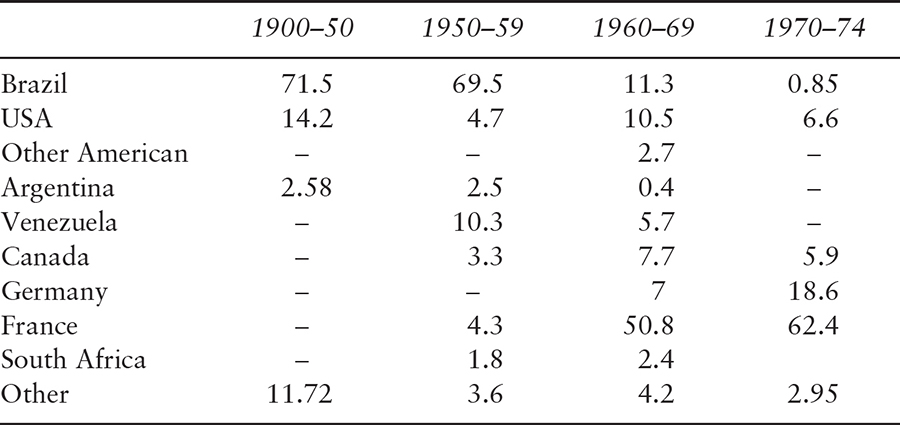
Sources: Engerman and Neves, ‘The Bricks of Empire’; Magalhães Godinho, ‘L’Emigration Portugaise (XVe-XXe Siècles)’; Castelo, Passagens para África.
Once again these broad figures hide some significant detail. Emigration from the Atlantic islands followed a very different pattern from that of mainland Portugal. Throughout the period 1955–74 the main destinations of islanders continued to be the New World, while those from the mainland went, by and large, to Europe.19 The reasons for this difference are obvious. Emigration to the Americas remained much easier for the islanders as there were large Azorean and Madeiran communities already established there and travel was relatively simple. Moreover the American air base in the Azores inevitably attracted would-be migrants to the US. Travel to mainland Portugal and onward journeying to France or Germany were much more complicated.
Who were the emigrants?
In the nineteenth century emigration had been overwhelmingly a male phenomenon, leading to severe imbalances in the Portuguese population. In the course of the twentieth century this gradually changed. More single women began to be seen among emigrants and more families emigrated as a unit or rejoined men who had already left. The level of education of those who emigrated gradually rose, while the percentage of those who came from a rural agricultural background fell.
During the period 1961–70, which was dominated by emigration to Europe, 40.7 per cent of emigrants were women, and the overwhelming number of emigrants (91 per cent) were under 45 years of age with the age group 25–29 predominant. The numbers of men exceeded the numbers of women in all age groups except 20–24, where women formed 58.3 per cent of the total; and also, surprisingly, in the age groups 55 and upwards. The large number of women who went to take up domestic service before marriage and the liability of men of that age to do military service probably account for the proportions in the 20–24 age group. The predominance of women in the 55 and upwards group reflects the dominance of women in this older age group in the population as whole.20
From 1964 onwards the larger proportion was made up of married emigrants, the married rising to 58 per cent in 1965. As the 1960s advanced it became ever more common for whole families to emigrate, or for a wife and children to travel to be reunited with their family. This, of course, was only possible because of the proximity of France and Germany and the comparative ease of travel, which had not been available to earlier generations.
The biggest change in the profile of emigrants, taking the period 1955–88 as a whole, was the sharp rise in numbers of those coming from the secondary economic sector. During the first half of the century the largest group among migrants had been those from rural farming communities, as had been the case in previous centuries, but those in the secondary and tertiary sectors of the economy began to increase in numbers as the European economy opened up opportunities for skilled and semi-skilled workers. By 1988 those coming from a rural agricultural background constituted only 16.86 per cent of those who left the country. There was less change in the profile of emigrants from the islands. A survey of Portuguese immigrants in Toronto in the early 1960s (many from the Azores) found that the average schooling for men was only 3.7 years and for women 2.8 years; 50 per cent had an agricultural background.21
Among those embarking for the colonies in Africa a similar trend can be seen. Until 1954 people travelling alone predominated, but after 1955 there was a steady increase in those travelling as families. On the other hand, in every year from 1943 to 1973 a majority of those who embarked for Africa, whether they travelled alone or as a family, were married. For the young unmarried men and women, going to the industrial areas of Europe always proved more appealing than emigration to Africa.22 The educational level of those emigrating to the colonies reflected the class from which most emigrants came. The figures show a slight rise in the proportion of emigrants who had secondary education, but in general the profile remained one of emigrants with primary education only and a considerable section who were classified as illiterate.23
How many returned?
One problem of relying on tables of statistics is the way that these appear to simplify what was often a very complex process. The number of migrants who returned to their homeland is one of the great unknowns of the emigration story.
In the nineteenth century there was a widespread belief that emigrants went abroad to earn enough money to return rich to Portugal. In Alfred Lewis’s novel Home is an Island, the village schoolmaster tells the hero, ‘Of course you will come back. Try as you will, the new land will not be your land; as you live, and perhaps love, away from your village you will for ever see it. Gradually it will acquire a new light; it will become a lovely mirage. You will return to it, if not in the physical sense, in your imagination, again and again.’24 Some of course did return, in the physical sense, and helped to create the myth of the Brasileiro, the man who had made his fortune in Brazil. Others returned as paupers, providing a cautionary tale exploited by those opposed to emigration. Such was poor Manuel da Bouça in Ferreira do Castro’s novel Emigrantes, who returned poor and disillusioned. Exactly how many returned is, however, profoundly uncertain. Oliveira Martins, writing in the 1880s, thought that half of all emigrants returned, however improbable that sounds. This estimate apart, it is likely that, except for the 1930s, returns probably never exceeded 10 per cent.
More difficult to quantify are those who emigrated and returned many times over. Some of the emigrant life stories recorded by Caroline Brettell and Marcelo Borges show that many migrant workers left Portugal for a period, returned, perhaps to marry, and then left again. For them emigration may never have been a single life-changing choice but part of a way of life in which a person had to be highly mobile to find work and to survive.25
There are, however, periods when it can be securely stated that there was a very considerable return migration. Joel Serrão thought that nearly 10,000 ‘indigents’ returned from Brazil in the decade 1919–30.26 Then, in the 1930s when the world economy was suffering from the 1929 economic collapse, there was not only a sharp decline in the numbers of those leaving but some statisticians have detected a still greater number returning. According to one estimate there was a net in-migration of 103,000 between 1931 and 1940,27 while according to Godinho, during the decade 1939–49, the low tide (marée basse) of emigration, 52.8 per cent returned.28
The second great period of return migration began in 1974 with the granting of independence to the African colonies and lasted until 1976. In those years there was a net in-migration of 898,000, amounting to nearly 10 per cent of the whole population of Portugal. Net in-migration, of course, is not the same as the total number who return—it is the number who return set off against the number who leave.
What is meant by return? The rise of migration to Europe in the 1960s made possible the seasonal return of emigrants who spent their holidays in Portugal and who retained a house in the community from which they had departed. Again, it is impossible to know how many emigrants maintained this foothold in their homeland and how many eventually retired to Portugal.
Summarising the research on this trend Maria Baganha wrote, ‘after ten to fourteen years of working permanently abroad, the objectives that led a significant number of men to leave Portugal, and later to call their families to join them, apparently were attained’. As numbers of emigrants had risen sharply in the 1960s, it is only to be expected that numbers of returnees would begin to increase equally sharply by the 1980s. This, indeed, is what happened. From 7,000 a year in the 1960s, numbers of returnees rose to 13,000 in the 1970s and to 52,000 in the 1980s. After this numbers began to decline, reflecting the decline in numbers of those who had originally left in the late 1970s. Of the returnees 90 per cent returned either to work on the land or to settle in the communities from which they had departed.29 ‘For the majority of these returning migrants, emigration was a success story. A house, major appliances, a car, a small trade or restaurant, the opportunity for wives to stop working … and a varying, but frequently reasonable, level of savings all guaranteed upward mobility.’30
What is clear is that for very many Portuguese emigrants, especially those going to Europe, the separation was never final and complete. They remained citizens of Portugal but living and working in another country for most of the year.
Emigration—the economic debate
Emigration loomed so large in the consciousness of the Portuguese that it was always a central issue in political debate. As with many political issues, the opposing sides were so finely balanced in their arguments that political paralysis was often the result.
Maria Baganha explains how this balance worked out in practice.
Between 1860 and 1930 the Portuguese political elites increasingly pursued an imperialistic/colonial orientation which, associated with the labor intensive character of the Portuguese economy, could have been expected to have resulted in a policy of no-exit. Such did not happen because during that same period demographic growth and economic backwardness made a substantial part of the population redundant; the chronic need for foreign currency made it advisable to trade national labor for foreign exchange. Entangled in a colonial vocation and contradictory socio-economic needs, the Portuguese elites opted for an emigratory policy aimed not to stem but rather to select the emigrant element.31
Nevertheless there were many who were thoroughly alarmed by the scale of emigration, which certainly reached epidemic proportions at certain periods around 1912–13 and 1919–20 and especially in the 1960s. This emigration was attributed, correctly one might say, to the backwardness of the Portuguese economy, which was neither able to absorb population growth nor even to provide a living for the existing population. Unemployment and extremely low wage levels were built into Portuguese economic life. Economic reform, including land reform, was therefore seen as the only way to resolve Portugal’s underdevelopment and at the same time stem the haemorrhage of population.
Ironically, emigration appeared to others to be a cause rather than a consequence of underdevelopment—some employers complained of labour shortages caused by emigration, while others pointed to the extremely low levels of domestic consumption which held back the expansion of the internal market for goods and services, made worse by the large-scale loss of population. Against this it was argued that emigrants sustained the economy through remittances sent to their families in Portugal, remittances that actually had the effect of increasing consumption. As Maria Baganha explains, ‘the restrictions on exit [that is, through the granting or withholding of passports] and the dependency on remittances are heads and tails of the same coin.… Restrictions created mechanisms that promoted family dispersion, which in turn insured the flow of remittances.’32
The shortage of any accurate statistics makes it very difficult to measure this inflow of money and to balance it against Portugal’s chronic payments deficit and fiscal shortfalls. Moreover, as Godinho pointed out, Portugal’s economic gains from emigration were not confined to remittances. To these have to be added the profits of successful emigrant businesses that were repatriated and the profits of trade between Portugal and the countries to which emigrants had gone.33 At the end of the nineteenth century a number of economists believed that remittances and other transfers went a long way towards meeting Portugal’s chronic balance of payments deficit. For example, by 1920 earnings through remittances were equal to about one quarter of earnings through exports and amounted to about 5 per cent of GNP. Godinho estimates that in the years 1924–26, the last years of the Republic, transfers covered between 40 and 60 per cent of the payments deficit.34 Therefore, although at this time remittances never came close to covering the payments gap completely, they were very important in enabling Portugal to sustain its relatively high level of imports.35
During the 1930s and the war years remittances declined, but so too did Portugal’s balance of payments deficit as the colonial economies started to provide Portugal with the food and raw materials that had previously been imported and to absorb more of Portugal’s exports. During the 1950s remittances from the growing white population in the colonies represented 90 per cent of all remittances; but the 1960s saw a massive growth in remittances from Europe as a result of the explosion of emigration during that decade. Remittances rose from 1,868,000 contos in 1960 to 14,343,000 contos in 1970 and 26,452,000 contos in 1973, when they covered 90 per cent of the deficit in trade and represented 10 per cent of GNP.36 Although colonial remittances ceased after the colonies became independent in 1975, remittances from emigrants in Europe continued at a very high level. In the second half of the 1970s they constituted between 6 and 12 per cent of GNP and amounted to between 20 and 46 per cent of the value of imports.37
The wider impact of remittances on the Portuguese economy is equally in dispute. The steady influx of money contributed substantially to inflation, but it may also have had a counter-cyclical effect when the cash continued to arrive during periods of economic downturn. It was sometimes argued that remittances helped to provide capital for investment, but most remittances went directly to the areas from which migrants had come and provided a subsidy to very poor communities that had the effect of allowing the subsistence family economy to survive and helping to keep local wages low.38 Remittances regularly supplemented the annual income of the recipients by as much as two-thirds, and where this income was not spent on day-to-day survival it was usually spent on building houses, buying consumer goods or setting up small village-based businesses rather than on any form of direct investment.
Out of this dialectic on the profitability of emigration there gradually emerged a political synthesis. What if emigration could be diverted from the Americas to the Portuguese colonies? If only a part of those who left for Brazil or the United States could be settled in Angola or Mozambique, a major transformation of those backward colonies could be effected, the flow of remittances would continue and the expanding production and consumption in Africa would provide the economic stimulus that the Portuguese economy needed. The New State, which replaced the Republic after the military coup of 1926, tried to develop a coherent policy towards emigration along these lines after the Second World War, and during the 1950s and 1960s planned emigration to the colonies had some success.
To manage emigration more generally a Junta da Emigração was created in 1947 ‘to implement a quota system that defined the maximum number of departures by region and occupation, after taking into account regional labour needs and the structure of the actual population’.39 The Junta granted passports to those seeking work abroad but refused them to people in certain key occupations. Shortly before the 1974 revolution the government took steps to remove all restrictions on emigration. As Maria Baganha explains, the policy of permitting unrestricted emigration was
capable of easing [the state’s] several needs. It protected the import–export and banking groups by increasing the country’s consumption power and increasing foreign exchange supply without putting in danger the country’s labor supply or promoting changes that could have endangered the entrenched interests of the landowners’ elite…. What in fact both emigration and remittances did was to help postpone economic change…. In sum, the removal of much of the male surplus population and the flow of remittances reduced the pressure on the Portuguese elites to favour policies which might have led to economic development and perhaps to their own displacement from power.40
What was the demographic impact of emigration on Portugal?
In the nineteenth and the early part of the twentieth century the vast majority of Portuguese emigrants were men—in the decade 1868–77 as much as 92 per cent, and as late as 1950 still 65 per cent—and their destinations were Brazil, South America or the United States. Some of these were single young men but many were husbands and fathers who left wives and families behind them. When these men departed there was certainly the expectation that they would at some stage return. As already explained, it was quite common for a man to emigrate, to return to Portugal to marry, and then to emigrate a second time, maybe taking his wife or children with him, before finally settling in either Brazil or back in Portugal. Such multiple comings and goings play havoc with numbers. The same persons may be counted over and over again among the statistics of those leaving and returning and they undermine the concept that all those who emigrate do so on a permanent basis. The fact that many people did come and go and live their lives in more than one country and more than one continent shows something of the part which migration played in the minds of the Portuguese. Migration—seasonal, periodic or permanent—was continually there as an option, as a career choice, or simply as a way of living life. Emigration was a means of escaping poverty, avoiding military service, restoring the family finances, finding employment, building a future; but returning to Portugal was likewise an option, a choice that was available if things did not work out, if one wanted to marry or to be reunited with a family. And to emigrate again remained an available option for the future. However, when women emigrated, it was mostly to join family already established overseas; and returning to Portugal was less likely.
The impact of emigration on Portuguese demography is a complex issue. Large-scale male emigration (like losses of men during wars) has a short-term, but very little long-term, impact on population numbers. On the other hand the departure of women or whole families has a much more significant effect. In Portugal this began to be felt once emigration switched from the Americas to Europe. From the 1960s women began to emigrate in much larger numbers (40 per cent of total emigration during the decade 1961–70), and among them were an increasing number of single women looking for work.41 In the 1960s, therefore, Portugal for the first time experienced a net loss of population. Continental Portugal registered a small increase over the decade of just 0.4 per cent, but there was a significant loss of population in the islands. In that decade every region registered a decline except for Aveiro, Braga, Lisbon, Porto and Setúbal. The decline was due not only to large numbers of emigrants but to a noticeable decline in natural increase, presumably due to the emigration of women and children, for, as already noted, in the 20–24 age group, the key age for having children, the majority of migrants (58.3 per cent) were women.42 However, the loss of population in the 1960s was more than made up for by the large-scale return of people from Africa in the years 1974–76, which may have added as much as 10 per cent to the population of Portugal.
Over the course of the twentieth century, the population of Portugal as a whole continued to grow (from around 5 million in 1900 to just over 9 million in 1976 and an estimated 10.69 million in 2013). At the same time the population of the rural areas of northern Portugal showed a steady decline, though much of this may have been due not to emigration as such but to the movement from rural areas to the cities, which was a phenomenon familiar in all of Mediterranean Europe.
A society of women
Maria Baganha states in her article ‘Portuguese Emigration after World War II’ that there is ‘an assumption that Portuguese emigration is essentially an international labor flow, which has changed according to the demand for labor in the international market’. Caroline Brettell, however, has argued that migration cannot be understood except in terms of the life choices made by individuals, which are often complex and are seldom as mechanistic as phrases like ‘international labour flow’ would suggest.
From the middle of the nineteenth century until 1960 the large majority of emigrants were men from the rural areas of northern Portugal and the islands. The consequences of this exodus for Portuguese society and for Portuguese culture were profound. It became quite common for married women to be left to manage the rural smallholdings and to bring up families on their own—with the help, if they were lucky, of remittances from husbands or sons overseas. Even when men did not emigrate to the Americas, they often left the villages to seek work in the towns, to go as seasonal labour to Spain or Morocco or to sail with the White Fleet to the Grand Banks and the Greenland cod fisheries.
Caroline Brettell summarised the impact of this pattern of migration: ‘Historically male-biased emigration can … be linked to such phenomena as delayed marriage for women, permanent spinsterhood, high rates of illegitimacy, uxorilocal residence patterns, female heirship, and unusually lengthy birth intervals.’43 It was quite common for many Portuguese women to remain unmarried—though this may have been due less to a shortage of men to marry than to the pressure on women not to have families and force the further division of the family farms. In Portugal in the 1860s 21 per cent of women over fifty remained unmarried, and this figure was still around 16 per cent in 1960. In some rural parishes, however, the numbers were much higher. The figures given by Caroline Brettell for the parish of Santa Eulalia in Minho show that 33.9 per cent of women over fifty in the decade 1860–69 were unmarried, with little change in the succeeding hundred years—the figure for 1950–59 being 31.2 per cent.44
As a result of the absence of men, women occupied a very prominent place in rural society in northern Portugal, making the important family decisions, bringing up children and managing family property. The downside of this was cultural isolation resulting from the very low level of education available for women and the various laws, particularly during the period of the Estado Novo, which prevented women from occupying positions of responsibility in the wider society. Many studies have emphasised the hardship that male emigration brought to the women left behind, reflected in the titles that Caroline Brettell gave to two of her books, We Have Already Cried Many Tears and Men Who Migrate, Women Who Wait; but few have expressed it so eloquently as Alfred Lewis. José, the hero of his novel Home is an Island, asks his mother if she would rather he stayed in the village. She replies,
No. you must go. Yes, you must go, as all the others before you. You can’t fight the sea. The stone houses will soon be empty. Soon our streets will be without people—as soon as the old die. Yes, they will die in sorrow and will lie in our cemetery and the weeds will grow over the graves and the crosses. … Soon the sea will call in vain, for only the old will be here….45
One of Wenona Giles’s informants in Canada, however, gave a rather different picture.
Work was shared among women. Now looking on it, I think my mother had a lot more control over her own life without my father around, than after we came here [Canada] and started living with him. And we never felt alone—other women either single or whose husbands were away and had no children, would come over and sleep in our house. So I basically was brought up with a lot of women all around me.46
The rapid rise of emigration to France radically changed this situation. Increasingly women were able to migrate to join their husbands and were able to find employment for themselves in France or Germany, even if only in domestic service. Many single women also emigrated to find work and some of them settled down outside Portugal. For many women emigration was undoubtedly a liberating experience, offering for the first time life opportunities that had never been available in Portugal.
The parish and the emigrants
Emigration to western Europe rather than to the Americas brought other changes. Those who emigrated to the Americas, with some few exceptions, tended to lose touch with ‘home’. Emigration to France, however, was different. Returning to Portugal was easy and many emigrants continued to maintain close contact with their ‘home’ village and with family members still resident there. In particular, people would return for prolonged holidays or to be present at the village festivals, usually in honour of the village’s patron saint. The doings of emigrants might be recorded in parish newsletters and emigrants would be asked to contribute to fundraising events. It also became common for emigrants to build holiday homes for themselves in their ‘home’ villages. These houses built by the so-called Francês (those who had made money working in France) were often ostentatious and even garish, as had been the houses built by the Brasileiros in the previous century. These regular close contacts did not necessarily mean large numbers of emigrants returning on a permanent basis. Rather the contrary, as it became increasingly popular for families with homes in Portugal to remain settled in France of Germany in relatively well-paid jobs.47 In this way the life of Portuguese communities, close-knit within Portugal itself, might come to include people resident outside Portugal altogether.
Portugal’s ‘fourth empire’: redefining the Portuguese nation
The triumph of the idea of the nation state after the end of the First World War was never complete—even during the 1930s when some nations sought self-sufficiency to insulate themselves from the hazards of the global depression. The European colonial empires, especially those of the French and Portuguese, kept alive, in one form or another, the idea of the multi-ethnic state, even the multi-ethnic nation, existing in different parts of the world; after the end of the Second World War the multi-ethnic state has steadily become the norm in most of the industrialised countries of the world, and especially among the independent states which emerged with the end of colonial rule. In the twenty-first century there are comparatively few countries of the world which can effectively claim that they are inhabited by a single ethnicity. Nor has the pluricontinental state entirely disappeared. France still has fully integrated départements in the Caribbean and the Indian Ocean and territoires in the Pacific.
Since the end of the Estado Novo and the dissolution of the pluricontinental Portuguese state, in which Angola, Goa, Timor and Macao were all provinces of a greater Portugal, Portugal joined the EU in 1986 and successive governments have sought actively to redefine its position in the world. No longer having overseas provinces, Portugal has sought to embrace the Portuguese diaspora as an extension of the nation—rather provocatively this has sometimes been referred to as the ‘fourth Portuguese empire’.48 In 1976 a law confirmed the right of Portuguese to emigrate and to return to Portugal, and asserted that ‘Portuguese citizens who are or who reside abroad enjoy the protection of the state for the exercise of their rights’.49 In 1980 a Portuguese Communities Council was set up to advise the government on policy relating to emigrants and to promote links between various diasporic communities.50 In 1985 a government department for overseas Portuguese communities was created and in 1992 provision was made for Portuguese emigrants to have dual nationality, a provision which allows them to vote in Portuguese elections. Following this, a raft of policies was put in place by which Portugal supported its diasporic communities. As Andrea Klimt has expressed it:
Portugal has moved increasingly to incorporate its deterritorialized population into definitions of the nation and it has become increasingly easier for the Portuguese residing abroad—even for long periods of time—to continue thinking of themselves as members of the Portuguese nation. Incorporation of dispersed populations into the national fabric has long been actively encouraged by both state and private institutions in Portugal: Portuguese banks facilitate the transfer of remittances and offer special interest rates to migrants; the Portuguese Catholic Church actively cultivates migrant congregations abroad; the state helps support Portuguese language schools for the children of migrants; and the interests of Portuguese living abroad are officially tended to by state agencies.51
The poet Fernando Pessoa is credited with having said, ‘My nation is the Portuguese language’. As Robert Moser and António Luciano de Andrade Tosta interpret this: ‘Pessoa’s words captured the patriotic verve behind much of Portugal’s imperial and neo-imperial discourse throughout the twentieth century.’52 Steps have been taken to promote the study of the Portuguese language and to keep its use alive in the diasporic communities. This programme is administered now by the Instituto Camões and by Portuguese consular offices across the world. It involves very large numbers of teachers of Portuguese who follow their teaching careers in the expatriate communities—in 1977 there were 275 teachers running courses in France alone.53 Some of these teachers move from country to country following their contracted obligations, like the scholars and churchmen of an early age.
In 1996 the CPLP (Comunidade dos Países de Língua Portuguesa) was established as a Portuguese version of the Francophonie and the (British) Commonwealth—although with the crucial difference that Brazil rather than Portugal itself is clearly the leader of this post-imperial Lusophone world. The CPLP started out as a loose association of countries which used Portuguese as their official language. It had ‘a utopic vision for a transnational community of Lusophone … countries held together by a common language and colonial past’,54 although it did not at that time include any other country that had a large Portuguese diasporic community. However, there have been requests from Mauritius, Equatorial Guinea and Senegal for associate observer status, and Equatorial Guinea has sought full membership, even though it is officially Spanish speaking. There is a historical dimension to these requests as Senegal is the immediate neighbour of Guinea-Bissau and includes the Casamance region, which was part of Portuguese Guinea until 1886. Equatorial Guinea includes the islands of Bioko (formerly Fernando Po) and Anobom which was a Portuguese possession until 1776 and where a Portuguese creole language is still spoken. The memories of an imperial past, which so many countries have rejected in their search for independence and national identity, are now being revived in a wholly unexpected way.
With the launch of the Lusophony Games in 2006, in imitation of the Commonwealth Games, a number of countries which at one time had close links with Portugal have expressed a wish to take part. These include Morocco, India, Flores (in Indonesia), Ghana and Sri Lanka. The 2014 games are actually being held in Goa. The next move will surely be to allow diasporic Portuguese communities to take part as well and to complete the refashioning of the pluricontinental Portuguese nation.