
{ ACKNOWLEDGMENTS }
For readings of chapter(s), advice, bits of information, words of encouragement, or simply asking how things were going, I thank: Elie Axelroth, Tim Barnes, Casey Nelson Blake, Tim Becher, Eileen Boris, Sarah Bridger, Lawrence Buell, Charlie Cohn, Kyle Cuordileone, Jimm Cushing, Richard Enfield, Christina Firpo, Cristina Giorcelli, Cindy Green, Melody Herr, Jim Hoopes, Matt Hopper, Robert Inchausti, Konstantina Karageorgous, Bruce Kuklick, Jeff Larsen, Ralph Leck, Jane Lehr, Nelson Lichtenstein, Robert Lockhart, Steven Marx, Kevin Mattson, Mike McCormick, Paul Miklowitz, Andrew Morris, Jay Parini, Giovanna Pompele, Marta Peluso, Tatiana Njosh Petrovich, Maria Quintana, Jennifer Ratner-Rosenhagen, Joan Shelly Rubin, Robert Rydell, Ann Schofield, Emanuele Scoppola, Richard Shaffer, Gary and Vallerie Steenson, Maxine Stein, Jack Sullivan, Leslie Sutcliffe, Quintard Taylor, John Thomas, Ilana Winter, and Martin Woessner. Thank you as well to the anonymous readers of the manuscript for Oxford.
My editor, Brendan O’Neill, has been unceasingly enthusiastic about this project, which has meant much to me. His reading of every chapter made this a better book. And thanks to him, as well, for recommending Holy Motors, a transcendently great film. Others with Oxford, Stephen Bradley and Joellyn Ausanka, have been excellent. Copyeditor Ben Sadock has been superb, earning my gratitude. My agent, John Thornton, has become a friend while helping me navigate the often choppy waters of publishing. Research was aided by archivists at a number of institutions: Columbia University (Ginsberg and Jong Papers), New York University (Gelber Papers), Stanford University (Ginsberg Papers), UCLA (Sontag Papers), and Yale University (Living Theatre Collection). Thank you, too, to Cal Poly Interlibrary Loan and to the Department of History at Cal Poly.
While working on this book, I often escaped by reading works distanced from my subject. These books left me impressed and inspired. I offer my appreciation to the following authors and urge readers to cast a glance in their direction: Sarah Bakewell, Laurent Binet, Kevin Birmingham, Lisa Cohen, Alexandra Harris, Kevin Jackson, Gilbert King, Olivia Laing, Helen Macdonald, Robert Macfarlane, D. T. Max, Maggie Nelson, Orhan Pamuk, Andrea Pitzer, George Prochnik, and the great W. G. Sebald.
Thank you to my Facebook friends for voting on potential titles for this book. As always, my deep love to Marta Peluso, who helps me to live better by urging me to turn away from my excessive nonhedonism to embrace bits of pleasure. And she is a great reader of page proofs—no easy task.
Feast of Excess
“Don’t you think that John has gone too far this time?” Lucretia Cage worried after first “hearing” her son John’s piano piece 4’33”.
A reasonable query, for nary a key had been touched nor a note sounded from the piano during the performance. But the ever sly and mischievous John Cage had created music, in a manner. The “expressive silences” of the work opened attendees to sounds aplenty in the immediate environment—creaking concert-hall rafters or the anxious whispering and fidgeting of people in their seats.1 When the piece debuted in August 1952, boos and groans of downright hostility had greeted it. The piece was excessive in its minimalism, but also delightful in its challenge to artistic conventions.
Earlier in that sublime August of creativity, Cage had staged a “happening,” a diverse-media frenzy in a dining hall at Black Mountain College in North Carolina. With a maximum of chaos, a dose of the absurd, and a desire for spontaneity, the event swirled with poetry read, a piano played, records spun, all-white paintings displayed, slides and movies shown—all as dancers wended their way through the phantasmagoria. It was a feast of excess.2
Jump ahead to the early 1970s in Southern California. A baby-faced artist named Chris Burden, wearing only a skimpy swimsuit, hands behind his back, slithered and crawled, body bleeding, across a fifty-foot gallery floor strewn with broken glass. In 1974, he had friends crucify him by hammering nails into his palms as he nestled against the curved back of a Volkswagen Beetle. Someone revved the engine, which screamed in contrast to Burden’s own silence. As part of the piece, he would later display the gritty “stigmata” scars that had been left on his palms. Nor should we forget his infamous performance piece Shoot from 1971. From a distance of fifteen feet, in front of an audience of friends, Burden had himself shot. A copper-jacketed .22-caliber bullet was supposed to graze his arm; instead it hit the fleshy part full on. A couple of photographs show the artist on the verge of shock—he was bleeding for his art. He remarked later that the piece had succeeded; after all, he had experienced being shot and lived to tell of it.3
From silence to blood, the American cultural scene between 1952 and 1974 pushed boundaries, defied expectations, and trafficked in excess.
Many artists joined Cage and Burden in this challenging and crazed adventure. Patricia Highsmith penned unsettling novels in which amoral criminals went unpunished and enjoyed ill-gotten prizes. Norman Mailer unleashed ego and violence-drenched performances in his writing (anal rape, approval of murder, and celebration of drugs) and in daily newspaper headlines, as when he stabbed his wife; Andy Warhol embraced boredom (films that went on for seven hours without much of anything happening) and repetition in his artwork (image after image of Marilyn Monroe, with lusty red lips) to become famously famous for more than fifteen minutes; Anne Sexton, in her confessional poetry, picked at the scabs of her physical and mental pain; John Coltrane assaulted listeners with the transcendental, almost unbearably long shrieks of his saxophone; Amiri Baraka’s poetry screamed with angry calls for blood in the streets (and sometimes his own flowed); Erica Jong explicitly described the delights for women of a “zipless fuck,” while Samuel R. Delany wrote in exacting detail of every sexual and coprophilial act imaginable; and Diane Arbus broke down barriers between photographer and subject (sometimes by having sex with her subjects) in a manner at once honest and frightening, especially since her subjects of choice were often those considered by society to be freaks and outcasts.
All of these artists were creating a new sensibility for American culture that refused the polite and traditional while celebrating the excessive and unconventional. Acts of excess; going to extremes; focusing on violence, sexuality, and madness; blurring lines between genres, between artist and audience, had always been present in art and culture of the past. But in the period under consideration in Feast of Excess, they became more common, pronounced, and pervasive. In large part, they came to constitute a culture—our culture—which still enthuses and beleaguers us to this day.
“The New Sensibility,” the white-suited dandy Tom Wolfe wrote in 1965, was a new cultural world. In manic, signature prose he exulted: “Baby baby baby where did our love go—the new world, submerged so long, invisible, and now arising, slippy, shiny, electric—Super Scuba-man!—out of the vinyl deeps.”4 A Columbus of cultural exploration, Wolfe jumped into the American landscape of demolition derbies, custom car stylization, and stock car racing. He cooed about the intensity of instant experience; he celebrated, with his usual irony, the celebrity of one Ms. Jane Holzer (a woman with great hair but no discernible talent). He was gleeful that the once traditional border between high and low culture had been trespassed. Content and style were brilliantly conjoined in his reporting on the signage of the Las Vegas strip: “Free form! Marvelous! No hung-up old art history words … artists for the new age, sculptors for the new style… . It was happening, baby!”
Susan Sontag—stunningly erudite and enticing, a young critic and novelist—was cooler in register than Wolfe. She discovered the New Sensibility in avant-garde theater, absurdist and experimental novels, and in the over-the-topness of camp style. She reveled in the experimental flourishing of American culture—in odd films such as Jack Smith’s Flaming Creatures (1963), in which blurred figures, some naked, others swathed in flowing sheets, cavorted in dream-like revelry. She rebelled against the need to find deep meaning (historical, psychoanalytic, or otherwise) in works of culture, preferring to experience the work of art on its own terms, to skate along its surface. Sontag was no cultural stick-in-the mud. She loved to kick off her shoes and dance to the pop music of the great girl group the Supremes.5
The differing visions of a New Sensibility enunciated by Wolfe and Sontag shared a fascination with excess, a demand for pleasure (of various sorts), a willingness to push further into experiments in style, and an openness to new content. As with Cage’s music, excess could lead in the direction of minimalism, a clearing out of the cupboards of the mundane. Burden’s dismissal of the usual artistic object (the painting or sculpture) was intended to make his own body and its experiences into a work of art. Yet the New Sensibility also embodied maximalism: the cacophony of Cage’s happening, the heated poetry of Allen Ginsberg, the macho musing of Mailer, the erudition gone wild of Thomas Pynchon, or the camp transvestism of Gore Vidal’s Myra Breckinridge (1968). Could there be anything more excessive than the perfervid use of four-letter words in a performance by Lenny Bruce or tales of drug-addled Las Vegas adventures as narrated by Hunter S. Thompson?
A theatrical or performative style was central to the New Sensibility. Life and work intermingled; the artist became enmeshed in the celebrity world, often willingly—as with Ginsberg, Mailer, Baraka, Vidal, Warhol, and Jong, to name a few. Artists in all media had become hyperconscious about themselves performing for an audience—of being watched; such was the essence of Burden’s thorny performances. Artists were in general, according to critic Richard Poirier, creating a new identity.6 In contrast, Pynchon was a performance artist of hiding, shielding himself from any public presence beyond his written words. Two of Burden’s pieces from 1971 played with the idea of anonymity, too, as when he once stayed for five days cramped in a school locker or when he spent three days in Kansas City with a mask always on his face—anonymity and attention at the same moment.
In the hands of less skillful artists, a mania for publicity translated into self-indulgent oversharing, confessional kitsch. But with the imperative to go farther, increasingly little was hidden, and much that was daring accomplished. The lines between the personal and the political, as feminists averred, grew skimpy. Confession became, in William Styron’s view, “a particularly 1960s form of address.”7
Divisions between artist and audience melted, in various ways. Since Warhol’s films and silkscreens seemed to exist only on the surface and paraded themselves either as works of brilliance or insipidity, critic Lucy R. Lippard contended that viewers were forced to take a stance in relation to the work. Passivity in relation to the products of the New Sensibility was discouraged.8 Performers of the Living Theatre tried to draw the audience into the play or take the performance into the audience. Such forms of involvement at first included actors, still in role, mingling with the audience during intermission; within the decade, cast members would encourage audience members to frolic with them in sexual acts.9 In similar manner, the happening, a nonrepeatable ecstasy of spontaneous expression, refused to be divorced from “daily life.” Happenings involved participants in its operation and critiqued, by so doing, the nature of art and its institutions. Allan Kaprow, an early proponent of happenings, imagined these new “alchemies” would define art in the decade of the 1960s.10
When protestors at the Democratic National Convention in the summer of 1968, amidst tear gas and beatings, intoned, “The whole world is watching,” they were, in a sense, summing up the performative ethos of the New Sensibility. Everything had become theater as radicals Abby Hoffman, Jerry Rubin, and Amiri Baraka understood perfectly well. There was, as social critic Marshall Berman observed a “new intimacy between” all aspects of culture and “the life of the street.”11
The New Sensibility aimed to obliterate the cultural divide in order to hurry forward into the territory of liberation. Mailer’s The Armies of the Night (1968) was subtitled History as a Novel/The Novel as History. Not only did Mailer blur divisions between reportage and fictional depiction, he performed as a central character in the drama. Truman Capote had already forged a similar hybrid with In Cold Blood (1966), which he called a “non-fiction novel.” The book narrated the horrific slaughter of a Kansas farm family by two ex-cons. It was a gripping tale, awash with violence and exhibiting both detachment and empathy for one of the murderers.12 Pynchon’s novel Gravity’s Rainbow (1973) was not only a crossword puzzle of clues but also an explosion that demolished genre distinctions.
Excess defined the stylistic imperative of the New Sensibility. “Apocalyptic expression” and “overkill” became its expressive coin of the realm. Norman O. Brown caught this heightened sense in 1966 by declaring, “Only the exaggerations are true.”13 Consider in this regard how a minimalist aesthetic could meld into a maximalist obsession. In his film Empire (1964), Warhol’s immobile camera focused on the iconic Empire State Building. Filming began at around 8:00 p.m. and ended just before 3:00 a.m. The six-hour film was later shown in slow motion, pushing it to eight hours in length. It was minimalist in conception and execution; it was maximalist in scope and audacity. The subject was less the Empire State Building than the unfolding of time, reveling in a fascination with the unexpected coming into view (birds, shifts in light, airplanes) and with the oddly dynamic interplay between boredom and attentiveness. It was, in effect, a child of Cage’s 4’33”.
The New Sensibility’s celebration of excess as a style, a way of seeing and presenting the world, was riveted on a common core of subjects: violence, liberation (especially sexual), and madness. Such topics had, of course, long been significant, but had often been handled with kid gloves, romanticized, or shunted to the sidelines of poor taste. No longer. Now, as critic and poet John Gruen put it in 1966, “No subject is taboo, no action forbidden.”14 Transgression was tattooed on the arm of American culture. The New Sensibility vigorously endorsed the notion of “thinking about the unthinkable,” a term which had been popularized in another context by Herman Kahn, a theorist of nuclear-war survival.
If one was going to depict violence, then so be it—do so in Technicolor imagery, horrifyingly exquisite detail, or feverish prose. In the 1950s, Brando emoted a sense of violence, almost savoring its possibility in every twitch of his body and facial expression. Violence stalked with screechy footsteps in the work of such diverse figures as Highsmith, Mailer, Delany, and Baraka. Although Warhol was famous for his repetitive images of celebrities and consumer products, he did a provocative series of prints that captured this burgeoning fascination with violence. Death and Disaster consisted of silkscreened images, often inked in different colors, of an electric chair (the one in Sing Sing Prison that had executed atomic spies Julius and Ethel Rosenberg), automobile and plane crashes, and even newspaper stories about women that had died from eating cans of tainted tuna fish. It was everyday death staring into your face.
By the late 1960s, an aesthetics of graphic gore reigned in the cinema. In earlier films, violent death was depicted without blood spurting, body parts being severed. With four cameras running, director Arthur Penn orchestrated the filming of a “spastic ballet of death” as eighty-six bullets riddled the bodies of his antiheroes Bonnie Parker and Clyde Barrow. A couple of years later, Sam Peckinpah’s The Wild Bunch (1969) offered a four-minute shootout orgy, with at least a hundred bloodied men twisted in agony—at once repellant and mesmerizing.
Artists (novelists, filmmakers, and painters), all supping at the table of the New Sensibility’s excess, savored sexual possibility and unabashed joy. Pleasure began to challenge the tragic for a central place among the cultural elite. Drama critic Walter Kerr wanted to see the “habit of unhappiness” broken. Artist Claes Oldenburg waxed about artworks that “a kid licks, after peeling away the wrapper.” Most famously, perhaps, Susan Sontag craved an “erotics of art” to displace the boring and staid that had dominated American culture and criticism. It seemed possible for viewers, if they so desired, to skip across the surface of some artworks—in the view of artist Robert Motherwell, writing in the mid-1960s, “One does not have to ‘understand’ wholly to feel pleasure.”15
Erotic sexuality, once suppressed in American culture or relegated to the privacy of the bedroom, now unblushingly abounded. Raw sexuality and much more exuded in works such as William S. Burroughs’s Naked Lunch (1959), John Rechy’s City of Night (1963), and Hubert Selby Jr.’s Last Exit to Brooklyn (1964). By the late 1960s, it would be ubiquitous in American culture.
Following on the heels of heterosexual male liberation, as narrowly exemplified by Playboy in the 1950s, Helen Gurley Brown greeted the 1960s with sharp advice about how single women could make sexiness pay dividends. Americans would soon view Benjamin Braddock, the antihero in the film The Graduate, cavorting with married Mrs. Robinson, or they might ogle full frontal nudity on the stage in Hair or Oh! Calcutta! Combining sexual detail, Jewish guilt, and careening lust, Philip Roth published a bestselling novel, Portnoy’s Complaint (1969), that charted the sex and times of one Alexander Portnoy and his female companion, affectionately known as “The Monkey.” If Roth’s sexuality was beholden to the Playboy ideal, Erica Jong’s novel Fear of Flying (1973) upturned tables to grapple with the personal and sexual liberation of a woman. By the 1970s, pornography was no longer housed in seedy theaters but was on screens across the nation and in bestselling books, even in work by highly respected authors such as Pynchon and Delany.
Many of the early masters of the New Sensibility (Cage, Rauschenberg, Highsmith, Brando, Ginsberg, Sontag, Vidal), it bears noting, were gay or bisexual. This is hardly surprising, since the New Sensibility was about aesthetic and personal liberation. It did not unlock the closet but made its confines more commodious. In time, through the jaunty excess of camp, aspects of a gay sensibility increasingly entered the cultural mainstream, as with the popularity of the Batman television series of the mid-1960s. And it was only a matter of time before Vidal’s fictional Myra Breckinridge proclaimed: “I broke the arms, the limbs, the balls of their finest warriors.”16
“The exemplary modern artist is a broker in madness,” announced Sontag. King Lear types romped about the culture at large. By the mid-1960s, the topic of madness had become for some a royal route to liberation. In a major assault on traditional rationality, thinkers as diverse as Herbert Marcuse, Norman O. Brown, Thomas Szasz, and R. D. Laing contended that madness freed the individual from the numbing repressiveness of normality. “Madness may not be all breakdown,” wrote Laing. “It may also be breakthrough.”17 With stunning verisimilitude, Diane Arbus photographed patients in mental facilities, and Sylvia Plath wrote candidly, albeit with a fictional overlay, about her own institutionalization. This theme resounded in films, captured in the French film King of Hearts, which played in one Cambridge, Massachusetts, movie theater for five years straight.18 The main character in the film, played by Alan Bates, awakens to find himself among an assortment of nutjobs. He eventually realizes that he—and they—all reside in an insane asylum. By the end of the film, this venue proves to be far more normal and humane than the killing fields of the surrounding countryside, then engulfed by the conflagration of World War I.
Poets and writers increasingly talked directly, perhaps excessively, about their own experiences with depression, abortion, madness, and suicide attempts. Plath and Sexton, no less than Ginsberg, Robert Lowell, John Berryman, and Mailer, revealed their own demons, balancing the constraint of art with the volcano of emotion. Sexton was explicit about this. “You see, I am given to excess,” she wrote a friend, “that’s all there is to it. I have found that I can control it best in a poem.”19
Some readers may have some questions at this point about the concept of a New Sensibility. First, might its definition be too capacious? Is it merely a version of philosopher William James’s summer home, once described as having “fourteen doors, all opening outward?” Second, what the heck is a sensibility? Third, where does the New Sensibility stand in relationship to entrenched categories such as modernism, late modernism, romantic modernism, and postmodernism?
In looking at the phenomenon of camp, Sontag noted that it was, ultimately, “ineffable.” This was good, she argued, for when one draws the strings too tightly around a sensibility, its life can be choked out.20 The New Sensibility, a term that Sontag helped to popularize, thrives when allowed to breathe. But, for the sake of clarity and emphasis, a sort of quick-study guide to the New Sensibility is necessary.
The New Sensibility was about excess, exaggeration, pushing limits, embracing the popular, and going too far in style and spirit. The New Sensibility, in opposition to much of what had come to be known as high modernism, vaulted the presumed barrier between high and low culture. Modernism was marked by an “anxiety of contamination,” to use critic Andreas Huyssen’s phrase.21 True, but tricky. After all, James Joyce was a modernist of the highest order, and in his fiction he did not eschew excess or popular culture (the ordinary details of daily life).22
Not surprisingly, some of the figures associated with the New Sensibility—Cage and Pynchon—followed in his footsteps, demonstrating that the lines drawn between the modern and the postmodern are inexact and sometimes wrong. Perhaps modernism in general was a bit tamer, pointed toward order, or at least the illusion of order, in contrast with the New Sensibility. A quip about T. S. Eliot, a modernist saint, might drive home this distinction. Eliot’s tailor, Cyril Langley, when asked about his client’s suits, replied: “Remarkable man, Mr. Eliot … very good taste. Nothing ever quite in excess.”23
The New Sensibility obsessively concerned itself with violence, madness, sexuality, confession, and liberation. The New Sensibility was a constellation of ideas, kept in orbit by the gravitational force of excess. No single cultural creator exemplified all its tensions and subjects, nor did one need apply for membership in the guild. One simply worked within its characteristic style and focused on its common themes, in the process expanding the reach of the sensibility.
Was the New Sensibility, then, a continuation of modernism or its last gasp? After all, traditional avant-gardes (itself an oxymoron, I realize) invariably sought to demolish lines between art and life, between the personal and the political, between artist and spectator—and to shake things up. Certainly, many aspects of the New Sensibility, even its excess, had resided within the castle of modernism, especially in futurism, surrealism, and Dadaism. Consider when Hugo Ball and his compatriots at Cabaret Voltaire in Zurich donned the oddest of costumes and recited the strangest of poems to protest against the greatest creative madness of all, the First World War. Or read some lines of Gertrude Stein’s “An Acquaintance with Description” (1926), where an experimental excess of minimalism and maximalism intertwine: “Let it be when it is mine to be sure let it be when it is mine when it is mine,” on and on.24 High modernist critics were often unamused with such displays. In response to Dada and surrealism, for instance, art critic Clement Greenberg rejected their “anti-institutional, anti-formal, anti-aesthetic nihilism” as a stance that was empty of force and irrelevant to the times.25
Little is absolutely new, except the persistent call to make it new, as uttered by poet Ezra Pound in the early twentieth-century (a phrase which, according to Michael North, only became popular in the period under consideration in this book).26 Newness itself—like measles or fads—has its outbreaks. But the styles and concerns of the New Sensibility coagulated and thickened sufficiently for a new movement to be realized and sustained over a long period of time—with connections to the earlier, but with a sustaining identity all its own. In this sense, borrowing from critic Edmund Wilson, the New Sensibility might be viewed as the “second flood of the same tide” of modernism—or as the first tide of the postmodern.27
How does one define or surround such elusive terms as modernism or postmodernism? Ironically, the best way to engage this concern might be with Cage’s or Samuel Beckett’s admonition for silence. Nonetheless, in 1970, critic Irving Howe composed a list of qualities associated with the modernist temperament: mania for the new, subjectivity, difficulty, despair, revolt, desire for purity, utopian longings, disdain for audience, a sense of historical discontinuity and the artist as heroic. But all these, he acknowledged, were peppered with internal divisions; it was unclear how to proceed, and to what destination.
Modernism continues to be placed under the microscope of analysis by legions of zealous and insightful scholars.28 Out of this frenzy have arisen further modifications, romantic modernism, anarchistic modernism, late modernism, and, of course, the fabulously catch-all term postmodernism (presumed to be marked by pastiche, hedonism, refusal of history, demise of the subject, rejection of master narratives and celebration of theoretical discourse, gaudy surfaces, or even a “form of Free-Style Classicism”). Where does this take us?29
To put my own cards on the table, the New Sensibility combined aspects associated with both modernism and postmodernism. The poet David Antin once remarked wisely, “From the modernism you want, you get the postmodernism you deserve.” And vice-versa. Or, better still, Ihab Hassan, who has spent as much time living in the postmodernist neighborhood as any scholar, admitted that postmodernism, no less than romanticism, and modernism, “suffer[s] from a certain semantic instability.”30 Definitional consensus about these terms, then, will forever be elusive; trying to reach one is a game that has its delights but never ends with victory.
Nor should one dwell on presumed contradictions within the New Sensibility, such as between its minimalism and maximalism. They existed alongside one another, as creative tensions, so long as they were taken to extremes. Writing in 1960, art critic Harold Rosenberg stated: “The new cannot become a tradition without giving rise to unique contradictions, myths, absurdities—often creative absurdities.”31 Indeed, these tensions were present at the birth of the New Sensibility in the 1950s. And this is as it should be.
Recall the famous imperative of William James’s pragmatism, the value of an idea is in how well it works, how it helps us to see things in a different light, how it leads us forward. Let the value of the New Sensibility be submitted to the pragmatic test. As James always desired for pragmatism, so too let the New Sensibility become a point of departure, rather than of closure. Let it be considered a style and subject matter that began to stir in the early 1950s, got named as a phenomenon and exploded in the 1960s, and became the lingua franca for much of our culture in the 1970s, continuing to our present day. It was, and is, a culture marked by excess, an imperative to shrug off limits.32
A few words about what is meant by the concept of a sensibility. A sensibility, new or otherwise, allows us to encounter and create culture. A sensibility is a style or a code—both conscious and unconscious, a certain attitude or way of approaching the world. As historian Daniel Wickberg smartly notes, a “sensibility is anterior to the objects it represents in various concrete manifestations.” Concepts closely related to sensibility have long been bandied about by great scholars: Raymond Williams’s “structure of feeling” (the tone, codes, and presumptions of a society); Michael Baxandall’s “the period eye” (“a stock of patterns, categories, methods of inference,” and training) or, borrowing from Max Weber, Clifford Geertz’s view that culture exists as “webs of significance” (rituals, symbols, and modes of being), or a version of Thomas Kuhn’s paradigm (a way of organizing materials into a coherent whole that initially dismisses anomalies and sets the direction for research). In a Kuhnian sense, the New Sensibility certainly emerged to guide the cultural creativity of the period from the early 1950s to the present.33
Problems arise, certainly. Concepts can become wet blankets smothering paradox and conflict and undermining agency. As literary critic Lionel Trilling put it, culture is a “struggle, or at least a debate,” marked by multiplicity.34 The style of the New Sensibility, in its essential aspects, was capacious—able to house Cage’s minimalist aesthetic as well as Lenny Bruce’s impassioned comedic spleen, Mailer’s monumental ego and Pynchon’s waterfall of prose. As the New Sensibility became powerful in the 1960s, it helped to create and reflect the contradictions of the era. In the words of literary editor Gerald Howard, “The coolly ironic mood so characteristic of so much of Sixties art seems to contradict the heated idealism, political activism and self-exploration so equally characteristic of the Sixties.”35
However, the New Sensibility never vanquished other cultural configurations. Restraint and tradition never exited the stage. The plurality of American culture has always been assured—if not by class, regional, and racial divisions, then by the need of commercial capitalism to increase rather than to foreclose the possibilities of consumption. As an example, American popular music in the 1960s, we need to remember, for all of the excitement and experimentation of the Beatles and the Rolling Stones, Dylan and the Velvet Underground, also had its fill of fluff. Historian George Lipsitz reminds us that the bestselling single record for 1960 was a sugary-sweet instrumental number, “Theme from A Summer Place,” by the Percy Faith Orchestra, and Kenny G. has long remained a musical star. The most widely viewed television show between 1962 and 1964 was The Beverly Hillbillies, and today mainstream television channels have no lack of pabulum.36
Nonetheless, our house of culture has settled permanently in the concrete of excess.
All sensibilities exist within political, social, and economic contexts, and these contexts, in turn, are dialectically affected by the sensibility. “Ours is indeed an age of extremity,” wrote Sontag in 1965. She had uncovered an “aesthetics of destruction” in science fiction films and in happenings, where the artwork had no lasting presence or, in some cases, self-destructed. Such excess and extremity mirrored the destructive power that had been birthed with the initial explosion of a hydrogen bomb in 1952 and was further heightened by the nuclear arms race of the 1950s. She also noted how excess was connected with the productivity of American culture and economy, threatening “a steady loss of sharpness in our sensory experience.”37
An “H-bomb world” registered in the New Sensibility.38 Sometimes this culture of destruction’s artistic presence was obvious: in Mailer’s philosophy of the hipster (“Our collective condition is to live with the instant death by atomic war”) or in Dylan’s “A Hard Rain’s a-Gonna Fall” or Warhol’s Disaster series of prints, or in Ginsberg’s poetry (“weeping and undressing while the sirens of Los Alamos wailed them down”).39 Might an unconsciousness of destruction lurk behind Robert Rauschenberg’s attempt in 1953 to erase a drawing by Willem de Kooning? That he failed, despite many hours of effort to remove all traces, can be taken as hinting at the survivability of art in an age of destruction. Might too the excessive devotion of camp to the ephemeral, or the wasted landscape in Delany’s Dhalgren (1974) or the V-2 rockets hitting London in Pynchon’s Gravity’s Rainbow (1973) be indicative of a lurking fear of annihilation? And might dreams of sexual liberation be linked with potential for destruction in the voluble lyrics of Jerry Lee Lewis’s 1957 song “Great Balls of Fire”?
It seems fair to anoint these years—when the “hydrogen jukebox” (to use Ginsberg’s phrase in Howl) of destruction played loudly—as an age of extremity, a period when going too far was de rigueur. Suffice it to say a fear of annihilation was in the air, breathed deeply by all, most chokingly in 1962 with the Cuban Missile Crisis (see chapter 11). But this sense of being on the “eve of destruction,” as a popular song phrased it in 1965, served as a compelling context for the New Sensibility’s willingness to go as far as it could to focus upon destruction, madness, and a clearing of the decks of repression and conventionality. In an existential sense, the proximity of destruction could push individuals down previously deserted streets of creativity. The New Sensibility, then, acknowledged reality and battled to transcend it. Poet Kenneth Rexroth found Ginsberg’s Howl to be a “confession of faith in the generation that is going to be running the world … if it’s still there to run.”40
This new culture was also connected with the explosive growth of capitalism, consumerism, and advertising in a “golden age” for the American economy.41 “Culture follows money,” F. Scott Fitzgerald wrote to his pal Edmund Wilson in 1921. Years later, Sontag acknowledged the cash-culture nexus as well: “There is really quite a close fit between avant-garde art and the values of the consumer society which needs products, constant turn-over, outrage, and so on.”42 A culture of excess was obviously well fitted for a burgeoning economy, one that until the late 1960s hummed along with possibility and hints of utopian satisfaction. But the push and pull between art and economics can be erratic. Historian Tom Frank has shown how creative people in business and advertising in the late 1950s began to follow culture—embracing a cultural sensibility or style as a way of selling products and liberating themselves from subservience to the stodgy.43 We must keep in mind, too, that artists respond to relatively internal aesthetic challenges. As Willem de Kooning once proudly declared, “History doesn’t influence me, I influence it.”44
Even when the economy had sputtered and nosedived in the early 1970s, with the drain of the Vietnam War, smoldering urban crises, the ignominy of Watergate, and the oil crisis, the New Sensibility continued to thrive—indeed, it never absented itself from the scene. By then it had become rooted, needing little water to grow.
The survival of the New Sensibility might suggest that it has become stale and trite—reduced to excess for the sake of excess. Speaking of the once shocking gyrations of Elvis Presley, poet Tom Gunn concluded that “what starts as revolt finishes as style—as mannerism,” as commonplace, shorn of revolt.45 Certainly an argument can be made that the New Sensibility did sometimes engage with excess cheaply—in violence, confession, sexuality, and much more. Going too far to make a buck, sell a product, or inflate an empty reputation is all too common. According to filmmaker Quentin Tarantino, for whom excess in art serves as his regular diet, “Violence is a totally aesthetic subject.” Nothing more, nothing less; violence denuded of meaning and reduced to style.46 On many television series featured on cable or through streaming services like Netflix, the titillation of nudity has been rendered blasé by its ubiquity. Rather than shock, it simply confirms our pretension that we are watching something adult and sophisticated.
Has the New Sensibility, then, been appropriated by capitalism and institutions of power (art galleries and collectors, publishing conglomerates, television networks, etc.)? Who would dare to dismiss such a proposition whole cloth? But the issue, as many cultural commentators have taught us, is complicated. Capitalism has survived, albeit not unchanged. It continues to thrive on excess, although today the financial and cultural surplus seems to accumulate in fewer and fewer hands. In popular culture—indeed, in all culture—as Stuart Hall contended, there is “a double movement of containment and resistance.”47 Many critics of the New Sensibility focus excessively on the first of Hall’s two movements of culture. Cooptation has its truths—the excess associated with the cultural products of the New Sensibility has not (and will not) dethrone capitalism. The logic of excess is shared by both capitalism and the New Sensibility.
Thus, some figures once associated with the New Sensibility later came to regret their apostolic roles. Looking back on her once excited reviews of campy or blood-lusty films, critic Pauline Kael lamented, “When we championed trash culture we had no idea it would become the only culture.”48 Even Sontag, the early cheerleader of the New Sensibility, later found some of her enthusiasm misplaced, if not downright false. Her Against Interpretation had once served as a sort of bible for experimental culture when it was published in 1966. Thirty years on she regretted her “evangelical zeal” in the battle “against philistinism, against ethical and aesthetic shallowness and indifference.”49
The liberation of excess and experimentation in the New Sensibility has not been rendered moribund. It has continued to shock past the period of 1952–74 covered in Feast of Excess. Consider outraged citizens and puffed-up politicians agitating against the erotically overcharged images of Robert Mapplethorpe in the late 1980s and early 1990s. Around this time, the “NEA four,” winners of National Endowment for the Arts grants, became national figures for ridicule or celebration with works that exuded excess. Under intense political pressure, the director of the NEA, John Frohnmeyer, rescinded the grants. That the four artists had received these grants in the first place, however, revealed how commonplace and accepted the New Sensibility had become, as well as its continued ability to rile and alienate.50
Punk was for many years outrageous—a screaming, sometimes bloody revolt—minimalist in song lyrics and instrumental skills, maximalist in energy and derision. By 2013 it had entered into the staid halls of the Metropolitan Museum of Art in New York City. Under bright lights and generously supported by corporate sponsorship (Versace and others), punk couture was literally placed on pedestals. The music pumped so loudly in the museum’s corridors that guards were shifted to other areas every twenty minutes. Was this exemplary of punk’s appropriation, of a stripping away of its original, ferocious anger? While this is a logical conclusion, it remains possible that punk’s throb continues to mock high culture and offer a return to the beat of the primal, the scream of liberation that breaks through the thick walls of museums.
The New Sensibility remains valuable and viable. Perhaps now it needs to be renamed “Our Sensibility.” It inspires cultural work that is fresh and complex, and naturally excessive. Listen to the repetitive spin of Philip Glass’s music. Consider how writer Kate Zambreno’s indefinable, genre-defying work Heroines (2012)—with heat and brilliance—combines scholarly acumen, feminist wrath, and personal confession to summon forth those female modernists who have been airbrushed out of history. The New Sensibility has also made possible the delightful excess and keen insight that informs Lena Dunham’s popular television program, Girls. In the show, the “dumpy” star gallivants around in the nude; in her writings she revels in revelations about herself, tempered only by her wit and insight. If Mailer in 1959 proclaimed his desire to effect “a revolution in the consciousness of our time,” then so too does Dunham aspire to be the voice of her generation. As her television character, Hannah Horvath, proclaims to her parents while she is on drugs: “I don’t want to freak you out, but I think that I may be the voice of my generation—or at least the voice of a generation.”51
The New Sensibility today grapples, in its best expressions, with a perennial problem which critic Roger Shattuck once referred to as the need “to reconcile liberation and limits.”52
A few additional words are in order about the methodology and repertoire of figures in this book. Feast of Excess offers its tale in the form of vignettes. This allows interplay between individual artists and historical moment—hence each chapter deals with a single year. Vignettes allow cultural creators to be examined in the passion of creation, at the point when their work helped to create and solidify the New Sensibility. In their own manner, these vignettes mimic aspects of the New Sensibility, foregoing some of the conventions of traditional historical scholarship in an attempt to capture the explosiveness and drama of the moment.
The book opens with John Cage, who, as Rauschenberg fondly put it, “gave you permission” to revolt against tradition and to go as far as you might imagine.53 Its pages are populated by musicians (Cage, Coltrane, James Brown, Jerry Lee Lewis, Dylan), artists (Warhol, Rauschenberg, Robert Frank, Arbus, Burden), figures from stage and screen (Brando, Judith Malina, Jack Gelber), writers and poets (Highsmith, Ginsberg, Mailer, Baraka, William Styron, Vidal, Jong, Pynchon, Delany), social commentators and critics (Bruce, Sontag, Wolfe, Thompson), and architects (Robert Venturi and Denise Scott Brown). All were drawn to new possibilities, to the thrill of demolishing the status quo, to a hankering for freedom—both for themselves and their art. And in their dreams and often in their actions, they tried to liberate politics and society.
Each figure in Feast of Excess has been chosen because he or she exemplified key elements of the New Sensibility—as defined by Sontag, Wolfe, and others in the 1960s. The apostles of the New Sensibility were numerous. Any number of substitutions of one artist for another might have been possible (Capote rather than Mailer, Albert Ayler in place of Coltrane, Roth instead of Jong). The characters in the vignettes are connected by their shared revolt against tepid conventions. And by their revelry in excess—invariably in their art, and perhaps too readily in their lives.54 If a hint of the arbitrary covers the choice of figures discussed, that seems in keeping with the aesthetic of the New Sensibility. Moreover, as the poet Anne Carson writes, “The things you think of to link are not in your own control. It’s just who you are, bumping into the world.”55
My bumps into this world of the New Sensibility, however, are not solely contingent. Links aplenty, stylistic and content, as we shall see, existed between the creative artists covered in Feast of Excess. Their paths, too, often crossed. Cage and Rauschenberg were close friends; Arbus photographed Mailer and Sontag; Warhol filmed both of them, and he did silkscreens of Brando in motorcycle regalia; Ginsberg appeared in a film of Frank’s, and he organized a protest against the arrest of Lenny Bruce on charges of “indecency,” finding it all part of “a pattern of harassment of the avant-garde” in New York City.56 Baraka, Malina, and Dylan admired Ginsberg; Dylan idolized Brando and was in the audience for Malina and Gelber’s production of The Connection; Delany attended Allan Kaprow’s Eighteen Happenings in Six Parts; Thompson and Wolfe were pals that admired one another’s work; Mailer famously head-butted Gore Vidal but later reconciled with him; Cage and Ginsberg were onstage together in Boulder, the former provoking as always, the latter trying to keep the peace, in the mid-1970s; around that time, Highsmith was in East Berlin hearing Sontag and Ginsberg lecture.
The term New Sensibility has never really sunk into the vocabulary of historians and critics. But it is a valuable way of thinking about and conceptualizing the period from 1952 to 1974—and beyond to our own day. It captures an essential beat of American culture. “The sixties” is the usual derivation applied to a transformative period in American culture and society, but it is limited by association with a particular decade and overemphasis on youth rebellion. The New Sensibility was not strictly analogous with the 1960s counterculture. Indeed, the contours of the revolt of the sixties, as Feast of Excess suggests, were drawn by an older generation of rebels against convention. The term New Sensibility offers a better, fuller way to describe and order a crucial and chaotic twenty-plus-year period in the development of American culture. It allows us to think about our present cultural configuration, perhaps to the point of grasping even the twerking of onetime child star and now full-time sex symbol Miley Cyrus.
Thirty-five years ago, Morris Dickstein’s marvelous The Gates of Eden employed the term New Sensibility in a chapter charting its role in the breakup of the late 1950s. He focused mainly on literary figures and obviously could not extend the term’s relevance deep into the 1970s (aside from a chapter) or to the present. Although he did not use the phrase New Sensibility, W. T. Lhamon Jr.’s Deliberate Speed: The Origins of a Cultural Style in the American 1950s, dealt impressively with some of the themes central to this book and, along with Dickstein, posited that the origins of a change in sensibility went back to the earlier decade. Lhamon’s volume emphasized “deliberate speed.” Feast takes a different tack by charting excess burgeoning even in the early years of the 1950s. By the 1970s, the term New Sensibility was bandied about a bit. Both Daniel Bell and Irving Howe attacked it as exemplary of the destructiveness of culture in the 1960s; in their view, it gave birth to little of artistic value. That pejorative tradition surfaces on occasion among conservative commentators, as shown in Roger Kimball, The Long March (2000).57 The New Sensibility deserves better, although its excess did not always result in magnificent art or improved lives.
Enough! It is time to harken back to a particular moment, New Year’s Day 1952. Actress Judith Malina is rushing to the Cherry Lane Theater to listen to a piece by John Cage, appropriately titled Music of Changes. She will prove eager, along with the other figures in Feast of Excess, to create a New Sensibility in the darkest moments of Cold War America.
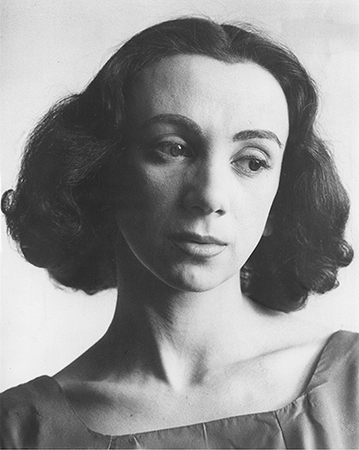
Judith Malina (© Photofest)