
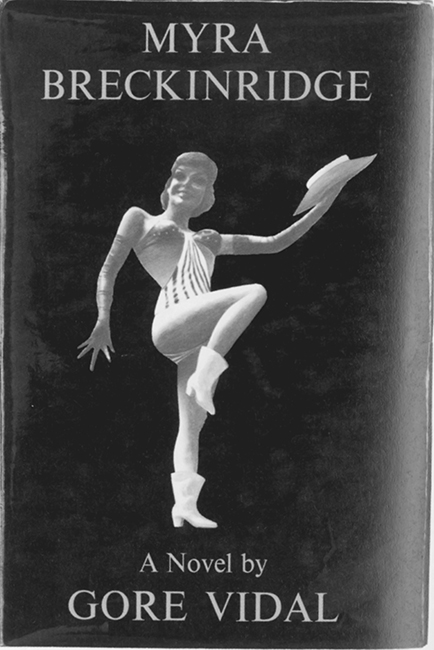
Cover for Gore Vidal’s Myra Breckinridge (1967) (© Photofest)
{ 17 }
Gore Vidal’s father, Eugene, was no rube. Although he had been reared in South Dakota, he had been an Olympian, aviation pioneer, government administrator, and sexual adventurer. But he was appalled after reading his son’s newest novel, Myra Breckinridge: “I never found rear ends sexually attractive.” Eugene Vidal worried that Gore’s novel had “gone too far.”1
Some reviewers agreed with Eugene. In the New York Times, Eliot Fremont-Smith considered much in the novel “repulsive.” Myra took the practices of the Marquis de Sade and repainted them in the colors of a “Mod and Pop” sensibility. While the novel was “brutally witty” at times, he stated that “the mind grows numb” against its onslaught of “Transvestitism, Bestiality, serious mutilation … pedophilia, necrophilia.”2
Early winter 1967 found Vidal in his Rome apartment, situated by Largo di Torre Argentina, famous for its bus fumes and infestation of felines. He had recently returned from a trip to the United States promoting his latest novel, Washington, D.C., in which he indulged his passion for politics and power. Now in Rome, before the heat set in, Vidal sat down one morning, as was his habit, to write a short piece for Kenneth Tynan’s planned off-Broadway production Oh! Calcutta! Tynan hoped to gather other contributions from Samuel Beckett, Jules Feiffer, John Lennon, Edna O’Brien, and other artistic luminaries. When it finally debuted in 1969, the play was a smash, as much for its onstage nudity as for its dialogue.
Once Vidal had cast his first sentence—“I am Myra Breckinridge whom no man will ever possess”—he realized that he must write a full novel rather than a theatrical skit. And he knew it would be deliciously controversial: “I let Myra spring from my brow, armed to the teeth, eager to lose me ladies, book clubs, book-chat writers.” But Myra would stand as “the only great ‘woman’ in American literature.” With his usual discipline and fluidity, Vidal dashed off an initial draft in less than a month, although he would rework the piece, with five more drafts before the manuscript was completed.3
New York City during Vidal’s recent visit had been abuzz with excitement and outrage over two new films, Andy Warhol’s Chelsea Girls and Michelangelo Antonioni’s Blow-Up. Andrew Sarris, film critic for the Village Voice, complained that “Warhol doesn’t exploit depravity so much as he certifies it.”4 Over three hours long and with split-screen projection, the film paraded Warhol’s “superstars”—the sultry Nico, various transvestites, and leather-clad boys chattered and exhibited themselves. After viewing the film, Vidal remarked to Warhol that he found it “kind of dull,” a sentiment shared by many. Warhol replied in his deadpan manner, “Oh, yes, that’s the point.”5
Blow-Up, in contrast, was a far more intriguing cinematic specimen. At once a look into the ultrahip world of fashion photography and the London mod scene, it was an ingenious murder mystery. Above all, in director Antonioni’s hands, it was an aesthetic triumph, many scenes vibrated with sensuous beauty. It was controversial, at least in the opinion of the MPAA, because it featured voyeurism (a scene where the photographer watches from his window as a couple make love) and displayed a brief snatch of pubic hair (when two nymphets engage in a wrestling match of sorts). Rather than a simple celebration of the mod sensibility, Sarris argued, Antonioni’s film expressed “his divided sensibility, half-mod, half-Marxist,” luxuriating in liberation and chafing at excess.6
Such a divided sensibility recalled Susan Sontag’s discussion of camp in 1964. She admitted that she was “strongly drawn to Camp, and almost as strongly offended by it.” Such ambivalence, she argued, gave her the necessary critical distance and appreciation to draw the outlines of the sensibility, without reducing it to a hard conceptualization. Also in the essay she famously downplayed the connection between homosexuality and camp. As with much of the New Sensibility, Sontag argued, camp was more about surface than depth. It was also ambivalent, in resting on “innocence” and at the same time corrupting it. Democracy and elitism, too, coexisted within camp, as active interpreters picked certain works of art (usually bad ones) and elevated them into a special realm—achingly bad or ugly enough to be good and beautiful. “It’s good because it’s awful,” she observed. Camp nicely opposed the moral seriousness of traditional high culture with its sense of pleasure. Finally, she announced that “Camp and tragedy are antitheses,” something that Vidal’s Myra Breckinridge would prove mistaken.
The violence and suffering in Myra switched easily back and forth between gritty and camp modes of presentation. In keeping with the New Sensibility, Myra was about sexual liberation, about the varieties of the pleasurable experience. Everything was ladled on with excess. The novel was a skilled juggling act, keeping various balls in the air.7
Camp was resplendent in the United States by the mid-1960s. Nothing demonstrated this more than the wild success of Batman on commercial television in 1966. It was, as various reviewers pointed out, an extension of the Pop sensibility mastered by Warhol—all surface, no depth. The screen exploded with words, all caps, and with as many exclamation points, as in a sentence by Tom Wolfe: “WHAM!” “SPLAT!” “WOW!” Camp comedy was full of double entendre, in many ways winking self-consciously at its homosexually rooted sensibility, as the actors seemed stilted and deadpan. It was, as critic George Melly had it, “unconscious absurdity.”8 But it worked. Even disapproving art critic Hilton Kramer realized Batman “cuts across widely disparate levels of commercial, intellectual and esthetic activity.” It was a “big put-on” that adults somehow got.9
By the time he was composing Myra, Vidal had read Sontag carefully. He had reviewed her experimental novel Death Kit in 1967. She possessed, he acknowledged, “great ambition” and deep knowledge of literature. But in attempting to catch the novelty of French experimental writers, she had proved disloyal to her roots, betraying natural propensities—which he rather condescendingly described as those of the “didactic, naturalistic, Jewish-American writer.”10
In a lengthy essay, “French Letters: Theories of the New Novel,” Vidal discussed Alain Robbe-Grillet and Nathalie Sarraute, writers that Susan Sontag, the doyenne of the New Sensibility, had embraced. They were experimental, working toward ridding the novel of elements of transcendence and omnipotent narration; they favored close, almost empirical observation, especially at the surface level.11 Thus, Robbe-Grillet played with meaning, titling one of his novels La Jalousie, which in French referred to both window blinds which keep out voyeurs and to the jealousy that is often associated with voyeurs. He filled pages with dense clinical description of an insect splattered against a wall. These novels, as Sontag argued, opposed both the “style and structure” of traditional literature. She approved of it without hesitation (although many years later she would reveal that her “evangelical zeal” for the “fresh winds” from France had been mistakenly arduous).12
Vidal, ever aloof—beholden to traditional narrative structures—found all of this too much. He respected Sontag, referring to her mind as “interesting and interested.” But he demurred at her experimental zeal in the novel, pop art, or the music of John Cage. Experimentalism and pure surface seemed pallid compared to the moral fervor and exciting display of style and narration in the traditional novel—like those he composed with stunning alacrity.13
Vidal had thus been thinking about Sontag, the French novelists, camp, and the New Sensibility while he worked on Myra. Here is the opening for the second chapter of Myra, written as one of her journal entries: “The novel being dead, there is no point to writing made-up stories. Look at the French who will not and the Americans who cannot.”14 A clear reference to the challenge that Vidal had addressed in “French Letters.”
Myra Breckinridge would be, moreover, like Antonioni’s Blow-Up, both an enthusiastic examination of the sexual revolution then erupting and a critique of experimental excess in the New Sensibility. The style of the novel—with camp sensibility front and center, with overwrought nostalgia for 1930s and 1940s films, dipping into pure pleasure and outrageous happenings, its mania and madness, violence and sexuality, and its pastiche—demonstrated Vidal’s dynamic brilliance, as he resided both within and outside the New Sensibility.
Myra Breckinridge hit the public like a bombshell upon publication in February 1968, with a publicity campaign that was nonexistent. Advance copies of the book had not been sent to reviewers, and little about the content of the work had leaked. As if by magic, the book appeared and became a bestseller. Booksellers, impressed with Vidal’s reputation and by the mystery of the marketing process, stocked it, hoping the book would prove potentially “winning” with the public. The volume was, perhaps fittingly, officially scheduled to debut on a leap-year February 29.15
The dust jacket for the book was dominated by a freaky image of a plaster statue of a woman that had revolved outside of the Chateau Marmont Hotel on Sunset Boulevard in Los Angeles. Vidal had stayed at the hotel in the 1950s while busy working on scripts for Hollywood films. The woman has a carnival-dummy face atop a body that is, by any standards, voluptuous. Her arms are sheathed with long gloves, one holding a wide-brimmed hat masquerading as a discus; her breasts appear to be covered with protective armor. The inside-cover flap offered scant information: “A new and very different novel by the author of Julian and Washington, D.C.” The back flap was blank, while the back cover featured death-mask images of the author.
Myra Breckinridge’s story is a roller-coaster ride along tracks of sexuality and power, transformation and reclamation. It is easy to see the cover image as Myra, since she is described early on by Vidal in the over-the-top, lush metaphors—often referring to Hollywood films—that recur throughout the book:
To possess superbly shaped breasts reminiscent of those sported by Jean Harlow in Hell’s Angels and seen at their best four minutes after the start of the second reel. What it is like to possess perfect thighs with hips resembling the archetypal mandolin from which the male principle draws forth music with prick of flesh so akin—in this metaphor—to pick of celluloid, blessed celluloid upon which have been imprinted in our century all the dreams and shadows that have haunted the human race… . Myra Breckinridge is a dish, and never forget it, you motherfuckers, as the children say nowadays.16
Oh, Myra, with her conflicted past, complicated present, and absurd future. Where to begin?
Myra had been born Myron. He was a film historian, sweet but meek, working on a scholarly study of real-life film critic Parker Tyler. A homosexual, Myron was attracted to nonhomosexual men, to rough trade. He took the submissive position in sexual encounters; his tricks often beat him. A sex-change operation has transformed Myron into the mighty Myra. She has many missions to accomplish—to claim his/her share of money from the land upon which rests the highly financially successful (but artistically challenged) Hollywood Academy of Drama and Modeling of Uncle Buck Loner (a former Cowboy movie star); to destroy male dominance (“to change the sexes, to re-create Man”), thereby revenging the indignities that Myron has suffered—“Is there a man alive who is a match for Myra Breckinridge?”; to push polymorphous sexuality; to gain power; to end the population explosion; and also to finish that book on Parker Tyler.17
The rough center of the novel is Myra’s rape of one of her students, Rusty Godowsky. Myra describes him as “tall, with a great deal of sand-colored curly hair and sideburns; he has pale blue eyes with long black lashes and a curving mouth… . It is safe to assume that he is marvelously hung.” In sum, a hunk, the myth of the macho male incarnate. Alas, he is smitten with Mary-Ann, who is “an extremely pretty girl with long straight blonde hair (dyed), beautiful legs and breasts, reminiscent of Lupe Velez.”18
Myra is determined to demolish Rusty’s macho manhood (ironically, Rusty is actually a sensitive and gentle lover) and free up Mary-Ann for herself. She tries to undercut Rusty’s confidence, hectoring him about his poor posture, which will prevent him from becoming a movie star. Under pretense of being required to give Rusty a physical examination, she begins to work her evil magic in the school infirmary. Rusty is largely clueless, despite the exam being scheduled for 10:00 p.m., when no one else will be around campus. Vidal gives Myra camp dialogue (“I am certain, for if there is a god in the human scale, I am she”). When Rusty protests against intrusions on his dignity, Myra responds, “Do that again, Rusty, and I will punish you.” She finally strips Rusty of his underpants and evaluates his penis. It is “not a success,” although “both base and head are uncommonly thick.”19
Let’s cut to the violent chase, when the “true terror” commences. Totally cowed into passivity by Myra, Rusty lies on the examination table, “ready for the final rite.” Myra then lifts her skirt to reveal a strapped-on dildo of immense proportions. “Rusty cried out with alarm… . ‘Jesus, you’ll split me!’ ” But Myra ignores him; she has work to do: “I spread him wide and put my battering ram to the gate.” Rusty eventually becomes a homosexual.20
After being struck by a car (perhaps on purpose), now imprisoned in a plaster body cast, Myra reverts back to Myron. The accident has caused her breasts to lose their stuffing (“Where are my breasts? Where are my breasts?”). Her hair has been shorn, and lack of female hormones means that “strange patches of beard” have appeared.21
Three years later, Myra, now Myron, resides in a modern home in the San Fernando Valley, “with every modern convenience,” including “an outdoor barbecue pit which is much admired by the neighbors.” Myron occupies this suburban paradise with his wife, Mary-Ann. They are, of course, childless (which fits Myra’s disdain for excess population), “raising dogs and working for Planned Parenthood,” practicing Christian Scientists living “a happy and normal life” cultivating their own garden.22
Who would have thought it possible?
Vidal’s Myra Breckinridge was perfectly suited for the moment in America known as the sexual revolution. Practices once taboo or confined to darkened bedrooms burst into the light of culture and practice.
There was no single cause for the sexual revolution. Certainly, Federal Drug Administration approval in 1960 for birth control pills helped. “Welcome to the post-pill paradise,” exclaim two characters in John Updike’s novel Couples (1968).23 The raging hormones of the baby boom generation, coming of age sexually in a society that valorized freedom, played a role, too. Sex sold, of course, as Playboy and Cosmopolitan magazines recognized. The New York League for Sexual Freedom had been lobbying to remove censorship of various words and prohibition of certain sexual acts. Court victories against censorship continued to pile up, allowing publication in Grove paperback editions of long suppressed classics such as John Cleland’s Fanny Hill and D. H. Lawrence’s Lady Chatterley’s Lover. Newer works, such as the then anonymously authored tale of bondage The Story of O and William Burroughs’s Naked Lunch, were freed for examination—in the case of the latter begrudgingly. The court found it “grossly offensive” but concluded that it was not pornographic.24
By 1967, little seemed off-limits anymore. The Fugs, a radical rock group in the Lower East Side of New York, recorded songs using most outrageous lyrics, such as this line by poet Ted Berrigan: “And I’m getting almost as much pussy as the spades.”25 Jim Morrison, of the rock group the Doors, emoted sexually onstage before thousands. In the endless stream of underground newspapers could be found language once unprintable and cartoons that were brilliantly explicit and gross, such as those by Robert Crumb. Lest one imagine the sexual revolution existing mainly below ground, Philip Roth in 1967 published in the highbrow journal Partisan Review a story titled “Whacking Off.” Its final line: “Enough being a nice Jewish boy, publicly pleasing my parents while privately pulling my putz. Enough!”26
“Enough!” agreed those heading to San Francisco in 1967 for the “Summer of Love” celebration. The hippies had arrived, promising to “make love, not war” and to free themselves from bourgeois repression (thus in practice trying to realize the dreams of philosophers Norman O. Brown and Herbert Marcuse). At Golden Gate Park, perhaps a hundred thousand hippies and hippie wannabes listened to former Harvard professor and guru of LSD Timothy Leary enjoin them to “turn on, tune in, drop out.” Even Newsweek magazine swooned:
For the hippies sex is not a matter of great debate, because as far as they are concerned the sexual revolution is accomplished… . Physical love is a delight—to be chewed upon as often and as freely as a handful of sesame seeds.27
Such chewing upon sexual freedom was hardly confined to rural hippie communes. Robert H. Rimmer scored a bestseller in 1966 with his ode to sexual freedom in the novel The Harrad Experiment. One of his female characters stated: “Sometimes I wake up in the night and for a sleepy moment I may forget whether I am with Stanley, Jack or Harry, and then I feel warm and bubbly.”28 Sexual freedom was not always depicted as quite so bubbly, as in the soon-to-be released film Bob and Carol, Ted and Alice, where sexual freedom flexed its muscles rather weakly.
In Hollywood and on Broadway, the sexual revolution reared its many heads. In 1968 The Graduate dealt with an illicit affair between a young man and an older woman (complicated by his growing enchantment with her daughter); Midnight Cowboy focused on a male prostitute and his lowlife pal. Within a few years, hardcore films would be shown in neighborhood theaters. The comic titillation in Barbarella (1968) was camp, but the sexual energy flowing out of a tight-suited space traveler, played by Jane Fonda, was not. She learns that taking a pill for sexual satisfaction is no substitute for the real thing. Hair, with its valorization of hippie ideals, began off-Broadway in 1967 but proved such a smash hit that it relocated to the Great White Way in 1968, retaining its songs, ideas, and display of full frontal nudity.
Homosexuality made it to Broadway, thanks to Mart Crowley’s play The Boys in the Band, which debuted at the same time as Myra Breckinridge. The play revolved around the painful lives of gay friends cornered together at a birthday party. It exposed many raw feelings that some in the gay community found denigrating; for others it demonstrated, the suffering caused by being forced to live inside the closet. Critic Rex Reed—who would later play Myron Breckinridge in the horrendous film version of the novel—wrote that, unlike most other plays, which avoided homosexuality or kept it in shadows, Boys presented the diversity of the homosexual experience and heroic attempts by characters wanting to get on with life—no small accomplishment.29
The sexual revolution, it soon became clear, was not always as “bubbly” as billed. For all of its talk about sexual freedom, the vision was mainly that of the heterosexual male. Radical feminism, beginning to emerge in these years, decried how the ideal of sexual revolution was a male construct fostering a “rape culture” in the United States.30 Even the hippie heaven of Haight-Ashbury in San Francisco proved to be no sexual utopia. Joan Didion in Slouching towards Bethlehem (1968) caught the dark undercurrents that diminished the dream in the Haight. Walking the same streets, cartoonist Robert Crumb faced reality clearly: “Guys were running around … saying, ‘I’m you and you are me and everything is beautiful so let’s get down and suck my dick.’ ”31
Vidal’s relation to his fictional character Myra was complex, like that of any author to one of their creations. He told an interviewer for Playboy magazine in 1969, “I exalted neither Myra nor her views.”32 In another interview, nearly twenty years later, he stated: “I have nothing in common with Myra Breckinridge except total admiration. She is magnificent, she is mad as a hatter, and yet that is one of my voices.”33 At the same time, Vidal labeled his portrayal an “impersonation,” although who he was impersonating was unclear—there had been a transvestite, John Breckinridge, known as Bunny, “a famous queen,” familiar to his mother’s circle of friends. But this association did not occur to Vidal as he was unfurling his creation.34 Rather, Vidal was proud that he could create new and different voices in his prose—and he was pleased by the camp sensibility that he had achieved with Myra.
In contrast to the sexual puritanism of Myra, Vidal appeared to be a libertine. On sexual matters, as on many other topics, Vidal was resoundingly matter-of-fact and pluralistic. He announced in 1966, without blinking an eye, “Homosexuality is now taken entirely for granted by pornographers because we take it for granted.” Quite a statement, one imagines, for most closeted gays, three years before the Stonewall riots and the birth of a widespread gay liberation movement.35
Vidal consistently maintained that what people did in the privacy of their bedroom was beyond government concern. Along with Sontag, adhering to one principle of the New Sensibility in art and life, Vidal upheld the expansion of experience and pleasure as a life goal—so long as certain standards were observed. Human beings were naturally bisexual and polymorphously perverse—and this was nothing to be troubled by. Vidal claimed that he had been “setting records for encounters with anonymous” young men (he hated the term “homosexual” for various reasons), and he also had sex, on occasion, with women. There is “nothing innate in us,” he wrote, “that can be called masculine or femme.”36 He claimed, “I never had the slightest guilt or anxiety about what I took to be a normal human appetite.”37
Vidal, however, separated sex from love. Sex was about power, love was about commitment. And in this aspect he resembled Myra. She had exercised power over men but, in the end, after reverting back to Myron, entered into a monogamous and sexually tame but caring relationship with his beloved Mary-Ann.38 Vidal’s enormous sexual promiscuity was, he once claimed, helpful to his writing: “The more active I am the better I write.”39 But he established a long-term relationship with Howard Auster (who worked in advertising and was an accomplished singer). After an initial sexual encounter, the two settled into a chaste relationship that was, by all accounts, devoted and deep.40
Sexual intercourse, however, was about domination—as much for Vidal as for Breckinridge. He was staggeringly blunt, for instance, about his sexual preferences.41 Vidal stated that he was not homosexual because he “never sucked cock or got fucked.” In any case, Vidal disapproved of sexual activities being “ghettoized” or “categorized,” in large part because then outside powers, such as the state, seek “to assert control of them.”42 Undoubtedly, Vidal preferred, in keeping with ancient Greek custom and working-class culture, to be in the dominant position sexually.43 In sum, to be in control.
To what degree Myra’s rape of Rusty touched nerves (or evoked harsh memories) for Vidal is unclear. In his memoir Palimpsest, Vidal revealed his most unnerving sexual experience. Lean of build and nineteen years of age, Vidal had picked up an older and heavier man. In a room, this fellow pushed Vidal onto his back and put him in “an expert half nelson” hold. Vidal stated, “I bucked like a horse from the pain” of being penetrated from the rear, until he finally broke free. “We rolled across the floor, slugging at each other. Then, exhausted, we separated. He cursed; dressed; left. That was my first and last experience of being nearly fucked.”44
In contrast, Vidal enjoyed telling the story of how he and a drunken Jack Kerouac had checked into the Chelsea Hotel one evening. After showering, they had sex—with Vidal certain that he was in the sexually dominant position. Kerouac, stinking drunk, simply accepted the situation.45
For both Vidal and Myra, then, sex was about power, about a will to dominate, and about how to derive pleasure from both. “Sex is politics,” Vidal stated, and he wanted victory.46 With his usual aloofness and blasé attitude toward things, unsurprisingly, Vidal was not overly impressed by the sexual revolution. Like Myra, he was in but not of the sexual revolution. Both of them (“Holy Myra Malthus”) had a phobia about overpopulation: “In an overpopulated world I do not think that people should be allowed to breed incontinently.”47 Vidal looked at the sexual revolution with a sigh of having been there and done that. He preferred to dwell in nostalgia, recalling when the screen sizzled with romance and stars were somehow regal in their sexuality. He also longed for the days of his youth when, presumably, homosexual encounters with mainly straight men appeared easier to achieve. In his view, “The quality of the trade has fallen off. When I was young there was a floating population of hetero males who wanted money or kicks or what have you and would sell their ass for a period of their lives.”48
Passivity, sexual or otherwise, seemed to be the least apt word to describe the thunderstorm of political violence that overtook America in 1968. By the summer, Vidal would be wrapped up in it, as a participant of sorts, on national television.
Violence opened the year thanks to the Tet Offensive in Vietnam. Huge numbers of Viet Cong, at the end of January, launched a near-suicidal attack against various targets in South Vietnam. More than one thousand US forces were killed, along with more than 2,300 men from the Army of the Republic of Vietnam. The attacks, from a statistical point of view, were a total failure—forty thousand Viet Cong perished. Many Americans had presumed that the United States was winning the war and that the cities of South Vietnam were immune from attack, and in dispelling this the massive offensive was a huge public relations victory. Walter Cronkite, a newscaster often seen as a sort of a conscience for America, shocked many when he stated, “We are mired in a stalemate.” The violence in Vietnam would grow, more troops would be committed, and the American economy would be sapped.49
Violence exploded on the streets of urban America following the assassination of Martin Luther King Jr. in Memphis on the evening of April 4. Increasingly frustrated by the war in Vietnam, divisions within the civil rights movement, FBI harassment, and much more, King was growing increasingly unsure whether nonviolent protest could turn America around. He wondered, “Maybe we just have to admit that the day of violence is here … and let violence take its course” as a necessary first step to heal “a sick nation.” The violence that followed his assassination took a toll—forty-six dead (forty-one of them black), 21,000 arrested, 3,000 injured—but it did not heal the nation.50
A real-world Myra existed in the streets of New York City. Valerie Solanas had been on the periphery of Warhol’s Factory scene, with walk-on roles in a couple of his films. She had left him a manuscript for a play, Up Your Ass, which he had not returned. She was daily growing more paranoid. She had penned something called The SCUM Manifesto, in which she attacked males as biologically inferior and “emotionally limited.” The SCUM Manifesto, perhaps reflecting on Warhol’s Death and Disaster series, noted that “the males like death—it excites him sexually, and, already dead inside, he wants to die.” Solanas decided to grant Warhol this presumed hidden wish, firing bullets into him at close range. He barely survived. She was arrested, found to have “paranoid schizophrenia,” and sentenced to a mental hospital.51
The rock group Buffalo Springfield at the end of 1966 had caught this sense of anxiety in a lyric: “Paranoia strikes deep / Into your life it will creep.” Every day witnessed antiwar protestors increasingly agitated and frustrated with the continuation of a war that they considered impossible to win and morally reprehensible. Demonstrations mounted against the war; males burned their draft cards. A few weeks after the King assassination, students at Columbia University, upset by the war and angered at the decision of the university to expand facilities into Harlem, took over Hamilton Hall and other campus buildings. One of the student leaders, Mark Rudd, wrote a letter to Columbia president Grayson Kirk, perfectly encapsulating the new, violent turn of 1968:
There is only one thing left to say. It may sound nihilistic to you, since it is the opening shot in a war of liberation. I’ll use the words of LeRoi Jones, whom I sure you don’t like a whole lot: “Up against the wall, motherfucker, this is a stick-up.”52
The takeover succeeded in stymying Columbia’s building plans, but it ended with New York City police marching onto campus to forcibly remove the students. In the account of Marvin Harris, a professor of anthropology, “Many students bled profusely from head wounds opened by handcuffs, wielded as weapons. Dozens of moaning people lay about the grass unattended.” The war had come home.53
Sontag spent part of spring in Hanoi. Her report documented in painful detail the effects of American bombing on civilians; she praised the resiliency and struggle of North Vietnam. Little of the ambivalence that she had brought to her cultural essays appeared in this piece, although she did find her North Vietnamese hosts a bit wooden and the state undemocratic. The trip to Hanoi did not radicalize Sontag; it only supported her earlier contention, noted earlier, that “the white race is the cancer of human history.” And that the entrenched Cold War leadership of the United States was the leading agent spreading that cancer.54
Vidal seconded such views, by and large. He was a long-time opponent of American imperial designs, and the situation in Vietnam was simply another in a long line of mistakes. His overall political position was a bit conflicted, perhaps. On the one hand, he was an elitist, distrustful of democracy for its many wrong turns and narrow perspective. On the other hand, he was a fighting liberal (becoming increasingly radical) who supported progressive causes, such as civil rights. He had been closely associated with the Kennedy clan and ran unsuccessfully for a congressional seat in New York.
Vidal and others continued to hope that change could come via political means, at least through early spring. President Lyndon B. Johnson had decided not to seek reelection after being surprised by a strong challenge from antiwar senator Eugene McCarthy in the New Hampshire Democratic presidential primary. Johnson anointed his loyal vice president Hubert H. Humphrey as his successor. Robert F. Kennedy, senator from New York, joined the race but was assassinated just after winning the California presidential primary on June 6.
This heatwave of violence and frustration showed no signs of abating as summer arrived. The Republicans, at their convention in Miami, nominated Richard M. Nixon as their candidate, hardly a man to inspire hope among the disaffected. All eyes focused now on Chicago, where antiwar activists sought to nominate someone other than Humphrey, and where radical activists (led by the anarchic Yippies) looked to score media attention and protest the war.
In Chicago protestors massed, staying in two of the city’s major parks. The police decided to enforce an 11:00 p.m. curfew at Lincoln Park. Should the students in the park exit peacefully? Some of them ached for a confrontation. Abbie Hoffman, a leader of the Yippies, reportedly said that if police closed the park, then protestors would “loot and pillage” the city. Saner minds, such as Allen Ginsberg, viewed such remarks as incendiary: “The park isn’t worth dying for.” When not making threats, Hoffman and his comrade Jerry Rubin captured media attention by outrageous stunts, such as nominating a pig, “Pigasus,” as their presidential candidate. It was an act at once disrespectful of the office of president and of the police (who were regularly denigrated as “pigs”).
On the night of August 28, all hell broke loose. Heavily armed police, behind a massive barrage of tear gas, moved in to exact vengeance and rid the streets of protestors. Mailer captured it succinctly: “Police cars rolled up, prisoners were beaten… . The rain of police, maddened by the uncoiling of their own storm,” had their way with the demonstrators.55 The violence was intense and nationally televised. Protestors chanted for what seemed an eternity: “The whole world is watching, the whole world is watching.”56
Vidal was among those watching and being watched. Along with archconservative William F. Buckley Jr., Vidal had been hired to provide spirited commentary and debate on the Miami and Chicago conventions. Fireworks were eagerly anticipated by ABC television, since it was well known that Buckley and Vidal despised one another. Vidal found Buckley given to “reckless ad hominem attacks.” According to Louis Auchincloss, Buckley considered Vidal “not the devil’s emissary but the devil himself.”57 But one reviewer, after their performance at the Republican Convention in Miami, dismissed them as “major bores.”58 At Chicago, they would be the opposite of boring; their spoken violence would escalate into a perfect complement for what was occurring in the streets.
On the night of August 27, Vidal and Buckley vigorously debated the war in Vietnam while discussing the Democratic platform and the policies of the Johnson administration. Vidal called Buckley a “warmonger,” pointing out that he favored use of nuclear weapons against missile facilities in the People’s Republic of China. Then, after moderator Howard K. Smith requested that they “not talk at the same time,” Vidal went on the offensive, citing Buckley’s support for an invasion of Cuba based on what he viewed as the bogus and antiquated grounds of the Monroe Doctrine. Vidal called Buckley “the most war-minded person in the United States,” deluded by visions of American empire, mistaken in believing we could achieve victory in Vietnam, and simply pushing the nation toward “total disaster.” At one point, Vidal told Buckley to stop pointing his tongue—a well-known Buckley affectation. Buckley, for his part, sneered that there was certainly no “encyclopedia of morality” to be found in Vidal’s published work.
Things exploded between Buckley and Vidal around 9:30 p.m. on August 28, as the police were doing their dirty work in the streets of Chicago. Buckley viewed the police as upholding law and order; Vidal differed completely. After telling Buckley to “shut up a minute,” Buckley attacked Vidal for giving comfort to the enemy, which resulted in the death of American soldiers. Vidal responded by saying, “The only pro-crypto-Nazi I can think of is yourself” (although he claimed to have mistakenly, in the heat of the moment, inserted Nazi rather than his intended term, fascist).
Buckley seethed, spitting out his retort, “Now listen, you queer, stop calling me a crypto-Nazi or I’ll sock you in your goddam face and you’ll stay plastered.” Administering what he imagined might be a coup de grace, he called Vidal a pornographer, a viewpoint no doubt encouraged by Buckley’s reading (or more probable skimming) of Myra Breckinridge prior to Chicago. Vidal maintained his patrician composure.
Their battle continued into 1969 when Buckley published an essay in Esquire, “On Experiencing Gore Vidal.” Apparently, expanding one’s realm of experience, a tenet of the New Sensibility, was alien to Buckley’s tastes. He mocked the notion that Myra was “not pornographic,” as Vidal had claimed on the Merv Griffin Show on television. Further upsetting Buckley were Vidal’s assertions that bisexuality and homosexuality were natural. Myra offered “gratification only to sadist-homosexuals, and challenges only the taxonomists of perversion.” Finally, Vidal mimicked de Sade, except that he was “more intellectual than bawdy.” At the end of this vituperation, Buckley apologized for having called Vidal a “faggot.” In the next issue of the magazine, Vidal responded with views about bisexuality and homosexuality. He finally unsheathed his sword, stating that Buckley had been “hysterical” in Chicago, “looking and sounding not unlike Hitler, but without the charm.” Lawsuits were duly filed.59
The violence that the New Sensibility had made a focus for its style and subject matter, perfectly captured in the films Bonnie and Clyde in 1967 and The Wild Bunch in 1969, was now ripping apart not only the nation but the consciousness of its artists. Vidal had addressed it with his characteristic distance. Others would jump into the roiling waters, perhaps no one as much as LeRoi Jones, who transformed from Greenwich Village bohemian/hipster into Amiri Baraka, black nationalist and dreamer of violent revolution.