
{ PART I }
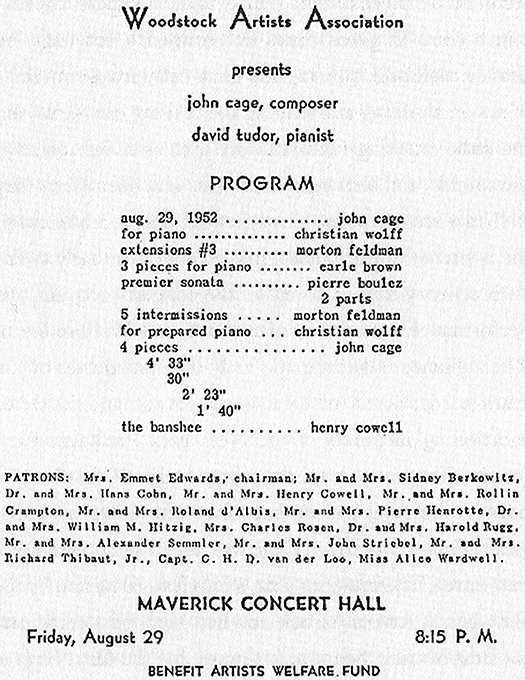
Program for first performance of John Cage’s 4’33ʺ(1952) (courtesy of the John Cage Trust at bard college)
{ 1 }
Going too far—as his mother realized—was Cage’s point. It had long been the imperative of the avant-garde around the globe, allowing artists to transcend limits through the freedom of excess. Yet the artist also came face to face with the dangers of absolute freedom without limits. This potentially invited the devil of anarchy and disorder into work. Via some magical alchemy, order and anarchy tugged at each other in Cage’s work. He managed to move the hearts of his listeners, causing them to pound faster and in unusual rhythms. That was the reaction of John Gruen, a composer, dance critic, and all-around avant-gardist in the Village. He had been at a low point in his own creative work, until he attended the New Year’s Day performance at the Cherry Lane Theater. “It was a fantastic experience,” he related. “It seemed that anything was possible after listening.”1
The year 1952 proved to be Cage’s annus mirabilis. That year he laid many of the foundation stones for the New Sensibility. The furor and influence of his performances evokes a comparison with the birthing of modernism thirty years earlier. Ezra Pound had declared that 1922 marked the beginning of a new artistic era, thanks to the publication of James Joyce’s Ulysses and T. S. Eliot’s The Waste Land. Cage was doing his part both to continue and to reject aspects of a modernist sensibility.
Cage created a stir, but many rejected his musical revolution. The reviewer for the New York Times was unimpressed with Cage’s radically innovative composition Music of Changes. No doubt readers of the paper chuckled to learn that Cage’s piece had featured the piano “treated like a great guitar, with its strings being strummed and plucked and its side tapped.” It all seemed quite absurd.2 The reviewer further noted that Music of Changes included slamming the piano lid, frenzied playing, and odd pedaling technique. The piece started and stumbled, sometimes lingering on a note, at other times offering achingly elongated silences.
If there was continuity between the notes, then it existed as mere coincidence. It was true only in the Zen sense that everything is, by dint of existence, connected with everything else. Not surprisingly, a month after the premiere, Cage began attending classes on Zen taught by D. T. Suzuki at Columbia University.3
Cage carefully orchestrated every whack and wham on the piano for Music of Changes. Only a virtuoso pianist like David Tudor, who was deeply in synch with Cage’s experimentalism, could have flawlessly mastered the mixed tempi, constant pedal changes, and strange emphases. Poet John Ashbery attended the New Year’s Day performance. He had a “fantastic experience” listening to the “disjointed chords” which repetitiously sounded “until you sort of went not out of your mind, but into your mind.”4
Music of Changes resisted any essential interpretation. Listeners could apply whatever meaning and perception to it that they chose—almost at random. This no doubt thrilled Cage, who had stated in his “Lecture on Nothing” (1950): “Our poetry now is the realization that we possess nothing. Anything therefore is a delight (since we do not possess it) and thus need not fear its loss.”5
An intricately developed methodology of chance powered the composition of Music of Changes. Cage wanted to distance music from emotion and subjectivity, which he considered old-fashioned and uninteresting. A chance-based compositional method rendered the piece immune to singular interpretation and searching for authorial intent. The piece existed in its immediacy, in the sensations that it evoked in listeners. Cage was thus exemplifying what would become, in the opinion of Susan Sontag in the mid-1960s, a key tenet of the New Sensibility—being “against interpretation.”6 As Cage put it, speaking of his work and that of dancer Merce Cunningham, “We are not saying something. We are simple-minded enough to think that if we were saying something we would use words.”7
Could chance actually determine a musical composition? The saga of how Cage achieved this end is familiar and perplexing. His student Christian Wolff had presented him in 1950 with a copy of a recent translation of the I Ching, also known as The Book of Changes. The book offered Cage a wealth of ancient wisdom along with a method that stressed randomness. Ever open to innovation and already intrigued with Eastern philosophy, Cage was ready to employ the text to tease out possibilities and break with the traditional standards of composition.8
Cage explained to his friend and fellow composer Pierre Boulez how his compositional process decided by change worked. He began with various charts for superpositions, tempi, durations, sounds, and dynamics. Half the charts were “mobile,” the other half “immobile.” Here is Cage’s description of just part of the laborious process:
Three coins tossed six times yield sixty-four hexagrams (two trigrams, the second written above the first) read in reference to a chart of the numbers 1 to 64 in a traditional arrangement having eight divisions horizontally corresponding to the eight lower trigrams and eight divisions vertically corresponding to the eight upper trigrams. A hexagram having lines with circles is read twice, first as written then as changed.9
Got it? The goal of the process was, according to Cage, to compose a work whose “continuity … is free of individual taste and memory (psychology)” and also of the “traditions” of art. Sounds were not in service to any “abstraction” which made “their 360 degrees of circumference free for an infinite play of interpretation.” Moreover, there could be no mistakes in the work, since “once anything happens it authentically is.”10
Cage, as fellow composer Virgil Thomson observed, exuded a “relentless” determination, a tendency to excess, even when in the service of simplicity11—and a hint of madness. Cage believed that madness was related to the “grandness of conception.” Only an Ahab—“madness maddened”—could chart new seas of creativity. Cage recalled his friend Norman O. Brown, the philosopher of the Dionysian, telling him that “any worthwhile activity is mad. And the only reason it ever is taken seriously eventually is that one persists.”12
Persistence was essential to Cage’s repertoire for life and music. The origins of Music of Changes and the revolutionary work that Cage composed and performed in 1952 can be traced back to his personal history and craving for new sounds.
Cage was, in the best sense of the word, a tinkerer, an American original. He came by this propensity naturally. His father was an inventor of great originality, if limited success; at one point, he patented a submarine that could remain underwater for a long time but which unfortunately failed because its motor caused bubbles to rise to the surface, undermining the concealment that was the reason for its submersion. Cage’s mother was a talented musician and always encouraging. The parents’ respective talents coalesced in their only child.
Born in 1912, Cage grew up in Southern California. His high school yearbook noted that he was “quite radical,” presumably in his politics and cultural taste. During this time, Cage imagined himself becoming a Methodist minister. Yet he had also briefly flirted with conversion to Catholicism. Spiritual searching was to frame much of his life and work, albeit in an untraditional fashion. Like an ascetic monk seeking to open his soul to God, Cage strove to enlarge his ears and ego to accommodate new sounds. “We must open up the ego,” he once explained, “open it up in the way Satie or Thoreau did! Open it up to all experiences.”13
After a stint at Pomona College and a joyful sojourn in France, with further excursions around Europe and North Africa, Cage returned to depression-ridden America in 1931. Following a year of odd jobs to support himself and his impoverished family, Cage acted upon his determination to study musical composition. Not only was he an able student, he was assertive in pursuing his goals. When he wanted something from someone, he tracked down their home address, knocked on their door, and, with a combination of naiveté and self-interest, implored them to take him on as a student. “I’ve always gone, insofar as I could,” Cage later remarked, “to the president of the company.”14 Although without funds, he managed to study with important teachers of music, including Henry Cowell and Arnold Schoenberg. The latter, who himself had taken modernism in new directions with his scale system, famously informed Cage that he “had no feeling for harmony,” which would, Schoenberg presumed, bode poorly for his career. Unperturbed, Cage came to reject harmony, at least of a classical sort, in his composition.15
In 1935, in a desert ceremony, Cage married an alluring artist/model, Xenia Kashevaroff. The relationship was heated from the outset; they were two artists with rebellious temperaments and visions. They drifted about, first to Seattle (where Cage befriended and collaborated with Merce Cunningham), then San Francisco, and later stays in Chicago to New York City, all with a hint of inevitability, of pending arrival before the cognoscenti. Penniless in New York, Cage managed to place himself and Xenia in the luxury apartment of the surrealist painter Max Ernst and megarich art connoisseur Peggy Guggenheim. When the living arrangement began to fray, the couple moved downtown to stay with dancer Jean Erdman and her husband, Joseph Campbell, a specialist in mythology. Cage did indeed have a knack for knowing the right people. But he also impressed nearly everyone with his ardor, openness, and creativity.16
Love and its vicissitudes weighed on Cage’s mind during in the early 1940s. Cunningham had relocated to New York. The two of them had fallen in love (before marrying Xenia, Cage had been involved in various homosexual relationships). For a time, Xenia joined Cage and Cunningham in a triadic relationship, but Cage’s affection and energy were directed toward Cunningham. This was a period of anguish for Cage about his sexual identity and the fate of his marriage. He finally divorced Xenia in 1945 and became a partner and collaborator with Cunningham, a relationship that would continue until Cage’s death in 1992.17
Love was probably not the emotion that Amores elicited from listeners at the Museum of Modern Art in February 1943. The evening’s entertainment had featured Cage playing a piano with its strings rigged with nuts and bolts and “damped with rubber wedges” to transform it into a percussive sound engine. Cage or his tuxedo-clad assistants banged the piano, sometimes with gentleness, sometimes with force. Here, as in much of his work, Cage was bowing to certain streams of modernism, especially Dada, while slowly working toward his own style, with its emphasis on contingency and involvement of the audience in the work.
Cage acknowledged that he was offering audiences “noise,” but as a way station on the road to a new sort of auditory comprehension. He wanted his auditors to hear the “unsuspected beauty in their everyday life.” This imperative had a genealogy in the work of Joyce, Gertrude Stein, and Virginia Woolf, for example.18 But Cage, in his manner, would in time take it farther. Attention to the clank of the mundane, Cage maintained, would expand the world of sounds and break down stodgy distinctions between life and music.19
Amores brought Cage to national attention. Time and Life magazines both reported on a recent performance of Amores at the Museum of Modern Art. The work premiered at a time when it must have appeared frivolous, if not downright disrespectful. After all, in February 1943 the Battle of Stalingrad finally concluded with millions dead, and the Battle of Guadalcanal had only recently commenced. Jolting sounds suggested bomb blasts, air raid sirens whirring, and cries of agony that filled the world at that pivotal time.
Life noted approvingly that when Chinese rice bowls had been “played,” they emitted “a very pleasant tinkling.”20 Cage explained to the reporter for Time that his “quartet for drums, rattle, woodblocks and specially prepared piano” was “intended to arouse … feelings of love.” If such was his intent, he failed to make explicit how such “feelings of love” were meant to soften the blows of war.
Three years later, in 1946, Cage showed some new experimental tricks in a concert at the Carnegie Chamber Music Hall. A reporter from the New York Times marveled that it took ten hours for Cage to prepare five pianos for the performance. Some of the results, at least in the view of the reporter, sounded “metallic, like the striking of a spoon on a frying pan.” Other sounds were more soothing and subdued. One wag in the audience remarked that the concert was “the dividing line between the peanuts and the caviar,” with the former being served. But the New York Times reporter admitted to being “opened up [to] all sorts of new and undreamed of rhythmic possibilities and musical effects in a fascinating world of tiny sonorities.”21
In January 1949, apparently having been filed in some category for the odd and interesting, Cage was again fodder for a Time report. As before, the article on Cage’s performance was certain to leave readers shaking their heads about the antics of the avant-garde. Yet the article’s opening lines quoted Cage in praise of silence, as an end in and of itself and as a form of music. Then Cage, whom the article described as having a “Huck Finn” grin, remarked, “I thought of composing a piece like that. It would be very beautiful, and I would offer it to Muzak.”
The performance Time covered had been part of a program at Carnegie Hall, full of “rhythmic, percussive ‘sounds and silence.’” In Cage’s usual manner, the piano had been “prepared” using all sorts of objects, ranging from the tried-and-true nuts and bolts to “pieces of rubber and plastic” designed to “short-circuit the tones.” Cage wanted “sounds” rather than “tones” in his music. He scoured “junk yards, bone yards and hardware stores” to find “brake drums, pipe lengths, asses’ jaws.” These “instruments” joined his prepared piano to produce music. The welter of sounds evoked all sorts of associations.22
“My music is changing,” Cage wrote to Boulez in December 1950. He had begun paying increased attention to chance and silence. It must be emphasized, however, that the desire was no sudden shift in Cage’s compositional consciousness. As early as 1937, he had realized that “wherever we are what we hear is mostly noise… . When we listen to it we find it fascinating.” He included among such sounds “static between stations” on the radio. He also noted in his letter a new devotion to “the flow of sound and silence.”23
Silence fascinated Cage. Although exactly when, and under what precise conditions, he came closest to experiencing it remains unclear. Perhaps it was in the fall of 1950, when he had paid a visit to one of two labs at Harvard University where there were chambers that were almost totally soundproof and reverberation free. As a connoisseur of silence, Cage “literally expected to hear nothing.” But once in the chamber Cage maintained that he “heard two sounds, one high and one low.” He asked the engineer what they might be and was told, he recalled, “The high one was my nervous system in operation, the low one my blood in circulation.” The experience stunned Cage, leading him to conclude, “Until I die there will be sounds. And they will continue following my death. One need not fear about the future of music.”24
Cage’s fixation on the relationship between sound and silence was strongly illustrated in his Imaginary Landscape No. 4, which premiered in May 1951 at Columbia University. Like Music of Changes, the piece relied upon a method of “unpredictability” offered by tossing coins according to instructions in the I Ching. The result, according to Cage, was that “value judgments” had been abolished for the “composition, performance, or listening” of the work. The piece was designed to allow anything to happen.25
Imaginary Landscape No. 4 featured twelve radios, each one “played” by two performers; one changed stations while the other manipulated the volume control. The twists and turns of the dial, however, were orchestrated by Cage’s evolving method of chance. Thus, Cage wanted contingency and spontaneity in the composition but precision in the performance. The audience that evening was able to discern simultaneously snippets of a news broadcast or play-by-play of a baseball game, or they heard a windy sound of static, or perhaps a groan of silence. Pure Cage.
Like so much of Cage’s work, the piece was avant-garde in its experimentalism and primed to outrage many of its listeners. Harold Norse, a fixture in the Village and a writer, reported that he heard many in the audience hiss, boo, and shout derogatory comments. This only seemed right and proper, Norse acknowledged, for a piece that was kooky and confrontational in a Dada mode. Two of Cage’s close friends and fellow composers, Lou Harrison and Virgil Thomson, according to Morton Feldman, disliked the piece; they “began to think that maybe he was going too far.”26
If it was inspired by Dada (one of the many streams comprising modernism), the World War I–era movement dedicated to absurd art as a response to an absurd and violent world, then the piece was also dead serious musically. Part of what Cage desired with his cacophony of sounds was the creation of new sound combinations. And these sounds, as had been the case in earlier work, should stimulate the imagination of listeners to hear something different and challenging, requiring them to bring their own meaning to the work. Norse maintained that the “effect” of the music was to make him imagine “an automobile ride at night on an American highway in which neon signs and patches of noise from radios and automobiles flash and disappear in the silence.”
This would have delighted Cage, especially since the work anticipated what in a year would become his most famous piece, his ode to silence. The long durations of silence that punctuated Imaginary Landscape No. 4 were disturbing, signaled by Cage, serving as the conductor. They left the audience uncertain if the piece was simply suspended or ended. But uncertainty, anxiety about silence, was the musical language through which Cage was beginning to compose.27
Was Cage’s work of the 1940s and early 1950s—with its banging and silences—intended to challenge the cultural lethargy often associated with this period—which poet Robert Lowell referred to as “tranquillized” by conformity, economic comfort, and political consensus? If so, then Cage seems an anomaly of the highest order, which attests even more to his relentless quest for creativity, under any conditions.
There is certainly truth in the view that American culture was rather lame and self-satisfied in this period. Even intellectuals who had in the 1930s upheld the ideal of Marxian revolution seemed tamed by the 1950s. In a famous symposium, “Our Country and Our Culture,” in the journal Partisan Review, almost all of the contributors (ranging from theologian Reinhold Niebuhr to sociologist David Riesman to cultural critic Lionel Trilling), although they disdained the deleterious effects of mass culture, were largely satisfied with American politics and social life. They were pleased to be in the catbird seat, in prestigious universities and exercising cultural authority. Trilling pronounced that over the last thirty years there had been “an unmistakable improvement … in the American cultural situation.”28 Works once banished from classroom and public examination were now available. Funding, once tightly limited to works in the classical canon, now flowed into newer modes of art. Modernism had triumphed.
Some worried that victory came at a cost. Joyce and Pound were now assigned on university reading lists and celebrated as canonical. Pound had even been awarded the Bollingen Prize for Poetry in 1948, despite his pro-Fascist activities during the Second World War. Did acceptance blunt the power of modernist thought? Writing in the New York Times Book Review, poet Stephen Spender claimed modernism had lost its “vital spontaneity,” victim to its own success and the constraints of conformity. He glimpsed nothing new and exciting on the cultural horizon.29 But, of course, he was writing at the historical moment when the New Sensibility was only beginning to percolate.
It has been argued, with some truth, that mainstream American culture in the 1950s was maple-syrup sweet in its tastes. Doris Day starred in a new musical, April in Paris. It promised to burnish her reputation as America’s bland, bouncy, and virginal queen of cinema. Another tepid blonde, Patti Page, wowed fans in December 1952 with a song that would become a huge hit, “(How Much Is) That Doggie in the Window.”30
But such generalizations about the sappiness of American culture are incomplete. Culture is rarely static and singular. The landscape of popular music, for example, was not simply reserved for bland and blonde singers. A Life magazine story highlighted sultry singer Eartha Kitt. When she sang, the magazine reported, “Every muscle in her lithe, feline body sways in a ballet of its own.” In the summer of 1952, a new film, Affair in Trinidad, promised viewers glimpses of Rita Hayworth’s abundant cleavage. For those desiring something experimental in literary culture, Ralph Ellison’s novel Invisible Man fit the bill, and readers eagerly anticipated publication on the first of September of Ernest Hemingway’s new novel, The Old Man and the Sea. An early review in the New York Times praised the novel’s existential verisimilitude. While artifice abounded in American culture, hints of authenticity and experiment were also present.31
In point of fact, Cage inhabited a world that was agog with creativity. And he was alive to varied experimental currents pulsating through a rich, albeit rather constrained area of Manhattan, from the Lower East Side where he lived to Greenwich Village, with occasional eruptions happening further uptown.
Cage interacted with, and learned from, artists of all types. He was friends with Robert Rauschenberg and regularly visited his studio to marvel at his white paintings (this will be discussed in chapter 2).32 Cage associated with others devoted to experimental music. He corresponded with Boulez, and worked alongside avant-gardists Henry Cowell, Christian Wolff, Morton Feldman, and Earle Brown closer to home. They all challenged traditional practices and often appeared on the same musical programs.33
Cage’s apartment was a veritable commune for such artists. “If there’s no social life, there’s no art movement,” Gruen announced.34 At the “Bozza Mansion” (so called after the building’s landlord), Cage served up “sumptuous dinners”—spaghetti with many types of mushrooms, picked by his own hands—for friends such as sculptor Richard Lippold, artist Philip Guston, dancer Caroline Brown, and many others.35
When not entertaining at home, Cage often headed to the Cedar Tavern, a home away from home for such painters as Franz Kline, Jackson Pollock, and Larry Rivers, among others. There he discussed the exciting work of abstract expressionists, sometimes staying until 3 a.m. when the bar finally closed. Nearby, he often attended the Artists’ Club on Eighth Street, a venue set up by abstract expressionists for the exchange of ideas. No doubt he appreciated one of its cardinal rules: “no politics” were to be discussed at get-togethers. Rather, artists were to mingle with philosophers (William Barrett gave a well-received chat on existentialism), while painters learned about Cage’s musical ideas when he delivered two lectures at the venue, one titled “Lecture on Nothing,” followed, naturally, by “Lecture on Something.”36
Clearly, something was afoot in New York City in the early 1950s. It was, as historians have remarked, vying with Paris for the title of cultural capital of the world. Artists with reputations lived there comfortably, and every promising young artist from the provinces traveled there to seek stimulation and reputation. While the cultural landscape in America overall may have seemed bleak in the summer of 1952, things were hopping in New York. The novelist Dan Wakefield arrived in the city that fall from Indiana, and he instantly realized that the city was “the place where everything happened first.”37
In August of 1952, John Cage was nearing forty years of age. Although he was never one to dwell on self-analysis, it is possible that this milestone event made him realize that the time had come for him to produce cultural landmarks both original and shocking. At the same moment, the new work was to be yet another examination of the relationship between sound and silence—but this time undertaken in a spirit of creative excess. There had always been a theatrical aspect to much of his earlier work—imagine the sight of tuxedoed performers playing rice bowls or whacking the side of a piano or tapping on some discard from a junkyard. But during this summer season, Cage would put it all together, taking his logic to its extreme, perhaps to a conclusive moment.
The first Cage blast happened in the unlikely space of a dining hall located beside Lake Eden, at Black Mountain College, near Asheville, North Carolina. The second occurred at the Maverick Concert Hall, not far from Woodstock, New York.
It is best to begin at Woodstock, because what actually happened there on a Friday evening in late August was etched clearly in the memories of those present. A concert of experimental music pieces by Cage, Wolff, Brown, Feldman, Boulez, and Cowell was to be staged to raise money for an Artists Welfare Fund.38 The setting was stunning. Maverick Concert Hall sat contentedly in a heavily wooded area. It loomed like a barn or an off-kilter house of worship. Its many windows filled the space with light, and its multiple doors made it possible for those seated outside to enjoy the music.
Darkness had settled in for the premiere of Cage’s second piece of the evening. Its title, 4’33”, referred to the duration of the composition. Such a title, however, was hardly stranger than that of Cage’s first piece for the concert, aug. 29, 1952, or Wolff’s for piano or Feldman’s extensions 3. Most concert attendees were probably familiar with Cage’s sly humor and musical experimentation.
The history of music changed once David Tudor sat down at the piano. His considerable keyboard skill was not demanded that evening. He did follow the score, however, with devotion to detail. Over the course of the next four minutes and thirty-three seconds, he raised and lowered the piano lid to indicate start and conclusion for each movement of the piece. At precisely determined moments, as well, he turned pages of the score and touched the pedals of the piano. Nary a key was struck.
The silence of the piano, allowed audience members to hear tree branches brush up against the concert hall walls and drops of rain splatter on the roof. Carolyn Brown recalled the “restlessness” of the audience, “bodies shifting uneasily in the seats, shuffling feet, the inevitable self-conscious giggle; the nervous cough.” Most auditors were unpleasantly perplexed, uncertain if they were the butt of a joke. One participant stormed out of the hall, shouting that Cage should be driven out of town.39
Cage considered 4’33” his most important composition, and its influence has resounded ever since its initial performance. Cage said that he had rolled the concept of a silent composition around in his mind for four years. In the view of a recent writer on Cage, the composition might well be “the apotheosis of twentieth-century music.”40
In many ways, once eyebrows raised in skepticism are lowered, the composition lives up to its hype. It was a hydrogen bomb of conceptual creativity that shattered musical expectations and opened up the ears of audiences to the sounds that surrounded them. It also compelled the audience to become performers, to attune themselves to the sounds they heard in the midst of their restlessness, anxiety, and stray thoughts. He was, in a way, deprogramming them of expectations—and trying to “reward” them with new possibilities.41 Cage, like Warhol and other creators of the New Sensibility, treasured repetition and boredom. Repetition, in their view, was a fiction, since no moment was ever replicated or experienced in precisely the same manner as the previous iteration. Boredom and silence, Cage maintained, were goads to reflection and imagination. In his famous formulation:
In Zen they say: if something is boring after two minutes, try it for four. If it is still boring, try it for eight, sixteen, thirty-two, and so on. Eventually one discovers that it’s not boring at all but very interesting.42
Cage bristled at overinterpretation that reduced art to a formula, one connected either to the author’s intentions or to a contextual reading of the work. He felt that such cerebral approaches stopped the ears and deadened the senses. Thus, a piece on silence, without a single note sounding, resisted any deep meaning—it simply existed. And it could not be pinned down, because each time it was “performed” the audience would be in a different state of mind and the environment would offer a new set of ambient sounds.
Finally, perhaps the best take on the piece came from Cage’s friend and fellow composer Morton Feldman. He argued that thanks to 4’33” composers “must ask questions that previously were avoided, never thought about when composing a musical composition.”43
The other crowning moment occurred earlier that August in 1952 when Cage and his partner Cunningham were teaching in Black Mountain College’s summer program. Black Mountain had been founded in 1933, and it was an oasis of the sort of experimentalism and daring associated with an avant-garde modernist ethos—a perfect place for Cage’s sensibility to blossom.
The piece that was to be performed at Black Mountain College came to be known as Theater Piece no. 1. It was a marvelous pastiche, a mixture of various art forms, an exercise in creative excess. In a sense, it was the summa for all of the eddies of art theory and practice that Cage had imbibed during long evenings at the Cedar Tavern, Bozza Mansion, and artists’ studios and listening to the music of his friends.44
After dinner in the Black Mountain dining hall, Cage and company went to work. Chairs were organized and props set up so that no single focal point was favored. Students and faculty were then treated to Theater Piece no. 1, which also later came to be known as Black Mountain Piece, or simply “The Event.”45
Since accounts of what transpired differ markedly, it is probably best to list those things that probably happened over a period of forty-five minutes or two hours, separately or simultaneously: Cage, positioned a few steps up a ladder, lectured, perhaps on the German mystic Meister Eckhart; Robert Rauschenberg played records (probably songs by Edith Piaf) on an old Victrola, and some of his recent all-white paintings were displayed in the dining hall; Mary Caroline Richards, a poet and translator of Antonin Artaud, read poetry; Charles Olson, the gargantuan poet of often intimidating verse, also read poetry; Merce Cunningham, with a handful of dancers, weaved through the seated audience, without paying attention to the rhythm of the music surrounding them; David Tudor played something on the piano; slides and movies were projected; and youthful servers, at some point in the evening, poured coffee into cups on the tables.
Whatever happened that evening, Theater Piece no. 1 may have been the first multimedia event of its sort in America. Within a few years, Allan Kaprow and other artists would be staging similar events called happenings.46 The allure of the performance piece was varied. First, it promised to resist commercialization, since it could not be bought and sold, given its temporal nature. Second, despite precise instructions from Cage about what each performer was supposed to do, the piece was chaotic, merrily bursting with miscues. And, as Cage had emphasized in regard to his musical compositions, such errors were welcomed. Third, since there was no focal point, members of the audience became part of the piece, experiencing it differently depending upon where they sat and the direction in which they gazed. Fourth, it signaled Cage’s adherence to an essential element of the New Sensibility—the “confusion of realms,” the mixing up of different art media.47 Finally, the value of the performance piece was that it created a community among artists, which Cage cherished.
Cage did not single-handedly create the New Sensibility. No one person, even the monumentally creative Cage, could exemplify such a complex movement. After all, his work exhibited not a whit of sensuality (perhaps because as a gay man he was exiled to a sort of expressive closet), and it was without a hint of confessional turn (unless one takes his silence as teeming with personal meaning).48 Although his work often shocked and surprised his listeners, Cage admitted in 1956, “I have never gratuitously done anything for shock.”49 In his openness to possibility, fascination with stylistic bravado and repetition, refusal to bow to tradition, and willful disdain for a firm division between various art forms, Cage nonetheless was a trailblazer preparing elements of the score for the New Sensibility. Other friends, such as Robert Rauschenberg, joined with Cage to go farther in other media.