
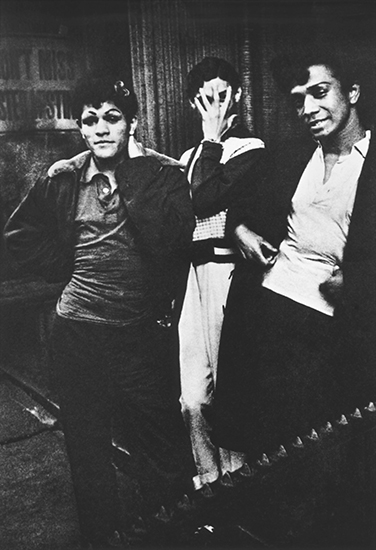
Robert Frank, New York City (© Robert Frank, from The Americans; courtesy Pace/MacGill Gallery)
{ 7 }
The editors of Popular Photography, a magazine of sparkling images, technical virtuosity, and plentiful advertisements, hated Robert Frank’s The Americans, a collection of photographs that he had taken while touring the United States. His work was incompetent, they said, reeking with “contempt for any standards of quality or discipline in technique.” It was full of “meaningless blur, muddy exposure, drunken horizons, and general sloppiness … out-of-focus pictures, intense and unnecessary grain, converging verticals, a total absence of normal composition.” The content of the images, the message that they conveyed, further riled the editors to the point of hysteria: “His book is an attack on America”; “a wart-covered picture of America”; “marred by spite, bitterness, and narrow prejudices”; “a slashing and biting attack”; it revealed “the desire to shock and provide cheap thrills.”1
Even Gilbert Millstein, who had helped to launch Jack Kerouac’s career with a beaming review of On the Road in the New York Times, was turned off by Frank’s vision. He damned the images for their harshness, distrust, and distaste toward their subjects. A reviewer for the San Francisco Chronicle agreed, finding Frank’s images “merely neurotic, and to some degree dishonest,” for all that they depicted was an “Ugly American.”2
Some viewed his work with admiration, however. U.S. Camera, 1958 featured a lengthy portfolio of his images. In addition to their own words of praise, they included the opinion of Walker Evans—a master of photography for decades—Frank’s photographs: “Positive, large, and basically generous.” A reviewer in the New Yorker lauded Frank’s “brutal sensitivity,” his awareness that behind the façade of middle class abundance and conformity lurked “latent violence.”3
A statement from the artist accompanied the portfolio, which contained thirty images from his soon-to-be-published book. Frank acknowledged that his photographs represented his own point of view. As he later explained, “I always prefer the extreme.”4
How could it be otherwise? What he wanted in his work, in addition to expressing his “extreme” vision, was to capture the “instantaneous reaction to oneself that produces a photograph.” A good photograph, in his opinion—and in keeping with the aesthetics of the New Sensibility—was one that would “nullify explanation.” Silence rather than deep interpretation, speed and spontaneity over compositional serenity.5
In April of 1958 Robert Frank took a car trip with Jack Kerouac to Florida. Kerouac’s classic On the Road had been published in the fall of 1957, and he wanted to drive to Florida to pick up his mother, her cats, and some belongings (his typewriter, various manuscripts) and move her to a house he had purchased on Long Island. Kerouac, the presumed king of the open road, did not drive, so he slept a lot in the backseat, while Frank was at the wheel. They intended to publish text and images in Life magazine, a project which fell through but which furnished them with a couple of hundred dollars each, as well funds for “gas, oil, and chow.” Kerouac observed and reported on Frank’s method of taking photographs. “I was amazed,” Kerouac recounted, “to see a guy, while steering at the wheel,” take a photo through an “unwashed window.” And, amazingly, the photograph worked. Their trip together was a tale of sudden stops whenever something caught Frank’s eye. Unlike Evans, Frank did not linger, waiting for the lighting to be perfect. He caught what interested him at the moment, without undue anxiety. His subject matter was what would dominate the soon-to-be-published The Americans—cars, “the lonely look of a crossroad stoplight,” African Americans, impoverished whites, and the iconography of America (advertising posters, flags).6
In contrast to the somewhat subdued tone in Kerouac’s account of their Florida jaunt, his introduction to The Americans was a paean to Frank’s beat-infused vision of America. It was an ode to spontaneity, to the freedom of the open road, to personal liberation, to the everyday. It related well to Kerouac’s jazz-inflected prose, to Ginsberg’s howling poetry, and to Cage’s enlightened silences and clanging instruments: to that “crazy feeling in America when the sun is hot on the streets and music comes out of the jukebox or from a nearby funeral.” Kerouac grooved to the rhythms that infused Frank’s images. He thought they celebrated the best parts of the American spirit. But he dug a bit deeper to recognize that the photographs had a clear theme, sometimes clinging to the side of the eye, sometimes front and center, sometimes slightly hidden from view. There was, in the heart of the images, a sense of violence and death—the content that the New Sensibility engaged. The lingering on implicit violence—along with the theme of sadness—was excessive, and brilliantly so. But the New Sensibility also shared much with the beat vision: improvisation, spontaneity, and speed—a willingness to challenge traditional cultural hierarchies and to savor (and critique) the everyday vernacular.7
Frank wanted his photographs to be poetry: “When people look at my pictures I want them to feel the way they do when they want to read a line of a poem twice.”8 An interesting notion, but did it jibe with his other stated desire that his images “nullify explanation”? At another time, he stated as much, in words that were a Cagean (or Beckettian) minimalist mantra: “Best would be no writing at all.” The photographs, in this view, would speak for themselves—combining content and style into a form of poetry. At once personal and public, the feeling and emotion of the image would suffice.9 Kerouac grasped this perfectly. “Robert Frank, Swiss, unobtrusive, nice, with that little camera,” he wrote, “sucked a sad poem right out of America onto film, taking rank among the tragic poets of the world.”10
Frank had arrived in the United States in 1947, at the age of twenty-three. Small in stature, rock-hard in confidence, Frank had been an indifferent student in Switzerland, although he had been an avid reader of existentialist literature and an apprentice photographer. His German Jewish family had avoided the Holocaust by residing in physical comfort but mental anguish in Switzerland. Living in the midst of the Second World War, Frank “heard Hitler every day on the radio, the voice of terror.”11 This, he later stated, “made me less afraid and better able to cope with different situations because I had lived through that fear.” In the United States, the fear that he captured on film was related to the specter of atomic annihilation and the tense state of racial relations in the United States.12
While Frank proved himself remarkably open to the American landscape, he carried his own baggage and personality to the United States. He was, as a Greenwich Village acquaintance put it, a blend of “European dourness and pessimistic wit.”13 Whether he was photographing in Wales, Peru, Spain, or Mississippi, those lenses of his personality informed each of his images.
His initial American sojourn in 1947 was short and largely unsatisfying. While he exulted in how America was “really a free country,” unbeholden to traditions, he initially found that “everything goes so exceptionally fast and … the only thing that counts is MONEY.”14
In New York City a year or so later, Frank began to carve out a niche as a commercial photographer. But he confronted that old bugaboo: “The only thing that mattered was to make more money.”15 And his restless energy demanded travel, so in 1948 he took his photographic equipment to South America, wandering around various nations, trying to see the new world with the Emersonian eyes of a child—with that sort of openness to experience, unhampered by social protocol. In typical Frank fashion, he sloughed off photographic expectations—“I didn’t think of what would be the correct thing to do; I did what I felt like doing,” creating a “diary” in images.16
One can wander only so long. In 1953 Frank was back in New York City, married to a beautiful artist, Mary Lockspeiser, with one child and another one about to enter the world. He had in the last few years, he said, “tried out things… . I learned about life. I learned about how to live in New York.” He wanted desperately to leave the world of fashion and commercial photography, to jettison the making of images that he considered “lyrical” in order to put his particular imprint on his work.17
All roads by 1954 seemed to lead him to a new, ambitious project: “a visual study of a civilization,” for which purposes the United States would serve quite nicely. In his 1955 application for a Guggenheim Fellowship, he acknowledged the hubris of his project: “ ‘The photographing of America’ is a large order—read at all literally, the phrase would be an absurdity.” All but declaring himself a modern-day Tocqueville, concerned less with politics and community and more with the rhythms and icons of American culture, he catalogued what he intended to capture on film: “a town at night, a parking lot, a supermarket, a highway, the man who owns three cars and the man who owns none.” With glowing letters of support from diverse photographers of note, Frank got the Guggenheim funding and took off in a 1950 Ford sedan for the open road, often by himself, sometimes accompanied by his family.18
But Frank refused to follow in the footsteps of mentors such as Evans and Edward Steichen. Much as he respected them, and sometimes hewed closely to their subject matter, he was in determined revolt against their more traditional, ordered sensibilities. Evans had made his reputation in the 1930s, working with the Works Progress Administration. James Agee handpicked him in 1936 to collaborate with him on a project, originally intended for Fortune magazine and later made into a book, Let Us Now Praise Famous Men, which brilliantly portrayed the poverty and dignity of tenant farmer families in the South. Like Frank, Evans was fascinated by advertising and signage, by rickety old buildings—what one of his biographers called Evans’s “politics of the vernacular.” And he worked hard to ensure that the subjects of his images were respected, endowed with a quiet grace. But unlike Frank, Walker employed cumbersome equipment. He would carefully size up a shot, accounting for available light—and how much light might be around once shooting commenced. There was none of the spontaneity, the instantaneous reaction between photographer and subject that Frank desired.19
A devoted modernist and a fine portrait photographer, Steichen believed in the power of photography to improve humanity. In the late 1940s and early 1950s, many intellectuals and artists signed on to a cultural imaginary that stressed the commonality of the human condition. Thanks to a rising interest in cultural anthropology, mythology, and Freudianism, and a momentary decline of racialist thinking (a result of horror at the Holocaust), some came to view humanity as singular, devoid of essential differences, other than circumstances (place of birth, cultural traditions, relative wealth, etc.).20 But no matter where one resided, no matter one’s skin color, one’s religion, or ethnicity, all human beings felt pain, loved their children, and worked to feed and clothe themselves and their loved ones. This sentimental vision of united humanity was at the center of a 1955 widely traveled exhibition and then a photographic volume that graced many coffee tables in America, called The Family of Man. Although the works varied widely in quality—and many of them did capture hostility and suffering—they drove home vigorously the universality of the human condition. Seven early Frank images were included in the massive compendium. Taken in the United States, Peru, Spain, and Wales, they tended toward the dour and despairing (a Welsh coal miner with blackened face, a lonely beggar). But one image was enlivened, atypically for Frank. A bunch of women are having lunch at a hamburger joint. They sit at a counter, grinning because they are looking out the window at the photographer taking their picture. What especially stands out in the image, however, is the cacophony of signs—for pies, beans, and soup, all framed above by fluorescent lights and the word “HAMBURGERS” in bold lettering—precisely the sort of thing that would later appeal to Robert Venturi and Denise Scott Brown about Las Vegas signage (see chapter 20).21
Frank’s style was predicated on his instantaneous response to a subject—feeling or emotion over conscious evaluation. Martialing such moments of emotion meant, as a first step, that the heavy equipment and large-format images favored by Evans and Steichen had to be abandoned. In their stead, Frank used a lightweight, 35 mm Leica camera that allowed him to shoot rapidly, from the hip.22 He respected what was known among abstract expressionist painters as “the gesture,” that moment of collision between canvas and artistic will. These artists, with whom he was chummy, he said, “reinforced my belief that you could really follow your intuition—no matter how crazy or far-off or how laughed at it would be. You could go out and make pictures that were not sentimental. You could photograph what you felt like.”23
The road trip across the United States began in June 1955 and continued for another year, supported by the Guggenheim Foundation. Frank ventured to parts of the coastal South, then to Dearborn to photograph the Ford plant at River Rouge, and later deeper into the southern states. On the second leg, he headed west, even stopping at the 1956 Democratic Convention in Chicago. Back in New York City, settled in what would today be considered the East Village, Frank began the arduous task of examining thousands of negatives, making prints, and deciding on what belonged in the book project and in what order. He was confident that he had caught his subject in the manner he had intended: “I had a feeling of compassion for the people on the street… . That gave me the push—that made me work so hard until I knew I had something, but I didn’t even know I had America.”24
It was quite a tall order to encompass America, in its ocean-to-ocean mass and teeming plurality. He wanted to embrace a “cross-section of America,” one that, of necessity, would reflect his “personal view.”25 On the first count, at least, as the reviews in Popular Photography and elsewhere indicated, many considered Frank neither compassionate nor extensive in his selection of images. And Frank, too, in certain moments admitted that he was always an angry outsider, distanced from American consensus and middle-class ideals: “I believe that it’s good to be angry, if you’re an artist… . The anger will make you work harder to produce things that will contain more conviction.” Frank’s own anger propelled The Americans beyond the realm of mere documentary or travelogue into a new style of critique and transcendence, always marked with what Allen Ginsberg called Frank’s “quality of loneliness.”26
Traveling around, often without the succor of the family circle and friends, does induce loneliness and feed alienation. Anger can surface easily when an individual confronts all sorts of hassles from law enforcement and others jittery about a Jewish guy with a foreign accent and a camera poking around their territory. Early in his journey, in July 1955 in Detroit, Frank wrote his wife that he had spent a night in jail, a result of having the wrong license plates on his car. He found the experience, he wrote, “depressing and I got scared.” Five months later, in McGehee, Arkansas, Frank was arrested again. According to the police report, “He was shabbily dressed, needed a shave and a haircut, also bath. Subject talked with a foreign accent.” Upon looking at the contents of the truck, the officer found lots of cameras and plenty of luggage, and the suspect seemed uncooperative—Might he be “in the employ of some unfriendly foreign power and the possibility of Communist affiliations”? The police interrogated Frank, finding it suspicious that he had been taking photographs of a major US auto plant. Listen to Frank describe one moment in the interrogation: “The lieutenant leaned back and inquired: ‘Now we are going to ask you a question: Are you a commie?’ ” After nearly two days of hassle and degradation along these lines, Frank was freed and returned to his travels.27
His travails continued in Port Gibson, Mississippi. This time he captured the tense situation on film. A group of about seven teenagers, in front of a high school, saw that Frank was taking photographs nearby. “What are you doing here? Are you from New York?” one of the kids inquired. Frank responded: “I’m just taking pictures… . For myself—just to see.” One of the kids then announced: “He must be a communist. He looks like one. Why don’t you go to the other side of town and watch the niggers play.”28
He was traversing America while the Red Scare lingered. As he surveyed “those faces, those people” in the United States, he came to discover a “kind of hidden violence. The country at that time—the McCarthy period—I felt it very strongly.”29
We see the violence, fear, and death in many of his images. They are most powerfully conveyed by how he juxtaposed images. Although he later claimed that he was not placing or ordering the images (and Susan Sontag concurred, finding the presentation “deliberately random”) into a logical progression—perhaps embracing the “random order” favored by Rauschenberg—there was a sequential logic to the images in The Americans.30
Consider a series of five images nestled side by side in the midsection of The Americans. In “U.S. 91, Leaving Blackfoot, Idaho,” Frank depicted the interior of an automobile, with two intent, grimly serious young Native American males about to begin a journey. The next image was “St. Petersburg, Florida,” an evocative study of elderly people sitting on two benches whose posts resemble the lanes of a highway. In the background of this image, counterposed to the rootedness of the old people in their waiting game of death, is a car—perhaps the one carrying the Idaho pair—streaking off to new horizons of possibility.
The next image similarly focuses attention on the death-in-life waiting of the old and the frenetic movement of the young. “Covered Car—Long Beach, California” shows the shadow of two palm trees. In front of them, in what might well be described as a Bauhaus crypt, is a tarp-shrouded car, immobile and dead. In this image, Frank examined the interplay of two symbols of the American dream, car culture and the liberation often associated with California. He presented both of them, however, as imbued with idle vanity and death. He dashed the expectation that the tarp might be lifted and the car reborn in the next photograph, an image of something else covered—this time a dead body, the victim of an accident, alongside the road of dreams and song, Route 66.
The final image in this montage returns us to the road and thus opens up a new set of possibilities. “U.S. 285, New Mexico” is an ode to the existential juxtaposition of life and death. In Frank’s photograph, the road stretches forever into the night; the lanes of the highway suggesting escape, speed, and freedom. But they also evoke danger. Far ahead, in the passing lane, one can glimpse, ever so faintly, the outline of an oncoming vehicle, its headlights barely visible. Here, as in the other images, freedom shares the road with death, possibility with closure. The photographs expressed the road of life, especially those moments when we are in the passing lane, traveling fast. And yet, as we seek to avoid inertia and complacency, we must always remain cognizant of that other car, the car of death, immobility, old age, conformity, coming closer and closer.
Out of a total of about sixty images depicting faces in The Americans, only a handful revealed a smile or exuberance. And even then the smiling person was usually situated next to a sad individual, or the smile was patently false. In one compelling image, a young television performer, pretty in a mainstream manner, paraded her artificial smile, rendered even more unconvincing by her face being reproduced at that moment on the television monitor next to the stage set. Even happiness in Frank’s world seemed falsified by a consumer-celebrity culture.
Frank presented images of self-important petty politicians. They are often shown suppressing a yawn or surrounded by tattered flags and banal political slogans on posters. When depicting workers, Frank caught them appearing alienated, burdened with a gut-wrenching sadness, gloomy and anonymous; he discovered them in all-night diners, elevators, buses, and bathrooms. In a photograph taken at the River Rouge factory, the workers’ faces are indistinct, blurred, scary analogs to the speeding assembly line that enslaves them and turns them into machines.
Frank turned an ironic eye on the contrasts between the political and spiritual emptiness of Americans and the liveliness of material artifacts that surrounded them. “Bar—Las Vegas, Nevada” presented the naked loneliness at the heart of American life. A young man steps up to a jukebox; he appears to be languid, oblivious to the world surrounding him. The jukebox, however, is alive. One imagines it revving and pulsating with the strains of a lively beat. The man, rather than the jukebox, is the material object, the dead machine in the night. Frank admitted that he considered the jukebox an icon of America, and in photographing it more than once in The Americans, he hoped that it would grant an element of imagined sound to his images.31
The Americans, unlike most photographic collections, paid close attention to African Americans and the painful realities of segregation and racism. Yet he sometimes fell prey to a sort of misplaced envy for African Americans, shared by hipsters such as Kerouac, Ginsberg, and Norman Mailer (see chapter 9) that arose out of their alienation from middle-class American culture, their search for something spontaneous (which they discovered in jazz music). Kerouac’s famous passage in On the Road captured this highly problematic sensibility: “At lilac evening I walked … in the Denver colored section, wishing I were a Negro, feeling that the best the white world had offered was not enough ecstasy for me, not enough life, joy, kicks, darkness, music, not enough night.”32
In keeping with this sensibility, Frank depicted white Americans as the walking dead. The New Sensibility was devoted to creation that rejected much of the tradition and rhythms of white society in the atomic age. Conformity to such values equaled death, in both life and work. Frank made this apparent, for instance, in one photograph, “Charity-Ball—New York City.” There we encounter a woman socialite, gaudy in jewels and bedecked in lifeless finery. Her grimace evinces severe ennui as she accepts on her cheek the kiss of a man whose long fingers wrap around her cold shoulders in a Dracula-like embrace. Even when America’s upper crust were presented as smiling, as in “Cocktail Party—New York City,” they appeared to be courting death: their wealth failed to free them but only seemed to weigh them down in the muck of despair. From Frank’s photographs one might surmise that the blood of America had been sucked out by a materialistic, alienating, and absurd culture—a depiction in photographic form of the Moloch that had powered much of Ginsberg’s Howl.
White Americans, in Frank’s images, were burdened with dullness in spirit and life. This contrasts with the way that Frank depicted African Americans responding to life’s trials. In “Funeral—St. Helena, South Carolina,” a group of young black males lean against their freshly shined automobiles. There is less a sense of grief weighing them down than of boredom, an unwillingness to allow death to interfere with the enjoyment of the living. Another photograph of the same funeral juxtaposes the cold stiffness of the corpse in an open coffin with the movement of the living as they file by. Death is acknowledged—how can it be ignored?—but the need is to move beyond it, to get on with one’s own engagement with life.
In contrast to the coldness of whites, Frank imagined African Americans as sexually vital and passionate. Of course, he was on shaky ground here, threatening to sink into the common racist symbolism of the emotional and sex-saturated Other that he deplored. In one marvelous image, “New York City,” Frank showed three Puerto Rican women (perhaps transvestites), who are aware of Frank’s presence; this is one of the rare noncandid shots. Instead of retreating from his lens, they strike a sexual pose. One caresses her own face, another thrusts out a hip. In the background, the third woman covers up, but not in a modest attempt to hide or to seek anonymity. The gesture is mocking and provocative, the fingers of her hand spread wide across her face.
Indeed, only African Americans regularly demonstrated emotion, deep feelings, or authenticity in The Americans. When he happens upon a group of African Americans from a motorcycle club, one looks at him warily, as if Frank is intruding on his private space. Consider, in this vein, the structure that Frank employed to organize one sequence of photographs. In “San Francisco,” his own favorite image in the book, Frank had clearly disturbed the peace and quiet of a black couple who had been sitting on a hillside enjoying a beautiful view of the city below. The woman and man react to Frank’s sudden intrusion—his vaunted invisibility again had failed him. They greet him with disdain and anger. Frank later referred to that look as saying, “You bastard, what are you doing!”33 The next photograph, “Belle Isle—Detroit,” shows white people in a setting that is as idyllic as the previous shot of the San Francisco hills. But these folks seem oblivious to the beauty of their surroundings and uninterested in Frank’s presence. In another image, also titled “Belle Isle—Detroit,” Frank depicted a moving convertible full of young black boys enjoying cool breezes on their bare chests, perhaps anticipating or still reveling in the joys of their beach outing. Their freedom arises from their relaxed relationship to nature. In contrast, Frank then offered an image of an elderly couple sitting in an enclosed hardtop automobile, stuck in heavy traffic. They seem less angry than numbed by the wait.
Other photographs return to the liveliness of African Americans. In one, Frank caught a black baby next to a jukebox; unlike the passive young man in Las Vegas, this child is joyful and kinetic—alive to the sounds of life. Even a shot of a large black woman sitting on a chair in an open field, an image that might suggest the ultimate loneliness, instead shows her striking a jaunty pose. Her smile positively illuminates the surrounding empty landscape. Though alone, she is not alienated; she lives in the moment.
Frank recognized the limits American racism placed upon black freedom. He had traveled the terrain of segregated America, finding it distasteful and unfair. As he put it in a letter to his parents in Switzerland, “America is an interesting country, but there is a lot here that I do not like and that I would never accept. I am trying to show this in my photographs.”34
He captured one aspect of this disdain in the image that he chose for the cover of the American edition of The Americans. Here, African American freedom is constrained. In this particularly powerful image there is no celebration of black sexuality, spontaneity, and emotions. The image shows the faces of a number of people sitting by the open windows of a New Orleans trolley car. There is pain and despair, aching in its detail and depth, in the face of one black man that demands our attention. He is framed by the window, as he looks with perhaps fear outside. In the seats in front of him—capturing the reality that African Americans had to sit in the back of buses and trolleys—a white boy, dapper in a bow tie, is blessed by his wealth and color.
Another poignant expression of racial realities in The Americans is found in the image “Charleston, South Carolina.” A richly black-skinned nurse, clothed in starched white uniform against a background of blurry white streets and institutional white walls, holds a very pale white baby. The immobile child stares, wide-eyed, straight ahead. It has a sagacious look well beyond its years, like the white child on the bus, anticipating the hidden benefits of whiteness. The attitude of the surrogate mother is uncertain. Though she holds the baby close, her look is not directed toward the child, whose reality seems alien to her. The woman appears to be lost in thought as well. Perhaps she too is contemplating her separateness from the child; perhaps she is thinking about the foreclosed futures of her own children as against the expansive possibilities of the privileged white child that she encloses in her arms.
The Americans nearly closed the book on Frank’s photographic career. In his last photographic series for many years, begun in 1958, Frank traveled on buses in New York City, photographing scenes that resonated with his sense of immediacy. Although he was taking his photographs from the inside of a bus, he remained as always an outsider. The images, he remarked, have “to do with desperation and endurance,” which he associated with living in New York.35 Taking photographs from a moving bus meant that the images were often jerky and blurred, but that was not a problem for Frank’s aesthetic.
As much as the images in The Americans, his bus photographs were about loneliness, about broken dreams—and about movement, in search if not of meaning, then at least motion for its own sake. In one photograph, a large, suited black man, with black fedora, head hanging down, passes a white woman, who is erect in her bearing and well-dressed, with a white hat. Neither has any sense of the existence of the other. A thin, nervous man, cigarette in hand, standing next to a building, has wind-up toys dancing on the street, for sale at fifty cents apiece. In a commercial vehicle, with its back doors swung open wide, leans a slim black man, hands in pockets, elegant in his simple outfit, staring into space.
By 1959 Frank had abandoned photography. He was now drawn to the speed and movement, as well as the community, involved in filmmaking.36 Much that had been central to his photographic vision translated nicely into film. Along with painter Alfred Leslie, he made Pull My Daisy, originally titled The Beat Generation. A strange combination of madcap comedy and often over-the-top symbolism, the film concerned a bishop’s visit to a couple (based on Neal and Carolyn Cassady). Over the course of the evening, however, their zany friends intrude on the solemnity of the event.
Kerouac narrated in his inimitable fashion:
Yes, it’s early, late or middle Friday evening in the universe. Oh, the sounds of time are pouring through the window and the key. All ideardian windows and bedarvled bedarveled mad bedraggled robes that rolled in the caves of Amontillado and all the sherried heroes lost and caved up, and translyvanian heroes mixing themselves up with glazer vup and the hydrogen bomb of hope.37
The actors were Frank’s pals, including poets Ginsberg and Gregory Corso and painters Larry Rivers and Alice Neel, with David Amram providing the score. As with his photography, the film had a choppy and jumpy editing style, which was in many ways anticipatory of the soon-to-emerge style of filmmaking known as cinéma-vérité. Reviewing the film for the Village Voice, Jonas Mekas exulted that Pull My Daisy offered “new ways out of the frozen officialdom and midcentury sterility of our arts, towards new themes, a new sensibility.”38
Along with John Cassavetes’s Shadows, with which it premiered in 1959, Pull My Daisy greatly influenced American filmmaking. Frank quickly found himself comfortable with the process of making a film. He was no longer an isolato with a Leica; he was now involved with a community, working out ideas and scenes with others, discussing cuts and edits, without diminishing the always strong stamp of his own spontaneous sensibility, accepting improvisation, and looking around various corners generally ignored by traditional culture.39
Gone was the time when he could exult, “As a still photographer I wouldn’t have to talk with anyone. I could walk around and not say anything. You’re just an observer; you just walk around, and there’s no need to communicate.”40 Yet, in its manner, The Americans did communicate; its images resonated with an emerging generation that readily embraced the New Sensibility in the 1960s. And it did so without using any words, by nullifying any need of explanation on Frank’s part—no small accomplishment.