
5
This chapter looks closely at Lehman’s liquidity crisis. I describe the firm’s strategy for liquidity management, the basic ways in which this strategy failed, and the details of the liquidity drains that pushed Lehman into bankruptcy. Understanding this story helps us see how the Fed might have rescued Lehman.
Lehman’s Strategy for Liquidity Management
Lehman’s liquidity management was based on a strategy it developed after the financial crisis of 1998, when Russia defaulted on its debt and the hedge fund Long Term Capital Management nearly failed. These events shook confidence in financial institutions, leading many, including Lehman, to lose liquidity. To guard against future crises, Lehman adopted a “funding framework” that it believed would ensure it always had enough cash to operate.
The firm described this framework in its 10-Ks and 10-Qs for various years, and in presentations to rating agencies and regulators.1 The following sections describe the key elements of the framework.
Sources of Funds
The basic goals of the funding framework were for Lehman to raise funds to finance all of its assets, and to always maintain that funding, even in “stressed liquidity environments.” To that end, the firm divided its assets into liquid and illiquid categories, and it funded these assets in different ways. Lehman defined liquid assets as those “for which the Company believes a reliable secured funding market exists across all market environments.”2 This meant that Lehman could always raise cash to finance these assets by pledging them as collateral in repos; it did not necessarily mean the assets were easy to sell outright. By Lehman’s account, its liquid assets included various equities, bonds, and mortgage-backed securities, including some with speculative-grade ratings.
Illiquid assets included those not commonly accepted as repo collateral, such as private equity, investments in real estate development projects, and corporate loans. The illiquid category also included collateral posted by Lehman in derivatives contracts. Lehman financed illiquid assets with stable sources of funds that it called “cash capital”: equity, long-term debt, and core deposits at Lehman’s bank subsidiaries. The firm also used cash capital to finance the haircuts on liquid assets pledged in repos.
Commercial paper was a modest source of funds ($8 billion at the end of 2008 Q2). Lehman used commercial paper “to mitigate short-term liquidity outflows such as unforeseen operational friction.”3
The Liquidity Pool
Another part of Lehman’s funding framework was a “liquidity pool” held by LBHI to protect itself against any losses of cash. The terminology here is confusing because the types of assets included in the pool were narrower than those considered liquid in determining sources of funding. The liquidity pool was “primarily invested in cash instruments, government and agency securities, and overnight [reverse] repurchase agreements collateralized by government and agency securities.”4 These assets could be turned into cash quickly. Assets included in the liquidity pool were not pledged as repo collateral or otherwise encumbered.
LBHI’s liquidity pool was $44.6 billion at the end of 2008 Q2 (May 31), up from $34.9 billion at the end of 2007. As Lehman claimed, the pool consisted primarily of highly liquid assets such as cash and government securities. However, the pool also included about $4 billion of collateralized loan obligations, which presumably were less liquid.5
LBHI’s liquidity pool was “primarily intended to cover expected cash outflows for twelve months in a stressed liquidity environment.” Its 10-Q for 2008 Q2 listed types of outflows that it thought might occur, of which the most significant were:6
· repayment of commercial paper and long-term debt due within a year, if Lehman could not roll over these debts;
· take-ups of commitments by Lehman to extend credit to clients;
· collateral calls in derivatives contracts that would be triggered by rating downgrades of LBHI’s bonds; and
· “reduced borrowing availability” in the repo market or increased haircuts on repo collateral.
Notice that the last point hedges on the claim elsewhere in the 10-Q that Lehman’s repo financing was reliable in all market environments.
Lehman’s broker-dealer subsidiaries in New York (Lehman Brothers Inc., LBI) and London (Lehman Brothers International Europe, LBIE) had their own liquidity pools of $0.3 billion and $7.0 billion respectively at the end of 2008 Q2.7 Regulations forbade LBHI from accessing these pools, but liquidity could flow in the other direction, from LBHI to a subsidiary. In that case, LBHI recorded a receivable on its unconsolidated balance sheet and the subsidiary recorded a payable.
Reliable Repo Funding
At the end of 2008 Q2, Lehman had $188 billion of collateral pledged in repo agreements.8 This amount greatly exceeded its liquidity pool of $44.6 billion, which meant the pool could absorb some loss of repo funding but not too much. Thus, another goal of Lehman’s funding framework was to ensure that its repo funding was stable.
Many of Bear Stearns’s counterparties refused to roll over repos with Bear during its crisis in March, and that episode shook Wall Street’s faith in the reliability of repo funding. In its 10-Q for 2008 Q2 and in statements to investors and regulators, Lehman took pains to argue that it was different from Bear and could maintain adequate funding in a crisis.9 The firm made several points about its repos:
· Relationships with Counterparties Lehman claimed its repo funding was secure because it had “broad and long-established relationships” with counterparties, and the counterparties understood the assets they were accepting as collateral. In addition, Lehman’s management would respond to any crisis with phone calls “to address rumors and reassure key stakeholders.”
· Quality of Collateral Of Lehman’s $188 billion in repo collateral, $83 billion was Treasury and agency securities, which could always be monetized easily. Of the remaining $105 billion, $65 billion was investment-grade securities and publicly traded equities for which, Lehman insisted in its 10-Q for 2008 Q2, “there exists a very active, reliable and liquid secured funding market.” That left only $40 billion of lower-quality collateral that counterparties might reject.
· Bank Subsidiaries Of the lower-quality assets, $8 billion were pledged in repos with LBHI’s banking subsidiaries. These units would always roll over repos with their parent, and they could even provide additional funding to it.
· Overfunding Lehman “overfunded” its non-Treasury/agency repos, which meant that it could lose some of its repo financing without needing to draw on its liquidity pool. Total overfunding was $27 billion at the end of 2008 Q2. The accounting here is subtle, with two types of overfunding:10
First, Lehman had $11 billion of “excess collateral” for its repos. That meant that $11 billion of the non-Treasury/agency collateral that it pledged to its repo counterparties was borrowed from other institutions, which received cash from Lehman. If some of Lehman’s repo agreements did not roll, it could offset the loss of liquidity by returning borrowed collateral and taking back its cash.
Second, Lehman had $16 billion of “ticket” overfunding. That meant repo counterparties agreed to accept $16 billion more in non-Treasury/agency collateral than Lehman actually had. Lehman delivered $16 billion of liquid Treasury and agency securities to the counterparties in place of the agreed-on less liquid collateral, but it could switch to delivering the less liquid collateral if it wanted to. Lehman would make such a switch if some of its other repos did not roll, leaving non-Treasury/agency collateral that it needed to finance. In this case, Lehman presumed, the Treasuries and agencies that it stopped delivering could be financed through new repos.
Assessments of Lehman’s Liquidity by Lehman and Others
In May and June 2008, Lehman told regulators and rating agencies that it was “building a liquidity fortress.”11 It supported this claim with stress tests which showed that the firm generally survived hypothetical liquidity crises.12 One of Lehman’s key assumptions in these stress tests was that most of its repos with investment-grade securities or equities as collateral (not just its Treasury and agency repos) would continue to roll over.
After the Bear Stearns crisis, the Fed performed its own stress tests on the remaining investment banks. These tests generally found that Lehman would not survive a liquidity crisis. Yet the Fed’s conclusions were not alarmist. In May, Fed analysts characterized Lehman’s liquidity as “poor but improving.” In June, they said, “Lehman recognizes its vulnerabilities and is trying to reduce illiquid assets and extend maturities where possible … Lehman should improve its liquidity position by $15 billion.”13
For a time, rating agencies were optimistic about Lehman’s liquidity. On March 17, the day after the Bear Stearns rescue, Moody’s reported, “Lehman’s liquidity management and position remain robust and are underpinned by a funding framework that is scaled to the firm’s expectations for, and vetting of, reliable secured funding.” On April 1, Fitch said, “Liquidity remains strong with Lehman’s lower reliance on short-term funding relative to its peers.”14
S&P’s view was more cautious. On April 3, it said:15
[Lehman’s] excess liquidity position is among the largest proportionately of the U.S. broker-dealers … Nonetheless we cannot ignore the possibility that the firm could suffer severely if there is an adverse change in market perceptions, however ill-founded.
In retrospect, Lehman’s claims about a liquidity fortress seem like wishful thinking. The Valukas Report criticizes the firm’s liquidity management, saying Lehman should have known that its repo funding was unreliable and that its liquidity pool was inadequate.16
Changes in Lehman’s Liquidity, May 31–September 9
Lehman started experiencing liquidity problems after May 31, the end of its Q2. This section chronicles developments between May 31 and September 9, when bad news about earnings and the Korean Development Bank triggered the fatal run on the firm. Over this period, LBHI reported a fairly stable liquidity pool, with losses of funding offset by sales of real estate assets. Yet this stability masked problems that would ultimately contribute to Lehman’s crisis and failure.
The information on Lehman’s liquidity comes primarily from memos from the firm’s treasury department, which are available through links in the Valukas Report footnotes. One key memo is “Funding Lehman Brothers,” written on September 10 as the firm struggled to survive.17 Another is “Liquidity of Lehman Brothers,” a post-mortem review of the crisis written on October 7.18
Factors Affecting LBHI’s Liquidity Pool
The September 10 memo summarizes Lehman’s liquidity management during Q3 (which had ended August 31):
Despite a challenging market environment, Lehman Brothers was able to maintain the status quo broadly in terms of liquidity – primarily as a result of deleveraging its balance sheet (which was done for risk reasons).
Lehman provided details of this deleveraging in its press release about its Q3 earnings. During the quarter, the firm shed $23.3 billion of illiquid assets, including $18.9 billion of real estate and $4.4 billion of “high yield acquisition finance.”19
The “challenging market environment” that Lehman acknowledged included decreases in several types of its funding. These funding losses are listed in the September 10 and October 7 memos:
· Long-term debt Lehman issued only $2 billion of long-term debt in Q3, down from $14 billion in Q2. The stock of long-term debt fell from $128 billion to $115 billion.
· Commercial paper Commercial paper outstanding fell from $8 billion at the end of Q2 to $4 billion at the end of Q3.
· Repos Lehman’s repo agreements fell by about $10 billion. The firm had to pay back the $10 billion of cash it had received from the lost repos, which cut into its liquidity pool. (Lehman maintained a constant level of overfunding of its repos, choosing not to absorb its losses through reduced overfunding.)20
Overall, Lehman’s claim that it “maintained the status quo” was consistent with LBHI’s reported liquidity pool, which fell only slightly from $45 billion at the end of Q2 to $42 billion at the end of Q3 and $41 billion on September 9.
Factors Not Accounted for in LBHI’s Liquidity Pool
The stability of LBHI’s liquidity pool masked several problems:
· Questionable Assets in the Liquidity Pool As noted earlier, LBHI’s liquidity pool included some non-Treasury/agency securities that were not very liquid. These assets grew from $4 billion at the end of Q2 to $7 billion, probably before September 9. Lehman was unable to monetize these securities during its crisis.
· Clearing-Bank Collateral Starting in June, JPMorgan Chase, Lehman’s clearing bank for tri-party repos, demanded collateral – either cash or liquid securities – to cover its intraday exposure to Lehman. Other banks that cleared transactions for Lehman demanded “comfort deposits” of cash. These other banks included Citi, which cleared Lehman’s currency trades, and HSBC, which cleared its trades of securities denominated in British pounds. These demands by clearing banks totaled $11.5 billion on September 9.
Lehman included assets held by clearing banks in its liquidity pool, but that practice is criticized in the Valukas Report21 and in Lehman’s October 7 post-mortem. The collateral held by JPMorgan was released every night, but it was not available to meet Lehman’s obligations during the day. Theoretically, Lehman had the right to withdraw comfort deposits from Citi and HSBC, but those banks might have stopped clearing Lehman’s transactions as a result.
· Broker-Dealer Liquidity Pools As confidence in Lehman fell, the separate liquidity pools at LBI and LBIE were depleted: From May 31 to September 9, LBIE’s pool fell from $7.0 billion to $0.8 billion, and LBI’s fell from $0.3 billion to zero. The reasons are not completely clear, but one factor was a loss of cash in LBIE’s prime broker business. After September 9, the broker-dealers had essentially no liquidity of their own, so they drew on LBHI’s liquidity pool.
Arguably we can measure Lehman’s true liquidity by adding the broker-dealers’ liquidity pools to LBHI’s pool, and subtracting clearing bank collateral and illiquid assets included in the pool. By this measure, liquidity was approximately $48 billion at the end of Q2 ($52 billion in liquidity pools minus $4 billion of illiquid assets). Liquidity fell to $23 billion on September 9 ($42 billion minus $7 billion of illiquid assets and $12 billion held by clearing banks).
Lehman and the PDCF
The Fed created the Primary Dealer Credit Facility (PDCF) in March 2008 to help investment banks cope with losses of liquidity. Lehman borrowed $2 billion from the PDCF on April 16, but did not access the PDCF as its liquidity fell over the summer. It did not borrow again until LBI accessed the facility after LBHI’s bankruptcy.
It is not completely clear why Lehman did not borrow more before September 14. A likely factor is that the PDCF did not accept speculative-grade securities or equities as collateral. A substantial fraction of Lehman’s repos used those types of collateral, and it was those repos that were the most difficult to roll when markets lost confidence in the firm. PDCF access, therefore, was not enough to protect Lehman from a severe run. At the same time, Lehman probably feared that borrowing from the PDCF would signal that the firm was in trouble, making a run more likely.
This situation changed dramatically on September 14. On that date, the Fed changed the rules to allow the PDCF to accept all tri-party repo collateral, and Lehman desperately sought PDCF support. Lehman probably would have borrowed enough from the PDCF on September 14 to avert its bankruptcy the next day, if not for a decision by Fed policymakers to restrict the firm’s access to the facility. Chapter 8 examines this Fed decision in detail.
Between April and September, Lehman borrowed Treasury securities from the Term Securities Lending Facility (TSLF) in amounts ranging from $10 billion to $20 billion, using agency securities and triple-A mortgage-backed securities as collateral. Access to the TSLF did not help Lehman during its crisis because of the narrow range of collateral the facility accepted.
The Run on Lehman, September 10–12
Lehman had the same experience as Bear Stearns: an erosion of liquidity over several months and then a sudden, fatal run. Lehman’s run occurred from Wednesday, September 10 to Friday, September 12. The firm’s post-mortem from October 7 describes the run in detail.
It seems that the run was triggered by two pieces of bad news: the failure of negotiations with the Korean Development Bank on September 9, and Lehman’s disappointing announcement about its earnings and strategic plan on September 10. These blows to confidence were reinforced by warnings about Lehman’s condition from rating agencies.22
Over September 10–12, about $20 billion of Lehman’s repo financing was cut off (including $5 billion of repos with Fidelity Investments). Lehman absorbed $18 billion of this loss by reducing its overfunding of repos, so its liquidity pool lost only $2 billion. This outcome meant, however, that little overfunding remained to absorb any further repo losses.
Over the same three-day period, collateral pledged to clearing banks rose by about $4 billion, as JPMorgan Chase reacted to Lehman’s crisis by demanding more collateral for clearing its tri-party repos.
A number of other factors reduced Lehman’s liquidity in its final days. The October 7 memo summarizes these factors in a chart, shown here as Exhibit 5.1. Some of the factors affected LBHI directly and some affected its broker-dealers, which LBHI had to fund because their liquidity pools were gone.
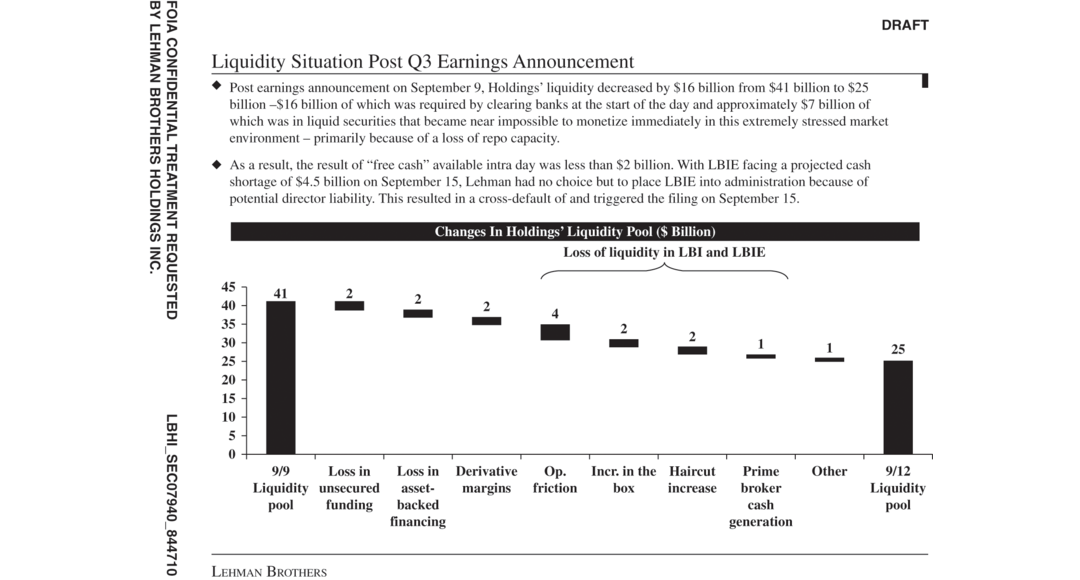
Exhibit 5.1
Estate of Lehman Brothers Holdings Inc., Analysis of Lehman’s Liquidity Crisis, October 7, 2008.
Source: Report of the LBHI Bankruptcy Examiner, footnote 6341.
The chart in Exhibit 5.1 shows the following drains from LBHI’s liquidity pool:
· Loss in unsecured funding, $2 billion: commercial paper that did not roll over.
· Loss in asset-backed financing, $2 billion: the failure of deals to issue asset-backed commercial paper.
· Derivative margins, $2 billion: demands for additional collateral by counterparties in derivatives contracts.
· Operational friction, $4 billion: withdrawals from prime broker accounts at LBIE; a temporary loss due to delays in transferring assets which Lehman expected to disappear in a few days.
· Increase in the box, $2 billion: The $2 billion loss of cash from repos was reflected in an increase in “boxed” assets, meaning assets that were not pledged as repo collateral.
· Haircut increase, $2 billion: modest increases in haircuts demanded by lenders that continued to roll over Lehman’s repos.
· Loss of prime broker cash, $1 billion: a permanent loss of cash from shrinkage in LBIE’s prime broker business.
These specific liquidity losses, plus another $1 billion drain of “Other,” totaled $16 billion. They reduced LBHI’s reported liquidity pool from about $41 billion on September 9 to $25 billion on September 12. As the October 7 memo acknowledges, the remaining pool included $16 billion of clearing bank collateral and $7 billion of “liquid securities that became near impossible to monetize immediately” (an oxymoron). Subtracting these amounts from $25 billion left true liquidity (which the memo calls “free cash”) of less than $2 billion. With less rounding of figures, the actual amount was $1.4 billion.
Lehman’s Predicament on September 13–14
Over the weekend of September 13–14, it became clear that if Lehman opened for business on September 15, it would quickly run out of cash and default on various payments due to its counterparties. With this grim outlook, LBHI’s board of directors approved a bankruptcy petition on the night of Sunday, September 14.
Liquidity Calculations for Monday, September 15
Several analyses concluded that Lehman’s liquidity needs on September 15 would greatly exceed its $1.4 billion of available cash:
· A Lehman memo, apparently from Saturday, September 13, made detailed liquidity projections for the following week.23 The memo predicted that $7.6 billion of repo agreements would not roll over on the 15th. It also predicted additional cash drains of $5.0 billion, but assumed that Lehman could replace $4.5 billion of these losses by drawing on credit lines.
· Lehman Brothers hired Lazard, another investment bank, to advise it during its crisis, and Lazard prepared a memo on Lehman’s liquidity on September 14.24 This Lazard memo was more pessimistic than Lehman’s: it estimated that $16 billion of repos would not roll on the 15th; that, because of rating downgrades, derivatives counterparties would demand an additional $2 billion of collateral; and that banks would cut off the credit lines that Lehman planned to access. The memo concluded, using “Green” as a code name for Lehman: “absent a sale transaction or extraordinary government intervention, Green believes it will not be able to open for business on Monday.”
· Lehman’s October 7 post-mortem memo highlights the untenable liquidity position of LBIE, the London broker-dealer. LBIE projected a cash shortage of $4.5 billion at the beginning of September 15.
Looming Catastrophes
Even if Lehman had opened for business and had somehow managed to meet its immediate obligations, it faced two imminent disasters:
· Rating downgrades On September 10 and 11, Moody’s and Fitch threatened to downgrade Lehman by two notches if it did not find a strategic partner by September 15.25 Presumably these downgrades would have accelerated the run on Lehman if it had tried to stay in business.
· Clearing banks On September 11, JPMorgan Chase, worried about its exposure to Lehman, threatened to stop clearing Lehman’s tri-party repos. If that happened, Lehman would lose access to any financing through the tri-party market. According to the Lazard memo:
JPMorgan CEO indicated to Green CEO Thursday evening September 11, that Green needed to announce a sale transaction by market open Monday September 15 or JPM would immediately discontinue doing business with Green and effectively “put Green out of business.”
Also on September 11, Citi threatened to stop clearing Lehman’s currency trades.
The Final Board of Directors Meeting
On Sunday, September 14, the LBHI board of directors convened at 5:00 PM. The meeting adjourned at 6:10 and reconvened at 7:55; it is not clear when it ended. The meeting is summarized in the board’s minutes, and accounts also appear in Sorkin’s Too Big to Fail and in the FCIC testimony of Harvey Miller, Lehman’s lead bankruptcy attorney.26
Lehman executives described the firm’s predicament to the board. The Barclays deal had failed, the firm was out of cash, and the Fed would not lend it enough to operate the next day. LBIE faced a special problem because, under British law, its directors faced criminal liability if they tried to operate the firm without sufficient cash. LBIE was planning to file for administration, the British version of bankruptcy, and would default on payments due Monday. Because LBHI guaranteed those payments, it, too, would be in default.
At one point the meeting was interrupted by a phone call from SEC Chair Christopher Cox and New York Fed General Counsel Thomas Baxter, who urged the board to “make a quick decision” about bankruptcy. Chapter 8 describes the details of this call.
After the phone call, LBHI’s board debated what to do. One director suggested “calling the government’s bluff” and attempting to open for business on Monday.27 In the end, however, the board concluded that opening on Monday would produce chaos, and that Lehman’s stakeholders would fare better under bankruptcy. The attorneys from Weil Gotshal rushed to prepare a bankruptcy petition and filed it with the bankruptcy court at 1:45 AM on Monday September 15.