
2
Miguel A. Zalama Rodríguez
In his Lives of the Artists (1550), Giorgio Vasari (1511–1574) determined that the arts were painting, sculpture and architecture. Two centuries later, Jean-Baptiste le Rond d’Alembert (1717–1783) in his ‘Preliminary Discourse’ in L’Encyclopédie (1750) corroborated this idea, and in spite of scholarly efforts to reassess other artistic endeavours considered by many to be minor, decorative or applied arts, this paradigm has been perpetuated in art historiography. Nevertheless, it is now recognized that in the early sixteenth century tapestries had great importance, even though the notion that painting triumphed over the rest of the visual arts during this century is widely accepted. In this chapter, I argue that this notion is a misconception, as painting did not entirely substitute tapestry as the ‘high art’ in the sixteenth-century Habsburg Spanish court. On the contrary, the luxurious collections of tapestries preserved their high status in the royal collections. This is demonstrated through an examination of the commemorative use of tapestries in the Alcázar in Madrid and elsewhere. As I explore in this chapter, ‘the triumph of painting’, to paraphrase the title of Jonathan Brown’s monograph of 1995,2 did not occur in the Spanish court until the seventeenth century, and even then this ‘substitution’ occurred partially and gradually over time as opposed to what has hitherto been believed.
The Value of Tapestries in the Sixteenth Century
During the fifteenth century and especially at the time of the Catholic Monarchs,3 painting and sculpture had a secondary presence in the royal treasuries. This is corroborated by the auction of Isabella I of Castile’s properties at the beginning of 1505, which happened only months after her passing. It is also reflected in the inventory of Joanna I of Castile’s properties in 1509 at the time of her confinement in Tordesillas (a confinement that had been ordained by her father, Ferdinand II of Aragon). In both cases the presence of sumptuous objects eclipsed any paintings and sculptures. These latter items were only considered when they carried material value in the form of gold or silver (even if precious metals were only found in the frame of the painting). At this time, precious metals and jewellery were the truly valued objects. They were weighed with acute precision, and the purity of the metal was determined by carat and size. As an example, the condition of the pearls was carefully annotated.4
By 1500 Isabella of Castile had collected a number of panel paintings and canvases. However, these had little quantitative or qualitative importance at the time in comparison with the value given to the tapestry collections and the manner in which they were described among her belongings. The Count of Valencia de Don Juan counted 300 tapestries among the queen’s belongings,5 an estimate that seems somewhat low. In the auction of Isabella’s possessions, paintings reached only a few reales while other objects, less considered by historiography, such as dresses and, especially, anything containing gold and silver, were highly valued.6 This is the case for tapestries, which were valued very highly, for instance the Raising of Lazarus was estimated at 150,000 maravedís, while a painting that was presumably Bosch’s Hieronimus (the inventory read: ‘Jeronimus’) was valued at 170 maravedís. This tapestry had been a gift from the Constable of Castile to the Queen, and had been in her possession at least since 2 April 1498.7 Ferdinand of Aragon bought it in the auction – having forced a second valuation to acquire it at a cheaper rate.8 The tapestry is now conserved in the Museum of Tapestry in the Seo Cathedral of Zaragoza.9 King Ferdinand paid the high price of 524,072 maravedís for two series with ‘much gold and silk’, one series of Nabucodonosor and the other one of Alexander The Great; each series comprised four tapestries,10 and this collection was composed of tapestries (paños) treasured by his father John II of Aragon.11
In 1509 Joanna I reached Tordesillas with a magnificent treasure, comprising numerous objects made of gold, silver or with precious stones, which we know of due to an inventory made at the time. Joanna possessed more than 70 tapestries, compared to the exiguous number of paintings, comprising only seven portraits in total. None of these paintings portrayed Joanna, her adored husband or children.12 In 1524, in what became a real ‘looting’, Charles V took a significant part of Joanna’s treasure of gold and silver for himself and for his sister Catherine of Austria (1507–1578), who was about to leave Tordesillas to meet her husband King John III of Portugal (1502–1557).13 Along with the precious metals the emperor took a number of tapestries. However, Charles V seemed uninterested in the paintings, of which he did not take any; they remained in Tordesillas until the death of Joanna.14
In 1526, Charles V completed the ‘plundering’ of his mother’s treasure: he took four tapestries belonging to the series Devotion of Our Lady or Paños de Oro,15 and two other tapestries from the series Episodes from the Life of the Virgin. In 1502, Joanna acquired all these tapestries in Toledo from Pieter van Aelst, the ‘royal tapestry maker’.16 Likewise, the emperor took the tapestry of the Mass of Saint Gregory: ‘And another paño of the history of Saint Gregory that had thirty anas17 and half on the whole.’18 These seven tapestries, conserved by Patrimonio Nacional (series 1, 2 and 7), did not pass unnoticed by Philip II of Spain, who decided to keep them when his father passed away, even though he had to pay a considerable sum (for the four tapestries of the Paños de Oro alone he paid 370,385 maravedís).19 The ruler showed his appreciation of these tapestries by sending them to the Monastery of El Escorial between 1572 and 1574.20
Contemporary chronicles confirm that tapestries comprised the main part of the treasures of the elites in the fifteenth century and at the beginning of the sixteenth century. Many travellers described the tapestries that monarchs and noblemen collected in their households in Europe. Tapestries covered royal chambers and galleries and were often taken to the streets and the town plazas for ceremonies and festivals. In this way the itinerary in Ghent was decorated with tapestries from the Palace of Prinsenhof to the Church of St Joan (now St Bavo Cathedral) for the baptism ceremony of the future Charles V in 1500.21 Charles V’s parents, Philip ‘The Handsome’ and Joanna I began a sojourn in 1501 to be recognized as the Catholic Monarchs’ heirs in Castile. The couple were received ceremonially in towns and cities during their journey. Tapestries played a crucial role in the ephemera displayed in every festival staged in their honour.22 Fifteen years later the tradition persisted as narrated by Laurent Vital, chronicler of the journey that the future Charles V made to Spain in 1517. On this sojourn Charles visited Tordesillas with his sister Eleanor, and Vital describes in the palace ‘a chamber covered with a fine and rich tapestry with histories and characters from the mystery of the Bible’.23
The examples of the use of tapestries multiply, and this was not merely a medieval tradition, as illustrated in Les Très Riches Heures (1412–1416) by Jean, Duke of Berry (1340–1416). In Italy the Medici also acquired costly series of arazzi: letters survive from Giovanni de’ Medici (1421–1463), brother of Piero il Gottoso (1416–1469), to his agents in Bruges, for example Tommaso Portinari, soliciting Flemish tapestries to be sent to him. Lorenzo de’ Medici (1449–1492) possessed around 40 tapestries at the time of his death.24
Philip II of Spain and the Art of Tapestry
Charles V lived his early years immersed in a cultural environment where tapestries eclipsed the other visual arts. In fact, until the 1540s the emperor seemed uninterested in royal portraiture and paintings in general.25 With time he became interested in painters, such as Titian (c. 1488/1490–1576), but he never disdained tapestries, which he commissioned and acquired throughout his life. The Honours, the Battle of Pavia, the Conquest of Tunes, and the Hunts of Charles V (also known as the Hunts of Maximilian I)26 are only some of the examples of the splendid collection formed by the emperor. His son and heir had similar interests. Since the study published by Fernando Checa on Philip II and the arts there can be no doubt about the fundamental role that the monarch had in the formation of one of the best collections of art in the sixteenth century. Numerous paintings, sculptures and buildings were collected, created and built thanks to the direct intervention of Philip ‘The Prudent’.27 Tapestries were of key importance in the ruler’s collections, Philip amassed around 700 tapestries and his collection is still partially conserved.28 There is no doubt that the monarch liked paintings, and that Anthonis Moor, Titian and Michel Coxcie among others were a crucial reference in his court. In addition, for the pictorial decoration of the Monastery of El Escorial the ruler employed the best artists of those who agreed to work on site; however, he never condemned tapestry. Tapestries that had once belonged to Joanna I, Philip II’s grandmother, decorated the primitive church for the foundation ceremony of El Escorial. Philip sent arguably the best tapestries in his collection at that time to decorate the temporary church of his major building project in construction. However, with the conclusion of the basilica, the ‘primitive church’ (a temporary church, known at the time as the iglesia de prestado) lost the leading religious role in the building. Furthermore, with the introduction of painting as the fundamental art for the decoration of the altars in the basilica (with the exception of the high altar, where sculpture has the same status, especially Leoni’s groups) one could interpret that tapestries had begun to play a secondary role in court. On the contrary, the king was well aware of the value of tapestries and in 1593 he ordered his grandmother’s tapestries to be returned to him.29
Philip II officially began his political career in the mid-sixteenth century, when supposedly painting had already become the most important medium for the visual arts. Philip II’s first contact with foreign lands was Italy – Genoa, Milan – and during this sojourn he discovered the arts of the Italian Renaissance. However, the art of tapestry was very far from dead, as he would have witnessed in the Low Countries. In the festivals organized by his aunt, Mary of Hungary, in the Palace of Binche in August 1549, he found himself surrounded by magnificent tapestry series. The Seven Deadly Sins, Vertumnus and Pomona, the Battle of Pavia are only some examples of the tapestries that the governor of the Low Countries displayed for her siblings, Charles V and Eleanor, Queen of France, and her nephew, Philip.30
These tapestry series made an impression on the young prince, and Philip soon used them assiduously in ceremonies. Upon his marriage with Mary Tudor, on 25 July 1554 in Winchester, the Conquest of Tunes series was sent from the Low Countries to be hung in the cathedral. However, the series never arrived at the ceremony. We know that Philip contemplated with admiration the tapestries woven by Willem de Pannemaker in the Palace of Whitehall, shortly after his triumphal entry into London with Mary Tudor.31 Philip promptly commissioned other tapestries from Pannemaker.32
During Philip’s second voyage to the Low Countries between 1555 and 1559, he acquired numerous tapestries, some of them greatly significant, such as the Apocalypses (Figure 2.1), eight tapestries woven by Willem de Pannemaker’s workshop which were acquired in 1556.33 For these Philip II paid the considerable amount of 7,264 escudos, and of this sum 100 escudos were the ruler’s gratuity [su magestad les haze merçed].34 The interest that the monarch showed in this series is extraordinary, not only on account of the 100 escudos that he paid over the agreed price, but also because six of the tapestries were lost in a shipwreck in 1559 on their way to Spain, after which Philip II immediately commissioned the workshop to recreate the lost tapestries to complete the series.35 Nevertheless, in the archival document for the acquisition of the series there is no reference to the scenes in the tapestries to be remade, while the dimensions of the tapestries are scrupulously annotated.36 However, it is significant that the information regarding the dimensions of the tapestries was not accompanied by a description, even a brief one, concerning the iconography of each of the scenes. In fact, the tapestries were only numbered. The poor interest shown in the archival documentation concerning the content of the scenes is neither the scribe’s mistake nor a singular case; what really mattered at the time were the tapestries’ dimensions, materials – ‘gold, silver and silk’ – and the overall cost. All this seems very far from the creativity and dexterity that was supposedly the main characteristic upon which art objects were valued.
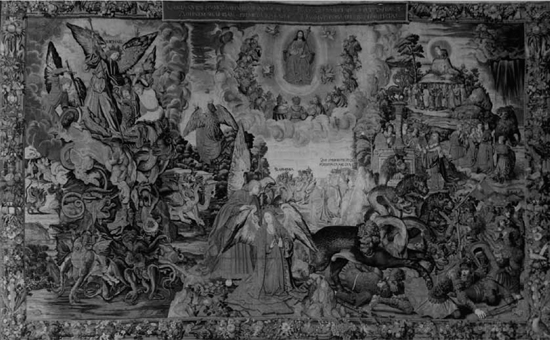
2.1 The Apocalypse series. Saint Michel defeats the Demon. Brussels, workshop of Willem de Pannemaker. c. 1560 Copyright © 2014 Patrimonio Nacional, Madrid
Until the end of his life Philip II continued to acquire tapestries for his collections. To the tapestries that he received from paternal inheritance must be added those that he took upon the death of his first wife, María Manuela of Portugal and, above all, those which he received from his aunt, Mary of Hungary, who named Joanna of Portugal, Philip’s younger sister, her heir. Joanna died in 1573 and Philip II received her collections.37 The impressive number of tapestries that Philip amassed shows his interest – and that of the period – in tapestry, which was still very important in sixteenth-century art collections. This is further proven when exploring the use of tapestries.
Tapestries in the Ceremony of the Golden Fleece in 1593 at the Royal Alcázar in Madrid
At the beginning the 1570s, Cardinal Alessandrini travelled to Spain as a papal legate and Giovanni Battista Venturino da Fabriano described some episodes of his sojourn; among these he accounts his visit to the Alcázar in Madrid. Venturino da Fabriano wrote that on the main floor of Philip II’s residence, just off the monumental staircase, there was a grand gallery without any decoration (una sala grande nuda), and adjacent to this gallery there were three chambers decorated with Flemish tapestries (tre camere ornati de panni ordinarij de Fiandra). In the floor plan of the Alcázar circa 1536 and attributed to Covarrubias, these chambers can be identified as the sala de guarda, on the northern side, and three rooms located on the northwest angle. In the plan by Juan Gómez de Mora of 1626 these chambers are marked in the tapestries from 4 to 8, although at that time a division had been erected in the sala mayor (Figure 2.2). The chronicler follows with a description of Philip II’s chambers and the fresco painted by Gaspar Becerra and Giovanni Battista Castello, il Bergamasco.38
Venturino da Fabriano highlights the magnificent paintings by Titian, who had died recently (di mano di Titiano gia poco tempo morto: Prometeo, Sisifo, Ticio et Ixione). Titian was ‘the divine’ for Italians, as was Michelangelo, to whom the chronicler refers when he compares The Last Judgement with the paintings of the Venetian painter. However, he pays little attention to the chapel of the palace, only noting that it was well adorned and painted and that it had a golden baldachin. He did not seem to consider it relevant to mention the paintings in the chapel – even though the main altar was decorated with a copy of a painting by the Van Eycks, the Adoration of the Mystic Lamb. Tapestries were a recurrent medium through which Philip II’s court displayed royal magnificence; for example, in 1576, when the Spanish ruler met his nephew, King Sebastian of Portugal at the Monastery of Guadalupe the rooms were covered with tapestries.39 The chronicler was so impressed with the display of tapestries that he began his narrative describing them and paying only secondary attention to the participants of the ceremonial meeting. Philip II took some fine samples of his collection with him: the chronicler noted the History of Noah, the Seven Deadly Sins, Vertumnus and Pomona as well as ‘some paños [woven] with silk and wool that belonged to the emperor, the history [represented] was the 7 virtues, [they] are very fine, and every [paño] is as large as the largest [piece] that the church has’.40 These tapestries were none other than the Honours. In addition, the chronicler described:
4 paños of gold and silk very exclusive and very rich, the history [represented] was that [with] figures of the Apocalypses [that were] finely made, the tapestries were so large that even though the corridor was [large too] with four [paños] only [the tapestries] filled [the space]; I was told they [the tapestry series comprised] eight [paños] and that his Majesty uses them for his chapel in Easter.41
Venturino da Fabriano did not see the tapestries in the chapel of the Alcázar, but according to King Sebastian of Portugal’s chronicler, the tapestries of the Apocalypse series hung in the chapel at Easter.42 The commemoration of the Passion of Christ was undoubtedly the correct time at which to introduce the apocalyptic stories represented in these magnificent tapestries. This was not the only occasion on which this series was exhibited in the chapel of the Alcázar in Madrid; they were hung at other ceremonies, for example, for the ceremony of the Order of the Golden Fleece in 1593 celebrating the incorporation of three new members into the Order.
Since 1430, when the Duke of Burgundy, Philip III ‘The Good’ (1396–1467), had created the Order of the Golden Fleece the date selected to stage major commemorations was 30 November, St Andrew’s day. This tradition continued with the heralds of the order succeeding Philip ‘The Good’, such as Charles ‘The Bold’ (1433–1477), Maximilian of Habsburg (1459–1519) – who inherited the title due to his marriage to Mary of Burgundy (1457–1482) – Philip ‘The Handsome’ (1478–1506) and Charles V. In 1555, Emperor Charles V handed over the Dukedom of Burgundy, and thus the title of Herald of the Order of the Golden Fleece went to his heir, Philip II. Upon succession Philip changed some of the customs and supressed the chapters; this was not well received, as the knights of the Order realized that their previous prerogative to debate or discuss the Herald’s decisions had disappeared. Philip II decided to confer chains (that is, knighthoods) arbitrarily. This decision was supported by two Papal Bulls signed by Gregory XIII (1577) and Clement VI (1596), which nullified much of the original spirit of the Order.43
Even though chapters were no longer celebrated, the ceremony for the imposition of the Order’s chain maintained the paraphernalia that had characterized these commemorations since its foundation. A manuscript of 1593, authored by ‘Juan de España, rey de armas. Intitulado Flandes’,44 described the event in detail, illustrating the use of tapestries as the main art form employed in court during the last decade of the sixteenth century. The manuscript, entitled Relaçión y memoria acerca de lo que passó haziendo su magestad la fiesta de sant Andrés en palaçio de Madrid, lunes a 29 de nobiembre y víspera de la fiesta del dicho santo, año 1593, y para dar la orden del tuzón a los duques del Infantado y el de Escalona y a don Pedro de Médiçis45 describes with precision the ceremony and decoration of the chambers used for the celebration in the Alcázar.46
The King of Arms (Juan de España), known as ‘Golden Fleece’ (Toisón de Oro), began his chronicle by describing the arrival of the noblemen on whom the chain was to be conferred. Juan de España was one of the four officials of the Order together with the chancellor, the treasurer and the greffier attending the ceremony. The prospective knights of the Order were Íñigo López de Mendoza, Fifth Duke of Infantado (1566–1601), Juan Fernández Pacheco, Fifth Duke of Escalona (1574–1615) and Pietro de’ Medici (1554–1604). The Duke of Infantado was the head of the powerful Mendoza family and esteemed by Philip II. López de Mendoza accompanied Philip on his journey to England for the wedding to Mary Tudor and hosted the ruler and his wife in his palace in Guadalajara when Philip married Elizabeth of Valois in 1560. The Duke of Infantado had an important courtly entourage and a significant collection of art. Juan Fernández Pacheco, V Duke of Escalona, was viceroy in Sicily with Philip III and even though his rents did not reach the level of the Infantado’s they were similar, as it is estimated that his annual income was between 80,000 and 100,000 ducats.47 The third nobleman distinguished with the knighthood was Pietro de’ Medici, son of Cosimo I de’ Medici, Grand Duke of Tuscany and his wife Eleanor of Toledo. Pietro was a controversial character, known for his debts; he stayed for a long time at the Castilian court where he married Beatriz de Lara, or de Meneses. Among the three new members he appeared to be the one with the fewest merits to become a knight of the Order created by Philip ‘The Good’.
The ceremony began on the eve of St Andrew’s day. The prospective members entered the Alcázar’s main gate surrounded by halberdiers, and the committee headed to the monumental staircase through which they ascended up to the north gallery. Upstairs they found the Spanish and German guards standing in formation from the chapel (located on the south side of the staircase) to the chamber where the ‘guards always stay’.48 This is the same chamber that Venturino da Fabriano described as a grand undecorated chamber (una sala grande nuda).
This grand chamber, which was still not divided in two parts by a wall (in the plan drawn by Juan Gómez de Mora the two divided parts are numbered 4 and 5), measured a little over 100 Castilian feet long (between 28 and 29 metres or 92 and 95 feet) and 30 Castilian feet wide (8.5 metres or 28 feet).49 The chronicler wrote: ‘at the door of the chamber there were in the beginning the butlers of the king our majesty, the Count of Fuensalida and the Count of Chinchón, so no one entered the chamber’ until ‘the knights of the Fleece [arrived] that were the Admiral of Castile and the Duke of Medinaceli and the Duke of Terranova and the emperor’s ambassador, Baron Kheuenhiller, and those who were to receive [the chain] the Dukes of Infantado and Escalona and Médici’.50 The chronicler’s account continues with the committee reaching the room (called the retrete) adjacent to the king’s chambers, where they waited for the ceremony to continue. In order to reach this room (no. 7) they had to cross through the guards’ chamber and through the antecámara (no. 6); detailed descriptions of these two rooms were also supplied.
The account reads: ‘the chamber in which there are three guards was lined with the tapestry of the expedition to Tunis that the emperor Charles fifth of glorious memory, father of our king [made] in 1536’.51 These famous tapestries were commissioned by the emperor from Willem de Pannemaker, and he wove the series based on the cartoons drawn by the Flemish painter Jan Cornelisz Vermeyen, who had worked previously for Philip’s aunts, Margaret of Habsburg and Mary of Hungary.52 Vermeyen accompanied the expedition to Tunis to sketch the events, and as a proof of his eyewitness account, he depicted himself within the tapestries. The series is very rich as it was woven with threads of silk, silver and gold.

2.2 Juan Gómez de Mora, plan of the main floor of the Alcázar in Madrid Copyright © 2014 Biblioteca Apostolica, Vatican
It is uncertain where Charles V wanted to exhibit the series, which after its completion travelled to England. The inventory of the emperor’s assets of 1558–1559 reads: ‘the tapestry of the expedition to Tunis’ was commissioned ‘by the emperor our lord for the grand chamber in front of the door of his majesty’s royal house’,53 it is impossible to determine whether the royal palace cited is in Coudenberg, in Brussels, or the Alcázar in Madrid.54 The series hung in the Grand Salle of the palace in Brussels in 1556 and in January of the same year it hung in the transept of the church of Our Lady in Antwerp (which became a cathedral in 1559) for the celebration of the XXII Chapter of the Order of the Golden Fleece, presided over by Philip II.55 In 1560, Jean de Vandenesse saw the tapestries hanging in the ‘Salón Grande’ (grand chamber) or of ‘Comedias’, in the southern wing of the Alcázar in Madrid.56 Jean Lhermite saw them in this same room some years later,57 however, they were not destined to have a permanent exhibition space, as during the seventeenth century their use in diverse rooms in the palace has been documented, as well as their use outside the palace and, indeed, outside the town of Madrid.58
In 1593 the series hung in the guards’ chamber for a ceremony of the Order of the Golden Fleece. Due to the dimensions of the tapestries (each between 7.15 and 10 metres (24 and 33 feet) in width and over 5 metres (16 feet) high) a space with a perimeter not less than 100 metres (109 yards) was necessary. The chamber cited in the manuscript was no more than 74 metres (81 yards) in perimeter, so that it was not feasible to hang all the tapestries that comprised the series. This is not exceptional; it is known that at the meeting between Philip II and King Sebastian of Portugal in the Monastery of Guadalupe only four tapestries from the Apocalypses series were hung because they were too large. This is significant. The fact that the series was not fully displayed in an orderly manner due to space constraints poses a problem. It has been generally believed that tapestry series were to be exhibited in full, and current interpretations seek an understanding of complete sets. However, patrons who commissioned these series did not seem concerned about their partial display, which if viewed from our current art historiographical interpretation would result in a slanted reading of the series. Therefore one may conclude that perhaps these series were not seen as integrated, as is generally believed. As we have seen, even a prestigious series such as the Conquest of Tunis (Figure 2.3) was partially hung, and yet its message and story were understood, albeit based on what was known of the event and the tapestries rather than on what could be seen at a given time. In the end, what mattered was the magnificence of the ceremony, and the rich tapestries hanging in the room were a fundamental part of it.
The committee crossed the sala in solemn procession to reach the room located in the northwest angle of the Alcázar, which gave access to Philip II’s chambers. The chronicler described the walls decorated with tapestries: ‘the saleta [i.e. small chamber] … where his majesty usually proposes the Courts was very well lined with a rich tapestry that is called the fame’.59 This series known now as the Honours (Patrimonio Nacional, series no. 8), was at the time also called the Fame, as Fame was represented in one of the main tapestries of the set. Little is known of the circumstances surrounding the commissioning of these tapestries, which were incorporated into Charles V’s collections in 1526. Pieter Van Aelst manufactured them and in 1523 had completed at least seven of the nine tapestries that comprised the series. In this same year Van Aelst was forced to give these tapestries in guaranty for a loan requested from the Fugger, the famous German bankers that had a branch in Antwerp. Two years later the tapestry weaver and merchant could not meet the payment of the loan and was forced instead to send the two remaining tapestries of the series to the bankers. Van Aelst knew that the pawning of the tapestries would cause him a considerable loss, as the Fugger would value them low with the aim of recovering their loan. He suggested that the tapestries should be sent to the emperor with the information that they had been woven for him. This idea seems feasible, as Van Aelst wanted to sell them to Charles V, even though they had not been commissioned – the tapestries do not have references to the emperor and it does not make sense that the Fugger would have disposed of tapestries that had been commissioned by the emperor. The bankers accepted the suggestion and sent the tapestries to Charles V. The tapestry set arrived in Seville between March and May 1526, at the time that the emperor was residing in the city for his nuptials to Isabella of Portugal.60

2.3 The Conquest of Tunis series. The Moors’ sortie from Goleta. Brussels, workshop of Willem de Pannemaker by Jan Cornelisz Vermeyen, 1548–1554 Copyright © 2014 Patrimonio Nacional, Madrid
A year later the heir Prince Philip was born in Valladolid, and a number of tapestries were hung during the baptism ceremony in the church of the Dominic convent of San Pablo. Among them were the tapestries acquired in Seville, as Fray Prudencio de Sandoval (1552–1620) mentions in his chronicle: ‘There were in the chapel another four [tapestries] of the emperor, of gold and silk, so rich and so finely worked that’ everyone that saw them said they were the best they had seen, ‘and one of them was the coronation of Our Lady, another [one was] Fortune, and the other two were Fame.’61 The duplication of the tapestries referring to Fame may have comprised Fame and Honour, which were often confused. Fortune’s identification is unequivocal, as is the Coronation of Our Lady, now known as Nobility. Sandoval wrote his chronicle a few decades after the ceremony, and it is tempting to propose that he may have forgotten to mention the rest. However, a contemporary French account is not explicit either.62
The use of only a few tapestries from a series instead of the complete set was not rare, as can be seen in the case of the Conquest of Tunis, as well as the Honours series. In the ceremony of the Order of the Golden Fleece in 1593, the Honours hung in a room with a perimeter of approximately 44 metres (48 yards) (Figure 2.2 no. 6), however the nine tapestries measured 81.5 metres (89 yards) in total length. To display the complete set, a room double the size would have been necessary. The scant information in the sources hinders our knowledge of the tapestries selected.63 This account further confirms that current interpretations of tapestry series do not reflect the manner in which they were considered and displayed at the time. Nevertheless, the chronicler seemed more interested in the magnificence of the tapestries, woven with threads of silk, silver and gold, and the multitude of figures represented, than in the manner in which they were displayed.
The chronicler’s interest in the riches is shown in the details described. He wrote that the chamber described above ‘was covered with beautiful carpets’ and he was especially impressed by the fact that the place where the platform or stage for His Majesty was located was covered with rich carpets. On this stage there was a canopy and ‘a very rich chair’ [i.e. throne]. The throne and the canopy were decorated with embroidery of gold and silver and very fine stones, among them diamonds, rubies, emeralds and pearls, ‘it is said that the canopy and chair cost the king in Antwerp eighty thousand ducats’.64 The sum – 30 million maravedís – sounds extraordinary; however, it seems this was not the chronicler’s exaggeration, as other expenses in jewellery reached similar quantities. For example, in 1536 Charles V bought a piece of jewellery with a diamond, a ruby and a big pearl for which he paid 10,000 ducats; he gave this as a present to Pope Paul III.65 Philip II was well aware of the importance of showcasing his wealth and power when required. He deployed his best tapestries for the ceremony of the Order of the Golden Fleece, as well as for his meeting with the King of Portugal in Guadalupe, at which he also showcased his magnificent canopy. The chronicler of the meeting in Guadalupe described the throne and canopy in detail: made of gold and with numerous precious stones, decorated with depictions of the giants at war with the deities, and the myth of Jupiter and Phaeton.66
The ceremony of the Order of the Golden Fleece of 1593 in Madrid followed the established etiquette.67 From the sala the committee went to the retrete (Figure 2.2 no. 7) where members of the Order, the noblemen receiving the chain and the officials waited for the king to be ready in his chamber (where he usually had his bed of honour). The ruler’s chamber appears in Gómez de Mora’s plan (Figure 2.2 no. 8), where the space occupied by the bed is also drawn. Having been informed that the members of the order had arrived, the ruler ordered them to join him, and asked the noblemen who were soon to become members to wait.68
The king sat in his ceremonial seat, which was flanked by two benches covered with carpets from the Indies, and on the right-hand bench sat Prince Philip, who was 15 years old at the time.69 As usual, the chronicler noted the decoration on the carpets from the Indies and the benches disposed for the members of the Order and the officials even before he mentioned the presence of the prince. The inclusion of the prince in the ceremony is significant. This was no symbolic presence. The prince was going to lead the ceremony because of the indisposition of his father. A curious incident occurred during the ceremony: the Duke of Terranova, then in his seventies and ill with gout, fell over when he bowed to the king and needed help to stand up again. The king consoled the duke, saying that the same would happen to him if he did not have help as he was in a poorer state.70
Once the oaths of the new knights of the Order of the Golden Fleece were concluded, the monarch could not continue any longer and saw off the committee with the prince, who from then on acted as the herald of the order during the ceremony.71 The commemoration continued in the chapel of the Alcázar. The committee left the royal chambers in procession and the chronicler noted again the richness of the event, pointing out the splendid fabrics of the participants’ costume, especially that of the prince.72
The decoration of the chapel impressed the chronicler; his majesty’s place of honour was covered with richly embroidered fabrics and cushions, and the bench where members sat was the one normally reserved for the Grandees and covered with a crimson velvet fabric.73 The account painstakingly describes the decoration of the benches and refers to some of the relics in the altar: ‘the altar was richly decorated and on it [was placed] the fleur-de-lis with the relic of the Lignum crucis and nail’,74 although the main elements decorating the chapel were the Apocalypses tapestries.75 This was the same set that Philip II had brought to his meeting in the Monastery of Guadalupe, where only four of them fitted, and which was used for the chapel of the Alcázar during Easter,76 and then hung for the ceremony of the Order of the Golden Fleece. However, the tapestries did not all fit well in this chapel either. The length of the chapel reached 70 Castilian feet (under 20 metres or 66 feet) and the width was 25 Castilian feet (7 metres or 23 feet). If we take into consideration that the space in the apse was occupied by the copy of the Adoration of the Mystic Lamb by Michiel Coxcie, the maximum perimeter usable (covering every centimetre of the walls) would not surpass 45 metres (49 yards). This would allow for the display of a maximum of five tapestries from the set of eight (the width of each tapestry varies between 8.5 and 8.9 metres (28 and 29 feet)). We do not know which tapestries from the set were selected for the chapel; however, we do know that not all of them fitted, which further demonstrates that the readings and narrations of the complete series were rarely possible at the Spanish Habsburg court.
Often sets of tapestries did not fit in chambers, and tapestries were displayed without any separation between them, covering the walls completely. This practice is shown in the miniatures of the Judgement of Jean, Duke of Alençon, attributed to Jean Fouquet (1420–1481),77 and in the Banquet of Charles The Bold and Frederick III in Trier.78 They even covered the doors, as we can see in the etching of the abdication of Charles V,79 with tapestries all around the perimeter of the walls; here it can be seen that in order to enter or leave the room it was necessary to lift part of the tapestry that covered the door. This also happened in the ceremony of the imposition of the chain of the Golden Fleece in 1593 in Madrid. Although he was officially absent during the ceremony, in his zeal for control, Philip II tried to be present yet unnoticed. He attended Mass, but in hiding: ‘His majesty because of his indisposition was in the chancel [screen] that there is in the chapel in this way he was unseen, and could see all, and the Infanta Isabella and her ladies [were] up in the tribune as usual.’80 It was not unusual that the king was present but not seen in the religious service: what is surprising is what he did during the repast.
The description of the celebration is clear regarding the location of the room where the repast took place. This room was decorated with tapestries of the Honours set and with a rich canopy with a ceremonial chair; the disposition of the knights and officials presided over by Prince Philip81 adhered to the etiquette of the Order that can be seen in the miniature from the book of the Statuts, Ordonnances et Armorial de l’Ordre de la Toison d’Or82 in which Charles ‘The Bold’ presides over a chapter and is surrounded by knights seated on benches.
Philip II did not join his son and the rest of the committee, however. As before in the chapel, the ruler not only followed every detail of the repast but also ordered (from his hidden location) the modification of anything in the protocol that seemed inappropriate. He could follow the banquet from the room adjacent to it (Figure 2.2 no. 7) where the king, together with the Infanta Isabella and Cardinal Albert could peer at the event from between the tapestries. For example, Philip sent a message to the Count of Chinchón ordering him to relocate the participants further from the tableau where the prince’s ceremonial seat was located.83
The narration of the commemoration seems implausible. The king was affected by gout and incapable of standing for a long time, but instead of leaving the commemoration to continue without him he followed it closely. For this to be possible, a wooden board was placed against the wall beside the door leading into the hall, for Philip to recline against and so relieve his legs of some of his body weight. It seems obvious that the king knew he would look rather pathetic in front of the knights in his indisposed state, so it was best to be hidden. Tapestries lined the hall and covered the door, so that Philip, behind the door, could observe the event between two tapestries without being seen.
In 1593 the ceremony of the Chain of the Order of the Golden Fleece had been celebrated with great sumptuousness, a fundamental part of this apparatus being the tapestries lining the walls. Tapestries that, at the turn of the sixteenth century, were still fundamental works in the artistic royal collections in Spain. This is showcased clearly in the narration of the chronicler, who expresses his admiration for the rich tapestries displayed during the event, and who does not mention a single painting, although we know that the Alcázar had a considerable collection of paintings by this time.84
The Gradual Triumph of Painting in the Spanish Court during the Seventeenth Century
It is widely known that Philip IV of Spain’s collection of paintings was among the most extraordinary collections at the time.85 However, it is important to emphasize how significant his tapestry collections were too. The ‘Planet King’ had inherited many from his predecessors, and also acquired tapestry sets, for example the History of the Consul Decius Mus (Patrimonio Nacional, series no. 52), the Story of Theseus (Patrimonio Nacional, series nos 56 and 57) and the History of the Life of Man (Patrimonio Nacional, series nos 58 and 59); these series were in the Buen Retiro Palace in 1651 and the king ordered that one of them should decorate Infanta Margarita’s room.86
Tapestries were not only used for the interior decoration of palaces; they were frequently exhibited outside in prominent streets and plazas. This usage had been frequent since the Middle Ages and in the seventeenth century it had not lost its validity. The richness of the tapestries demonstrated the magnificence of the collector and tapestries became prominent in festivals and commemorations, such as the procession of the Corpus Christi of 1626 in Madrid. Cardinal Legate Barberini witnessed this event.
Francesco Barberini, nephew and papal legate a latere of Urban VIII, was received at the Spanish court with the grandeur and magnificence expected from the young King Philip IV. The contemporary account of the event narrated that Barberini entered Madrid on 24 May and that the streets were richly decorated with tapestries (ricamente colgadas), with fabrics reaching the height of the buildings.87 The procession stopped at the stage on Puerta de Alcalá, where a wide ephemeral theatre had been erected with four grandstands covered with rich carpets and imitating a grand chamber. Here hung the expensive tapestries of the Seven Deadly Sins series woven with gold and silk. This tapestry set was highly esteemed for the refinement of its figures and the fine metre of its distich.88 The description emphasized that only six tapestries in the series were hung: ‘[they] hung only six paños, two on each side and two on the frontispiece’.89 As in previous ceremonies it was more important that the tapestries fitted the space available than it was to show the series in full, and above all, it was crucial to compose a rich display that in this case included ‘a majestic altar with a golden crucifix, and six candelabra under a rich canopy embroidered over golden fabric’.90
If the entry into Madrid was ostentatious, and tapestries played a special role in its magnificence, the procession of the Corpus Christi celebrated in the grounds of the main façade of the Alcázar on 11 June was no less sumptuous. The chronicler began describing how the streets were decorated with rich tapestries.91 The street adjacent to the plaza of the Alcázar was decorated ‘on both sides in this way: on the side of the King’s stables were hung seven tapestries of gold and silk of the triumphs92 … Then twelve tapestries that were woven upon the second capture of Tunis with the explanation in romance, all of gold and silk, and up to the principal gate of the palace were [hung] the eight tapestries of the Apocalypses.’93 The spatial composition of the display directed the visual focus towards the altar (located in front of the monarch’s balcony) on which there was a rich canopy. The display of the royal tapestry collection did not stop there. Above the altar there was a grandstand where
following consecutively [hung] eight paños of the Acts of the Apostles … four paños with figures of gold and silk that seemed [to be] the triumphs, one [was] Fame, another [was] Honour, another the Theology and another [was] Nobility … and the hanging on this side finished with [the] other four paños very similar to these of different fables and stories, all of [them of] gold and silk.94
The façade of the Alcázar was also covered with tapestries: four paños of the History of Noah,95 ‘ten small paños of gold and silk that were [scenes] of arches and flowers in the form of a pleasing garden’,96 the series of the Story of Cyrus97 and ‘the tapestries of the seven vices,98 [which is a] copy of the already mentioned [series]’.99 It seems clear that tapestries still maintained an important status among the visual arts displayed in the principal courtly ceremonies at the beginning of the reign of Philip IV.
Charles II of Spain was the last of the Spanish Habsburgs and, crowned king in 1665 when he was only three years old,100 inherited a great collection of paintings from his father, many of which hung from the walls of the Alcázar in Madrid. However, tapestries held great significance and were still displayed during the ceremony of the Order of the Golden Fleece. In November 1665, the Chain of the Golden Fleece was ceremoniously imposed on the newly crowned King Charles II (who had just reached four years of age). Philip IV had left detailed instructions on how to organize the event just before his passing; however due to mourning, his wife the queen did not want to deploy great ostentation in the commemoration. Instead Queen Mariana of Austria selected the tapestries of the Tunis campaign for the decoration of the antechamber of her deceased husband and king, and the floor of the chamber was covered with rugs. In addition, the chamber was decorated with a canopy that covered a chair positioned on a platform, from which three steps led up to three benches and a desk (Figure 2.4).101

2.4 Design of the distribution of the Order of the Golden Fleece’s knights and officials when Charles II was awarded the Chain of the Order Source: Archivo Histórico Nacional, Códices, Libro 1496, fol. 459 (detail). Copyright © 2014 Archivo Histórico Nacional, Madrid
The tapestries of the Conquest of Tunis were once again the set used, and yet as before the series could not be displayed in full as the chamber’s perimeter (Figure 2.2 no. 6) was under 44 metres (48 yards), less than half the space needed for the 12 tapestries that composed the series. Tapestries were still present in courtly culture, but taste was changing.
Three years later, in the autumn of 1668, Cosimo III de’ Medici, Grand Duke of Tuscany, visited the palace as part of the journey he made through Castile and Portugal; chronicles of this sojourn also described the Alcázar.102 The account records the art exhibited in the different rooms which included superb tapestries: the set of the Acts of the Apostles, which according to the sources was woven based on cartoons created by Rafael, hung in the chapel; the Seven Deadly Sins; and the Conquest of Tunis ‘in tredici pezzi’,103 hung in the Golden Hall (also known as the Hall of Comedias). Tapestries were still relevant, yet painting was no less prominent. The chroniclers described the quadri de’ più eccellenti maestri, and in the same room there was a series of portraits of the kings and queens of Castile. They mentioned painters whose works decorated the rooms such as Dürer, Titian, Correggio, Veronese, Carracci, Bassano, Tintoretto, Guido Reni and Rubens. However, they did not specify in which chambers the paintings were located and sometimes the painters were not cited. The case of the painting described in the chapel of the Alcázar is illustrative, there was un Cristo che porta la Croce al Calvario opera delle più celebrate de Raffaello (Rafael’s Christ Falling on the Way to Calvary, which was substituted for Coxcie’s painting in 1663).
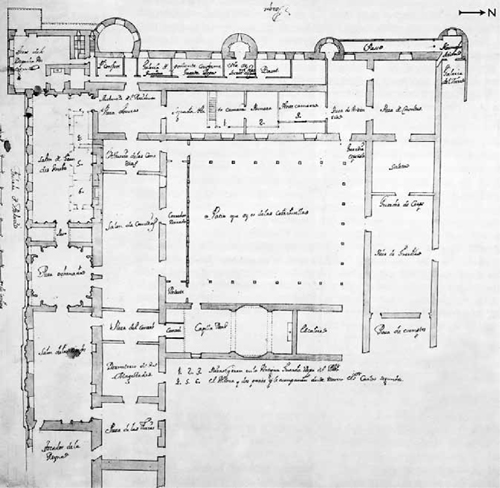
2.5 Teodoro Ardemans, Plan of the Main Floor of the Alcázar in Madrid (detail), c. 1709 Copyright © 2014, Patrimonio Nacional, Madrid
If at the start of the seventeenth century chroniclers and travellers who visited the Alcázar highlighted the richness of tapestries and hardly mentioned paintings, in the second half of the century the interest had shifted. This is corroborated in the account of the reception for the Ambassador of the Grand Duke of Moscovia held at the Alcázar on 5 December 1687.104 The Ambassador passed through a great part of the building, however the chronicle only refers to the tapestry series of The Conquest of Tunis hung in the ‘Salón grande dorado’ [‘The Great Golden Hall’], (Figure 2.2 no. 23). In contrast to this short reference to the tapestries the accounts describe the rich paintings in this great hall, all originals from the major painters in Europe, the most numerous being those of Titian.105
The chronicler was impressed by the pictorial decoration of the Salón de los Espejos [Room of Mirrors], where the king received the ambassador and describes how
its roofing is painted with different fables by the hand of two of the most distinguished men in all Europe who flourished in painting in this time, Mr Francisco Rici and Mr Juan Carreño … all its walls are covered in large and grandiose paintings, in which [one can] enjoy Titian’s ability, the colour and splendour of Rubens, the arrangement of Velazquez’s figures and many other excellent painters.106
Tapestries remained in the palace,107 however, they did not attract the same interest as before, since painting was reaching its zenith. In the end, painting had triumphed in the Spanish royal collections. Nevertheless, this happened over a century after Vasari’s publication. Tapestries were still the most valued and displayed forms of art in the collections up until the mid-seventeenth century. This is shown in the sources studied and the key role that tapestries played in courtly festivals. Therefore it seems that the paradigm ‘created’ by Vasari’s definition of ‘high art’ needs an in-depth reassessment.
Notes
1 This work is one of the outputs of the Research Project, funded by the Ministerio de Economía y Competitividad de España HAR2013-41053-P Arte y lujo. Valoración y presencia de los tapices flamencos en España en los siglo XV y XVI y su fortuna posterior. Laura Fernández-González has translated this chapter from Spanish into English.
2 J. Brown, El Triunfo de la Pintura. Reyes Coleccionistas en la Europa del siglo XVII (Madrid, 1985).
3 ‘Catholic Monarchs’ is the term used in historiography for Queen Isabella I of Castile (1451–1504) and King Ferdinand II of Aragon (1452–1516).
4 M. A. Zalama, Juana I. Arte, poder y cultura en torno a una reina que no gobernó (Madrid, 2010), pp. 41–61.
5 J. Crooke y Navarrot, Tapices de la Corona de España, I (Madrid, 1903), p. 13.
6 M. A. Zalama, ‘La infructuosa venta en almoneda de las pinturas de Isabel la Católica’, Boletín del Seminario de Arte y Arqueología (Arte), LXXIV (2008), pp. 45–66; M. A. Zalama, ‘Oro, perlas, brocados… La ostentación en el vestir en la corte de los Reyes Católicos’, Revista de Estudios Colombinos, 8 (2012), pp. 13–22.
7 F. J. Sánchez Cantón, Libros, tapices y cuadros que coleccionó Isabel la Católica (Madrid, 1950), pp. 128–9.
8 After which Ferdinand offered the tapestry to his natural son, Alonso de Aragón, Archbishop of Zaragoza. Archivo General de Simancas (AGS), Contaduría Mayor de Cuentas (CMC), 1.a época, leg. 81, fol. 5/105, ‘Un paño grande de Ras rico con oro e plata que es de la resurrección de san Lázaro, que tiene de cayda quatro varas e media e de largo cinco varas e dos tercias e tiene una guarniçión por el envés de asytuní negro e por lo alto del, que estava apreçiado en quatroçientos ducados. Apreciaron los sobredichos [Pedro de Covarruvias y Juan de la Mota] este paño todo en trezientos e ochenta florines de oro. Tornose a apreciar a seys ducados la ana, tiene XXXVII anas media. Vendiose para la cámara del rey nuestro señor en LXXXIIII U LXXV como está tasado.’
9 E. Torra de Arana, et al., Los tapices de la Seo de Zaragoza (Zaragoza, 1985), pp. 46–7.
10 AGS, Cámara de Castilla-Cédulas, libro 15, fols 145v.–147v.
11 M. A. Zalama, J. F. Pascual Molina, ‘Tapices de Juan II de Aragón y Fernando el Católico en La Seo de Zaragoza’, Boletín del Museo e Instituto Camón Aznar, 109 (2012), pp. 285–320.
12 Zalama, Juana I…, pp. 304–310; M. A. Zalama, ‘Joanna I of Castile. The inventory of the Queen’s artistic property’, in F. Checa Cremades (ed.), The Inventories of Charles V and the Imperial Family (Madrid, 2010), pp. 835–912.
13 M. A. Zalama, Vida cotidiana y arte en el palacio de la reina Juana I en Tordesillas (Valladolid, 2003), pp. 368–80.
14 Zalama, Juana I, pp. 304–318; Zalama, ‘Juana I de Castilla. El inventario’, pp. 899–902.
15 Paño could be translated as ‘cloth’, however, in this context they refer to one tapestry unit in a set or series. Paños de Oro would read in English as ‘golden cloths’, or ‘cloths of gold’, which means in this context ‘the golden tapestries’. This tapestry set was so named for the quantity of gold in the pieces.
16 P. Junquera, ‘Colección del Patrimonio Nacional. Tapices de los Reyes Católicos y de su época’, Reales Sitios, 26 (1970), p. 21.
17 Ana (aune, old French: aulne) was the measurement unit used for tapestries in late medieval and early modern times. This unit was slightly smaller than the Castilian vara, see S. Covarruvias Horozco, Tesoro de la Lengua Castellana o Española (Madrid, 1611) p. 67.
18 M. A. Zalama, ‘Origen y destino de la colección de tapices de la reina Juana I’, in F. Checa Cremades (ed.), Museo Imperial. El coleccionismo artístico de los Austrias en el siglo XVI (Madrid, 2013), pp. 53–69.
19 AGS, CMC, 1.a época, leg. 1145, fol. 293; Zalama, Juana I, p. 308.
20 J. Zarco Cuevas, ‘Inventario de las alhajas, relicarios, estatuas, pinturas, tapices y otros objetos de valor y curiosidad donados por el rey don Felipe II al monasterio de El Escorial. Años 1571 a 1598’, Boletín de la Real Academia de la Historia, 97 (1930), pp. 119–20; F. Checa Cremades (ed.), The Escorial ‘Delivery Books’ of Philip II (Madrid, 2013), pp. 186 and 218.
21 Zalama, Juana I, pp. 110–12.
22 A. de Lalaing, ‘Voyage de Philippe le Beau en Espagna, en 1501’, in L. P. Gachard, Collection des voyages des souverains des Pays-Bas, I (Brussels, 1876), pp. 121–340
23 L. Vital, ‘Relation du premier voyage de Charles-Quint en Espagne’, in L. P. Gachard, C. Piot, Collection des voyages des souverains des Pays-Bas, III (Brussels, 1881), p. 133.
24 E. Müntz, Les précurseurs de la Renaissance (Paris, 1882), pp. 161–2 and 194. For an overview of the importance that tapestries had in Renaissance Italy see T. P. Campbell, Tapestry in the Renaissance. Art and Magnificence (New York, 2002).
25 F. Checa Cremades, Tapisseries flamandes. Pour les ducs de Bourgogne, l’empereur Charles Quint et le roi Philippe II (Brussels, 2008), pp. 104–108.
26 The series is known as the Hunts of Maximilian I (Paris, Musée du Louvre), however they were not woven until the reign of Charles V in the period c. 1531–1533. There is no documentary evidence that Charles V commissioned this series.
27 F. Checa Cremades, Felipe II. Mecenas de las artes (Madrid, 1992).
28 G. Delmarcel, ‘Le Roi Philippe II d’Espagne et la tapisserie. L’Inventaire de Madrid de 1598’, Gazette des Beaux-Arts, CXXXIV (1999), p. 174.
29 C. Herrero Carretero, ‘Tapices donados par el culto de la iglesia vieja’, in Iglesia y monarquía. La liturgia. IV Centenario del Monasterio de El Escorial (Madrid, 1986), pp. 114–16.
30 For a detailed description of the tapestries that decorated the Palace of Binche see J. C. Calvete de Estrella, El felicíssimo viaje del muy alto y muy poderoso príncipe don Phelippe (edited by P. Cuenca and including: V. Álvarez, Relación del Camino y buen biaje que hizo el príncipe de España don Phelipe), (Madrid, 2001), pp. 315–21 and 644–9.
31 J. Pascual Molina, ‘Porque vean y sepan cuánto es el poder y la grandeza de nuestro príncipe y señor. Imagen y poder en el viaje de Felipe II a Inglaterra y su matrimonio con María Tudor’, Reales Sitios, 1987 (2013), pp. 6–25.
32 AGS, CMC, 1.a época, leg. 1184, s. f. ‘Contadores o otras qualesquier personas a cuyo cargo fuese tomar quentas a Domingo de Orbea mi thesorero, por quanto el dicho thesorero por mi mandado e seruiçio a hecho dar en Flandes a Guillanme de Pannemaler tapiçero vezino de la villa de Bruxellas por mano de Miguel de Çaçaya mercader estante en Emberes, quatroçientos escudos de a treinta e seis placas moneda de Flandes cada vno que azen çiento e quarenta e quatro mill maravedís, a razón de diez maravedís por cada placa que son para en quenta y parte de pago de çiento e seis reposteros que el dicho tapiçero aze para mi seruiçio, por ende yo vos mando que paséis en quenta al dicho thesorero por virtud desta mi çédula sin otro recaudo razón ni diligençia alguna los dichos quatroçientos escudos y por ellos çiento e quarenta e quatro mill maravedís sobredichos. Fecha en Londres a XVII de diziembre de 1554 años. El rey prínçipe. Por mandado de su magestad Francisco de España […] Al dicho Guillaome a quenta destos tapiçes por la data adelante del año de I U DLV en partida de CCXVII U CC maravedís parece que se acabaron de pagar estos reposteros sobre estos CXLIIII U maravedís y allí se sacó cargo dellos.’ AGS, CMC, 1.a época, leg. 1345, fol. 66, ‘a Guillermo Panemaca tapicero a cumplimiento de dos mill y ciento y sesenta y seys florines que huuo de auer por ciento y seys reposteros que hizo para su magestad que tenían I U CXL [anas] de Flandes’.
33 R. Beer, ‘Acten, Regesten und Inventare aus den Archivo General zu Simancas’, Jahrbuch der Kunsthistorischen Sammlungen des Allerhöchsten Kaiserhauses, XII (1890), p. CV, Beer only partially published the opening of the document. This document (AGS, Estado, leg. 98, fol. 48) is in a bundle with others largely dated to 1553, although this one has no date.
34 AGS, Estado, leg. 98, fol. 48: ‘Los ocho paños de tapiçería de la istoria de sant Juan Apocalipsi, de hilo de oro, plata, seda y sayeta que su magestad mandó tomarla de Diric de Mulenare y Gaspar van Utreque. Tienen seteçientas noventa y seis anas … a razón cada ana de a IX escudos de a 40 placas y más 100 escudos del dicho preçio de que su magestad les haze merçed, que monta todo VII U LXIIII escudos de a XL placas cada escudo¡. Un escudo equivalía a 400 maravedís, por lo que los ocho paños importaron 2.905.600 maravedís.’
35 J. K. Steppe, ‘De reis naar Madrid van Willem de Pannemaker, in Augustus–Oktober 1561’, Artes Textiles, X (1981), pp. 81–124; I. Buchanan, ‘The tapestries acquired by King Philip in The Netherlands in 1549–50 and 1555–59. New documentation’, Gazette des Beaux-Arts, CXXXIV (1999), pp. 131–52.
36 AGS, Estado, leg. 98, fol. 48: ‘Vn paño n.o 1 tiene 7 anas 3/4 de cayda y 12 anas 3/4 de largo: XCVIII anas 13/16. Otro paño n.o 2 tiene de cayda 7 anas 3/9 y de largo 12 anas 1/2: XCVI anas 7/8…’ One vara equates to 835.9 mm, which is equivalent to 1.2 anas. The original measurements given in the document vary by barely a few centimetres when transformed to the metric system.
37 This is not the place to expand on these aspects. See introduction, in Checa Cremades, Tapisseries flamandes.
38 G. B. Venturino Da Fabriano, Del viaggio fatto dall’illmo. et revmo. Card. Alessandrini Legato, Apostólico alli Serenissimi Re di Francia, Spagna et Portogallo, con le annotazioni delle cose principali della città, terre e luoghi (1571), cited in F. Checa Cremades (ed.), El real alcázar de Madrid (Madrid, 1994), pp. 143–4.
39 A. Rodríguez-Moñino, Viaje a España del rey don Sebastián de Portugal (1576–1577), (Madrid, 1948).
40 Rodríguez-Moñino, Viaje a España, pp. 91–2.
41 Rodríguez-Moñino, Viaje a España, p. 115.
42 Rodríguez-Moñino, Viaje a España, p. 115.
43 R. Domínguez Casas, ‘Ceremonia de la Orden del Toisón de Oro (1501–1598)’, in K. De Jonge, B. J. García, A. Esteban Estríngana, (eds), El legado de Borgoña. Fiesta y ceremonia cortesana en la Europa de los Austrias (1454–1648) (Madrid, 2010), p. 385.
44 Juan de España was the King of Arms of the House of Burgundy representing Flanders at least from 1585 to 1593. He served in Italy from 1585 to 1587. J. Martínez Millán, S. Fernández Conti, (eds), La monarquía de Felipe II: La casa del rey, II (Madrid, 2005), p. 148.
45 AGS, Estado, leg. 108, fol. 136. (This document was taken out from its original bundle in the Simancas Archive, most probably to learn the procedure of the ceremonies, and it was returned to a different bundle dated 1638.) The great interest of this document is proven in the two copies made of it and kept in the Archivo General de Palacio, Registro 7006, fols 191–201 and Archivo Histórico Nacional (AHN), Estado, leg. 7663, fols 24–31. Domínguez Casas, ‘Ceremonia de la Orden’, pp. 385–92.
46 Regarding the Alcázar in Madrid see J. J. Martín González, ‘El alcázar de Madrid en el siglo XVI (nuevos datos)’, Archivo Español de Arte, XXXV (1962), pp. 1–19; V. Gerard, De castillo a palacio. El alcázar de Madrid en el siglo XVI (Madrid, 1984), pp. 31–140; S. N. Orso, Philip IV and the Decoration of the Alcázar of Madrid (Princeton, 1986); J. M. Barbeito, El alcázar de Madrid (Madrid, 1992), pp. 33–83, and Checa Cremades, El real alcázar.
47 Martínez Millán, Fernández Conti, La monarquía, p. 582.
48 Domínguez Casas, ‘Ceremonia de la Orden’, pp. 385–92; AGS, Estado, leg. 108, f. 136.
49 In a letter from Juan de Herrera dated in October 1575, published in Colección de Documentos para la Historia del Arte en España, I (CODOIN), (Zaragoza, 1981), doc. 167 he refers to a chancel in the ‘sala de guarda’ and that some doors had been bricked up, however, there is no reference to the division of the chamber in two parts that appears in Figure 2.2.
50 AGS, Estado, leg. 108, f. 136: ‘En la puerta de la sala dicha estubieron al prinçipio los maiordomos del rey nuestro señor, el conde de Fuensalida y el conde de Chinchón, para que nadie entrase en la sala, pero venidos los señores del Tuzón que fueron el almirante de Castilla y el duque de Medina Çeli y el duque de Terranoua y el embaxador del emperador, el barón Kheuenhiller, y los que lo auían de reçebir, los duques del Infantado y Escalona y Médiçis’. Pedro López de Ayala, IV Count of Fuensalida, High Steward since 1582; Diego Fernández de Cabrera y Bobadilla, III Count of Chinchón, House of Burgundy Steward between 1578 and 1598; Luis Enríquez de Cabrera, III Count of Medina de Rioseco, Admiral of Castile; Juan de la Cerda, V Duke of Medinaceli; Carlos de Aragón Tagliavia, I Duke of Terranova, Prince of Castelnuovo; Baron Hans Khevenhüller zu Aichelberg, Ambassador to Emperor Rudolf II who resided in Spain from 1592.
51 AGS, Estado, leg. 108, fol. 136: ‘La sala en que están las tres guardas estaua entapissada con la tapissería de la jornada de Tunes que hizo el emperador Carlos quinto de gloriosa memoria, padre del rey nuestro señor a 1536.’
52 J. Horn, Jan Cornelisz Vermeyen. Painter of Charles V and his Conquest of Tunis (Doornspijk, 1989); M. A. Bunes Ibarra, M. Falomir Faus, ‘Carlos V, Vermeyen y la conquista de Túnez’, in J. L. Castellano Castellano, F. Sánchez-Montes González (eds), Carlos V. Europeísmo y universalidad, V (Madrid, 2001), pp. 243–57; J. L. González García, ‘Pinturas tejidas. La guerra como arte y el arte de la guerra en torno a la empresa de Túnez (1535)’, Reales Sitios, 174 (2007), pp. 24–47; Checa Cremades, Tapisseries flamandes, pp. 153–79.
53 Checa Cremades, The Inventories, I, p. 341, ‘la tapiçería de la jornada de Túnez [la mandó] haçer el emperador nuestro señor para la sala grande delante de la puerta de la casa real de su magestad’.
54 González García, ‘Pinturas tejidas’, p. 38; Checa Cremades, Tapisseries flamandes, p. 174.
55 Buchanan, ‘The tapestries’, p. 133.
56 J. Vandenesse, ‘Journal des voyages de Philippe II, de 1554 a 1569’, in L. P. Gachard, C. Piot, Collection des voyages des souverains des Pays-Bas, IV (Brussels, 1882), p. 77.
57 Checa Cremades, El real alcázar, p. 492.
58 Orso, Philip IV, pp. 138–40.
59 AGS, Estado, leg. 108, fol. 136: ‘La saleta que está antes del retrete adonde su magestad suele proponer las Cortes estaua muy bien entapisada con vna tapissería muy rica que llaman de la fama.’
60 P. Saintenoy, ‘Les tapisseries de la Cour de Bruxelles sous Charles V’, Annales de la Société royale d’Archeologie de Bruxelles, XXX (1921), pp. 17–18. For a detailed study on this series see G. Delmarcel, Los Honores. Flemish Tapestries for the Emperor Charles V (Mechelen, 2000).
61 P. Sandoval, Historia de la vida y hechos del emperador Carlos V, II (Madrid, 1955), pp. 247–8: ‘Había en la capilla otros cuatro [paños] del emperador, de oro y seda, tan ricos y tan de buena mano que ninguno los veía que no dijese que eran los mejores que hubiese visto, y era el uno de ellos de la coronación de Nuestra Señora, otro de la Fortuna, y los otros dos de la Fama.’
62 J. M. March, Niñez y juventud de Felipe II. Documentos inéditos sobre su educación civil, literaria y religiosa y su iniciación al gobierno, I, (Madrid, 1941), p. 36.
63 The series was named Honour, after the scene displayed in one tapestry in the series, although it was often known as Fame after the best tapestry. Sources state that the Fame was on display, although this may well refer to Honour.
64 AGS, Estado, leg. 108, fol. 136: ‘[la sala] estaba cubierta de muy lindas alhombras, estaua en medio vn dozel y abaxo del vna silla riquíssima, la silla y dozel todo bordado de oro y plata y piedras finíssimas de diamantes, rubíes y esmeraldas y perlas que dizen que costó dozel y silla a su magestad en Anberes ochenta myl ducados’.
65 AGS, CMC, 1.aépoca, leg. 1537: ‘un joyel con un diamante tabla grande y un rubí tabla y una perla grande pinjante’.
66 Rodríguez-Moñino, Viaje a España, p. 91. The excerpt reads: ‘vna silla y dosel que auía de aguja y oro donde estauan en lo largo del dibuxados los gigantes que hizieron la guerra a los dioses precipitados de las torres por donde intenteuan subir al cielo, y Phaetón que caya hecho pedaços con el carro y cauallos, en lo que buelue el dosel estaua un Júpiter ayrado arrojándoles rayos tan ricos y con tantas piedras y cosas preciosas que si acertaran a caer en casa de un pobre hombre le pudieran matar muy bien la hambre’.
67 Concerning etiquette at the commemoration see Domínguez Casas, ‘Ceremonia de la Orden’.
68 AGS, Estado, leg. 108, fol. 136: ‘Estando su magestad en su cámara, que es luego a par del retrete, adonde suele tener la cama de honor, y auisado que ya eran venidos los señores del Tuzón y assí mesmo los que auían de reçibir, mandó entrar a los quatro de la orden y a los dos offiçiales, quedando en el retrete los tres señores que los avían de reçebir’.
69 AGS, Estado, leg. 108, fol. 136: ‘estaua sentado en su silla y del vn lado y del otro hazia delante estauan sendos bancos cubiertos de vnas alhombrillas de las Yndias, en el banco que estaua al lado derecho del rey nuestro señor estaua sentado el príncipe don Felippe nuestro señor, siendo de edad de quinçe años y siete meses y medio poco más o menos’.
70 AGS, Estado, leg. 108, fol. 136: ‘le consoló diziendo que lo mismo haría él sy no le tuviessen, por estar peor que él’.
71 AGS, Estado, leg. 108, fol. 136: ‘Su magestad hecho esto congratulándose con ellos, les dixo que él holgaría mucho de poder solempnisar y alegrar la fiesta con ellos pero la poca salud y indispusiçión que tenía no le daua lugar para ello de que le pesaua, y que assí el príncipe su hijo yría en su lugar y asistiría con ellos, assí como lo auía hecho su padre con él siendo príncipe, y con esto despidiéndose dellos se retiró’.
72 AGS, Estado, leg. 108, fol. 136: ‘El príncipe don Phelippe nuestro señor que Dios guarde venía detrás de todos solo, con calza y cuera amarilla y vn bohemio de raso amarillo impresado afforrado en lobos ceruales, bota blanca, vayna amarilla, plamas [sic] amarillas y blancas y hayrones y el collar grande de la orden sobre los hombros que paresçía en estremo bien y galán’.
73 AGS, Estado, leg. 108, fol. 136: ‘Entrados en la capilla, su alteza se metió abaxo de su cortina abierta toda, que era de tela de brocado muy rico y lo mesmo el sitial y almohadas que tenía delante y tomado su puesto el príncipe, luego los señores del Tuzón tomaron el suyo, que fue el mesmo banco que acostumbraban a sentar los grandes, el qual estaua cubierto de vn paño de terçiopelo carmesy y vna alhombra abaxo sin ningunas almohadas como suelen tener, y el dicho banco está puesto de la cortina del príncipe a lo largo’.
74 AGS, Estado, leg. 108, fol. 136: ‘El altar estaua muy ricamente adressado y puesto en él la flor de liz con la reliquia del ligno cruzes y el clauo.’
75 AGS, Estado, leg. 108, fol. 136: ‘La capilla estaua muy bien intapissada con vna tapissería muy rica del Ypocalipse.’
76 Rodríguez-Moñino, Viaje a España, p. 115.
77 De casibus vivorum illustrium (1458), at the Bayerische Staatbibliothek in Munich.
78 Diebold Schilling, Chronik der Burgunderkriege (1480), at Zentralbibliothek in Zurich (MS A5, fol. 121).
79 Frans Hogenberg, Abdicación de Carlos V, after 1556, Metropolitan Museum of Art, New York.
80 AGS, Estado, leg. 108, fol. 136: ‘Su magestad por su indispusiçión estubo en el canzel que ay en la capilla de manera que no le echaban de ver, y él lo veya todo y la infante doña Ysabel y las damas arriua en las tribunas como suelen.’
81 AGS, Estado, leg. 108, fol. 136: ‘Acauada la missa se salió de la capilla por la misma orden que se auía venido para el aposento del rey, con grand son de trompetas y atabales, adonde entrado en la saleta estaua puesta la mesa para comer el príncipe nuestro señor, ençima de la tarima dicha, y abaxo del dozel rico y declarado, quatro pasos desta mesa y tarima estaua puesta otra mesa para los señores del Tusón de manera que estaua al soslaio y sobre mano ysquierda de la mesa del príncipe, y tenía por espaldas esta mesa la ventana que cae sobre la casa del campo y dexado espacio para poder en andar entre ella y la pared y banco en que estauan sentados los señores del Tusón. La dicha ventana tiene un balcón grande de piedra como corredor que cae sobre el campo en que estubieron los cantores de la capilla del rey, los quales mientras duró la comida hizieron muy linda y diuersas músicas.’
82 The Hague, Koninklijke Bibliotheek, Ms. 76 E 10. (fol. 5v). Written circa 1470 with additions circa 1481.
83 AGS, Estado, leg. 108, fol. 136: ‘mientras duró la comida, estubo en la puerta del retrete abiendo hecho poner en ella vna tabla que le llegaua hasta los pechos sobre que se echó mirando por entre el tapiz lo que passaua y con él la infanta doña Ysabel y el cardenal Alberto, gouernando de ay haziendo dezir al conde de Chinçón por vn uxer de cámara que hiziesse que los caualleros se apartassen de la tarima en que estaua el príncipe nuestro señor, mirándolo todo desde la puerta su magestad’.
84 A. Pérez de Tudela, ‘La decoración pictórica del Alcázar de Madrid durante el reinado de Felipe II’, in De Jonge, García García, Esteban Estríngana, El Legado, pp. 109–141.
85 Brown, El triunfo de la pintura.
86 Real Academia de la Historia, Colección Salazar y Castro, N-70, fols 322–3: ‘que se entregue al tapicero de la Reyna, Colmenares, la tapiçería de Theseo o la de la Vida del Hombre que están en Buen Retiro, para que se cuelgue vna pieza para la infanta Margarita, mi hija’.
87 Crónica de Juan Antonio de la Peña (Madrid, 1626). J. Simón Díaz (ed.), Relaciones breves de actos públicos celebrados en Madrid de 1541 a 1650 (Madrid, 1982), p. 345. ‘las calles estuuieron ricamente colgadas, ostentación que llegó hasta las buardas de los tejados’.
88 Simón Díaz, Relaciones breves, p. 345: ‘un teatro capaz y anchuroso con quatro gradas por largo, cubierto de ricas alfombras, y en contorno a modo de un salón se colgó la costosa tapizería de los siete vicios, que es de oro y seda, estimada por el primor de sus figuras y agudo metro de sus dísticos’.
89 Simón Díaz, Relaciones breves, p. 345. ‘colgaron solo seis paños, dos a cada lado y dos en el frontispicio’.
90 Simón Díaz, Relaciones breves, p. 345.
91 Simón Díaz, Relaciones breves, pp. 354–5.
92 This was no other than The Triumphs of Petrarch (Patrimonio Nacional, serie 38).
93 Simón Díaz, Relaciones breves, pp. 354–5. ‘se colgó por las dos hileras, en esta forma: por la parte de las cauallerizas del rey se pusieron siete paños de oro y seda de los triunfos … los doze paños que se labraron la segunda vez de la toma de Túnez con la explicación en romance, todos de oro y seda, y hasta la puerta principal de palacio remataua esta colgadura en los ocho paños del Apocalypsis … que es de las mejores que el rey tiene. A la mano derecha de la otra hazera se pusieron los siete paños de los vicios, y otros doze de Túnez, que son los primeros que se labraron, unos y otros marauilla del arte.’
94 Simón Díaz, Relaciones breves, pp. 354–5. ‘consecutivamente siguiendo ocho paños de los Actos de los Apóstoles … quatro paños de figuras de oro y seda que parecían ser triunfos, el uno de la Fama, otro del Honor, otro de la Teología y otro de la nobleza […] y acababa la colgadura deste lado en otros quatro paños casi semejantes a estos de diferentes fábulas e historias, todo de oro y seda’.
95 Patrimonio Nacional, series no. 37.
96 Simón Díaz, Relaciones breves, pp. 354–5: ‘diez paños pequeños de oro y seda que todos eran de arcos y flores a manera de un vistoso jardín’.
97 Patrimonio Nacional, series 39.
98 Meaning the ‘seven deadly sins’.
99 Patrimonio Nacional, series 22. ‘la tapicería de los siete Vicios, copia de la ya dicha’.
100 V. Mínguez Cornelles, La invención de Carlos II. Apoteosis simbólica de la casa de Austria (Madrid, 2013).
101 AHN, Códices, Libro 1496, fol. 459. I thank Dr Álvaro Pascual Chenel for this reference. ‘La pieza que señaló la reyna nuestra señora doña Mariana de Austria madre del rey nuestro señor para la funzión fue la ante-cámara de su Magestad el rey; estuvo colgada la tapizería de oro y seda que llaman de Túnez, cubierta todo el suelo de alfombras; en ella había vn dosel y debaxo vna silla y en frente a distancia de tres pasos un sitial baxo con vna almohada encima y otra a los pies, tres bancos vaxos cubiertos con bancales de tapiz y vn bufete cubierto en la forma que está aquí señalado.’
102 AHN, Códices, Libro 1497, fols. 190–202.
103 The series had only 12 cloths, however, it seems an extra tapestry was woven, although it has disappeared and led to the belief that the set comprised 13 tapestries instead of 12. P. Benito García, ‘El alcázar vestido de seda. Colgaduras y alfombras de S.M.C. Carlos II’, in Checa Cremades, El real alcázar, p. 315.
104 AHN, Códices, Libro 1497, fols 190–202.
105 Sánchez Rivero, Mariutti, Viaje de Cosme de Médicis, pp. 122–5. ‘la galería de los Grandes, la pieza de la Imagen y la Ochavada no tenían más adorno que el que continuadamente tienen porque qualquiera cosa que se le pusiera, por rica que fuera, quedará deslucida a vista de las ricas pinturas que en las dichas tres piezas ay, todas originales de los mayores pintores de Europa, y las que más sobresalen en número son las muchas que ay del Ticiano’. The opening of these new chambers in the seventeenth century can be seen in the plan by Teodoro Ardemans circa 1709.
106 Sánchez Rivero, Mariutti, Viaje de Cosme de Médicis, pp. 122–5: ‘su techumbre está pintada de diferentes fábulas por mano de los dos más insignes varones que en toda Europa florecieron en pintura en estos tiempos, don Francisco Rici y don Juan Carreño […] todas sus paredes están cubiertas de grandes y grandiosas pinturas, en las quales se goza la destreza del Ticiano, lo colorido y hermoso de Rubens, la colocación de las figuras de Velázquez y de otros muchos pintores excelentes’.
107 C. Herrero Carretero, ‘Las tapicerías ricas del alcázar de Madrid’, in Checa Cremades, El real alcázar, pp. 288–307.