
4
Laura Fernández-González
On 16 April 1581 the Courts of Tomar designated Philip II of Spain as Philip I of Portugal (r. 1581–1598).1 This marked the beginning of the period known in historiography as the Iberian Union (1581–1640). The dynastic crisis arose in Portugal after the death of King Sebastian (r. 1557–1578) in the battle of Alzaquivir, which left the realm without an heir. The crisis was not solved during King Henry’s short reign (r. 1578–1580).2 Diplomacy, bribery and an effective four-month invasion led by the Duke of Alba gave Philip control over mainland Portugal.3 António (1531–1595), Prior de Crato, an illegitimate grandson of King Manuel I (r. 1469–1521) was designated King of Portugal on 19 July 1580. However, soon afterwards Alba defeated António’s military contingent in the Battle of Alcântara on 25 August 1580 in the vicinity of Lisbon. António resisted with his flotilla until the Azores defeat in 1583. In 1581, Philip, now King of Portugal, progressed toward Lisbon.
In 1581 the Lusitanian capital was in turmoil with outbreaks of the plague and the political instability characteristic of a post-war period.4 Nevertheless, a ceremonial entry with 15 triumphal arches and other artefacts took place on 29 June 1581 to receive Philip as the new king. This chapter explores the image that the ruler wished to project through artistic display and a studied visual etiquette in the pageant. I show how the king and his entourage aimed to combine an image of a just, peace-seeking ruler with that of a mighty and powerful king, able to destroy his enemies at once, including, or especially, those within his kingdom.
… for the universal good of the vassals of that crown … I will look after all of them very gladly because of my great desire … that it is never necessary to come to hard measures with my own blood relatives, with my own nation, with my own children, whom I have in this place …5
In this letter Philip was instructing the Duke of Osuna on the message that he should transmit to King Henry so that the matter of the succession to the Kingdom of Portugal was resolved in his favour. In the message, the Spaniard sharply defined his strategy to achieve his succession to the Kingdom of Portugal. He claimed to be the rightful heir and the ruler most suited to protect the realm. Philip II preferred a diplomatic solution, although he would not hesitate to vanquish those who resisted his will. This tense relationship was to dominate the discourse used by the ruled and the ruler in the pageant of 1581 in which, as I would argue, both were ‘negotiating’ their place in the new political tableau through their words and postures.
It is surprising that this festival has attracted less attention than the ceremonial entry of Philip III into Lisbon in 1622. In this latter case, the printed propaganda in the form of lavishly decorated festival books with exquisite prints contrasts with the austere printed sources of Philip II’s entry of 1581.6 Neither Guerreiro’s nor Velazquez Salmantino’s accounts included images, which has undoubtedly influenced the perception of the festival in the literature. However, Guerreiro’s book had an exhaustive description of the measurements of the arches and the façades, and of the iconographic programme, which was described by both chroniclers.7
Ana María Alves’ pioneering publication surveyed the festival tradition in Lisbon and included considerations of the Habsburg period.8 The seminal work of Fernando J. Bouza on the cultural aspects of royal propaganda in early modern Iberia is essential reading. Among his publications concerning Portugal, some of his finest pieces explore the ceremonial entries of the Habsburg period through the lens of the print culture and poetry.9 Miguel Soromenho and Ana Paula Torres Megiani have studied diverse aspects of this festival. Soromenho compared this ceremonial entry with that of 1619 and the funeral exequies to mourn Philip II in 1598.10 Torres Megiani compared the ceremonial entries of 1581 and 1619, paying special attention to the notion of the absent ruler and festival books.11 Annemarie Jordan Gschwend has recently published a series of essays concerning the ceremonial entries of sixteenth-century queens.12 Jordan Gschwend’s work is fundamental to an examination of the ceremonial tradition prior to Philip II’s festival in the city. In general, publications regarding the festival culture in Lisbon remain largely in the form of paper-length essays.13
Nevertheless, the complexity of the discourses and narratives deployed in the entry of 1581 deserves further analysis. The rich array of ephemeral decorations provides an astounding source for investigation and interpretation. The high number of ephemeral structures erected for this festival was extraordinary for Lisbon and for many other capital cities at the time.14 Due to space constraints, this chapter focuses principally on the water festival, which has been largely omitted from the literature and, in particular, on one of the façades of the German Merchants’ arch, although references to other structures and events form part of the narrative.15
Waterborne Pageants and Warfare Representation: The River Tagus
The River Tagus was an essential part of the festival culture during ceremonial entries in the capital long before Philip II arrived in 1581. The reception of Joanna of Habsburg in Lisbon in 1552 began on the Tagus.16 Guerreiro reports that on 29 June 1581 at 3 p.m., the king departed in his royal vessel from Almada towards the Terreiro do Paço in Lisbon, sailing up the River Tagus. Profusely decorated boats, with musicians playing on board, escorted the committee. The king’s departure was announced by the firing of guns from the coast, followed by the guns of the eleven vessels escorting the royal ship. The gunpowder smoke covered the sky and, in combination with the incredible noise, it appeared to be a battle instead of a celebration. Once this ceased, a clear day and calm sea became visible. Then the Castle of St George began with the blasting of its armament.17
The citizens of Lisbon were not only welcoming the new king but also competing for the prize that the city council had promised to the most beautifully garlanded vessel. The winner of the award was a vessel that imitated a ‘big fish’.18 Rodrigues Soares describes a similar prize for the best decorated building.19 This is what Fernando J. Bouza has called a ‘poetic joust’, showing that the dialogue between ruled and ruler was not unidirectional.20
However, these competitions not only show the active participation of the local community but also demonstrate that Lisbon had an established festival culture prior to the arrival of Philip II, since the entries of Eleanor (1521) and Joanna (1552) of Habsburg to wed Portuguese monarchs had similar prizes.21 The vessel in which the monarch sailed to the festival was offered by the city of Lisbon and was highly ornamented for the occasion, with rich silks for the canopy.22
On the other side [of the German Merchant’s arch at Terreiro do Paço], the women selling fruits and products from the orchards had planted trees and green herbs that perfumed [the air] nicely, and in the [same] area of the river bank [were placed] the inventions of the fishermen [i.e., the boats competing] to win the prizes promised by the city …23
The water festival’s final destination was the Terreiro do Paço. In this plaza stood lavish ephemeral architecture, and, adjacent to it, on the river, an array of richly decorated boats competing for the prize, were anchored. The Terreiro do Paço with its ephemeral decorations acted as a backdrop to an exhibition of the local naval inventions. The fruit farmers had planted trees and aromatic herbs that perfumed the air. The intention was to showcase the richness and fertility of Lisbon, as well as creating a festival atmosphere to fill the senses with perfume, colour, music and the noise of guns.
The closest image to what occurred that day in the Tagus is that of Philip III’s entry in 1619. The booklet of this event is richly engraved with depictions; the edition of 1622 is of particular interest (Figure 4.1). A recently discovered painting shows an earlier version of this entry (Figure 4.2). Andreas Gehlert has argued that since this image was created in 1613, before the festival occurred, it was an early ‘template’ to show to the court for approval, rather than an account of events, and may therefore have been inspired by the ceremonial of his father’s entry in 1581.24

4.1 Entry of Philip III into Lisbon, 1619. Print from the chronicle of Lavanha published in 1622

4.2 Template (?) for Philip III’s entry into Lisbon, possibly based upon Philip II’s entry of 1581 Source: Oil on Canvas dated 1613. Weilburg Castle. Photograph Copyright © 2014 Andreas Gehlert.
Both the engraving in Lavanha’s booklet and the anonymous painting show the Tagus with a number of galleys and smaller vessels. However, the participation of the locals in the waterborne festival is either subdued or segregated from royal participation. The naval inventions of 1619 were sophisticated artifices and a number of large sea creatures navigated the Tagus during the military parade: ‘his Majesty enjoyed particularly some artificial fishes, [a] whale, [a] mermaid, [some] tunas and others that jumped on the water, and with music [coming from] inside of some of them, the river seemed a real paradise’.25 These creatures are discernible in the canvas of 1613 (Figure 4.2). Although the painting is in a poor state of conservation, it shows a number of small boats on the River Tagus just in front of the display of the Maritime Customs building. These are clearly segregated from the royal navy; as discussed earlier, this segregation also occurred in the entry of 1581. On the upper left side of this detail (Figure 4.3) a boat led by a crowned male figure with a trident in his hand can be identified as Neptune’s carriage. On the right hand side of this same detail there is a giant lagosta (lobster) surrounded by tritons and a mermaid.

4.3 Template (?) for Philip III’s entry into Lisbon, dated in 1613 (detail). See details of the Sea Creatures, Tritons, the Carriage of Neptune and the famous Lagosta Photograph Copyright © 2014 Andreas Gehlert.
The images included in the print of 1622 (Figure 4.4) show an idealized version of these sea creatures and Neptune’s carriage, but on the other side of the scene, in front of the royal palace. In the print, the smaller boats are distributed among the royal navy ships flanking the royal galley, filling the space but also losing strength in the overall depiction. Both the segregation and the redistribution of the local boats show a clear visual hierarchy intended to reflect order or precedence in the water festival. The official accounts describing the river artifices in the festival of 1581 and earlier royal entries are not explicit about the specifics of these, except that there were naval inventions imitating sea creatures. The sophistication of the artefacts deployed in 1619 was part of a longstanding tradition in waterborne celebrations and perhaps an important improvement on the earlier decorated boats. The inclusion of fantastical sea and mythological creatures evokes the legendary origins of the city described by poets and writers. Damião de Góis, for example, in his description of Lisbon states that tritons and mermaids used to inhabit the banks of the River Tagus.26

4.4 Details of the Sea Creatures, the Carriage of Neptune and the Lagosta in the print published in Lavanha’s chronicle of Philip III’s entry into Lisbon in 1622
The aquatic performance is represented differently in these images. The earlier canvas of 1613 displays the galleys in squadron as described in the sources recording Philip II’s entry of 1581 (Figure 4.2). In contrast, the later version of 1622 does not emphasize this and only a few galleys are shown firing their guns (Figure 4.1). The aquatic parade is shown profusely decorated in the canvas of 1613, compared with the engraving in the booklet. The latter was the official account and in it the display of the river representation has a more austere appearance. In the canvas great detail is used to emphasize the might of the fleet and its bellicose character. In the booklet engraving only some boats are firing their guns and the galleys do not appear decorated as in the painted depiction. The difference in the use of guns between both depictions may be because they represent different stages in the entry. In Philip II’s entry of 1581 the fire of the armament stopped once the monarch’s flotilla was approaching the pier at the Terreiro do Paço.
Guerreiro wrote: ‘and all these composed a superb image of war in the entry’.27 Similarly, Escobar noted that the blasting of the artillery ‘emulated a war devastating the city’.28 The difference between the earlier view dated 1613 and Lavanha’s booklet reflects, too, the different atmosphere that surrounded the celebration of the festivals. In the accounts printed to celebrate Philip III’s entry into Lisbon, the description of the water festival is exiguous and the writer passes over some details about activity on the river. On the other hand, the accounts of 1581 display a delight in describing the aquatic performance, especially the display of the artillery, as in the following verses by André Falcão de Resende:
Once his Majesty
had boarded his galley,
the thunder of artillery
performed a horrisonous salute;
the bellicose galleys
[were] in an ordered squadron:
the royal [galley], as the lady
[and] patron, in their midst29
This poem evoked the military character of the water festival. In 1581 the royal galley was accompanied by music, with royal Ministriles performing with slide trumpets.30 The triumph began with an exaltation of the mighty power of the Spaniard. The conquest of Lisbon had occurred ten months earlier. Citizens of the Portuguese capital lamented the Lisbon assault commanded by the Duke of Alba. Rodrigues Soares reported the profound sorrow that this assault caused in Portugal in a chapter entitled: ‘The entry and Sack of Lisbon …’. He compared this intervention with the infamous Sack of Rome (1527).31 However, the king’s official historians gave a sanitized account of the events, in sharp contrast to Connestaggio’s narration condemning the ferocity of the troops.32 There is surviving archival material reporting the state Lisbon was left in after the Duke’s assault.33 The looting in Lisbon and Porto during the campaign and the prolonged military character of Philip’s Portuguese sojourn and residency in Lisbon is widely accepted among scholars.34 The Duke of Alba was not present during the main itinerary in the festival of 1581 as he was reportedly affected by gout. He only appears saluting the ruler from a balcony in the royal palace, right at the end of the itinerary and the narration of the chronicles.35
One may wonder if the absence of Alba was the result a sophisticated political strategy instead, as Philip may have wished to distance himself from the military campaign led by the Duke.36 This seems plausible, especially as the image of Alba and his troops in the Portuguese campaign was associated with looting and brutality. Philip aimed to impose his authority on his new realm, but his image had to be that of a just ruler, one who would deploy justice, fight against his enemies and protect Portugal. These ideas are replicated in the festival decorations of 1581. The focus of Philip’s military force, as we see below, included his enemies in Portugal. However, this implementation of royal justice was to be grounded in moral rights and nobility rather than unruly brutality and looting. In short, Alba’s diminished role in the festival may suggest that Philip wanted to distance himself from the Duke’s reputation. This would reinforce the close control Philip’s entourage had on the kingly image the ruler was to project in his entry in the Portuguese capital. Philip’s court aimed to balance the need to show military prowess and authority, and a generous and protective king who would bring peace and wealth to his Portuguese subjects.
The bellicose emphasis that the water festival in Lisbon had would be reflected in some images produced at the time. Engravings depicting the battle in Lisbon and the assault by Alba’s troops circulated in Europe. The acquisition of Portugal by Philip II was an event of immense magnitude in European politics. Although the canvas of 1613 was painted many years later, it seems to evoke the character of the festival of 1581 with more clarity than the atmosphere of the festival in 1619. The earlier image reinforced the military character of the river parade, in consonance with the accounts of the entry of Philip II. This is not to say the canvas reports the entry of Philip II fully, but the image of the Tagus fits well with the chronicles of 1581, to a greater extent than the description of the festival staged in 1619.37
In this depiction of the battle of Lisbon (Figure 4.5), the action on the Tagus is the central focus of the piece. Yet the image closely resembles the drawings and descriptions of the water festival of 1581. If we ‘add’ the festival structures by the dock of the river to the image of the battle of Lisbon, it could have served as one of the visual sources representing the festival, especially when the water performance in the canvas of 1613 resembles so closely the battle representation (Figure 4.5). The performance and re-enactment of sea battles in ceremonial entries and festivals of the period was recurrent; indeed, famous naumachias were staged in European festivals.38 During festivals, tapestries with these representations and other themes decorated streets, ceremonial halls, churches and festival structures.39 Representations of battles were depicted in the ephemeral triumphal routes fabricated especially for festivals. For example, the temporary structures of Canto de’ Bischeri for the ceremonial entry of Christine of Lorraine in Florence in 1589 featured statues of Philip II of Spain and Charles V with images of the Battle of Lepanto and the defeat of the Turks near Vienna respectively.40 Sometimes, as in this case in Florence, the streets of the city were decorated for a pageant to evoke the gallery of princely virtues that was a traditional hall in palatial architecture of the period.41 These ephemeral structures imitated the spatial configuration and iconographical repertoire of the long galleries in European royal palaces such as the Hall of Battles at El Escorial and the Hall of Realms at the Buen Retiro in Madrid.42
The Lisbon entry of 1581 had panels with battle representations in the triumphal path erected between the German Merchants’ and Ribeira arches. Unfortunately, as noted before, no images of them have survived. During the entry of Christine of Lorraine in Florence in 1589 the Pitti Palace hosted the re-enactment of a sea battle, this being a more sophisticated turn in the evocation of military victories in festivals. Naumachias had obvious Roman roots and were dynamic visual dramatizations to reinforce the might of the ruling powers and the central part that war played in early modern society.43 The military parades in ceremonial entries were sometimes a mere gun salute, but in the case of Lisbon in 1581 they aimed to represent more. In short, the triumph of the prince was celebrated through the memory of his victories at war and representation of his most celebrated defeats. It is hardly surprising that the epic tone of the accounts of 1581 intended to create an image of kingship that exalted the military power of Philip II. The emphasis on the military parade in the Tagus of 1581 clearly asserted the ruler’s control and power over Portugal. In the entry of his heir, the diplomatic tableau was different and thus reflected the political discourse printed and depicted in the official propaganda.

4.5 The Conquest of Lisbon by the Royal Spanish Army, 25 August 1580 Source: Print entitled originally Die Belagerung von Lissabon by Leonard Blümel (1580). Copyright © 2014 Zürich, Zentralbibliothek
The River Tagus was the ‘soul’ of Lisbon and the epicentre of the Portuguese global empire. Lisbon was one of the most important commercial centres in Europe during the 1500s. As Philip II wrote in 1579, Lisbon was ‘the principal port and commercial [hub] of everything because of commodity of the port’ [sic].44 The aquatic festival simulated war but also presented Lisbon as the ‘capital’ of the Atlantic; in the words of Damião de Góis, Lisbon was ‘The Queen of the Ocean’, emphasizing the strategic role that the port had in the management of the Portuguese empire.45 The cosmopolitan character of the Portuguese capital would also be expressed in other accounts of the event. The Tagus was the aquatic stage for royal and official receptions in the city. The relationship between, and identification of, Lisbon with the Atlantic Ocean was the basis for iconographical programmes that celebrated the imperial achievements of the Habsburg dynasty as displayed in the ephemera erected at Terreiro do Paço. The Portuguese empire was conquered via the sea. This identification was also pertinent to the Castilian empire, as the Spanish had to conquer the ocean before reaching American soil. The Portuguese fleet was the ‘pillar’ that sustained the imperial enterprise, and therefore had a crucial role in royal receptions. The heroic connotations of the water festival on the Tagus therefore aimed to present the prestigious sea force of Iberia and their dominion of the Atlantic, now put to the service of King Philip.
Building a Festival for a Foreign King: Religious and Local Authorities in Lisbon
The authors of the festival programme are unknown except for the commission of the court architect Filippo Terzi.46 Terzi had previously worked for King Sebastian and was appointed by Philip II as one of his court architects in Portugal. Juan de Herrera and Francisco de Mora went to Lisbon in 1581, although their direct intervention in the festival structures has not yet been established.47 In fact, the attribution of Herrera’s intervention in the festival is much debated.48 In addition to the organization of the festival, Philip asked for some works to be carried out in the Lisbon river palace before his arrival, together with the festival organisation. When the king was in Almada he received a committee of the local authorities begging him to postpone the festival by a few days as they were still finishing some structures. Philip II agreed, but he went incognito to visit his premises in the riverfront palace.49 This is not the first episode in which the ruler wished to see and thus control but not be seen. This ambiguous notion of royal presence would become an inherent practice of the Spanish Habsburgs and in particular would be seen in their role in festivals and commemorations.50
One of the major omissions in the discussion concerning the artists involved in the design of the pageant is the role that local masons and designers had in the festival. Guerreiro’s account narrates how the veedor de obras in Lisbon was involved in the ceremonial of the oath in which the keys of the city were offered to King Philip. The role of the veedor de obras was to supervise the works in the city, mostly those that were either funded by or in the interest of the city council, such as a festival. Lucas da Silva was the veedor de obras of public works. He handed the ceremonial golden keys to Filipe Aguilar, who bowed to the king and presented them, saying: ‘This very noble and always loyal city of Lisbon, gives your Majesty the keys to all its gates, and the loyal hearts of their residents, and their bodies, and goods, everything to serve you.’51 The majority of the structures erected for the festival of 1581 were funded by local guilds and notably the Portuguese merchants in Lisbon had the Porta da Ribeira decorated.52 It is strange that the crucial local input in this festival has been largely neglected in the literature.
King Philip II expected to have a festival of great magnificence, wanting, as was traditional, for it to be funded by the city. On 25 May 1581, barely a month before the reception, Philip wrote to the Lisbon authorities concerning the arrangements for the festivities on his arrival.53 He expressed his ‘anxiety’ over some complaints in Lisbon that had come to his attention regarding the funding for the festival and stated that it was not his desire to oppress the citizens of Lisbon. In the second letter, written on 5 June 1581, he suggested that the city should plan his entry in a customary Portuguese fashion while adding that he was confident that the city would receive him in a manner appropriate to such an occasion. This was a response to a letter in which the city authorities implied that it was not accustomed to such receptions and that they were costly.54 However, Philip was aware of the Portuguese festival tradition as he had been involved in some of the preparations for the ceremonial entry of his sister Joanna of Habsburg into Lisbon in 1552.55
This epistolary discussion was addressed in the pageant. Once the king arrived at the Ribeira waterfront gate a member of the city council celebrated the ruler in a speech, which referred to the privileges and liberties of the city and how the citizens hoped the ruler would ratify these. The veedor apologized for the postponement of the festival and begged for forgiveness for possible misunderstandings in the correspondence prior to the royal arrival. Philip thanked the reception and agreed to maintain the city rights granted by his predecessors. The local authorities feared that the Spanish ruler had read the city’s limitations regarding the organization of such a costly festival as a hesitation or even reluctance to please him by complying with his wishes and to celebrate his victory. The anxiety perceptible in the dialogue between the ruler and the ruled at the Porta da Ribeira in 1518 shows how tentative the city authorities were, given the political situation; when the epistolary discussion took place, the city of Lisbon had already signed a document of obedience to Philip II and the local authorities had been invited to the Courts of Tomar, that had ratified Philip as King of Portugal. The speech in the festival expressed the fears and expectations of the city of Lisbon regarding the abrupt change of dynasty.56
The iconographic repertoire of the Porta da Ribeira supported the speech of the local authorities. This important landmark was a city gate that had been decorated for the occasion. On top of the structure was placed a figure representing Lisbon, inspired by Francisco de Holanda’s iconography57 flanked by the patrons St Vincent and St Anthony. One of the inscriptions read: ‘CATHOLICO CHRISTIANI NOMINIS ASSERTORI, PIO SEMPER AVGVSTO, INVICTO HISPANIARVM REGI TRIUMPHATORI. ATQVE ORIENTALIS ET OCCIDENTALIS PLAGAE DOMINATORI GLORIOSO.’58 This city gate was decorated with motifs identified with the capital city; however, the inscription is illustrative of the role played by Philip II at the festival. He was the king who finally ‘united’, under his sole rule, the Iberian Peninsula, which had been fragmented into different realms since the demise of Roman ‘Hispania’. Philip II was now the ruler of Iberia and its extensive and growing empire.
The speech of the local authorities would not be the only occasion in which the ruler would be asked to participate. The religious authorities led by the Archbishop had decorated the façade of the Sé cathedral. The iconographical programme on the panel covering part of the façade of the temple was La Iglesia Militante [The Church Militant] in a holy war against infidels and heretics. At the top of the painting the Holy Spirit illuminated the Virgin Mary flanked by the Apostles. The composition showed the Evangelists, representing the Catholic doctrine and defending the Holy Church. The Pope was represented beside an armed king. Guerreiro identifies this ruler as Philip II, depicted here as the Captain of the Catholic Church whose duty was to defend the purity of Christian doctrine against heretics and fight the advancement of the infidels.59 The Archbishop of Lisbon, Jorge de Almeida, and the rest of the clergy, had prepared the relic of the sancto lenho [Holy Cross] which Philip kissed with great emotion.60 Philip II was devoted to relics and a great collector.61 The Archbishop used his sermon to highlight the responsibilities of Philip as a Christian ruler and as a monarch to the Portuguese people. More importantly, he asked the king to grant a general pardon for the rebels, to which the monarch replied that he would consider the suggestion but that it was still too early to do so. Rodrigues Soares describes how the ruler had the followers of António executed, even though official chronicles record the general pardon the monarch instituted once he was sworn in in the Courts of Tomar.62
The theatrical ‘performance’ staged by the ruler and the local and religious authorities of Lisbon reflects their tense relationship. The local authorities tried to soften their communication with the ruler by adopting an apologetic tone. In the event, their financial struggle to fund the festival had been interpreted as hesitation to receive this new monarch. Once the ruler arrived they feared the consequences. The Archbishop felt he was in a position to ask for the pardon of the rebels. Philip II’s reply to the Archbishop describes the political context in which the festival took place. The monarch was acutely aware of the delicate position of his rule in Portugal, since even the capital of his realm had shown some ‘hesitation’ in the preparation of his reception. António was still resisting defeat not far away from the capital. The realm needed his presence, so that he could establish his rule. There was no space for rebels, and those still lurking in his kingdom would need to be punished, along with their leader, António.
The German Merchants’ Arch: Philip II, Janus and Global Dominion
The German Merchants’ arch was a celebration of the Habsburg dynasty (Figure 4.6). This arch and its allied structures were by far the most sophisticated and finely finished ephemeral display in the festival.63 The main triumphal arch, described by Velázquez Salmantino as a fortress due to its large dimensions, was profusely decorated on all faces (including interior passages and exterior walls). The chronicler provided a detailed account of the extended wooden quay especially prepared to facilitate the reception of the monarch and his retinue (see Figure 4.2).64 The metric dimensions of the arch were monumental: the façade was between 14 and 15 metres in length, 12 metres in height and about 8 metres deep. The middle arch was between 6 and 7 metres high and the collateral entrances were 4 metres high, the middle arch being almost double the size of the others.65
In the years prior to Philip’s accession to the Lusitanian crown, there was a proliferation of propaganda on both sides: those supporting the Spaniard’s candidacy and those advocating one of the other pretenders. In the written culture of the period, this phenomenon became what Bouza has called a ‘quills war’,66 in which philosophers, jurists and others used dialectics to defend their version of the matter. This was not exclusive to print culture, as other arts and artists played their roles too: for example, poets such as Luis Franca, who wrote verses in favour of Philip II’s claims to the throne.67

4.6 Arch of the German Merchants, Lisbon, 1581, façade facing the River Tagus, hypothetical recreation Copyright © 2011 Laura Fernández–González
Many images in the form of engravings, medals and other works of art emerged in Philip II’s court circle at this time. In the entry of 1581, a number of these images were adapted in the art displayed in the arch of the German Merchants, as well as in the decorative programme of the ‘triumphal path’. The direct identification of these motifs in the festival with those produced in the king’s entourage further sustains the argument for the involvement of the court artists in these temporary structures.68 The side of the arch facing the waterfront (Figure 4.6 above) was a panegyric composition with persuasive images and inscriptions reinforcing the absolute power of Philip II as a global ruler. The artifice exalted the messianic mission of the ruler and his identification with the sun. The hierarchy of the artistic programme and, therefore, the ‘narrative’ of this façade began at the top with the exaltation of Philip’s power and global reach and concluded with the benefits and reward that this union brought to both realms.
The recess on the top of the structure (Figure 4.6, nos 1–3) had its background painted blue with golden stars.69 Inside was a naturalistic statue of Philip II with real hair, clad in black with the imperial emblems, holding a sceptre. Philip’s statue was presented in a warrior-like state of command demonstrating his forceful might. It was flanked by the supporting figures of Atlas (no. 3) and Neptune (no. 2),70 whose nakedness was barely covered with red taffeta.
The inscription beneath Philip (no. 1) read:
Philip II, King of Spain, pious son of the Emperor Caesar Augustus D. Charles V, … defending the saintly religion, spreading the Catholic faith around the world by sea and on land, keeper of the peace and justice. With an open temple [Philip] arrives to a Portugal gained by inheritance, with good laws and institutions …71
The inscription may appear to be an extended ‘motto’ for the festival celebrating the imperial might of the Habsburg dynasty, including the acquisition of new territories and the promulgation of the Catholic faith. The inscription stated that Philip was the legitimate heir of the Portuguese crown and highlighted his responsibility to protect his newly acquired realm. A number of motifs in the festival reiterated the justification of the rights the ruler had to the Lusitanian crown.
The figures atop the structure were three lions representing Spain (no. 4), Burgundy and Flanders (nos 5–6), with inscriptions regarding their submission to the king.72 The statues beside Philip – Atlas and Neptune – also received generous texts. Atlas: ‘My body is deteriorated because of my age and the immense machina I carry, incommensurate with my strength, defeated I leave it for you to carry on your shoulders. You are fit for it.’ Neptune: ‘Until now I commanded over the Oceans, now Philip I give you the sceptre, and from now on there will be no more unpunished corsairs in this sea, neither robberies.’73 Neptune and Atlas were appropriated to Philip’s dominion, thus deifying him as the new ruler of the world’s lands and oceans.
The panels above the lateral passages in the German arch were decorated with paintings imitating bronze bas-reliefs. On the right-hand entrance (no. 7), Diana can be seen offering her empire to Philip. She was represented as a three-headed figure with bow and arrows dominating three lions beneath: ‘TVO ILLVSTRATA LUMINE PONAM TOLLAMQUE. OCEANVM QVUOCVMQVE JUSSERIS’ [‘Enlightened with your luminosity, I will calm and shake the ocean if you so command’]. In Guerreiro’s view, Diana was offering her empire together with her dominion over hunting to the king.74 The emblem may have been one where Philip’s radiance illuminated Diana’s actions to obey his rule and show how his ‘solar authority’ was as mighty as hers. Diana would ‘calm or shake’ the oceans under Philip’s orders; again, this provides the image that the ruler aimed to convey in the pageant, combining not only power and peace-seeking but also extraordinary might when required.
The ‘solar theme’ and the exaltation of light embodied in the idea of Philip II’s dominion continued in the panel on the left (no. 8). The god was Janus, represented with four faces rather than with two as was customary. The god held a sceptre pointing towards the ‘spectator’ so that an eye could be perceived on the sceptre’s tip. The representation of Janus showed him leading the carriage of the sun with four horses. In the composition, the sun’s rays seemed to be reflecting on the horizon and illuminating the painting. The emblematic language pinpoints how the sun illuminated the four continents that Philip II dominated – Asia, Africa, America and Europe: ‘TV SOL SPLENDENS SEMPER VIGILANS ABSQVE OCASSV’ [‘You are the luminous sun, that always guards without setting’].75 The solar qualities attributed to Philip in the imperial propaganda echo his global and ‘absolute’ power. This evoked ideas of ‘enlightenment’ that Philip II brought to his dominions.
This emblem of Philip II was used previously in a medal by Jacobo Trezzo in 1555. The representation was exactly the same as in Ruscelli’s Le Imprese Illustri of 1566 (Figure 4.7).76 In this earlier representation Apollo is shown riding in a carriage. The god Apollo was traditionally associated with the young ruler. However the apollonian reference is muted in the Lisbon representation, appearing in the four-faced Janus, embodying the four continents known at the time.77
The modification of the earlier engraving also affected the inscription: ‘IAM ILLUSTRABIT OMNIA’, which translates as ‘Now he will enlighten all.’ Diana was the sister of the Sun God Apollo and the Goddess of Night. The location of Diana’s panel in the arch’s façade complements Janus’s panel on the other side in which the solar attributes are emphasized through Apollonian iconography. Diana serves as a ‘sisterly’ guide to her counterpart on the other panel and to the ruler.

4.7 Philip II’s Emblem (detail) Source: Print, J. Ruscelli, Le Imprese Illustri (Venice, 1566), p. 233.
Janus opened and closed the gates of wars and thus the substitution of Apollo for him in the Lisbon emblem was intended to emphasize Philip II’s control and military power over the globe. This highlighted the overall message that the ruler and his entourage aimed to project in the capital of his new realm. The meaning combined the idea of military power with that of the illumination of his ‘good government’; with both, his authority was legitimized. In short, the panel exhibited the ‘luminous triumphal path’ which the Universal Monarchy, and subsequently Portugal, had taken since Philip II had become commander. In Lisbon, the connotations were also intended to encompass the increased territorial dominion of Philip. The king’s emblem was modified and adapted throughout his reign. In this print from Baerland’s booklet, Philip is represented as the ruler of Brabant: it shows the conquest of Portugal in the background (Figure 4.8). The emblem at the top of Baerland’s print highlighted the messianic mission of Philip’s duties as a global emperor. It included the inscription ‘DOMINUS MIHI ADIUTOR’ (which is a fragment from Hebrews 13.6 ‘The Lord is my helper. I will not be afraid’), in other words, ‘the Lord is on my side’ or ‘I am guided by the Lord’s designs’.78
The artistic representation of Philip after his seizure of Portugal was discussed in court circles. When the ruler’s retinue was at Tomar in 1581, a Burgundian knight who was part of Cardinal Granvelle’s entourage suggested that they could change the original motto in the emblem to ‘NIHIL NUMQUAM OCCIDIT’. This was intended to embed the notion that Philip’s Universal Monarchy was an empire on which the sun never sets.79 Thus, the ideas represented in the display at Lisbon evoked the idea of ‘illumination’ with messianic connotations, in which the Catholic faith was viewed as the ‘light of the world’. Philip, as its leader, therefore ‘enlightened’ a civilization which embraced both the Christian faith and Roman (or classical) thought. This was in line with the Renaissance concepts formulated by Erasmus and other thinkers.80 Thus the image of Philip II made him appear to be chosen by God to spread religion and rule the world. He had to bring the ‘light’ of a Castilianized civilization with its particular religious and moral beliefs to the rest of his lands. The Iberian union and the immense extension of the overseas dominions of Castile and Portugal gave Philip a strong sense that he was on a divine mission to become the leader of a Christian world. These ideas of empowerment and ‘new order’ were reflected in the festival display at Lisbon and in the notion of ‘illumination’ that Philip’s rule brought to his empire.81
Visual culture associated with the imperial image of Philip II was also a source of inspiration for other motifs in the festival display.82 The pedestal supporting an obelisk to the left hand of this façade (Figure 4.6, no. 10) was embellished with a winged Fortune holding the sails of a vessel and shielding a navy beneath her legs. This represented the protection and fortune of the king’s fleet between the West and East Indies. The inscription read: ‘BONA SPES’ with reference to the Cape of Good Hope circumnavigated by Bartolomeu Dias in 1488 and identified at that time as the dividing point between the Atlantic and Indian oceans.83 This painting intended to highlight the place where the two fleets of the East and West Indies met in their navigation routes. The final inscription in this passage read: ‘FORTUNA REGIS’ [‘king’s fortune’], reinforcing similar ideas.84 The panel on the same pedestal facing the waterfront showed an armed figure in a triumphal posture riding in a carriage with three horses, who was holding in his right hand a Roman standard with the letters ‘S. P. Q. L.’ (i.e., ‘The Senate and People of Lusitania’). This figure also held a palm branch with the inscription: ‘VICTORIA PHILIPPE’.85 This triumphal grammar clearly evoked Imperial Rome.
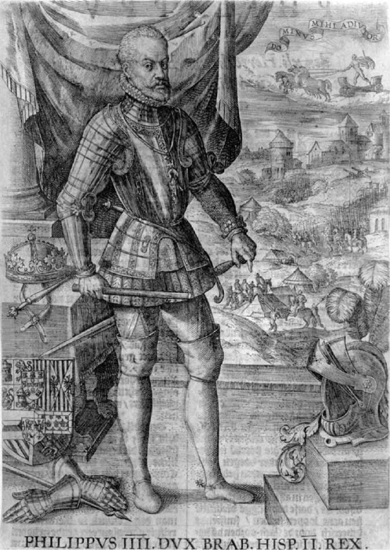
4.8 Philip IV Duke of Brabant and II King of Spain. See detail of Carriage of Apollo at the top right Copyright © A. Jordan Collection

4.9 King Philip II as World’s Ruler by J. Holzhammer (Vienna, 1585) Copyright © Austrian National Library (ÖNB)
The representation of Philip II as a global ruler in the aftermath of the Iberian union can be seen in a depiction of 1585 (Figure 4.9 above). The image appears in a chronicle of Philip II’s Portuguese campaign, the author of which, Johann Holzhammer, was an Austrian observer. In the ‘medallion’ to the left (Figure 4.9), the insignia embodies the global dimension of Philip’s authority. This is stated in the Latin inscription with allusions to his realms in Spain and Portugal and the West and East Indies, as was seen repeatedly in the festival panels. The image represents an armed Philip standing on a globe and brandishing his sword, dominating the oceans. The navy is an assortment of diverse vessel types. The ‘medal’ was a simulation of the globe with the sun and the moon painted in front of each other. Philip II was the commander of the world and his dominions were so vast that the sun and moon could illuminate both latitudes at the same time. The representation could have been inspired by the iconography used at the 1581 entry. For instance, the armed statue of Philip dominating Atlas and Neptune, with connotations of the globe and the oceans respectively, was located in the front upper level recess of the German Merchants’ arch facing the waterfront, as is examined above (Figure 4.6, nos 1–3). In this same façade, the ‘solar’ dimension of Philip’s authority, and the extension of his empire, was also stated in the iconography of the panels above the lateral entrances. The navy shows the dominion of the seas and the might of Philip’s fleet, with associations with the water festival that took place on the Tagus in 1581. The inscriptions referring to the West and East Indies were used a few times on the arch.
The paired medallion on the right (Figure 4.9) resorts to the traditional representation of the ‘communion’ of the realms with two adjacent coats of arms. The representation of the two shields together, topped with two lions uniting the world and the sea beneath, possibly represented the Cape of Good Hope. The Cape was the place where the two navies linked their maritime routes, and the armed soldiers the respective national customs of Portugal and Castile. The Cape of Good Hope was also displayed in the German Merchants’ arch, as mentioned earlier. The scale depicted in the ‘medallion’ is self-explanatory of the Iberian union (signed in the Courts of Tomar) that would only work so long as it was ‘balanced’ and if the ruler maintained equity and justice.
Conclusion
The decorative programme of the arch of the German community showcased the vigorous imperial supremacy of the Habsburg dynasty. The façade facing the city exalted Philip II’s lineage and his role in the propagation and defence of the Catholic faith and the empire. In this sense, the iconographic programme of the festival supported the image that Philip aimed to project in his new realm, especially the iconography of the façade facing the river. The military parade staged in the Tagus only reinforced the mighty power of the ruler and the message he had prepared for Portugal. The dialogue exchanged between the king and the city’s ruling powers, both lay and religious, highlights the tense moment in the dynastic transition. In the month before his arrival in the city Philip II informed the city authorities of his decision to make Lisbon the temporary residence of his court.86 The king would not enter the city in passing but, on the contrary, he wished to stay, although in the end Philip stayed only until his rival António had been defeated. His intention was clearly to establish his rule through government and by vanquishing his enemies within the kingdom.
The fact that only a couple of months before his arrival the city was anxious about the organization of the royal festival is enlightening. The ruler interpreted this struggle as a hesitation. This made the situation tense, as Philip II’s letters concerning this matter contained subtle threats, along the same lines as his earlier correspondence concerning the Portuguese succession. Many of the structures were unfinished, yet their high number is extraordinary when compared with previous festivals staged in Lisbon. Although a generous number of tableaux vivants had been built for the entry of Joanna in 1552, on that occasion there was only one triumphal arch.87 It is indeed surprising that the city managed to erect up to fifteen structures – arches and façades – for Philip in 1581. Reviews of the quality of the ephemera were mixed, but the writers of these accounts were biased, especially in such a political climate. The local authorities aimed to please the king and compensate for the dramatic political events and ‘misunderstandings’ prior to his arrival. There might have been an element of fear, as it seems logical to believe that no one in the city was in a position to challenge the Spaniard directly. It is clear now that the festival was the product of a common effort between royal designers and local powers. Lisbon’s local guilds, lay and religious authorities, military and religious orders and foreign communities were able to reverse the formerly tense situation with the construction of a festival that Philip II was to cherish: it is widely known that the ruler kept a painting in the Alcázar in Madrid which depicted the arches deployed in Lisbon.88 In fact, the Lisbon festival of 1581 surpassed any earlier royal entry and radically transformed the festival culture of the capital for years to come. The royal designers implemented an iconographical programme that resorted to the emblems and ideas used to represent the ruler, but these were adapted to embrace the imperial expansion and the message they aimed to transmit to his enemies. The combination of local festival traditions and the extent of iconography deployed in the structures may suggest that there was an established ceremonial culture far beyond what thus far has been believed to exist.
The festival in Lisbon deployed an artistic programme and a theatre in the pageant (especially the river parade) that supported the image that Philip as ruler (and military commander) wished to portray. The wishes, concerns and fears of the local authorities were expressed too, not only through discourses but also in the art displayed. For example, decorating the fountain in the Rua Nova dos Mercadores was an immense structure in the form of a façade that covered it. A female figure representing Victory presided at the apex of the machina. The central panel was painted with a figure of Temperance carrying the Portuguese flag, dominating Desire in which the iconography was that of a man trying to ‘eat’ the Earth. On the left-hand panel the iconography was of Time with an inscription that read: ‘the power of fame is subject to the free will of Time, that discovers all badness …’89 The last panel represented Fame, which in combination with Mexerico (translated as ‘tattle’ or ‘gossip’) would divulge everything, ‘saying more than is expected’.90 The theme underpinned in this structure’s display intended to warn the king of the dangers of his power and dominion over the world. ‘Didactic’ recommendations like these were common in early modern festivals. However, on this occasion, the ‘lecture’ was presented in a ‘direct language’ with accusatory subtleties. There was no reference to Philip II’s good government at all or any other flattering messages. The iconographic representation emphasized the ‘direct’ tone of the inscriptions: the only kingdom represented was Portugal whose arms were on a flag carried by Victory. In short, the scene was presented as Victory trying to calm the greed of man who wanted to eat the earth. Earlier on, we saw how much of the artistic programme was devoted to the exaltation of Philip II’s domination of the world. Here it is strange that there was no explicit statement that would exempt Philip from any relationship with this ‘greedy character’.91 This might have been a form of visual contestation or a warning to the ruler. Teófilo Ruiz has recently argued that Castilian and Aragonese festivals were a space of contestation and protest too.92 In the end, it shows how the festival not only portrayed the king’s wishes but also, even when chroniclers tried to minimize it, the expectations of the rest of the society that composed Philip’s new realm.
Notes
1 Philip II ruled Spain and Sicily from 1556 until his death in 1598. He had been crowned King of Naples in 1554 and was briefly King of England and Ireland (jure uxoris) during Mary Tudor’s reign 1554–1558. Philip entered Lisbon as Philip I of Portugal as indicated in the present chapter’s title. However, for the rest of the chapter I use the monarch’s Spanish designation instead, as other authors have done in several chapters in the present book.
2 A. Jordan Gschwend, ‘Cardinal Infante Henry of Portugal’, The Dictionary of Art (London, 1996) vol. 2, pp. 874–5.
3 There is a wealth of scholarship devoted to the Iberian Union. To mention only some seminal works, but not a comprehensive list: J. F. Schaub, Portugal na Monarquia Hispánica (1580–1640) (Lisbon, 2001) and J. F. Schaub, Le Portugal au temps du Comte-Duc d’Olivares, 1621–1640: le conflit des? juridictions comme exercice de la politique (Madrid, 2001); F. J. Bouza Álvarez, Imagen y propaganda. Capítulos de la historia cultural del reinado de Felipe II (Akal, 1998) and F. J. Bouza Álvarez, Portugal en la Monarquía Hispana (1580–1640), las Cortes de Tomar y la génesis del Portugal Católico (PhD Thesis University Complutense, Madrid, 1987); D. Ramada Curto, Cultura política no tempo dos Filipes (1580–1640) (Lisbon, 2001); R. Valladares, La Rebelión de Portugal, 1640–1680: Guerra, conflicto y poderes en la Monarquía Hispánica (Toledo, 1998).
4 Barely a month before his arrival Philip II wrote to the city authorities with concerns about hygiene and the measures needed to eradicate the plague that isolated the capital. Arquivo Histórico Municipal de Lisboa (AHML) COD. 58 ‘Livro 1o rei-D. Filippe I’, fol. 12. The most recent publication regarding the seizing of Portugal by the Duke of Alba and its devastating effects is Rafael Valladares, La conquista de Lisboa. Violencia militar y comunidad política en Portugal 1578–1583 (Madrid, 2008).
5 Letter from Philip II of Spain to the Duke of Osuna (1579) in J. Cowans, Early Modern Spain: /a Documentary History (Philadelphia, 2003), p. 113.
6 Contemporary printed material and other accounts with information on the triumphal entry are as follows: A. Escobar, Recopilacion de la Felicissima Jornada que la Catholica Real Magestad del Rey don Phelipe nuestro señor hizo en la Conquista del Reyno de Portugal … (Valencia, 1583). A.M. Vasconcellos, Sucession del Señor Rey Don Filipe Segundo en la Corona de Portugal (Madrid, 1639). I. Velázquez Salmantino, La Entrada que en el Reino de Portugal hizo la S.C.R.M. de Don Philippe, Invistissimo Rey de las Españas, Segundo de este nombre, Primero de Portugal … (Madrid, 1581). G. Conestaggio, The Historie of the Uniting of the Kingdom of Portugall to the Crowne of Castill … (London, 1600). A. Guerreiro, Das Festas que se Fizeram na Cidade de Lisboa, na Entrada de el-rei D. Filipe, Primeiro de Portugal (Lisbon, 1581). The copy used in this chapter is from El Escorial Library, this version has a different pagination to other copies elsewhere. An incomplete version of the book was reprinted by Reimpressoes: Portugal Amarrado, Nódoas de Lisboa, Empresa da revista, Lisboa, 1950. The Memorial by Pêro Rodrigues Soares is a manuscript kept at the National Library of Lisbon with a narrative against the Spanish Monarch: P. Rodrigues Soares, M. Lopes de Almeida, Memorial de Pêro Rois Soares (Lisbon, 1953). There is an anonymous account at the National Library of Spain (Mss. 12026): Relación de la Jornada que hizo Felipe II desde Santarem hasta Lisboa. Another significant contribution on Philip II’s entry is Lavanha’s booklet on the Entry of Philip II of Portugal or Philip III of Spain into Lisbon, edited in 1619 and 1622.: J. B. Lavanha, Viage de la Catolica Magestas del Rey Don Felipe III … a su Reino de Portugal y Relación del Solemne Recibimiento … (Madrid, 1619). Also a large-scale painting of the Lisbon entry in 1581, probably commissioned by Philip II, hung in the Alcázar palace in Madrid in the large hall where the king held public audiences, but was later lost in the fire of 1734. Described in situ in 1604 by the Portuguese traveller, Severim de Faria: ‘Tem nesta mesma galleria o retrato de Lisboa, tirado a vista depois do forte acabado [the tower or Torreão of the Lisbon palace built by Philip II]…,’, published in Ángel Marcos de Dios, ‘Itinerario hispánico del Chantre de Évora, Manuel Severim de Faria, en 1604’, Revista de Estudios Extremeños, vol. 62, 1986, pp. 139–85.
7 This has enabled me to develop scaled hypothetical recreations of the ephemeral structures and the first metric model of the street network of the Baixa in Lisbon at the time. The hypothetical recreation included in this essay adheres to the London Charter (2.1.2009 www.londoncharter.org). My research on the use of virtual heritage for the study of this festival is the aim of an essay to be published elsewhere.
8 A. M. Alves, As Entradas Régias Portuguesas. Uma Visão de Conjunto (Lisbon, 1986), pp. 50–67.
9 Bouza Álvarez, Imagen y Propaganda, F. J. Bouza Álvarez, Portugal No Tempo dos Filipes: Política, Cultura, Reprentações (1580–1668) (Lisbon, 2000). F. J. Bouza Álvarez, D. Filipe I (Lisbon, 2005). F. J. Bouza Álvarez, Felipe II y el Portugal Dos Povos. Imágenes de Esperanza y Revuelta (Salamanca, 2011). F. J. Bouza Álvarez, ‘Retórica da Imagem Real: Portugal e a Memória Figurada de Filipe II’, Penélope: Revista de História e Ciências Sociais, No. 4, 1990, pp. 19–58. This article was translated into Spanish with some additions in his book cited above, Bouza Álvarez, Imagen, pp. 58–92.
10 M. Soromenho, ‘Ingegnosi Ornamenti: Arquitecturas efémeras em Lisboa no Tempo dos Primeiros Filipes’, in J. Castel Branco, Arte Efémera em Portugal Exhibition Catalogue (Lisbon, 2001), pp. 21–38.
11 A.P. Torres Megiani, O Rei Ausente. Festa e Cultura Política nas Visitas dos Filipes a Portugal, 1581 e 1619 (São Paulo, 2004).
12 A. Jordan Gschwend, ‘Ma meilleur soeur: Leonor of Austria, Queen of Portugal and France. The Queen’s ceremonial entry into Lisbon’, in F. Checa Cremades, The Inventories of Charles V and the Imperial Family (Madrid, 2010), pp. 2573–74. A. Jordan Gschwend, Catarina de Áustria. A rainha colecionadora (Lisbon, 2012), pp. 35–37 and 39–55. A. Jordan Gschwend, ‘Cosa Veramente Di Gran Stupore. Entrada Real y Fiestas Nupciales de Juana de Austria en Lisboa’, in K. De Jorge, B. J. García García and A. Esteban Estríngana, El Legado de Borgoña. Fiesta y Ceremonia Cortesana en la Europa de los Austrias (1454–1648) (Madrid, 2010), pp. 179–240.
13 The publications concerning the entry of Philip III into Lisbon in 1619 are many. Of special interest for its references to the entry of 1581 are E. M. Vetter, ‘Der Einzug Philipps III in Lissabon 1619’, Spanische Forschungen der Görresgesellschft vol. VII (1962), pp. 187–263. The most important contribution by Vetter is the idea of reusing ephemeral structures. The article is introduced by Philip II’s entry of 1581, however Vetter had a limited view of the festival, observing only the account by Velázquez Salmantino. The contribution by Velázquez is indeed important, although incomplete, and somewhat biased if not compared with other sources. George Kubler’s interpretation of the entry of 1581 is also based only on Velázquez Salmantino’s account and Vetter’s work, although he uses this festival merely as an introduction to his study on the entry of 1619. G. Kubler, Portuguese Plain Architecture. Between Species and Diamonds, 1521–1706 (Boston, 1972), pp. 105–127. See also, K. De Jonge, ‘De kunst van het efemere: Portugees –Vlaamse feestarchitectuur in de zestiende eeuw’, Vlaanderen. Jaargang 40 (1991), pp. 157–62.
14 For example festivals, especially those in Rome and in the Low Countries, had staged ceremonial entries with a high number of ephemeral structures. However, in sixteenth-century Europe the number of ephemeral structures in festivals oscillated from approximately five to nine.
15 I have published and have forthcoming publications on aspects and sections of this festival. See, for instance, L. Fernández-González, ‘La Representación de las Naciones en las Entradas Triunfales de Felipe II y Felipe III en Lisboa (1581–1619)’, in B. J. Garcia-Garcia, O. Recio Morales (eds), Las Corporaciones de Nación en la Monarquía Hispánica (1580–1750). Identidad, Patronazgo y Redes de Sociabilidad (Madrid, 2014), pp. 413–50.
16 Jordan Gschwend, ‘Cosa Veramente’, pp. 179–240.
17 Guerreiro, Das Festas, p. 11.
18 Rodrigues Soares, Lopes de Almeida, Memorial, p. 193.
19 Rodrigues Soares, Lopes de Almeida, Memorial, p. 193.
20 Bouza Álvarez, Felipe II y el Portugal, p. 38.
21 See Jordan Gschwend, ‘Cosa Veramente’ and Jordan Gschwend, ‘Ma meilleur soeur’. In these publications the author explains that the entries had similar competitions. The idea of a continuum in the water festival tradition in Lisbon has not been examined until now.
22 J. Teixeira Marques de Oliveira, Fontes Documentais de Veneza referentes a Portugal (Lisbon, 1997), p. 212.
23 Velázquez Salamantino, La Entrada, p. 120.
24 A. Gehlert, ‘Uma Esplendida vista de Lisboa no Castelo de Weilburg’, Monumentos, Revista Semestral do Patrimonio Construído e da Reabilitacao Urbana, 28 (December, 2008), pp. 208–13. (p. 209) The canvas was also reproduced in J. M. García (ed.), Lisboa do século XVII, ‘A mais deliciosa terra do Mundo’ (Lisbon, 2008), p. 30.
25 J. Serrano de Vargas y Ureña, Entrada en publico y recibimiento grandioso de la Magestad del Catolicismo Rey don Felipe nuestro Senor en la insigne, noble y leal ciudad de Lisboa (Seville, 1619), p. 3. The Tarasca, an artifice that imitated a monster, was used in Castilian festivals of the period, especially for the Corpus Christi processions, see T. F. Ruiz, A King Travels: Festive Traditions in Late Medieval and Early Modern Spain (Princeton, 2012), pp. 280–82.
26 See J. S. Ruth, Lisbon in the Renaissance Damião de Góis, A New Translation of the Urbis Olisiponis Descriptio (New York, 1996, pp. 10–12.
27 Guerreiro, Das Festas, p. 12.
28 Escobar, Recopilacion, p. 109.
29 A. Falcão de Resende, Romance da Entrada del Rey Philippe o Primeiro em Portugal em Lisboa, included in Bouza Álvarez, Portugal no Tempo, p. 95. The term horrisonous is a word uniting ‘horrendous’ or ‘horrid’ with ‘unisonous’ that could be defined as the storming noise produced by all galleys firing their guns at the same time. The poem has been adapted above for it to be comprehensible in English. Its literal translation line by line is as follows: ‘Once his Majesty,/ boarded in his galley,/ the thunder of the artillery,/ horrisonous salute performed,/ the bellicose galleys,/ in ordered squadron,/ the royal [galley] as the lady,/[and] patron in the midst was’.
30 Velázquez, La Entrada, p. 120.
31 See Rodrigues Soares, Lopez Almeida, Memorial, p. 179.
32 The crossed descriptions of the military incursion became a propaganda war. There are many reports on this matter, see, for example, the conflicting versions of Velázquez Salmantino, La Entrada, pp. 56–57 and the Memorial de Pêro Rodrigues Soares, cited above.
33 Archivo General de Simancas (AGS), Estado, Leg. 426. This bundle is almost entirely devoted to the military incursion in Portugal. As cited earlier, one of the latest and most complete contributions to this topic is Valladares, La Conquista.
34 Valladares, La conquista.
35 Contemporary chronicles concur, see, for instance, Velázquez Salmantino, La Entrada, p. 141 and Guerreiro, Das Festas, pp. 59–60.
36 I thank John H. Elliot for suggesting this idea. Our discussion on this topic had a significant impact on this section of the chapter.
37 As mentioned earlier, the canvas of 1613 was made to show the plans projected for the ceremonial entry of Philip III of Spain (II of Portugal) into Lisbon, which will only occur in 1619.
38 On Naumachias there is a wealth of literature. For instance the three volumes edited by J. Jacquot, Les Fêtes de la Renaissance, vols I, II and III (1955, 1962 and 1972) included a number of essays that dealt with water festivals. Although there has been a longstanding interest in early modern festivals with the publications authored by Frances A. Yates, Elizabeth McGrath, Roy Strong and Jacques Jacquot (mentioned before) among others, it is possibly the digitization project of Renaissance festivals books at the British Library and the Warburg Institute that has greatly promoted this topic in academia (www.bl.uk/treasures/festivalbooks/homepage.html). This digitization has included many booklets that described naumachias and other water-related artifices and performances. This is one of the outputs of the Europa Triumphans project, which also resulted in the publications: J. R. Mulryne, Goldring (eds), Court Festivals of the European Renaissance: Art, Politics and Performance (Aldershot, 2002), and subsequently J. R. Mulryne, H. Watanabe-O’Kelly and M. Shewring (eds), Europa Triumphans: Court and Civic Festivals in Early Modern Europe (Aldershot, 2004). More recently, a conference organized by the Society for European Festival Research dealt with water festivals; this meeting will result in an edited book: Margaret Shewring (ed.), Waterborne Pageants and Festivities in the Renaissance (Aldershot, 2013).
39 This has been clearly illustrated in a number of essays in this book. See, for instance, the chapters by Miguel Ángel Zalama and David Sánchez Cano. In addition, Fernando Checa in his chapter in this book examines battle representation in Renaissance tapestries and their relationship with contemporary warfare.
40 See Arthur R. Blumenthal, Theater Art of the Medici (Dartmouth College Museum and Galleries, 1980). One of the festival books of this festival can be consulted at: http://special-1.bl.uk/treasures/festivalbooks/BookDetails.aspx?strFest=0204 (accessed July 2012).
41 For an analysis of these long galleries in European palaces, see: K. De Jonge, ‘Espacio Ceremonial. Intercambios en la Arquitectura palaciega entre los Países Bajos Borgoñones y España en la Alta Edad Moderna (1520–1620)’, in K. De Jonge, B. J. García García, A. Esteban Estríngana, El Legado de Borgoña: Fiesta y Ceremonia en la Europa de los Austrias (Madrid, 2010), pp. 61–90.
42 See J. Brown, J. H. Elliot, A Palace for a King. El Buen Retiro and the Court of Philip IV (New Haven and London, 2003), pp. 156–63.
43 See Blumenthal, Theater.
44 Bouza Álvarez, Imagen, p. 114.
45 During the sixteenth century and later, writers evoked the River Tagus as the ‘mirror’ of Lisbon and as a projection of the Portuguese oceanic empire. See, for instance, Damião de Góis ‘Urbis Olisiponis Descriptio’, cited earlier. Góis also entitled Seville with this same name: Ruth, Lisbon in the Renaissance, p. 3.
46 Soromenho, ‘Ingegnosi Ornamenti’, p. 21.
47 J. Segurado, ‘Juan de Herrera em Portugal’, As Relações Artísticas entre Portugal e Espanha na Época dos Descobrimentos (Coimbra, 1987), pp. 99–111. Soromenho, ‘Ingegnosi Ornamenti’, p. 21. A. Jordan Gschwend, Portuguese Royal Collections (1505–1580): A Bibliographic and Documentary Survey, Master Dissertation, The George Washington University (1985), p. 12.
48 Soromenho, ‘Ingegnosi Ornamenti’, p. 21.
49 Guerreiro, Das Festas, pp. 11–12.
50 This idea of ‘ver sin ser visto’ is widely known and has been long discussed in scholarship. For a couple of fascinating examples see the essays by Miguel Ángel Zalama and David Sánchez Cano in the present book.
51 Guerreiro, Das Festas, p. 28. ‘Esta sua muy nobre e sempre leal cidade de Lisboa, entrega a vossa Magestade as chaves de todas suas portas, e dos leales coraçoes de seus moradores, e de seus corpos e averes pero todo seu seruciço’.
52 Velázquez Salmantino, La Entrada, p. 133: ‘EXPENSIS ET OPERA VLIXBONENSIVM MERCATORVM, ATVTVM EDICATVM’.
53 Letter from Philip II to the City Authorities in Lisbon, AMLH, Livro 1o Festas, fol. 103. One of these letters has been transcribed in Torres Megiani, O Rei Ausente.
54 AMLH, Livro 1o Festas, fol. 105.
55 Jordan Gschwend, ‘Cosa Veramente’, p. 187.
56 The acceptance of Lisbon’s city electors of their new ruler AMLH, COD. 58 Livro 1o rei-D. Filippe I, fols. 1. The king invited the electors Vereadores of Lisbon to participate in the Courts of Tomar which ratified him as Philip I of Portugal (see AMLH, COD. 58 Livro 1o rei-D. Filippe I, fols. 2.).
57 The female figure described in the pageant corresponds with the drawing included in F. Holanda, Da Fábrica que Falece à Cidade de Lisboa (Lisbon, 1571).
58 Guerreiro, Das Festas, p. 26.
59 Guerreiro, Das Festas, pp. 49–50.
60 This relic was meant to be a fragment of the Holy Cross, see Guerreiro, Das Festas, p. 51.
61 His collection at El Escorial was, and is, famous, see G. Lazure, ‘Possessing the Sacred: Monarchy and Identity in Philip II’s Relic Collection at the Escorial’, Renaissance Quarterly, 60/1 (2007), pp. 58–93.
62 Rodrigues Soares, Lopez Almeida, Memorial, p. 193.
63 The iconographic lecture displayed in this great triumphal arch occupied most of Guerreiro’s chronicle, with more than half the book devoted solely to the description of the ephemeral structures promoted by the German merchants.
64 Velázquez Salmantino, La Entrada, pp. 119–20.
65 Guerreiro, Das Festas, p. 15. The arch erected by the German merchants for Philip III in 1619 was similar to the arch of 1581 and at least part of the structure was likely to be recycled.
66 F. J. Bouza Álvarez, Felipe II y El Portugal Dos Povos, Imágenes de Esparanza y Revuelta (Valladolid, 2010), p. 15.
67 Bouza Álvarez, Felipe II, p. 22.
68 The arch funded by the German community in Lisbon has also been attributed to the Flemish community in contemporary accounts of the event. These attributions and notions of visual representation of national identities in festival structures are discussed in Fernández-González, ‘La Representación’.
69 Only some of the colours of the arch are documented, such as this recess. It is also known that most of the painted panels imitated bronze bas-reliefs. No further information was given for the rest of the arch except that it imitated stone (it is unknown whether this was marble, granite or another kind). See Velázquez Salmantino, La Entrada, p. 121. In the digital recreation, a shade of grey was used when the material was unknown or not precise enough to be included.
70 Neptune was also one of the statues in the Alfândega, while Janus was used in both nearby structures: the Customs and German Merchants’ arch. This needless repetition reinforces the lack of coherence between the structures and the authorship of different designers. See Fernández-González, ‘La Representación’.
71 Guerreiro, Das Festas, p. 16.
72 See Guerreiro, Das Festas, p. 17, Velázquez Salmantino, La Entrada, p. 122.
73 Guerreiro, Das Festas, p. 16.
74 Guerreiro, Das Festas, p. 17.
75 Guerreiro, Das Festas, p. 17. Velázquez Salmantino, La Entrada, p. 123.
76 Real Biblioteca del Monasterio del Escorial (RBME) 42-V-48. Enc. Esc. G. Ruscelli, Le Imprese Illustri (Venice, 1566), p. 216. The medal is conserved at the Victoria & Albert Museum in London, catalogue no. 6759-1860. Gallery location: Sculpture, room 111, case DR14.
77 For the apollonian aspects associated with Philip II’s representation in art see: F. Checa Cremades, Felipe II Mecenas de las Artes (Madrid, 1992), pp. 100–109, M. Tanner, The Last Descendant of Aeneas. The Hapsburgs and the Mythic Image of the Emperor, Ch. XII, The Regnum Apollonis, pp. 223–48; especially pp. 235–48 which discuss at length Philip’s empresa: Iam Illustrabit Omnia. Also Philip Attwood discusses J. Trezzo’s medal in: P. Attwood, Italian Medals c. 1530–1600 in British Public Collections (London, 2003). See also V. Mínguez Cornelles, Los Reyes Solares: Iconografía Astral de la Monarquía Hispánica (Castellón, 2001), pp. 89–98.
78 I thank Annemarie Jordan Gschwend for pointing out the interest of this print for my research and for allowing me the use of this image from her collection. There is another copy of this print at the Biblioteca Nacional de España in Madrid. I also thank Ronnie Mulryne for his comments on the Latin ‘epigraphy’ included in this essay.
79 Bouza Álvarez, Imagen, p. 85.
80 L. Jardine (ed.), The Education of a Christian Prince with the Panegyric for Archduke Philip of Austria by Erasmus (Cambridge, 1997), p.3.
81 There is much literature on Philip II’s embodiment of this messianic mission. There are, however, two particularly informative works: the first concerns his relationship with the Ottoman empire, M. J. Rodríguez Salgado, Felipe II. El Paladín de la Cristiandad y la Paz con el Turco (Valladolid, 2004) and the second, his role as the paladin of the Counter-Reformation, G. Parker, The World is Not Enough: The Imperial Vision of Philip II of Spain (Waco, 2000).
82 There are many other motifs that I will not discuss here due to space constraints.
83 The dividing point is Cape Agulhas.
84 Guerreiro, Das Festas, p. 18. Velázquez Salmantino, La Entrada, p. 123.
85 Guerreiro, Das Festas, p. 18. Velázquez Salmantino, La Entrada, p. 123.
86 Letter from Philip II to the City authorities June 1581, AMLH COD. 58 Livro 1o rei-D. Filippe I, fols. 12.
87 Jordan Gschwend has suggested that some of the decorations such as the Anjo Custódio displayed at Porta da Moeda in 1581 and arch might have been recycled, see Jordan Gschwend, ‘Cosa Veramente’, p. 198.
88 Marcos de Dios, ‘Itinerario hispánico’, pp. 139–85.
89 Guerreiro, Das Festas, p. 56.
90 Guerreiro, Das Festas, p. 57.
91 The accounts describing this structure present some incoherence between the descriptions of the decorative programme and its attribution to one of the local guilds. Especially incoherent was the oficial chronicle of Velázquez Salmantino; however interesting, its analysis falls beyond the scope of this chapter.
92 Ruiz, The King.
* Research for this chapter was made possible thanks to the postdoctoral fellowships funded by Calouste Gulbenkian Foundation in Portugal and the Hispanex programme of the Spanish Ministry of Education and Culture. I am indebted to John H. Elliot, Annemarie Jordan Gschwend, Marjorie Trusted and Hugo Crespo for their attentive reading and suggestions on this chapter.